
Examples of healthy boundaries are the specific words, actions, and limits that communicate to others what treatment you will accept and what you will not, in a way that protects your emotional, physical, and mental wellbeing without controlling the other person’s behavior. A healthy boundary is not a demand. It is a declaration of your own conduct. “I will not respond to work emails after 7 p.m.” is a boundary. “You cannot email me after 7 p.m.” is a demand. One describes what you will do. The other attempts to control someone else.
The American Psychological Association identifies chronic boundary violations as a contributor to ongoing stress, which is associated with elevated cortisol levels, disrupted sleep, increased blood pressure, and higher risk of anxiety and depression. Boundaries are not just relationship advice. They are a physiological intervention. A 2023 meta-analysis published in the Journal of Occupational Health Psychology found that workers with clear work-life boundaries had measurably lower cortisol levels at bedtime and reported better sleep quality than those with porous boundaries, independent of total hours worked.
This guide gives you specific examples of healthy boundaries organized by type and by relationship, exact phrases you can use to set them, and the framework to distinguish between a boundary that protects your health and a preference that you might choose to be flexible about. You will learn what boundaries look like in practice, not in theory, and how to communicate them without apology.
What are healthy boundaries
Healthy boundaries are the physical, emotional, and mental limits a person establishes to protect their wellbeing, identity, and autonomy within relationships. They define where you end and another person begins. They are not walls that keep people out. They are gates that you control, opening and closing based on your assessment of what is safe, respectful, and sustainable for you at any given time.
The concept of boundaries entered the psychological mainstream through the work of family systems theorists and has since been integrated into multiple therapeutic modalities. In cognitive behavioral therapy, boundaries are framed as a form of assertiveness that reduces the cognitive dissonance between what a person feels internally and what they tolerate externally. In dialectical behavior therapy, interpersonal effectiveness skills include specific boundary-setting techniques designed to maintain self-respect while preserving relationships.
A boundary is healthy when it protects your wellbeing without isolating you or controlling others. An unhealthy boundary is either too rigid, cutting you off from connection, or too porous, allowing others to intrude on your wellbeing without consequence. The healthy boundary sits in the middle, firm enough to protect you, flexible enough to let in what nourishes you.
Key Takeaway: Healthy boundaries are the limits you set to protect your wellbeing. They are gates you control, not walls or open doors.
What do healthy boundaries look like
Healthy boundaries look like a person who can say no without excessive guilt, who does not take responsibility for other people’s emotions, who protects their time and energy, and who communicates their limits clearly and calmly without apology or aggression. They look like someone who is neither a doormat nor a fortress. They look like someone who respects themselves enough to teach others how to treat them.
In practice, healthy boundaries show up in specific behaviors. A person with healthy emotional boundaries does not absorb the moods of everyone around them. They can listen to a friend’s problems without feeling responsible for solving them. They can disagree with a partner without feeling threatened by the disagreement. They can receive criticism without either collapsing into shame or attacking in return.
In the physical realm, healthy boundaries show up as comfort with touch, personal space, and privacy being respected. A person with healthy physical boundaries does not allow unwanted touch and does not impose touch on others. They lock their phone and their journal. They close the bathroom door. They expect their body autonomy to be honored.
Key Takeaway: Healthy boundaries look like calm, clear communication of limits, emotional separateness, physical autonomy, and the ability to say no without guilt.
What are some healthy boundaries
What are some healthy boundaries includes a range of limits organized around the areas of life where boundary violations most commonly occur. These examples are not theoretical. They are specific behaviors that real people implement to protect their time, energy, money, body, and emotional bandwidth.
Physical boundaries include not allowing uninvited touch, expecting others to respect your personal space, having privacy in your home and on your devices, and deciding who has access to your body and under what circumstances. Time boundaries include not answering work communications outside of work hours, declining invitations without inventing excuses, and allocating your free time according to your priorities rather than other people’s expectations.
Emotional boundaries include not taking responsibility for how other adults feel, not absorbing the emotional states of people around you, and limiting access to your emotional energy when someone consistently uses it without reciprocating. Material boundaries include setting limits on lending money or possessions and being clear about the terms when you do lend. Intellectual boundaries include being respected for your ideas and opinions even when others disagree.
Key Takeaway: Healthy boundaries span physical, time, emotional, material, and intellectual domains. They protect your body, schedule, feelings, possessions, and thoughts.
Types of healthy boundaries
The types of healthy boundaries correspond to the different dimensions of human experience that require protection. Understanding the categories helps identify where in your life boundaries are functioning well and where they need reinforcement. The five primary types are physical, emotional, time, material, and intellectual boundaries.
Physical boundaries govern touch, personal space, and bodily autonomy. Emotional boundaries separate your feelings and emotional responsibilities from those of others. Time boundaries protect your schedule and prevent overcommitment. Material boundaries govern your possessions, money, and resources. Intellectual boundaries protect your ideas, opinions, and the right to think differently from those around you.
A person may have strong boundaries in one domain and weak boundaries in another. Someone with excellent time boundaries at work may have porous emotional boundaries with family. The goal is not to be equally firm in every domain. It is to be conscious of where your boundaries are serving you and where they are failing you, and to adjust accordingly.
Key Takeaway: The five boundary types are physical, emotional, time, material, and intellectual. Strength in one domain does not guarantee strength in others.
Emotional boundaries examples
Emotional boundaries examples are the specific limits that protect your emotional energy and prevent you from taking on emotional burdens that belong to other people. Emotional boundaries do not mean being cold or uncaring. They mean caring without absorbing, supporting without rescuing, and listening without fixing.
An emotional boundary with a friend who repeatedly dumps their problems on you without asking about your life sounds like this: “I care about you and I want to hear what is going on, but I have noticed our conversations are mostly about your challenges. I need our friendship to include space for my life too.” An emotional boundary with a parent who criticizes your choices sounds like this: “I understand you have opinions about my decisions. When you share them in a way that feels judgmental, I will end the conversation and we can try again another time.”
An emotional boundary with a partner who uses you as their sole emotional outlet sounds like this: “I love supporting you, and I cannot be the only person you talk to about difficult things. I need you to also lean on friends, family, or a therapist when things are heavy.” Emotional boundaries are hardest to set because they can feel like abandonment. They are not. They are the difference between being someone’s friend and being someone’s emotional sponge.
Key Takeaway: Emotional boundaries protect your emotional energy. They let you care for others without absorbing their pain or taking responsibility for their feelings.
Physical boundaries examples
Physical boundaries examples are the limits that protect your body, personal space, and privacy. They govern touch, proximity, and access to your physical self. Physical boundaries are violated when someone touches you without consent, stands too close, reads your messages, or enters your private space without permission.
A physical boundary with a relative who insists on hugs sounds like this: “I am not a hugger, but I am happy to shake hands or wave. Thank you for understanding.” A physical boundary with a partner who goes through your phone sounds like this: “My phone is private. I am not hiding anything, and I need you to respect my privacy. If there is something you are worried about, let us talk about it directly.”
A physical boundary at work with a colleague who touches your shoulder or back sounds like this: “Please do not touch me. I prefer to keep physical contact out of the workplace.” Physical boundaries are the most concrete and often the easiest to articulate because the violation is tangible. The challenge is not clarity. It is the social pressure to prioritize politeness over comfort.
Key Takeaway: Physical boundaries protect your body, space, and privacy. They include limits on touch, proximity, and access to your personal information and belongings.
Time boundaries examples
Time boundaries examples are the limits that protect your schedule from being consumed by other people’s priorities. Time is the only resource you cannot get back, and time boundaries are the mechanism that ensures you spend it on what matters to you rather than on what matters to everyone else.
A time boundary at work sounds like this: “I am not available for meetings before 9 a.m. or after 5 p.m. If something urgent comes up outside those hours, you can reach me by text for emergencies.” A time boundary with a friend who is always late sounds like this: “I will wait for 15 minutes. After that, I will leave and we can try another day.”
A time boundary with yourself sounds like this: “I am scheduling Saturday morning as my time. I do not book anything during that block unless it is an emergency.” Time boundaries are the most frequently violated because the violation often appears minor in the moment. Five extra minutes here, a quick call there. The cumulative effect over months and years is a life lived on other people’s schedules.
Key Takeaway: Time boundaries protect your schedule. They ensure your hours are spent on your priorities, not consumed by other people’s requests and expectations.
Healthy boundaries vs unhealthy boundaries
Healthy boundaries versus unhealthy boundaries can be distinguished by their flexibility, their motivation, and their effect on relationships. A healthy boundary is firm enough to protect you and flexible enough to respond to context. An unhealthy boundary is either too rigid, shutting people out completely, or too porous, failing to protect you at all.
A rigid boundary sounds like: “I never help anyone with anything. People need to handle their own problems.” This boundary is not protecting the person from genuine intrusion. It is protecting them from the vulnerability of connection. A porous boundary sounds like: “I know I said I could not help you move this weekend, but you sound stressed, so I will cancel my plans and be there.” This boundary dissolves at the first sign of another person’s distress.
The healthy version of both scenarios preserves the relationship and the self. “I can help you move for two hours in the morning, but I have plans in the afternoon that I am keeping.” This boundary acknowledges the other person’s need while protecting the speaker’s time. The distinction between a boundary and a preference matters here. A boundary is non-negotiable because violating it harms you. A preference is a desire that you can flex around. Mistaking preferences for boundaries dilutes the power of both.
Key Takeaway: Healthy boundaries are firm and flexible. Unhealthy boundaries are either too rigid, isolating you, or too porous, failing to protect you.
Healthy boundaries in relationships
Healthy boundaries in relationships create the conditions for two autonomous people to share a life without losing themselves. They are the framework that allows intimacy without enmeshment and independence without distance. A relationship without boundaries is not closer. It is less safe, because neither person knows where they stand.
A boundary about communication in a romantic relationship sounds like this: “I need us to talk about important things in person, not over text. If something is bothering you, let me know and we will sit down and discuss it.” A boundary about alone time sounds like this: “I need 30 minutes after work to decompress before I am ready to engage. It is not about you. It is about how I recharge.”
A boundary about fidelity sounds like this: “I consider flirting with other people outside our relationship to be a violation of what we have agreed to. If that is something you want to do, we need to have a different conversation about what our relationship is.” Boundaries in relationships are not about control. They are about clarity. They tell your partner what you need and what you can offer, and they invite your partner to do the same.
Key Takeaway: Healthy boundaries in relationships preserve individual autonomy within the partnership. They create clarity, safety, and mutual respect.
Healthy boundaries at work
Healthy boundaries at work protect your time, energy, and professional identity from exploitation while allowing you to be a collaborative, engaged team member. The workplace is structurally prone to boundary violations because the power dynamics favor the employer, and the culture often rewards overwork.
A workload boundary sounds like this: “I can take on this additional project if we reprioritize my current assignments. Which of my existing tasks should I deprioritize or delegate?” A communication boundary sounds like this: “I check email at 8 a.m., 1 p.m., and 4 p.m. If something is urgent, you can reach me by phone or Slack.”
A role boundary sounds like this: “That task falls outside my job description. I am happy to help if we discuss adjusting my responsibilities and compensation, but I cannot take it on as an unacknowledged addition to my current workload.” Workplace boundaries are easier to set when you have documented your contributions and can reference your capacity objectively rather than framing the conversation as a personal grievance.
Key Takeaway: Workplace boundaries protect your time, workload, and professional role. Frame them in terms of capacity, priorities, and job description for maximum effectiveness.
Healthy boundaries with family
Healthy boundaries with family members are often the most difficult to set because family relationships come with decades of established patterns, deeply held expectations, and the cultural belief that family obligations override personal limits. Setting boundaries with family does not mean loving them less. It means loving them in a way that does not cost you your wellbeing.
A boundary with a parent who gives unsolicited advice about your parenting sounds like this: “I appreciate that you have experience raising children. When I want advice, I will ask for it. Otherwise, please trust that I am making the decisions that are right for my family.” A boundary about holiday obligations sounds like this: “We will spend Christmas Eve with you and Christmas Day at home with just us. That is the arrangement that works for our family this year.”
A boundary with a sibling who expects you to manage a parent’s care alone sounds like this: “I have been handling Mom’s appointments for the past six months. I need you to take over the next six months, or we need to discuss hiring help that we split the cost of.” Family boundaries are often met with resistance because the family system is organized around the old patterns. The resistance is not proof that the boundary is wrong. It is proof that the boundary was needed.
Key Takeaway: Family boundaries break old patterns that cost you your wellbeing. Expect resistance. The resistance confirms the boundary was necessary.
Healthy boundaries in friendships
Healthy boundaries in friendships preserve the mutual enjoyment and respect that define a friendship in the first place. A friendship without boundaries becomes one-sided, draining, and eventually unsustainable. The boundaries that protect friendships are often the ones that feel most awkward to set because friendship is supposed to feel effortless.
A boundary about availability sounds like this: “I love our long phone calls, and I cannot do them during the workday anymore. Let us schedule a call on Sunday afternoons when I can really focus on you.” A boundary about one-sided support sounds like this: “I want to be there for you, and I have noticed I am doing most of the listening lately. Can we check in on how I am doing too?”
A boundary about a friendship that has become draining sounds like this: “I value our history and I have noticed I feel drained after our conversations. I would like to keep spending time together, and I need our dynamic to change for that to work for me.” Friendship boundaries are a test of the friendship. A friend who responds to a reasonable boundary with understanding is a friend worth keeping. A friend who responds with anger or guilt is demonstrating exactly why the boundary was necessary.
Key Takeaway: Friendship boundaries preserve mutuality. A friend who respects your boundaries is a friend worth keeping. A friend who punishes you for them was not a friend.
Signs you need boundaries
The signs you need boundaries are the emotional, physical, and behavioral red flags that indicate your current limits are not protecting you. The most common sign is resentment, the feeling that you are giving more than you are getting, that your efforts are unappreciated, or that you are being taken advantage of. Resentment is not a character flaw. It is data. It tells you a boundary is missing.
Other signs include chronic exhaustion that is not explained by sleep or physical health, avoidance of calls, texts, or interactions with specific people, irritability disproportionate to the situation, and the sense that you are losing yourself in your roles and relationships. If you feel like a supporting character in your own life, boundaries are the mechanism that puts you back in the lead role.
Physical signs of boundary deficiency include tension headaches, digestive issues, and disrupted sleep, all of which have been associated with chronic stress in research literature. The American Psychological Association notes that interpersonal stress, particularly from relationships where a person feels unable to set limits, is a stronger predictor of burnout than workload alone. Your body keeps score. The exhaustion you feel is not just emotional. It is physiological.
Key Takeaway: Resentment, exhaustion, avoidance, and irritability are signs you need boundaries. Your body signals boundary violations through stress-related physical symptoms.
How to set healthy boundaries
How to set healthy boundaries involves a process of identifying the boundary, communicating it clearly, and following through with consistent action when the boundary is tested. The process is not a one-time conversation. It is a pattern of behavior that teaches people how to treat you over time.
Identify the boundary by noticing where you feel resentful or drained. That feeling is the location of a missing boundary. Name the specific behavior you will no longer tolerate and the specific behavior you will implement instead. Communicate the boundary using clear, simple language without apology, justification, or over-explanation. A boundary stated in one sentence is more effective than a boundary buried in a paragraph of explanation.
Follow through when the boundary is tested. People test boundaries because old patterns are comfortable. A boundary without follow-through is just a preference that was stated out loud. If you say you will not respond to work emails after 7 p.m. and then you respond at 9 p.m., you have taught the other person that the boundary is not real. You enforce your boundaries by keeping them yourself. Other people do not enforce them for you.
Key Takeaway: Set boundaries by identifying the resentment, communicating the limit in one clear sentence, and following through consistently when the boundary is tested.
How to communicate boundaries
How to communicate boundaries effectively requires directness, emotional neutrality, and a focus on your own behavior rather than the other person’s behavior. The most effective boundary statements use “I” language, are specific about what you will do, and avoid accusing or blaming the other person.
The structure of an effective boundary statement is simple: state what you will do or will no longer do, without demanding that the other person change. “I will not discuss this topic at family dinners” is a boundary. “You need to stop bringing this up” is a demand. The first is enforceable because it describes your own behavior. The second is unenforceable because it depends on someone else’s compliance.
Tone matters. Boundaries delivered with anger trigger defensiveness. Boundaries delivered with apology invite negotiation. Boundaries delivered with calm neutrality signal that the boundary is simply a fact about how you operate, not an attack or a request. You are not asking permission. You are providing information.
Key Takeaway: Communicate boundaries with “I” statements about your own behavior, delivered calmly and without apology or accusation. You are informing, not negotiating.
Boundary setting phrases
Boundary setting phrases are the exact words you can use when you need to set a limit in the moment and do not have time to plan. Having phrases ready prevents the paralysis that happens when a boundary is needed but the right words will not come.
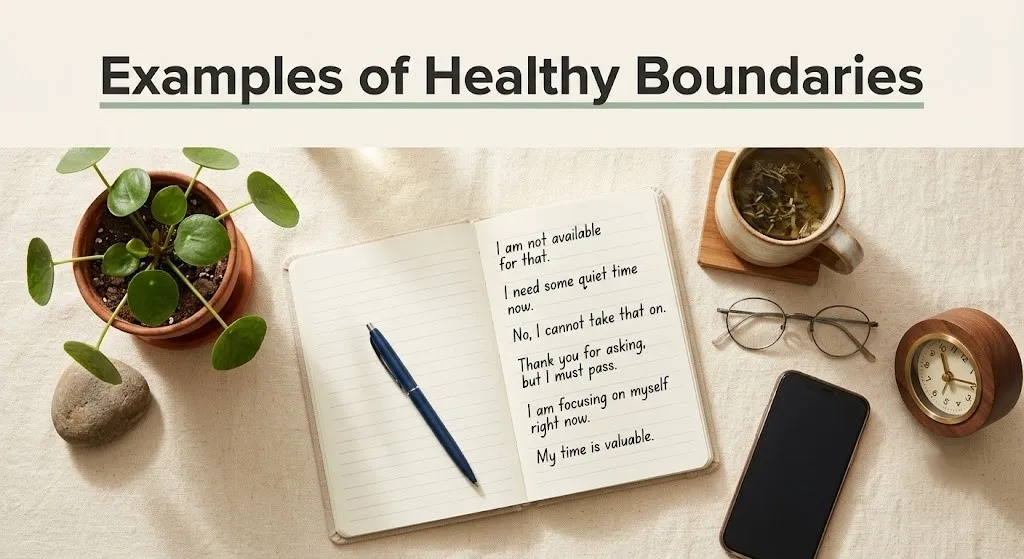
General boundary phrases include: “That does not work for me,” “I am not available for that,” “I will have to think about it and get back to you,” “I am not comfortable with that,” and “Let me stop you there.” These phrases work in almost any situation and require no explanation.
Relationship-specific boundary phrases include: “I care about you and I cannot be your only support person,” “I need some time to myself right now,” “I am not ready to talk about that yet,” and “I love you and I need you to respect my decision.” Workplace boundary phrases include: “I am at capacity right now,” “I can take that on if we discuss what to deprioritize,” “I am not available outside of work hours,” and “That falls outside my role, but I am happy to discuss adjusting my responsibilities.”
Key Takeaway: Memorizing a few boundary phrases like “That does not work for me” and “I am not available for that” prepares you to set limits in the moment without overthinking.
Benefits of healthy boundaries
The benefits of healthy boundaries include reduced stress, improved relationships, increased self-respect, better physical health outcomes, and more time and energy for the people and activities that genuinely matter to you. Boundaries are not a luxury. They are a health intervention.
The physiological benefits of boundaries are measurable. A 2022 study in the journal Psychoneuroendocrinology found that participants who reported clear interpersonal boundaries had lower baseline cortisol levels and a faster cortisol recovery after stressful events compared to those with porous boundaries. The mechanism is straightforward. Boundaries reduce the frequency, intensity, and duration of interpersonal stress, and the body responds accordingly.
The relational benefits are equally real. Relationships with healthy boundaries are more honest, more respectful, and more sustainable because both people know where they stand. The fear that boundaries will drive people away is often reversed in practice. People with clear boundaries attract others who respect them. People who are offended by your boundaries were benefiting from your lack of them.
Key Takeaway: Healthy boundaries reduce stress, improve relationships, increase self-respect, and are associated with better physical health markers including lower cortisol.
Frequently Asked Questions About Healthy Boundaries
What are the 5 types of healthy boundaries?
The five types of healthy boundaries are physical, emotional, time, material, and intellectual.
Physical boundaries govern touch and personal space. Emotional boundaries protect your feelings. Time boundaries protect your schedule.
Material boundaries govern possessions and money. Intellectual boundaries protect your ideas and opinions.
How do I know if I need to set a boundary?
You need to set a boundary when you feel chronic resentment, exhaustion, or dread about interactions with a specific person or situation.
If you feel taken advantage of or notice you are avoiding someone, a missing boundary is likely the cause.
Your body also signals the need for boundaries through stress symptoms like tension headaches, poor sleep, and irritability.
What do you say when setting a boundary?
Use simple “I” statements that describe your own behavior: “I am not available for that,” “That does not work for me,” or “I will not discuss this topic.”
Avoid over-explaining or apologizing. State the boundary calmly as a fact, not a request.
Enforce the boundary through your own actions. You control your response, not the other person’s.
Can setting boundaries improve my physical health?
Yes, setting healthy boundaries is associated with lower cortisol levels, better sleep, and reduced blood pressure.
Chronic boundary violations create ongoing interpersonal stress that activates the body’s stress response.
By reducing the frequency and intensity of these stressors, boundaries produce measurable physiological benefits over time.
What is the difference between a boundary and a preference?
A boundary is non-negotiable because violating it harms your wellbeing. A preference is a desire you can flex around without harm.
When a boundary is crossed, it causes distress or damage. When a preference is not met, it causes disappointment.
Confusing the two weakens your boundaries. Reserve the word “boundary” for limits that genuinely protect your health.
Boundaries are not about pushing people away. They are about keeping yourself intact so that the people you let in get the best version of you, not the exhausted, resentful version that has been giving away pieces of yourself to everyone who asked. A boundary is a declaration of worth. It says that your time, your energy, your body, and your emotional bandwidth have value, and you are the person who decides how they are spent.
The most practical thing you can do is start with the place in your life where resentment lives. That is where the boundary is missing. Identify the specific behavior you will no longer tolerate. Write down the one sentence you will say the next time it happens. Practice saying it out loud. The first boundary is the hardest. Each one after that gets easier, because you are not just setting a limit. You are building a skill, and like any skill, it strengthens with use.