
A healthy weight for a cat is not a single number on a scale. It is a body condition where the ribs are easily felt but not visible, a visible waist is present when viewed from above, and a tucked abdomen is visible from the side. The number on the scale is secondary to what you see and feel.
The American Association of Feline Practitioners (AAFP) estimates that roughly 60 percent of domestic cats in the United States are overweight or obese. This is not a cosmetic issue. Feline obesity is directly linked to diabetes mellitus, arthritis, urinary tract disease, and a shortened lifespan. A cat at a healthy weight lives, on average, longer and with a higher quality of life than an overweight cat.
This guide covers how to assess your cat’s weight at home using the body condition score, what the healthy weight range is for different breeds and ages, how many calories your cat actually needs, and how to safely help a cat lose weight without triggering hepatic lipidosis. You will find a full body condition score chart, a breed weight table, and a practical feeding schedule for weight management.
What Is a Healthy Weight for a Cat?
A healthy weight for a cat is a weight at which the cat has a body condition score of 4 to 5 on a 9-point scale, meaning the ribs are palpable with a light fat covering, the waist is visible, and the abdomen is tucked. The actual number on the scale varies by breed, frame size, and individual body composition.
The concept of ideal body weight in cats is similar to the concept in humans. Two cats can weigh the same and have completely different body compositions. A 12-pound cat might be lean and muscular or overweight and carrying excess fat. The scale alone cannot distinguish between these two states. This is why body condition scoring was developed as a standardized assessment tool.
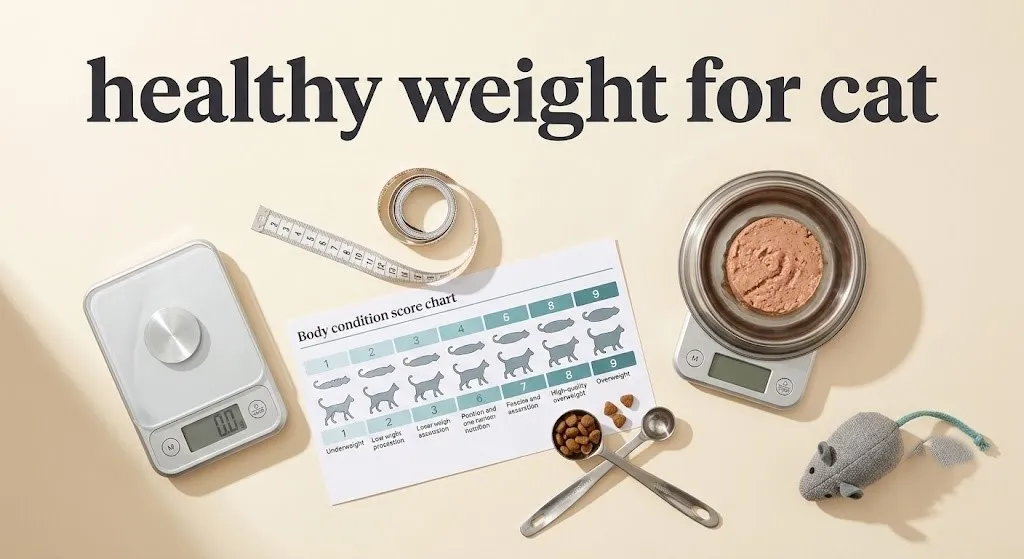
The World Small Animal Veterinary Association (WSAVA) endorses the 9-point body condition score scale as the gold standard for assessing weight status in cats. A score of 1 is emaciated. A score of 5 is ideal. A score of 9 is severely obese. Each one-point increase above 5 corresponds to roughly 10 percent excess body weight. A cat with a body condition score of 7 is approximately 20 percent overweight.
What’s a Healthy Weight for a Cat? The Short Answer
A healthy weight for most domestic shorthair and domestic longhair cats falls between 8 and 12 pounds. However, this range is a population average, not a rule. A specific cat’s healthy weight may fall above or below this range.
The average domestic cat, which is the mixed-breed cat that makes up the majority of the pet cat population, typically has an ideal body weight somewhere in the 8 to 12 pound range. Female cats tend toward the lower end. Male cats tend toward the middle and upper end. Neutered cats have a slightly lower metabolic rate than intact cats and may require slightly fewer calories to maintain the same weight.
Purebred cats have more specific breed weight ranges. A Siamese might be perfectly healthy at 8 pounds. A Maine Coon might be healthy at 18 pounds. A Norwegian Forest Cat might carry 16 pounds without being overweight. The breed sets the expected frame size. The body condition score determines whether the weight on that frame is appropriate.
Key Takeaway: The scale number is a starting point. The body condition score is the answer. An 8-pound cat can be overweight if it has a tiny frame. An 18-pound Maine Coon can be lean.
Healthy Weight of a Cat: Why the Scale Is Not Enough
The scale provides a number. The body condition score provides context. A cat’s healthy weight is defined by its body composition, not by a comparison to a breed average or a bathroom scale reading.
A scale cannot distinguish between muscle, fat, bone, and water. A muscular, fit cat may weigh more than a sedentary cat of the same frame size and be healthier at the higher weight. A cat with ascites, which is fluid accumulation in the abdomen from heart or liver disease, may weigh more on the scale while being severely ill and underweight in terms of lean body mass.
Veterinary weight management programs use body condition score and muscle condition score together. Muscle condition score assesses the muscle mass over the spine, shoulder blades, skull, and hindquarters. A cat can be overweight in body fat and simultaneously muscle-wasted, particularly senior cats or cats with chronic disease. This is called sarcopenic obesity. The scale weight may appear normal or even elevated while the cat’s body composition is unhealthy.
The practical approach is to weigh your cat monthly on the same scale, track the trend, and assess body condition score at the same time. A stable weight with a stable body condition score of 4 to 5 is the goal. A rising weight with a rising body condition score indicates overfeeding. A dropping weight with a dropping body condition score indicates underfeeding or an underlying health issue.
Healthy Weight Adult Cat: Ranges and Variables
A healthy weight for an adult cat, defined as 1 to 7 years old, depends on breed, frame size, sex, and neuter status. The range is broad, but the body condition score standardizes the assessment across all variables.
The adult cat has reached its full skeletal size. Weight gain after adulthood is predominantly fat, not growth. A cat that continues to gain weight after 2 years of age is almost certainly gaining fat, not muscle or bone. This is the period when obesity most commonly develops, as the cat’s metabolic rate slightly declines with maturity while the feeding amount often remains unchanged from the higher-calorie kitten period.
| Variable | Effect on Healthy Weight |
|---|---|
| Breed | Sets frame size. Maine Coon larger than Siamese. |
| Sex | Males typically 1 to 3 pounds heavier than females of same breed. |
| Neuter status | Neutered cats have slightly lower metabolic rate. Risk of weight gain increases after neutering if food is not adjusted. |
| Age (adult) | Stable weight expected. Weight gain signals overfeeding. |
| Activity level | Indoor cats need fewer calories than outdoor or highly active cats. |
The caloric requirement for an adult cat at ideal weight is roughly 20 to 25 calories per pound per day. A 10-pound cat needs roughly 200 to 250 calories daily to maintain weight. This is a starting point. Individual cats may need more or less based on activity level, metabolism, and body condition score trends.
Key Takeaway: Adult cats should maintain a stable weight from 2 to 7 years. Any weight gain during this period is excess fat. Adjust food, not the definition of normal.
Cat Body Condition Score Chart: The 9-Point Scale
The 9-point body condition score chart is the tool veterinarians use to assess weight status. Learning to use it at home gives you an objective way to track your cat’s weight health between veterinary visits.
| Score | Description | Ribs | Waist | Abdominal Tuck |
|---|---|---|---|---|
| 1 to 2 | Underweight | Visible, easily felt with no fat | Severe waist, bony | Severe tuck, bony |
| 3 | Thin | Easily felt, minimal fat cover | Visible waist | Tucked abdomen |
| 4 to 5 | Ideal | Felt with light fat cover | Visible waist | Tucked abdomen |
| 6 | Overweight | Felt with moderate fat cover | Waist visible but less defined | Slight abdominal tuck |
| 7 | Heavy | Felt with difficulty, thick fat | Waist barely visible | Tuck absent |
| 8 to 9 | Obese | Not palpable, heavy fat | No waist, rounded | Distended, no tuck |
To assess your cat at home, use three views and one touch. View from above: the waist should indent behind the ribs. View from the side: the abdomen should tuck up behind the ribcage. View from behind: the cat should not have rolls of fat at the tail base. Touch: run your hands along the ribcage. You should feel each rib with a slight fat covering, similar to the feeling of the bones on the back of your hand.
The most common error in home assessment is normalizing overweight. If every cat in the household, every cat on social media, and every cat the owner has ever had was overweight, the owner’s perception of normal shifts. A body condition score of 6 or 7 starts to look normal. This is why the objective, hands-on assessment matters.
How to Tell If Your Cat Is Overweight at Home
You can tell if your cat is overweight at home by checking for three specific signs: you cannot easily feel the ribs, the waist is not visible from above, and the abdomen does not tuck up behind the ribcage. Any one of these suggests the cat is over its ideal weight.
The rib test is the most reliable single indicator. Stand your cat on a non-slip surface. Place your hands on either side of the ribcage with your thumbs on the spine. Run your fingers lightly over the ribs. In a healthy-weight cat, the ribs feel like the bones on the back of your hand when your hand is flat. You can feel each rib distinctly but there is a thin layer of tissue over them. If the ribs feel like the knuckles of a closed fist, the cat is too thin. If you cannot feel the ribs at all or have to press firmly to locate them, the cat is overweight.
The waist test is viewed from directly above. Stand over your cat while it is standing. Look for an indentation behind the ribs, just before the hips. A healthy-weight cat has a visible waistline. An overweight cat is straight or slightly bulging from ribs to hips. A severely obese cat is wider at the hips than at the ribs.
The abdominal tuck is viewed from the side. A healthy-weight cat has a visible upward slope from the ribcage to the hind legs. The belly does not hang down. Many owners mistake a prominent primordial pouch, the loose flap of skin and fat that hangs between the hind legs, for an overweight belly. The primordial pouch is present in cats of all weights and is not an indicator of obesity.
Average Cat Weight by Breed
Average cat weight by breed provides a reference range, but individual variation within breeds is significant. The body condition score remains the more accurate assessment tool.
| Breed | Healthy Weight Range (lbs) |
|---|---|
| Domestic Shorthair/Longhair | 8 to 12 |
| Siamese | 8 to 12 |
| Persian | 10 to 15 |
| Maine Coon | 15 to 25 |
| Ragdoll | 12 to 20 |
| Bengal | 10 to 15 |
| British Shorthair | 12 to 18 |
| Sphynx | 7 to 12 |
| Abyssinian | 8 to 10 |
| Norwegian Forest Cat | 13 to 20 |
These ranges assume an ideal body condition score. A 20-pound Maine Coon with a body condition score of 5 is healthy. A 20-pound Maine Coon with a body condition score of 8 is obese. The breed sets the expected frame. The body condition score tells you whether the weight on that frame is appropriate.
Mixed-breed cats, which are the most common household cats, fall into the Domestic Shorthair or Domestic Longhair category. Their healthy weight range is the widest because their frame sizes vary the most. A mixed-breed cat with a small, delicate frame might be ideal at 7 pounds. A mixed-breed cat with a large, sturdy frame might be ideal at 14 pounds.
Key Takeaway: Breed weight charts are a starting point. Use the body condition score to determine whether your specific cat, regardless of breed, is at a healthy weight.
Feline Obesity Health Risks
Feline obesity is a disease state, not a cosmetic issue. It is directly linked to diabetes mellitus, arthritis, lower urinary tract disease, hepatic lipidosis, and a shortened lifespan. The health risks are severe and well-documented.
Diabetes mellitus in cats is strongly associated with obesity. Excess body fat causes insulin resistance, where the body’s cells stop responding normally to insulin. The pancreas compensates by producing more insulin, eventually exhausting the insulin-producing cells. The result is Type 2 diabetes, which in cats is often reversible with weight loss and dietary management. A 2016 study in the Journal of Feline Medicine and Surgery found that obese cats were four times more likely to develop diabetes than ideal-weight cats.
Arthritis and joint disease are exacerbated by excess weight. Every extra pound of body weight increases the mechanical load on joints. Fat tissue also produces inflammatory cytokines that contribute to joint inflammation and pain. Cats hide pain well. An overweight cat that is less active, reluctant to jump, or no longer grooming its lower back may be experiencing arthritis pain that is directly worsened by its weight.
Lower urinary tract disease, including feline idiopathic cystitis, is more common in overweight cats. The proposed mechanism involves reduced activity, reduced water intake, and the metabolic effects of obesity on the bladder lining. Obese cats are also at higher risk for complications under anesthesia, should they require dental procedures or surgery.
How Many Calories Does a Cat Need per Day?
A cat needs roughly 20 to 25 calories per pound of ideal body weight per day for maintenance. The exact number depends on activity level, age, neuter status, and individual metabolism. Weight loss requires fewer calories, typically 15 to 20 calories per pound of ideal weight.
The resting energy requirement (RER) is the number of calories a cat needs for basic bodily functions at rest. The formula for RER is 70 times the cat’s weight in kilograms raised to the power of 0.75. For a 10-pound cat, this equals roughly 200 calories. The maintenance energy requirement (MER) is the RER multiplied by a factor that accounts for activity and life stage. For a neutered adult indoor cat, the factor is typically 1.0 to 1.2.
To calculate daily calories for a 10-pound cat at ideal weight:
- 10 pounds divided by 2.2 equals 4.5 kilograms
- RER equals 70 times 4.5 to the power of 0.75, which equals roughly 200 calories
- MER equals 200 times 1.0 to 1.2, which equals 200 to 240 calories per day
For weight loss, the cat is fed the MER for its target weight, not its current weight. A 15-pound cat that should weigh 12 pounds is fed the 12-pound calorie requirement. The AAFP recommends a weight loss rate of 0.5 to 2 percent of body weight per week. Faster weight loss risks hepatic lipidosis.
Best Wet Food for Cat Weight Loss
The best wet food for cat weight loss is a high-protein, low-carbohydrate, moisture-rich canned food that meets AAFCO nutritional adequacy standards for adult maintenance. Wet food supports weight loss through its caloric density, protein content, and moisture level.
Wet food contains roughly 75 to 78 percent water. This means a 5.5-ounce can might contain only 150 to 200 calories while being physically large and satiating. A cup of dry food, which is roughly 10 percent water, can contain 350 to 500 calories. The volume-to-calorie ratio of wet food is more favorable for a cat on a calorie-restricted diet. The cat eats a satisfying portion size without exceeding its calorie budget.
The protein content of wet food is typically higher on a dry matter basis than dry food. Cats are obligate carnivores. Their metabolism is designed to use protein and fat for energy, not carbohydrate. A high-protein, low-carbohydrate diet supports lean muscle mass retention during weight loss. This is important because muscle loss lowers metabolic rate and makes long-term weight maintenance harder.
Look for wet foods that list a named animal protein source first, contain minimal carbohydrate fillers like corn, wheat, or potato, and have a protein content of 40 percent or higher on a dry matter basis. Pate-style foods are generally more calorie-dense than shredded or gravy-style foods, which is relevant to the calorie math.
Key Takeaway: Wet food supports weight loss through higher moisture, higher protein, and lower calorie density. A cat can eat a satisfying volume of food while staying within a calorie deficit.
Feeding Schedule for Weight Management
A feeding schedule for weight management uses measured, scheduled meals rather than free feeding. Two to three meals per day, with the daily calorie allotment divided evenly, is the standard recommendation.
Free feeding, also called ad libitum feeding, means dry food is left out at all times for the cat to graze. This feeding method is the single largest contributor to feline obesity in multi-cat households. Cats are not natural grazers. Their wild ancestors ate discrete meals of prey, not a constant stream of kibble. Free feeding disconnects the cat from its natural feeding pattern and makes calorie control nearly impossible.
Scheduled meal feeding involves measuring the daily food portion, dividing it into two or three meals, and feeding at consistent times. The cat eats the meal, the bowl is picked up, and no food is available until the next meal. This method controls calories, allows monitoring of appetite and intake, and creates a predictable routine that reduces food-related anxiety in many cats.
To transition from free feeding to scheduled meals:
- Measure the current daily food amount. This is your baseline.
- Reduce the amount by 5 to 10 percent per week until you reach the target calorie amount.
- Divide the target amount into two or three meals. Feed at the same times every day.
- Pick up any uneaten food after 30 minutes. Do not leave food out.
- Use a puzzle feeder for one of the meals to slow eating and provide mental stimulation.
How to Help a Cat Lose Weight Safely
Helping a cat lose weight safely requires a veterinarian-confirmed target weight, a calculated calorie deficit, measured meals, and a slow, steady rate of loss. Rapid weight loss is dangerous for cats.
The AAFP recommends a weight loss rate of 0.5 to 2 percent of body weight per week. For a 15-pound cat, that is roughly 0.075 to 0.3 pounds per week, or about 1 to 4 ounces. This is slow. A 15-pound cat might take 6 to 12 months to reach a 12-pound target weight. Impatience is the enemy of safe feline weight loss.
To help your cat lose weight safely:
- Confirm the target weight with a veterinarian. Get blood work to rule out underlying conditions like hypothyroidism.
- Calculate the daily calorie target based on the ideal weight, not the current weight.
- Choose a high-protein, low-carbohydrate wet food. Measure every meal with a gram scale for accuracy.
- Feed two to three scheduled meals per day. No free feeding. No treats that exceed 10 percent of daily calories.
- Increase activity with interactive play sessions. Two 10-minute sessions per day with a wand toy or laser pointer.
- Weigh the cat weekly on the same scale. Track the trend. Adjust calories if weight loss stalls or exceeds 2 percent per week.
- Return to the veterinarian for progress checks every 4 to 6 weeks during active weight loss.
A veterinarian should supervise any weight loss plan for a cat that is more than 20 percent over its ideal weight or has a body condition score of 7 or higher. Obese cats may have underlying metabolic disease that requires medical management.
Key Takeaway: Feline weight loss is measured in ounces per week, not pounds. A veterinarian should supervise. Rapid weight loss can kill a cat.
Hepatic Lipidosis: The Danger of Rapid Feline Weight Loss
Hepatic lipidosis, also called fatty liver disease, is a life-threatening condition in which fat accumulates in the liver when a cat stops eating or loses weight too rapidly. It is unique to cats and can be fatal within days to weeks without aggressive treatment.
Cats are obligate carnivores with a high protein requirement. When a cat stops eating or receives too few calories, the body mobilizes stored fat for energy. The liver is responsible for processing this fat. In cats, unlike many other species, the liver can become overwhelmed by the sudden influx of fat. The fat accumulates inside the liver cells, impairing their function. The cat becomes jaundiced, nauseated, and anorexic, which creates a vicious cycle of not eating and further liver damage.
Hepatic lipidosis was first widely recognized when well-intentioned owners put their overweight cats on crash diets. A cat that stops eating for as little as 48 to 72 hours, or loses weight faster than 2 percent of body weight per week, is at risk. The primary prevention strategy is to ensure the cat eats every day during weight loss, even if the calorie intake is slightly higher than the target. A cat that refuses the diet food should be offered its previous food to restart eating, and a veterinarian should be contacted immediately.
The signs of hepatic lipidosis include sudden weight loss, hiding, vomiting, drooling, jaundice (yellowing of the gums, ears, or eyes), and complete loss of appetite. This is a veterinary emergency. Do not wait to see if the cat improves on its own.
Kitten Healthy Weight Milestones
Kittens should gain weight steadily and predictably from birth through 12 months. Tracking weight gain is the best early indicator of health in kittens.
A newborn kitten weighs roughly 3 to 4 ounces at birth. It should gain roughly 0.5 ounces, or 14 grams, per day during the first few weeks. By 8 weeks, a healthy kitten typically weighs 1.5 to 2 pounds. By 4 months, roughly 4 to 5 pounds. By 6 months, roughly 6 to 8 pounds. By 12 months, the kitten is approaching its adult weight, which varies by breed and frame size.
| Age | Approximate Healthy Weight |
|---|---|
| Birth | 3 to 4 oz |
| 2 weeks | 7 to 10 oz |
| 4 weeks | 12 to 16 oz (0.75 to 1 lb) |
| 8 weeks | 1.5 to 2 lbs |
| 4 months | 4 to 5 lbs |
| 6 months | 6 to 8 lbs |
| 12 months | 8 to 15 lbs (breed dependent) |
A kitten that is not gaining weight, or is losing weight, requires veterinary attention. Growth is rapid, and nutritional demands are high. Kittens should be fed kitten-specific food, which is higher in protein, fat, calcium, and phosphorus than adult maintenance food, until 12 months of age. Free feeding is appropriate for kittens under 6 months because their caloric needs are high and their stomachs are small. After 6 months, transitioning to scheduled meals prevents the development of overeating habits.
Senior Cat Weight Loss Causes and Concerns
Weight loss in a senior cat, defined as 7 years and older, is a red flag. It should never be dismissed as a normal part of aging. The most common causes are chronic kidney disease, hyperthyroidism, diabetes mellitus, dental disease, and gastrointestinal disease.
Chronic kidney disease (CKD) is the most common disease of senior cats. The kidneys lose the ability to concentrate urine, causing increased water loss and often a reduced appetite due to uremic toxins building up in the blood. Weight loss in CKD is predominantly muscle wasting, which is visible as loss of muscle over the spine and hindquarters.
Hyperthyroidism is the second major cause of weight loss in senior cats. A benign tumor on the thyroid gland produces excess thyroid hormone, which dramatically increases the cat’s metabolic rate. The cat eats ravenously but loses weight. The heart rate increases, and the cat may become restless, vocal, and have a poor coat. Hyperthyroidism is treatable with medication, prescription diet, or radioactive iodine therapy.
Any senior cat losing weight should have blood work performed, including a complete blood count, serum biochemistry panel, and thyroid hormone level. A veterinarian should interpret the results and recommend treatment. Do not attribute weight loss to old age without ruling out these treatable conditions.
Key Takeaway: Weight loss in a senior cat is never normal aging. Kidney disease and hyperthyroidism are the most common causes. Blood work is essential.
Maine Coon and Large Breed Healthy Weights
Maine Coons and other large breed cats have healthy weight ranges that far exceed the domestic cat average. A healthy Maine Coon can weigh 15 to 25 pounds, and some well-muscled males can exceed this range while maintaining an ideal body condition score.
Maine Coons are the largest domestic cat breed. They have a slow maturation rate, not reaching full size until 3 to 5 years of age. This is significantly longer than the typical 1 to 2 years for domestic shorthairs. A Maine Coon at 1 year old might weigh 12 to 15 pounds and still have years of growth ahead. This slow maturation means calorie needs remain elevated longer than for other breeds.
Norwegian Forest Cats and Ragdolls are also large breeds with healthy weight ranges in the 13 to 20 pound range. British Shorthairs are medium-large with a stocky build and a healthy range of 12 to 18 pounds. The body condition score remains the assessment tool across all breeds. A 20-pound Maine Coon should still have palpable ribs, a visible waist, and an abdominal tuck.
Large breed cats are at risk for joint stress if they become overweight. The extra weight on an already large frame accelerates the development of arthritis. Keeping a large breed cat at a body condition score of 4 to 5 is particularly important for long-term mobility and comfort.
Cat Weight Loss Meal Prep and Tracking
Cat weight loss meal prep and tracking use a gram scale, a food journal, and a consistent routine. The same principles that work for human weight loss apply to cats: measure everything, track everything, and adjust based on results.
A digital kitchen scale is the most accurate way to measure cat food portions. Measuring cups are inconsistent because kibble size and shape vary, and wet food compresses. Weigh the empty bowl, add the food, and record the grams. Track the calories based on the food’s caloric density, which is listed on the label in kilocalories per kilogram or per can.
To meal prep for a cat on a weight loss plan:
- Calculate the daily calorie target based on the ideal weight, confirmed by a veterinarian.
- Determine the grams of food needed to meet the calorie target using the food label.
- Weigh out the full day’s portion each morning. Divide into the number of meals.
- Store pre-portioned meals in small covered containers in the refrigerator for wet food.
- Weigh the cat weekly on the same scale, at the same time of day.
- Record the weight, the daily food amount, and any treats in a simple log.
- Review the log every 2 to 4 weeks. If weight is not trending down at the target rate, reduce calories by 5 to 10 percent.
The precision of a gram scale makes the difference between a weight loss plan that works and one that stalls. Estimating portions leads to portion creep, where the amount fed gradually increases without the owner realizing it.
Frequently Asked Questions About Cat Weight
How do I know if my cat is overweight?
Check three signs: ribs that are difficult to feel, no visible waist when viewed from above, and no abdominal tuck from the side. If you cannot feel the ribs without pressing firmly, the cat is likely overweight. A body condition score of 6 or higher indicates excess weight.
How much should I feed my cat to lose weight?
Feed the calorie amount appropriate for the target weight, not the current weight. A cat that should weigh 10 pounds needs roughly 200 to 250 calories per day. Measure food with a gram scale. Reduce treats. A veterinarian should confirm the calorie target.
Can a cat lose weight too fast?
A cat can lose weight too fast. Weight loss exceeding 2 percent of body weight per week can trigger hepatic lipidosis, a life-threatening liver condition. A safe rate for a 15-pound cat is 1 to 4 ounces per week. Rapid weight loss is a veterinary emergency.
What is a healthy weight for a tabby cat?
Tabby is a coat pattern, not a breed, so the healthy weight depends on the cat’s breed and frame size. Most tabby domestic shorthairs fall in the 8 to 12 pound range. Assess body condition score, not coat pattern, to determine whether the weight is healthy.
Should I free feed my cat or use scheduled meals?
Scheduled meals are healthier for weight management than free feeding. Free feeding is associated with higher rates of obesity. Feed two to three measured meals per day. Pick up uneaten food after 30 minutes. The routine helps control calories and monitor appetite.
Your cat’s weight is not a mystery. It is a physical assessment you can learn to perform in under a minute. The ribs, the waist, the tuck. Three checkpoints. One body condition score. That score is more reliable than the number on the scale and more actionable than a breed weight chart.
If your cat is overweight, move slowly. A few ounces per week. Measured meals, not free feeding. Wet food, not dry. A veterinarian on your team. The goal is not just a lower number. It is a cat that moves without pain, grooms without struggle, and lives years longer than an obese cat. That is the weight that matters.