You are standing in the snack aisle. Your hand hovers over the familiar red box. You have been eating Cheez-Its since childhood. They are baked, not fried. The box says “made with real cheese.” That counts for something, right? You wonder whether this is a reasonably acceptable snack or whether you need to find something better.
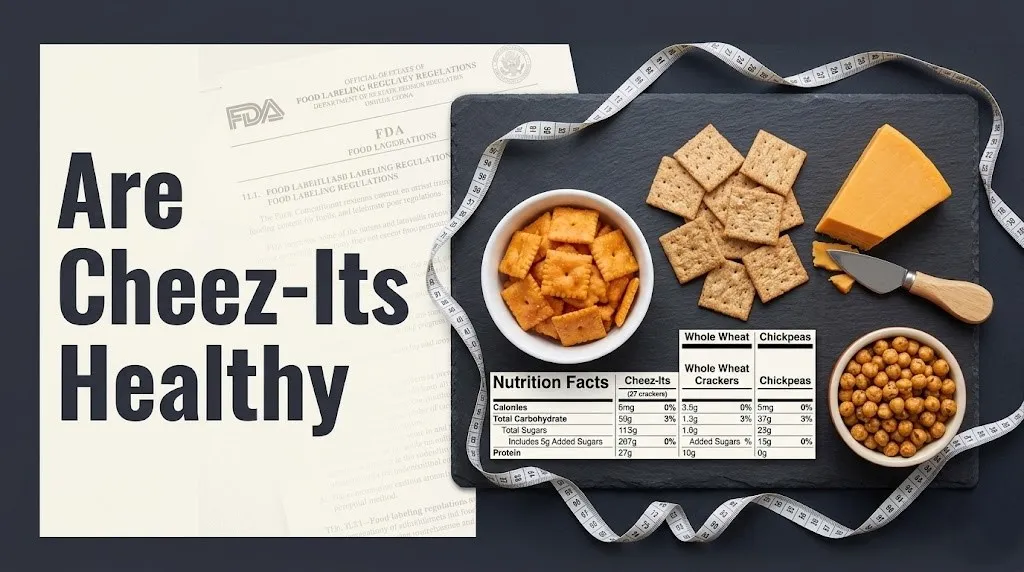
Cheez-Its are not a health food. They are a processed snack cracker made from enriched flour, cheese, oil, and salt. A standard 30-cracker serving, roughly 30 grams, contains 150 calories, 8 grams of fat, 2 grams of saturated fat, 230 milligrams of sodium, and 17 grams of refined carbohydrates with less than 1 gram of fiber. They provide small amounts of calcium, iron, and B vitamins from the enriched flour and cheese. They are not empty calories in the way that soda is empty. They are also not nutrient dense.
What surprises most consumers is that the phrase “made with real cheese” is both true and misleading. The cheese in Cheez-Its is real cheddar cheese made from cultured milk, salt, and enzymes. It is listed in the ingredients. It contributes to the flavor and the small amount of protein and calcium. It is also a minor component compared to the enriched flour and oil. The cheese is real. The cracker is still a processed snack.
The legal framework around snack food labeling is more relevant than most people realize. The FDA updated its definition of the “healthy” nutrient content claim in 2025. For a product to be labeled and sold as “healthy,” it must contain a meaningful amount of food from a recommended food group and meet specific limits on saturated fat, sodium, and added sugars. Cheez-Its would not qualify. They exceed the saturated fat and sodium limits and do not contain enough cheese to count as a meaningful dairy serving.
are cheez its healthy
No, Cheez-Its are not a healthy food. They are a processed snack cracker that provides calories, fat, and sodium with minimal fiber, protein, or micronutrients relative to their calorie content. They can be eaten as an occasional snack in a reasonable portion. They should not be a dietary staple.
The nutritional profile of a standard 30-gram serving of original Cheez-Its breaks down as follows. The 150 calories come primarily from refined flour and oil. The 8 grams of fat include 2 grams of saturated fat, roughly 10 percent of the American Heart Association’s recommended daily limit. The 230 milligrams of sodium is about 10 percent of the daily recommended upper limit. The 17 grams of carbohydrates include less than 1 gram of fiber and less than 1 gram of sugar. The 3 grams of protein is modest.
The problem is not that Cheez-Its are uniquely harmful. It is that they are a calorie-dense, nutrient-poor food that is easy to overeat. The serving size on the box is 30 crackers. Most people eat more than that in one sitting. A mindless handful from the box while watching television can easily deliver 300 to 500 calories with minimal satiety.
The enriched flour in Cheez-Its is refined wheat flour to which thiamin, riboflavin, niacin, iron, and folic acid have been added back after processing. Enrichment restores some of the nutrients lost during refining. It does not restore the fiber. It does not restore the naturally occurring phytonutrients in whole grains. Enriched flour is better than unenriched refined flour. It is not as good as whole grain flour.
are cheez-its healthy
Cheez-Its are not healthy by any standard nutritional definition. They are a processed snack cracker with a nutritional profile similar to other refined grain snacks like potato chips, pretzels, and Goldfish. The “baked with real cheese” marketing distinguishes them from fried snacks, but the nutritional difference is modest.
The hyphenated spelling “Cheez-Its” is the correct trademarked spelling of the product name. The product is manufactured by Kellanova, formerly the Kellogg Company snack division. The brand has been on American shelves since 1921. The longevity is a testament to the product’s taste and market position. It is not a testament to its nutritional value.
The ingredient list for original Cheez-Its reads as follows: enriched flour (wheat flour, niacin, reduced iron, vitamin B1 thiamin mononitrate, vitamin B2 riboflavin, folic acid), vegetable oil (soybean and palm oil with TBHQ for freshness), cheese made with skim milk (skim milk, whey protein, salt, cheese cultures, enzymes, annatto extract color). The list continues with salt, paprika, yeast, and baking soda.
The ingredient list reveals the product’s nutritional character. The first ingredient is enriched flour, a refined grain. The second is vegetable oil, a mix of soybean and palm oil. The cheese is third, and it is real cheese. The TBHQ is an antioxidant preservative that the FDA has affirmed as safe at the levels used in food. The annatto extract is a natural color derived from the achiote tree seed. The ingredient quality is standard for the packaged snack category. It is not a whole food.
Key Takeaway: Cheez-Its are a processed snack with real cheese as a minor ingredient. The primary ingredients are refined flour and oil. They are not a health food. They are an occasional snack.
are cheez-its healthy for weight loss
Cheez-Its are not a good food for weight loss. They are calorie-dense, low in fiber and protein, and easy to overeat. A single serving of 30 crackers contains 150 calories. Most people eat two to three times that amount in one sitting, delivering 300 to 450 calories that do not fill the stomach or promote satiety.
The satiety problem is the primary issue for weight loss. Protein and fiber are the two nutrients most strongly associated with satiety, the feeling of fullness after eating. Cheez-Its contain 3 grams of protein and less than 1 gram of fiber per serving. A 150-calorie serving leaves most people hungry shortly after eating. The hunger drives additional snacking, which drives calorie intake above the weight loss target.
The calorie density is the secondary issue. Cheez-Its contain roughly 150 calories per 30 grams, which is a small volume of food. A person can eat 30 crackers in a few minutes while distracted. The hand-to-mouth motion, the crunch, and the salt make the product highly snackable. The design of the food encourages overconsumption.
If someone insists on including Cheez-Its in a weight loss plan, strict portion control is the only viable strategy. Measure a single serving into a small bowl. Put the box away. Do not eat directly from the box. Pair the crackers with a protein source like a cheese stick or a hard-boiled egg to improve satiety. The combination of protein and the crackers will be more filling than the crackers alone.
are cheez its processed food
Yes, Cheez-Its are a processed food. They are made from refined flour, oil, cheese, and additives that have been combined, shaped, and baked in a manufacturing facility. They are not an ultra-processed food in the strictest sense, but they are closer to ultra-processed than to minimally processed on the food processing spectrum.
The NOVA food classification system, developed by researchers at the University of Sao Paulo and used by the Food and Agriculture Organization, categorizes foods into four groups. Group 1 is unprocessed or minimally processed foods like whole grains, milk, and vegetables. Group 2 is processed culinary ingredients like oil and salt. Group 3 is processed foods like cheese and canned vegetables. Group 4 is ultra-processed foods, which are formulations of ingredients, mostly of exclusive industrial use, that result from a series of manufacturing processes.
Cheez-Its fall into Group 4, ultra-processed foods, under the NOVA classification. They contain ingredients like TBHQ, an antioxidant preservative, and enzyme-modified cheese, which are industrial ingredients not found in home kitchens. They are manufactured through processes that include extrusion, sheeting, cutting, and high-temperature baking. The final product is far removed from the original whole foods.
The Academy of Nutrition and Dietetics does not classify foods using NOVA in its official guidance. The Academy emphasizes that processing exists on a spectrum and that some processed foods, like canned beans and fortified cereals, contribute positively to dietary quality. Cheez-Its are on the indulgent end of the processed food spectrum. They are a snack to enjoy in moderation, not a staple to build a diet around.
are cheez its made with real cheese
Yes, Cheez-Its are made with real cheese. The ingredient list includes cheese made from skim milk, whey protein, salt, cheese cultures, enzymes, and annatto extract for color. The cheese is real cheddar cheese produced through standard cheese-making processes. The claim “made with real cheese” on the box is factually accurate.
The legal significance of the “real cheese” claim is governed by the FDA’s standards of identity for cheese. Cheddar cheese is defined in 21 CFR Part 133. It must be made from milk, cream, or both, with specific cultures and enzymes. The cheese in Cheez-Its meets this standard. It is not imitation cheese. It is not cheese product. It is real cheese.
The nutritional significance of the real cheese is modest. The cheese is the third ingredient by weight, after enriched flour and vegetable oil. A 30-gram serving of Cheez-Its contains roughly 3 to 5 grams of cheese. The cheese contributes flavor, a small amount of protein, and a small amount of calcium. It does not make the cracker a significant source of dairy.
The marketing significance of the real cheese claim is substantial. The claim distinguishes Cheez-Its from snacks made with cheese powder or artificial cheese flavor. It implies a quality difference. The quality difference is real but limited. The cheese is real. The cracker is still a refined grain product with more flour and oil than cheese.
are cheez it snap’d healthy
Cheez-It Snap’d are not healthy. They are a thinner, crispier version of original Cheez-Its with a similar nutritional profile. The Snap’d variety is made from potato starch and rice flour in addition to wheat flour, which gives it a lighter, crispier texture. The calorie and fat content are similar to original Cheez-Its.
A 30-gram serving of Cheez-It Snap’d contains roughly 140 to 150 calories, 7 to 8 grams of fat, 2 grams of saturated fat, 200 to 250 milligrams of sodium, and 17 to 19 grams of carbohydrates with minimal fiber and protein. The numbers are nearly identical to original Cheez-Its. The Snap’d format does not change the nutritional profile meaningfully.
The ingredient list for Cheez-It Snap’d includes potato starch and rice flour, which are both refined carbohydrates. The combination of wheat flour, potato starch, and rice flour creates a product that is even more processed than original Cheez-Its. The texture is different. The nutrition is the same or slightly worse depending on the flavor.
The Snap’d branding and thinner shape may create a perception that the product is lighter and healthier. The perception is not supported by the nutrition facts panel. Cheez-It Snap’d are a cracker variation, not a health upgrade.
Key Takeaway: Cheez-It Snap’d are nutritionally equivalent to original Cheez-Its. The thinner, crispier texture does not change the calorie, fat, or sodium content. They are an occasional snack, not a healthy alternative.
are cheez its high in sodium
Yes, Cheez-Its are high in sodium relative to their serving size. A 30-gram serving contains 230 milligrams of sodium, which is 10 percent of the daily recommended upper limit of 2,300 milligrams. The sodium density is high. A person who eats several servings in one sitting can consume a significant portion of the daily sodium budget.
The sodium in Cheez-Its comes from three sources. The cheese contains salt from the cheese-making process. The cracker dough is salted before baking. Salt is sprinkled on top of the crackers before baking. The combination creates the salty, savory flavor that defines the product.
The American Heart Association recommends a daily sodium limit of 2,300 milligrams with an ideal limit of 1,500 milligrams for most adults. A single serving of Cheez-Its uses 10 to 15 percent of the daily limit. The sodium is one of the primary nutritional concerns with the product. High sodium intake is associated with hypertension and increased cardiovascular risk.
For someone monitoring sodium intake, Cheez-Its should be an occasional snack eaten in controlled portions. The reduced-fat version of Cheez-Its has similar sodium content to the original. The flavored varieties often have more sodium. The Hot and Spicy variety contains 250 milligrams of sodium per serving. The White Cheddar variety contains 230 milligrams. The sodium content is consistent across the product line.
are reduced fat cheez its healthy
Reduced fat Cheez-Its are marginally healthier than original Cheez-Its but are still not a healthy food. The fat content is reduced from 8 grams to 6 grams per serving. The calorie count is reduced from 150 to 140 calories. The sodium and refined carbohydrate content are similar.
The FDA regulates the term “reduced fat” as a nutrient content claim. A product labeled “reduced fat” must contain at least 25 percent less fat than the reference product. Reduced fat Cheez-Its meet this standard. The fat reduction is 25 percent. The calorie reduction is roughly 7 percent, from 150 to 140 calories. The sodium is the same.
The ingredient list for reduced fat Cheez-Its includes modified food starch and additional binders to compensate for the texture changes that occur when fat is removed. Fat contributes to the crisp, tender texture of crackers. Removing it requires reformulation. The reduced fat product is more processed than the original in terms of the number and types of additives.
The health advantage of reduced fat Cheez-Its is small. The fat reduction saves 2 grams of fat and 10 calories per serving. For someone who eats Cheez-Its regularly and wants to make a small improvement without giving them up entirely, the reduced fat version is a marginal upgrade. It is not a health food.
are cheez its healthier than chips
Cheez-Its are roughly comparable to potato chips in overall healthfulness. They are baked rather than fried, which reduces the fat content slightly. They contain a small amount of protein and calcium from the cheese, which chips lack. They are similar in calories, sodium, and refined carbohydrate content.
A 30-gram serving of original Cheez-Its contains 150 calories, 8 grams of fat, and 230 milligrams of sodium. A 30-gram serving of classic Lay’s potato chips contains 160 calories, 10 grams of fat, and 170 milligrams of sodium. The Cheez-Its have slightly fewer calories and less fat. The chips have slightly less sodium. The differences are small.
The baking versus frying distinction matters for fat content. Baked crackers absorb less oil during cooking than fried potato chips. The fat savings is roughly 2 grams per serving. Over time, that difference adds up. It is not large enough to make Cheez-Its a health food.
The cheese in Cheez-Its provides a nutritional advantage that chips do not have. The cheese contributes roughly 3 grams of protein and a small amount of calcium per serving. Potato chips have essentially no protein and no calcium. The protein difference is small but meaningful for a snack food.
| Snack (30g serving) | Calories | Total Fat | Sodium | Protein | Fiber |
|---|---|---|---|---|---|
| Original Cheez-Its | 150 | 8g | 230mg | 3g | <1g |
| Classic Lay’s | 160 | 10g | 170mg | 2g | 1g |
| Goldfish Crackers | 140 | 5g | 250mg | 3g | <1g |
| Pretzels | 110 | 1g | 380mg | 3g | 1g |
| Tortilla Chips | 140 | 7g | 120mg | 2g | 2g |
are white cheddar cheez its healthy
White cheddar Cheez-Its are not healthy. They are nutritionally similar to original Cheez-Its with a different cheese variety used for flavoring. The calorie, fat, sodium, and refined carbohydrate content are comparable.
The white cheddar variety uses white cheddar cheese instead of the orange cheddar used in the original. Orange cheddar gets its color from annatto, a natural plant extract. White cheddar is the same cheese without the added color. The nutritional difference between orange and white cheddar is negligible. Both are real cheese with similar fat and protein content.
The ingredient list for white cheddar Cheez-Its is similar to the original. The primary ingredients are enriched flour, vegetable oil, and white cheddar cheese. The salt, yeast, and baking soda are the same. The product is a flavor variation, not a nutritional upgrade.
Some consumers perceive white cheddar as a more natural or premium ingredient than orange cheddar. The perception is a marketing and culinary distinction, not a nutritional one. White cheddar Cheez-Its are a processed snack cracker with the same nutritional strengths and weaknesses as the original.
are cheez its healthy for kids
Cheez-Its are not a healthy snack for children as a daily food. They are an acceptable occasional snack in a reasonable portion. Children have smaller daily calorie and sodium budgets than adults. A single serving of Cheez-Its uses a larger percentage of a child’s daily limits.
A 30-gram serving of Cheez-Its contains 230 milligrams of sodium. The American Heart Association recommends that children ages 4 to 8 consume no more than 1,500 milligrams of sodium per day. A single serving of Cheez-Its uses 15 percent of that budget. A child who eats multiple servings or eats Cheez-Its alongside other processed snacks can quickly exceed the daily sodium limit.
The calorie density of Cheez-Its is also a concern for children. Childhood obesity rates in the United States remain elevated. The CDC reports that roughly 20 percent of children and adolescents have obesity. Snack foods like Cheez-Its contribute to excess calorie intake because they are easy to eat in large quantities and do not promote satiety.
The marketing of Cheez-Its to children is a legal and regulatory issue. The product is packaged in bright colors and marketed with playful branding. The FTC has guidelines for food marketing to children, though the guidelines are largely voluntary. State attorneys general have become more active in challenging food marketing practices they consider deceptive. The legal landscape around marketing processed snacks to children is evolving in 2026.
Legal Bottom Line: The FTC’s Children’s Online Privacy Protection Act (COPPA) regulates how food companies market to children online. The agency has signaled interest in expanding oversight of food marketing to children more broadly. Cheez-Its, like many snack brands, must navigate this evolving regulatory environment.
healthy alternatives to cheez its
Healthy alternatives to Cheez-Its include whole grain crackers, seed-based crackers, roasted chickpeas, air-popped popcorn, and homemade cheese crackers made with whole grain flour and real cheese. These alternatives deliver more fiber, more protein, and less sodium per serving.
Whole grain crackers like Mary’s Gone Crackers, Crunchmaster multi-seed crackers, or Simple Mills almond flour crackers are the best direct replacements. They provide the crunch and salt of Cheez-Its with more fiber, more protein, and better ingredient quality. A serving of Mary’s Gone Crackers contains 140 calories, 3 grams of fiber, and 3 grams of protein. The ingredient list is shorter and more recognizable.
Roasted chickpeas are a whole-food alternative that delivers a crunchy, salty snack with 6 grams of protein and 6 grams of fiber per serving. They can be seasoned with cheese powder or nutritional yeast for a cheese-like flavor. They are more filling than Cheez-Its because of the fiber and protein content.
Air-popped popcorn with nutritional yeast is a high-volume, low-calorie alternative. Three cups of popcorn contain roughly 90 calories and 3 grams of fiber. Nutritional yeast adds a savory, cheese-like flavor with B vitamins. The combination satisfies the crunchy, savory craving with a fraction of the calories and sodium of Cheez-Its.
Quick Tip:
- Choose whole grain or seed-based crackers for a direct Cheez-Its replacement
- Roasted chickpeas deliver more protein and fiber than any processed cracker
- Air-popped popcorn with nutritional yeast is the lowest-calorie crunchy alternative
- Homemade cheese crackers let you control the flour, oil, and salt
are goldfish healthier than cheez its
Goldfish crackers are marginally healthier than Cheez-Its. They contain less fat and fewer calories per serving. The sodium content is similar or slightly higher. The nutritional differences are small. Both are processed snack crackers made from refined flour, oil, and cheese.
A 30-gram serving of original Goldfish contains 140 calories, 5 grams of fat, 1 gram of saturated fat, and 250 milligrams of sodium. A comparable serving of original Cheez-Its contains 150 calories, 8 grams of fat, 2 grams of saturated fat, and 230 milligrams of sodium. Goldfish have slightly fewer calories and less fat. Cheez-Its have slightly less sodium.
The ingredient lists are similar. Both products start with enriched wheat flour. Both use vegetable oil. Both use real cheese. Both contain salt, yeast, and baking soda. Goldfish use a slightly different oil blend. The baking process is similar. The nutritional differences are attributable to small variations in formulation, not fundamentally different product philosophies.
For a parent choosing between the two for a child’s snack, Goldfish have a marginal nutritional edge. The edge is small enough that taste preference and portion control matter more than the choice between brands. Both should be occasional snacks, not dietary staples.
are extra toasty cheez its healthy
Extra Toasty Cheez-Its are not healthy. They are a flavor variation of original Cheez-Its with a darker, more browned appearance and a slightly more intense cheese flavor. The nutritional profile is nearly identical to the original.
The Extra Toasty variety is baked longer or at a higher temperature to achieve the darker color and crispier texture. The Maillard reaction, the browning that occurs when proteins and sugars are heated, creates the toasty flavor compounds. The longer baking time may also increase the formation of acrylamide, a probable human carcinogen that forms when starchy foods are cooked at high temperatures.
The FDA provides guidance to manufacturers on reducing acrylamide levels in processed foods. The guidance is not a legal limit. Acrylamide levels in Extra Toasty Cheez-Its are likely slightly higher than in the original due to the longer, hotter baking. The absolute risk from occasional consumption is low. The risk from daily consumption is poorly understood.
The nutritional differences between Extra Toasty and original Cheez-Its are negligible. The calorie, fat, sodium, and carbohydrate content are virtually identical. The Extra Toasty variety is a flavor choice, not a health choice.
are hot and spicy cheez its healthy
Hot and Spicy Cheez-Its are not healthy. They are nutritionally similar to original Cheez-Its with added spices for heat. The sodium content is slightly higher at 250 milligrams per serving compared to 230 milligrams in the original.
The added spices include paprika, chili pepper, and natural flavors. The spices themselves are not a health concern. Capsaicin, the compound that makes chili peppers hot, has been studied for potential metabolic benefits. The amount of capsaicin in a serving of Hot and Spicy Cheez-Its is small. The metabolic effect, if any, is negligible.
The heat from the spices may encourage some people to eat more slowly or drink water alongside the crackers, which could reduce total consumption. The heat may also irritate the digestive tract in people with acid reflux, gastritis, or irritable bowel syndrome. The spicy variety is not recommended for those individuals.
The nutritional profile is essentially the same as original Cheez-Its with slightly more sodium. The hot and spicy flavor does not change the fundamental health assessment. The product is an occasional snack, not a health food.
are cheez its healthy during pregnancy
Cheez-Its are safe to eat during pregnancy in moderate portions. They are a processed snack with no specific pregnancy-related risks. The sodium content is a concern if blood pressure is elevated. The refined carbohydrate content is a concern if gestational diabetes is present.
The safety of Cheez-Its during pregnancy is not in question. The ingredients are all FDA-approved for use in food. The baking process kills any potential pathogens. There is no risk of Listeria, Salmonella, or other foodborne illness from commercially baked crackers. This is a food safety advantage over some pregnancy-restricted foods like soft cheeses and deli meats.
The sodium content is the primary pregnancy-related nutritional concern. Pregnancy-induced hypertension and preeclampsia are serious conditions that affect roughly 5 to 8 percent of pregnancies. Excess sodium intake can worsen fluid retention and blood pressure. Pregnant women with elevated blood pressure should limit Cheez-Its and other high-sodium snacks.
The refined carbohydrate content is a concern for women with gestational diabetes. Cheez-Its are a high-glycemic food. The carbohydrates digest quickly and can spike blood glucose. Women with gestational diabetes should pair Cheez-Its with protein and fat if they eat them, or choose a lower-carbohydrate, higher-fiber snack instead.
are cheez its healthy for people with diabetes
Cheez-Its are not a good snack choice for people with diabetes. They are made from refined flour that digests quickly and raises blood glucose. The lack of fiber and protein means the carbohydrate load hits the bloodstream rapidly.
A 30-gram serving of Cheez-Its contains 17 grams of carbohydrates with less than 1 gram of fiber. The glycemic load is high for the serving size. A person with diabetes who eats multiple servings in one sitting can experience a significant blood glucose spike.
Pairing Cheez-Its with protein and fat blunts the glucose response slightly. Eating the crackers alongside a cheese stick or a handful of nuts slows gastric emptying and reduces the glucose spike. The pairing strategy helps but does not change the fundamental issue that Cheez-Its are a refined carbohydrate snack.
The American Diabetes Association does not prohibit specific foods for people with diabetes. It recommends managing total carbohydrate intake and choosing nutrient-dense carbohydrate sources. Cheez-Its are not nutrient-dense. They are a snack to limit or avoid for someone trying to manage blood glucose.
are homemade cheese crackers healthy
Homemade cheese crackers can be significantly healthier than Cheez-Its. The home cook controls the flour, the fat, the cheese, and the salt. Using whole wheat flour, real butter or olive oil, real cheese, and moderate salt produces a cracker with more fiber, better fat quality, and less sodium than the commercial product.
A homemade cheese cracker recipe typically combines whole wheat pastry flour, cold butter or olive oil, shredded real cheddar cheese, salt, and water. The dough is mixed, rolled thin, cut into squares, and baked at 350 degrees Fahrenheit for 12 to 15 minutes. The result is a crisp, cheesy cracker with roughly 120 to 140 calories, 4 to 5 grams of fat, 2 grams of fiber, and 150 to 200 milligrams of sodium per serving.
The ingredient control is the primary health advantage. The home cook can use whole wheat flour for fiber. Real butter or olive oil for better fat quality. Real cheese with no enzyme-modified additives. Sea salt in controlled amounts. No TBHQ, no disodium phosphate, no industrial preservatives.
The convenience disadvantage is real. Homemade crackers take time. They do not stay fresh as long as commercial crackers. They require planning. For someone who snacks on cheese crackers regularly and wants the healthiest version possible, homemade is worth the effort. For someone looking for a quick, shelf-stable snack, commercial whole grain crackers are a reasonable compromise.
Key Takeaway: Homemade cheese crackers made with whole wheat flour, real cheese, and controlled salt are the healthiest version of a cheese cracker. The nutritional upgrade over Cheez-Its is significant.
Common Questions About Cheez-Its
Are Cheez-Its a healthy snack for weight loss?
No, Cheez-Its are not a good snack for weight loss.
They are calorie-dense, low in fiber and protein, and easy to overeat.
A single serving of 30 crackers contains 150 calories with minimal satiety.
Most people eat multiple servings in one sitting, consuming 300 to 500 calories.
What are the main ingredients in Cheez-Its?
The main ingredients in Cheez-Its are enriched wheat flour, vegetable oil, and real cheddar cheese.
Enriched flour is refined wheat flour with added B vitamins and iron.
The vegetable oil is a blend of soybean and palm oil with TBHQ preservative.
The cheese is made from skim milk, whey protein, salt, cheese cultures, and enzymes.
Are Cheez-Its healthier than potato chips?
Cheez-Its are roughly comparable to potato chips in overall healthfulness.
They have slightly less fat because they are baked rather than fried.
They have slightly more protein because of the cheese.
The calorie and sodium differences are small.
Can I eat Cheez-Its if I have high blood pressure?
Cheez-Its should be limited if you have high blood pressure.
A serving contains 230 milligrams of sodium, roughly 10 percent of the daily recommended upper limit.
The sodium content is significant for a small snack.
Low-sodium alternatives like unsalted popcorn or fresh vegetables are better choices.
Is there a healthier alternative to Cheez-Its?
Yes, several healthier alternatives to Cheez-Its exist.
Whole grain crackers from brands like Mary’s Gone Crackers or Simple Mills offer more fiber and better ingredients.
Roasted chickpeas provide more protein and fiber with a similar crunchy, salty experience.
Homemade cheese crackers give full control over ingredients and sodium.
The single most important thing to understand about Cheez-Its is that the phrase “made with real cheese” is true but does not make the product healthy. The cheese is real. The cracker is still a processed snack built on refined flour and oil.
Eat Cheez-Its if you enjoy them. Measure a serving into a bowl. Do not eat from the box. Pair them with something that has protein and fiber. Treat them as an occasional snack, not a daily staple.
If you want cheese crackers as a regular part of your diet, make them at home with whole wheat flour and real cheese. The nutritional upgrade is worth the effort.