French fries are not a health food, but they are not a dietary poison either. How you prepare them, what oil you use, and how many you eat makes all the difference between a problematic indulgence and a perfectly reasonable side dish. This article breaks down the potato, the frying process, and the real science so you can decide without the food guilt or the nutrition spin.
The average American eats nearly 30 pounds of french fries per year, according to USDA data. That volume turns a single food choice into a recurring dietary pattern with real metabolic consequences. Most of those pounds come from restaurant deep fryers filled with oil that has been heated, cooled, and reheated for hours, creating a chemical profile far different from a potato fried in fresh oil in a home kitchen. The health story of a fry lives entirely in the details of its journey from soil to plate.
This guide walks you through every variable that changes the answer to “are fries healthy.” You will learn why the potato variety matters, what happens to restaurant fryer oil at hour six of a dinner rush, exactly how a fry affects your blood sugar, and the step-by-step method for making a crisp, golden fry at home with a fraction of the problematic compounds found in fast-food versions. You are about to become the most informed fry eater at the table.
are fries healthy
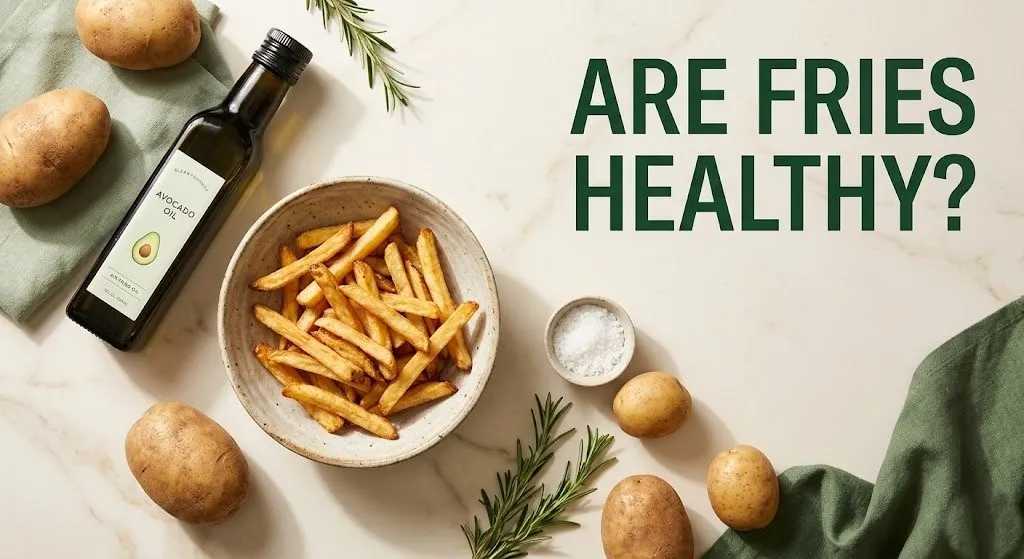
Fries are conditionally healthy depending on the potato type, cooking oil, frying temperature, and portion size. A plate of heavily salted, deep-fried Russet fries from a restaurant that reuses oil repeatedly is a high-calorie, high-glycemic, pro-inflammatory food that should be a rare indulgence. That same potato cut thick, air-fried in fresh avocado oil, and eaten in a modest portion with a balanced meal can be a completely reasonable choice for a healthy adult.
The nutritional baseline for a standard 3-ounce fast-food french fry serving sits at roughly 300 calories, 15 grams of fat, and 30 grams of carbohydrate. That small cardboard sleeve also delivers about 250 to 400 milligrams of sodium before you add a single salt packet. The problem is rarely the potato itself. It is the concentration of rapidly digestible starch, the degraded frying fat, and the sodium load delivered in a form engineered to override your natural satiety signals.
Research from the Harvard T.H. Chan School of Public Health has repeatedly identified frequent fried potato consumption as one of the dietary factors most strongly associated with long-term weight gain and cardiometabolic risk. The American Heart Association classifies deep-fried foods as a category to limit for heart health. What matters is the word “frequent.” Context, frequency, and preparation transform the answer from a hard no to a qualified yes.
| Fry Variable | Health-Damaging Version | Health-Supportive Version |
|---|---|---|
| Potato Type | Starchy Russet Burbank | Waxy or all-purpose like Yukon Gold |
| Oil Type | Repeatedly heated soybean oil blend | Fresh avocado oil or high-oleic sunflower oil |
| Cooking Method | Deep frying at 350°F+ | Air frying or convection baking |
| Portion | Large fast-food serving (150g+) | Measured 85g (3 oz) side portion |
Key Takeaway: Fries exist on a health spectrum, and three specific variables—potato type, oil freshness, and portion size—determine where your plate lands on that spectrum.
is french fries healthy
The french fry, in its classic deep-fried restaurant form, is not healthy when eaten regularly. The combination of rapidly absorbed starch from starchy potatoes and degraded, pro-inflammatory frying oil creates a food with a high glycemic load and a fat profile that can promote oxidative stress and inflammation when consumed multiple times per week.
A 2023 analysis in the American Journal of Clinical Nutrition confirmed that frequent fried food consumption, with french fries as the dominant contributor, correlates with increased all-cause mortality risk. The mechanism involves more than just calories. Industrially fried potatoes contain lipid oxidation products and advanced glycation end-products (AGEs) formed when starches and fats are heated together at high temperatures. These compounds trigger inflammatory pathways that are absent in boiled or baked potatoes.
The fast-food french fry also represents one of the most successful examples of engineered hyperpalatability. The precise ratio of fat, salt, and crispy starch texture hits what food scientists call the “bliss point,” making a standard serving size feel unsatisfying. Your brain registers the combination as so rewarding that stopping at 10 fries genuinely requires more conscious effort than stopping at 10 boiled potato wedges. That is not a moral failing. It is food chemistry working exactly as designed.
| Nutrient | Small Fast-Food Fry (85g) | Medium Baked Potato (173g) |
|---|---|---|
| Calories | 265 | 161 |
| Total Fat | 13g | 0.2g |
| Saturated Fat | 2.5g | 0.1g |
| Sodium | 180mg | 17mg |
| Fiber | 3.2g | 3.8g |
| Potassium | 490mg | 926mg |
can french fries be healthy
French fries can be healthy when you change the cooking method, control the oil, and treat them as an occasional side dish rather than a dietary staple. The switch from deep frying to air frying or convection baking eliminates the massive oil absorption that turns a 110-calorie potato into a 400-calorie pile of fried starch.
The potato itself brings real nutritional value to the table. A medium Russet potato contains 4 grams of fiber, more potassium than a banana, and about 30 percent of your daily vitamin C requirement. Deep frying does not erase those nutrients, but it dilutes them in a flood of degraded oil. When you bake or air fry a potato with just a tablespoon of avocado oil brushed on the surface, you keep the nutrient-to-calorie ratio favorable.
The “healthy” version also depends on what else is on your plate. Pairing fries with a lean protein source and a generous serving of non-starchy vegetables changes the metabolic impact of the entire meal. The fiber and protein slow gastric emptying, blunting the blood sugar spike that would occur if you ate the fries alone or with a sugary soda. In that context, even restaurant fries become less of a metabolic stressor, though they remain a high-calorie addition.
Quick Tip:
- Blanch potato strips in hot water for 8 minutes before baking to remove surface starch and create a crisp exterior without excess oil.
- Soak cut potatoes in cold water for 30 minutes if you are skipping the blanch step to achieve a similar starch-removal effect.
- Always dry potato strips completely with a clean kitchen towel before adding any oil.
are fries healthy for you
Whether fries are healthy for you depends specifically on your metabolic health, your current diet quality, and your health priorities. For a physically active person with good insulin sensitivity and an otherwise nutrient-dense diet, weekly homemade fries pose a negligible health risk. For someone with prediabetes, high blood pressure, or established heart disease, even modest portions of deep-fried restaurant fries demand more careful consideration.
The sodium content deserves particular attention if you are managing hypertension. A large fast-food fry can deliver over 400 milligrams of sodium, and that is before ketchup, which adds roughly 160 milligrams per tablespoon. The American Heart Association’s 2,300-milligram daily sodium upper limit means a single large fry order consumes nearly 20 percent of your day’s sodium budget. For the nearly half of American adults with elevated blood pressure, that math gets tight quickly.
Your individual response to the high glycemic load of fries also varies. Two people can eat the same portion and have meaningfully different blood sugar responses based on their muscle mass, activity level, and genetic factors. If you wear a continuous glucose monitor, you may see a sharp spike from restaurant fries that homemade baked fries do not produce. That data is more useful than any generalized rule about whether fries are “allowed” in your eating pattern.
| Health Profile | Guidance |
|---|---|
| Physically active, metabolically healthy | 1 to 2 servings of homemade fries per week is reasonable |
| Prediabetes or type 2 diabetes | Strict portion control; only paired with protein and fiber; monitor glucose response |
| Hypertension | Careful with sodium; homemade with salt control preferred |
| Heart disease or high LDL cholesterol | Limit restaurant fries; use high-monounsaturated-fat oils only |
Key Takeaway: The question “are fries healthy for you” has no single answer because your personal metabolic terrain, not the potato, determines the final health impact.
are potato fries healthy
Potato fries are nutritionally a mixed proposition because the base vegetable is genuinely nutritious but the standard preparation method loads it with problematic fats and strips it of water, concentrating the starch calories. The potato plant, Solanum tuberosum, produces tubers that contain quality carbohydrates, vitamin C, potassium, and vitamin B6 when you eat the skin and flesh together.
The trouble starts when you peel the potato. A significant portion of the fiber and a meaningful share of the potassium and vitamin C live in or just beneath the skin. Peeling for fries removes that fiber, which is one of the potato’s best metabolic defenses against rapid starch absorption. The thin matchstick cut that defines a classic french fry also dramatically increases the surface area that absorbs oil compared to a thick-cut wedge or steak fry.
Starch structure matters here more than most people realize. Potatoes contain both amylose and amylopectin starches. Russet Burbank potatoes, the industry standard for fries, are high in amylopectin, which gelatinizes during cooking and becomes rapidly digestible. A waxy potato like the Red Bliss contains more amylose and a different starch granule structure that digests more slowly. Choosing a waxy potato for your homemade fries immediately improves the blood sugar response while keeping everything else about your recipe the same.
| Potato Variety | Starch Type | Glycemic Impact | Best Fry Use |
|---|---|---|---|
| Russet Burbank | High amylopectin | High | Classic thin fries, diner-style |
| Yukon Gold | Medium starch, balanced | Medium | Thick-cut, air-fried wedges |
| Red Bliss | Waxy, high moisture | Lower | Pan-fried home fries, steak fries |
| Purple/Blue varieties | Medium starch, high antioxidants | Medium | Baked wedges, air-fried |
are steak fries healthy
Steak fries can be a healthier french fry choice compared to thin-cut versions because their lower surface-area-to-volume ratio means they absorb less oil per ounce of potato. A thick, wedge-cut steak fry exposes less cut potato surface to hot oil, resulting in a fry that is more about the potato interior and less about the fried outer shell.
The geometry of a fry directly governs its fat content. Think of it this way: a standard shoestring fry is mostly crust. The Maillard reaction, which creates the golden-brown color and savory flavor, happens at the surface where the starch meets hot oil. A thicker fry delivers more tender, moist potato interior relative to its fried exterior. That interior potato is essentially steamed, not fried, containing the water-soluble vitamins and potassium largely intact rather than displaced by absorbed fat.
Restaurant steak fries are not automatically healthier, however. Many chain restaurants take their thick-cut fries and deep-fry them just as aggressively as thin fries, often at a slightly lower temperature to cook through the larger mass. A steak fry from a casual dining restaurant can still carry 350 to 500 calories per serving. The potential advantage of the shape only materializes when the cooking method and portion are also optimized. Homemade steak fries roasted in the oven with a light olive oil coating genuinely deliver on the lower-fat promise that the shape suggests.
Quick Tip:
- Cut steak fries to a uniform 1-inch thickness for even cooking and the ideal interior-to-crust ratio.
- Parboil thick-cut wedges for 5 minutes, drain, and rough up the edges with a fork before roasting to create crispy surface texture without deep frying.
why are french fries unhealthy
French fries become unhealthy through the combined effects of high-temperature frying, oil degradation, sodium saturation, and the engineered hyperpalatability that encourages overconsumption. The potato itself is not the villain. The industrial frying process transforms a whole, water-rich, fiber-containing vegetable into a calorie-dense, rapidly digestible, and pro-inflammatory food product.
The first mechanism is oil absorption. Potatoes are about 80 percent water before frying. When submerged in 350°F oil, that water instantly turns to steam and escapes, leaving behind empty channels that immediately fill with oil. A fried potato’s fat content jumps from near zero to 15 to 20 percent of its total weight. What had been a 110-calorie medium potato becomes a roughly 400-calorie serving of fries, with the added fat contributing nothing to satiety beyond what the original potato would have provided.
The second mechanism is starch gelatinization. The intense heat breaks down the potato’s starch granules into a form that digestive enzymes can convert to glucose with alarming speed. This creates a high-glycemic food that spikes blood sugar and insulin, promoting fat storage and triggering a subsequent blood sugar crash that can leave you hungry within an hour. The third mechanism is the chemical transformation of the frying oil itself, which develops inflammatory polar compounds and lipid peroxides when heated repeatedly, a topic covered in detail in a later section.
- Rapid fluid loss replaced by degraded oil
- Starch gelatinization enabling a fast blood sugar spike
- Sodium concentration far beyond what the potato naturally contains
- Acrylamide formation from the asparagine-sugar reaction under high heat
- Low satiety despite high calorie density driving passive overconsumption
Key Takeaway: French fries are unhealthy not because of one factor but because frying sets off a cascade of nutritional, chemical, and behavioral changes that transform a whole vegetable into something your body processes like a processed snack.
acrylamide in french fries
Acrylamide is a chemical compound that forms naturally in starchy foods, including french fries, when they are cooked at temperatures above 248°F through a reaction between the amino acid asparagine and reducing sugars. The U.S. Food and Drug Administration (FDA) classifies acrylamide as a probable human carcinogen based on animal studies, and it has issued guidance to the food industry on reducing acrylamide levels in processed foods.
Darker fries contain significantly more acrylamide than lighter golden fries. The Maillard reaction that creates the appealing brown crust and savory flavor is the exact same chemical pathway that produces acrylamide. This creates a direct trade-off between visual and flavor appeal and potential chemical risk. A fry cooked to a deep golden brown can contain two to three times the acrylamide of a pale gold fry from the same batch of potatoes. The FDA recommends frying to a light golden color and avoiding the dark brown, crispy bits for this reason.
You can meaningfully reduce acrylamide formation through specific preparation steps. Soaking raw potato strips in water for 15 to 30 minutes before cooking leaches out some of the surface sugars and asparagine that serve as acrylamide precursors. Blanching in hot water for a few minutes reduces precursor availability even further. Storing potatoes properly also matters. Refrigerating raw potatoes increases their sugar content through a process called cold-induced sweetening, which paradoxically produces more acrylamide upon frying. Store potatoes in a cool, dark pantry instead of the refrigerator.
| Fry Color | Acrylamide Level | Flavor Profile |
|---|---|---|
| Pale gold | Lowest | Mild, less developed crust |
| Golden yellow | Moderate | Balanced, classic fry flavor |
| Deep golden brown | High | Strong roasted notes, crispy |
| Dark brown | Very high | Bitter edge, burnt aftertaste |
french fries glycemic index
French fries have a high glycemic index (GI), typically falling between 70 and 80 depending on the potato variety and cooking method, which classifies them as a high-glycemic food that causes a rapid spike in blood glucose. The Russet Burbank potato, which dominates commercial fry production, has a GI of approximately 77 when deep-fried. That number drops to around 64 for a waxy variety like the Red Bliss prepared the same way.
The glycemic index number tells only part of the story. Glycemic load (GL), which accounts for the actual carbohydrate quantity in a serving, provides a more realistic picture of blood sugar impact. A standard 85-gram serving of fast-food fries delivers roughly 30 grams of available carbohydrate, yielding a glycemic load of about 22 for Russet fries. Anything above 20 is considered a high glycemic load. This means a single side of fries delivers a blood sugar punch comparable to drinking a 12-ounce regular soda, though the fries at least contribute some fiber and micronutrients alongside the carbohydrate.
An interesting nutritional hack exists for fries, though it requires planning ahead. Cooking and then cooling potatoes forms retrograded resistant starch, a type of carbohydrate that resists digestion in the small intestine and ferments in the colon like fiber. Reheating previously cooked and cooled fries reduces the glycemic response compared to freshly fried potatoes. The effect is not dramatic enough to turn fries into a low-glycemic food, but it shifts the glucose curve in a favorable direction for anyone tracking their blood sugar.
Quick Tip:
- Cook fries until fully done, cool completely in the refrigerator for at least 12 hours, then reheat in an air fryer or oven to recrisp.
- A tablespoon of vinegar-based dressing on a side salad consumed before your fries can reduce the post-meal blood sugar spike by 20 to 30 percent according to research from Arizona State University.
deep frying oil degradation
Deep frying oil degradation refers to the chemical breakdown of cooking oil that occurs when it is repeatedly heated to frying temperatures, producing polar compounds, polymers, and oxidized fatty acids that can promote inflammation when consumed regularly. A restaurant deep fryer at 6 p.m. on a Friday evening contains oil that is chemically distinct from the fresh oil that filled the vat that morning.
The three primary degradation reactions are hydrolysis, oxidation, and polymerization. Hydrolysis occurs when water from the potatoes splits triglyceride molecules, producing free fatty acids that lower the oil’s smoke point and create off-flavors. Oxidation happens when oxygen attacks unsaturated fatty acids, generating lipid peroxides and aldehydes that give rancid oil its characteristic smell and have been linked to cellular damage. Polymerization causes oil molecules to bind together into larger compounds that increase oil viscosity, making the oil cling more thickly to the fry surface and increasing the final fat content of the food.
Fast-food chains manage this process with filtration systems and frequent oil turnover, but the oil in a heavily used fryer still undergoes significant chemical changes over a shift. Independent restaurants with less rigorous oil management protocols can serve fries cooked in oil with substantially higher levels of total polar compounds, which the European Food Safety Authority identifies as the most reliable marker of frying oil quality. Homemade fries fried in a single batch of fresh oil avoid this entire category of concern, which is one of the strongest arguments for making your own.
| Oil Condition | Total Polar Compounds | Health Implications |
|---|---|---|
| Fresh, first use | Below 5 percent | Minimal oxidative stress concern |
| After 4 to 6 frying cycles | 12 to 15 percent | Increased inflammatory markers observed in animal models |
| Heavily degraded (8+ hours continuous use) | Above 25 percent | Regulated as unfit for use in several European countries |
Key Takeaway: The oil your fries swim in matters as much as the potato, and restaurant oil at peak service hours has already undergone chemical changes that homemade fry oil has not.
are sweet potato fries healthier than regular fries
Sweet potato fries offer more beta-carotene, vitamin A, and vitamin C than white potato fries, but they are not automatically healthier when deep-fried in the same degraded restaurant oil. The nutritional upgrade is real on the vitamin front but negligible on the fat and calorie front unless you also change the cooking method and oil.
A sweet potato delivers over 400 percent of your daily vitamin A requirement in a single medium root, primarily as beta-carotene, the pigment that gives orange sweet potatoes their color. White potatoes contain essentially zero vitamin A. Sweet potatoes also bring a slightly higher fiber content and a lower glycemic index of around 54 when baked, compared to a Russet potato’s 78. That glycemic advantage shrinks when both are deep-fried because the fat absorption slows gastric emptying and compresses the blood sugar differences between the two root vegetables.
The trap many people fall into is ordering sweet potato fries at a restaurant and assuming they have made a meaningfully healthier choice. They have made a marginally healthier choice, but a large order of restaurant sweet potato fries still carries 400 to 500 calories and 20 to 25 grams of fat, nearly all of it from the same degraded frying oil used for the regular fries. The vitamin A bonus is genuine and worth appreciating, but it does not cancel out the metabolic impact of the fat, sodium, and acrylamide load. Treat sweet potato fries as a slightly upgraded alternative, not a health food free pass.
| Nutrient per 100g | Sweet Potato Fries (Baked) | White Potato Fries (Baked) |
|---|---|---|
| Calories | 155 | 172 |
| Vitamin A (RAE) | 1,920 mcg | 0 mcg |
| Vitamin C | 19 mg | 12 mg |
| Fiber | 3.8 g | 2.9 g |
| Potassium | 475 mg | 520 mg |
| Fat (with 1 tbsp oil) | 7 g | 7 g |
is homemade fries healthy
Homemade fries can be healthy because you control the oil type, the oil quantity, the cooking temperature, and the portion size, four variables that collectively determine whether a fry is a nutritional problem or a reasonable side dish. A homemade fry made from a waxy potato, cut thick, air-fried or baked with a measured tablespoon of avocado oil, and seasoned lightly with salt contains roughly 190 to 230 calories and 7 to 10 grams of heart-healthy monounsaturated fat per serving. That nutritional profile fits comfortably into almost any balanced eating pattern.
The full control over oil freshness cannot be overstated. Every batch of homemade fries starts with oil that has not spent hours oxidizing at high heat. You eliminate the polar compounds, the polymerized oil residues, and the lipid oxidation products that make restaurant fries a different chemical product from your kitchen fries. That single variable may matter more for long-term health than whether you used a white potato or a sweet potato.
You also control the finishing salt. A homemade batch allows you to season before cooking, which develops flavor with far less sodium than the post-fry salt dump that fast-food workers apply. Restaurant fries get a heavy exterior salt coating because the salt has no time to integrate. When you toss raw potato strips with salt and oil before roasting, the salt dissolves partially into the potato surface moisture, distributing flavor more efficiently with roughly half the total sodium.
- Use a measured 1 tablespoon of oil per medium potato to prevent accidental over-oiling.
- Salt before cooking for flavor integration with less total sodium.
- Cook at 425°F to achieve browning without the extended high-heat exposure that maximizes acrylamide.
- Store leftover fries in a single layer in the refrigerator, then reheat in an air fryer for a lower-glycemic leftover.
are air fried french fries healthy
Air-fried french fries are a health-supportive alternative to deep-fried fries because the method uses rapid hot air circulation to create a crisp exterior with just a fraction of the oil, reducing the final fat content by 60 to 75 percent compared to deep-fried versions. An air fryer is essentially a compact convection oven optimized for high-velocity air movement around the food. It dehydrates the potato surface quickly, setting a crust without submerging the food in fat.
The calorie savings are substantial and verifiable. A 100-gram serving of deep-fried fries absorbs roughly 15 to 18 grams of oil, adding 135 to 160 calories from fat alone. The same potato cut air-fried after being tossed with 5 grams of oil absorbs effectively no additional fat during cooking. The final product delivers the same potato nutrients with about 80 to 100 fewer calories from fat, saving you roughly 1,000 calories per month if you eat fries weekly.
Texture is the trade-off. An air fryer does not perfectly replicate the shatteringly crisp, oil-bathed crust of a deep-fried shoestring fry. What it produces is a satisfyingly crisp exterior with a fluffy interior, closer to a very good oven fry than a fast-food fry. The texture gap continues to narrow as air fryer technology improves, with 2026 models offering more even airflow and better browning. For the nutritional upgrade, most people find the texture difference completely acceptable, especially when the fries are properly blanched and dried before cooking.
| Method | Calories per 100g | Fat | Texture Result |
|---|---|---|---|
| Deep frying (restaurant) | 290 to 310 | 16 to 18g | Uniformly crisp, rich |
| Air frying (1 tsp oil) | 165 to 180 | 5 to 6g | Crisp exterior, fluffy interior |
| Oven baking (1 tsp oil) | 170 to 185 | 5 to 6g | More variable browning |
Key Takeaway: The air fryer earns its reputation as the single most impactful appliance upgrade for making genuinely healthier fries that still satisfy the crunch craving.
are baked fries healthy
Baked fries are a healthy preparation method when done correctly because they absorb minimal oil, avoid the chemical degradation products of deep frying, and preserve more of the potato’s water-soluble vitamins. The challenge has always been texture. A properly baked fry that is actually crisp requires more technique than throwing potato sticks onto a sheet pan with oil and hoping for the best.
The essential technique for crisp baked fries involves a sequence of starch management steps. Soaking the cut potatoes in hot water for 10 minutes removes surface starch that would otherwise gelatinize into a gummy layer during baking. Thorough drying afterward is non-negotiable. Any surface moisture steams the potato instead of crisping it. A light coating of oil plus cornstarch creates a thin batter-like layer that browns and crisps in the high dry heat of the oven. Spreading the fries in a single layer with space between each piece allows the oven’s hot air to circulate, carrying moisture away from the potato surface.
Baking at 425°F hits the sweet spot between browning and acrylamide control. Higher temperatures speed browning and crisping but accelerate acrylamide formation. Lower temperatures produce oven-dried potatoes without the crisp exterior. A 25-to-30-minute bake time at 425°F with a flip at the 15-minute mark produces evenly golden, crisp-edged fries that contain no degraded frying oil, minimal acrylamide, and all of the potato’s intrinsic nutritional value.
To make crisp baked fries:
- Preheat oven to 425°F and place a heavy sheet pan in the oven during preheating.
- Cut potatoes into 1/2-inch batons and soak in hot tap water for 10 minutes.
- Drain, rinse, and dry completely with a clean kitchen towel until no surface moisture remains.
- Toss with 1 tablespoon oil and 1 teaspoon cornstarch per medium potato until evenly coated.
- Spread in a single layer on the preheated hot sheet pan with space between each fry.
- Bake 25 to 30 minutes, flipping once at the 15-minute mark, until golden and crisp.
healthiest oil to fry french fries
The healthiest oil for frying french fries is an oil with a high smoke point, a fatty acid profile dominated by monounsaturated fat, and high oxidative stability, making avocado oil the top choice, followed closely by high-oleic sunflower oil and refined olive oil. These oils resist the heat-induced oxidation that generates inflammatory compounds in the fryer far better than the polyunsaturated fat-rich soybean and corn oil blends used by most fast-food chains.
Oxidative stability determines how well an oil holds up structurally when held at 350°F to 375°F for extended periods. Polyunsaturated fats contain multiple double bonds in their fatty acid chains, and those double bonds are chemically vulnerable to oxygen attack at frying temperatures. An oil high in linoleic acid, an omega-6 polyunsaturated fat, degrades faster than an oil high in oleic acid, a monounsaturated fat with only one double bond. That degradation produces the compounds that give used frying oil its sharp, paint-like smell and pro-inflammatory character.
Refined avocado oil offers a smoke point of 500°F, well above standard frying temperatures, with an oleic acid content of roughly 70 percent. High-oleic sunflower oil, bred specifically for frying stability, delivers comparable performance at a lower price point. Refined olive oil, distinct from extra-virgin olive oil, has a mild flavor and a 465°F smoke point, making it suitable for frying without the strong olive flavor that would clash with ketchup. These three oils turn homemade frying into a chemically stable process instead of the oxidative stress generator that commercial fryers represent.
| Oil | Smoke Point | Monounsaturated Fat | Polyunsaturated Fat | Frying Stability |
|---|---|---|---|---|
| Avocado oil (refined) | 500°F | 70% | 13% | Excellent |
| High-oleic sunflower oil | 450°F | 84% | 4% | Excellent |
| Refined olive oil | 465°F | 73% | 11% | Very good |
| Soybean oil | 450°F | 23% | 58% | Moderate |
| Unrefined coconut oil | 350°F | 6% | 2% | Poor (smoke point too low) |
what is a healthy portion of french fries
A healthy portion of french fries is roughly 85 grams, or about 3 ounces, which amounts to approximately 12 to 15 standard-cut fries or a small fast-food fry order. That serving delivers around 230 to 265 calories and 11 to 13 grams of fat in a fast-food context, or significantly less if baked or air-fried at home. The USDA MyPlate guidelines, which recommend that half your plate consist of vegetables and fruit and only one quarter be starch, reinforce treating fries as a small side, not a plate-filling main component.
Visual calibration helps more than weighing your food in a restaurant. A healthy portion of fries fits in one cupped hand for most adults. It occupies roughly a quarter of a standard dinner plate rather than spilling across half of it. The large fry orders common at fast-food chains often deliver 150 to 180 grams, nearly double the reasonable serving, and pushing 500 calories before any dipping sauce enters the picture. The small size is almost always the correct choice unless you are splitting a medium with someone and your meal is otherwise vegetable-forward.
Portion control with fries is harder than with most foods because of their engineered hyperpalatability. Eating 10 fries creates a stronger urge to eat 10 more than eating 10 baby carrots does. This means external portioning, plating what you intend to eat and putting the rest away, works better than relying on internal fullness signals. Decide on your portion before the fries hit your plate, and do not eat directly from a shared basket or large container that removes the visual stop signal of an empty plate.
Quick Tip:
- Order the smallest size available when eating out, or split a medium fry across two meals.
- Plate your fries on a separate small dish rather than piling them next to your main meal, which reduces automatic consumption by an average of 20 percent according to Cornell Food Lab research.
what to eat with fries to make it healthy
Pairing fries with a lean protein, a generous serving of non-starchy vegetables, and a fat source that is not degraded frying oil creates a metabolically balanced meal that blunts the blood sugar spike and increases satiety. The goal is to surround the fast-digesting starch and fat with fiber, additional protein, and water-rich vegetables that slow gastric emptying and moderate the insulin response.
Grilled chicken breast, baked fish, or seasoned black beans provide the protein anchor. A large side salad with a vinegar-based dressing, roasted broccoli, sautéed spinach, or a generous portion of coleslaw made with yogurt instead of mayonnaise delivers the fiber and volume that turn a fry-heavy snack into a complete meal. The vinegar in your salad dressing deserves special attention. Acetic acid in vinegar has been shown to reduce the post-meal blood sugar response by slowing starch digestion, making it an ideal companion to any potato-based side.
What you drink alongside your fries matters almost as much as what you eat with them. A sugary soda compounds the blood sugar problem by adding liquid fructose to an already high-glycemic meal, creating a metabolic double hit. Water, unsweetened iced tea, or sparkling water with lemon keeps the meal’s glycemic impact confined to the fries alone. A post-meal walk, even just 10 to 15 minutes, further blunts the blood sugar excursion by directing glucose into working muscles independent of insulin.
- Pair fries with at least 20 grams of lean protein per serving.
- Include a large portion of non-starchy vegetables dressed with vinegar.
- Drink water or unsweetened beverages instead of sugary soda.
- Take a 10-minute walk after eating to improve glucose clearance.
Key Takeaway: Fries do not exist in a nutritional vacuum, and the company they keep on your plate determines more about your metabolic response than the fries themselves.
are frozen french fries healthy
Frozen french fries from the supermarket fall somewhere between fast-food fries and homemade fries on the health spectrum. They are pre-cut, often pre-fried at the factory in oil that may include problematic stabilizers, and designed for convenience rather than nutritional optimization. Some frozen fry products are pre-fried in partially hydrogenated oils, though the FDA’s ban on partially hydrogenated oils has reduced this concern. Always check the ingredient label for “hydrogenated” in any form.
The ingredient list tells you everything you need to know. A clean frozen fry product contains potatoes, oil, and possibly a light coating of modified food starch or rice flour for crispness. A problematic one adds dextrose for browning, sodium acid pyrophosphate to prevent discoloration, dimethylpolysiloxane as an anti-foaming agent, and natural flavors that mask the taste of industrial processing. The best frozen fries have three ingredients or fewer. The rest are engineered food products with a potato substrate.
Frozen fries offer one genuine advantage over restaurant fries. You cook them in fresh oil or, better yet, in an air fryer or oven where the factory-applied par-fry oil is all the additional fat they receive. The chemistry of the final product in your kitchen involves no degraded fryer oil, and you control the finishing salt. A cautious consumer who reads labels and opts for air-fryer reheating can get a convenient, reasonably healthy fry. The person who deep-fries a dextrose-coated, chemically stabilized frozen fry is eating something far closer to a fast-food product.
| Frozen Fry Ingredient Profile | Assessment | Best Cooking Method |
|---|---|---|
| Potatoes, oil, salt (3 ingredients) | Good | Air fryer or oven bake |
| Added modified food starch | Acceptable; improves crispness | Oven bake at 425°F |
| Added dextrose or sugar | Caution; increases browning and acrylamide risk | Lower temperature, monitor color |
| Multiple preservatives and anti-foaming agents | Poor; highly processed food product | Not recommended |
Frequently Asked Questions About French Fries and Health
Are french fries bad for your heart?
Regular consumption of deep-fried restaurant french fries can contribute to heart disease risk through high sodium, degraded frying fats, and calorie excess.
A 2021 study in the journal Heart found that frequent fried food intake was associated with a higher risk of major cardiovascular events.
Homemade fries prepared in fresh, high-monounsaturated-fat oils and eaten occasionally pose a much lower risk for most people.
What is the healthiest way to cook french fries?
Air frying is the healthiest cooking method that still produces a recognizable crispy french fry with minimal added oil.
Baking at high heat with a cornstarch coating achieves a similar nutritional profile with slightly less even browning.
Both methods avoid the oil degradation products and excess fat absorption that define deep frying.
Do french fries have any nutritional value?
French fries retain much of the potassium, vitamin C, and vitamin B6 present in the raw potato, especially when the skin is left on.
A serving of baked fries provides more potassium than a banana and meaningful vitamin C.
These nutrients come packaged with calorie and fat loads that vary dramatically depending on preparation method.
Can I eat french fries and still lose weight?
You can eat french fries and lose weight if you control portions strictly, choose air-fried or baked versions, and account for the calories within your overall intake.
A 85-gram serving of air-fried fries adds roughly 170 calories to your day, which fits into most calorie-restricted eating plans when not accompanied by high-calorie toppings.
The challenge is stopping at one small serving given french fries’ low satiety and high palatability.
Are sweet potato fries always the healthiest choice?
Sweet potato fries are not always the healthiest choice, especially when deep-fried in the same degraded oil as regular fries.
They provide more vitamin A and slightly more fiber, but the fat and calorie differences disappear when both are restaurant deep-fried.
A baked sweet potato fry made at home with controlled oil is a genuinely healthier alternative to a fried white potato fry.
Your relationship with fries should not be built on guilt or restriction. It should be built on enough knowledge to know when a fry is a potato side dish and when it has become something your body does not recognize as food. The potato itself is a nutritious whole food. Deep frying in degraded oil removes it from that category. Air frying, baking, and home preparation with stable oils bring it back.
Make the fries that you actually enjoy but choose your method and your moment. A pile of hot, crisp, golden fries on a plate with grilled fish and a sharp, vinegary salad after a long week is not a dietary failure. It is a meal with a rhythm that makes sense. The same fries eaten mindlessly from a paper sleeve in a car three times a week is a pattern worth rethinking.
Walk away from this article knowing that the best fry in 2026 is thick-cut, air-fried in avocado oil, lightly salted, and eaten in reasonable company on a plate full of color. That is not deprivation. That is good cooking informed by good science.