A healthy tooth extraction site begins with a stable blood clot that fills the empty socket. The right foods, eaten at the right temperature and in the right way, protect that clot while delivering the nutrients your gum tissue needs to close the wound.
The American Association of Oral and Maxillofacial Surgeons confirms that most post-extraction complications, including dry socket, are linked to what patients eat and drink in the first 72 hours. This is not just about avoiding the wrong foods. It is about actively choosing foods that supply the building blocks for new tissue: protein, vitamin C, zinc, and vitamin A.
This article walks you through exactly what a healing socket should look like at each stage, paired with the safe foods, soft recipes, and eating techniques that match that stage. You will find a day-by-day visual and dietary guide, a no-straw smoothie method, pureed soup recipes, and clear answers on when you can eat normally again.
What Is a Healthy Tooth Extraction Site?
A healthy tooth extraction site is an open socket in the gum and jawbone that has filled with a stable, dark red blood clot. That clot is the foundation for all healing that follows.
The blood clot serves three functions. It stops active bleeding. It protects the underlying bone and nerve endings from air, food particles, and bacteria. It provides a scaffold for granulation tissue, the new connective tissue that fills the socket from the bottom up over the following days and weeks. Without an intact clot, the bone is exposed. That is dry socket, and it is the most common and painful post-extraction complication.
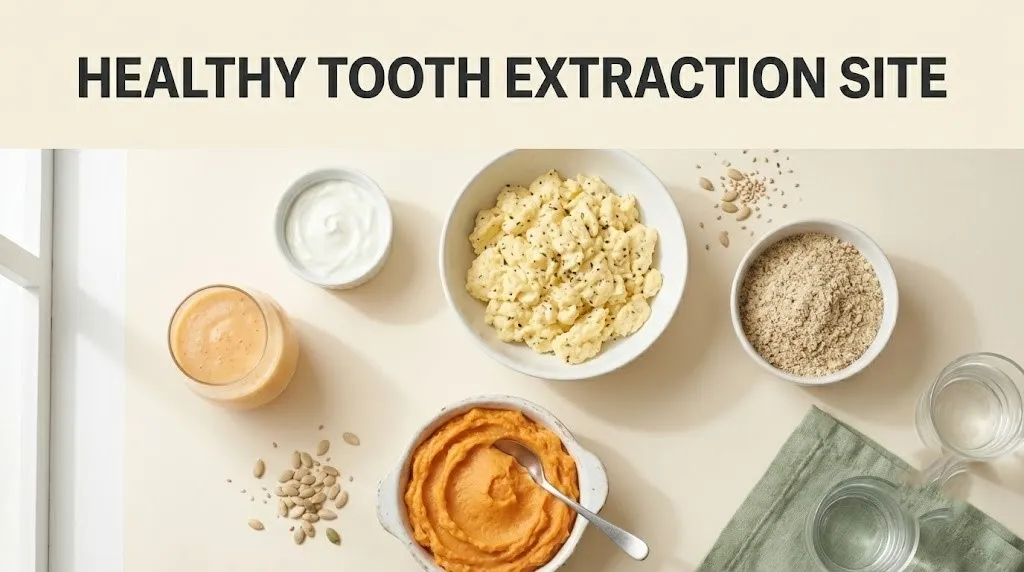
Visual signs of a normal, healthy site include a dark red or maroon clot visible in the socket. The surrounding gum tissue may appear slightly swollen and pink or reddish. A small amount of oozing blood tinting the saliva pink is normal for the first 24 hours. Bright red, active bleeding that fills the mouth quickly is not normal and requires immediate attention from the treating dentist or oral surgeon.
| Normal Sign | What It Means | When to Call Your Provider |
|---|---|---|
| Dark red clot in socket | Stable clot protecting bone | No call needed |
| Pink-tinged saliva for 24 hours | Normal minor oozing | If bright red or heavy bleeding continues |
| Mild swelling of gum tissue | Inflammatory healing response | If swelling increases after day 3 |
| White or yellow film over clot | Fibrin and healing tissue, not pus | If accompanied by fever or foul taste |
The first 24 hours are the most critical for clot stability. Every food choice, every sip of liquid, and every movement of your mouth affects whether that clot holds.
What Does a Healthy Tooth Extraction Look Like Day by Day?
A healthy tooth extraction site changes appearance daily. Understanding the visual stages prevents unnecessary panic and helps you spot a genuine problem early.
Day 1: The socket is filled with a dark red or maroon blood clot. The gum edges may look raw or have visible sutures. Expect pink-tinged saliva and mild swelling. The clot surface should appear slightly concave, sitting just below the gumline.
Day 2 to 3: The clot begins to organize. It may appear darker, almost black at its center, which is normal clotted blood. A thin whitish film may start to form over the clot. This is fibrin, a protein involved in clotting and tissue repair. It is not pus. Swelling typically peaks around day 2 or 3 before beginning to subside.
Day 4 to 7: Granulation tissue, which looks like small, red, bumpy tissue, begins to grow from the base of the socket upward. The clot may appear smaller as this new tissue fills in from the bottom. Sutures, if placed, may begin to loosen or dissolve. The whitish fibrin layer may become more prominent.
Week 2 to 4: The socket edges smooth out as gum tissue, called epithelium, grows over the top from the edges inward. The opening visibly shrinks. By week 4, the socket should appear as a small indentation rather than a deep hole.
Month 1 to 6: The underlying bone remodels and fills the socket completely. The gum surface flattens out. Full bone healing takes 4 to 6 months, but the site looks closed and smooth well before that.
Key Takeaway: A healthy socket transitions from a dark clot to a whitish fibrin-covered surface to pink, bumpy granulation tissue before closing completely over weeks.
What Should a Healthy Tooth Extraction Look Like Compared to Dry Socket?
The difference between a healthy tooth extraction site and a dry socket is visible and symptomatic. Knowing what to look for helps you decide whether to ride out the discomfort or call your dentist immediately.
A healthy socket contains a visible clot. Pain gradually decreases day by day after the initial 24 to 48 hours of peak soreness. Any pain responds to over-the-counter medication or prescribed pain relief. There is no persistent bad taste or odor.
A dry socket, clinically called alveolar osteitis, occurs when the blood clot dislodges or dissolves before the socket has healed. The exposed bone is visible as an empty-looking socket. The walls of the socket may appear white, which is bare bone. Pain is the defining symptom: sharp, throbbing, radiating to the ear or temple, and poorly responsive to standard pain medication. A bad taste or unpleasant breath is common.
| Feature | Healthy Healing Socket | Dry Socket (Alveolar Osteitis) |
|---|---|---|
| Clot visibility | Dark red clot present | Empty socket, bone visible |
| Pain level | Decreasing after day 2 | Increasing, severe, radiating |
| Pain response | Responds to medication | Poor response to standard meds |
| Taste or odor | Neutral | Foul taste, bad breath |
| Timing of onset | Gradual improvement | Typically days 3 to 5 post-extraction |
According to the American Association of Oral and Maxillofacial Surgeons, dry socket occurs in roughly 2 to 5 percent of routine extractions. The rate jumps to 20 percent or higher for impacted wisdom teeth. The biggest modifiable risk factors are smoking, straw use, spitting forcefully, and eating hard or crunchy foods within the first week.
Healthy Tooth Extraction Site Day 2: What to Expect
Day 2 after a tooth extraction is typically when swelling peaks. The healthy tooth extraction site on day 2 should show a stable clot, and your food choices become slightly more flexible but still require careful attention.
The clot on day 2 appears darker and more organized than on day 1. The edges of the gum may look white or yellow where fibrin is accumulating. This is a normal part of the wound-healing process. Your jaw may feel stiff, a condition called trismus. This stiffness makes chewing difficult, which is why food texture remains important.
Pain on day 2 can be significant. The local anesthesia from the procedure has long worn off. Take any prescribed or recommended pain medication about 30 minutes before you plan to eat. This makes the eating experience less miserable and allows you to get adequate nutrition. Skipping meals on day 2 because of pain delays healing.
The food strategy for day 2 centers on cold and room-temperature items that require zero chewing. Cold foods help constrict blood vessels and may reduce swelling. The suction risk from a straw still applies. Drink directly from a cup or use a spoon.
Foods safe for day 2 include:
- Plain Greek yogurt, cold from the refrigerator
- Chilled applesauce, no added sugar
- Cold pureed soup, such as carrot or butternut squash
- Smooth, runny hummus eaten with a spoon
- Cold protein shakes, drunk from a cup
- Mashed avocado, lightly salted and thinned with a little water
Healthy Tooth Extraction Site Day 3: The Healing Progression
By day 3, the healthy tooth extraction site should show early signs of tissue repair. The clot remains in place, and a more substantial whitish fibrin network covers it. Swelling typically begins to decrease, though some puffiness may persist.
Day 3 is a transition point for food. You are likely tired of cold liquids and yogurt. The wound is not yet stable enough for chewing, but warm, soft foods can be introduced at a lukewarm temperature, never hot. Heat dilates blood vessels and can restart bleeding or dissolve the clot.
The granulation tissue that forms the foundation of new gum tissue needs nutritional support. Protein intake becomes more important starting around day 3. The Academy of Nutrition and Dietetics notes that wound healing increases protein requirements. Aim for 1.2 to 1.5 grams of protein per kilogram of body weight during active healing. For a 150-pound person, that means roughly 82 to 102 grams of protein daily.
Soft, warm protein sources appropriate for day 3:
- Soft scrambled eggs, cooked gently with no browning, cooled to lukewarm
- Smooth cottage cheese, allowed to come to room temperature
- Pureed lentil soup, strained if necessary, served warm not hot
- Smooth bone broth with collagen protein, sipped from a mug
- Warm, thinned oatmeal made with milk for added protein
Quick Tip:
- Test the temperature of every food against your inner wrist, just like you would test a baby bottle. If it feels more than slightly warm, let it cool further.
- Continue eating on the opposite side of your mouth from the extraction site.
- Rinse gently with warm salt water after eating, but do not swish forcefully. Let the water fall out of your mouth rather than spitting.
Key Takeaway: Day 3 allows warm, soft foods. Prioritize protein to support the granulation tissue forming in the socket, and keep everything lukewarm.
Healthy Wisdom Tooth Extraction Site: What Is Different?
A healthy wisdom tooth extraction site follows the same healing principles as any other tooth socket but involves a larger wound, deeper bone involvement, and typically more post-operative swelling and discomfort. The food strategy needs adjusting.
Wisdom teeth, especially impacted ones, sit deep in the jawbone. The extraction site is larger and may involve a surgical flap, meaning the gum was cut and folded back to access the tooth. Sutures are almost always placed. The American Association of Oral and Maxillofacial Surgeons reports that wisdom tooth extractions carry a higher risk of dry socket, so dietary caution must extend longer.
The eating challenge with wisdom teeth is compounded by location. The extraction site is at the very back of the mouth. Food naturally migrates there during chewing and swallowing. Even careful eating can introduce particles near the wound. This makes smooth, cohesive foods more important for wisdom tooth patients than for those with a front tooth extraction.
Swelling after wisdom tooth removal can cause trismus severe enough that opening the mouth wide enough for a spoon is difficult. Small spoons, like a teaspoon rather than a tablespoon, help. Some patients find that drinking from a cup with a wide mouth is easier than trying to maneuver a spoon past swollen cheeks.
The soft food timeline often extends by 2 to 3 extra days for wisdom tooth extractions compared to simple molar extractions. Chewing may not feel comfortable until day 7 to 10. Plan for a full week of exclusively soft foods, and do not rush back to a normal diet just because a friend recovered faster. Individual surgical complexity and healing speed vary widely.
Tooth Extraction Healing Day by Day: A Visual Timeline
This visual timeline consolidates the healing stages with the corresponding safe food phases. Knowing what your mouth looks like at each stage makes it easier to trust the healing process or recognize when something is off.
| Day | What the Socket Looks Like | What You Can Safely Eat |
|---|---|---|
| Day 1 | Dark red clot, mild oozing, swollen gums | Cold liquids, cold yogurt, cold applesauce. Nothing hot. |
| Day 2 | Dark organized clot, fibrin film starting, swelling peaks | Same as day 1 plus cold pureed soups and thin hummus |
| Day 3 | Clot with whitish fibrin cover, swelling decreasing | Lukewarm scrambled eggs, warm oatmeal, pureed soups |
| Day 4 to 5 | Granulation tissue appearing at base, clot shrinking | Soft pasta, flaked fish, soft tofu, mashed sweet potato |
| Day 6 to 7 | Red bumpy tissue filling socket, sutures loosening | Soft bread without crust, ground meat, steamed vegetables |
| Week 2 | Socket edges smoothing, epithelium growing inward | Most foods if chewed on opposite side, avoid hard or sharp foods |
| Week 3 to 4 | Small indentation remains, gum surface closing | Return to normal diet cautiously, avoid popcorn and nuts until fully healed |
The foods listed at each stage assume normal healing without complications. If you experience increased pain, unusual swelling, or suspect the clot has dislodged, revert to the day 1 food list and contact your oral surgeon or dentist. Continuing to eat as planned with a compromised socket can worsen the problem.
The Best Foods to Eat After Tooth Extraction
The foods that serve you best after a tooth extraction share three qualities: they are soft or liquid, they deliver concentrated nutrition for wound repair, and they can be consumed without suction, chewing, or vigorous mouth movement.
The first 24 hours demand cold foods and liquids. Cold constricts blood vessels and helps stabilize the clot. Yogurt, ice cream without mix-ins, and chilled protein shakes fit this window perfectly. Do not use a straw for any of them. Sip from a cup or eat with a spoon.
After 24 hours, the nutritional priorities shift. Wound healing requires increased protein, vitamin C, zinc, and vitamin A. A 2014 review in the Journal of Oral and Maxillofacial Surgery noted that nutritional deficiencies in these specific nutrients are associated with delayed oral wound healing and increased complication rates. This is not about vague wellness. It is about giving your body the literal building materials it needs.
The best foods to eat, organized by healing function:
- Protein for tissue repair: Greek yogurt, cottage cheese, scrambled eggs, soft tofu, smooth hummus, pureed chicken, bone broth
- Vitamin C for collagen synthesis: Pureed strawberries, mashed sweet potato, smooth mango puree, diluted orange juice (no pulp)
- Zinc for cell division and immune function: Smooth pumpkin seed butter, pureed chickpeas (hummus), yogurt
- Vitamin A for epithelial tissue: Mashed sweet potato, pureed carrots, pureed butternut squash, soft scrambled eggs
- Healthy fats for reduced inflammation: Mashed avocado, smooth almond butter, olive oil stirred into pureed soups
Complete Soft Foods List After Tooth Extraction
A comprehensive soft foods list removes the guesswork when you are tired, hungry, and standing in front of an open refrigerator wondering what is safe. This list is organized by meal type and includes preparation notes.
This list applies to the first 5 to 7 days after extraction. Individual healing speed varies. Your oral surgeon or dentist can advise on when to advance your diet based on your specific procedure.
| Meal | Soft Foods | Preparation Notes |
|---|---|---|
| Breakfast | Scrambled eggs, Greek yogurt, cottage cheese, oatmeal, cream of wheat, smoothie bowl, applesauce | Cook eggs soft with no browning. Cool oatmeal to lukewarm. No granola or nuts. |
| Lunch | Pureed soup, hummus, avocado mash, tuna salad (finely minced), egg salad, soft tofu, refried beans | Strain soups if fibrous. Serve at room temp or lukewarm. |
| Dinner | Mashed potatoes, pureed squash, soft polenta, flaked poached salmon, ground turkey, soft pasta, risotto | Overcook pasta slightly for extra softness. No tomato seeds or skins. |
| Snacks | Pudding, gelatin, ice cream (no mix-ins), smooth nut butter, banana, protein shake, meal replacement drink | No crunchy snacks. No chips, crackers, or popcorn. |
| Beverages | Water, milk, plant milk, bone broth, herbal tea, diluted juice, protein shakes, meal replacement drinks | No carbonation. No alcohol. No straws. Nothing hot for 48 hours. |
Foods that seem soft but are problematic include: rice that can lodge in the socket, oatmeal with coarse seeds, chunky nut butter, bread with crust, and any food that breaks into sharp shards like chips or crackers.
Key Takeaway: If you have to ask whether a food is safe, err on the side of waiting another day or two. No single meal is worth a dry socket.
Key Vitamins That Speed Up Wound Healing After Oral Surgery
Wound healing in the mouth depends on specific vitamins that orchestrate collagen formation, new blood vessel growth, and immune defense against infection. The extraction socket is a healing wound like any other, and it responds to the same nutritional inputs.
Vitamin C, known formally as ascorbic acid, is the most critical nutrient for oral wound healing. It is a required cofactor for collagen synthesis. Collagen is the structural protein that forms granulation tissue and eventually closes the socket. The NIH Office of Dietary Supplements sets the Recommended Dietary Allowance for vitamin C at 75 to 90 milligrams daily for adults. During wound healing, some researchers suggest that needs may be higher, though no official wound-healing RDA exists. A single cup of pureed strawberries supplies about 90 milligrams. A cup of mashed sweet potato delivers about 22 milligrams alongside vitamin A.
| Vitamin | Role in Wound Healing | Post-Extraction Food Sources | RDA for Adults |
|---|---|---|---|
| Vitamin C | Collagen synthesis, antioxidant | Pureed strawberries, mango, sweet potato | 75 to 90 mg |
| Vitamin A | Epithelial tissue formation | Sweet potato, carrot, scrambled egg | 700 to 900 mcg RAE |
| Vitamin K | Blood clotting, bone metabolism | Pureed spinach, kale in smoothies | 90 to 120 mcg |
| Zinc | Protein synthesis, immune function | Yogurt, pumpkin seed butter, hummus | 8 to 11 mg |
Vitamin A supports the formation of epithelial cells, the type that eventually covers the wound. Vitamin K plays a role in the clotting cascade that forms the initial blood clot. A diet that was adequate in these nutrients before surgery supports better outcomes. Correcting a deficiency after surgery takes too long to affect the acute healing window.
How Protein and Amino Acids Repair Extraction Tissue
The extraction socket heals by filling with new tissue built from protein. Granulation tissue, the early healing tissue that appears as red bumpy growth, is mostly collagen. Collagen is constructed from amino acids, specifically glycine, proline, and hydroxyproline. Without enough dietary protein, the body cannot build this scaffold efficiently.
The Academy of Nutrition and Dietetics recommends that adults recovering from surgery or wounds consume 1.2 to 1.5 grams of protein per kilogram of body weight. For a 150-pound person, that is 82 to 102 grams daily. This is higher than the standard 0.8 grams per kilogram for maintenance. The increase is not dramatic, but it matters when eating is already difficult.
Certain amino acids appear to play specific roles in oral healing. Arginine, found in dairy, poultry, and soy, supports blood flow and immune cell function at the wound site. Glutamine, abundant in bone broth and cooked vegetables, fuels the rapidly dividing cells that close the wound.
Practical high-protein soft foods that fit within the post-extraction restrictions:
- 1 cup Greek yogurt: 17 grams protein
- 2 scrambled eggs: 12 grams protein
- 1 cup cottage cheese: 25 grams protein
- 1 cup bone broth: 6 to 12 grams protein (varies by brand and preparation)
- 1/2 block silken tofu blended into soup or smoothie: 18 grams protein
- 1 cup whole milk: 8 grams protein
Spreading protein intake across three or four small meals maintains a steady amino acid supply to the healing socket. A single high-protein meal is less effective than consistent intake.
Key Takeaway: Healing a tooth socket requires more protein than your normal diet. Target 82 to 102 grams daily through soft foods like Greek yogurt, eggs, and pureed tofu.
Foods to Avoid After Tooth Extraction and Exactly Why
Certain foods pose specific risks to the extraction site. The reasons are mechanical, thermal, or chemical. Understanding the “why” makes the restrictions easier to remember when you are standing in the kitchen hungry and tempted.
Hard and crunchy foods like chips, nuts, popcorn, and raw vegetables are the most obvious risk. They require significant chewing force and break into sharp fragments that can stab into the healing socket or dislodge the clot. Popcorn hulls are notorious for lodging in extraction sites and causing localized infections.
Hot foods and beverages like coffee, soup fresh off the stove, or hot tea increase blood flow to the oral tissues through vasodilation. In the first 48 hours, this can restart bleeding or dissolve the clot. After 48 hours, warm is safe. Hot is not.
Chewy and sticky foods like caramel, taffy, gum, and even soft bread with a chewy crust create suction as they pull away from teeth. This mechanical tug can lift the clot right out of the socket.
Small, seedy, or granular foods like rice, quinoa, chia seeds, and sesame seeds can pack into the open socket. Once lodged, they are difficult to remove without disturbing the healing tissue. Some seeds can be used if thoroughly ground into a smoothie or soup.
Alcohol and carbonated beverages should be avoided for at least 48 hours. Alcohol interferes with clotting and pain medication. Carbonation creates bubbles that can dislodge the clot. Both are chemical irritants to raw tissue.
Spicy and acidic foods like citrus juice with pulp, tomato sauce, and hot sauce cause stinging and irritation to the raw gum edges. They do not directly cause dry socket but make eating painful.
How to Make Smoothies After Tooth Extraction Without Using a Straw
Smoothies are an ideal post-extraction food. They are cold, nutrient-dense, and require zero chewing. The problem is that everyone instinctively reaches for a straw. That straw creates suction that can dislodge the blood clot in seconds.
The no-straw smoothie method relies on three adjustments: blending to a completely smooth consistency, pouring into a cup or wide-mouth glass, and drinking directly like you would a beverage. A smoothie bowl eaten with a spoon is another option that avoids suction entirely.
To prepare a safe post-extraction smoothie:
- Choose soft, non-fibrous ingredients: banana, Greek yogurt, milk, silken tofu, avocado, cooked and cooled sweet potato, smooth nut butter.
- Avoid seedy or fibrous ingredients: raspberries, blackberries, raw kale stems, chia seeds, flax seeds (unless ground to a fine powder).
- Blend for 60 to 90 seconds, longer than a typical smoothie. The goal is absolute smoothness. Any detectable grit or fiber strand is a risk to the socket.
- Pour the smoothie into a cup. Let it settle briefly so any remaining bubbles dissipate.
- Drink from the cup with your mouth positioned away from the extraction side.
- Rinse your mouth gently with plain water afterward, letting the water fall from your mouth without swishing.
A sample no-straw healing smoothie combines 1 cup plain Greek yogurt, 1/2 cup whole milk, 1/2 ripe banana, 1 tablespoon smooth almond butter, and 1/2 cup cooked, cooled sweet potato. Blend on high until velvety. This smoothie supplies roughly 25 grams of protein, vitamin A, zinc, and healthy fats in a single cup. Approximate calories: 420.
Key Takeaway: Blend smoothies until absolutely silky, pour into a cup, drink directly without a straw, and avoid seedy or fibrous ingredients that could lodge in the socket.
Pureed Soup Recipes That Support Post-Extraction Healing
Pureed soups deliver warmth, hydration, and concentrated nutrition when cold foods become unappealing after a day or two. These recipes are designed to be completely smooth, with no fibrous bits, seeds, or chunks that could threaten the clot.
The critical technique for post-extraction soups is pureeing longer than seems reasonable. An immersion blender should run for a full 2 to 3 minutes. A standard blender should run for at least 90 seconds on high. The finished soup should pass through a fine-mesh strainer if there is any doubt about its smoothness.
Carrot and Ginger Healing Soup
This soup supplies vitamin A from carrots and anti-inflammatory compounds from ginger. The olive oil adds calories when eating whole meals is difficult.
Ingredients:
- 2 pounds carrots, peeled and chopped
- 1 yellow onion, diced
- 1 tablespoon fresh ginger, minced
- 2 tablespoons olive oil
- 4 cups vegetable or chicken broth
- 1/2 cup plain Greek yogurt stirred in after pureeing (optional for protein)
To prepare, sauté the onion and ginger in olive oil until soft, about 5 minutes. Add carrots and broth. Simmer until carrots are fork-tender, about 20 minutes. Puree with an immersion blender until completely smooth. Stir in Greek yogurt after the soup has cooled to lukewarm for added protein. Approximate calories per serving: 180 (without yogurt), 220 (with yogurt).
Butternut Squash and Red Pepper Protein Soup
This soup combines vitamin A from squash with vitamin C from red pepper. Silken tofu adds protein with a neutral flavor.
Ingredients:
- 1 medium butternut squash, peeled and cubed (about 4 cups)
- 1 red bell pepper, seeded and chopped
- 1/2 block silken tofu (about 8 ounces)
- 3 cups vegetable broth
- 1 tablespoon olive oil
- Pinch of salt
To prepare, roast the squash and bell pepper at 400 degrees Fahrenheit for 25 minutes until soft. Transfer to a pot with broth. Simmer 10 minutes. Add silken tofu. Puree until smooth. Serve lukewarm. Approximate calories per serving: 250. Protein: 14 grams.
Quick Tip:
- Both soups freeze well in individual portions. Make a batch before your extraction if possible.
- Add unflavored collagen peptides to any soup for extra wound-healing protein. Stir in after the soup has cooled to warm, not hot.
- If a soup separates after thawing, re-blend briefly before serving.
How to Eat Safely After Tooth Extraction
The mechanics of eating after an extraction are as important as the food itself. Safe eating prevents the clot from dislodging, minimizes food trapping, and keeps you nourished without incident.
Eat on the opposite side of your mouth from the extraction site. This sounds obvious, but food naturally migrates. Tilting your head slightly so the extraction side faces upward while chewing can help gravity keep food on the intact side. For bilateral extractions, such as multiple wisdom teeth removed, eating becomes trickier. Small spoonfuls placed directly on the tongue and swallowed with minimal mouth movement is the safest approach.
Chew slowly and deliberately. You have time. There is no rush to finish a meal. Rapid chewing creates more jaw movement and increases the chance of food veering toward the socket. Post-extraction eating is a slow, mindful activity.
After eating, rinse gently. A warm saltwater rinse, roughly one-half teaspoon of salt dissolved in a cup of warm water, helps keep the socket clean. Do not swish aggressively. Take a mouthful, tilt your head gently from side to side, and let the water fall out of your mouth into the sink. Forceful spitting creates suction. Let gravity do the work.
If food gets stuck in the socket, do not dig at it with a finger, toothpick, or fork. A gentle rinse usually dislodges small particles. Your dentist may provide a curved-tip syringe for irrigation starting around day 5 to 7. Use it exactly as instructed, with gentle pressure. Too forceful a stream can disrupt healing tissue.
Dry Socket Prevention: Food and Eating Tips That Matter
Dry socket is the most common complication after an extraction. Food and eating behaviors are directly responsible for many cases. These practical tips reduce your risk.
The single most important rule: no straws for at least 7 days. The suction generated by a straw, even a gentle sip, is enough to pull a clot from an otherwise stable socket. This applies to smoothies, milkshakes, water, and any other beverage. Drink from a cup or use a spoon.
Avoid spitting for the first 5 days. Brushing your teeth requires an adjustment. Let the toothpaste and saliva drool out of your mouth into the sink rather than spitting. It is inelegant, but it protects the clot.
Smoking is the strongest behavioral risk factor for dry socket. The combination of suction, heat, and nicotine-induced vasoconstriction is a perfect storm for clot loss. The American Association of Oral and Maxillofacial Surgeons strongly advises against smoking for at least 72 hours after extraction, and ideally longer. Nicotine patches avoid the suction but still constrict blood vessels and reduce healing blood flow.
Do not probe the site with your tongue. It is nearly impossible to resist, but your tongue is strong enough to dislodge a fresh clot. Consciously rest your tongue on the roof of your mouth when you are not eating or speaking.
Stay hydrated. A dry mouth creates a more acidic environment and makes the clot more vulnerable. Sip water frequently throughout the day. Dehydration thickens saliva, which can create suction during swallowing.
Key Takeaway: No straws, no spitting, no smoking, and no tongue-probing for at least a week. These four behaviors cause most preventable dry socket cases.
Frequently Asked Questions About Healthy Tooth Extraction and Eating
When can I eat solid food after tooth extraction?
Most people can begin soft solid foods like pasta or flaked fish around day 4 to 5.
Chewy or crunchy solid foods like raw vegetables, chips, and steak should wait until the socket has visibly closed, typically 2 to 3 weeks.
Your dentist can confirm when the site is stable enough based on your specific healing.
What color is a healthy tooth extraction site?
A healthy extraction site begins as a dark red or maroon blood clot in the first 24 hours.
By day 2 to 3, a whitish or yellowish fibrin film forms over the clot, which is normal healing tissue, not pus.
Granulation tissue that follows appears pink or red and bumpy.
How do I know if I have dry socket or just normal pain?
Dry socket pain is severe, throbbing, and radiates to the ear or temple, typically starting around day 3 to 5.
Normal post-extraction pain gradually decreases after day 2 and responds to over-the-counter medication.
A visible empty socket with exposed bone strongly suggests dry socket, and you should contact your dentist immediately.
Can I drink water after tooth extraction?
Yes, drinking water is encouraged starting immediately after the extraction.
Sip gently from a cup. Do not use a straw.
Staying hydrated supports healing and prevents the mouth from becoming dry and acidic.
What happens if food gets stuck in the extraction hole?
Food particles in the socket usually rinse out with a gentle warm salt water rinse.
Do not probe with fingers, toothpicks, or sharp objects, which can damage healing tissue or introduce bacteria.
If gentle rinsing does not work, your dentist can irrigate the socket safely at a follow-up visit.
Healing an extraction socket is a partnership between your body’s natural repair process and the choices you make at every meal. The blood clot needs protection. The new tissue needs protein, vitamin C, and zinc. Your mouth needs rest.
For the next few days, treat food as medicine. Eat the soft scrambled eggs. Sip the lukewarm pureed soup. Blend the smoothie and drink it from a cup. Avoid the crunchy, the hot, the straw-sucked, and the rushed. Your mouth will heal faster and hurt less. In about a week, you will be back to eating normally, and the socket will just be a memory instead of a complication.