A healthy snack box is a curated selection of nutritious, portion-controlled snacks delivered directly to your home or workplace, usually through a subscription. The best ones take the guesswork out of snacking by pre-screening ingredients, managing portion sizes, and often filtering for specific dietary needs.
Snacking is not a minor habit. According to the USDA Dietary Guidelines for Americans, 2020-2025, snacks account for roughly 23% of daily caloric intake for American adults. What you snack on genuinely shapes your overall dietary pattern, your energy levels between meals, and your long-term nutrition.
This guide covers everything you need to evaluate a healthy snack box confidently: what to look for on the nutrition label, which dietary filters actually matter, how delivery subscriptions work, what organic certification means for snacks, and how to calculate whether a subscription box is actually worth the cost compared to buying snacks yourself.
What Is a Healthy Snack Box?
A healthy snack box is a pre-assembled collection of snacks selected based on nutritional criteria, portioned for single servings, and packaged for delivery or retail purchase.
The term “healthy” on a snack box is not federally regulated in the same way that terms like “low sodium” or “reduced fat” are governed by the FDA’s nutrient content claim standards. That distinction matters enormously when you are comparing products.
What separates a genuinely nutritious snack box from a marketing-forward one comes down to the actual Nutrition Facts panel. Look for boxes where individual snack portions contain 3g or more of dietary fiber, 5g or more of protein, less than 8g of added sugar per serving, and fewer than 200mg of sodium per serving. Those thresholds reflect the American Heart Association’s general guidance on daily added sugar and sodium limits scaled to snack-size portions.
Snack boxes come in three broad formats:
- Subscription delivery boxes: Shipped on a weekly, bi-weekly, or monthly schedule directly to your address
- One-time purchase curated boxes: Ordered online without a recurring commitment
- Retail gift-style boxes: Available in specialty grocery stores, online marketplaces, or directly from snack brands
| Box Format | Typical Cost Range | Customization Level | Dietary Filter Options |
|---|---|---|---|
| Subscription delivery | $25 to $55/month | High (ongoing profile) | Usually extensive |
| One-time purchase | $18 to $45 per box | Moderate | Limited |
| Retail gift box | $15 to $60 per box | Low | Minimal |
The subscription model gives you the most nutritional customization but requires a commitment. One-time boxes work well for trying a service before committing to recurring billing.
What Nutrients Should Healthy Snacks Have?
Healthy snacks should provide a meaningful combination of dietary fiber, protein, and healthy unsaturated fats, while keeping added sugar, sodium, and saturated fat within reasonable limits.
The Academy of Nutrition and Dietetics defines a nutritionally useful snack as one that bridges the gap between meals without spiking blood glucose sharply or contributing excessive sodium and added sugar to daily totals. That is a practical standard that can be applied directly to any snack label.
Think of snack nutrition like a three-legged stool. Fiber slows digestion. Protein slows glucose absorption. Healthy fat extends satiety. Pull out any one of those three, and the snack becomes less satisfying and nutritionally thinner.
Here are the specific nutrient benchmarks worth applying per standard snack serving (approximately 28 to 30 grams):
| Nutrient | Goal Per Snack Serving | Why It Matters |
|---|---|---|
| Dietary fiber | 3g or more | Slows digestion, supports satiety |
| Protein | 5g or more | Blunts blood glucose rise, extends fullness |
| Added sugar | Under 8g | Limits energy spikes and dental impact |
| Sodium | Under 200mg | Supports cardiovascular health (AHA guidance) |
| Saturated fat | Under 3g | Limits LDL cholesterol contribution |
| Total fat | Varies; unsaturated preferred | Unsaturated fats from nuts/seeds support heart health |
A study published in the American Journal of Clinical Nutrition found that snacks combining protein and dietary fiber produced greater satiety ratings and lower subsequent meal energy intake compared to snacks high in refined carbohydrates and added sugar.
People managing type 2 diabetes should also pay attention to total net carbohydrates per serving. The American Diabetes Association recommends pairing any carbohydrate-containing snack with a protein or fat source to moderate the glycemic response.
How to Choose the Best Healthy Snack Subscription Box
The best healthy snack subscription box for you is one that matches your specific nutritional benchmarks, accommodates your dietary restrictions, and delivers snacks you will actually eat consistently.
Start with the dietary filter. Before you evaluate any box by brand or price, identify your non-negotiables: nut-free, gluten-free, low sugar, vegan, halal, high protein, or organic. A box that fails your primary dietary requirement is not a good box regardless of how well it scores on everything else.
Next, evaluate the nutrition label policy. The best subscription services display the Nutrition Facts panel for every individual snack in the box before you purchase. If a service does not make per-snack nutrition data available on its website, that is a red flag worth noting.
Key questions to ask before subscribing:
- Does the box show the Nutrition Facts panel for each snack item?
- Is the ingredient list available, not just a product photo?
- What is the average calorie range per snack (a reasonable healthy snack is typically 100 to 200 calories per serving)?
- Are snacks third-party certified for any dietary claim (gluten-free, organic, non-GMO, vegan)?
- What is the cancellation policy for the subscription?
- Does the service offer a customization quiz to match snacks to your dietary profile?
The customization quiz feature is worth weighting heavily. Services that ask about your dietary restrictions, taste preferences, and health goals upfront tend to deliver better nutritional matches than those that send generic curated assortments.
Key Takeaway: A healthy snack box is only as useful as its nutrition transparency. Before subscribing, confirm you can read the full Nutrition Facts panel and ingredient list for every snack it contains.
How Healthy Snack Delivery Works
Healthy snack delivery works through either a recurring subscription model or an on-demand ordering system, with snacks shipped in insulated or standard packaging depending on whether any items require temperature control.
Most subscription snack boxes ship on a 4-week cycle by default, though many services offer bi-weekly or weekly options. Fulfillment is typically handled through a dedicated warehouse rather than a retail store, which means product freshness and packaging quality depend heavily on the service’s supply chain standards.
Temperature-controlled delivery matters if the box includes items like fresh fruit, refrigerated protein snacks, or dark chocolate in warm climates. Standard cardboard box shipping is adequate for shelf-stable items such as nuts, seeds, dried fruit, whole grain crackers, and packaged bars. If you live in a region with summer temperatures regularly above 85°F (29°C), confirm whether the service uses insulated liners or ice packs for temperature-sensitive items.
Delivery timelines vary by geography. Most U.S.-based services ship within 2 to 5 business days for standard shipping. Some services offer expedited options at an additional cost.
Quick Tip:
- Look for services that use recyclable or compostable packaging if sustainability is a priority for you
- Confirm the box ships to your specific ZIP code before entering payment information
- Check whether the service pauses deliveries easily, since life circumstances change and a subscription that is hard to pause tends to become a subscription that gets canceled
Getting Healthy Snacks Delivered to Your Door
Getting healthy snacks delivered to your door has become genuinely practical in 2026, with dozens of services offering nutritionally curated options shipped nationwide.
The logistics differ meaningfully between services. Some curate entirely from established brands you might recognize from specialty grocery stores. Others produce proprietary snack items specifically for their subscription boxes, which can mean better nutritional control but also less familiarity with what you are receiving.
For office deliveries or bulk household orders, several services now offer bulk box formats with 30 to 50 snack servings per shipment rather than the typical 10 to 20 item individual box. These bulk formats reduce per-serving cost and are well suited for households with multiple adults or for office snack programs.
What sets the better home delivery services apart:
- Individual nutrition data displayed per snack before shipment
- Allergen cross-contamination disclosures (not just ingredient lists)
- Flexible delivery scheduling with easy pause or skip options
- Variety rotation so the same items do not repeat in consecutive boxes
- Customer service responsiveness for handling shipping damage or incorrect items
People with severe food allergies should note that many snack production facilities handle multiple allergens, including peanuts, tree nuts, wheat, and soy. A product listed as nut-free may still carry a “may contain tree nuts” advisory if it is produced in a shared facility. Reading both the ingredient list and the allergen statement on every individual snack is the only reliable verification step.
Key Takeaway: Home snack delivery is convenient, but allergen cross-contamination disclosures are not always prominently displayed. Read the full allergen statement on every individual snack, not just the box-level description.
Organic Healthy Snacks for Adults: What the Label Really Means
USDA Organic certification on a snack means the ingredients were grown without synthetic pesticides, synthetic fertilizers, or genetically engineered inputs, and that the product was processed without certain prohibited substances.
It does not automatically mean the snack is nutritionally superior to a non-organic equivalent. A USDA Certified Organic cookie with 18g of added sugar is still a high-sugar snack. The organic label addresses agricultural and processing standards. The Nutrition Facts panel tells you what you are actually eating.
That said, organic certification does carry meaningful implications for specific snack categories. For items like dried fruit and nut butters, where pesticide residues on the source crop are a documented concern, choosing organic provides a measurable reduction in synthetic pesticide exposure. The Environmental Working Group (EWG) publishes annual data on pesticide residues in common produce categories that is relevant when evaluating dried fruit snack components.
| Certification | What It Guarantees | What It Does Not Guarantee |
|---|---|---|
| USDA Organic | No synthetic pesticides or fertilizers; no GMO inputs | Nutritional quality, low sugar, low sodium |
| Non-GMO Project Verified | No genetically engineered ingredients | Organic farming practices, pesticide-free |
| Certified Gluten-Free (NSF or GFFS) | Gluten below 10 to 20ppm depending on certifier | Organic status, nut-free production |
| Vegan Certified | No animal-derived ingredients or by-products | Organic status, allergen-free |
Adults shopping for organic snack boxes should also check whether the entire box is certified organic or whether only some items carry the certification. Box-level “organic” marketing sometimes means a majority of snacks are organic while others are not.
Best Healthy Snacks for Adults at Work
The best healthy snacks for adults at work are ones that require no refrigeration, generate minimal smell, are individually portioned, and provide enough protein and fiber to sustain energy between meals without a sharp glucose crash.
Workplace snacking has a specific set of constraints that home snacking does not. Shared kitchen access is often limited. Refrigeration may not be available at a desk. Strong food smells in open-plan offices are a legitimate social consideration. And the time pressure of a workday means snacks that require preparation beyond unwrapping are less likely to be eaten.
Research published in Nutrients found that mid-morning snacks containing at least 10g of protein were associated with reduced afternoon caloric intake in working adults compared to carbohydrate-only snacks of the same calorie level.
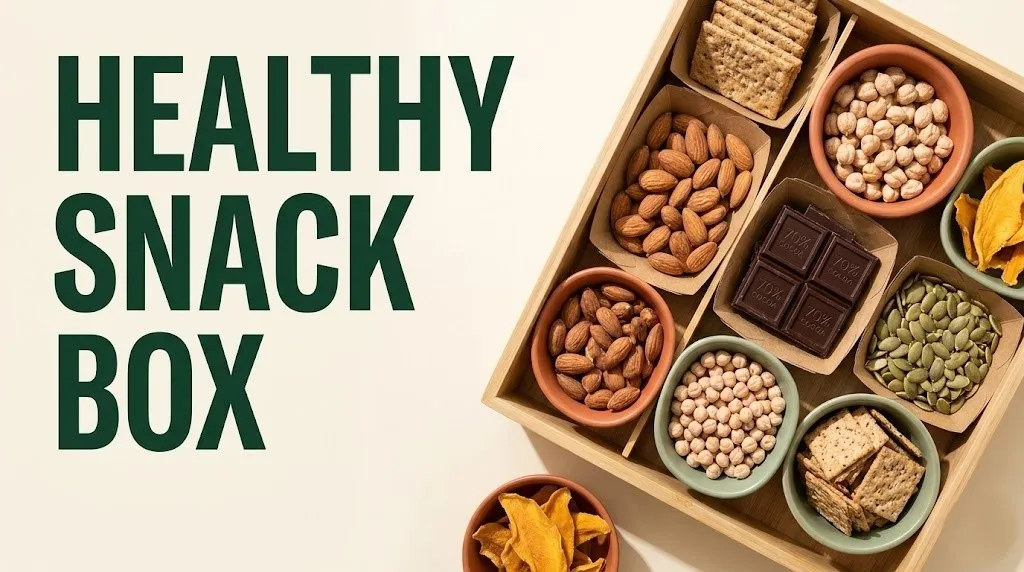
Strong snack box choices for office or workplace use include:
- Roasted almonds (Prunus dulcis): 30g serving provides approximately 6g protein, 3.5g dietary fiber, 14g fat (mostly monounsaturated), 75mg magnesium
- Pumpkin seeds (Cucurbita pepo pepitas): 28g provides approximately 7g protein, 1.7g fiber, 156mg magnesium, good option for nut-free workplaces
- Whole grain crackers with individual nut butter packets: Combines complex carbohydrate with protein and fat for a balanced glucose response
- Roasted chickpeas (Cicer arietinum): 30g provides approximately 5g protein, 4g dietary fiber; shelf-stable, low-smell option
- Dark chocolate (Theobroma cacao, 70% or higher cacao): 20g serving provides 2g dietary fiber, polyphenols including flavanols; pairs well with nuts for a balanced snack
Workers managing nut allergies can substitute seed-based options. Workers managing gluten sensitivity should verify individual snack certification rather than relying on the box-level description.
Key Takeaway: For workplace snacking, prioritize shelf-stable, low-odor snacks with at least 5 to 7g of protein per serving. That combination supports sustained energy without requiring refrigeration or meal prep.
Low Sugar Snack Box Subscriptions: What to Look For
A low sugar snack box subscription means individual snacks in the box contain limited added sugar, which the FDA defines separately from naturally occurring sugars in fruit, dairy, or whole foods.
The distinction between added sugar and total sugar on the Nutrition Facts panel matters here. A dried mango snack with 12g total sugar and 0g added sugar has a very different nutritional profile than a granola bar with 12g total sugar and 10g added sugar. Reading the “Added Sugars” line on the panel, which became mandatory on FDA-compliant labels as of 2020, is the only reliable way to make that comparison.
The American Heart Association recommends that adult women limit added sugar to no more than 25g per day and adult men to no more than 36g per day. A snack box that contributes more than 8 to 10g of added sugar per snack represents a meaningful portion of that daily limit from a single snack.
Red flags to watch for in “low sugar” snack box marketing:
- The term “naturally sweetened” does not mean low sugar. Dates, honey, and agave nectar are natural sweeteners that still contribute added sugar when used as ingredients.
- Sugar alcohols such as erythritol and xylitol reduce net carbohydrates but can cause gastrointestinal discomfort in some people when consumed in quantity. People with irritable bowel syndrome (IBS) should check for sugar alcohol content.
- “No added sugar” claims on dried fruit snacks may still mean high total sugar from the concentrated natural fruit sugars. Portion size context is essential.
People managing blood glucose levels, including those with prediabetes or type 1 or type 2 diabetes, should look specifically for snacks where total carbohydrate minus dietary fiber (net carbs) stays under 15g per serving.
High Protein Snack Box Delivery: Why Protein Matters
A high protein snack box delivers individual snacks containing at least 7 to 10g of protein per serving, enough to meaningfully support satiety, muscle maintenance, and stable blood glucose between meals.
Protein is the macronutrient most directly associated with satiety signaling. When you eat a protein-containing snack, it triggers a more sustained hormonal satiety response than an equivalent-calorie carbohydrate-only snack. A study published in the American Journal of Clinical Nutrition found that increasing protein intake at snack time was associated with reduced total daily caloric intake in healthy adults.
For active adults, older adults over 65, or anyone following a resistance training program, protein intake between meals takes on additional importance. The Academy of Nutrition and Dietetics notes that distributing protein intake across multiple meals and snacks throughout the day may support muscle protein synthesis more effectively than concentrating protein in one or two meals.
Common high-protein snack types in delivery boxes:
| Snack Type | Typical Protein Per 30g Serving | Notes |
|---|---|---|
| Roasted edamame (Glycine max) | 9 to 11g | Plant-based; contains soy allergen |
| Pumpkin seeds (pepitas) | 7 to 8g | Nut-free; good magnesium source |
| Jerky (beef, turkey, salmon) | 10 to 14g | Watch sodium content; target under 300mg/serving |
| Hard cheese crisps | 8 to 10g | Dairy allergen; high saturated fat |
| Greek yogurt bark | 6 to 9g | Requires refrigerated shipping |
| Roasted chickpeas | 5 to 6g | Vegan; gluten-free; good fiber |
People following vegan or plant-based diets should look for boxes that specifically highlight plant-protein-forward curation, since many high-protein snack categories default to animal-based products.
Key Takeaway: High-protein snack boxes are worth the premium if you are managing hunger between meals, supporting an active lifestyle, or over 65 and working to maintain muscle mass. Aim for at least 7g of protein per snack serving.
Gluten-Free and Nut-Free Snack Box Options
Gluten-free and nut-free snack boxes serve two distinct dietary needs, and the certifications that back each claim are not the same.
Gluten-free certification on a snack box means individual items have been tested and verified to contain less than 20 parts per million (ppm) of gluten, which is the FDA’s threshold for gluten-free labeling. Some certifying bodies, including the NSF International and the Gluten-Free Food Service (GFFS), use a stricter threshold of 10ppm. For people managing celiac disease, choosing a box where individual snacks carry third-party gluten-free certification rather than relying on the box-level description is a meaningful safety step.
Nut-free claims are more complex. A nut-free snack is not automatically produced in a nut-free facility. Cross-contamination in shared production environments is the primary risk for people with immunoglobulin E (IgE)-mediated tree nut allergies or peanut allergies. The only way to verify production environment status is to read the full allergen advisory statement on the individual snack packaging, not the subscription box description.
For households managing both gluten and nut allergies simultaneously, the available verified options narrow considerably. Seed-based snacks, specifically roasted sunflower seeds (Helianthus annuus) and pumpkin seeds (Cucurbita pepo), dried fruit with no shared-facility nut advisories, and plain rice-based crackers with certified gluten-free status represent the most reliably safe category overlap.
- Check each individual snack for both a gluten-free certification mark and an allergen advisory statement
- Contact the subscription service directly to ask about production facility allergen practices before subscribing if managing a severe allergy
- Prioritize services that clearly list allergen information per snack on their website rather than requiring you to wait for the box to arrive
Diabetic-Friendly and Vegan Snack Box Options
A diabetic-friendly snack box is one where individual snacks support stable blood glucose levels, typically by keeping net carbohydrates under 15g per serving and pairing any carbohydrate with protein or dietary fiber.
The American Diabetes Association does not recommend a single universal snacking approach for people with diabetes, since individual responses to carbohydrates vary by medication type, insulin sensitivity, activity level, and the time of day the snack is consumed. However, snacks that combine fiber-rich carbohydrates with protein consistently produce more moderate postprandial glucose responses than high-carbohydrate, low-fiber snacks of the same calorie level. If you are managing diabetes and evaluating a snack box, reviewing individual snack nutrition profiles with a registered dietitian nutritionist (RDN) who specializes in diabetes management is the most reliable way to confirm compatibility with your specific treatment plan.
Vegan snack boxes exclude all animal-derived ingredients, which means no meat, dairy, eggs, honey, gelatin, or casein. Practically, this eliminates most jerky options, dairy-based protein snacks, and many flavored coatings that contain milk derivatives.
Strong vegan snack categories that also tend to support blood glucose management:
- Roasted chickpeas: High fiber, moderate protein, plant-based
- Edamame (Glycine max): Complete protein profile, plant-based
- Dark chocolate (70%+ cacao, dairy-free formulation): Flavanol-rich; check for dairy-free labeling
- Mixed seeds with dried tart cherries: Fiber, healthy fat, moderate sugar from whole fruit
- Nut and seed bars with no added honey: Check labels; many “natural” bars use honey as a binder
| Snack Category | Vegan | Diabetic-Friendly | Notes |
|---|---|---|---|
| Roasted chickpeas | Yes | Yes | Under 15g net carbs per 30g serving |
| Beef jerky | No | Generally yes | Not vegan; watch sodium |
| Dark chocolate (dairy-free) | Yes | In small portions | 20g is a reasonable portion |
| Greek yogurt bark | No | Generally yes | Dairy; not vegan |
| Pumpkin seeds | Yes | Yes | Negligible net carbs |
Key Takeaway: For diabetic-friendly snacking, the paired combination of fiber and protein per snack is more useful than calorie count alone. For vegan options, check ingredient labels carefully since many flavored snack coatings use hidden dairy derivatives.
Where to Buy Healthy Snacks Online
Healthy snacks are available online through dedicated subscription box services, direct-from-brand websites, major e-commerce platforms, and specialty health food retailers.
Each purchasing channel has trade-offs worth understanding. Dedicated subscription services typically offer the most nutritional customization and pre-screened curation, but they require an ongoing billing commitment. Direct brand websites let you buy specific snacks you have already vetted nutritionally, without paying a curation premium. Major e-commerce platforms offer the widest variety and competitive pricing but require more manual label verification since nutritional standards vary enormously by product.
Specialty health food online retailers often carry products with verified organic, gluten-free, or vegan certifications at competitive pricing, with the added benefit that their product selection is already filtered to a higher nutritional standard than a general marketplace.
When buying healthy snacks through any online channel, these verification steps protect you:
- Read the Nutrition Facts panel from the product listing, not just the product name or marketing description
- Check the ingredient list for added sugars listed under multiple names: cane sugar, brown rice syrup, evaporated cane juice, dextrose, maltose, and corn syrup are all added sugars
- Look for visible third-party certification marks (USDA Organic, Non-GMO Project, Certified Gluten-Free) rather than brand-owned claims like “all-natural” or “guilt-free”
- Verify serving size before comparing calories across products; manufacturers sometimes use atypically small serving sizes to reduce apparent calorie counts
People with specific dietary restrictions managing their snacking online should also build a short personal checklist of their required certifications and prohibited ingredients, then apply it uniformly to every product they consider rather than relying on category-level assumptions.
Are Healthy Snack Subscription Boxes Worth It?
Healthy snack subscription boxes are worth the cost if they consistently deliver snacks that meet your nutritional criteria, fit your dietary restrictions, and cost no more than $1.50 to $2.50 per snack serving after accounting for delivery fees.
The honest cost comparison requires calculating cost per individual snack, not cost per box. A box priced at $40 per month containing 20 snack servings works out to $2.00 per serving. That is a reasonable premium over buying equivalent snacks at a grocery store if the curation genuinely saves you time and reduces the likelihood of making poor snack choices under time pressure.
Where subscriptions tend to underdeliver value:
- When snacks are nutritionally mediocre despite premium presentation
- When the variety is low and the same items repeat frequently
- When the cancellation or pause process is deliberately complicated
- When the per-snack nutritional data is not available before ordering
Where subscriptions tend to deliver genuine value:
- For adults who consistently make worse snack choices when they have to decide in the moment
- For people managing specific dietary restrictions who find label-reading in a grocery store time-consuming
- For offices supplying snacks to a team, where bulk formats reduce per-serving cost
- For people genuinely unfamiliar with the nutritional landscape of snacking, who benefit from expert curation
| Monthly Budget | Snacks Per Box | Cost Per Snack | Comparable Grocery Cost |
|---|---|---|---|
| $25 | 12 to 15 | $1.67 to $2.08 | $0.80 to $1.50 |
| $40 | 18 to 22 | $1.82 to $2.22 | $0.80 to $1.50 |
| $55 | 25 to 30 | $1.83 to $2.20 | $0.80 to $1.50 |
The grocery store will almost always win on raw cost. The subscription box wins on convenience, curation, and reduced decision fatigue, which is a real and measurable benefit for people with busy schedules or limited bandwidth for nutrition research.
Frequently Asked Questions About Healthy Snack Boxes
What should I look for in a healthy snack box?
Look for boxes that display the full Nutrition Facts panel for every individual snack and that show the ingredient list before purchase.
Per serving, target at least 3g dietary fiber, 5g protein, fewer than 8g added sugar, and under 200mg sodium.
Third-party certifications for any dietary claims you require (organic, gluten-free, vegan) should be visible on individual snack packaging, not just the box description.
How many calories should a healthy snack be?
A nutritionally appropriate snack for most adults falls between 100 and 200 calories per serving, according to general guidance from the Academy of Nutrition and Dietetics.
Calorie needs vary by individual body size, activity level, and how many meals per day a person eats.
The calorie count matters less than the nutritional composition: a 150-calorie snack with 8g protein and 4g fiber is meaningfully more satisfying than a 150-calorie snack made almost entirely of refined carbohydrates.
Are snack subscription boxes actually healthy?
Some are and some are not. The label “healthy” on a subscription box is not federally regulated, which means nutritional quality varies widely between services.
The only reliable way to assess whether a box is healthy is to review the Nutrition Facts panel and ingredient list for individual snacks before subscribing.
Services that make per-snack nutrition data publicly available on their website before purchase are demonstrably more transparent than those that do not.
What is the best snack box for weight management?
The best snack box for weight management is one where individual snacks combine protein and dietary fiber in adequate amounts to support satiety between meals.
Research from the American Journal of Clinical Nutrition indicates that high-protein, high-fiber snacks reduce subsequent meal caloric intake more reliably than low-protein, high-carbohydrate alternatives.
Portion control is built into most subscription boxes by design, which is a structural advantage over buying snacks in bulk and self-portioning.
Can I get a healthy snack box that is gluten-free and nut-free?
Yes, but you should verify both claims at the individual snack level, not just the box level.
Gluten-free certification requires testing to below 20ppm gluten per FDA standards; look for a third-party certification mark on individual snack packages.
Nut-free production requires a separate allergen advisory statement confirming no shared equipment with tree nuts or peanuts; contact the service directly to confirm production facility practices if managing a severe allergy.
The Bottom Line on Healthy Snack Boxes in 2026
The best healthy snack box for you is the one that passes the nutrition label test on every individual snack it contains. Start with the Nutrition Facts panel. Check the added sugar line. Count the grams of protein and fiber. Read the allergen advisory if that applies to you.
A subscription is worth the premium when it saves you time, reduces poor snacking decisions, and consistently delivers snacks that meet your actual nutritional benchmarks. If a service cannot show you the full nutrition data before you subscribe, that is the answer you need.
Build your short checklist, apply it every time, and snacking stops being a question mark in your overall eating pattern.