All visible hair is biologically dead. The hair strand that emerges from your scalp is a column of compacted, keratinized protein with no living cells, no blood supply, and no capacity for self-repair. The difference between what people call “dead hair” and “healthy hair” is really the difference between a damaged cuticle and an intact one. When you look at a split end, you are looking at the cortex of the hair shaft spilling out because its protective outer layer, the cuticle, has been worn away by heat, chemicals, or mechanical friction.
Healthy hair reflects light evenly off a flat, tightly closed cuticle layer, appearing shiny, smooth, and elastic. Damaged hair, which most people refer to as “dead hair,” has a raised, chipped, or entirely missing cuticle, leaving the inner cortex exposed, frayed, and dull. The distinction matters because it determines your strategy. You cannot revive a split end. You can nourish the follicle so the next strand grows in stronger.
This guide breaks down the exact structural differences between healthy and damaged hair, the nutritional pipeline from your stomach to your scalp, and the specific foods that deliver the amino acids, iron, and zinc your follicles need to produce resilient, shiny hair. You will learn why your hair feels like straw, which nutrients you are likely missing, and exactly what to eat to fix it from the inside out.
dead hair vs healthy hair
Dead hair is hair with a severely damaged or missing cuticle layer, exposing the inner cortex, resulting in a rough, dull, brittle texture, while healthy hair has a flat, intact cuticle that reflects light, retains moisture, and stretches without breaking. Biologically, both are dead keratinized protein. The difference is the integrity of the structure.
The hair cuticle is composed of overlapping scales, similar to roof shingles, that lie flat along the hair shaft when healthy. These scales are made of a hard, waterproof protein that protects the softer cortex beneath. When the cuticle is intact, light reflects off the smooth surface, producing the shine that people associate with healthy hair. The cortex remains hydrated because the cuticle seal prevents water loss.
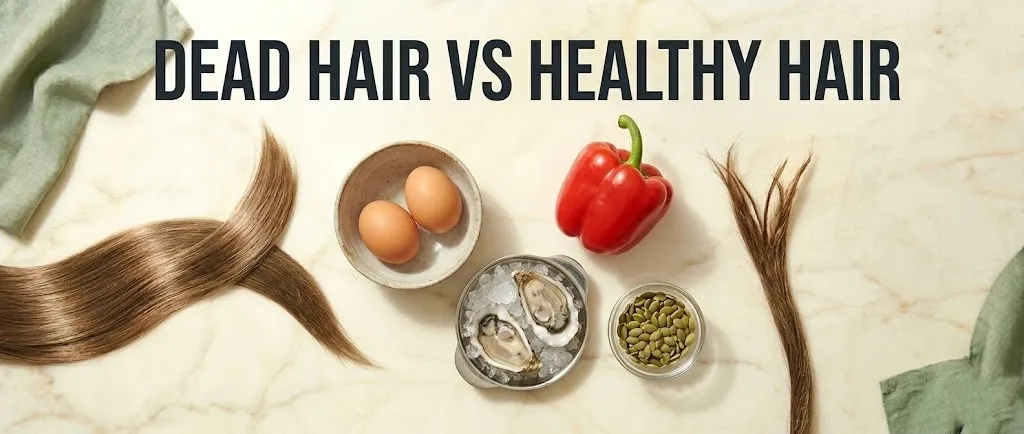
When the cuticle is damaged, the scales lift, chip, or break off entirely. Light hits the rough surface and scatters, producing a dull, matte appearance. Moisture escapes through the gaps in the cuticle, leaving the hair dry and brittle. The exposed cortex frays and splits, creating the classic forked end of a hair strand that has lost its protective outer layer. This is the hair that people call “dead.”
| Feature | Healthy Hair | Dead/Damaged Hair |
|---|---|---|
| Cuticle | Flat, intact, overlapping scales | Lifted, chipped, or missing |
| Texture | Smooth, slippery to touch | Rough, catches on fingers |
| Shine | High, light reflects evenly | Dull, matte, light scatters |
| Elasticity | Stretches and returns | Snaps immediately when pulled |
| Ends | Tapered or blunt, no splits | Split, frayed, white dots |
healthy hair vs unhealthy hair
Healthy hair displays a smooth cuticle, consistent diameter, high tensile strength, and a natural sheen, while unhealthy hair shows raised cuticles, irregular diameter from protein loss, low tensile strength, and a rough, straw-like texture. The comparison is visible to the naked eye and measurable with simple at-home tests.
The strand test is the most reliable way to distinguish healthy from unhealthy hair. Take a single shed hair and run your fingers along it from root to tip. Healthy hair feels smooth and slippery because the cuticle scales are pointing downward and lying flat. Run your fingers from tip to root. You will feel slight resistance, which is normal. The hair should not feel rough or bumpy in either direction. If it does, the cuticle is lifted.
The elasticity test measures the protein integrity of the cortex. Take a single wet hair and stretch it slowly between your fingers. Healthy hair will stretch by 25 to 30 percent of its original length and return to its original shape when released. Damaged hair will stretch very little, then snap immediately. The protein matrix in the cortex has been degraded. The hair has lost the amino acid bonds that give it flexibility. This is structural failure, not a cosmetic issue.
- Smooth to the touch from root to tip: Healthy cuticle.
- Stretches 25 to 30 percent when wet and returns: Healthy cortex.
- Even color and shine: Flat cuticle reflecting light.
- Rough texture, snaps instantly: Damaged cuticle and cortex.
Key Takeaway: Healthy hair feels like silk thread between your fingers. Unhealthy hair feels like rough cotton yarn. The difference is the cuticle.
healthy vs unhealthy hair
Healthy versus unhealthy hair is a comparison of structural integrity at the protein level. Healthy hair contains an intact matrix of keratin proteins cross-linked by disulfide bonds, wrapped in a flat cuticle. Unhealthy hair has broken disulfide bonds, gaps in the protein matrix, and a damaged cuticle that no longer seals the shaft.
The chemistry of hair damage is a cascade. It begins when the cuticle is lifted by alkaline chemicals from hair dye or by the sudden expansion of water trapped under the scales during high-heat styling. Once the cuticle is lifted, the cortex is exposed. The cortex is composed of long chains of keratin proteins held together by hydrogen bonds, which are weak and easily broken by water, and disulfide bonds, which are strong and broken by chemical treatments like bleaching and perming. When these bonds break, the cortex loses its structural integrity, and the hair becomes porous, weak, and inelastic.
This is why hair that has been bleached repeatedly feels fundamentally different from virgin hair. The bleaching process breaks the disulfide bonds that hold the keratin proteins together. The cortex becomes a weakened, porous sponge. The cuticle is stripped away by the alkaline developer. The resulting hair is not just cosmetically different. It is structurally compromised at the molecular level.
- Disulfide bonds: Broken by bleach, permanent waves.
- Hydrogen bonds: Broken by water and heat, reform when dry.
- Cuticle cement: Dissolved by alkaline products like hair dye.
damaged hair vs healthy hair
Damaged hair has lost the protective cuticle layer and has a porous, fractured cortex, while healthy hair has an intact cuticle and a dense, continuous protein cortex. The damage is cumulative and irreversible once it reaches the split-end stage. The only repair for a split end is scissors.
The progression from healthy to damaged hair follows a predictable path. Heat styling above 350°F causes water trapped inside the cortex to flash-boil, creating tiny explosions that rupture the cuticle from the inside. This is why hair that is frequently flat-ironed develops a characteristic roughness and loss of shine. Chemical treatments like bleaching and perming strip the cuticle and break the disulfide bonds. Mechanical damage from aggressive brushing, tight ponytails, and rough towel drying chips away at the cuticle scales over time.
Healthy hair, by contrast, has never been exposed to these forces or has been protected from them. The cuticle is intact. The cortex is dense. The hair retains its natural moisture content, roughly 10 to 15 percent by weight. The sebum produced by the scalp can travel down the smooth cuticle surface, naturally conditioning the hair. Damaged hair cannot distribute sebum effectively because the rough cuticle surface blocks the flow.
- Heat damage: Flash-boiling water creates cuticle explosions.
- Chemical damage: Bleach and perms break disulfide bonds.
- Mechanical damage: Rough brushing, tight styles, towel friction.
healthy hair vs damaged hair
Healthy hair versus damaged hair is the difference between a rope that is tightly twisted and coated in protective varnish and a rope that has been unraveled, the outer coating stripped, and the inner fibers frayed. The healthy rope bears weight and stretches. The damaged rope snaps under tension.
The comparison is visible at the ends first. A healthy hair strand tapers to a smooth, pencil-like point or a clean, blunt cut from scissors. A damaged hair strand ends in a split, a fork, a feathery fray, or a white dot. The white dot is a pre-split, a section of the shaft where the cuticle is gone and the cortex is about to snap. Once a hair splits, the damage travels upward. A split end that is not trimmed can travel several centimeters up the shaft, progressively destroying healthy hair above it.
The porosity test reveals the extent of cuticle damage. Place a strand of clean hair in a glass of water. Healthy hair with an intact cuticle is hydrophobic and will float for a long time. Porous, damaged hair absorbs water immediately and sinks. If your hair sinks within seconds, the cuticle is severely compromised, and the cortex is absorbing water like a sponge.
| Test | Healthy Hair Result | Damaged Hair Result |
|---|---|---|
| Float Test | Floats for minutes | Sinks immediately |
| Touch Test | Smooth both directions | Rough, catches on fingers |
| Elasticity | Stretches 25 to 30 percent | Snaps immediately |
| End Inspection | Tapered or clean blunt cut | Split, frayed, white dot |
Key Takeaway: The split end is the final stage of cuticle failure. Once you see it, the damage is done. Trim it before it travels.
healthy vs damaged hair
Healthy hair has a water content of 10 to 15 percent, a protein content of 80 to 90 percent, and a lipid content of 5 to 10 percent. Damaged hair has lost a significant portion of its protein and lipids, leaving it porous, dry, and unable to retain moisture. The numbers tell the story.
The protein loss in damaged hair is measurable. A 2022 study in the International Journal of Cosmetic Science found that bleached hair lost up to 40 percent of its tensile strength compared to virgin hair. This means the hair can withstand less than half the pulling force before it snaps. The protein that was lost is primarily from the cortex, where the keratin macrofibrils have been fractured. The amino acids cysteine and methionine, which form the disulfide bonds that give hair its strength, are particularly depleted.
The lipid loss is equally damaging. The cuticle is held together by a lipid cement composed of 18-methyleicosanoic acid and other fatty acids. This cement is washed away by alkaline shampoos, chemical treatments, and prolonged water exposure. When the lipid cement is gone, the cuticle scales lift and chip away. The hair loses its waterproof seal. The internal moisture evaporates, and the hair becomes permanently dry.
- Protein content: Healthy 85 percent, damaged as low as 50 percent.
- Tensile strength: Reduced up to 40 percent by bleaching.
- Lipid cement: Depleted by alkaline products and overwashing.
dead hair vs healthy
The phrase “dead hair” is scientifically a misnomer. All visible hair is dead. The living part of hair is the follicle, buried roughly 4 millimeters beneath the scalp surface. The hair shaft you see is the product of that follicle, extruded upward as a column of keratinized cells that die as they move away from the blood supply. The correct distinction is “damaged hair” versus “healthy hair.”
The follicle is where the nutritional intervention happens. The dermal papilla at the base of the follicle receives nutrients from the bloodstream. If the blood is delivering adequate amino acids, iron, zinc, and biotin, the follicle produces a structurally sound hair shaft with a dense cortex and a flat cuticle. If the blood is delivering inadequate nutrients, the follicle produces a thinner, weaker hair shaft that is more vulnerable to external damage.
This is why dietary changes take months to show visible results. The hair grows at roughly 1 centimeter per month. The hair that emerges from your scalp today was built from nutrients you consumed two to three weeks ago. The hair that is currently damaged and splitting at the ends was built from nutrients you consumed months or years ago. You are always seeing the nutritional past on your head.
- Living follicle: Buried 4mm beneath the scalp, receives blood supply.
- Hair shaft: Dead keratin, no blood supply, no self-repair.
- Growth rate: 1 cm per month. Nutritional changes take months to become visible.
what does dead hair look like
Dead hair, correctly understood as severely damaged hair, looks dull, frizzy, and rough under light, with visible split ends, white dots along the shaft, and a color that appears faded or uneven. It does not move as a single sheet but separates into individual, chaotic strands because the cuticle is too rough for the strands to slide smoothly past each other.
The visual signature of damaged hair is the absence of shine. Shine is produced by light reflecting off a flat surface. A healthy cuticle is that flat surface. When the cuticle is damaged, light hits the raised scales and reflects in many different directions, creating a matte, dusty appearance. This is the same optical principle that makes a polished stone shiny and a rough stone dull.
Split ends are the most recognizable sign of dead hair. They come in several forms. The classic split, a fork at the end. The feather, multiple small splits along the last few centimeters. The white dot, a weakened section where the cuticle is gone and the cortex is about to snap. The tree, a single strand that has split into multiple branches. Each split end is a terminal failure of the hair’s structure. Nothing repairs it.
- Dull, no shine: Cuticle is rough, light scatters.
- Split ends: Cortex is exposed and fraying.
- White dots: Pre-split, about to snap.
- Faded color: Cuticle cannot hold pigment molecules.
Key Takeaway: Dead hair looks dusty, not shiny. It feels rough, not smooth. The ends are split, and there is no product that can glue them back together.
what does healthy hair feel like
Healthy hair feels smooth, cool, and slippery when you run it between your fingers, like a strand of silk thread. It slides easily against itself. You can hold a single strand and pull it gently, and it will stretch slightly and spring back. It does not feel rough, bumpy, or crunchy.
The smoothness of healthy hair is a direct result of the cuticle structure. The overlapping scales of the cuticle lie perfectly flat, all pointing in the same direction, like the tiles on a sleek roof. Your fingers glide over this flat surface without resistance. This is also why healthy hair tangles less. The smooth cuticles of adjacent hairs slide past each other rather than catching and knotting.
The temperature of healthy hair is another subtle tactile cue. Intact hair feels cool to the touch because it reflects light and does not trap heat. Porous, damaged hair feels slightly warmer because the rough surface absorbs ambient heat. Run the back of your hand over your hair. Healthy hair feels like a cool, smooth sheet. Damaged hair feels like warm, dry straw.
- Smooth and slippery: Flat cuticle.
- Stretches slightly: Intact cortex.
- Feels cool: Reflects light, low porosity.
- No tangles: Cuticles slide past each other.
what causes dead hair
Damaged hair, commonly called dead hair, is caused by thermal destruction from heat styling, chemical degradation from bleaching and dyeing, mechanical abrasion from brushing and tight styles, and nutritional deficiencies that weaken the hair structure from the moment it grows. The causes are both external and internal.
Thermal damage is the most common cause of cuticle destruction. Flat irons, curling wands, and blow dryers operate at temperatures between 300°F and 450°F. At these temperatures, the water trapped inside the hair cortex flash-boils, creating steam that ruptures the cuticle from the inside. A single pass of a flat iron at 450°F can lift cuticle scales. Repeated passes over the same section can strip them entirely.
Nutritional deficiency is the most overlooked cause of weak, damage-prone hair. The hair follicle requires a constant supply of amino acids to build keratin. If dietary protein intake is inadequate, the body prioritizes vital organs over hair, and the follicle produces a thinner, weaker hair shaft. Iron deficiency, the most common nutritional deficiency worldwide, reduces the oxygen-carrying capacity of the blood, starving the follicle of oxygen. Zinc deficiency directly impairs keratin synthesis.
- Heat styling above 350°F: Flash-boils internal water, ruptures cuticle.
- Bleach and dye: Strips cuticle, breaks disulfide bonds.
- Aggressive brushing: Chips away cuticle scales.
- Protein deficiency: Follicle produces weak, thin hair.
- Iron deficiency: Follicle is starved of oxygen.
can dead hair become healthy again
Dead hair, meaning a hair strand that is already grown out of the scalp and damaged, cannot become healthy again because it is composed of dead, keratinized cells with no metabolic activity and no capacity for self-repair. A split end cannot be glued back together. A stripped cuticle cannot regenerate. The only fix for damaged hair is to cut it off and grow new, healthy hair from a nourished follicle.
The hair follicle, however, can absolutely recover. If the damage was caused by nutritional deficiency, restoring the missing nutrients will cause the follicle to produce a healthy hair shaft again. The recovery process takes three to six months to become visible because the new healthy hair must grow long enough to replace the damaged length. During this transition period, the roots will feel smooth and healthy while the ends remain damaged.
The products that claim to “repair” damaged hair are not actually repairing it. They are depositing a temporary coating of silicones, hydrolyzed proteins, or conditioning agents that fill in the gaps in the cuticle and smooth the surface. This is cosmetic repair, not structural repair. The hair looks and feels better, but the underlying damage remains. The next shampoo washes the coating away, and the damage is visible again.
- Split ends: Cannot be repaired. Must be cut.
- Stripped cuticle: Cannot regenerate. Only temporary coatings.
- Damaged follicle: Can recover with nutrition. Takes 3 to 6 months to see results.
Key Takeaway: You cannot fix damaged hair. You can only coat it temporarily. To get healthy hair, grow new hair from a well-fed follicle.
best foods to repair damaged hair
The best foods to repair damaged hair are eggs, oysters, red bell peppers, lentils, salmon, pumpkin seeds, and Greek yogurt because they deliver the specific amino acids, iron, zinc, and vitamin C that the follicle requires to produce a keratin-rich, structurally intact hair shaft. The food you eat today becomes the hair that emerges from your scalp in three weeks.
Eggs are the most complete hair food. They contain all nine essential amino acids required for keratin synthesis, plus 147 milligrams of choline and biotin in the yolk. The protein in eggs has a biological value of 100, meaning it is perfectly absorbed and utilized by the human body. Two eggs for breakfast provide roughly 12 grams of protein directed toward hair synthesis.
Oysters are the richest food source of zinc, with a single oyster providing roughly 5 milligrams, more than half the 8-milligram daily requirement. Zinc is a cofactor for the enzymes that build keratin proteins. Zinc deficiency causes hair to become thin, brittle, and slow to grow. Pumpkin seeds are a plant-based alternative, with a quarter-cup providing 2.5 milligrams of zinc.
| Food | Key Nutrient | Hair Function |
|---|---|---|
| Eggs | Complete protein, biotin | Keratin synthesis, cuticle strength |
| Oysters | Zinc | Enzyme cofactor for keratin production |
| Red bell pepper | Vitamin C | Collagen synthesis, iron absorption |
| Lentils | Iron, protein | Oxygen delivery to follicle |
| Salmon | Omega-3, vitamin D | Scalp health, inflammation reduction |
| Pumpkin seeds | Zinc, magnesium | Keratin synthesis, follicle support |
Frequently Asked Questions About Dead Hair vs Healthy Hair
What is the difference between dead hair and damaged hair?
All visible hair is technically dead keratin. “Dead hair” is a colloquial term for hair that has been severely damaged.
Damaged hair has a stripped cuticle and fractured cortex, while healthy hair has an intact cuticle and dense protein structure.
True “dead hair” at the follicular level means the follicle itself is dead and will never produce hair again.
Can dead hair be repaired?
Dead or damaged hair cannot be structurally repaired because the cuticle and cortex cannot regenerate.
Products labeled as “repairing” coat the hair temporarily with silicones or hydrolyzed proteins.
The only permanent solution is to cut the damaged ends and nourish the follicle for new growth.
What vitamin deficiency causes dead hair?
Iron deficiency is the most common nutritional cause of weak, brittle hair because it reduces oxygen delivery to the follicle.
Zinc deficiency directly impairs the enzymatic process of keratin synthesis.
Vitamin C deficiency weakens the collagen that anchors the hair follicle in the dermis.
How do I know if my hair follicle is dead?
A dead hair follicle no longer produces a visible hair strand and the pore is closed or absent.
A dermatologist can examine the scalp with a dermatoscope to determine if a follicle is inactive but alive or permanently dead.
If the follicle is scarred over, the hair loss is permanent.
What is the healthiest food for hair growth?
Eggs are the single most complete food for hair growth because they contain complete protein, biotin, choline, and iron.
They provide the exact amino acids required to synthesize the keratin protein that forms the hair shaft.
Oysters are a close second due to their high zinc content, which is essential for keratin production.
Your hair is a running record of what you ate three months ago, how much heat you applied last week, and whether your body has enough iron and zinc to prioritize protein synthesis in the follicle over more critical organs. The strands you see in the mirror are dead. They were dead the moment they left your scalp. What they reveal is entirely alive. The follicle is the patient. The hair is the symptom.
Trim the split ends. Stop flat-ironing at the highest setting. Eat the eggs, the oysters, and the lentils. Drink water. Give your body the amino acids and minerals it needs to build a dense, resilient hair shaft, and then wait three months. The new growth will tell you whether you got the message right.
The hair strand itself cannot be resurrected. The follicle that produced it can be fed. Feed it well, protect the strand it produces, and your hair will feel like silk because you built it that way from the inside out.