Spinach wraps are marginally healthier than white flour tortillas due to a slightly higher fiber content and the addition of spinach powder, but they are not a health food, and they do not count as a serving of vegetables. The vibrant green color is primarily a marketing tool. The actual spinach content in a commercial spinach wrap is typically 2 to 4 percent of the total weight, a dusting of dried spinach powder added for color, not nutrition.
The “health halo” of spinach wraps is a well-documented phenomenon in consumer psychology. A 2022 study in the Journal of Consumer Research found that consumers perceive green-colored foods as healthier, more natural, and lower in calories than identically formulated beige or white foods. The food industry exploits this bias. A spinach wrap is a white flour tortilla that has been dyed green.
This guide audits the nutritional reality of spinach wraps against their marketing claims, compares them to flour tortillas, and ranks the genuinely healthy tortilla alternatives available in 2026. You will learn exactly which wrap to buy and which to leave on the shelf.
are spinach wraps healthy
Spinach wraps are not inherently healthy. They are a slightly improved version of a refined flour tortilla. A standard 10-inch spinach wrap contains roughly 180 to 210 calories, 4 to 5 grams of fat, 30 to 35 grams of carbohydrate, and 1 to 2 grams of fiber. These numbers are nearly identical to a standard white flour tortilla.
The nutritional similarity between spinach wraps and white flour tortillas is the most important fact in this guide. The spinach powder added to the wrap provides a trace amount of iron, vitamin K, and vitamin A, but the quantities are nutritionally insignificant. A single spinach wrap contains roughly 2 percent of the daily value for vitamin A, which is less than a single bite of a raw spinach leaf.
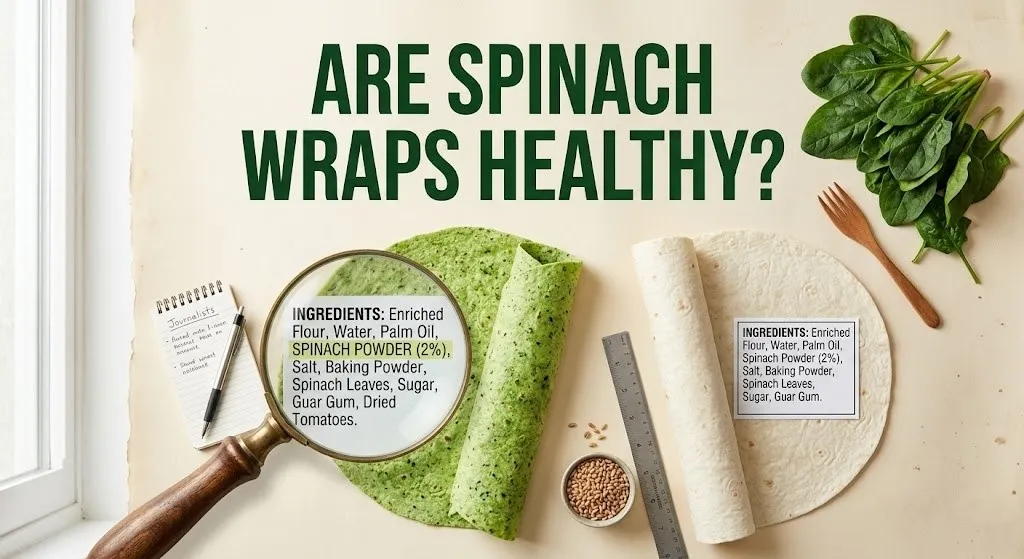
The ingredient list reveals the truth. A typical commercial spinach wrap lists enriched wheat flour as the first ingredient, followed by water, vegetable shortening, and then spinach powder or “spinach flakes” near the end of the list, often after salt and preservatives. This is a white flour tortilla with a green tint.
| Nutrient | Spinach Wrap (10-inch) | White Flour Tortilla (10-inch) |
|---|---|---|
| Calories | 200 | 190 |
| Fat | 4g | 4g |
| Carbohydrate | 34g | 33g |
| Fiber | 2g | 1g |
| Protein | 4g | 4g |
| Iron | 8% DV | 6% DV |
is spinach wrap healthy
A spinach wrap is healthier than a white flour tortilla by a small margin, but it is not a health food, and the green color does not make it equivalent to eating vegetables. The singular “spinach wrap” question asks for a verdict on the specific product in your hand.
The small nutritional advantage of a spinach wrap is the fiber content. The spinach powder adds roughly 1 gram of fiber per wrap compared to a white flour tortilla. This is a genuine improvement. Fiber reduces the glycemic response to the wrap’s carbohydrates and supports gut health. However, a whole wheat tortilla adds 3 to 4 grams of fiber. The spinach wrap is a half-step toward health, not a full step.
The sodium content of spinach wraps is an overlooked concern. Many commercial spinach wraps contain 300 to 450 milligrams of sodium per wrap, which is higher than a white flour tortilla’s 200 to 300 milligrams. The added sodium compensates for the slightly bitter taste of the spinach powder. A person who chooses a spinach wrap for “health” may inadvertently consume more sodium.
- Marginally better than white flour: Slightly more fiber, trace nutrients.
- Not a vegetable serving: The spinach content is negligible.
- Higher sodium: Watch the label for 300+ milligrams per wrap.
Key Takeaway: A spinach wrap is a white flour tortilla with a green paint job. It is a tiny nutritional upgrade, not a health transformation.
are spinach tortillas healthy
Spinach tortillas are nutritionally almost identical to spinach wraps, as the terms are used interchangeably in the marketplace, and they share the same greenwashing issue. The word “tortilla” implies a more authentic product, but the nutritional reality is the same.
The tortilla category is divided into two worlds: the flour tortilla world and the corn tortilla world. Spinach tortillas belong to the flour world. A corn tortilla is made from masa harina, water, and lime. It contains roughly 50 calories, 1 gram of fat, and 1.5 grams of fiber for a 6-inch size. A spinach flour tortilla of the same size contains 100 calories, 2 grams of fat, and 1 gram of fiber. The corn tortilla is the genuinely healthier product.
The comparison that matters is not spinach versus white flour. It is flour versus corn. A corn tortilla is a whole grain product, naturally gluten-free, and made from only a few ingredients. A spinach flour tortilla is an enriched, processed product with added coloring. The corn tortilla wins on nutritional integrity.
- Spinach tortilla: Enriched flour, spinach powder, vegetable shortening.
- Corn tortilla: Masa harina, water, lime. 50 calories, whole grain.
- Verdict: Corn tortillas are the genuinely healthy choice.
is a spinach wrap healthy
A spinach wrap is a moderately healthy choice when compared to a white flour tortilla, but it is not a health food, and it does not replace vegetables in the diet. The indefinite article “a” signals a single, specific wrap on a plate.
The context of the meal determines whether the spinach wrap is a net positive. A spinach wrap filled with grilled chicken, avocado, and vegetables is a healthy meal. A spinach wrap filled with fried chicken, cheese, and ranch dressing is an unhealthy meal. The wrap itself is a relatively minor contributor to the total nutritional profile.
The psychological trap of the spinach wrap is the “health halo” effect. People who choose a spinach wrap for their burrito are more likely to add higher-calorie fillings, believing the wrap has already done the nutritional work. A 2018 study in the Journal of Marketing Research found that consumers who perceive a product as healthy underestimate the calorie content of the entire meal by roughly 15 to 20 percent.
- Healthy wrap plus healthy fillings: Good choice.
- Healthy wrap plus unhealthy fillings: The wrap does not rescue the meal.
- Psychological trap: The green color licenses indulgence.
is spinach tortilla healthy
A spinach tortilla is healthy only in the narrow sense that it contains slightly more fiber than a white flour tortilla. The broader nutritional truth is that a spinach tortilla is a refined grain product with a green marketing angle.
The ingredient that determines the health of a tortilla is the first item on the list. If the first ingredient is “enriched wheat flour,” the tortilla is a refined grain product, regardless of whether it is white, green, or red. The enrichment process adds back a small number of B vitamins and iron that were lost during refining, but it does not restore the fiber, the magnesium, or the phytonutrients of the whole grain.
A genuinely healthy tortilla has “whole wheat flour,” “corn masa flour,” “almond flour,” or “cassava flour” as the first ingredient. These whole-food bases provide fiber, protein, and micronutrients that an enriched flour tortilla does not.
- Enriched flour: Refined grain, minimal fiber.
- Whole wheat flour: Whole grain, 3 to 5g fiber.
- Corn masa flour: Whole grain, gluten-free, minimal ingredients.
Key Takeaway: Ignore the color. Read the first ingredient. If it says “enriched,” it is a refined grain product.
spinach wrap vs flour tortilla
A spinach wrap contains roughly 1 gram more fiber and a trace amount of additional vitamins compared to a white flour tortilla. The two products are otherwise nutritionally identical in calorie count, fat content, and protein. The spinach wrap is a marginal upgrade.
The cost difference between the two products is another factor. Spinach wraps typically cost 30 to 50 percent more than white flour tortillas. The consumer is paying a premium for the green color and the health halo, not for a meaningful nutritional improvement.
The taste difference is subtle. Spinach wraps have a slightly earthy, vegetal note, but it is barely perceptible when the wrap is filled with flavorful ingredients. The green color is the primary differentiator. A blind taste test would not reliably distinguish between a spinach wrap and a white flour tortilla.
| Feature | Spinach Wrap | White Flour Tortilla |
|---|---|---|
| Fiber | 2g | 1g |
| Price | Higher | Lower |
| Color | Green | White |
| Nutritional Difference | Negligible | Baseline |
are green tortillas healthy
Green tortillas are a category of products that include spinach, jalapeño, cilantro, and nopal (cactus) tortillas. Their health value depends entirely on the specific ingredients. Most are flour-based and nutritionally equivalent to white flour tortillas.
Nopal tortillas are the exception. Made from nopal cactus, a traditional Mexican ingredient, these tortillas are higher in fiber and lower in calories than flour tortillas. They are often made with a blend of corn masa and nopal purée, giving them a genuine vegetable content. A nopal tortilla contains roughly 70 calories and 3 grams of fiber for a 6-inch size.
Jalapeño and cilantro tortillas follow the same pattern as spinach tortillas. They are flour tortillas with a small amount of dried pepper or herb added for color and flavor. They are not vegetable servings. They are flavored flour tortillas.
- Spinach/Jalapeño/Cilantro: Flour tortillas with flavor.
- Nopal: Corn-flour blend with genuine vegetable content.
- Best green tortilla: Nopal corn tortilla.
best healthy tortillas 2026
The best healthy tortillas in 2026 are corn tortillas, Siete Almond Flour Tortillas, Egglife Egg White Wraps, and homemade spinach tortillas made with actual spinach. These options provide fiber, protein, and whole-food ingredients.
Corn tortillas remain the gold standard for health, cost, and authenticity. They are made from nixtamalized corn, a process that increases the bioavailability of niacin and calcium. A 6-inch corn tortilla contains 50 calories and 1.5 grams of fiber. They are the traditional wrap of Mesoamerica.
Siete Almond Flour Tortillas are a grain-free option made from almond flour and cassava flour. They contain 70 calories, 5 grams of fat from almonds, and 2 grams of fiber. The fat is monounsaturated and heart-healthy.
- Corn Tortillas: 50 cal, 1.5g fiber, whole grain.
- Siete Almond Flour: 70 cal, 2g fiber, grain-free.
- Egglife Egg White Wraps: 30 cal, 5g protein, zero carb.
- Homemade Spinach: Actual spinach, whole grain flour, controlled sodium.
Key Takeaway: The healthiest tortilla in 2026 is still the corn tortilla. The most innovative is the egg white wrap. The spinach wrap is a compromise, not a champion.
Frequently Asked Questions About Spinach Wraps
Do spinach wraps have real spinach?
Most commercial spinach wraps contain spinach powder, not fresh spinach.
The spinach content is typically 2 to 4 percent of the total weight.
The green color comes primarily from this powder, not from a meaningful amount of the vegetable.
Are spinach wraps good for weight loss?
Spinach wraps are not specifically helpful for weight loss.
They contain nearly the same calories as white flour tortillas.
The small increase in fiber may provide a minor satiety advantage.
Are green tortillas healthier than white?
Green tortillas are marginally healthier than white tortillas due to slightly more fiber.
The difference is small and should not be the primary factor in choosing a tortilla.
The first ingredient on the label is a better indicator of health than the color.
What is the healthiest type of tortilla?
Corn tortillas are the healthiest type of tortilla for most people.
They are whole grain, low in calories, and made from minimal ingredients.
Almond flour and egg white wraps are healthy alternatives for grain-free and low-carb diets.
Are spinach wraps gluten-free?
Most commercial spinach wraps are not gluten-free because they are made from wheat flour.
Check the label for “gluten-free” certification if you have celiac disease.
Corn tortillas are naturally gluten-free.
The spinach wrap is a marketing success, not a nutritional one. It is a white flour tortilla that wears a green costume. The slightly higher fiber content is a genuine benefit, but it is a tiny upgrade, not a transformation.
If you like the color and the taste, buy the spinach wrap. It is not harming you. Just do not believe that you are eating vegetables. You are eating a tortilla with a trace amount of dried spinach powder.
The genuinely healthy tortilla is the corn tortilla. It is cheaper, more authentic, and nutritionally superior. The spinach wrap is a compromise. The corn tortilla is the real deal.