Healthy alternatives to chips are snacks that deliver the same satisfying crunch and salt that make potato chips irresistible, while providing more fiber, more protein, less saturated fat, and fewer empty calories. The best alternatives are air-popped popcorn, roasted chickpeas, kale chips, snap pea crisps, and lentil or quinoa chips, each of which provides a genuine nutritional upgrade over the fried potato slices that dominate the snack aisle.
The American Heart Association recommends limiting sodium to 2,300 milligrams per day, with an ideal limit of 1,500 milligrams for people with hypertension. A single 1-ounce serving of standard potato chips contains 150 to 180 milligrams of sodium, and most people eat 2 to 4 ounces in a sitting, consuming 300 to 720 milligrams of sodium from a snack that provides almost no nutritional compensation. The alternatives in this guide reduce the sodium load while adding fiber and protein that promote satiety.
This article gives you a structured comparison of chip alternatives, from homemade options you can make in your oven or air fryer to the best store-bought brands that are actually worth buying. You will learn how to evaluate the “healthy chip” claims in the snack aisle, which alternatives match which dietary needs, and how to address the craving for chips at its root rather than just swapping one snack for another.
Healthy substitute for potato chips
A healthy substitute for potato chips is any crunchy snack that provides more fiber, protein, or micronutrients per serving while reducing saturated fat, sodium, and empty calories. The best substitutes are not just lower-calorie versions of chips. They are foods that naturally deliver crunch and flavor without requiring deep-frying or heavy processing. Air-popped popcorn, roasted chickpeas, kale chips, and raw vegetables with hummus are the top-tier substitutes.
The nutritional comparison between potato chips and the best substitutes is decisive. A 1-ounce serving of standard potato chips provides approximately 150 calories, 10 grams of fat, 1 gram of fiber, and 2 grams of protein. The same weight of roasted chickpeas provides approximately 120 calories, 4 grams of fat, 5 grams of fiber, and 6 grams of protein. The chickpeas deliver five times the fiber and three times the protein for fewer calories and less than half the fat.
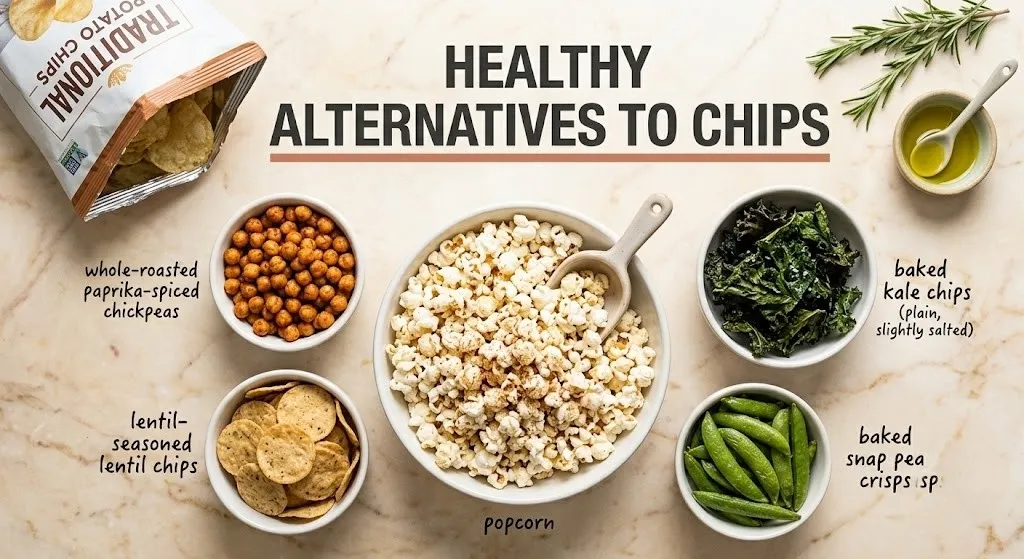
The satisfaction equation matters as much as the nutritional comparison. A chip substitute that looks good on paper but leaves you unsatisfied will not replace chips in your diet. The substitute must deliver on the sensory experience: the crunch, the salt, the mouthfeel, and the hand-to-mouth ritual. Air-popped popcorn provides volume and crunch. Roasted chickpeas provide a dense, nutty crunch. Kale chips provide a delicate, shattering crunch.
Key Takeaway: The best substitutes for potato chips provide more fiber and protein, less fat, and the same satisfying crunch. Roasted chickpeas and popcorn lead the category.
Healthy snacks to replace chips
Healthy snacks to replace chips fall into four categories: roasted legumes, vegetable chips, whole grain snacks, and fresh crunchy vegetables. Each category has different nutritional strengths and satisfies different aspects of the chip craving.
Roasted legumes include roasted chickpeas, roasted edamame, and roasted lentils. These snacks provide plant protein and fiber with a dense, crunchy texture. A 1-ounce serving of roasted chickpeas contains approximately 5 grams of fiber and 6 grams of protein. The fiber and protein combination promotes satiety, making it less likely that you will eat the entire bag.
Vegetable chips include kale chips, baked sweet potato chips, beet chips, and zucchini chips. These provide vitamins, minerals, and antioxidants along with the crunch. The nutritional quality depends on the cooking method. Baked or air-fried vegetable chips made at home with a small amount of oil are healthy. Deep-fried vegetable chips from a bag are often nutritionally similar to potato chips.
Fresh crunchy vegetables like carrot sticks, celery, bell pepper strips, cucumber slices, and radishes are the healthiest chip replacement by every nutritional metric. They provide fiber, vitamins, water, and crunch for negligible calories. The limitation is that they do not satisfy the salt-and-fat craving that chips fulfill.
Key Takeaway: Roasted legumes, baked vegetable chips, whole grain snacks, and fresh vegetables each replace chips in different ways. Combine them for the most satisfying result.
Potato chips healthy alternative
Potato chips have healthy alternatives that range from nearly identical in form to completely different in composition. The closest alternatives are baked potato chips and sweet potato chips, which provide the potato flavor and chip shape with less fat. The most nutritionally upgraded alternatives are legume-based snacks like roasted chickpeas and lentil chips, which add meaningful protein and fiber.
The chip aisle now includes products made from lentils, chickpeas, black beans, quinoa, and cassava flour. These alternative-base chips are marketed as healthier than potato chips. Some are. Some are not. A lentil chip that is deep-fried in vegetable oil and heavily salted is nutritionally similar to a potato chip with slightly more protein. The base ingredient matters less than the cooking method and the added oil and salt.
The evaluation standard for any chip alternative is the Nutrition Facts panel and ingredient list. A healthy chip alternative should have 3 grams or more of fiber per serving, 5 grams or more of protein per serving, less than 150 calories per ounce, and less than 150 milligrams of sodium per ounce. The ingredient list should start with a whole food, lentils, chickpeas, whole corn, rather than a refined starch or flour.
Key Takeaway: Potato chip alternatives range from baked potato chips to legume-based snacks. Evaluate by fiber, protein, and sodium content, not by the base ingredient alone.
Healthy crunchy snacks
Healthy crunchy snacks satisfy the universal human desire for foods that make noise when you bite them, without the nutritional downsides of fried potato products. The crunch craving is real and may have evolutionary roots. Crisp, crunchy foods signal freshness in fruits and vegetables. The food industry has exploited this preference by engineering hyper-crunchy, hyper-palatable processed snacks. The solution is to redirect the crunch craving toward whole foods that naturally deliver it.
The crunchiest healthy snacks ranked by crunch satisfaction and nutritional quality:
- Air-popped popcorn: High volume, high fiber, whole grain, 30 calories per cup.
- Roasted chickpeas: Dense crunch, high protein, high fiber, 120 calories per ounce.
- Kale chips: Delicate shatter, high vitamin K, high vitamin A, 50 calories per ounce.
- Rice cakes: Light crunch, whole grain if brown rice, 35 calories per cake.
- Snap pea crisps: Satisfying snap, moderate protein, 110 calories per ounce.
The key to making healthy crunchy snacks work is seasoning. The salt on potato chips is a significant part of the craving. Healthy alternatives need seasoning to compete. Nutritional yeast adds a cheese-like savory flavor. Smoked paprika adds depth. A light spray of oil and a sprinkle of salt on air-popped popcorn creates a snack that satisfies the salt craving without the fat load of chips.
Key Takeaway: Air-popped popcorn, roasted chickpeas, and kale chips are the crunchiest healthy snacks. Proper seasoning is essential for satisfying the salt craving.
Low calorie chip alternatives
Low calorie chip alternatives provide the crunch and flavor experience of chips for 50 to 120 calories per serving compared to 150 to 160 calories for standard potato chips. The calorie reduction comes from replacing fried oil with air, water, or baking, and from choosing base ingredients that are naturally lower in calorie density.
The best low calorie chip alternatives by calorie content:
- Air-popped popcorn: 30 calories per cup, 1 gram of fiber. A 3-cup serving is a large, satisfying bowl for 90 calories.
- Rice cakes: 35 to 50 calories per cake, depending on size and flavor. Choose plain brown rice cakes and add your own seasoning.
- Seaweed snacks: 25 to 50 calories per package, with a naturally salty, umami flavor. They are thin and crispy, not a volume snack.
- Kale chips (homemade baked): 50 to 70 calories per ounce. A full baking sheet of kale chips is visually abundant.
- Pickles (crunchy spears): 5 to 10 calories per spear. They deliver crunch and salt with almost no calories.
The calorie savings only matter if the alternative is satisfying. A 50-calorie rice cake that leaves you craving chips and leads to eating chips anyway is not a successful swap. Pairing a rice cake with a tablespoon of hummus or a slice of turkey adds protein and fat that increase satiety and make the snack more chip-replacing.
Key Takeaway: Air-popped popcorn and vegetable-based snacks provide the most volume and crunch for the fewest calories. Pair with protein for satiety.
Best healthy chips
The best healthy chips in the 2026 market are products that use whole-food base ingredients, are baked or air-fried rather than deep-fried, and keep sodium and saturated fat within reasonable limits. The category has expanded significantly, and the quality range is wide. Some “healthy chips” are nutritionally indistinguishable from potato chips with a different vegetable on the front of the bag.
The best healthy chip brands by category:
- Legume chips: Hippeas (chickpea puffs), The Good Bean (roasted chickpeas), Biena (roasted chickpeas).
- Tortilla chip alternatives: Siete (grain-free tortilla chips made from cassava and coconut flour), Late July (organic whole grain tortilla chips).
- Vegetable chips: Rhythm Superfoods (dehydrated kale and vegetable chips), Brad’s (dehydrated vegetable chips), Bare (baked apple and vegetable chips).
- Lentil and quinoa chips: SimplyProtein (lentil chips), Quinn (quinoa chips).
The evaluation standard for any packaged chip is the ingredient list first, then the Nutrition Facts panel. The ingredient list should be short and recognizable. The first ingredient should be the vegetable or legume the chip claims to be made from. The fiber content should be 3 grams or more per serving. The sodium should be 150 milligrams or less per serving.
Key Takeaway: Hippeas, Siete, Rhythm Superfoods, and Bare are among the best healthy chip brands. Always verify with the ingredient list and nutrition panel.
Are veggie chips healthy
Veggie chips are not automatically healthy. Many packaged veggie chips are made from potato starch or corn flour with vegetable powder or puree added for color and marketing. The ingredient list reveals the truth. If the first ingredient is potato starch or corn flour and the vegetable appears further down, the product is a potato chip with vegetable branding.
True vegetable chips are made from actual vegetables that are sliced, dehydrated, baked, or fried. Kale chips, beet chips, sweet potato chips, and carrot chips made from the whole vegetable are nutritionally superior to potato chips because they retain the vegetable’s fiber, vitamins, and minerals. A 1-ounce serving of baked beet chips provides approximately 2 grams of fiber, vitamin A, and potassium. A 1-ounce serving of kale chips provides 3 grams of fiber and significant vitamin K.
The cooking method determines whether a vegetable chip is healthy. Baked or dehydrated vegetable chips made at home with a light coating of olive oil are healthy. Deep-fried vegetable chips from a bag are marginally healthier than potato chips and not meaningfully different in fat and calorie content. The vegetable’s nutritional advantages are largely negated by the frying process.
Key Takeaway: Veggie chips are only healthy when the first ingredient is the actual vegetable and the chips are baked or dehydrated, not deep-fried.
Healthy chips at the store
Healthy chips at the store can be found by reading labels and ignoring the marketing on the front of the package. The snack aisle is designed to confuse. “Made with real vegetables,” “gluten-free,” “non-GMO,” and “no artificial flavors” are claims that can appear on products that are still deep-fried, high in sodium, and nutritionally similar to potato chips.
The systematic approach to finding healthy chips at the store follows four checks. First, check the ingredient list. The first ingredient should be a whole food: chickpeas, lentils, whole corn, kale, sweet potatoes. Second, check the fiber. The product should have 3 grams or more of fiber per serving. Third, check the cooking method. “Baked,” “air-fried,” or “dehydrated” is preferable to “fried.” Fourth, check the sodium. The product should have 150 milligrams or less per serving.
The store sections to check include the natural foods aisle, the chip aisle, and the produce section. The produce section often has refrigerated or shelf-stable vegetable chips and legume snacks that are less processed than their chip aisle counterparts. The chip aisle itself has improved significantly, with baked, legume-based, and whole-grain options from mainstream brands now available alongside traditional potato chips.
Key Takeaway: Find healthy chips by checking the ingredient list for whole-food first ingredients, 3+ grams of fiber, baked preparation, and 150 milligrams or less of sodium.
Healthy tortilla chips alternative
A healthy tortilla chips alternative provides the corn flavor and sturdy crunch of tortilla chips with more whole grain, more fiber, and less sodium. Traditional tortilla chips are deep-fried and salted, with a 1-ounce serving providing 140 calories, 7 grams of fat, and 150 milligrams of sodium. The alternatives improve on these numbers.
Baked tortilla chips are the simplest swap. Brands like Late July and Tostitos Baked produce tortilla chips that are baked rather than fried, reducing the fat content by 30% to 50% while maintaining the corn flavor and crunch. Siete grain-free tortilla chips are made from cassava flour, coconut flour, and avocado oil, providing a crunch that is remarkably similar to traditional tortilla chips with a cleaner ingredient list.
For a homemade alternative, cut corn tortillas into triangles, spray or brush lightly with oil, sprinkle with salt, and bake at 375 degrees Fahrenheit for 10 to 12 minutes until crisp. These baked tortilla chips have 40% to 50% less fat than fried versions because they absorb only the oil that is applied to the surface.
Key Takeaway: Baked tortilla chips, Siete grain-free chips, and homemade baked corn tortilla chips are healthier alternatives to traditional fried tortilla chips.
Healthy chips for weight loss
Healthy chips for weight loss provide volume, crunch, and satiety for the fewest calories, helping to maintain a calorie deficit without feeling deprived. The best weight loss chip alternatives are air-popped popcorn, kale chips, and raw vegetables with a small amount of dip. These provide the hand-to-mouth eating experience and oral satisfaction of chips with a fraction of the calories.
The volume-to-calorie ratio is the key metric for weight loss snacks. A 3-cup serving of air-popped popcorn is physically large and satisfying for 90 calories. A 1-ounce serving of potato chips is a small handful for 150 calories. The popcorn provides approximately five times the volume for 60% of the calories. This is the definition of a weight-loss-friendly food.
Portion control is still required. Even healthy chip alternatives contribute calories. Pre-portioning snacks into small bowls or bags prevents the mindless eating that turns a snack into a meal. The Academy of Nutrition and Dietetics recommends using small plates and bowls for snacks as a visual cue that supports appropriate portion sizes.
Key Takeaway: Air-popped popcorn and baked kale chips are the best chip alternatives for weight loss because they provide high volume and crunch for few calories.
Homemade healthy chips
Homemade healthy chips give you complete control over the ingredients, cooking method, and seasoning. You can make chips from almost any vegetable or legume with an oven, an air fryer, or a dehydrator. The process is simple: slice thin, coat lightly with oil and seasoning, and cook until crisp.
To make homemade healthy chips:
- Choose your base: kale (stems removed, torn into pieces), sweet potatoes (thinly sliced on a mandoline), beets (thinly sliced), zucchini (thinly sliced), or canned chickpeas (drained, rinsed, and dried thoroughly).
- Toss with a small amount of oil, approximately 1 teaspoon per 2 cups of vegetables or 1 can of chickpeas.
- Season with salt and any additional seasonings: smoked paprika, garlic powder, cumin, nutritional yeast, or chili powder.
- For vegetables, bake at 350 degrees Fahrenheit on a parchment-lined baking sheet in a single layer. Kale chips take 10 to 15 minutes. Sweet potato and beet chips take 20 to 25 minutes, flipping halfway through.
- For chickpeas, bake at 400 degrees Fahrenheit for 25 to 35 minutes, shaking the pan halfway through, until golden and crunchy.
The chips will crisp further as they cool. If they are soft out of the oven, they need more time. Cool completely before storing in an airtight container. Homemade chips do not have preservatives and are best eaten within 2 to 3 days.
Key Takeaway: Homemade chips require a vegetable or legume base, a light coating of oil, seasoning, and an oven or air fryer. Cool completely for maximum crunch.
Kale chips healthy
Kale chips are healthy when baked or air-fried at home with a small amount of oil. A 1-ounce serving of homemade kale chips provides approximately 50 to 70 calories, 3 grams of fiber, 3 grams of protein, and significant amounts of vitamin K (over 100% of the Daily Value), vitamin A, and vitamin C. They are one of the most nutrient-dense crunchy snacks available.
Store-bought kale chips vary in healthfulness. Rhythm Superfoods kale chips are dehydrated with a small amount of oil and seasoning, preserving the nutritional content of the kale. Other brands fry their kale chips, adding fat and calories that reduce the nutritional advantage. Check the ingredient list and the fat content. A healthy kale chip should have less than 8 grams of fat per ounce.
The one downside of kale chips is their fragility. They crumble easily and do not travel well in a bag. They are best eaten at home, made fresh, or carefully packed in a rigid container. The delicate shatter is part of the appeal for some people and a frustration for others.
Key Takeaway: Homemade baked kale chips are one of the healthiest crunchy snacks, providing fiber, protein, and over 100% of the Daily Value for vitamin K.
Roasted chickpeas
Roasted chickpeas are one of the best healthy alternatives to chips because they provide a dense, satisfying crunch along with 5 grams of fiber and 6 grams of protein per ounce. They are made from a single whole-food ingredient, chickpeas, which are a legume rich in folate, iron, magnesium, and plant protein.
The technique for crunchy roasted chickpeas requires thorough drying before roasting. Canned chickpeas should be drained, rinsed, and dried with a clean kitchen towel or paper towels until the skins start to loosen and the chickpeas feel dry to the touch. Removing the loose skins is optional but produces a crunchier result. Toss with oil and seasonings, then roast at 400 degrees Fahrenheit until deeply golden and crunchy, 25 to 35 minutes.
Roasted chickpeas lose their crunch within a day if stored in an airtight container. They are best eaten the day they are made. If you need a shelf-stable version, commercial roasted chickpea snacks like The Good Bean and Biena are crunchy and available in multiple flavors. They are more expensive than homemade but convenient.
Key Takeaway: Roasted chickpeas provide 5 grams of fiber and 6 grams of protein per ounce. Thorough drying and high-heat roasting are essential for maximum crunch.
Vegetable chips healthy
Vegetable chips are healthy when they are made from actual vegetables, baked or dehydrated rather than fried, and minimally processed. The vegetables that make the best chips are kale, sweet potatoes, beets, carrots, parsnips, and zucchini. Each provides different nutrients and a different crunch profile.
Sweet potato chips provide vitamin A (as beta-carotene), fiber, and potassium. Beet chips provide folate, manganese, and nitrates that may support blood flow. Carrot chips provide vitamin A and a natural sweetness. Zucchini chips provide a light, delicate crunch with very few calories.
The vegetable chip category is undermined by products that use vegetable powders or purees mixed with starches and fried. These products are vegetable-flavored chips, not vegetable chips. The distinction is on the ingredient list. If the first ingredient is a vegetable and the chip is baked or dehydrated, it is a vegetable chip. If the first ingredient is potato starch or corn flour, it is a potato chip with vegetable marketing.
Key Takeaway: True vegetable chips are made from sliced vegetables, baked or dehydrated. Read the ingredient list to distinguish them from vegetable-flavored starch chips.
Air popped popcorn
Air-popped popcorn is arguably the single best healthy alternative to chips because it is a 100% whole grain that provides high volume, high fiber, and complete customizability for very few calories. A 3-cup serving of air-popped popcorn contains approximately 90 calories, 3 grams of fiber, 3 grams of protein, and less than 1 gram of fat. It is naturally low in sodium and contains zero additives.
The whole-grain status of popcorn is a nutritional advantage that most chip alternatives cannot claim. The USDA Dietary Guidelines recommend that at least half of grain intake be whole grains, and popcorn is one of the most accessible and affordable whole-grain snack foods. The fiber in popcorn is predominantly insoluble, which supports digestive regularity.
Popcorn becomes unhealthy when it is drowned in butter, oil, or sugary coatings. Movie theater popcorn can contain 400 to 600 calories and 30 to 50 grams of fat for a medium bag. Microwave popcorn varies by brand, with some containing significant added fat and sodium. Air-popped popcorn seasoned with a light spray of oil and a sprinkle of salt or nutritional yeast is the healthy version.
Key Takeaway: Air-popped popcorn is a whole-grain, high-fiber, low-calorie crunchy snack that replaces chips effectively when seasoned well and not drowned in butter.
Keto chip alternatives
Keto chip alternatives are crunchy snacks that keep net carbohydrates below 5 grams per serving while providing the fat that the ketogenic diet requires. Traditional potato chips and tortilla chips are incompatible with keto because of their carbohydrate content. The alternatives use low-carb vegetables, cheese, or pork rinds as the base.
The best keto chip alternatives include kale chips ( 3 grams net carbs per ounce ), cheese crisps (baked parmesan or cheddar rounds with 0 grams carbs ), pork rinds ( 0 grams carbs , high protein), zucchini chips (baked thin with 2 grams net carbs per ounce ), and seed crackers made from flax, chia, or sesame seeds. These provide crunch and salt without the carbohydrates of grain or potato-based snacks.
Commercial keto chip options include Whisps (baked cheese crisps), Moon Cheese (dehydrated cheese snacks), 4505 and Epic pork rinds, and Flackers (flax seed crackers). These products are available in the chip aisle and the natural foods section.
Key Takeaway: Kale chips, cheese crisps, pork rinds, zucchini chips, and seed crackers are keto-compatible chip alternatives with under 5 grams of net carbohydrates per serving.
How to stop eating chips
How to stop eating chips requires addressing the craving at its source, which is often a combination of habit, salt preference, and the specific sensory experience of crunch and mouthfeel. Simply removing chips without replacing the sensory experience they provide sets up a deprivation dynamic that is difficult to sustain.
The most effective strategy is substitution plus environmental control. Replace chips with one or two of the alternatives in this guide that genuinely satisfy you. Remove chips from your home. If chips are not in the pantry, eating them requires a deliberate trip to the store, which creates a pause between craving and consumption. Keep the healthy alternatives visible and accessible.
The salt craving can be addressed by ensuring adequate hydration and electrolyte intake. Sometimes a chip craving is a salt craving, and a glass of water with a pinch of salt or a serving of salted edamame satisfies it. The crunch craving can be addressed by adding crunchy raw vegetables to meals, so the need for crunch is met before it becomes a snack-specific craving.
Key Takeaway: Replace chips with satisfying alternatives, remove chips from your environment, and address the salt and crunch cravings at their source through hydration and crunchy vegetables at meals.
Frequently Asked Questions About Chip Alternatives
What is the healthiest alternative to potato chips?
Air-popped popcorn is the healthiest alternative because it is a whole grain with 3 grams of fiber per 3-cup serving for only 90 calories.
Roasted chickpeas provide more protein at 6 grams per ounce with 5 grams of fiber.
Both are whole foods that deliver crunch without the empty calories and excess sodium of potato chips.
Are veggie chips actually healthier than potato chips?
True vegetable chips made from sliced, baked vegetables are healthier than potato chips because they retain fiber, vitamins, and minerals.
Many packaged veggie chips are made from potato starch with vegetable powder and are nutritionally similar to potato chips.
Check the ingredient list. The first ingredient should be the actual vegetable, not starch or flour.
How do I stop craving chips?
Replace chips with a satisfying alternative that delivers the same crunch and salt, like seasoned popcorn or roasted chickpeas.
Remove chips from your home so that eating them requires a deliberate trip to the store.
Ensure you are hydrated and getting enough salt from whole-food sources. Sometimes a chip craving is a salt or crunch craving in disguise.
Can I eat chips and still lose weight?
You can eat chips and lose weight if you control the portion size and fit them into your calorie deficit.
A single 1-ounce serving of chips is 150 calories. The problem is that most people eat 2 to 4 ounces at a time.
Pre-portion chips into a small bowl rather than eating from the bag, and pair them with a protein source for satiety.
What are the best healthy chips to buy at the store?
Hippeas (chickpea puffs), Siete (grain-free tortilla chips), Rhythm Superfoods (dehydrated kale chips), and Bare (baked apple and vegetable chips) are among the best.
Look for whole-food first ingredients, 3 grams or more of fiber, baked or air-fried preparation, and 150 milligrams or less of sodium per serving.
The natural foods aisle often has better options than the main chip aisle.
The chip craving is one of the most powerful forces in the modern snack food environment. It is not a personal failing to want chips. Chips were engineered to be exactly what you want. The solution is not to overpower the craving with willpower. It is to redirect it toward foods that satisfy the same sensory needs without the nutritional consequences.
The most practical thing you can do is pick two alternatives from this guide and stock them this week. One homemade, one store-bought. When the chip craving hits, eat the alternative first. If you still want chips after that, have a measured portion. The goal is not to eliminate chips from your life. It is to make them occasional rather than habitual, and to build the habit of reaching for something better first.