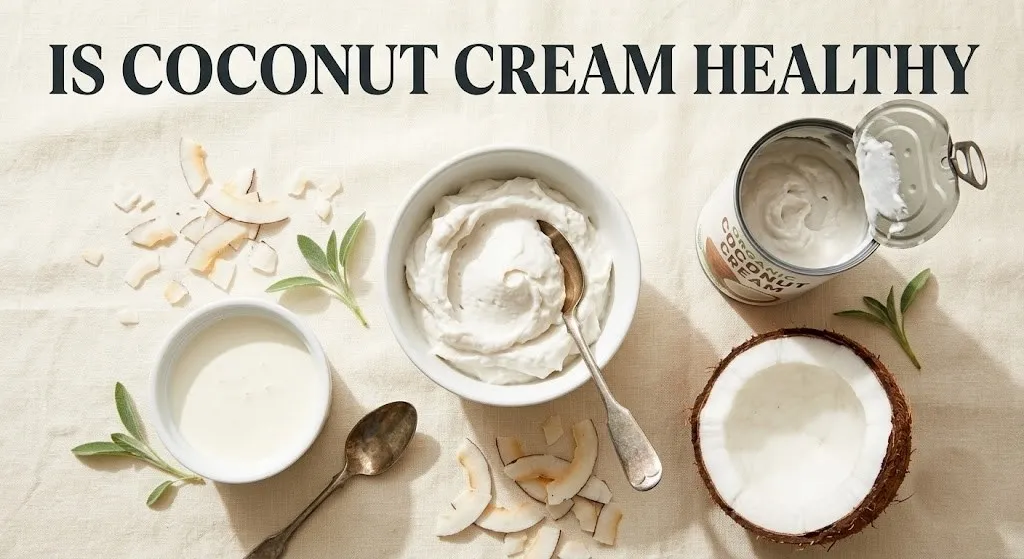
Coconut cream is healthy in moderation and unhealthy in excess, which makes it exactly like almost every other calorie-dense fat source in the human diet. Two tablespoons deliver roughly 100 calories, 10 grams of total fat, and 9 grams of saturated fat alongside meaningful amounts of manganese and copper. Whether that nutritional profile works for you depends on your overall dietary pattern, your cardiovascular risk factors, and what coconut cream is replacing on your plate.
The saturated fat in coconut cream is not identical to the saturated fat in butter or beef tallow. Roughly half of it is lauric acid, a 12-carbon medium-chain triglyceride that the body metabolizes differently than the long-chain saturated fats in animal products. The American Heart Association still recommends limiting all saturated fat to less than 6 percent of daily calories, citing the LDL cholesterol raising effect. More recent research from a 2023 study in the Journal of the American College of Cardiology suggests that the food matrix and the specific fatty acid type matter more than the total saturated fat number alone.
This article gives you the full nutritional breakdown, explains the MCT science, compares coconut cream directly to heavy cream, coconut milk, coconut creamer, and cream of coconut, and offers a clear framework for deciding how much coconut cream belongs in your specific eating pattern. You will walk away knowing whether the can in your pantry is a smart staple or a sometimes food.
Is Coconut Cream Healthy
Coconut cream can be part of a healthy diet when used in appropriate portions and when it replaces less healthy fat sources rather than adding extra calories on top of an already energy-dense meal. The direct answer is not a simple yes or no. It is a qualified yes for most people consuming 1 to 2 tablespoons per day as part of a dietary pattern rich in vegetables, fiber, and unsaturated fats from sources like olive oil, nuts, and fish.
The health impact of coconut cream depends on three factors. The first is portion size. A tablespoon stirred into a curry that serves four people distributes the saturated fat across multiple portions and adds creaminess for roughly 25 calories and 2.5 grams of saturated fat per serving. Half a can poured into a smoothie bowl for one person delivers 400 calories and 36 grams of saturated fat in a single meal. The ingredient is the same. The dietary effect is completely different.
The second factor is what coconut cream replaces. Swapping coconut cream for heavy dairy cream in a recipe removes dietary cholesterol, lactose, and dairy proteins while adding MCTs and minerals. The saturated fat grams are roughly equivalent. Swapping coconut cream for olive oil or avocado in a dressing increases the saturated fat and decreases the unsaturated fat, which is a less favorable trade for cardiovascular health. The third factor is the individual’s baseline LDL cholesterol, family history, and overall saturated fat intake from the rest of their diet.
| Health Context | Is Coconut Cream Healthy? | Guidance |
|---|---|---|
| Replacing heavy cream in a plant-based diet | Yes, in 1 to 2 tbsp portions | Comparable saturated fat, no dietary cholesterol, adds manganese |
| Replacing olive oil or avocado | No, increases saturated fat intake | Prefer unsaturated fat sources for heart health |
| Daily staple in large amounts (1/2 cup+) | No, excessive saturated fat | Exceeds AHA saturated fat guidelines for most people |
| Occasional use in curries and soups | Yes | Distributed across multiple servings, adds culinary value |
| Elevated LDL cholesterol | Use with caution, limit to 1 tbsp | Discuss with healthcare provider, prioritize unsaturated fats |
People with diagnosed cardiovascular disease or familial hypercholesterolemia should apply more conservative saturated fat limits than the general population. The Academy of Nutrition and Dietetics recommends individualizing saturated fat guidance based on lipid panel results and overall dietary pattern quality rather than applying a single number to everyone.
Coconut Cream Healthy
The question “coconut cream healthy” searches the same nutritional evaluation as the main keyword. Coconut cream earns its health-conscious reputation from its micronutrient content and MCT profile, not from its saturated fat load. A two-tablespoon serving provides 15 percent of the daily value for manganese and 8 percent for copper, according to USDA FoodData Central. Manganese functions as a cofactor for the antioxidant enzyme superoxide dismutase and supports bone formation and wound healing. Copper contributes to iron metabolism and connective tissue formation.
The fiber content in coconut cream is modest, roughly 0.5 grams per two tablespoons. It is not a fiber source worth counting toward daily goals. The protein content is also minimal at 1 gram per serving. Coconut cream is nutritionally a fat source with incidental micronutrients, not a balanced whole food. Framing it as a health food because of the manganese would be like calling bacon a health food because of its selenium content. The full nutritional picture matters more than any single micronutrient.
Coconut cream fits well into specific dietary patterns that emphasize fat as a primary energy source. The ketogenic diet, which restricts carbohydrates to under 50 grams daily, uses coconut cream as a compliant high-fat ingredient for sauces, fat bombs, and coffee. Plant-based diets that exclude dairy use coconut cream as a functional replacement for heavy cream in recipes where nut-based creams would separate or lack the required fat content. In both cases, coconut cream solves a culinary problem while aligning with the dietary framework. That is a legitimate form of healthy.
Quick Tip:
- Look for canned coconut cream with a short ingredient list: coconut, water, and sometimes guar gum as a stabilizer. Avoid products with added sugar, which puts them in the cream of coconut category with a different nutritional profile.
- Shake the can before opening or stir the contents after opening. Coconut cream separates naturally with the thick cream rising to the top and the liquid settling at the bottom.
Coconut Cream Nutrition Facts
A standard two-tablespoon serving of canned coconut cream weighs approximately 30 grams and contains the following nutrient breakdown based on USDA FoodData Central values for unsweetened coconut cream. The numbers represent a typical national brand. Specific products vary by brand, coconut variety, and whether stabilizers like guar gum affect the water content.
| Nutrient | Amount per 2 tbsp (30g) | Percent Daily Value |
|---|---|---|
| Calories | 100 | N/A |
| Total Fat | 10g | 13% |
| Saturated Fat | 9g | 45% |
| Monounsaturated Fat | 0.4g | N/A |
| Polyunsaturated Fat | 0.1g | N/A |
| Trans Fat | 0g | N/A |
| Cholesterol | 0mg | 0% |
| Sodium | 5mg | 0% |
| Total Carbohydrate | 1g | 0% |
| Dietary Fiber | 0.5g | 2% |
| Total Sugars | 0g | N/A |
| Protein | 1g | 2% |
| Manganese | 0.3mg | 15% |
| Copper | 0.07mg | 8% |
| Iron | 0.5mg | 3% |
| Phosphorus | 30mg | 2% |
| Magnesium | 10mg | 2% |
| Potassium | 60mg | 1% |
The saturated fat number dominates the label. Nine grams represents nearly half the American Heart Association recommended daily limit of 13 grams for someone consuming 2,000 calories per day and limiting saturated fat to 6 percent of calories. A single two-tablespoon serving uses up almost half the daily saturated fat budget. Two servings use essentially the whole budget. That math, more than any single study, is the practical reason nutrition professionals recommend moderation with coconut cream.
The zero sugar and zero cholesterol numbers are genuine positives compared to many processed cream alternatives and dairy creams respectively. Coconut cream contains no lactose, making it suitable for people with lactose intolerance. It contains no dairy proteins, making it safe for people with a cow’s milk protein allergy. These are real nutritional advantages for specific populations, not marketing spin.
Key Takeaway: Coconut cream delivers 100 calories and 9 grams of saturated fat in just 2 tablespoons, using nearly half the AHA daily saturated fat limit. Its manganese and copper content is meaningful but does not offset the saturated fat load for someone with elevated cardiovascular risk.
Is Coconut Cream a Healthy Fat
Coconut cream is a healthy fat for people whose dietary pattern benefits from a plant-based saturated fat source with a favorable MCT profile and who consume it within the context of an overall diet low in animal-based saturated fats. It is not a healthy fat for someone adding it to a diet already rich in butter, cheese, fatty meats, and processed foods. The health assessment of any fat depends on the total dietary pattern, not the isolated ingredient.
The fat in coconut cream is roughly 90 percent saturated. That number sounds alarming through the lens of 1990s nutrition science that treated all saturated fat as equally harmful. Current understanding, reflected in a 2020 review in the journal Nutrients, distinguishes between saturated fat types based on chain length and food source. Lauric acid, which makes up about 47 percent of the fatty acids in coconut cream, is a 12-carbon saturated fat that raises HDL cholesterol more than it raises LDL cholesterol in most studies. Stearic acid, the 18-carbon saturated fat in beef and chocolate, has a neutral effect on blood lipids. Palmitic acid, the 16-carbon saturated fat concentrated in palm oil and dairy fat, consistently raises LDL cholesterol.
The fat in coconut cream is metabolized more like a medium-chain triglyceride than a long-chain saturated fat, though the distinction is not clean. True MCTs are caprylic acid (C8:0) and capric acid (C10:0), which are absorbed directly into the portal vein and transported to the liver for rapid oxidation. Coconut cream contains only small amounts of these true MCTs, roughly 6 to 8 percent of total fatty acids. Lauric acid, the dominant fat, has properties of both MCTs and long-chain fats. Some of it is absorbed through the portal system like an MCT. Some of it is packaged into chylomicrons like a long-chain fat. The net metabolic effect is intermediate between the two categories.
| Fat Type | Chain Length | Primary Food Sources | Effect on LDL Cholesterol | Effect on HDL Cholesterol |
|---|---|---|---|---|
| Lauric acid (C12:0) | Medium (12 carbons) | Coconut cream, coconut oil | Modest increase | Larger increase |
| Palmitic acid (C16:0) | Long (16 carbons) | Dairy fat, beef, palm oil | Consistent increase | Minimal effect |
| Stearic acid (C18:0) | Long (18 carbons) | Beef, cocoa butter | Neutral | Neutral |
| Caprylic/Capric acid (C8:0/C10:0) | Medium (8-10 carbons) | Coconut oil, MCT oil supplements | Neutral to minimal | Minimal effect |
| Oleic acid (C18:1) | Long monounsaturated | Olive oil, avocado | Decrease | Neutral to increase |
The practical takeaway: coconut cream’s fat is healthier than butter or palm oil for blood lipid profiles, less healthy than olive oil or avocado oil, and roughly comparable to dairy cream with a different mechanism of metabolic effect. The best use of coconut cream is as a replacement for less healthy saturated fat sources, not as an addition to an already adequate diet.
Coconut Cream Saturated Fat Good or Bad
The saturated fat in coconut cream is neither uniformly good nor uniformly bad. It raises total cholesterol, which concerns some cardiologists, but it raises HDL cholesterol proportionally more than LDL cholesterol in many studies, which complicates the risk calculation. A 2023 study in the Journal of the American College of Cardiology examined the relationship between different saturated fatty acid types and cardiovascular outcomes in a large prospective cohort. The researchers found that saturated fat from dairy sources was not associated with increased cardiovascular risk, while saturated fat from meat sources showed a modest positive association. Coconut-derived saturated fat was not analyzed as a separate category, but the study reinforces the current scientific position that saturated fat type and food matrix matter more than total saturated fat grams.
The practical problem with the saturated fat in coconut cream is not the lauric acid itself. It is the displacement effect. When someone adds coconut cream to their diet without removing something else, total calorie and saturated fat intake increases. When someone uses coconut cream to replace olive oil in a dressing or avocado in a smoothie, they are swapping a fat with proven cardiovascular benefits for a fat with mixed evidence. The American Heart Association maintains its recommendation to limit saturated fat based on decades of randomized controlled trials showing that replacing saturated fat with polyunsaturated fat reduces cardiovascular events. That recommendation stands in 2026.
People without elevated LDL cholesterol or other cardiovascular risk factors have more dietary flexibility with saturated fat than people managing diagnosed heart disease. The Academy of Nutrition and Dietetics notes that dietary guidance should consider the individual’s lipid profile, family history, and overall dietary pattern rather than applying population-level saturated fat targets rigidly to every person. Someone with LDL cholesterol below 100 mg/dL, HDL above 60 mg/dL, and triglycerides below 150 mg/dL who eats a Mediterranean-style diet with minimal processed food can likely include coconut cream in moderation without concern.
Quick Tip:
- If you use coconut cream regularly, ask your healthcare provider to include a lipid panel in your next blood work. Track your LDL, HDL, and triglyceride numbers over time. The individual response to dietary saturated fat varies genetically, and your own lipid numbers are more informative than any population-level guideline.
- Pair coconut cream with soluble fiber sources like beans, oats, or barley in the same meal. Soluble fiber binds bile acids in the intestine and reduces LDL cholesterol, partially offsetting the saturated fat effect.
Key Takeaway: The saturated fat in coconut cream has a more favorable metabolic profile than animal saturated fats due to lauric acid’s HDL-raising effect, but it still raises total cholesterol. Its health impact depends on what it replaces and the individual’s baseline cardiovascular risk.
Coconut Cream Benefits
Coconut cream offers several nutritionally legitimate benefits beyond its macronutrient profile. The manganese content is the most concentrated micronutrient benefit at 15 percent of the daily value per two-tablespoon serving. Manganese functions as an essential cofactor for manganese superoxide dismutase, a primary antioxidant enzyme that protects mitochondria from oxidative damage. It also supports the enzymes involved in bone mineralization and collagen synthesis. A dietary pattern that includes coconut cream contributes to manganese status without requiring a supplement.
The antimicrobial properties of lauric acid are supported by laboratory research, though the clinical relevance for dietary intake is less established. Lauric acid and its monoglyceride form, monolaurin, demonstrate bactericidal and virucidal activity in vitro against lipid-enveloped pathogens. The NIH notes that human breast milk contains lauric acid for this immunological purpose. The amount of lauric acid in a serving of coconut cream is far lower than a therapeutic dose of monolaurin, and dietary consumption does not produce the same tissue concentrations as direct supplementation. The benefit is real at a biochemical level but modest at a dietary level.
Coconut cream provides culinary functionality that supports healthier eating patterns for people with dietary restrictions. It makes creamy soups and curries possible without dairy. It whips into a dessert topping without the need for stabilizers or added sugars. It adds richness to plant-based sauces that would otherwise rely on refined oils. These culinary benefits matter because they help people adhere to dietary patterns that exclude dairy for allergy, intolerance, ethical, or preference reasons. A food that makes a restrictive diet more enjoyable and sustainable has a behavioral health benefit that does not show up on a nutrition facts panel.
| Benefit Category | Specific Benefit | Strength of Evidence |
|---|---|---|
| Micronutrient density | Manganese 15% DV, copper 8% DV per serving | Strong (USDA documented) |
| Antimicrobial potential | Lauric acid and monolaurin activity in vitro | Moderate (laboratory evidence, limited clinical dietary data) |
| Culinary functionality | Dairy-free cream replacement, emulsification, whipping | Strong (practical application) |
| Dietary pattern adherence | Supports dairy-free, vegan, keto, paleo eating patterns | Strong (behavioral nutrition) |
| Satiety | High fat content promotes satiety signaling | Moderate (consistent with general fat satiety research) |
People with tree nut allergies should consult their allergist about coconut. The FDA classifies coconut as a tree nut for labeling purposes, but most people with tree nut allergies can safely consume coconut because the allergenic proteins in coconut are distinct from those in walnuts, almonds, and other tree nuts. Cross-reactivity is rare but documented. An allergist can perform specific IgE testing to determine individual reactivity.
Coconut Cream vs Coconut Milk Health
Coconut cream is the concentrated, higher-fat version of coconut milk. Coconut cream contains roughly 20 to 25 percent fat by weight. Coconut milk contains roughly 15 to 18 percent fat for full-fat canned versions, and 5 to 7 percent for light versions. The two products are made from the same starting material, pressed mature coconut meat, but coconut cream uses a higher ratio of coconut to water during processing. The nutritional difference is primarily fat concentration and calorie density.
For health purposes, coconut cream and full-fat coconut milk are interchangeable in terms of fatty acid profile. Both are dominated by lauric acid with similar proportions of MCTs, monounsaturated fat, and polyunsaturated fat. The micronutrient profile is similar, with coconut cream offering slightly higher manganese and copper per tablespoon simply because there is less water diluting the coconut solids. The choice between them is a texture and calorie decision, not a nutritional quality decision.
Light coconut milk is a meaningfully different product from a health perspective. It contains 5 to 7 percent fat, roughly one-third to one-half the fat of full-fat coconut milk. The calorie reduction is substantial: 50 to 70 calories per half cup for light coconut milk versus 200 to 220 calories for the same amount of full-fat coconut milk. Light coconut milk achieves the lower fat content either through dilution with water or through centrifugal separation to remove some of the cream. It is the better choice for someone who wants coconut flavor and creaminess in soups and curries without the full saturated fat load.
| Product | Fat Content | Calories per 1/2 cup | Saturated Fat per 1/2 cup | Best Use |
|---|---|---|---|---|
| Coconut cream | 20 to 25% | 400 to 480 | 36 to 42g | Whipped cream replacement, thick curries, desserts |
| Full-fat coconut milk | 15 to 18% | 200 to 220 | 16 to 18g | Curries, soups, sauces, general cooking |
| Light coconut milk | 5 to 7% | 50 to 70 | 4 to 6g | Lower-calorie soups, smoothies, everyday cooking |
| Coconut milk beverage (carton) | 1 to 2% | 35 to 50 | 0 to 1g | Drinking, cereal, coffee (not for cooking) |
The carton coconut milk beverage sold in the refrigerated section next to oat and almond milk is a different product entirely. It is heavily diluted with water and typically fortified with calcium, vitamin D, and vitamin B12. It contains minimal coconut fat and will not perform the same way in recipes. It is a beverage, not a cooking ingredient. Using it in a curry that calls for canned coconut milk will produce a thin, watery result.
Key Takeaway: Coconut cream is simply concentrated coconut milk with about 30 to 50 percent more fat. Light coconut milk cuts the fat by two-thirds while retaining coconut flavor, making it the smarter daily choice for people who cook with coconut regularly.
Coconut Cream vs Heavy Cream Nutrition
Coconut cream and heavy whipping cream are nutritionally distinct fats used for similar culinary purposes. Heavy cream is a dairy product containing approximately 100 calories, 11 grams of total fat, and 7 grams of saturated fat per two-tablespoon serving. It also contains cholesterol, about 20 milligrams per serving, and small amounts of vitamin A and calcium. Coconut cream contains 100 calories, 10 grams of total fat, and 9 grams of saturated fat per two-tablespoon serving with zero cholesterol, more manganese and copper, and no calcium to speak of.
The saturated fat comparison is closer than most people assume. Heavy cream has 7 grams of saturated fat per two tablespoons. Coconut cream has 9 grams. The difference of 2 grams per serving is modest. The type of saturated fat is the more meaningful distinction. Heavy cream’s saturated fat is primarily palmitic acid, which consistently raises LDL cholesterol in controlled feeding studies. Coconut cream’s saturated fat is primarily lauric acid, which raises HDL cholesterol along with LDL, producing a less atherogenic lipid profile shift overall according to multiple metabolic ward studies.
The absence of dietary cholesterol in coconut cream is a real advantage for individuals who are dietary cholesterol hyper-responders, a genetic subset where dietary cholesterol intake directly influences blood cholesterol levels. For the majority of people, dietary cholesterol has a smaller effect on blood cholesterol than saturated fat intake, per the USDA Dietary Guidelines. For hyper-responders, swapping heavy cream for coconut cream removes a dietary cholesterol source while keeping saturated fat roughly constant, which may improve lipid numbers.
| Nutrient (per 2 tbsp) | Coconut Cream | Heavy Whipping Cream | Difference |
|---|---|---|---|
| Calories | 100 | 100 | Equal |
| Total Fat | 10g | 11g | Coconut: 1g less |
| Saturated Fat | 9g | 7g | Coconut: 2g more |
| Cholesterol | 0mg | 20mg | Coconut: none |
| Carbohydrate | 1g | 0.4g | Coconut: 0.6g more |
| Protein | 1g | 0.3g | Coconut: 0.7g more |
| Calcium | 0% DV | 2% DV | Cream: more |
| Manganese | 15% DV | 0% DV | Coconut: more |
| Copper | 8% DV | 0% DV | Coconut: more |
People with lactose intolerance, which affects roughly 68 percent of the global population according to the NIH, can use coconut cream as a direct functional replacement for heavy cream. People with a cow’s milk protein allergy, which is distinct from lactose intolerance and involves an immune response to casein or whey, require strict dairy avoidance and coconut cream is safe for them. People without dairy issues can use either product based on flavor preference, dietary pattern, and saturated fat source preference.
Is Coconut Creamer Healthy
Coconut creamer, the product sold in cartons or shelf-stable containers for coffee and tea, is a processed food whose health profile depends entirely on the specific brand and formulation. Coconut creamers range from relatively simple products containing coconut cream, water, and a stabilizer, to highly processed products containing added sugars, oils, emulsifiers, and natural flavors. The average coconut creamer contains 10 to 30 calories and 1 to 2 grams of fat per tablespoon, significantly less than the 100 calories and 10 grams of fat in canned coconut cream.
The lower fat content in coconut creamers is achieved through dilution. The coconut base is mixed with water and often supplemented with thickeners like guar gum, gellan gum, or carrageenan to create a creamy mouthfeel without the fat load. Some brands add sunflower lecithin or other emulsifiers to prevent separation in hot coffee. The ingredient list for a typical coconut creamer might read: water, coconut cream, cane sugar, calcium phosphate, guar gum, gellan gum, natural flavors. This is a processed food by any reasonable definition.
The health assessment of coconut creamer depends on the sugar content. Unsweetened coconut creamers with simple ingredient lists are reasonable daily-use products for people who want a dairy-free coffee additive. Sweetened coconut creamers with 3 to 5 grams of added sugar per tablespoon turn a morning coffee ritual into a modest sugar delivery system. Multiple cups per day with sweetened creamer can contribute 15 to 25 grams of added sugar before breakfast, approaching the American Heart Association daily added sugar limit of 25 grams for women and 36 grams for men.
| Coconut Creamer Type | Calories per tbsp | Fat per tbsp | Sugar per tbsp | Ingredient Quality |
|---|---|---|---|---|
| Unsweetened, minimal ingredients | 10 to 15 | 1g | 0g | Good (coconut cream, water, stabilizer) |
| Unsweetened, barista blend | 20 to 25 | 2g | 0g | Moderate (added thickeners, emulsifiers) |
| Sweetened, standard | 20 to 30 | 1 to 2g | 3 to 5g | Poor (added sugar as primary concern) |
| Powdered coconut creamer | 15 to 25 | 1 to 3g | 2 to 4g | Poor (often contains corn syrup solids, hydrogenated oils) |
Quick Tip:
- Read the ingredient list, not the front label. A coconut creamer marketed as plant-based and dairy-free can still contain 4 grams of added sugar per tablespoon. Unsweetened versions from brands like Nutpods, Califia Farms, and So Delicious are the better daily choice.
- Powdered coconut creamers are the most processed category and often contain sodium caseinate, a milk protein, which makes them not dairy-free despite the coconut branding. Check the label if you are avoiding dairy.
Is Cream of Coconut Healthy
Cream of coconut is not a health food and should be categorized as a dessert ingredient or cocktail mixer, not a dietary staple. Cream of coconut is coconut cream that has been heavily sweetened with sugar, typically containing 20 to 25 grams of sugar per two-tablespoon serving. Brands like Coco Lopez and Goya Cream of Coconut are formulated specifically for pina coladas and tropical cocktails. The ingredient list for Coco Lopez reads: coconut, sugar, water, polysorbate 60, sorbitan monostearate, salt, propylene glycol alginate, citric acid, ascorbic acid.
The nutritional comparison between coconut cream and cream of coconut is stark. Two tablespoons of unsweetened coconut cream contain 100 calories, 10 grams of fat, and 0 grams of sugar. Two tablespoons of cream of coconut contain 130 to 160 calories, 5 to 7 grams of fat, and 20 to 25 grams of added sugar. The sugar content alone is nearly the entire American Heart Association daily added sugar limit for women and more than half the limit for men, in two tablespoons of a product that is often used in much larger quantities in blended drinks.
The emulsifiers and stabilizers in cream of coconut (polysorbate 60, sorbitan monostearate, propylene glycol alginate) are FDA-approved food additives that are generally recognized as safe in the amounts typically consumed. Their presence signals that the product is formulated for process stability in canned and shelf-stable applications, not for nutritional quality. There is no reason to avoid these additives from a safety standpoint. There is also no reason to choose cream of coconut over unsweetened coconut cream from a health standpoint unless you are specifically making pina coladas and accept the sugar load as part of the indulgence.
People sometimes confuse cream of coconut with coconut cream and use them interchangeably in savory recipes. The result is a sugary curry or a sweet soup that tastes unmistakably wrong. Store cream of coconut next to the cocktail mixers mentally, not next to the cooking ingredients. If a can says “cream of coconut” and lists sugar as the second ingredient, it belongs in a cocktail shaker, not a stir-fry.
Key Takeaway: Cream of coconut is a sugar-sweetened cocktail product with 20 to 25 grams of sugar per 2 tablespoons. It is not a health food and should not be confused with unsweetened coconut cream. Use it for pina coladas, not for everyday cooking.
Is Canned Coconut Cream Healthy
Canned coconut cream is healthy under the same moderation framework as any coconut cream product. The canning process itself does not degrade the nutritional profile. The primary health concern with canned coconut cream is the BPA (bisphenol A) used in some can linings. BPA is an endocrine-disrupting chemical that can leach into fatty foods, and coconut cream is a high-fat food stored in direct contact with the can lining for months or years.
The FDA has not banned BPA in food packaging as of 2026, but consumer pressure has pushed many coconut product manufacturers to switch to BPA-free can linings. Brands including Native Forest, Natural Value, and Trader Joe’s coconut products use BPA-free cans. The brand’s website or the can label typically states BPA-free status if applicable. If the information is not available on the label, contacting the manufacturer is the only way to confirm.
The nutritional content of canned coconut cream is identical to coconut cream from any other packaging format. The fat content, MCT profile, manganese level, and calorie density are determined by the coconut-to-water ratio, not by the can. Canned coconut cream often separates in storage with the thick cream rising to the top of the can. This is normal and does not indicate spoilage. Shake the can before opening or scrape the cream and liquid into a bowl and whisk to recombine.
Canned coconut cream should be stored in a cool, dry pantry before opening. After opening, transfer any unused portion to a glass or ceramic container with a tight lid. Do not store opened coconut cream in the can itself. Exposure to air and the can’s metal interior accelerates oxidation and off-flavor development. Refrigerated, opened coconut cream stays fresh for 4 to 5 days. Frozen, it keeps for up to 3 months though the texture may separate slightly upon thawing.
| Canned Coconut Cream Brand | BPA-Free Can? | Organic? | Stabilizers Added? |
|---|---|---|---|
| Native Forest | Yes | Yes | None (coconut, water) |
| Natural Value | Yes | No | Guar gum |
| Thai Kitchen | Not labeled | No | Guar gum |
| Trader Joe’s | Yes | No | None |
| Whole Foods 365 | Not labeled | No | Guar gum |
People concerned about BPA exposure should prioritize BPA-free labeled brands. People without that specific concern can focus on the ingredient list and choose products with minimal additives: coconut and water, with or without guar gum as a stabilizer.
Coconut Cream MCT Oil Content
Coconut cream contains medium-chain triglycerides, but the quantity is modest compared to purified MCT oil supplements and the composition skews heavily toward lauric acid rather than the faster-metabolized C8 and C10 MCTs. A two-tablespoon serving of coconut cream delivers roughly 1.5 to 2.5 grams of MCTs depending on the specific fatty acid definition used. Of that, approximately 0.5 to 0.8 grams are the true MCTs caprylic acid (C8:0) and capric acid (C10:0). The remaining MCT fraction is lauric acid (C12:0), which the body metabolizes more slowly.
Purified MCT oil, by comparison, contains 14 grams of MCTs per tablespoon, primarily C8 and C10, with minimal lauric acid. Coconut cream is not a replacement for MCT oil supplementation. Someone using MCT oil for ketogenic therapy or cognitive performance purposes will not achieve the same metabolic effect by eating coconut cream. The MCT dose is simply too low relative to the total fat and calorie load.
Lauric acid’s intermediate metabolism has been studied more intensively in recent years. Research from a 2021 study in the Journal of Nutrition demonstrated that lauric acid is absorbed through both the portal vein (like true MCTs) and the lymphatic system packaged into chylomicrons (like long-chain fats). The proportion absorbed through each pathway varies by individual and by meal composition. Roughly 25 to 40 percent of lauric acid follows the portal route, giving it a partial MCT-like metabolic profile. The remaining 60 to 75 percent follows the standard long-chain fat absorption pathway through the lymphatics.
This metabolic data supports the practical conclusion that the saturated fat in coconut cream is not identical to the saturated fat in butter or beef tallow, but it is also not identical to the therapeutic MCTs in a supplement. Coconut cream sits in a metabolic middle ground. It is a food fat with some MCT character but not enough to justify treating it as a health supplement or a ketogenic fuel source in its own right.
Quick Tip:
- If you want the metabolic benefits of MCTs, use a purified MCT oil supplement, not coconut cream. The C8 and C10 concentration in coconut cream is too low to replicate supplement effects.
- If you want the culinary benefits of a creamy, dairy-free fat with some MCT character and solid micronutrient content, coconut cream is excellent. Use it for what it actually is, not for what supplement marketing claims it might be.
Key Takeaway: Coconut cream contains 1.5 to 2.5 grams of MCTs per serving, mostly as lauric acid. It is not a replacement for MCT oil and should not be consumed with the expectation of therapeutic MCT effects.
Coconut Cream for Weight Loss
Coconut cream is not a weight loss food, and consuming it with the specific goal of losing weight is not supported by evidence. Its calorie density, 100 calories per two tablespoons, means that adding it to meals without adjusting other ingredients increases total energy intake. Weight loss requires a sustained calorie deficit, and calorie-dense fats are the easiest food category to overconsume relative to energy needs.
The satiety argument for coconut cream is reasonable but not unique. High-fat foods slow gastric emptying and trigger satiety hormones including cholecystokinin (CCK) and peptide YY. A meal that includes fat is more satiating than a fat-free meal with the same calorie count. Coconut cream achieves this effect. So do olive oil, avocado, nuts, and full-fat yogurt. Coconut cream has no special satiety advantage over other fat sources. The claim that MCTs specifically increase energy expenditure and fat oxidation is supported by some studies using purified MCT oil at doses of 15 to 30 grams per day. The MCT content of coconut cream is too low, roughly 1.5 to 2.5 grams per serving, to replicate this effect.
Some ketogenic diet advocates claim that coconut cream supports weight loss by enabling higher fat intake while maintaining ketosis. Ketogenic diets do produce weight loss in many individuals, primarily through appetite suppression and the practical elimination of highly processed, hyper-palatable foods. Coconut cream is compatible with a well-formulated ketogenic diet. It does not independently cause the weight loss that the dietary pattern achieves. The distinction between “compatible with” and “causes” matters for honest nutrition communication.
| Weight Management Consideration | Coconut Cream’s Role |
|---|---|
| Calorie density | High (100 cal per 2 tbsp), easy to overconsume |
| Satiety effect | Moderate (consistent with all high-fat foods) |
| MCT thermogenesis claim | Not applicable at coconut cream MCT doses |
| Ketogenic diet compatibility | Compatible, but not independently causal for weight loss |
| Replacement for higher-calorie ingredients | Useful swap if replacing butter or excessive oil |
People pursuing weight loss should measure coconut cream by the tablespoon, not pour it freely from the can, and count the calories within their daily energy target. The food is not the problem. Unmeasured consumption is. A curry made with a quarter cup of coconut cream per serving adds 200 calories from the cream alone, which matters in the context of a weight loss eating plan.
How Much Coconut Cream per Day Is Healthy
One to two tablespoons of coconut cream per day is a reasonable intake for most adults without elevated LDL cholesterol or diagnosed cardiovascular disease. This amount provides the culinary and micronutrient benefits of coconut cream while contributing 100 to 200 calories and 9 to 18 grams of saturated fat. For someone consuming a 2,000-calorie diet and following the American Heart Association guideline of less than 6 percent of calories from saturated fat, the daily saturated fat budget is approximately 13 grams. Two tablespoons of coconut cream uses most or all of that budget.
The daily amount should be lower for people with elevated LDL cholesterol, a family history of premature heart disease, or a diagnosis of cardiovascular disease. One tablespoon provides 50 calories and 4.5 grams of saturated fat while still adding creaminess to a dish. For people in this category, the Academy of Nutrition and Dietetics recommends prioritizing unsaturated fat sources (olive oil, avocado, nuts, seeds, fatty fish) over any saturated fat source, including plant-based ones.
The daily amount can be higher for people on a ketogenic diet who are using fat as their primary energy source and who have normal lipid panels. Three to four tablespoons per day, distributed across meals, may fit within a 70 to 80 percent fat ketogenic macro split. This amount should be guided by individual lipid response. Anyone consuming more than two tablespoons of coconut cream daily should monitor their LDL, HDL, and triglyceride levels at least annually.
| Health Status | Recommended Daily Limit | Notes |
|---|---|---|
| Normal lipids, no CVD risk factors | Up to 2 tbsp | Uses most of AHA saturated fat budget |
| Elevated LDL or family CVD history | Up to 1 tbsp | Prioritize unsaturated fats |
| Diagnosed CVD or FH | Limit to occasional use | Discuss with lipidologist or cardiologist |
| Ketogenic diet, normal lipids | Up to 3 to 4 tbsp | Monitor lipids every 6 to 12 months |
| Weight loss phase | 1 to 2 tbsp, measured | Count calories, do not pour freely |
Children can consume coconut cream in age-appropriate portions. A toddler eating a coconut milk curry prepared for the whole family might consume half a tablespoon of coconut cream distributed across their small portion. This is a non-issue. The saturated fat in coconut cream is not harmful for children in the context of a varied diet, and the American Academy of Pediatrics does not restrict plant-based saturated fats specifically in pediatric nutrition guidance beyond general healthy eating pattern recommendations.
Key Takeaway: One to two tablespoons of coconut cream daily is a reasonable limit for most adults, providing flavor and micronutrients without exceeding the AHA saturated fat budget. People with cardiovascular risk factors should cut that to one tablespoon or less.
Coconut Cream Heart Health
Coconut cream’s effect on heart health depends on the individual’s baseline lipid profile, the saturated fat sources it replaces, and the overall dietary pattern. The lauric acid in coconut cream raises HDL cholesterol, which is cardioprotective, but it also raises total cholesterol and, in some studies, LDL cholesterol. The net effect on cardiovascular risk is less negative than the saturated fat in butter or palm oil and less positive than the unsaturated fat in olive oil or nuts.
A 2023 study in the Journal of the American College of Cardiology that tracked over 150,000 participants for up to 30 years found that replacing 5 percent of calories from saturated fat with polyunsaturated fat reduced cardiovascular risk by 12 percent. Replacing the same saturated fat calories with monounsaturated fat reduced risk by 8 percent. Replacing saturated fat with refined carbohydrates did not reduce risk. The study reinforces the current scientific consensus: the replacement nutrient matters as much as the saturated fat reduction. Coconut cream should replace less healthy fat sources, not olive oil or fish.
The apolipoprotein B (apoB) measurement is a more precise cardiovascular risk marker than LDL cholesterol alone, and some lipidologists recommend it for patients with borderline lipid numbers. Apolipoprotein B (apoB) represents the total number of atherogenic lipoprotein particles. Coconut cream’s effect on apoB has not been studied as extensively as its effect on standard lipid panels. If you are monitoring cardiovascular risk with advanced lipid testing, ask your healthcare provider whether coconut cream consumption could affect your apoB number.
For someone following a Mediterranean diet, which has the strongest evidence base for cardiovascular risk reduction of any dietary pattern according to the American Heart Association, coconut cream is an occasional ingredient, not a daily staple. Olive oil, nuts, seeds, and fatty fish provide the dominant fat sources. Coconut cream appears in a Thai curry or a coconut-based soup once or twice per week, not every day. That usage pattern aligns with the evidence on dietary fat quality and cardiovascular outcomes.
Quick Tip:
- Use coconut cream for specific culinary applications where its flavor and texture are distinct and irreplaceable: Thai curries, coconut-based soups, dairy-free whipped cream. Use olive oil, avocado, nuts, and seeds for everyday fat needs.
- If your healthcare provider has prescribed a statin or other lipid-lowering medication, discuss your overall saturated fat intake, including coconut cream, during medication review appointments. Dietary changes and medication work together, not as alternatives.
Coconut cream is a real food with a real nutritional profile that belongs in a well-structured eating pattern, not a health food to consume freely or a dietary villain to avoid entirely. Two tablespoons give you creaminess, manganese, copper, and lauric acid alongside 9 grams of saturated fat. That math works for most people most of the time, provided the rest of the day’s saturated fat comes in under the AHA limit and the overall dietary pattern prioritizes unsaturated fat sources.
Buy the canned coconut cream with the shortest ingredient list. Measure it. Use it in curries and soups where the fat distributes across multiple servings. Do not pour it freely from the can, and do not confuse it with cream of coconut, which is a sugar-sweetened cocktail mixer wearing a similar name. If your lipid numbers are healthy and your saturated fat intake from other sources is low, coconut cream can be a staple. If your LDL is elevated, cut the portion to a tablespoon and use it less often.
The saturated fat science has matured enough in 2026 to say clearly that coconut fat is not a health hazard and not a health miracle. It is a plant-based saturated fat with a more favorable metabolic profile than animal saturated fats, a less favorable profile than olive oil, and a legitimate place in a diet built around whole foods and reasonable portions.