The best healthy breakfast ideas for kids combine protein, dietary fiber, and key micronutrients in portions sized for a child’s actual appetite, not an adult’s. Getting this right most mornings makes a measurable difference in how children think, focus, and feel before lunch.
According to the USDA Dietary Guidelines for Americans 2020-2025, breakfast eaters among school-age children consistently show better nutrient intake across the day compared to those who skip it. The American Academy of Pediatrics links regular breakfast consumption in children to improved concentration, steadier energy, and better dietary patterns overall.
This guide covers what makes a morning meal genuinely worth eating for a child, which nutrients matter most by age group, how to handle picky eaters and food allergies, and 15 specific sections of practical ideas you can actually use on a Tuesday morning.
Healthy Breakfast Ideas for Kids
Healthy breakfast ideas for kids work best when they balance three things: a quality protein source, a complex carbohydrate with dietary fiber, and at least one fruit or vegetable.
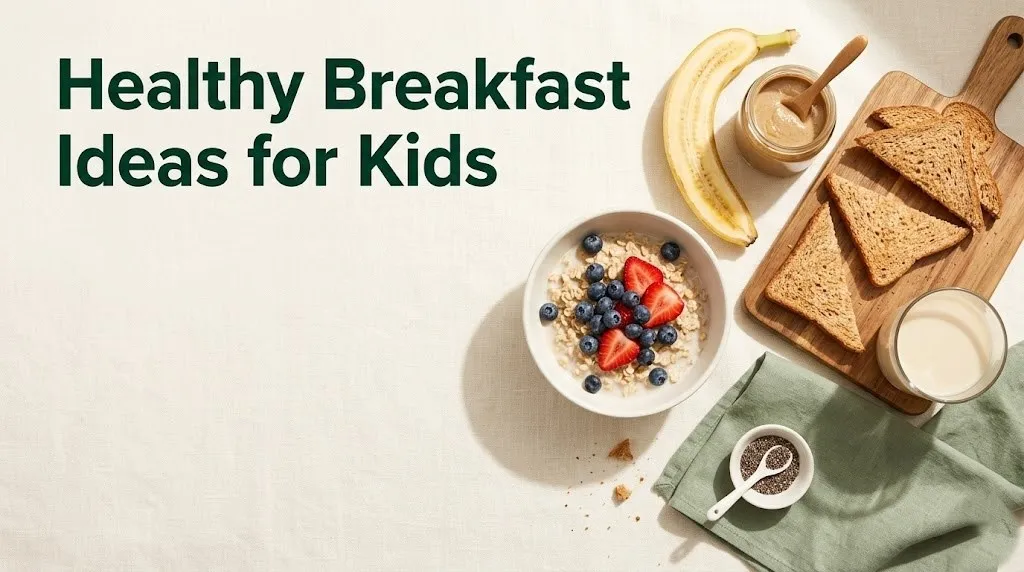
That combination is not complicated to achieve. A bowl of whole grain oats (Avena sativa) topped with berries and a side of Greek yogurt covers all three categories. So does a scrambled egg on whole wheat toast with sliced banana. The key is building a plate that provides slow-releasing energy, not a blood glucose spike that collapses before second period.
Variety matters for both nutrition and acceptance. Children who eat the same two or three breakfasts every week tend to develop strong aversions faster than children who rotate through a wider range of foods. Parents who stock five or six breakfast staples and rotate them consistently create more flexible eaters over time.
A useful mental shortcut: think of a child’s breakfast plate like a traffic light. Green foods (fruit and vegetables) go on first. Amber foods (whole grains) fill the middle. Red foods (added sugars, ultra-processed cereals, flavored syrups) stay minimal or absent on school mornings.
| Breakfast Category | Example Foods | Primary Nutrient Benefit |
|---|---|---|
| Protein-first | Eggs, Greek yogurt, cottage cheese | Satiety, muscle support, choline |
| Whole grain base | Rolled oats, whole wheat toast, whole grain waffles | Dietary fiber, sustained energy |
| Fruit addition | Blueberries, banana, strawberries | Vitamin C, potassium, antioxidants |
| Healthy fat | Nut butter, avocado, chia seeds | Brain development, fat-soluble vitamin absorption |
What Makes a Breakfast Healthy for Kids
A healthy breakfast for kids is one that meets a meaningful portion of a child’s daily needs for protein, dietary fiber, and key micronutrients without relying heavily on added sugars or ultra-processed ingredients.
The USDA Dietary Guidelines for Americans define added sugars as sugars introduced during processing or preparation, distinct from naturally occurring sugars in fruit or unsweetened dairy. A breakfast that gets most of its calories from added sugar, even one marketed as “vitamin-fortified,” does not provide the same metabolic foundation as a meal built from whole foods.
Three components define a breakfast worth the effort. First, protein: it slows gastric emptying and supports sustained satiety. Second, complex carbohydrates with dietary fiber: they release glucose into the bloodstream gradually rather than all at once. Third, micronutrients: iron, calcium, vitamin D, and choline are all commonly under-consumed in children’s diets and breakfast is one of the most reliable delivery windows.
What to look for on a cereal box if you’re using packaged foods:
- Added sugar below 6 grams per serving
- Dietary fiber at least 3 grams per serving
- Whole grain listed as the first ingredient
- No artificial colors (particularly Red 40, Yellow 5, and Yellow 6, which some pediatric researchers have flagged for attention concerns in sensitive children)
- Iron listed as 10% or more of the daily value
What Nutrients Do Kids Need at Breakfast
Children need a morning meal that delivers iron, calcium, vitamin D, choline, protein, dietary fiber, and omega-3 fatty acids (specifically alpha-linolenic acid, or ALA) in developmentally appropriate amounts.
The NIH Office of Dietary Supplements reports that iron deficiency is the most common nutritional deficiency among children in the United States. Iron supports cognitive function, attention, and energy production. Breakfast is an ideal delivery window because pairing iron-rich foods with vitamin C sources significantly improves iron absorption. Oatmeal with strawberries is a practical example of this pairing.
Calcium and vitamin D work together to support bone mineralization during the rapid growth years. The American Academy of Pediatrics recommends 700mg of calcium daily for children aged 1 to 3, rising to 1,000mg for children aged 4 to 8, and 1,300mg for children aged 9 to 18. One cup of fortified milk or calcium-set tofu at breakfast covers a substantial portion of that daily need.
Choline, found in particularly high concentrations in eggs, supports brain development and neurotransmitter production. Many parents are not aware of choline at all. The NIH reports that most children in the US consume below the adequate intake level for choline.
| Nutrient | Primary Breakfast Source | Why It Matters for Kids |
|---|---|---|
| Iron | Fortified oats, eggs, fortified cereal | Cognitive function, energy production |
| Calcium | Yogurt, fortified milk, fortified oat milk | Bone and teeth development |
| Vitamin D | Fortified milk, eggs | Calcium absorption, immune function |
| Choline | Eggs | Brain development, memory support |
| Dietary fiber | Whole oats, whole wheat, fruit | Digestive health, blood glucose regulation |
| Omega-3 (ALA) | Chia seeds (Salvia hispanica), walnuts | Brain structure, anti-inflammatory support |
Best Breakfast for Kids Brain Development
The best breakfast for supporting kids’ brain development includes choline-rich eggs, omega-3 fatty acids from chia seeds or walnuts, iron-rich whole grains, and vitamin C from fresh fruit to maximize iron absorption.
Research published in the Journal of the Academy of Nutrition and Dietetics found that children who consumed breakfast regularly showed better performance on memory and attention tasks compared to children who skipped it, with the effect more pronounced when the breakfast included protein and complex carbohydrates. This is not a trivial finding. The brain accounts for roughly 20% of the body’s resting energy expenditure, and it runs primarily on glucose. A breakfast that delivers glucose steadily, rather than in a spike-and-crash pattern, keeps that fuel supply consistent through the morning.
Think of your child’s breakfast like a slow-release drip of fuel to a high-performance engine. A sugary cereal dumps fuel all at once and the engine sputters by 10am. A bowl of oats with eggs alongside releases that fuel gradually, keeping cognitive performance more consistent into late morning.
Choline deserves particular attention in this context. It is a precursor to acetylcholine, a neurotransmitter involved in memory and muscle control. Two large eggs provide approximately 294mg of choline, against the NIH adequate intake of 250mg daily for children aged 4 to 8.
Brain-supporting breakfast combinations:
- Scrambled eggs with whole wheat toast and orange slices
- Oatmeal with chia seeds (Salvia hispanica), blueberries (Vaccinium corymbosum), and a drizzle of honey
- Greek yogurt parfait with walnuts and mixed berries
- Whole grain avocado toast with a soft-boiled egg
Key Takeaway: The first three sections establish the foundation: a well-built kids’ breakfast delivers protein, dietary fiber, and specific micronutrients like iron, choline, and calcium. These are not vague “nutrients.” They are specific compounds with documented roles in children’s cognitive performance, bone development, and energy regulation.
High Protein Breakfast for Kids
A high-protein breakfast for kids is one that provides at least 10 to 15 grams of protein per serving, using sources like eggs, Greek yogurt, cottage cheese, or nut butter on whole grain bread.
The Academy of Nutrition and Dietetics recommends that protein be distributed across all three meals rather than concentrated at dinner, as children’s bodies use protein most efficiently when it is consumed consistently throughout the day. At breakfast specifically, protein slows the rate at which the stomach empties, which extends feelings of satiety and reduces the likelihood of mid-morning hunger driving poor snacking choices.
Protein targets vary by age. Children aged 2 to 3 need approximately 13 grams of protein per day. Children aged 4 to 8 need about 19 grams. Children aged 9 to 13 need roughly 34 grams. A single breakfast with two eggs and half a cup of Greek yogurt can deliver around 22 grams, covering a large portion of the daily requirement for younger children in one meal.
High-protein breakfast options that work on real school mornings:
- Two scrambled eggs with shredded cheese on a whole wheat tortilla: approximately 18 to 22 grams of protein
- Three-quarters cup of plain Greek yogurt with mixed berries: approximately 15 to 17 grams of protein
- Half cup of cottage cheese with fruit: approximately 14 grams of protein
- Two tablespoons of natural peanut butter (or sunflower seed butter for nut-free households) on whole wheat toast: approximately 7 to 8 grams of protein
Note for parents managing children with kidney disease or rare metabolic conditions: high-protein recommendations do not apply universally. A pediatric dietitian should be consulted when a child has any condition affecting protein metabolism.
Whole Grain Breakfast Ideas for Kids
Whole grain breakfast foods for kids are those made from grains where the bran, germ, and endosperm remain intact, including old-fashioned rolled oats, whole wheat bread, whole grain cereals, and whole wheat pancakes.
Whole grains deliver dietary fiber, B vitamins (including thiamin, niacin, and folate), iron, and magnesium at levels significantly higher than refined grain counterparts. The USDA Dietary Guidelines recommend that at least half of all grain servings for children come from whole grain sources. For most children, breakfast is the single best opportunity to meet that target.
Beta-glucan, the soluble dietary fiber found in whole grain oats, is worth understanding specifically. It forms a gel-like substance in the digestive tract that slows glucose absorption and contributes to longer satiety. This is one concrete reason oatmeal performs so reliably as a children’s breakfast: not because it’s trendy, but because the fiber it contains slows things down in a way that refined grain cereals do not.
Whole grain options accessible to most families:
- Old-fashioned rolled oats (not instant): the most fiber-dense and least processed oat format
- Whole wheat bread: check that “whole wheat flour” is the first ingredient, not “enriched wheat flour”
- Whole grain corn tortillas: a wheat-free whole grain option
- Whole wheat English muffins: work well for egg sandwiches and require no morning prep
- Whole grain cereals with at least 3 grams of fiber and fewer than 6 grams of added sugar per serving
Children with diagnosed celiac disease or non-celiac gluten sensitivity should work with a registered dietitian to identify appropriate whole grain alternatives. Certified gluten-free oats, brown rice, and quinoa are whole grain sources that do not contain gluten.
Low-Sugar Breakfast Options for Kids
The best low-sugar breakfast options for kids use naturally sweet whole foods like fruit and unsweetened dairy instead of products with added sugars, keeping added sugar at breakfast below 6 grams total.
The American Heart Association recommends that children aged 2 to 18 consume fewer than 25 grams of added sugar per day. Many popular children’s breakfast cereals contain 10 to 15 grams of added sugar in a single serving. That is more than half the recommended daily ceiling before 8am.
This does not mean breakfast has to taste bland. The distinction matters: natural sugars in a ripe banana or fresh strawberries come packaged with fiber, vitamins, and water. Added sugars in flavored yogurts, breakfast bars, and sweetened oatmeal packets deliver energy without that nutritional context. A banana mashed into plain oatmeal provides sweetness, potassium (approximately 422mg per medium banana), and vitamin B6 with no added sugar at all.
| Breakfast Product | Added Sugar (typical) | Better Alternative | Added Sugar |
|---|---|---|---|
| Flavored instant oatmeal packet | 12g | Plain oats with mashed banana | 0g |
| Sweetened yogurt tube | 9g | Plain Greek yogurt with berries | 0g |
| Frosted corn flake cereal (1 cup) | 12g | Plain whole grain cereal + fruit | 0-1g |
| Chocolate milk (8oz) | 12g | Plain fortified milk | 0g |
| Store-bought breakfast bar | 8-15g | Homemade oat and nut bar | 2-4g |
Key Takeaway: Whole grain breakfasts with low added sugar, adequate protein, and fruit as the natural sweetener are not a compromise. They are what actually keeps a child’s energy and focus consistent through the school morning, and they take no more effort than opening a cereal box once you have the right ingredients stocked.
Quick Healthy Breakfast for School Mornings
The quickest healthy breakfasts for school mornings are those with five minutes or less of active preparation, including whole grain toast with nut butter and banana, Greek yogurt with fruit, and microwave-scrambled eggs.
Time is the real obstacle on weekday mornings. Parents already know what healthy looks like. What they need are options that fit into a 10-minute window between 7:15 and 7:25am without requiring a clean skillet, multiple cutting boards, or any degree of kitchen creativity before coffee.
The most reliable five-minute breakfasts are:
- Whole wheat toast with natural almond butter or sunflower seed butter and sliced banana: spread, slice, done
- Greek yogurt layered with granola (low-sugar) and any fruit from the fridge: three ingredients, one bowl
- Microwave scrambled eggs: two eggs, a splash of milk, 90 seconds in a mug, with whole wheat toast on the side
- Overnight oats made the night before: no morning prep required beyond pulling from the fridge
- Whole grain cereal with fortified milk and fruit: the classic format works when the cereal is chosen well
The real time-saving move is preparation the night before. Measuring oats into a jar takes 90 seconds at 9pm and saves three to five minutes the next morning. Slicing fruit on Sunday covers the whole week. Batch-cooking hard-boiled eggs on Sunday provides a grab-and-eat protein source for five mornings.
Quick Tip:
- Keep a “breakfast shelf” in the fridge stocked Sunday evening: pre-sliced fruit, pre-made overnight oats, hard-boiled eggs, and pre-portioned yogurt containers
- A microwave egg cooker requires zero pan cleanup and produces cooked eggs in under two minutes
- Whole grain frozen waffles are a legitimate school-morning option when topped with nut butter and fruit rather than syrup
Make-Ahead Healthy Breakfast for Kids
Make-ahead healthy breakfasts for kids are prepared partially or fully in advance, stored safely in the refrigerator or freezer, and served with minimal morning effort, including overnight oats, egg muffins, and whole grain banana muffins.
Batch cooking on weekends genuinely changes the breakfast equation during the week. The investment is 45 to 60 minutes on a Sunday afternoon. The return is five mornings where breakfast is already done.
Overnight oats are the most accessible starting point for most families. Here is a base recipe that produces a reliable result:
To make one serving of overnight oats for kids:
- Measure half a cup of old-fashioned rolled oats into a jar or airtight container.
- Add half a cup of fortified milk (dairy or unsweetened, fortified oat milk for dairy-free households).
- Stir in 2 tablespoons of plain Greek yogurt for added protein.
- Add 1 teaspoon of honey or maple syrup if desired (optional; ripe mashed banana adds natural sweetness without honey).
- Stir to combine, seal the container, and refrigerate overnight (minimum 6 hours, maximum 3 days).
- In the morning, stir, add fruit toppings, and serve cold or gently warmed for 60 seconds in the microwave.
Egg muffins are another high-protein make-ahead option. Pour whisked eggs mixed with vegetables and cheese into a greased muffin tin, bake at 375°F (190°C) for 20 to 22 minutes, and refrigerate for up to 4 days. Reheat in the microwave for 45 seconds. Each muffin provides approximately 5 to 6 grams of protein.
Whole grain banana muffins made with oat flour, ripe bananas, eggs, and a small amount of honey freeze well for up to 3 months. Pull one out the night before and it will be thawed by morning.
Healthy Grab-and-Go Breakfast for Kids
A healthy grab-and-go breakfast for kids is a portable, pre-assembled meal that requires no utensils, no reheating, and no more than 30 seconds to hand to a child heading out the door.
Not every morning allows for a seated breakfast. Travel days, late starts, and activity mornings all create situations where parents need something a child can eat in a car seat or walking to school.
The trap with grab-and-go foods is that the most convenient options in most grocery stores are also the most processed. Individually wrapped granola bars, flavored yogurt pouches, and breakfast biscuits often deliver 10 to 15 grams of added sugar in a package that feels like a health food because it says “whole grain” on the front.
Better grab-and-go options that actually meet nutritional standards:
- Whole grain muffin (homemade or from a bakery that lists ingredients) + cheese stick + piece of fruit: approximately 15 to 18 grams of protein with fiber
- Hard-boiled egg + whole wheat toast folded around it + banana: no container needed, full nutritional profile
- Sunflower seed butter sandwich on whole wheat bread + apple: nut-free, portable, complete
- Greek yogurt in a squeezable pouch (plain or lightly sweetened, not the cartoon-branded ones) + whole grain crackers
- Whole grain tortilla rolled with cream cheese and sliced strawberries
Key Takeaway: Make-ahead and grab-and-go solutions are not a nutritional compromise when they are built from whole food ingredients. The difference between a homemade egg muffin and a processed breakfast bar is not just marketing. It is real: fiber content, protein quality, and added sugar levels differ dramatically.
Healthy Breakfast for Picky Eaters
A healthy breakfast for picky eaters works by building on the few foods a child already accepts and introducing nutrition through familiar textures, flavors, and presentations rather than forcing new foods as standalone items.
Picky eating in children is developmentally normal, particularly between ages 2 and 6. Research published in the journal Appetite found that food neophobia (fear of new foods) peaks in early childhood and typically decreases by age 8 in most children. The goal during this period is not to win battles. It is to maintain nutritional adequacy while keeping mealtimes low-stress.
The most effective strategy for picky eaters at breakfast is “bridge foods.” A child who will eat pancakes but nothing else will often accept pancakes made with oat flour, mashed banana mixed in, and blueberries baked inside. The pancake is the bridge. The nutrition is inside it.
Strategies that work for most picky eaters:
- Smoothies: blend spinach, frozen berries, banana, and fortified milk. The color comes out purple, not green. The taste is berry-forward. The spinach is nutritionally present but texturally invisible.
- Oatmeal shaped or served in a way that feels like play: face shapes with fruit, “dirt” made from cocoa powder, or served in a small cup instead of a bowl
- Eggs in a different format: a child who refuses scrambled eggs may accept a soft-cooked egg in a cup, or egg baked inside a bell pepper ring
- Toast with “hidden” toppings: avocado mashed smooth looks like green butter. Cream cheese with finely grated carrot mixed in looks like orange-tinged cream cheese.
Never pressure a child to finish a breakfast they are resisting. The American Academy of Pediatrics advises that children have an innate ability to regulate caloric intake, and forcing food at one meal often leads to reduced intake at the next.
Dairy-Free and Egg-Free Breakfast Ideas for Kids
Dairy-free and egg-free breakfast ideas for kids rely on plant-based proteins, fortified milk alternatives, and whole grain foundations to meet comparable nutritional targets without triggering food allergies or intolerances.
Dairy and egg allergies are among the most common food allergies in childhood. The Food Allergy Research and Education organization (FARE) reports that milk and egg allergies together affect millions of American children. Neither allergy requires a nutritionally inferior breakfast. It requires knowing the right substitutions.
For dairy-free children, the key nutritional concern is calcium and vitamin D. Fortified oat milk, fortified almond milk, and fortified soy milk can all provide 300mg of calcium per cup, comparable to cow’s milk, but only when the label specifically confirms fortification. Unfortified nut milks provide very little calcium.
For egg-free children, the protein and choline gap is the main concern. Silken tofu scrambled in a skillet with turmeric, nutritional yeast, and salt provides a similar texture to scrambled eggs and approximately 8 to 9 grams of protein per serving. Chia seeds soaked in liquid form a gel that replaces eggs in most baked breakfast recipes at a ratio of 1 tablespoon of chia seeds plus 3 tablespoons of water per egg.
| Dairy-Free Swap | Nutritional Note |
|---|---|
| Fortified oat milk (300mg Ca/cup) | Confirm fortification on label |
| Fortified soy milk | Highest protein of all dairy-free milks, ~7g/cup |
| Coconut yogurt | Lower protein; choose fortified versions |
| Cashew yogurt | Look for added calcium; protein varies |
| Egg-Free Swap | Nutritional Note |
|---|---|
| Silken tofu scramble | ~8-9g protein per serving; needs seasoning |
| Chia seed “egg” (1 tbsp + 3 tbsp water) | Works in baked goods; adds omega-3 ALA |
| Flax egg (1 tbsp ground + 3 tbsp water) | Good binder; adds fiber and omega-3 ALA |
Nut-Free Breakfast Ideas for School
Nut-free breakfast ideas for school replace peanut butter and tree nut butters with seed-based alternatives like sunflower seed butter or pumpkin seed butter while maintaining comparable protein and healthy fat content.
Many schools now maintain nut-free policies to protect children with severe peanut and tree nut allergies. For parents accustomed to peanut butter as their default protein shortcut, this requires a genuine pantry shift. The good news is that sunflower seed butter (made from ground Helianthus annuus seeds) provides a very similar nutritional profile: approximately 5 to 6 grams of protein per 2-tablespoon serving, 16 grams of healthy fats, and meaningful amounts of vitamin E.
Seed-based alternatives that work in school-safe lunches and breakfasts:
- Sunflower seed butter on whole wheat toast with sliced banana: replaces peanut butter toast directly
- Pumpkin seed butter (pepita butter) in oatmeal or smoothies: higher in zinc and iron than most nut butters
- Tahini (sesame seed paste) swirled into yogurt with honey: calcium-rich and school-safe in most jurisdictions
- Hemp seeds sprinkled on oatmeal or smoothie bowls: approximately 10 grams of protein per 3-tablespoon serving
One practical note: sunflower seed butter reacts with baking soda and baking powder to turn baked goods green inside. This is a harmless chemical reaction between chlorogenic acid in the seeds and the alkaline leavening agent. It surprises parents the first time they see it. The muffins are perfectly safe to eat.
Families in schools with sesame allergy restrictions (sesame is now a top 9 allergen per the FDA’s FASTER Act) should check tahini’s status with the school before including it.
Key Takeaway: Dairy-free, egg-free, and nut-free restrictions do not require nutritionally hollow breakfasts. Fortified plant milks, seed butters, and silken tofu fill the gaps with real nutritional content, provided parents know which specific products and fortification levels to look for.
Healthy Breakfast for Toddlers vs School-Age Kids
Healthy breakfasts for toddlers differ from those for school-age kids primarily in portion size, texture safety, and caloric density, with toddlers requiring smaller portions, softer textures, and careful attention to choking hazards.
A 2-year-old and a 10-year-old are not simply different sizes of the same eater. Their caloric needs, texture tolerances, and developmental nutrition priorities are genuinely different. The USDA’s MyPlate guidance separates recommendations by age group precisely for this reason.
For toddlers aged 1 to 3, the AAP recommends watching closely for choking hazards. Whole grapes, chunks of hard cheese, large pieces of raw apple, whole nuts, and thick globs of nut butter all pose documented choking risks in children under age 4. All of these foods can still be served to toddlers in appropriate modified forms: grapes halved or quartered, cheese grated, apple steamed or thinly sliced, nut butter thinned with a small amount of water or spread very thinly on toast.
For school-age children aged 5 to 12, the focus shifts toward building independence in food choices and meeting higher caloric and micronutrient demands from growth and physical activity. A 10-year-old boy who plays sports after school may need a breakfast providing 400 to 500 calories with 20 or more grams of protein to sustain energy through a full school day plus afternoon activity.
| Age Group | Approximate Breakfast Calories | Key Nutritional Focus | Portion Example |
|---|---|---|---|
| Toddlers (1-3 years) | 200-300 calories | Soft textures, iron, calcium, healthy fats | 1/4 cup oatmeal, 1 oz soft cheese, halved berries |
| Preschool (3-5 years) | 250-350 calories | Variety, calcium, vitamin D | 1/3 cup oatmeal, 1 egg, 1/2 banana |
| School-age (6-9 years) | 300-400 calories | Fiber, protein, iron | 1/2 cup oatmeal, 1-2 eggs, 1 piece fruit |
| Pre-teen (10-12 years) | 350-500 calories | Higher protein, calcium, zinc | 3/4 cup oatmeal, 2 eggs or yogurt, fruit |
Healthy Breakfast Recipes for Kids
The best healthy breakfast recipes for kids are ones with fewer than eight ingredients, under 20 minutes of total preparation time, and enough flexibility to accommodate common dietary restrictions.
Below are three tested recipe frameworks, each covering a different format: a cooked egg dish, a no-cook fruit and grain base, and a blended option for children who resist solid foods in the morning.
Recipe 1: Veggie Egg Muffins (makes 6 muffins)
To make veggie egg muffins:
- Preheat oven to 375°F (190°C) and grease a standard 6-cup muffin tin with olive oil or cooking spray.
- Whisk 6 large eggs in a bowl with 2 tablespoons of whole milk (or fortified oat milk) and a pinch of salt.
- Finely dice half a red bell pepper and a small handful of baby spinach. Divide evenly among muffin cups.
- Pour the egg mixture over the vegetables, filling each cup approximately three-quarters full.
- Top each cup with 1 tablespoon of shredded cheddar cheese if desired.
- Bake for 20 to 22 minutes until the centers are set and the edges are lightly golden.
- Cool for 5 minutes before removing. Store in an airtight container in the refrigerator for up to 4 days. Reheat each muffin in the microwave for 45 seconds.
Each muffin provides approximately 90 to 110 calories, 7 to 8 grams of protein, and meaningful amounts of vitamin D, choline, and vitamin C from the peppers.
Recipe 2: 5-Ingredient Overnight Oats (1 serving)
To make overnight oats for one child:
- Add half a cup of old-fashioned rolled oats to a jar with a lid.
- Pour in half a cup of fortified milk or unsweetened fortified oat milk.
- Add 2 tablespoons of plain Greek yogurt and stir to combine.
- Add 1 teaspoon of honey or a quarter of a mashed ripe banana for sweetness.
- Seal the jar and refrigerate for at least 6 hours.
- In the morning, top with 2 to 3 tablespoons of mixed berries or sliced strawberries and serve cold or warmed for 60 seconds.
This produces approximately 280 to 320 calories, 12 to 14 grams of protein, and 5 to 6 grams of dietary fiber per serving.
Recipe 3: Berry Spinach Smoothie (1 child serving)
To make a berry spinach smoothie:
- Add 1 cup of frozen mixed berries to a blender.
- Add 1 large handful of baby spinach (approximately 30 grams).
- Pour in three-quarters cup of fortified milk or fortified oat milk.
- Add 2 tablespoons of plain Greek yogurt and 1 tablespoon of chia seeds (Salvia hispanica).
- Blend on high for 45 to 60 seconds until smooth.
- Serve immediately in a cup with a straw. Smoothies separate quickly; stir before drinking if there is a delay.
This provides approximately 220 to 250 calories, 10 to 12 grams of protein, 6 grams of dietary fiber, iron from the spinach, omega-3 ALA from the chia seeds, and vitamin C from the berries to support iron absorption. For egg-allergic or dairy-free children, substitute fortified oat milk and omit the yogurt or replace with coconut yogurt.
Key Takeaway: Three recipe formats, reliably three nutritional profiles: egg muffins for high protein, overnight oats for fiber and sustained energy, and smoothies for children who need breakfast in liquid form. All three can be modified for common dietary restrictions without losing their nutritional function.
Frequently Asked Questions About Healthy Breakfast Ideas for Kids
What is the healthiest breakfast for a child?
The healthiest breakfast for a child combines a protein source, a whole grain, and fresh fruit or vegetables in age-appropriate portions.
A scrambled egg on whole wheat toast with sliced berries, or plain Greek yogurt with oatmeal and fruit, consistently meets this standard.
According to the USDA Dietary Guidelines, breakfasts built from whole foods with minimal added sugar support better overall daily nutrient intake in children.
How much protein does a child need at breakfast?
Children need approximately 10 to 15 grams of protein at breakfast to support satiety and meet a meaningful portion of their daily protein requirement.
The exact daily protein target is 13 grams for children aged 2 to 3, 19 grams for ages 4 to 8, and 34 grams for ages 9 to 13, per the USDA Dietary Reference Intakes.
Two eggs plus half a cup of Greek yogurt delivers approximately 22 grams of protein at breakfast alone.
What can I give my child for breakfast if they hate eggs?
Children who dislike eggs can meet their protein needs at breakfast through Greek yogurt, cottage cheese, nut butter on whole grain toast, or a high-protein smoothie made with Greek yogurt and fortified milk.
Plain Greek yogurt provides 15 to 17 grams of protein per three-quarter cup serving.
Sunflower seed butter on whole wheat toast, paired with milk and fruit, is a school-safe, egg-free option with complete nutritional coverage.
Is cereal a healthy breakfast for kids?
Cereal can be a healthy breakfast for kids when it is made from whole grains, contains at least 3 grams of dietary fiber per serving, and has fewer than 6 grams of added sugar per serving.
Many popular children’s cereals contain 10 to 15 grams of added sugar per serving, which exceeds the American Heart Association’s recommended daily added sugar limit for children in a single meal.
Pairing a lower-sugar whole grain cereal with fortified milk and fresh fruit significantly improves the nutritional profile.
What breakfast foods help kids focus at school?
Breakfast foods that support focus at school include eggs (for choline), whole grain oats (for beta-glucan fiber and sustained glucose release), blueberries (for anthocyanins linked to cognitive performance), and fortified milk (for calcium and vitamin D).
Research published in the Journal of the Academy of Nutrition and Dietetics found that children who ate breakfast showed better memory and attention scores than those who did not, particularly when the breakfast included protein and complex carbohydrates.
Avoiding high-added-sugar breakfasts is as important as choosing the right foods: glucose spikes from sugary cereals tend to be followed by drops in energy and attention within 90 to 120 minutes.
Making Breakfast Work in the Real World
Every parent already knows that breakfast matters. The harder part is executing something nutritious before 7:30am with a child who has opinions about which bowl their oatmeal goes in.
The framework is simpler than most advice makes it sound: protein, a whole grain, and some fruit. Rotate five or six combinations your child actually accepts. Prepare as much as possible the night or weekend before. Keep the ingredients stocked consistently so you’re never improvising from an empty fridge.
Start with one change this week: swap the sweetened cereal for plain rolled oats with fruit and see how your child responds over five mornings. That single shift reduces added sugar, increases dietary fiber, and improves protein content. It does not require a complete kitchen overhaul.