Food workers are required to change gloves any time they switch tasks, touch a contaminated surface, handle a different food type, or after an interruption like answering a phone or touching their face. The FDA Food Code 2022 sets the federal baseline, and the rule is straightforward: a new task almost always means new gloves.
What makes this genuinely important is the scale of what’s at stake. According to the Centers for Disease Control and Prevention (CDC), contaminated food prepared by an infected or improperly gloved food handler is one of the leading causes of foodborne illness outbreaks in the United States, contributing to an estimated 48 million illnesses each year.
This guide covers every situation that legally requires a glove change, the mandatory handwashing steps that go with each change, allergen protocols, glove material rules, and what federal versus state law actually requires. Whether you’re a line cook, a food safety manager, or simply curious about what’s happening in the kitchen before your meal arrives, here’s what the rules say and why they exist.
When Are Food Workers Required to Change Gloves
Food workers are required to change gloves whenever there is a risk of cross-contamination between foods, surfaces, tasks, or after any interruption that could compromise glove integrity or cleanliness.
This isn’t a suggestion. The FDA Food Code 2022, which serves as the model regulation adopted in various forms by state and local health departments across the United States, specifies that single-use gloves must be discarded and replaced in a defined set of circumstances. The code treats gloves as a single-task barrier, not a reusable protective layer.
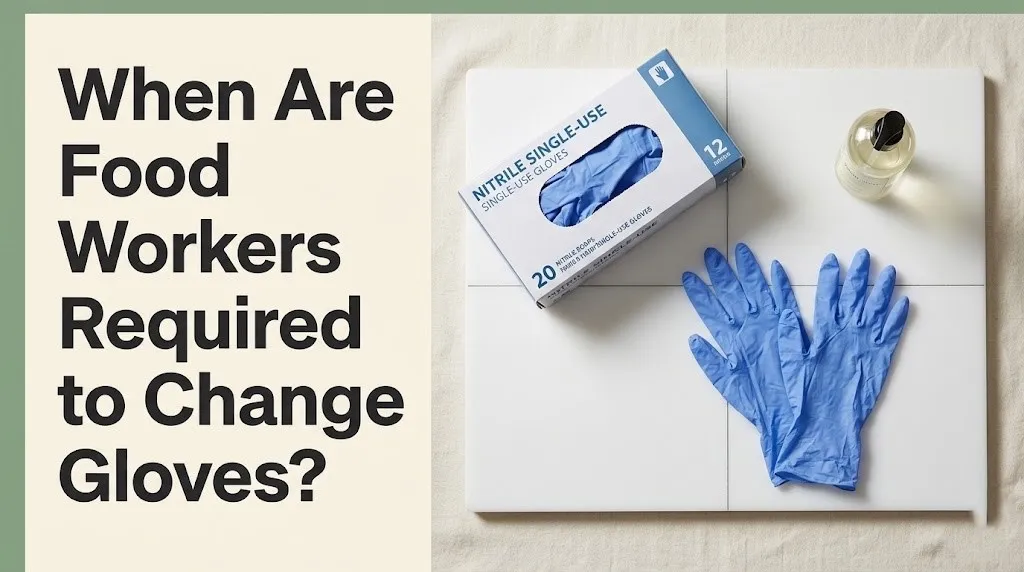
Gloves get contaminated faster than most people assume. Think of them the way you would think of a cutting board: a surface that picks up whatever it touches. Every new food category, every new surface, every break in a task creates a contamination pathway that a fresh pair of gloves closes off.
The core required change scenarios include:
- After handling raw animal foods (meat, poultry, seafood, eggs) before touching ready-to-eat items
- After touching any non-food-contact surface (trash can, door handle, phone, cleaning cloth)
- After an interruption in a task, including leaving the prep station and returning
- When switching between incompatible food types (raw beef to raw vegetables that will be served uncooked)
- When gloves are torn, punctured, or visibly soiled
- After four continuous hours of use, at minimum
- After touching the face, hair, or body while gloved
- Before handling ready-to-eat foods that were previously being prepared with bare hands
FDA Food Code Glove Change Rules for Food Handlers
The FDA Food Code 2022, Section 3-304.15, is the federal document that defines glove use requirements for food workers in the United States. It requires that single-use gloves be used for only one task and then discarded.
The Code specifies that gloves used for food contact must be of an intact, single-use type and must not be used for multiple tasks or washed and reused. The language is explicit: once you’ve completed a task or interrupted a task, the gloves come off. This applies regardless of how long the gloves have been worn or how clean they appear visually.
It’s important to note that the FDA Food Code is a model code. It does not automatically become law. Each state, county, or municipality adopts and amends it. Some jurisdictions are more restrictive. No jurisdiction that has adopted a version of the Code is permitted to be less restrictive than the federal model.
| FDA Food Code 2022 Glove Requirement | Required Action |
|---|---|
| Switch from raw to ready-to-eat food | Remove gloves, wash hands, new gloves |
| Touch non-food-contact surface | Remove gloves, wash hands, new gloves |
| Glove torn or punctured | Remove immediately, wash hands, new gloves |
| Task interrupted (leaving station) | Remove gloves, wash hands, new gloves on return |
| After four hours of continuous use | Remove gloves, wash hands, new gloves |
| Before handling a new allergen category | Remove gloves, wash hands, new gloves |
When Should a Food Handler Change Gloves Between Tasks
A food handler should change gloves every time they move from one distinct food preparation task to another, particularly when those tasks involve different food types, different contamination risks, or different food contact surfaces.
The challenge in a real commercial kitchen is defining what counts as a separate “task.” The ServSafe program, developed by the National Restaurant Association Educational Foundation, teaches that a task is any specific food preparation activity. Moving from slicing raw chicken to chopping romaine lettuce for a salad is a task change. Moving from portioning raw burger patties to plating a cooked entrée is a task change.
What often gets overlooked is the internal task change: touching a shared prep surface, answering a radio, handing something to a colleague, or adjusting equipment all constitute interruptions that compromise glove cleanliness, even within the same task.
Common task-change scenarios requiring new gloves:
- Raw protein prep to vegetable prep (cooked or raw)
- Trash disposal to food preparation
- Handling money or a touchscreen terminal to food prep
- Cleaning or sanitizing surfaces to food prep
- Wiping down equipment to food handling
- Plating a dish after touching shared kitchen equipment
Key Takeaway: Gloves are single-task tools. Any time you finish one food preparation job and start another, or touch something that isn’t your current food, a new pair is required along with handwashing first.
Glove Change Requirements After Handling Raw Meat or Poultry
Food workers must change gloves immediately after handling raw meat, poultry, seafood, or raw eggs before touching any other food, surface, or utensil in the kitchen.
This is one of the highest-priority glove change scenarios under the FDA Food Code 2022 because raw animal proteins are primary carriers of pathogens including Salmonella enterica, E. coli O157:H7, Listeria monocytogenes, and Campylobacter jejuni. These organisms transfer from raw protein to glove surfaces on contact. If those gloves then touch ready-to-eat foods, the risk of illness transmission is direct and documented.
According to a study published in the Journal of Food Protection, glove surfaces that have contacted raw poultry show bacterial transfer rates sufficient to cause contamination on subsequent food contact within seconds. The visual appearance of the glove at that moment is not a reliable safety indicator.
| Raw Animal Food | Key Pathogen Risk | Required Next Step |
|---|---|---|
| Raw poultry | Salmonella, Campylobacter | Remove gloves, wash hands, new gloves |
| Raw ground beef | E. coli O157:H7 | Remove gloves, wash hands, new gloves |
| Raw pork | Salmonella, Yersinia | Remove gloves, wash hands, new gloves |
| Raw seafood | Vibrio, Listeria | Remove gloves, wash hands, new gloves |
| Raw shell eggs | Salmonella | Remove gloves, wash hands, new gloves |
When Should Food Handlers Who Wear Gloves Wash Their Hands
Food handlers who wear gloves are required to wash their hands before putting on a new pair of gloves and after removing a used pair, making handwashing a mandatory step every time gloves are changed.
This is the most widely misunderstood part of glove use in food service. Gloves don’t eliminate the handwashing requirement. They work alongside it. The FDA Food Code 2022 is unambiguous: handwashing must occur before donning gloves for food preparation. The glove is not a substitute for clean hands; it’s a barrier placed over already-clean hands.
There are also specific situations that require handwashing even while still in a gloved work session:
- After using the restroom (gloves are removed before entering)
- After handling garbage or waste
- After coughing, sneezing, or touching the face
- After handling chemicals or cleaning agents
- After any activity that soils or potentially contaminates the hands
According to the CDC, hand hygiene failures by food handlers are among the most common contributing factors identified in foodborne illness outbreak investigations. Gloves reduce but do not eliminate the risk when handwashing is skipped.
Key Takeaway: Every glove change includes a handwash. That’s the rule, not just the recommendation. New gloves on unwashed hands are a compliance failure, not a safety measure.
Do Gloves Replace Handwashing for Food Workers
Gloves do not replace handwashing for food workers. Handwashing is a separate, mandatory step that must occur before putting on gloves and at multiple points throughout a shift regardless of glove use.
The reasoning is practical: gloves are not impermeable barriers. Nitrile, latex, and vinyl gloves all develop microscopic pores or small tears during normal food handling. Pathogens can migrate through damaged glove material. More importantly, the exterior of the glove accumulates contamination with every surface it touches, and those contaminants transfer to hands when the gloves are removed if hands are not immediately washed.
Think of it like a rain jacket. A jacket keeps you dry in light rain, but if you stand in a downpour long enough, moisture finds a way through. Gloves buy time and create a barrier, but they don’t make the underlying hygiene requirement disappear.
A 2019 study in the American Journal of Infection Control found that improper glove removal was associated with hand contamination in a significant proportion of observed healthcare and food service workers, reinforcing that the removal process itself is a contamination risk that only handwashing resolves.
Handwashing Steps Required Before Putting On New Gloves
The correct handwashing sequence before putting on new gloves includes wetting hands with warm water, applying soap, scrubbing for at least 20 seconds, rinsing thoroughly, and drying with a single-use paper towel.
The FDA Food Code 2022 specifies this sequence precisely. The water temperature should be at least 100 degrees Fahrenheit (38 degrees Celsius). The scrubbing step must include the backs of hands, between fingers, and under fingernails. Rinsing must be thorough enough to remove all soap residue, which itself can act as a skin irritant and affect glove integrity over time.
To wash hands correctly before glove use:
- Turn on warm water (at least 100°F / 38°C) at a designated handwashing sink.
- Wet both hands completely, including wrists.
- Apply enough liquid or powdered soap to cover all hand surfaces.
- Scrub vigorously for a minimum of 20 seconds, including backs of hands, between fingers, and under nails.
- Rinse under clean running water until all soap is removed.
- Dry with a single-use paper towel or a designated air dryer.
- Use the paper towel to turn off the faucet if it’s not foot- or sensor-operated.
- Proceed directly to the glove dispenser. Do not touch non-food-contact surfaces between washing and gloving.
Workers with open cuts or wounds on their hands should cover them with a bandage and a finger cot or single-use glove before the outer glove goes on, per FDA Food Code guidance.
Ready-to-Eat Food and Bare Hand Contact Glove Rules
Food workers are prohibited from touching ready-to-eat (RTE) foods with bare hands under the FDA Food Code 2022, which requires gloves, utensils, or deli tissue as an approved barrier between worker hands and any food that will not undergo further cooking.
Ready-to-eat foods include any item a customer will consume without additional heat treatment: fresh produce for salads, sliced deli meats, cooked proteins, bread, pastries, sandwiches, and garnishes like herbs or lemon wedges. The prohibition on bare hand contact exists because these foods have no final cooking step to kill any pathogens transferred during preparation.
Some jurisdictions allow an exception to the bare hand contact prohibition if a food establishment has an approved Alternative Operating Procedure (AOP) on file with the local health authority. This procedure typically requires enhanced hand hygiene practices, worker health monitoring, and manager training. The exception is jurisdiction-specific and must be formally approved; it is not a general permission.
| Food Category | Bare Hand Contact Allowed? | Gloves/Utensil Required? |
|---|---|---|
| Raw steak (will be cooked to 145°F) | Yes, with precautions | Recommended; not always required |
| Fresh salad greens (served raw) | No | Yes |
| Sliced cooked deli meat | No | Yes |
| Bread and rolls | No | Yes |
| Garnishes (lemon, parsley, herbs) | No | Yes |
| Cooked pasta being plated | No | Yes |
| Raw ground beef (will be cooked to 155°F) | Yes, in some jurisdictions | Recommended |
Key Takeaway: If a food goes directly from your hands to a customer’s plate without heat in between, gloves or a utensil are required. That covers more foods than most workers initially assume.
Allergen Cross-Contact and Glove Change Protocols
Food handlers must change gloves and wash hands before preparing food for a customer with a known food allergy, and a dedicated allergen protocol requires a complete glove change any time work switches from an allergen-containing preparation to an allergen-free one.
This is distinct from standard cross-contamination prevention. Allergen cross-contact occurs when a food allergen is transferred from one food to another, even in trace amounts. Unlike bacteria, allergens are not destroyed by cooking, sanitizing, or washing. A glove that touched peanut butter, tree nuts, shellfish, wheat, milk, eggs, soy, sesame, or any of the nine major food allergens recognized by the FDA’s FALCPA (Food Allergen Labeling and Consumer Protection Act) carries that allergen on its surface until the glove is discarded.
For a customer with a peanut allergy, a server using the same gloves to plate a peanut dish and then an “allergen-free” dish creates a real and potentially life-threatening exposure. Commercial kitchens that take allergen management seriously use color-coded gloves to designate allergen-free preparation stations, though the FDA Food Code does not currently mandate a specific color system.
Allergen glove change protocol:
- Change gloves before beginning any allergen-free preparation order
- Use a clean utensil and a clean prep surface in addition to new gloves
- Wash hands thoroughly between the allergen preparation and the allergen-free task
- Document the glove change in kitchens that maintain allergen logs
Types of Gloves Used in Food Service and Which Are Approved
The FDA Food Code 2022 approves single-use gloves made from nitrile, latex, vinyl, and polyethylene for food contact use, with specific suitability differences for different kitchen tasks.
Not all glove materials perform equally in every food preparation scenario. The right material matters because some break down faster under oils, heat, or chemical exposure, which affects both worker safety and food safety. Thicker gloves (measured in mil, or thousandths of an inch) generally offer more puncture resistance, which is relevant when handling sharp bones, shells, or cutting tools.
Reusable heavy-duty gloves made from rubber or neoprene are used for dishwashing and cleaning tasks but must never be used for direct food contact. The distinction between single-use food-contact gloves and task-specific reusable gloves is one that inspectors frequently assess during health department visits.
| Glove Type | Material | Best For | Limitations |
|---|---|---|---|
| Nitrile | Synthetic rubber | Most food prep tasks; high durability | More expensive than vinyl |
| Latex | Natural rubber | Dexterity-sensitive tasks | Allergen risk for latex-sensitive workers or customers |
| Vinyl (PVC) | Polyvinyl chloride | Light prep tasks; lower cost | Lower puncture resistance; less form-fitting |
| Polyethylene | Thin plastic film | Casual handling; counter service | Minimal barrier protection; not for raw protein work |
Latex vs Nitrile vs Vinyl Gloves for Food Handlers
Nitrile gloves are the industry standard recommendation for most food service tasks because they combine chemical resistance, puncture resistance, and latex-free composition in a single option.
Latex gloves were once the dominant choice in food service for their flexibility and tactile sensitivity, but their use has declined because latex proteins are a documented allergen. A food worker with a latex allergy can experience skin reactions, respiratory symptoms, or anaphylaxis. More critically, latex proteins can transfer from the glove to food, creating a risk for latex-allergic customers. Many food service establishments have eliminated latex gloves entirely.
Vinyl gloves are the most affordable option but offer the least protection. According to research published in the Journal of Food Protection, vinyl gloves show higher rates of micro-perforation after stretching and food handling tasks compared to nitrile. They are appropriate for light tasks like bagging items or brief food contact but are not recommended for extended raw protein handling.
Quick Tip:
- Use nitrile gloves (at least 4 mil thickness) for raw meat, seafood, and extended prep work
- Avoid latex gloves entirely in environments serving customers with potential latex sensitivities
- Reserve vinyl or polyethylene gloves for brief, low-risk food contact tasks only
- Check that all gloves purchased for food service are FDA-compliant and food-grade labeled
Key Takeaway: Nitrile is the safest all-purpose choice for food service gloves in 2026. Vinyl is a cost-saving option with real performance limitations. Latex carries allergen risks that most commercial kitchens are no longer willing to accept.
Can Food Workers Reuse Gloves Between Tasks
Food workers cannot reuse single-use gloves between tasks. The FDA Food Code 2022 explicitly prohibits washing, sanitizing, or reusing single-use food-contact gloves.
The prohibition exists for sound microbiological reasons. Single-use gloves are manufactured to a specific barrier standard for one use. Once they’ve been worn, stretched, and exposed to food, heat, oils, or moisture, their structural integrity is compromised in ways that are not visible to the naked eye. Washing a used glove with soap or a sanitizing solution does not restore that integrity. It may reduce surface bacterial counts but does not eliminate contamination from within glove material pores or microtears.
There is sometimes confusion about reusable rubber utility gloves used for dishwashing or cleaning. Those are not food-contact gloves and must be kept entirely separate from food preparation areas and supplies. Using dishwashing gloves for food prep, even if they appear clean, is a health code violation in all FDA Food Code jurisdictions.
The practical cost argument is real in a high-volume kitchen, but the regulatory and liability position is clear. A box of 100 nitrile gloves costs between $8 and $20 depending on thickness and supplier. The cost of a foodborne illness outbreak investigation, including lost business, fines, and legal exposure, is categorically different.
How Long Can a Food Handler Wear the Same Pair of Gloves
A food handler should not wear the same pair of gloves for more than four hours of continuous use, and must change them immediately if a task change, contamination event, or glove damage occurs before that time limit is reached.
The four-hour guideline reflects the accumulation of microbial load on glove surfaces over time, even when the task remains consistent. Bacteria and viruses from the food being handled, the air, and incidental surface contact accumulate on glove exteriors throughout the wear period. At some point, even a visually intact glove becomes a contamination source rather than a protective barrier.
In practice, most kitchen tasks require a glove change well before four hours have elapsed. A prep cook working a two-hour mise en place shift that involves raw protein, then vegetables, then plating would need multiple glove changes within that period based on task changes alone, not time.
The four-hour maximum is best understood as the outer limit, not the standard. According to ServSafe training materials, food handlers should think of four hours as the point at which gloves must be changed regardless of any other factor, not the point at which a change first becomes necessary.
| Scenario | Glove Change Required? | Reason |
|---|---|---|
| 30 minutes into raw chicken prep, switch to salad prep | Yes | Task change |
| 2 hours into same continuous task | Not yet (check for damage) | Under four-hour limit, same task |
| 4 hours of continuous same-task prep | Yes | Time limit reached |
| Glove develops small tear at 90 minutes | Yes immediately | Integrity compromised |
| Left station to answer a question, returned | Yes | Task interrupted |
How to Properly Change Gloves in a Commercial Kitchen
Proper glove removal in a commercial kitchen requires pulling the first glove off from the wrist without touching the outer surface, then removing the second glove by sliding fingers inside and pulling it off inside-out, followed immediately by handwashing.
The removal technique matters because the outside of a used glove is the contaminated surface. Touching it with bare skin during removal transfers whatever was on the glove to the worker’s hands, defeating the purpose of the change. The standard medical and food service technique keeps the contaminated exterior sealed inside the discarded glove.
To properly change gloves in a commercial kitchen:
- Stop the current task and move away from food contact surfaces.
- Grasp the wrist edge of the first glove with the opposite gloved hand.
- Pull the first glove off, turning it inside-out as it comes off.
- Hold the removed glove in the palm of the still-gloved hand.
- Slide two fingers of the bare hand inside the wrist of the second glove without touching its exterior.
- Pull the second glove off, encasing the first glove inside it.
- Discard both gloves immediately in a covered trash bin.
- Proceed directly to a designated handwashing sink.
- Wash hands using the correct 20-second technique with soap and warm water.
- Dry hands with a single-use paper towel.
- Put on a new pair of single-use gloves before resuming food preparation.
Quick Tip:
- Never set used gloves on prep surfaces before discarding
- Never reuse gloves left on a counter during a break
- Train all staff on the inside-out removal technique at onboarding
State vs Federal Glove Requirements for Food Handlers
The FDA Food Code is a federal model regulation, not a federal law, meaning state and local health departments set the actual enforceable glove requirements in their jurisdiction, and these can be stricter but not less strict than the federal model.
Every state in the United States has adopted some version of the FDA Food Code, but the version and any local amendments vary. As of 2026, most states are operating under versions of the 2013, 2017, or 2022 FDA Food Code. States that have adopted the 2022 edition follow the most current federal guidance. States still operating under older editions may have slightly different language around ready-to-eat food contact and alternative operating procedures.
Some local jurisdictions, particularly major metropolitan health departments, have added requirements beyond the state code. These can include mandatory allergen-specific glove color coding, minimum glove thickness requirements, or additional documentation for ready-to-eat food preparation.
Food workers and food safety managers should verify their specific requirements with their state health department or local environmental health office, not assume the federal model applies verbatim. For food businesses operating across multiple states, compliance must be managed jurisdiction by jurisdiction.
| Jurisdiction Level | Authority | Applicability |
|---|---|---|
| Federal (FDA Food Code) | Model regulation only | Baseline standard; not directly enforceable |
| State health department | Adopted and amended version | Primary enforceable law in most cases |
| Local/county health department | May add stricter requirements | Enforceable within that jurisdiction |
| City health department | May exceed state requirements | Check specifically for your operating city |
Key Takeaway: The FDA Food Code tells you the floor. Your state, county, or city health department tells you the ceiling you’re actually being inspected against. Verify locally before assuming federal guidance is all that applies.
Frequently Asked Questions About Food Handler Glove Rules
Do food workers have to wash their hands before putting on gloves?
Yes, food workers are required to wash their hands before putting on a new pair of gloves every time.
The FDA Food Code 2022 mandates handwashing as a step that precedes gloving, not an alternative to it.
Placing gloves over unwashed hands does not meet regulatory requirements and creates a contamination risk under the gloves.
How often should a food handler change their gloves?
A food handler must change gloves after every task change, after touching any contaminated surface, and after a maximum of four continuous hours of wear.
In a typical commercial kitchen shift, most workers need to change gloves multiple times per hour based on task changes alone.
The four-hour maximum applies even when the task and contamination risk haven’t changed.
Are food handlers allowed to touch ready-to-eat food with bare hands?
Food handlers are generally prohibited from touching ready-to-eat foods with bare hands under the FDA Food Code 2022.
Ready-to-eat foods include anything consumed without further cooking: salads, sandwiches, cooked proteins, deli items, bread, and fresh garnishes.
Some jurisdictions allow an exception through an approved Alternative Operating Procedure, but this requires formal health department approval and enhanced hygiene protocols.
What type of gloves are required for food service workers?
Food service workers must use single-use, food-grade gloves made from nitrile, latex, vinyl, or polyethylene, as approved under the FDA Food Code 2022.
Nitrile is the most widely recommended material due to its durability, chemical resistance, and latex-free composition.
Gloves must be new for each task, must not be washed for reuse, and must be discarded immediately when torn, soiled, or after the task is complete.
Do gloves count as a substitute for handwashing in a commercial kitchen?
Gloves do not substitute for handwashing under any food safety regulation in the United States.
Handwashing and glove use are parallel requirements, not alternatives. Gloves must go over clean, properly washed hands.
According to the CDC, skipping handwashing before gloving is one of the most common hygiene failures identified in foodborne illness outbreak investigations.
Closing
Glove use in food service comes down to one core principle: a new task means new gloves, and new gloves always mean washed hands first. The specifics from the FDA Food Code 2022 around ready-to-eat food, raw protein handling, allergen cross-contact, and the four-hour maximum give that principle its operational shape.
If you manage a kitchen or work in one, the glove change scenarios in this guide give you the exact situations that require a change and the correct removal and handwashing steps to go with each one. Verify your state and local health code for any jurisdiction-specific requirements beyond the federal model.
Food safety compliance isn’t complicated when the rules are clearly laid out. The harder part is building the habit so that the right behavior happens automatically, on every shift, without a manager watching.