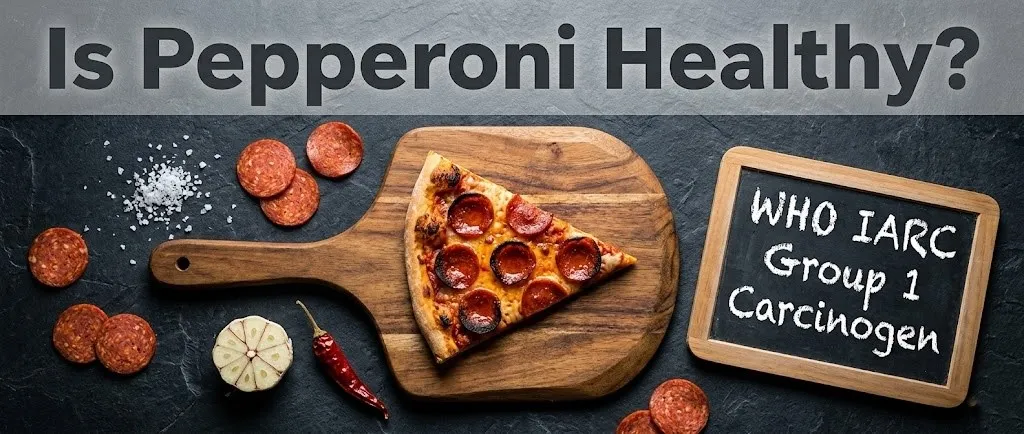
No, pepperoni is not a healthy food. It is an energy-dense, high-saturated-fat, high-sodium processed meat that the World Health Organization (WHO) classifies as a Group 1 carcinogen, meaning there is strong evidence that regular consumption increases the risk of colorectal cancer.
That does not mean a single slice of pepperoni pizza will harm you. It means the product belongs in the “occasional indulgence” category, not the “weekly staple” category. The American Heart Association (AHA) recommends limiting saturated fat to less than 6 percent of daily calories and sodium to under 2,300 milligrams. A single ounce of pepperoni can consume nearly a quarter of that sodium budget.
We will walk through the exact nutrition numbers, explain the nitrate-to-nitrosamine chemistry that happens inside a hot pizza oven, and compare the standard Hormel cup-and-char pepperoni against the turkey and “uncured” alternatives. You will know exactly what you are eating and how to manage the risk without swearing off pizza forever.
Is Pepperoni Healthy
Pepperoni is fundamentally not a health food because it is a calorie-dense, fat-saturated, sodium-loaded cured sausage designed for shelf stability and intense flavor, not for nutritional density. A single ounce, roughly 14 thin slices, packs 140 calories, 13 grams of fat, and 500 milligrams of sodium into a very small, non-filling volume.
The calorie-to-satiety ratio is poor. You can eat 300 calories of pepperoni in under a minute and still feel hungry. You would need to eat a massive bowl of steamed broccoli to hit the same calorie count. The pepperoni is what nutrition researchers call a “hyperpalatable food,” meaning it hits the fat, salt, and umami receptors so hard that it overrides the brain’s natural fullness signals.
The fat profile is the second major issue. Of the 13 grams of fat in an ounce of pepperoni, 5 grams are saturated fat. The USDA Dietary Guidelines for Americans 2020-2025 explicitly link high saturated fat intake to elevated LDL cholesterol and increased cardiovascular risk. Eating pepperoni regularly, especially on a pizza already loaded with cheese, pushes the saturated fat total for that meal well into the double digits.
The protein content, around 6 grams per ounce, is the one redeeming nutritional feature, but it comes at too high a metabolic cost. You are trading 6 grams of protein for 500 milligrams of sodium and 5 grams of saturated fat. A skinless chicken breast delivers the same protein for a fraction of the sodium and fat. Pepperoni is not a protein source. It is a flavoring agent.
Is Pepperoni Healthy to Eat
Pepperoni is healthy to eat only in the context of a strict, calorie-budgeted, infrequent indulgence where the total intake of saturated fat and sodium for that day remains within the limits set by the American Heart Association. It is not a food that contributes positively to your health. It is a food you manage to minimize harm.
The WHO IARC classified processed meat as a Group 1 carcinogen in 2015, placing it in the same category as tobacco and asbestos in terms of the strength of the evidence, not the magnitude of the risk. The absolute risk increase is modest. The IARC estimates that every 50-gram portion of processed meat eaten daily increases the risk of colorectal cancer by 18 percent. A serving of pepperoni on a large pizza weighs roughly 30 to 40 grams. Eating it once a week falls well below the threshold of the daily intake that drives the statistical risk.
The people who should genuinely avoid pepperoni entirely are those with diagnosed hypertension, heart failure, chronic kidney disease, or a personal or family history of colorectal cancer. For those populations, the sodium load and the carcinogenic risk are not worth the flavor. The decision is a medical one, not a culinary one.
For a generally healthy adult with normal blood pressure and no family cancer history, a few slices of pepperoni on a Friday night pizza are metabolically insignificant in the context of an otherwise whole-food, high-fiber diet. The problem is not the occasional slice. The problem is the American habit of eating pepperoni daily as a snack stick, a lunch meat, and a pizza topping, which pushes the cumulative processed meat intake into the danger zone.
Why Is Pepperoni Bad for You
Pepperoni is bad for you because it combines three independent disease risk factors, saturated fat, sodium, and N-nitroso compounds, into a single highly palatable, easy-to-overeat package that directly targets the cardiovascular system and the colorectal epithelium. The harm is not from one chemical. It is from the synergistic load.
The saturated fat in pepperoni raises apolipoprotein B, the protein that carries LDL cholesterol through the bloodstream. When LDL particles lodge in the arterial intima and oxidize, they trigger the inflammatory cascade that leads to atherosclerosis. The sodium simultaneously raises blood pressure, increasing the mechanical stress on the arterial walls and accelerating the damage. You are hitting the vasculature from two separate angles simultaneously.
The N-nitroso compounds are the cancer link. Pepperoni contains sodium nitrite, a curing agent that prevents botulism and gives the meat its characteristic pink color. When pepperoni is cooked at high heat, particularly on top of a pizza in a 500-degree oven, the nitrites react with the amines in the meat to form nitrosamines, which are known carcinogens. The acidic environment of the tomato sauce further accelerates this conversion. The specific food matrix of pepperoni pizza is uniquely efficient at generating the compounds you want to avoid.
The high-temperature rendering of the fat also creates lipid peroxides and advanced glycation end-products, which are additional inflammatory triggers. The pepperoni curls up and chars at the edges, and those crispy charred bits contain the highest concentration of oxidized lipids. The crunch you love is chemically the most damaging part of the slice.
Pepperoni Nutrition Facts
According to the USDA FoodData Central, a 1-ounce serving of standard beef-and-pork pepperoni contains 140 calories, 13 grams of fat (5 grams saturated), 6 grams of protein, and 500 to 550 milligrams of sodium. It contains zero carbohydrates and a negligible amount of sugar.
The serving size is the first place where the nutrition facts deceive. The label says a serving is 1 ounce, or about 14 thin slices. On a typical large pepperoni pizza, the pepperoni layer contains 30 to 40 slices, or roughly 2 to 3 ounces. If you eat three slices of pizza, you have consumed roughly an ounce of pepperoni. The sodium from that ounce is roughly 500 milligrams. The cheese on those three slices adds another 600 milligrams. The dough adds another 400. A three-slice pepperoni pizza meal easily exceeds 1,500 milligrams of sodium, approaching the entire daily limit recommended by the AHA.
The micronutrient profile is thin. Pepperoni does contain vitamin B12 and zinc, both of which are essential for red blood cell formation and immune function. But the dose you get from an ounce of pepperoni is easily obtainable from a palm-sized piece of lean beef or a small handful of pumpkin seeds, without the sodium and saturated fat baggage.
The ingredient list on a standard pepperoni package tells the rest of the story: pork, beef, salt, contains 2 percent or less of water, dextrose, spices, lactic acid starter culture, oleoresin of paprika, garlic powder, sodium nitrite, BHA, BHT, citric acid. The dextrose is sugar added to feed the fermentation culture. The BHA and BHT are synthetic antioxidants added to prevent rancidity, which are themselves under FDA review for their long-term safety profile.
Is Pepperoni Processed Meat
Yes, pepperoni is a quintessential processed meat, defined by the WHO as a meat product that has been transformed through salting, curing, fermentation, smoking, or other processes to enhance flavor or improve preservation. Pepperoni is specifically a dry-cured, fermented, and smoked sausage.
The processing begins with the grinding of the beef and pork. Salt, sugar (dextrose), curing salts (sodium nitrite), and spices are mixed in. A lactic acid starter culture is added to ferment the meat, dropping the pH and creating the tangy flavor characteristic of pepperoni. The mixture is stuffed into a casing and then dried and smoked at a controlled temperature and humidity. The entire process is designed to remove water, inhibit pathogen growth, and intensify the flavor.
The “processed” label is not a moral judgment. It is a legal and nutritional category. The processing methods used to make pepperoni are what create the nitrosamine risk and concentrate the saturated fat. You cannot un-process a pepperoni. Even a “naturally cured” pepperoni made with celery powder is still a processed meat by every regulatory definition.
The American Institute for Cancer Research (AICR) recommends avoiding processed meat entirely, or limiting it to special occasions only, precisely because the processing itself introduces the carcinogenic risk factors. The AICR does not distinguish between “natural” and “conventional” cured meats. The processing is the problem.
Pepperoni and Nitrates Health Risk
The health risk from pepperoni and nitrates centers on the conversion of sodium nitrite into N-nitroso compounds (NOCs) during high-heat cooking, especially in the presence of heme iron and acidic ingredients like tomato sauce, which directly increases the formation of known carcinogens. The nitrate itself is not the primary villain. The nitrosamine is.
Sodium nitrite is added to pepperoni for three reasons: it inhibits Clostridium botulinum, it creates the characteristic pink cured-meat color by binding to myoglobin, and it gives the tangy, sharp cured flavor. When the pepperoni is cooked at a high temperature, the nitrite reacts with the secondary amines present in the meat protein to form nitrosamines. This reaction accelerates in acidic environments, and pizza sauce has a pH of roughly 4.0 to 4.5, which is the optimal range for nitrosamine formation.
The “uncured” pepperoni products that use celery powder instead of synthetic sodium nitrite are chemically almost identical. Celery powder is naturally high in nitrate. When it is added to the meat, bacterial cultures convert the nitrate into nitrite. The final molecule present in the pepperoni is the same sodium nitrite, just from a botanical source rather than a synthetic one. The USDA requires these products to be labeled “uncured” and to state “no nitrates or nitrites added except those naturally occurring in celery powder.” The nitrite molecule does not care where it came from. It will form nitrosamines under heat and acid regardless of its origin.
The risk is dose-dependent. A single pepperoni pizza a month is a negligible nitrosamine exposure. A pepperoni pizza twice a week for a decade is a measurable risk factor. The NIH National Cancer Institute notes that the cumulative exposure to dietary nitrosamines is one of the few dietary factors consistently associated with colorectal cancer in large prospective cohort studies.
Key Takeaway: Pepperoni is a triple threat of saturated fat, sodium, and carcinogenic nitrosamines that concentrates all three into a small, hyperpalatable, easy-to-overeat slice. The risk is cumulative and dose-dependent.
Is Turkey Pepperoni Healthy
Turkey pepperoni is a slightly healthier alternative to traditional beef-and-pork pepperoni because it cuts the saturated fat by roughly 40 to 50 percent and the total calories by about 20 percent, but it remains a high-sodium processed meat with the same nitrosamine formation risk as the original. It is a harm-reduction strategy, not a health food.
A 1-ounce serving of turkey pepperoni contains roughly 80 to 90 calories, 6 grams of fat (2 grams saturated), and 450 to 500 milligrams of sodium. The fat reduction is meaningful. Swapping turkey pepperoni for standard pepperoni on a large pizza saves about 40 calories and 3 grams of saturated fat per ounce. Across a full pizza, that adds up.
The sodium content, however, is nearly identical. Turkey pepperoni is just as salty as the original. The curing process requires the same salt concentration to reach the correct water activity for shelf stability. If you are choosing turkey pepperoni solely to lower your sodium intake, you are making a lateral move, not a forward one.
The nitrite issue remains. Turkey pepperoni is still cured with sodium nitrite or celery powder, and it still forms nitrosamines when baked on a pizza at high heat. The leaner meat profile does not change the chemical reaction between the nitrite and the amines in the meat. The turkey version also tends to be drier and less flavorful, which can lead to using more of it to achieve the same flavor impact, erasing the per-serving calorie savings.
Uncured Pepperoni Healthy
Uncured pepperoni is not meaningfully healthier than conventionally cured pepperoni, because the “uncured” label is a USDA marketing designation that refers to the use of celery powder instead of synthetic sodium nitrite, not the absence of nitrites in the final product. The term “uncured” is a regulatory loophole, not a nutritional distinction.
The celery powder used in uncured pepperoni is a concentrated source of nitrate, which the bacterial starter culture reduces to nitrite during the fermentation step. The chemical reaction is the same. The final pepperoni contains sodium nitrite. The molecule that preserves the meat, gives it the pink color, and forms nitrosamines during cooking is present in both products.
A 2023 analysis by the Center for Science in the Public Interest (CSPI) found that several uncured pepperoni brands had nitrite levels that were comparable to or even higher than their conventionally cured counterparts. The manufacturer cannot control the exact nitrate-to-nitrite conversion rate as precisely with celery powder as with a measured dose of synthetic nitrite. The result is a product with variable and sometimes higher residual nitrite levels.
The health halo around uncured pepperoni is a marketing victory, not a scientific one. Consumers pay a premium of 30 to 50 percent more for a product that carries the same fundamental health risks as the $3 conventional pack. If you want to avoid nitrites entirely, you must avoid all cured meats, regardless of the source of the curing agent. A truly nitrite-free pepperoni does not exist in a shelf-stable form.
Pepperoni vs Salami Health
Pepperoni and salami are nutritionally very similar, with pepperoni being slightly higher in fat and calories per ounce and salami often being slightly higher in sodium, but both belong to the same category of cured, fermented, high-risk processed meats. The choice between them is a minor navigational adjustment, not a fundamental health upgrade.
A 1-ounce serving of Genoa salami contains roughly 110 calories, 9 grams of fat (3.5 grams saturated), and 530 milligrams of sodium. Pepperoni runs 140 calories, 13 grams of fat, and 500 milligrams of sodium. The salami is marginally leaner and lower in calories, but the sodium is often higher because salami is a larger-diameter sausage that requires a longer curing time and a higher initial salt concentration.
Both products are cured with sodium nitrite. Both are fermented with lactic acid cultures. Both form nitrosamines when heated. The specific Italian herbs used in the spice blend are the primary difference. Salami often contains white wine and garlic. Pepperoni contains paprika and cayenne. Neither spice blend changes the fundamental health calculus.
The portion control argument favors neither. Both are sliced thin and served in piles. A “few slices” of either can easily become a few ounces. The visual similarity between a pepperoni slice and a salami slice means the portion creep is identical. If you are building a charcuterie board and want the least damaging option, choose a thin slice of prosciutto, which is a whole-muscle cured meat, not a fermented ground sausage, and carries a slightly different risk profile.
| Cured Meat (1 oz) | Calories | Fat (g) | Saturated Fat (g) | Sodium (mg) |
|---|---|---|---|---|
| Pepperoni | 140 | 13 | 5 | 500 |
| Genoa Salami | 110 | 9 | 3.5 | 530 |
| Turkey Pepperoni | 85 | 6 | 2 | 480 |
| Prosciutto | 70 | 4 | 1.5 | 600 |
Is Pepperoni Good for Weight Loss
No, pepperoni is not good for weight loss because it is a highly energy-dense food that provides a large number of calories in a physically small, non-satiating volume, which works directly against the core weight-loss principle of maximizing food volume per calorie. The calorie math is unforgiving.
A single ounce of pepperoni packs 140 calories into roughly 14 thin, nickel-sized slices. You can eat that ounce in three bites, and your stomach will register almost zero physical fullness. To lose weight sustainably, you need foods that fill the gastric fundus and trigger stretch receptors that signal the brain to stop eating. Pepperoni does the opposite. It slips past the satiety system and leaves you reaching for more.
The weight-loss context that occasionally makes pepperoni appear is the ketogenic diet. Pepperoni is a zero-carb, high-fat food that fits cleanly into a keto macro split. A keto dieter can eat pepperoni chips, baked until crispy, as a crunchy snack. The metabolic context of ketosis changes the rules slightly, but the caloric density remains. You can still gain weight on keto if you eat 800 calories of pepperoni chips on top of your daily meals.
If you are counting calories for weight loss, pepperoni is a “track it and cap it” food. Measure exactly 15 grams, roughly 7 to 8 slices, as a pizza topping. That is a 70-calorie, 3-gram-saturated-fat hit that adds the flavor you want without blowing the calorie budget. The “crispy cup” pepperoni that curls up and holds a pool of grease is the worst offender. The grease pool is pure rendered saturated fat that you are spooning into your mouth with each slice.
Healthiest Pepperoni Brand
The healthiest pepperoni brand is the one with the simplest ingredient list, the lowest saturated fat per serving, and the lowest sodium content you can find, which in 2026 typically means a turkey-based uncured product from a brand like Applegate Naturals, which lists roughly 70 calories, 5 grams of fat, and 420 milligrams of sodium per ounce. The “healthiest” label is relative in a category with no truly healthy options.
Applegate Naturals Turkey Pepperoni uses turkey as the primary meat, celery powder as the curing agent, and no synthetic nitrites, BHA, or BHT. The saturated fat content is lower because turkey is naturally leaner than pork and beef. The ingredient list is recognizable: turkey, water, sea salt, celery powder, spices, paprika. There is no dextrose and no lactic acid starter culture, which means the tang is milder.
Boar’s Head Turkey Pepperoni is a close second, though it is a bit higher in sodium. It is sold at the deli counter, which allows you to buy exactly the amount you need, reducing the “bag finish” risk where a whole package gets eaten over two days simply because it is open.
The important note is that “healthiest” in this context does not mean “healthy.” It means “least metabolically damaging within the category.” The celery powder in Applegate’s product still creates nitrites. The sodium content is still high. You are choosing the best house on a bad block. The truly healthy choice is to treat all pepperoni, regardless of brand, as an occasional food, and to build your regular meals around whole, unprocessed protein sources.
How to Eat Pepperoni in a Healthy Diet
To eat pepperoni in a healthy diet, you must treat it as a condiment, not a protein source, and cap your portion at 7 to 8 thin slices (roughly 15 grams) per meal, which adds the smoky, spicy, umami flavor to your dish without tipping the saturated fat and sodium scales into the danger zone. The strategy is flavor dilution.
The pizza context is the most common use, and the simplest fix is the “half-and-half” method. Order or make your pizza with half pepperoni and half a leaner protein or a vegetable. Three slices of pepperoni pizza is a sodium and fat bomb. One slice of pepperoni plus two slices of mushroom and grilled chicken is a reasonable meal that still satisfies the pepperoni craving.
The salad context is an underrated strategy. Crumble 7 to 8 slices of pepperoni over a large, high-fiber salad with arugula, chickpeas, cherry tomatoes, and a lemon vinaigrette. The pepperoni acts as the crunchy, salty crouton replacement, adding the flavor you want while the fiber from the greens physically fills your stomach and blunts the post-meal glucose response.
The charcuterie board context requires a specific rule: build the board around whole foods first. Fill the board with fresh fruit, raw vegetables, whole-grain crackers, and a measured portion of a good cheese. Then add exactly 1 ounce of pepperoni per person, not per plate. The pepperoni is the accent, not the anchor. Do not put the pepperoni pile at the center of the board, because visual prominence drives consumption volume.
Key Takeaway: The smartest way to eat pepperoni is to slice it thin, measure it in grams, and scatter it as a flavor accent across a high-fiber, high-volume meal that physically fills your stomach and pushes the pepperoni into the condiment category where it belongs.
Frequently Asked Questions About Pepperoni
Is pepperoni a carcinogen?
Yes, the WHO IARC classifies processed meats, including pepperoni, as a Group 1 carcinogen based on strong evidence that they increase the risk of colorectal cancer.
The risk is tied to the N-nitroso compounds formed when the curing agents react with the meat amines, especially during high-heat cooking.
The absolute risk is modest and dose-dependent, meaning the occasional slice is not the same risk as daily consumption.
Can I eat pepperoni on a low-sodium diet?
You should generally avoid pepperoni on a strict low-sodium diet because a single ounce contains roughly 500 milligrams of sodium.
If you are on the DASH diet or managing hypertension, a single ounce consumes a significant portion of your daily sodium target, leaving little room for other foods.
A rare exception is a turkey pepperoni portioned at exactly half an ounce, which provides the flavor at a lower sodium hit.
Is uncured pepperoni nitrate-free?
No, uncured pepperoni is not nitrate-free.
It is cured with celery powder, which naturally contains high levels of nitrate that the bacterial starter culture converts to nitrite during processing.
The final product contains the same sodium nitrite molecule as conventionally cured pepperoni, just from a botanical source.
How many calories are in 10 slices of pepperoni?
Ten standard thin slices of beef-and-pork pepperoni weigh roughly 0.7 ounces and contain approximately 100 calories and 9 grams of fat.
If the pepperoni is thick-cut deli style, ten slices weigh closer to 1.5 ounces and contain roughly 210 calories.
Always weigh your portion because the “slice” count is inconsistent across brands and styles.
Is pepperoni keto-friendly?
Yes, pepperoni is keto-friendly because it contains zero carbohydrates and a high percentage of fat, which fits the standard ketogenic macronutrient split.
However, the high-calorie density means you must still count the calories if you are using keto for weight loss.
The processed-meat health risks from nitrosamines and saturated fat remain regardless of the metabolic state of ketosis.
Pepperoni is not going to kill you on a Friday night, but it does not deserve a spot in your daily lunch rotation. It is a cured, fermented, fat-concentrated sausage that was invented to preserve meat before refrigeration, not to nourish a 21st-century human sitting at a desk.
If you love it, keep it in your life as a measured, intentional flavor bomb. Crumble a few slices onto a giant salad. Order the half-pepperoni pizza. Buy the turkey version with the shortest ingredient list. Weigh it, track it, enjoy it, and then let the rest of the week be built on whole, unprocessed protein sources that do not come with a carcinogen classification.
The goal is not to eat perfectly. The goal is to know exactly what you are swallowing and to make the decision with your eyes wide open, not with a marketing label telling you it is “uncured” and therefore somehow safe.