
Healthy cat teeth are ivory white, free of brown or yellow tartar buildup, and sit firmly in pink or uniformly pigmented black gums with no redness at the gumline. The breath should smell neutral or faintly of food, not rotten or metallic. A cat with healthy teeth can eat dry kibble, wet food, and treats without head shaking, pawing at the mouth, or dropping food, and the absence of these signs is just as telling as the visible condition of the teeth themselves.
The American Veterinary Dental College reports that by age three, roughly 70 percent of cats have some form of periodontal disease. This number is not a reflection of normal aging. It is a reflection of how rarely cat teeth receive the daily mechanical cleaning that human teeth get as a matter of routine. The bacteria that colonize the gumline form a biofilm called plaque within 24 hours of a meal. If that plaque is not removed, it mineralizes into calculus within 48 to 72 hours, and from that point forward, brushing alone will not remove it.
This guide covers the exact visual differences between healthy and unhealthy cat teeth, the step-by-step protocol for training your cat to accept a toothbrush, the specific foods and treats backed by the Veterinary Oral Health Council, and the early warning signs of gingivitis and tooth resorption that require a veterinarian. A veterinarian is the only person qualified to diagnose and treat dental disease in your individual cat. This guide prepares you to recognize when that visit is necessary.
healthy cat teeth
Healthy cat teeth consist of 30 permanent adult teeth that are clean, white, and firmly anchored in the jaw with no visible fractures, discoloration, or movement when gentle pressure is applied. The surrounding gingiva, or gum tissue, should be a uniform pink color, though some cats have naturally pigmented black or spotted gums that are also healthy. The defining characteristics of healthy feline dentition are smooth enamel, tight gum adhesion, and the complete absence of bleeding.
The enamel surface of a healthy cat tooth is smooth and glistening when dry. This smoothness is important because it resists plaque adhesion. When the enamel becomes roughened by acid erosion from plaque bacteria or by mechanical damage from chewing hard objects, plaque adheres more readily, accelerating the cycle of dental disease. A healthy tooth feels like glazed ceramic. A diseased tooth feels like sandpaper.
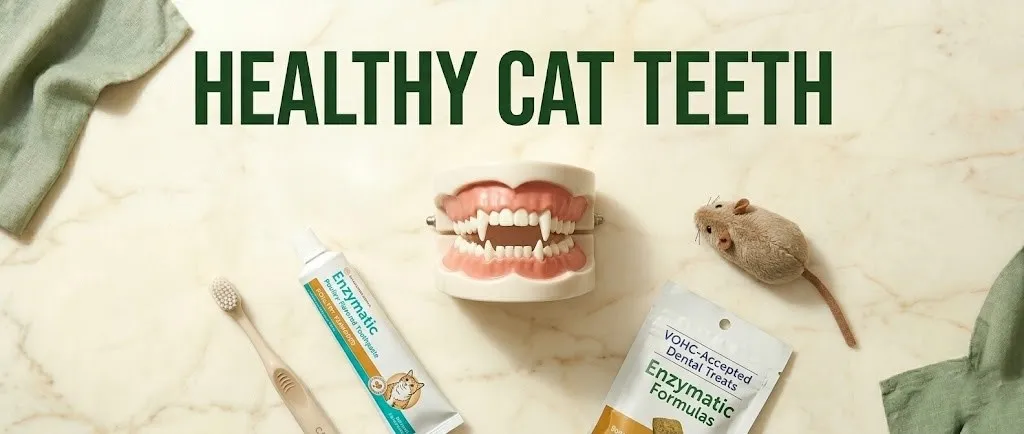
The gumline is where most dental disease begins, and it should be the focus of your visual inspection. In a healthy mouth, the gingiva hugs the tooth tightly, forming a seal that prevents bacteria from reaching the periodontal ligament and the jawbone. The gum edge is flat and follows a scalloped contour around each tooth. There is no swelling, no rounding of the gum papilla between teeth, and absolutely no blood when the gum is touched. The space between the tooth and gum, called the sulcus, should be no deeper than 0.5 to 1 millimeter in a cat. Deeper pockets indicate periodontal disease.
- White to light cream color: No yellow or brown deposits.
- Smooth surface: No rough calculus or fractures.
- Tight gum attachment: No redness, swelling, or bleeding.
- Neutral breath: No foul, metallic, or rotten odor.
what do healthy cat teeth look like
Healthy cat teeth look like small, sharp, ivory-white daggers. The incisors at the very front are tiny and almost translucent. The canines are long, smooth, and gently curved. The premolars and molars along the sides are triangular, with pointed cusps designed for shearing meat. The gum tissue around all of them should be a consistent pink, although some cats, particularly those with orange or calico coats, have black or freckled gums that are entirely normal.
The color of healthy feline teeth is not pure, bleached white. The natural color of dentin, the layer beneath the enamel, is slightly yellow. In a cat with healthy enamel, this dentin shows through as a warm ivory tone. A tooth that is stark white can actually be a sign of enamel hypoplasia, a developmental defect where the enamel is thin or absent. A tooth that is grey, purple, or pink is a sign of pulp damage or internal bleeding and requires immediate veterinary attention.
The shape of each tooth is specific to its function. The tiny incisors across the front are for grooming and nibbling. The four prominent canines are for grasping and puncturing prey. The premolars and molars form a scissor-like shearing surface that cuts meat into swallowable pieces. Cats have no flat grinding teeth because they are obligate carnivores. Their teeth are designed to slice, not crush.
| Tooth Type | Number (Adult Cat) | Healthy Appearance |
|---|---|---|
| Incisors | 12 | Tiny, white, translucent edges |
| Canines | 4 | Long, smooth, gently curved |
| Premolars | 10 | Triangular, sharp cusps |
| Molars | 4 | Small, sharp, used for shearing |
Key Takeaway: Healthy cat teeth are not pure white. They are ivory, smooth, and sharp, surrounded by pink or pigmented gums that hug each tooth tightly.
healthy cat teeth vs unhealthy
Healthy cat teeth are ivory, smooth, and surrounded by flat, pink gums, while unhealthy cat teeth show yellow or brown tartar accumulation, red or puffy gums, and in advanced cases, visible gum recession exposing the root surface or actual holes in the tooth enamel from resorptive lesions. The comparison between healthy and unhealthy is stark once you know the specific signs.
Calculus, also called tartar, is the most visible sign of unhealthy teeth. It appears as a hard, yellow-brown deposit, usually starting at the gumline on the cheek surfaces of the premolars and molars. Calculus itself is not the direct cause of periodontal disease. It is the rough surface that harbors the bacterial biofilm. The bacteria in that biofilm produce toxins that inflame the gums. A tooth completely covered in calculus may look alarming, but the disease process is happening invisibly under the gumline.
The gum tissue tells the story that the teeth only suggest. Healthy gums are flat and have a knife-edge margin against the tooth. Diseased gums are puffy, rounded, and bleed at the slightest touch. The color shifts from pink to angry red or dusky purple-red. This is gingivitis, and it is reversible with professional cleaning and home care. Untreated gingivitis progresses to periodontitis, where the attachment between gum and tooth is destroyed, creating pockets that trap more bacteria and eventually lead to bone loss and tooth mobility.
| Feature | Healthy | Unhealthy |
|---|---|---|
| Tooth Color | Ivory, white | Yellow, brown, grey, or pink |
| Tooth Surface | Smooth | Rough, calculus deposits |
| Gum Color | Pink (or black/pigmented) | Red, purple, dusky |
| Gum Shape | Flat, tight margin | Puffy, rounded, receding |
| Breath | Neutral | Foul, metallic, rotten |
| Pain Signs | None | Drooling, pawing, chattering, head shaking |
how to keep cats teeth healthy
You keep a cat’s teeth healthy through daily mechanical plaque removal, ideally by brushing with a feline enzymatic toothpaste, combined with a diet that includes Veterinary Oral Health Council (VOHC) accepted foods and treats. The gold standard of feline dental care is identical to the human standard: mechanical disruption of plaque every single day before it mineralizes.
Tooth brushing is the single most effective intervention. A 2021 study in the Journal of Veterinary Dentistry found that daily brushing reduced plaque accumulation by 80 percent compared to no brushing. Brushing every other day reduced plaque by roughly 50 percent. Brushing once a week was statistically indistinguishable from not brushing at all. The frequency is the determining factor. The goal is to prevent the 48-hour mineralization window from closing.
Dental diets and treats are not a substitute for brushing, but they are a valuable adjunct. They work through two mechanisms. The first is mechanical abrasion. The kibble or treat is formulated to be larger and more fibrous than standard food, forcing the cat to bite through it rather than swallowing it whole. The tooth sinks into the kibble, and the kibble wipes the tooth surface as it fractures. The second mechanism is chemical. Some dental diets contain sodium hexametaphosphate, a polyphosphate that binds salivary calcium, preventing it from mineralizing into calculus.
- Daily brushing with a cat-specific enzymatic toothpaste.
- Annual or biannual veterinary dental examinations.
- Use of VOHC-accepted dental treats and diets.
- Avoiding high-carbohydrate diets that feed oral bacteria.
how to keep cat teeth healthy
Keeping cat teeth healthy requires a multi-layered approach starting with daily brushing, supported by a veterinary-recommended dental diet, and monitored through weekly at-home mouth inspections to catch changes early. The protocol is simple in theory but requires patience to implement with a cat that has never had its mouth handled.
The foundation is brushing. Start by getting your cat accustomed to having its face and mouth touched. This process, called desensitization, takes roughly two to four weeks. Begin by gently petting the cheeks and lifting the lip for one second, followed by a high-value treat. Gradually extend the lip-lift duration over several days. When the cat tolerates this, introduce a finger wrapped in gauze dipped in tuna water, and rub it along the outer surfaces of the teeth for a few seconds. Finally, transition to a finger brush or a small cat toothbrush with enzymatic toothpaste.
Enzymatic toothpaste contains enzymes like glucose oxidase and lactoperoxidase that break down bacterial biofilms and neutralize odor-causing compounds. These toothpastes do not foam and do not require rinsing. They are formulated to be safe for cats to swallow. Human toothpaste must never be used on a cat. The fluoride, detergents, and xylitol in human toothpaste are toxic to cats and can cause severe illness.
To train a cat to accept tooth brushing:
- Week 1: Lift the lip for a few seconds daily, followed by a treat.
- Week 2: Rub the outer teeth with a finger gauze dipped in tuna water.
- Week 3: Introduce a small amount of enzymatic toothpaste on your finger.
- Week 4: Transition to a finger brush or small cat toothbrush. Focus on the outer surfaces of the cheek teeth.
- Maintain: Brush daily for 30 seconds, focusing on the gumline where the upper lip meets the teeth.
Key Takeaway: Brushing your cat’s teeth daily is the single most effective thing you can do for their dental health, and it is trainable in almost any cat with a four-week desensitization protocol.
cat healthy teeth
Maintaining cat healthy teeth through the senior years requires adjusting the care protocol as the cat ages, because the teeth naturally wear, the gums become more sensitive, and the risk of resorptive lesions increases dramatically. A healthy mouth at age two looks different from a healthy mouth at age fifteen, and the definition of “healthy” shifts with the cat’s life stage.
Kittens begin erupting their deciduous, or baby, teeth at roughly 3 to 4 weeks of age. By 6 to 7 weeks, all 26 baby teeth are present. These teeth should be small, sharp, and pearly white. The permanent teeth begin erupting around 3 to 4 months, and by 6 to 7 months, the cat should have a full set of 30 adult teeth. During this transition, you may find tiny, rice-grain-sized baby teeth on the floor or in the food bowl. This is normal. Retained baby teeth, where the baby tooth does not fall out and the adult tooth erupts alongside it, require veterinary extraction.
Adult cats in their prime, roughly one to seven years old, should have the full set of 30 teeth with minimal wear, no fractures, and no calculus if brushing is maintained. Senior cats over age ten often show some age-related changes. The tooth tips may be slightly rounded from wear. The gum tissue may be thinner and more delicate, making brushing gentleness more important. The most common dental issue in senior cats is tooth resorption, where the body’s own cells begin eating away at the tooth structure. This is painful and requires veterinary treatment.
- Kitten (0 to 6 months): Baby teeth erupt, then shed. Monitor for retained teeth.
- Adult (1 to 7 years): Full set of 30 teeth, minimal wear, no disease with care.
- Senior (8+ years): Normal wear, increased resorptive lesion risk, needs more frequent vet checks.
best food for cat teeth health
The best foods for cat teeth health are prescription dental diets that carry the Veterinary Oral Health Council (VOHC) seal of acceptance, specifically formulated with a large, fibrous kibble texture that mechanically scrubs the tooth surface and ingredients like sodium hexametaphosphate that bind salivary calcium. The VOHC seal is the only independent verification that a dental product actually reduces plaque or tartar.
The VOHC does not sell products and does not accept money from manufacturers for the seal. Companies submit their products for rigorous, standardized trials that measure plaque and calculus reduction compared to a control diet. A product that passes receives a seal that states “VOHC Accepted: Helps Control Plaque” or “VOHC Accepted: Helps Control Tartar.” In 2026, the list of VOHC-accepted cat foods includes prescription options from Hill’s Prescription Diet t/d, Royal Canin Dental, and Purina Pro Plan Veterinary Diets DH.
The mechanical action of these diets is fundamentally different from standard dry cat food. A standard kibble is small and shatters with little resistance, providing almost no tooth scrubbing. A dental kibble is larger, often up to 15 to 17 millimeters in diameter, with a fibrous, non-shattering texture. The cat must bite into the kibble, and the kibble wipes along the tooth surface as the tooth penetrates it. This mechanical action is similar to brushing, though less effective, and only reaches the crown of the tooth, not the gumline.
| Diet Category | Mechanism | VOHC Seal? |
|---|---|---|
| Prescription Dental Kibble | Mechanical scrubbing + polyphosphates | Yes |
| Standard Dry Kibble | Minimal abrasion | No |
| Raw Bones/Muscle Meat | Mechanical tearing | No (safety risk) |
| Wet/Canned Food | No mechanical action | No |
cat healthy teeth food
Cat healthy teeth food includes any diet that actively reduces plaque and tartar accumulation, whether through mechanical abrasion from a specifically designed kibble or through the inclusion of compounds that alter the oral microbiome. The term “healthy teeth food” means the food contributes to dental health rather than simply avoiding harm.
Wet food is nutritionally complete and provides essential hydration, but it provides zero mechanical cleaning action. The soft, pate-like texture slides off the teeth and leaves a food film on the gumline that feeds plaque bacteria. This is not an argument against wet food. The hydration benefits of wet food are real and important for urinary tract health. It means that cats on an exclusively wet food diet require even more diligent tooth brushing because there is no dry kibble providing even the minimal abrasive effect.
Raw meaty bones are a controversial recommendation. Chewing on a raw chicken neck or wing certainly provides mechanical cleaning, and feral cats maintain relatively healthy teeth on a whole-prey diet. However, raw bones carry risks. They can fracture teeth, particularly the upper carnassial premolars. They can lodge in the esophagus or perforate the intestine. Cooked bones are even more dangerous and should never be given to a cat. The American Veterinary Medical Association discourages raw bone feeding due to these risks. If you choose to feed raw bones, discuss it with your veterinarian and supervise your cat closely.
- VOHC-accepted kibble: Clinically proven, safe, convenient.
- Raw bones: Mechanical cleaning, but risk of dental fracture and GI perforation.
- Wet food: No cleaning action, requires diligent brushing.
cat dental treats that actually work
Cat dental treats that actually work carry the VOHC seal of acceptance and use either a mechanical scrubbing action from a large, abrasive texture or chemical agents like chlorophyll and green tea extract to reduce oral bacteria and freshen breath. The treat aisle is filled with products that claim to clean teeth. Only a handful have the independent testing data to back up those claims.
Greenies Feline Dental Treats are the most widely available VOHC-accepted treat for cats. They have a crunchy texture and a shape designed to encourage chewing. The mechanical action of the treat against the tooth surface removes plaque, and the treat dissolves before the cat swallows it, eliminating the risk of choking. Purina DentaLife Cat Treats use a porous, spongy texture that is easier for cats to chew than some harder treats, and they also carry the VOHC seal.
Dental treats supplement brushing. They do not replace it. A treat can reach the crown of the tooth but cannot clean under the gumline where periodontal disease begins. Think of dental treats as a toothbrush that only reaches the chewing surfaces. They are helpful for the molars and premolars, but they leave the canines and incisors essentially untouched. A daily dental treat combined with brushing provides the most comprehensive home care.
- Greenies Feline Dental Treats (VOHC Accepted).
- Purina DentaLife Cat Treats (VOHC Accepted).
- Virbac C.E.T. VeggieDent Chews (VOHC Accepted for dogs, feline version available).
- Avoid: Treats without VOHC seal making unverified cleaning claims.
Key Takeaway: The VOHC seal is the only reliable indicator that a dental treat actually works, and even the best treat is a supplement to brushing, not a substitute.
can I brush my cat’s teeth
You can and should brush your cat’s teeth, and with a patient, gradual training protocol, most cats will accept daily brushing. The belief that cats will not tolerate tooth brushing is a barrier erected by humans, not by cats. Cats respond to consistent, positive-reinforcement training when it is done on their terms.
The required tools are a cat-specific toothbrush and feline enzymatic toothpaste. A cat toothbrush is much smaller than a human toothbrush, with a narrow head that fits between the cheek and the teeth. A finger brush, a soft silicone sleeve that fits over your index finger, is a good starter tool for cats that are uncomfortable with a long-handled brush. Both work. The enzymatic toothpaste is available in cat-friendly flavors like poultry, malt, and seafood. The flavor is part of the training. A cat that thinks toothpaste is a treat is a cat that will cooperate.
The technique focuses on the outer surfaces of the teeth, the side facing the cheek. This is where plaque and calculus accumulate most heavily. You do not need to open your cat’s mouth. Simply lift the lip and brush in small, circular motions along the gumline. The whole process takes 30 seconds. Focus on the upper premolars and molars first. These are the teeth most prone to disease. The canines and incisors are secondary.
- Use a cat-specific toothbrush or finger brush.
- Use enzymatic toothpaste. Never use human toothpaste.
- Brush the outer surfaces only. The tongue cleans the inner surfaces.
- Brush daily. Every other day is acceptable. Weekly brushing is ineffective.
signs of cat tooth pain
The most common signs of cat tooth pain include drooling, pawing at the mouth, head shaking while eating, dropping food, chewing only on one side, loud chattering or crying when biting down, and a sudden preference for soft food after a lifetime of eating kibble. Cats are masters of masking pain, and dental pain can be present for months or years before the owner notices.
Behavioral changes are often the only outward sign. A cat in dental pain may become withdrawn, irritable, or aggressive when touched near the face. It may stop grooming, leading to a matted, unkempt coat because grooming requires the teeth to pull through the fur. The cat may press its head against walls or furniture, a behavior called head pressing, though this is a non-specific sign that can indicate many conditions. More subtle signs include a slight tilt of the head while chewing, as the cat tries to keep food on the less painful side.
Visible physical changes in the mouth are direct evidence of dental disease. A red line along the gum edge, a missing tooth with a dark hole in its place, a lump on the gum or under the eye, and drool tinged with blood are all signs that should trigger an immediate veterinary appointment. A cat that yelps when eating or backs away from the food bowl is in significant pain and should be seen by a veterinarian the same day.
- Dropping food, chewing on one side, preferring soft food.
- Pawing at mouth, head shaking, excessive drooling.
- Red, swollen, or bleeding gums.
- Bad breath that worsens suddenly.
- Reclusiveness, aggression when touched near the face.
cat gingivitis
Cat gingivitis is inflammation of the gum tissue caused by the accumulation of bacterial plaque at the gumline, visible as a bright red or purple-red line where the gum meets the tooth, and it is the earliest and fully reversible stage of periodontal disease. In a healthy mouth, the gum is pink and flat against the tooth. In gingivitis, the gum is red, puffy, and bleeds easily.
The cause of gingivitis is the body’s immune response to the plaque biofilm. The bacteria in the biofilm release toxins and enzymes that penetrate the gingival sulcus. The immune system responds by increasing blood flow to the area, which causes the redness, and by sending inflammatory cells, which causes the swelling. This inflammation, if the plaque is removed, resolves completely within a few days to a week. There is no permanent damage at the gingivitis stage.
Untreated gingivitis progresses to periodontitis, which is not reversible. The inflammatory process destroys the periodontal ligament and the supporting bone. The gums recede, exposing the roots. The teeth become mobile and eventually fall out. The bacteria from the infected pockets enter the bloodstream and can damage the heart valves, kidneys, and liver. Gingivitis is a warning sign that the system is failing, and the failure can be stopped if addressed at this early stage.
- Gingivitis: Red, swollen, bleeding gums. Reversible with cleaning.
- Periodontitis: Deep pockets, gum recession, bone loss. Irreversible.
- Stomatitis: Severe, widespread inflammation involving the entire mouth. Autoimmune component. Requires advanced veterinary treatment.
Key Takeaway: Gingivitis is the red flag that saves your cat’s teeth. If you see redness at the gumline, the clock is ticking, but the damage is still reversible with professional veterinary care and improved home brushing.
Frequently Asked Questions About Healthy Cat Teeth
What does bad cat teeth look like?
Bad cat teeth appear yellow or brown from tartar buildup, with red, puffy, or bleeding gums.
Advanced cases show gum recession exposing the darker tooth roots, loose teeth, and holes in the enamel from resorptive lesions.
The breath is consistently foul, and the cat may drool blood-tinged saliva.
Can I use human toothpaste on my cat?
You cannot use human toothpaste on a cat because it contains fluoride, detergents, and sometimes xylitol, all of which are toxic to cats.
Human toothpaste also foams, which cats find distressing, and it is not meant to be swallowed.
Always use a cat-specific enzymatic toothpaste formulated to be safe for swallowing.
Does dry food really clean cats’ teeth?
Standard dry cat food does not clean cats’ teeth effectively because the small, brittle kibble shatters without significant tooth contact.
Only VOHC-accepted dental diets with a specific large, fibrous kibble design provide a proven mechanical cleaning benefit.
Relying on standard dry food for dental health is a myth.
Why does my cat’s breath smell like fish?
A fishy smell in a cat’s breath is usually caused by bacteria breaking down food particles and producing volatile sulfur compounds.
It can also indicate gingivitis, periodontitis, or a rotting tooth.
A sudden increase in bad breath warrants a veterinary dental examination.
How often should a vet clean my cat’s teeth?
Most adult cats benefit from a professional veterinary dental cleaning once per year, though cats with advanced periodontal disease may need cleanings more frequently.
The procedure requires general anesthesia and includes scaling, polishing, and full-mouth radiographs to detect disease below the gumline.
Your veterinarian can recommend a specific schedule based on your cat’s oral health assessment.
Your cat’s teeth are a hidden metric of overall health, silently accumulating plaque, harboring bacteria, and developing painful lesions that your cat will do everything in its power to hide from you. The window for intervention is narrow. Gingivitis is reversible. Periodontitis is not. Tooth resorption is painful and progressive. The only way to catch these conditions before they cause irreversible damage is to look inside your cat’s mouth every week.
Lift the lip tonight. Look at the gumline. If it is pink and flat against the tooth, your cat’s dental health is on track. If it is red, puffy, or bleeding, call your veterinarian and schedule a dental examination. The best food, the best treats, and the best brushing technique in the world will not matter if you never look. The mouth tells the truth. The skill is learning to read it.
Start the brushing protocol this week. Order the enzymatic toothpaste in the poultry flavor. Buy a finger brush. Commit to the four-week training plan. Your cat will resist, then tolerate, then accept. A year from now, your veterinarian will look at your cat’s clean, white teeth and healthy pink gums and tell you something you already know. You did the work, and it mattered.