Carne asada can be a healthy protein choice, delivering high-quality complete protein, iron, zinc, and B vitamins from grilled beef with a marinade made from real food ingredients like citrus and garlic. The healthiness of the dish depends on three variables: the cut of beef used, how much of it you eat, and what you eat it with. A 4-ounce serving of skirt steak carne asada provides approximately 250 to 300 calories and 30 to 35 grams of protein. That is the nutritional profile of a lean protein source. Served on a corn tortilla with onion and cilantro, it is a reasonable meal component.
The same carne asada served as a large burrito with a flour tortilla, rice, beans, cheese, sour cream, and guacamole can exceed 1,200 calories and 40 grams of fat. The carne asada itself did not change. What it was served with changed. The health analysis of carne asada that stops at the meat misses the point. Carne asada is almost never eaten alone. The meal context determines whether it is a healthy choice.
This article breaks down the nutrition of carne asada by cut, compares it to other taco fillings, explains how the marinade affects the nutritional profile, and gives you practical guidance for ordering healthier carne asada at a restaurant or making it at home. You will learn what to ask for at a taqueria, how to build a balanced asada plate, and when carne asada fits into weight loss, muscle building, and keto eating patterns.
Are asada tacos healthy
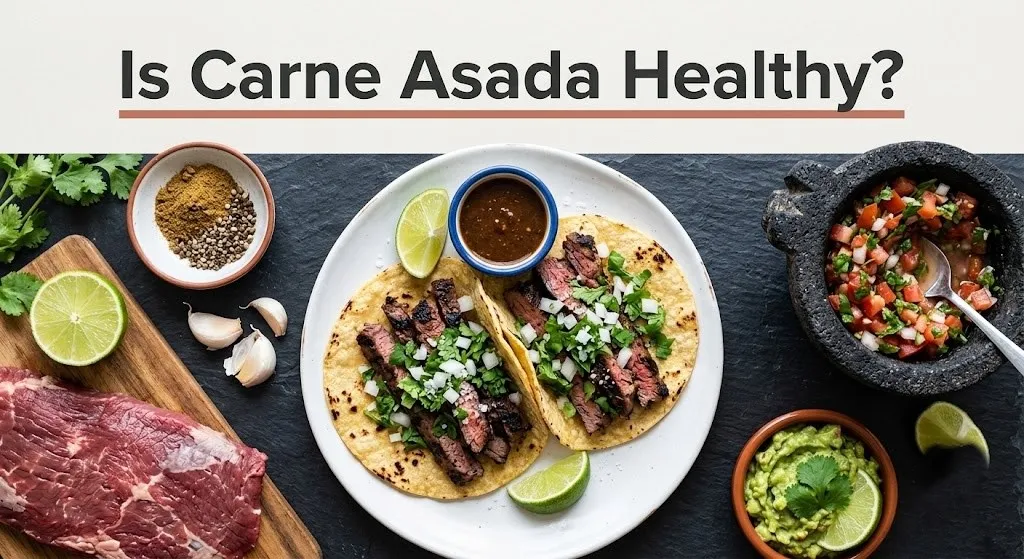
Asada tacos can be healthy when built on corn tortillas with lean carne asada and vegetable-based toppings like onion, cilantro, and salsa. Two street-style carne asada tacos on 4-inch corn tortillas with a total of 4 ounces of carne asada, onion, cilantro, and a squeeze of lime contain approximately 400 to 500 calories, 30 to 35 grams of protein, 15 to 20 grams of fat, and 30 to 40 grams of carbohydrates. That is a reasonable meal for most eating patterns.
Asada tacos become less healthy when the tortilla is flour, the portion is doubled, and the toppings include large amounts of cheese, crema, and guacamole without accounting for the additional calories. A flour tortilla adds 100 to 150 calories compared to a corn tortilla of the same diameter and contributes refined carbohydrates with less fiber. Cheese and crema add saturated fat and sodium. Guacamole adds healthy fat and calories, roughly 50 to 80 calories per generous tablespoon, which can be nutritionally valuable or calorically excessive depending on the total meal.
The taco format has a built-in portion control advantage that other Mexican food formats lack. Tacos are individually portioned. A person can eat two tacos and stop. A burrito is a single item that contains an entire meal’s worth of food, making it harder to stop partway through. For weight management, the taco format is superior to the burrito format because it makes portion awareness easier.
Key Takeaway: Street-style carne asada tacos on corn tortillas with onion and cilantro are a reasonable 400 to 500 calorie meal. Flour tortillas and heavy toppings increase the calorie and fat content.
Carne asada nutrition
Carne asada nutrition varies by the cut of beef used and the marinade recipe, but a standard 4-ounce (113-gram) serving of grilled skirt steak carne asada provides approximately 250 to 300 calories, 30 to 35 grams of protein, 15 to 20 grams of total fat, 5 to 8 grams of saturated fat, 80 to 100 milligrams of cholesterol, 1 to 3 grams of carbohydrates from the marinade, and 300 to 500 milligrams of sodium before added salt. The protein content is the nutritionally significant positive. The saturated fat content is the primary variable.
The micronutrient profile of carne asada reflects the nutrient density of beef. A 4-ounce serving provides approximately 15% to 20% of the Daily Value for iron as highly bioavailable heme iron, 30% to 40% for zinc, 40% to 50% for selenium, and 50% to 60% for vitamin B12. These four nutrients are among the most common nutrient deficiencies globally, and beef is one of the most concentrated food sources of all four. The iron in beef is absorbed two to three times more efficiently than non-heme iron from plant sources.
The beef cut used for carne asada affects the nutritional profile significantly. Skirt steak, the traditional cut, is flavorful and moderately fatty. Flank steak is leaner but can be tougher if not sliced correctly against the grain. Flap meat, sometimes called sirloin tip, falls between skirt and flank in fat content. Understanding the cut helps you estimate the fat and calorie content of the carne asada on your plate.
Key Takeaway: Carne asada provides 30 to 35 grams of protein and significant iron, zinc, selenium, and B12. Saturated fat content varies by cut.
Carne asada calories
Carne asada calories range from 200 to 350 per 4-ounce serving depending on the beef cut and the amount of oil in the marinade and cooking process. Skirt steak contains approximately 250 to 300 calories per 4 ounces cooked. Flank steak contains approximately 200 to 250 calories for the same portion. Flap meat falls in between at 225 to 275 calories. The calorie difference between cuts is approximately 50 to 100 calories per serving, which is meaningful for someone tracking calories carefully but not dramatic in the context of a full day’s intake.
The calorie count increases when carne asada is cooked with added oil or when the marinade contains significant oil that remains on the meat during grilling. A traditional carne asada marinade is made with citrus juice, garlic, cilantro, and a small amount of oil, roughly 1 to 2 tablespoons of oil per pound of meat. The oil contributes approximately 15 to 30 calories per serving, most of which stays on the meat surface. This is a modest addition compared to the beef’s own fat content.
Restaurant portions of carne asada are often larger than 4 ounces. A typical taqueria serving of carne asada for a plate or for three tacos is 6 to 8 ounces, delivering 375 to 600 calories from the meat alone. The portion size is the most powerful calorie lever for restaurant carne asada. Asking for a smaller portion, sharing a plate, or boxing half before eating are practical strategies for managing calories when dining out.
Key Takeaway: Carne asada calories range from 200 to 350 per 4-ounce serving by cut. Restaurant portions are often 6 to 8 ounces, doubling the calorie count.
Carne asada protein
Carne asada protein content is its strongest nutritional attribute. A 4-ounce serving provides 30 to 35 grams of complete protein, which is 60% to 70% of the Daily Value and comparable to a large chicken breast. The protein is complete, containing all nine essential amino acids in proportions that support human protein synthesis. Beef protein has a Protein Digestibility Corrected Amino Acid Score (PDCAAS) approaching 1.0, the maximum possible, indicating near-complete absorption and utilization.
The amino acid profile of beef protein is particularly rich in leucine, the branched-chain amino acid that serves as the primary signal for muscle protein synthesis. A 4-ounce serving of carne asada provides approximately 2.5 to 3 grams of leucine, which exceeds the threshold believed to maximally stimulate muscle protein synthesis in a single meal. This makes carne asada a functional post-workout protein source for athletes and a useful food for preserving lean body mass during weight loss.
The protein density of carne asada, 30 to 35 grams of protein for 250 to 300 calories, makes it one of the more protein-efficient foods available. It delivers approximately 0.12 grams of protein per calorie. Chicken breast delivers approximately 0.16 grams per calorie. The difference is modest. Both are excellent protein sources. The choice between them can reasonably be made on taste and cultural preference rather than nutritional optimization.
Key Takeaway: Carne asada provides 30 to 35 grams of highly bioavailable protein per serving, including 2.5 to 3 grams of leucine for muscle protein synthesis.
Carne asada fat content
Carne asada fat content varies by cut, with skirt steak containing approximately 15 to 20 grams of total fat per 4-ounce serving and flank steak containing approximately 10 to 15 grams. The saturated fat content follows the same pattern: 5 to 8 grams in skirt steak and 3 to 5 grams in flank steak. The American Heart Association recommends limiting saturated fat to 13 grams per day on a 2,000-calorie diet. A serving of skirt steak carne asada uses 38% to 62% of that limit. A serving of flank steak carne asada uses 23% to 38%.
The fat in beef is approximately 40% to 50% saturated, with the remainder split between monounsaturated and a small amount of polyunsaturated fat. The monounsaturated fat in beef is predominantly oleic acid, the same fatty acid found in olive oil. Beef is not the nutritional equivalent of olive oil. The saturated fat content is the dominant health consideration. The monounsaturated fat is a partial nutritional offset.
The visible fat on a carne asada steak can be trimmed before or after cooking to reduce the fat content by 10% to 30%. The marinade does not add significant fat beyond the small amount of oil used, most of which stays on the meat surface rather than penetrating the muscle. Choosing flank steak over skirt steak and trimming visible fat are the two most effective ways to reduce the fat content of carne asada at home. At a restaurant, asking for the leanest cut available is a reasonable request.
Key Takeaway: Skirt steak has 15 to 20 grams of fat per serving. Flank steak has 10 to 15 grams. Trimming fat and choosing leaner cuts reduce saturated fat intake.
Carne asada sodium
Carne asada sodium content comes from the salt in the marinade and any salt added after cooking. A 4-ounce serving of homemade carne asada contains approximately 300 to 500 milligrams of sodium, depending on the marinade recipe. Restaurant carne asada can contain 600 to 1,000 milligrams or more, as commercial kitchens salt meat more aggressively than home cooks typically do. The American Heart Association recommends limiting sodium to 2,300 milligrams per day with an ideal limit of 1,500 milligrams. Restaurant carne asada can use 40% to 65% of the ideal daily limit in a single serving.
The marinade is the primary sodium vehicle for carne asada. Traditional recipes use salt as a dry brine or dissolved in the citrus marinade to season the meat and help it retain moisture during high-heat grilling. Soy sauce, used in some modern carne asada recipes, is a concentrated sodium source at 900 to 1,000 milligrams per tablespoon. A marinade with soy sauce produces a significantly saltier finished product than a traditional citrus and salt marinade.
At home, reducing sodium in carne asada is straightforward: use less salt in the marinade, avoid soy sauce or use a reduced-sodium version, and salt lightly after cooking instead of before. At a restaurant, requesting that the meat be cooked without added salt is sometimes accommodated. The marinade is typically pre-made, so the sodium is already in the meat before it is cooked. Asking about the marinade ingredients and sodium content is reasonable.
Key Takeaway: Homemade carne asada sodium is 300 to 500 milligrams per serving. Restaurant versions can reach 600 to 1,000 milligrams. Soy sauce marinades increase sodium significantly.
Is skirt steak healthy
Skirt steak is moderately healthy, providing the same high-quality protein, iron, zinc, and B12 as other beef cuts, with a fat content that is higher than lean cuts like flank steak or sirloin but lower than heavily marbled cuts like ribeye. A 4-ounce serving of skirt steak contains approximately 30 grams of protein, 18 grams of total fat, and 7 grams of saturated fat. It delivers the nutritional benefits of beef with a saturated fat content that requires attention to portion size and meal context.
Skirt steak is the traditional cut for carne asada because its loose grain structure absorbs marinade effectively and its relatively high fat content keeps it juicy during high-heat grilling. The fat is distributed as marbling within the muscle and as a thin surface layer. Trimming the surface fat reduces the total fat by 15% to 25% without sacrificing the interior juiciness.
For someone with normal cholesterol levels and no cardiovascular disease, skirt steak in reasonable portions, 4 to 6 ounces, a few times per week fits within a healthy eating pattern. For someone with elevated LDL cholesterol or existing heart disease, flank steak or a leaner cut is a better choice because of the lower saturated fat content. The American Heart Association’s saturated fat guideline provides the benchmark against which individual choices can be evaluated.
Key Takeaway: Skirt steak is moderately healthy with good protein but notable saturated fat. It is traditional for carne asada and can fit into a healthy diet in reasonable portions.
Carne asada vs chicken
Carne asada and chicken represent different nutritional tradeoffs rather than a clear winner-loser comparison. Carne asada provides more iron, zinc, and vitamin B12 than chicken. Chicken breast provides more protein per calorie and less saturated fat. The choice between them depends on which nutritional priority matters more.
A 4-ounce serving of grilled chicken breast provides approximately 180 calories, 35 grams of protein, 4 grams of total fat, and 1 gram of saturated fat. The same serving of skirt steak carne asada provides approximately 275 calories, 30 grams of protein, 18 grams of fat, and 7 grams of saturated fat. Chicken breast wins on calories, total fat, and saturated fat. Skirt steak wins on iron, zinc, and vitamin B12. The protein difference of 5 grams is not nutritionally significant for most people.
The flavor and satisfaction difference between carne asada and chicken cannot be captured in a nutrition table. Carne asada has a richer, beefier flavor from the fat and the Maillard reaction during grilling. Chicken breast is milder and accepts marinade flavors well but does not develop the same depth of flavor. For someone trying to enjoy a Mexican meal while maximizing nutritional quality, chicken is the better choice. For someone who wants beef and is willing to accept the nutritional tradeoffs, carne asada is a reasonable option.
Key Takeaway: Chicken breast has fewer calories and less fat than carne asada. Carne asada provides more iron, zinc, and B12. Both are healthy protein choices with different tradeoffs.
Is grilled beef healthy
Grilled beef is healthy in the context of a balanced diet that does not exceed the American Heart Association’s saturated fat and sodium limits. The grilling method itself is a healthier cooking technique than frying because it allows fat to drip away from the meat rather than being absorbed. A grilled beef steak retains its protein and micronutrients while losing some of its surface fat to the grill grates.
The health concern with grilled beef is not the grilling itself but the formation of heterocyclic amines (HCAs) and polycyclic aromatic hydrocarbons (PAHs) , compounds formed when meat is cooked at high temperatures and when fat drips onto hot coals or heating elements, creating smoke that deposits PAHs on the meat. These compounds are probable human carcinogens. The risk from grilled meat is smaller than the risk from processed meat and is considered acceptable within the context of occasional consumption.
Marinating beef before grilling reduces HCA formation by up to 90% in some studies, possibly because the antioxidants in the marinade ingredients, citrus, garlic, herbs, inhibit the chemical reactions that produce HCAs. The traditional carne asada marinade, made with lime juice, garlic, and cilantro, may provide this protective effect. This is a nutritional argument in favor of the traditional preparation method.
Key Takeaway: Grilled beef is a healthy cooking method compared to frying. Marinating reduces potentially harmful compounds formed during high-heat grilling.
Is carne asada good for weight loss
Carne asada is good for weight loss because its high protein content supports satiety and lean body mass preservation during calorie restriction. A 4-ounce serving provides 30 to 35 grams of protein for 250 to 300 calories, making it an efficient way to meet elevated protein targets during weight loss. Research consistently shows that higher protein diets improve body composition outcomes during calorie deficits by preserving muscle and increasing the thermic effect of food.
The weight loss utility of carne asada depends heavily on the meal format. Carne asada tacos on corn tortillas with vegetables are a weight-loss-compatible meal. A carne asada burrito with rice, beans, cheese, and sour cream is a calorie-dense meal that is harder to fit into a deficit. The carne asada is not the variable. The tortilla type, the portion size, and the toppings are the variables.
For meal prepping for weight loss, carne asada can be cooked in bulk, portioned into 4-ounce servings, and paired with vegetables and a controlled carbohydrate source. A bowl with carne asada, black beans, fajita vegetables, salsa, and a small amount of guacamole provides protein, fiber, and healthy fat for approximately 500 to 600 calories. This meal format is more filling and nutrient-dense than many standard weight loss meals.
Key Takeaway: Carne asada supports weight loss through high protein and moderate calories. The taco or bowl format is preferable to the burrito for portion control.
Carne asada keto
Carne asada is keto compatible because it contains minimal carbohydrates, typically 1 to 3 grams per serving from the marinade. The ketogenic diet requires keeping net carbohydrates below 20 to 50 grams per day. A serving of carne asada contributes negligibly to that total while providing the protein and fat that form the foundation of a ketogenic meal.
The traditional taco format requires modification for keto because corn tortillas contain 10 to 15 grams of carbohydrates each. A plate of three street tacos on corn tortillas provides 30 to 45 grams of net carbohydrates, which can use an entire day’s keto budget. Keto-compatible alternatives include eating the carne asada without tortillas, using lettuce wraps, or ordering a carne asada bowl or plate with no tortillas, no rice, and no beans.
A keto carne asada bowl includes the meat, cheese, guacamole, sour cream, salsa, and lettuce or fajita vegetables. This combination is high in fat, moderate in protein, and low in carbohydrates, aligning with ketogenic macronutrient targets. The meal is nutritionally similar to what would be in tacos or a burrito, with the high-carbohydrate components removed.
Key Takeaway: Carne asada is keto compatible with 1 to 3 grams of carbohydrates per serving. Skip the tortillas, rice, and beans for a keto-friendly bowl format.
Best cut for carne asada
The best cut for carne asada from a health perspective is flank steak, which provides the same protein and micronutrient benefits as skirt steak with 30% to 40% less fat and 25% to 35% fewer calories. Flank steak comes from the same general area of the cow as skirt steak but is a leaner, thicker muscle. It requires careful slicing against the grain after cooking to achieve tenderness. A flank steak sliced with the grain is tough and chewy. Sliced correctly, it is tender and satisfying.
Skirt steak is the traditional and most flavorful cut for carne asada. It has a looser grain that absorbs marinade effectively and a higher fat content that keeps the meat juicy during high-heat grilling. It is the standard against which carne asada is judged, and the flavor difference between skirt steak and leaner cuts is noticeable.
Flap meat, sometimes labeled as sirloin tip or bavette, is a middle-ground option between skirt and flank in fat content, flavor, and tenderness. It is often more affordable than skirt steak and more forgiving to cook than flank steak. For home cooks making healthy carne asada, flap meat is a practical choice that balances nutrition, flavor, cost, and cooking ease.
Key Takeaway: Flank steak is the leanest cut for carne asada. Skirt steak is the traditional and most flavorful. Flap meat is a practical middle ground.
Carne asada marinade healthy
Carne asada marinade is healthy when made from traditional ingredients: lime juice, orange juice, garlic, cilantro, olive oil, cumin, and salt. These are whole food ingredients that add flavor without processed additives. The citrus juice serves a functional purpose beyond flavor. The acid partially denatures the meat proteins on the surface, allowing the marinade flavors to penetrate and improving the meat’s ability to retain moisture during cooking.
The oil in the marinade is the most calorie-dense ingredient, and it is used in small quantities. A typical marinade uses 1 to 2 tablespoons of oil per pound of meat, which adds approximately 15 to 30 calories per serving. The oil helps transfer fat-soluble flavors from the garlic and spices into the meat and prevents the meat from sticking to the grill. The quantity is nutritionally modest.
Some commercial and restaurant marinades add sugar, honey, or agave nectar to promote caramelization. These additions increase the carbohydrate content and add empty calories. A sugary marinade can contribute 5 to 15 grams of sugar per serving, which is not traditional and is nutritionally unnecessary. Asking whether a restaurant’s marinade contains sugar or sweeteners is a reasonable question for a health-conscious diner.
Key Takeaway: Traditional marinade ingredients are healthy whole foods. Avoid marinades with added sugar or excessive oil.
How to make healthy carne asada
How to make healthy carne asada at home involves choosing a lean cut, using a traditional oil-light marinade, grilling instead of pan-frying, slicing against the grain, and serving with vegetable-forward accompaniments on corn tortillas or in a bowl format. Each decision reduces calories, fat, or sodium while preserving the flavor that makes carne asada worth eating.
To make healthy carne asada:
- Choose flank steak or flap meat for a leaner result, or use skirt steak and trim visible fat.
- Marinate in a mixture of 1/4 cup lime juice, 1/4 cup orange juice, 4 minced garlic cloves, 1/2 cup chopped cilantro, 1 tablespoon olive oil, 1 teaspoon cumin, and 1 teaspoon salt for 2 to 4 hours in the refrigerator.
- Preheat a grill or grill pan to high heat. Remove the meat from the marinade and pat dry to promote browning.
- Grill for 3 to 5 minutes per side for medium-rare, or to an internal temperature of 145°F. Let rest for 5 minutes before slicing.
- Slice thinly against the grain. Serve on corn tortillas with diced onion, fresh cilantro, salsa, and a squeeze of lime. Add sliced avocado instead of guacamole to control fat portions.
Key Takeaway: Choose a lean cut, use a traditional light marinade, grill to 145°F, slice against the grain, and serve on corn tortillas with vegetable toppings.
Carne asada tacos healthy
Carne asada tacos are healthiest when built on 4-inch corn tortillas with a reasonable portion of meat, 2 to 3 ounces per taco, and topped with fresh vegetables rather than heavy dairy. Two tacos built this way provide a satisfying meal for 400 to 500 calories. The same tacos built on flour tortillas with cheese, crema, and a large portion of meat can reach 800 to 900 calories.
Corn tortillas are nutritionally superior to flour tortillas for several reasons. They contain 50 to 60 calories each compared to 100 to 150 calories for a similar-sized flour tortilla. They are made from whole-grain corn masa, providing approximately 1 to 2 grams of fiber per tortilla compared to less than 1 gram in most flour tortillas. They are naturally gluten free. The flavor of corn tortillas complements carne asada better than flour tortillas do.
The toppings on carne asada tacos should emphasize vegetables. Diced white onion and chopped cilantro are the traditional toppings and add negligible calories. Salsa adds flavor and a small amount of vitamins from tomatoes and chiles for 5 to 10 calories per tablespoon. Guacamole or sliced avocado adds 50 to 80 calories per generous tablespoon of healthy fat. Cotija cheese and crema add saturated fat and sodium and should be used sparingly by health-conscious diners.
Key Takeaway: Healthy carne asada tacos use corn tortillas, 2 to 3 ounces of meat, and vegetable-based toppings. Limit cheese and crema.
Healthiest Mexican food
The healthiest Mexican food items are those that feature grilled proteins, corn tortillas, and fresh vegetable toppings without heavy sauces, fried preparations, or excessive cheese. Carne asada tacos on corn tortillas with onion, cilantro, and salsa belong in this category. So do ceviche, grilled fish tacos, chicken fajitas, and black bean soup.
The least healthy Mexican food items are fried, smothered in cheese and sauce, or built on large flour tortillas. Chimichangas, fried flautas, queso fundido, super nachos, and large burritos with all the toppings can exceed 1,500 calories and a full day’s saturated fat and sodium in a single serving. The issue is not the Mexican cuisine. It is the specific preparation methods and portion sizes used in many American Mexican restaurants.
The healthiest Mexican food strategy is to order from the taco menu on corn tortillas, choose grilled proteins, load up on salsa and fresh vegetable toppings, and skip or limit cheese, sour cream, and fried items. This approach works at taquerias, fast-casual chains, and sit-down Mexican restaurants. The cuisine is inherently compatible with healthy eating when the traditional, ingredient-forward preparations are chosen over the Americanized, indulgence-focused versions.
Key Takeaway: Grilled proteins on corn tortillas with fresh vegetables are the healthiest Mexican food choices. Avoid fried items and heavy cheese and cream sauces.
Healthy carne asada bowl
A healthy carne asada bowl is a deconstructed taco or burrito served without the tortilla, with the proportions shifted toward vegetables and away from calorie-dense toppings. The bowl format works well for meal prep and for restaurant ordering where the bowl is an option, as it is at Chipotle and similar chains. The bowl removes the refined carbohydrates of the tortilla and lets the diner control the quantity of each component.
A balanced healthy carne asada bowl includes: 4 ounces of carne asada, 1/2 cup of black beans or pinto beans, a generous portion of fajita vegetables (grilled peppers and onions), fresh tomato salsa, shredded lettuce, a tablespoon of guacamole or sliced avocado, and a squeeze of lime. This bowl provides approximately 500 to 600 calories, 35 to 40 grams of protein, 15 to 20 grams of fiber, and healthy fat from the avocado. The vegetables provide volume and micronutrients for minimal calories.
The bowl format avoids the common pitfalls of restaurant Mexican food. There is no flour tortilla adding 300 calories. There is no half-cup of cheese adding 200 calories. There is no quarter-cup of sour cream adding 120 calories. The bowl makes it easier to taste the carne asada itself and to feel satisfied from the protein and fiber rather than from the refined carbohydrates and saturated fat.
Key Takeaway: A healthy carne asada bowl combines the meat with beans, vegetables, salsa, and a small amount of avocado for a balanced, high-fiber, high-protein meal.
Frequently Asked Questions About Carne Asada
Is carne asada healthier than chicken?
Carne asada provides more iron, zinc, and vitamin B12 than chicken. Chicken breast has fewer calories and less saturated fat.
Carne asada contains about 275 calories and 7 grams of saturated fat per 4-ounce serving. Chicken breast has about 180 calories and 1 gram of saturated fat.
Both are healthy protein choices. Chicken is better for saturated fat reduction. Carne asada is better for iron and zinc.
Can I eat carne asada on a diet?
Carne asada fits into a weight loss diet because it provides 30 to 35 grams of filling protein for 250 to 300 calories per serving.
Choose corn tortillas over flour, load up on vegetable toppings, and skip heavy cheese and crema.
A plate of two street-style carne asada tacos is a reasonable 400 to 500 calorie meal.
Is the marinade on carne asada unhealthy?
Traditional carne asada marinade made from citrus juice, garlic, cilantro, and spices is healthy and adds negligible calories.
Some commercial marinades add sugar, honey, or excess oil, which increase calories and added sugar.
Ask about the marinade ingredients or make it at home to control what goes into it.
What is the healthiest cut for carne asada?
Flank steak is the leanest cut for carne asada, with about 10 to 15 grams of fat per serving.
Skirt steak is the traditional cut with more marbling and flavor but higher fat at 15 to 20 grams per serving.
Flap meat is a practical middle ground that balances nutrition, flavor, and cost.
How many calories are in a carne asada taco?
A street-style carne asada taco on a small corn tortilla with onion and cilantro contains approximately 200 to 250 calories.
A larger taco on a flour tortilla with cheese and crema can contain 400 to 500 calories each.
The tortilla type and toppings are the primary calorie drivers beyond the meat itself.
Carne asada is a nutritionally sound food that has been eating well for a long time. It is grilled beef, simply marinated, served in a format that can be as light or as heavy as the eater chooses. The carne asada itself is not the problem and never has been. The problem, when there is one, is the mountain of cheese, the lake of sour cream, the oversized flour tortilla, the massive portion that could feed two people.
The most practical thing you can do is order like someone who knows the difference. Corn tortillas. Onion and cilantro. Salsa. A reasonable portion. That is how carne asada has been eaten for generations before anyone thought to wrap it in a pound of flour and cover it in cheese sauce. The traditional way is the healthy way. You do not need to reinvent the food. You just need to order it the way it was meant to be eaten.