Healthy pet insurance is pet insurance that goes beyond accident and illness coverage to include preventive wellness care such as vaccinations, annual exams, dental cleanings, and spay or neuter procedures. The term “healthy pet insurance” is not an industry-standard label. It describes a coverage philosophy where the insurance supports keeping a pet healthy rather than only paying for treatment after the pet gets sick or injured. Some providers, including the brand Healthy Paws, build their identity around this concept even if their core product is accident and illness coverage.
The American Veterinary Medical Association (AVMA) recognizes that financial concerns are one of the primary barriers to preventive veterinary care. A 2025 AVMA survey found that roughly 28 percent of pet owners reported delaying or skipping veterinary visits due to cost. Pet insurance that includes or offers wellness add-ons directly addresses this barrier by covering predictable, routine expenses alongside unexpected emergencies. The result, according to the American Animal Hospital Association (AAHA) , is improved adherence to preventive care schedules, earlier disease detection, and better long-term health outcomes for pets.
This guide defines what healthy pet insurance means in 2026, explains the difference between standard insurance and wellness-inclusive coverage, analyzes Healthy Paws and its major competitors, and provides practical cost comparisons and decision frameworks for dog and cat owners. You will walk away knowing whether a wellness-inclusive policy makes financial sense for your specific pet and how to evaluate the fine print that determines what your premium actually buys.
What Is Healthy Pet Insurance
Healthy pet insurance refers to a pet health insurance policy that covers preventive and routine care in addition to, or as part of, accident and illness coverage. The core distinction is between reactive coverage, which pays for treatment after an injury or diagnosis, and proactive coverage, which pays for the vaccinations, exams, and screenings that prevent disease or catch it early. Most pet insurance in 2026 is reactive. Healthy pet insurance in its truest form is both.
The industry term for the proactive component is a wellness plan or preventive care rider. It is almost always an add-on to a standard accident and illness policy, not a standalone product. A typical wellness add-on covers a defined list of routine services up to a set dollar limit per year. The list usually includes one annual wellness exam, core vaccinations (rabies, distemper, parvovirus for dogs, panleukopenia for cats), a fecal test, a heartworm test, and sometimes a dental cleaning or spay/neuter contribution. The annual limit for wellness add-ons ranges from $200 to $650 depending on the provider and tier.
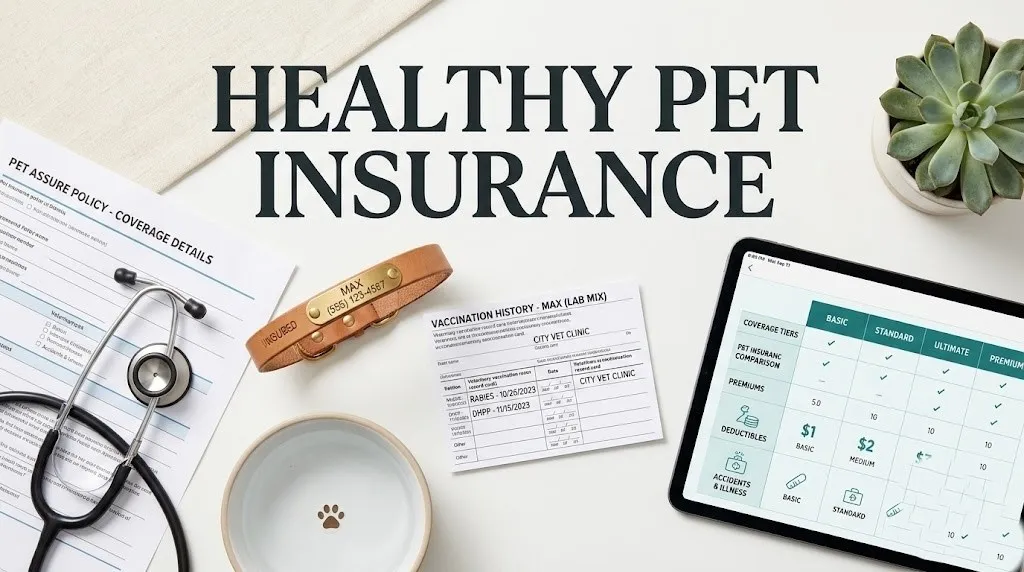
The reactive component, the standard accident and illness policy, covers injuries (broken bones, lacerations, toxin ingestion) and illnesses (cancer, infections, chronic conditions) after a waiting period and subject to deductible, reimbursement rate, and annual or lifetime limits. Healthy Paws offers accident and illness coverage with unlimited lifetime benefits, no per-condition caps, and no annual limits. It does not offer a wellness add-on. The company’s name implies a focus on health, but its product is a high-quality reactive policy, not a proactive wellness package. This distinction between brand identity and product structure is one of the most important things to understand when researching healthy pet insurance.
| Coverage Type | What It Pays For | Typical Annual Cost (Dog) | Typical Annual Cost (Cat) |
|---|---|---|---|
| Accident-only | Injuries, emergencies, toxin ingestion | $150 to $250 | $100 to $180 |
| Accident and illness | Above plus illnesses, cancer, chronic conditions | $400 to $900 | $250 to $500 |
| Wellness add-on (basic) | Annual exam, core vaccines, fecal test | $200 to $350 | $150 to $250 |
| Wellness add-on (premium) | Above plus dental cleaning, spay/neuter, blood work | $400 to $650 | $300 to $500 |
Pet insurance premiums vary by species, breed, age, location, and the specific coverage choices. A comprehensive accident and illness policy with a premium wellness add-on for a young Golden Retriever in a major city might cost $1,200 to $1,600 annually. The same coverage for a young mixed-breed cat in a rural area might cost $400 to $600 annually. The variation is wide enough that personalized quotes are essential for accurate budgeting.
Key Takeaway: Healthy pet insurance is accident and illness coverage plus wellness care, a combination that supports both unexpected emergencies and routine preventive health. Healthy Paws offers the former with unlimited benefits but does not sell the latter as an add-on.
Healthy Pet Insurance
The phrase “healthy pet insurance” searches the same concept as the main keyword and often reflects a consumer who has heard the term and wants to understand what it actually includes. The consumer expectation behind the search is reasonable: pet insurance should help keep a pet healthy, not just pay bills after something goes wrong. The reality of the pet insurance market in 2026 is that most policies are designed around the unexpected, not the routine. The wellness component that would make the insurance genuinely “healthy” is an upsell.
The North American Pet Health Insurance Association (NAPHIA) reported that approximately 5.6 million pets were insured in the United States in 2025, up from 4.4 million in 2023. The growth is driven by rising veterinary costs, increased pet ownership, and a cultural shift toward viewing pets as family members whose healthcare deserves the same financial protection as human healthcare. Despite the growth, only about 4 percent of U.S. pets are insured. The market has significant room for expansion, and the wellness-inclusive model is one of the growth frontiers.
A genuinely healthy pet insurance model would integrate preventive care reminders, coverage for prescription diets when medically necessary, and behavioral health coverage. Some providers are moving in this direction. Trupanion offers coverage for veterinary therapeutic diets when prescribed for a covered condition. Nationwide offers an avian and exotic pet plan that covers wellness for birds, reptiles, and small mammals. Pumpkin offers a wellness add-on that includes coverage for parasite prevention and behavioral training. The market is evolving toward the holistic health model that the phrase “healthy pet insurance” implies.
The consumer’s job is to read the policy document, not the marketing copy. A brand can call its product healthy or wellness-focused, but the legal contract defines what is covered, what is excluded, and what the limits are. A policy that covers emergency surgery but not annual blood work is financially protective but not health-promoting in the preventive sense. A policy with a wellness add-on that reimburses $50 for a $300 dental cleaning is wellness in name only. The dollar limits on wellness add-ons are the numbers that determine whether the add-on is genuinely useful or just a marketing feature.
Healthy Pets Pet Insurance
“Healthy pets pet insurance” is a variant search phrase that combines the concept of health with pet ownership. The searcher likely has a currently healthy pet and wants to keep it that way, or they are researching insurance options that reward or support good health. The pet insurance industry’s relationship with healthy pets is complex. Insurance is priced based on risk. A healthy young pet is the lowest risk to insure, which means the lowest premiums. It is also the pet for whom insurance feels least immediately necessary, which leads many owners to delay enrollment until a health issue arises.
Enrolling a pet when it is young and healthy is the financially optimal strategy. Premiums are lowest for puppies and kittens, typically 8 weeks to 2 years old. Once enrolled, the policy covers future illnesses and injuries. Pre-existing conditions, defined as any condition that showed symptoms or received treatment before the policy effective date or during the waiting period, are excluded from coverage. A pet enrolled at 8 weeks has essentially no pre-existing conditions. A pet enrolled at 8 years may have arthritis, dental disease, and early kidney changes documented in the veterinary record, all of which become excluded conditions.
The waiting period is a separate timeline that catches new enrollees off guard. Accident coverage typically begins after a 2 to 5 day waiting period. Illness coverage begins after a 14 to 30 day waiting period. Orthopedic conditions, including cruciate ligament tears, may have a 6-month waiting period on some policies. A pet that develops symptoms or is diagnosed during a waiting period has a pre-existing condition, not a covered claim. The waiting period is the window during which the insurance company protects itself from adverse selection, people enrolling pets who are already sick. The practical implication for healthy pet owners is to enroll before there is any reason to suspect a problem.
| Enrollment Age | Premium Range (Dog, Monthly) | Pre-Existing Condition Risk | Best Time to Enroll? |
|---|---|---|---|
| 8 weeks to 2 years | $25 to $50 | Minimal | Yes, optimal |
| 2 to 5 years | $35 to $70 | Low to moderate | Yes, still good |
| 5 to 8 years | $50 to $100 | Moderate to high | Yes, but premiums rise |
| 8 to 12 years | $70 to $150 | High | If no documented conditions |
| 12+ years | $100 to $200+ | Very high, limited options | Limited, some insurers cap enrollment age |
Pet insurance for a currently healthy pet is a bet that the pet will eventually need care that exceeds the cumulative premiums paid. It is a risk management tool, not an investment. The peace of mind value, knowing that a $5,000 emergency surgery will be covered at 80 or 90 percent after the deductible, is the primary benefit for healthy pet owners. The wellness add-on, if chosen, provides a structured way to budget for routine care that you would pay for anyway.
Key Takeaway: The healthiest financial decision in pet insurance is enrolling a young, healthy pet before any conditions develop. Waiting until a pet shows symptoms creates pre-existing condition exclusions that no policy will cover.
Pet Insurance That Covers Wellness
Pet insurance that covers wellness means a policy that includes a rider or add-on specifically for routine and preventive care expenses. The core accident and illness policy does not cover wellness. Wellness coverage is always an additional purchase, either as a flat add-on fee or as a higher-tier plan that bundles wellness into the base policy. The add-on structure is the industry standard because wellness expenses are predictable and budgetable, unlike accident and illness expenses, which are unpredictable and insurable.
A wellness add-on typically operates on a schedule of benefits. The policy lists specific covered services and a maximum reimbursement per service per year. A basic wellness add-on might offer $50 for an annual exam, $30 for rabies vaccine, $25 for a fecal test, and $25 for heartworm testing, totaling $130 in available annual benefits. The add-on might cost $15 per month or $180 per year. The math is straightforward: paying $180 to receive $130 in benefits is a net loss. The add-on’s value depends entirely on whether you use every listed service at a provider whose fees align with the reimbursement limits.
A premium wellness add-on might offer higher limits: $75 for an annual exam, $40 for vaccines, $150 for a dental cleaning, $150 for spay/neuter, and $50 for blood work, totaling $465 in available benefits. If the add-on costs $40 per month or $480 per year, the math is roughly break-even if every service is used. The add-on functions as a forced savings account for pet healthcare rather than a financial value-add. The behavioral benefit of prepaying for preventive care through the insurance premium, which ensures the care gets scheduled because it feels already paid for, is the less tangible value proposition.
| Wellness Add-On Provider | Annual Cost (Est.) | Annual Benefit Limit | Key Covered Services | Net Value (If Fully Used) |
|---|---|---|---|---|
| Pumpkin (Preventive Essentials) | $240 to $300 | $250 to $400 | Exam, vaccines, fecal, heartworm test | Roughly break-even |
| Embrace (Wellness Rewards) | $250 to $650 | $250 to $650 | Flexible, owner chooses allocation | Break-even to modest gain |
| Nationwide (Whole Pet with Wellness) | Built into premium | Varies by plan | Exam, vaccines, dental, spay/neuter | Included in comprehensive premium |
| ASPCA (Preventive Care add-on) | $120 to $300 | $100 to $350 | Exam, vaccines, fecal, dental, spay/neuter | Break-even to modest loss |
Pet owners should compare the wellness add-on cost to the out-of-pocket cost of the same services at their specific veterinary clinic. If your vet charges $65 for an exam and the add-on reimburses $50, the gap reduces the add-on’s value. If your vet charges $40 for an exam and the add-on reimburses $50, the add-on is financially beneficial. The value is location and clinic specific. A broad recommendation for or against wellness add-ons is impossible without knowing the local veterinary pricing.
Healthy Paws Wellness
Healthy Paws does not offer a wellness add-on. The company’s product is a pure accident and illness policy with unlimited lifetime benefits, no annual limits, and no per-condition caps. The name “Healthy Paws” is a brand identity, not a description of a wellness-inclusive product. The company’s marketing emphasizes the health-protective value of comprehensive accident and illness coverage. The absence of a wellness add-on is a deliberate product decision, not an oversight. Healthy Paws has chosen to focus on the catastrophic and unexpected side of pet healthcare and to leave routine care to the owner’s budget.
The Healthy Paws policy covers accidents and illnesses including cancer, hereditary conditions, congenital conditions, chronic conditions, emergency care, hospitalization, surgery, prescription medications, and diagnostic testing. The policy excludes pre-existing conditions, elective procedures, anal gland expression, and wellness care such as vaccinations, annual exams, dental cleanings, and spay/neuter. The exclusions are standard for an accident and illness policy. The unlimited lifetime benefit structure is the product’s distinguishing feature. Once the annual deductible is met, Healthy Paws pays the chosen reimbursement percentage, typically 70 to 90 percent, with no upper limit on total claims paid.
The Healthy Paws brand is relevant to the “healthy pet insurance” search because it is the most recognized brand name containing the word “healthy.” Consumers searching for healthy pet insurance may be looking specifically for this company without knowing its product limitations. The company’s customer satisfaction ratings are consistently high. The NAPHIA and independent review platforms have rated Healthy Paws among the top pet insurance providers for claims processing speed and customer service. The absence of a wellness add-on does not diminish the quality of the accident and illness coverage. It simply means the product does not match the full definition of healthy pet insurance that includes preventive care.
| Healthy Paws Feature | Detail |
|---|---|
| Coverage type | Accident and illness only |
| Wellness add-on available? | No |
| Annual limit | Unlimited |
| Lifetime limit | Unlimited |
| Per-condition limit | None |
| Deductible options | $100, $250, $500 (annual) |
| Reimbursement options | 70%, 80%, 90% |
| Waiting period (accident) | 15 days |
| Waiting period (illness) | 15 days |
| Hip dysplasia waiting period | 12 months (dogs) |
| Direct vet pay available? | No (reimbursement model) |
Healthy Paws has a referral program that offers discounts or Amazon gift cards to referring customers. The cluster keywords including “healthy paws referral” and “healthy paws logo” indicate that some searchers are looking for the brand’s promotional materials or referral links rather than educational content about pet insurance. This article provides the educational context. The referral program is a marketing feature, not a health feature, and does not affect the insurance coverage itself.
Key Takeaway: Healthy Paws offers high-quality accident and illness insurance with unlimited benefits but no wellness add-on. Its name implies a health focus, but its product covers the unexpected, not the routine. Pet owners wanting coverage for vaccinations and annual exams must add a wellness plan from a different provider or self-fund those expenses.
Healthy Paws vs Other Pet Insurance
Healthy Paws competes in the accident and illness insurance category against a field of providers that includes Trupanion, Nationwide, Embrace, Pets Best, Pumpkin, Fetch, MetLife, Lemonade, Spot, and Figo. The competitive differentiators are the benefit limits, the waiting periods, the deductible structure, the reimbursement model, and the availability of wellness add-ons. Healthy Paws excels on benefit limits (unlimited) and claims processing satisfaction. It trails competitors on wellness add-on availability (none) and direct vet payment options (not available).
Trupanion offers a per-condition deductible rather than an annual deductible. Once the deductible for a specific condition is met, all future claims for that condition are covered at 90 percent for the pet’s lifetime with no annual reset. This structure benefits pets with chronic conditions. Nationwide offers a Whole Pet with Wellness plan that bundles accident, illness, and wellness into a single premium with a single deductible, making it one of the few providers offering true one-stop healthy pet insurance. Embrace offers a flexible Wellness Rewards add-on where the owner chooses the annual wellness budget and is reimbursed for a wide range of preventive expenses.
The deductible structure comparison matters because it determines when the insurance actually starts paying. An annual deductible resets each policy year. A per-condition deductible applies once per condition and then disappears for that condition. A pet with a chronic condition like diabetes or allergies will reach the deductible earlier with a per-condition model and likely pay less out of pocket over the pet’s lifetime. A pet with occasional unrelated incidents, an ear infection one year, a broken tooth the next, may prefer an annual deductible because the condition variety means the per-condition deductible resets each time.
| Provider | Annual Limit | Wellness Add-On? | Deductible Type | Direct Vet Pay? | Distinctive Feature |
|---|---|---|---|---|---|
| Healthy Paws | Unlimited | No | Annual | No | Unlimited benefits, fast claims |
| Trupanion | Unlimited | No | Per-condition | Yes | Lifetime per-condition deductible |
| Nationwide | Varies | Yes (Whole Pet) | Annual | No | Bundled wellness option |
| Embrace | $5,000 to unlimited | Yes (Wellness Rewards) | Annual | No | Flexible wellness budget |
| Pumpkin | $10,000 to unlimited | Yes | Annual | No | Covers prescription food and behavior |
| Lemonade | $5,000 to $100,000 | Yes | Annual | No | AI-driven claims, low premiums |
Pet owners comparing Healthy Paws to other providers should identify their priority. If the priority is a wellness-inclusive policy that covers routine care, Healthy Paws is not the right choice. If the priority is unlimited catastrophic coverage with a simple annual deductible and high customer satisfaction, Healthy Paws is a strong contender. The wellness gap can be filled by purchasing a standalone wellness plan from a different provider or self-funding routine care alongside the Healthy Paws accident and illness policy.
Pet Insurance With Preventive Care
Pet insurance with preventive care is an accident and illness policy that includes or offers a wellness add-on covering the routine services that maintain health and detect disease early. Preventive care in veterinary medicine follows guidelines published by the American Animal Hospital Association (AAHA) and the American Veterinary Medical Association (AVMA) . Core preventive care for dogs includes annual to biannual physical exams, core vaccinations (rabies, distemper, parvovirus), heartworm testing and prevention, flea and tick prevention, and dental care. For cats, the list is similar: exams, core vaccines (rabies, FVRCP), feline leukemia testing, parasite prevention, and dental care.
A pet insurance policy that covers these services, either as an add-on or as a bundled plan, directly supports adherence to the AAHA and AVMA preventive care standards. The financial mechanism, paying a predictable monthly or annual premium that covers both unpredictable emergencies and predictable routine care, removes the cost consideration from individual preventive care decisions. The pet owner is more likely to schedule the annual exam if the exam cost is reimbursed through a policy they already pay for. The behavioral economics of sunk cost work in the pet’s favor.
The limitations of preventive care coverage are the reimbursement caps. A wellness add-on might cover $50 of a $75 exam fee and $30 of $50 in vaccine costs. The owner still pays the difference. The add-on reduces the cost burden but does not eliminate it. A pet owner considering a preventive care add-on should calculate the total out-of-pocket cost for their pet’s expected preventive care at their specific veterinary clinic and compare it to the add-on’s cost plus the uncovered portion. The calculation answers whether the add-on is a financial benefit or a budgeting convenience.
To evaluate preventive care coverage:
- List the preventive services your pet needs annually based on your veterinarian’s recommendations.
- Get the actual cost of each service at your specific clinic.
- Compare the total cost to the wellness add-on premium plus the uncovered portions (the difference between the reimbursement limit and the actual cost for each service).
- Choose the add-on if the total cost with the add-on is less than or equal to the total cost without it, or if the budgeting convenience is worth a small premium.
Key Takeaway: Pet insurance with preventive care supports AVMA and AAHA preventive care guidelines by reducing the financial barrier to routine exams, vaccines, and screenings. The financial value of the wellness add-on depends on local veterinary pricing and the add-on’s reimbursement limits.
Best Pet Insurance for Healthy Pets
The best pet insurance for a currently healthy pet balances three factors: comprehensive accident and illness coverage with high or unlimited benefit limits, a reasonable premium for the pet’s species, breed, and age, and the option to add wellness coverage if the owner wants preventive care included. The “best” designation depends on the owner’s priorities. An owner who wants catastrophic coverage only will rank providers differently than an owner who wants a fully bundled wellness-inclusive policy.
For owners prioritizing unlimited catastrophic coverage with strong customer satisfaction: Healthy Paws and Trupanion are the leading contenders. Both offer unlimited lifetime benefits with 90 percent reimbursement options. Healthy Paws uses an annual deductible. Trupanion uses a per-condition deductible. The choice between them depends on whether the owner prefers the simplicity of one annual deductible or the chronic-condition-friendly structure of per-condition deductibles.
For owners prioritizing bundled wellness coverage: Nationwide Whole Pet with Wellness is the most comprehensive single-policy option. It covers accident, illness, and wellness in one plan with one deductible. The trade-off is that Nationwide’s premium tends to be higher than unbundled competitors, and the plan may not be available for all breeds in all states. Pumpkin and Embrace offer strong accident and illness policies with flexible wellness add-ons that allow the owner to choose the level of preventive coverage.
For owners prioritizing affordability: Lemonade and Spot offer competitive base premiums, particularly for young pets, with the option to add wellness coverage. Lemonade’s AI-driven claims processing can produce faster reimbursement. Spot offers a more traditional insurance experience with good customization of deductible and reimbursement levels. Both are worth quoting alongside the premium providers for cost comparison.
| Owner Priority | Best Fit Provider | Why |
|---|---|---|
| Unlimited catastrophic coverage | Healthy Paws, Trupanion | No benefit limits, strong claims satisfaction |
| Bundled wellness | Nationwide Whole Pet with Wellness | Single policy, single deductible |
| Flexible wellness add-on | Embrace, Pumpkin | Choose wellness budget, customize coverage |
| Affordability | Lemonade, Spot | Lower base premiums, wellness options available |
| Chronic condition focus | Trupanion | Per-condition deductible eliminates annual resets |
Breed, age, and location affect the “best” designation more than any comparative chart can capture. A French Bulldog owner in Los Angeles will receive different quotes than a Labrador owner in rural Kansas. The practical process is to request quotes from three providers that match the owner’s priority category, compare the specific premiums and coverage details, and read the sample policy documents for exclusions before enrolling.
Does Pet Insurance Cover Vaccinations
Standard accident and illness pet insurance does not cover vaccinations. Vaccinations are considered routine preventive care, which is excluded from the base policy. Coverage for vaccinations requires a wellness add-on or a bundled wellness-inclusive plan. The wellness add-on typically covers core vaccines up to a set dollar limit per year. Non-core vaccines, such as bordetella, leptospirosis, or Lyme vaccines for dogs, may or may not be covered depending on the specific add-on terms.
Core vaccines for dogs are rabies, distemper, adenovirus, and parvovirus (often combined as the DA2PP or DHPP vaccine). Core vaccines for cats are rabies, feline herpesvirus, calicivirus, and panleukopenia (the FVRCP combination). These vaccines are considered medically necessary for all pets regardless of lifestyle. The AVMA and AAHA publish vaccination guidelines that veterinarians follow. A wellness add-on that covers core vaccines aligns with these guidelines.
The reimbursement limit for vaccines on a typical wellness add-on ranges from $25 to $50 annually. The actual cost of core vaccines at a veterinary clinic ranges from $60 to $120 for the full set, depending on geographic location and whether the clinic bundles vaccines with the exam fee or charges them separately. The wellness add-on reduces the vaccination cost but rarely eliminates it. The owner pays the difference between the actual vaccine cost and the add-on’s reimbursement limit.
Some pet insurance providers market their plans as covering vaccinations without clarifying the wellness add-on structure. A plan described as “covering vaccinations” is accurate only if the wellness rider is purchased. The base accident and illness policy does not cover them. Pet owners should read the policy document’s list of covered services and exclusions rather than relying on marketing summaries. The sample policy, available from every provider before purchase, is the authoritative document.
Pet Insurance Pre Existing Conditions
Pet insurance does not cover pre-existing conditions. A pre-existing condition is any illness, injury, or irregularity that showed symptoms, was diagnosed, or received treatment before the policy effective date or during the waiting period. The definition is broad and is applied by the insurance company at the time of the first claim, when the company reviews the pet’s medical records from all veterinary visits prior to the policy start date. A condition does not need to have been formally diagnosed to be considered pre-existing. Clinical signs recorded in the medical notes, limping, vomiting, a skin lesion, are sufficient for the exclusion.
The pre-existing condition exclusion is the most important concept in pet insurance. It is the reason to enroll a pet young and healthy, before any conditions develop. It is the reason to read the policy’s definition of a pre-existing condition carefully. Some providers distinguish between curable and incurable pre-existing conditions. A curable condition, such as a urinary tract infection or an ear infection that resolves and does not recur for a specified period (often 180 days), may be covered if the pet remains symptom-free. An incurable condition, such as diabetes, arthritis, or cancer, is permanently excluded.
Bilateral conditions are a specific pre-existing condition nuance that affects orthopedic and ophthalmologic coverage. If a pet develops a cruciate ligament tear in the right knee before enrollment, the left knee may be excluded as a pre-existing condition under a bilateral condition clause, even if the left knee was healthy at enrollment. The rationale is that bilateral conditions often affect both sides, and the predisposition existed before the policy. Not all providers apply bilateral exclusions. Trupanion does not. Healthy Paws and many others do. This single clause can affect thousands of dollars in coverage for breeds prone to cruciate ligament disease.
| Pre-Existing Condition Scenario | Covered? | Notes |
|---|---|---|
| Condition diagnosed before enrollment | No | Permanently excluded (or curable period may apply) |
| Symptoms noted before enrollment, not diagnosed | No | Vet notes are sufficient for exclusion |
| Curable condition resolved 180+ days | Possibly | Provider-specific curable condition policy applies |
| Bilateral condition (opposite side affected after enrollment) | Varies | Depends on provider’s bilateral condition clause |
| Condition develops during waiting period | No | Treated as pre-existing, waiting period is part of the exclusion window |
| Undiagnosed condition with no prior signs | Yes | Covered as a new condition after waiting period |
Pet owners with a pet that has pre-existing conditions can still purchase insurance. The policy will cover future accidents and illnesses unrelated to the pre-existing condition. A dog with pre-existing arthritis can still be insured for cancer, toxin ingestion, or a broken bone. The insurance is not worthless. It is narrowed. The premium does not adjust downward for the exclusion, which is a legitimate frustration but an industry standard.
Key Takeaway: Pre-existing conditions are not covered by any pet insurance provider. Enrolling a pet before any symptoms or diagnoses appear is the only way to secure full coverage. Curable condition exceptions and bilateral condition clauses vary by provider and should be read in the sample policy before purchase.
Pet Insurance Dental Coverage
Pet insurance dental coverage is divided into two tiers: coverage for dental accidents and illness, and coverage for routine dental cleanings. Standard accident and illness policies typically cover dental trauma, a fractured tooth from chewing a bone, oral injuries from an accident, and periodontal disease if the policy includes illness coverage for dental conditions. Routine dental cleanings, also called dental prophylaxis, are considered preventive care and are covered only through a wellness add-on.
The dental illness coverage varies significantly by provider. Some policies cover periodontal disease as an illness, subject to the same deductible and reimbursement as other conditions. Other policies exclude periodontal disease unless the pet has had a dental cleaning within the last 12 to 24 months and the owner can provide veterinary records proving compliance. The requirement is designed to exclude dental disease that results from neglect rather than unavoidable illness. Pet owners should check the dental cleaning requirement in the sample policy before assuming periodontal disease is covered.
Routine dental cleaning coverage through a wellness add-on typically offers $50 to $200 per year toward a professional dental cleaning. The actual cost of a veterinary dental cleaning under anesthesia ranges from $300 to $1,200 depending on the pet’s size, age, dental disease severity, and geographic location. The wellness add-on covers a fraction of the cost. The owner is responsible for the remainder. The add-on reduces the financial barrier to regular dental care but does not eliminate it.
| Dental Service | Accident & Illness Policy | Wellness Add-On | Typical Owner Cost (After Reimbursement) |
|---|---|---|---|
| Fractured tooth (trauma) | Covered | N/A | Deductible + copay (10 to 30%) |
| Periodontal disease treatment | Varies, may require prior dental cleaning | N/A | Deductible + copay, plus any uncovered portion |
| Annual dental cleaning (prophylaxis) | Not covered | $50 to $200 benefit | $200 to $1,000+ depending on clinic and benefit |
| Oral surgery (tumor removal) | Covered | N/A | Deductible + copay |
The AVMA and AAHA recommend annual to biannual professional dental cleanings for dogs and cats, with frequency depending on breed, age, and individual dental health. Periodontal disease is one of the most common health problems in adult dogs and cats, affecting an estimated 70 to 85 percent of pets over age 3. Insurance that covers dental care, both the preventive cleaning and the treatment of disease, directly addresses one of the most prevalent and undertreated health conditions in companion animals.
Affordable Pet Insurance for Dogs
Affordable pet insurance for dogs balances premium cost against coverage adequacy. The cheapest policy is not affordable if it excludes the care the dog is most likely to need. The most expensive policy is not necessary if the dog is a young, healthy mixed breed with low hereditary disease risk. Affordable means the premium fits the owner’s budget while covering the accident and illness scenarios that would otherwise create financial hardship or force a decision between veterinary care and other financial obligations.
The primary drivers of dog insurance premiums are breed, age, and location. Breed affects premium because certain breeds have well-documented hereditary condition risks. A French Bulldog or English Bulldog carries high premiums due to brachycephalic syndrome, skin fold dermatitis, and orthopedic issues. A Golden Retriever or Labrador Retriever carries elevated premiums due to hip dysplasia and cancer risk. A mixed-breed dog of moderate size typically receives the most favorable premiums. Age increases premiums across all breeds because older dogs have higher statistical healthcare costs.
Location affects premiums because veterinary care costs vary geographically. A policy for a dog in New York City or San Francisco costs more than the same policy for the same dog in a rural area of the Midwest. The premium reflects the local cost of veterinary care, which the insurance will reimburse at the chosen percentage. This is not a markup for urban living. It is a reflection of the underlying healthcare costs the policy is insuring against.
To find affordable dog insurance:
- Request quotes from at least three providers for the same coverage parameters (same deductible, reimbursement rate, and annual limit).
- Compare the premiums and read the sample policies for exclusions that affect the specific breed.
- Consider a higher deductible ($500 or $1,000) to reduce the monthly premium if the owner can cover the deductible from savings.
- Consider accident-only coverage for a young, healthy dog if the primary concern is emergency injury rather than illness.
| Dog Profile | Estimated Monthly Premium Range | Recommended Coverage Type |
|---|---|---|
| Young mixed breed, small to medium | $20 to $40 | Accident and illness, moderate deductible |
| Young purebred, known hereditary risks | $35 to $70 | Accident and illness, wellness add-on optional |
| Adult mixed breed, 5 to 8 years | $40 to $80 | Accident and illness, evaluate pre-existing |
| Adult purebred, 5 to 8 years | $50 to $100 | Accident and illness, check breed exclusions |
| Senior dog, 8+ years | $70 to $150+ | Limited options, accident-focused may be only choice |
Quick Tip:
- Some employers offer pet insurance as a voluntary benefit with group discounts. Check the employee benefits portal before purchasing an individual policy. The group discount can reduce premiums by 10 to 20 percent.
Key Takeaway: Affordable pet insurance for dogs balances premium against coverage adequacy. The primary cost drivers are breed, age, and location. A higher deductible reduces the monthly premium for owners who can cover the deductible from savings.
Pet Wellness Plans vs Insurance
Pet wellness plans and pet insurance are distinct products that serve different financial functions. Insurance protects against unpredictable, high-cost events: accidents, injuries, and illnesses. Wellness plans cover predictable, routine expenses: exams, vaccines, and preventive care. They are complementary, not interchangeable. A pet wellness plan without insurance leaves the owner exposed to a $5,000 emergency surgery. Pet insurance without a wellness plan leaves the owner budgeting separately for annual preventive care.
Pet wellness plans are offered by some veterinary practices as in-house membership programs. These are not insurance. They are prepaid preventive care bundles sold directly by the veterinary clinic. A typical in-house wellness plan charges a monthly fee of $30 to $80 and includes a defined set of services: one or two exams per year, core vaccines, a fecal test, a heartworm test, and sometimes a dental cleaning discount or included nail trims. The plan is only valid at that specific clinic or clinic network. The financial arrangement benefits the clinic by creating predictable revenue and patient loyalty. It benefits the owner if the included services align with what the pet needs and the total cost is less than paying for the services individually.
Insurance-based wellness add-ons, offered by pet insurance companies, provide reimbursement for preventive care rather than direct service provision. The owner pays the veterinary clinic directly, submits a claim, and receives reimbursement up to the benefit limit. This model allows the owner to use any licensed veterinarian. The trade-off is the claims process and the reimbursement caps, which may not cover the full cost of services.
| Feature | Pet Insurance (Accident & Illness) | Wellness Add-On (Insurance) | Veterinary Wellness Plan (In-House) |
|---|---|---|---|
| Covers accidents and illness | Yes | No | No |
| Covers preventive care | No | Yes | Yes |
| Valid at any vet | Yes | Yes | No, specific clinic only |
| Claims process | Yes, reimbursement | Yes, reimbursement | No claims, services provided |
| Monthly cost | $25 to $100+ | $10 to $50 | $30 to $80 |
| Financial function | Risk protection | Budgeting convenience | Budgeting convenience + clinic loyalty |
Pet owners can combine a veterinary wellness plan for routine care at their preferred clinic with a standalone accident and illness insurance policy for emergencies. This approach provides comprehensive coverage without requiring the insurance company’s wellness add-on. The in-house plan may offer better value for preventive care if the clinic pricing is competitive, while the insurance handles the unpredictable.
Is Pet Insurance Worth It for Healthy Pets
Pet insurance is worth it for healthy pets when the owner values financial predictability and would face difficult decisions if an unexpected $3,000 to $8,000 veterinary bill arrived. The financial calculation compares the cumulative premiums paid over the pet’s lifetime to the likelihood and cost of major medical events. The emotional calculation considers the peace of mind of knowing that treatment decisions will not be constrained by immediate cash availability.
The financial math is not straightforward. A pet owner who pays $45 per month for 12 years pays $6,480 in total premiums. If the pet has one $4,000 emergency surgery and one $2,000 chronic condition workup during those 12 years, the insurance pays $5,400 after the deductible and copay. The owner breaks roughly even. If the pet has two $6,000 events, the insurance pays substantially more than the premiums. If the pet stays healthy and dies peacefully at an old age with minimal veterinary intervention, the owner has paid $6,480 for peace of mind that was not used.
The argument for insuring a healthy pet is that the health is temporary and unpredictable. Cancer, orthopedic injuries, toxin ingestions, and autoimmune diseases occur in previously healthy pets with no warning. The owner who insures early locks in coverage for those future events at the lowest possible premium. The owner who waits until the pet shows symptoms finds the condition excluded as pre-existing. The insurance decision is a risk management choice made under uncertainty, not a value calculation that can be determined in advance.
| Scenario | Financial Outcome | Emotional Outcome |
|---|---|---|
| Healthy pet, no major claims | Premiums exceed claims paid | Peace of mind purchased, not used |
| One major event ($5,000) | Roughly break-even | Financial relief at time of event |
| Multiple major events ($10,000+) | Insurance pays significantly more than premiums | Decisions made based on prognosis, not cost |
| Pet develops chronic condition | Insurance covers ongoing care | Long-term management is financially sustainable |
A veterinarian is the right person to discuss a specific pet’s health risks. The breed, age, lifestyle, and geographic risk factors (prevalence of tick-borne disease, access to toxins) all affect the likelihood of future claims. The veterinarian can provide an honest assessment of what conditions are most common for the specific pet and what the typical diagnostic and treatment costs look like in the local area. That conversation informs the insurance decision better than any general guide.
Key Takeaway: Pet insurance for a healthy pet is a risk management tool, not a guaranteed financial return. The value is peace of mind and protection against the unpredictable. Enrolling early locks in the lowest premiums and prevents pre-existing condition exclusions.
Pet Insurance for Older Cats
Pet insurance for older cats is more expensive, more limited in coverage options, and more valuable than insurance for young cats because older cats have higher statistical healthcare costs and are more likely to develop the chronic conditions that make insurance financially protective. The challenge is finding a provider that enrolls older cats and offers meaningful coverage at a premium the owner can afford.
Many pet insurance providers cap enrollment age at 10 to 14 years for cats. Some providers, including Healthy Paws, cap enrollment at 14 years. Others, including Trupanion and Nationwide, have no upper age limit but adjust premiums upward for older enrollees. A 12-year-old cat enrolling for the first time might pay $60 to $120 per month for accident and illness coverage. The premium reflects the actuarial risk of a senior cat developing hyperthyroidism, chronic kidney disease, diabetes, dental disease, or cancer.
The pre-existing condition challenge is more acute for older cats than for young pets. A 12-year-old cat has likely had years of veterinary visits that documented minor abnormalities. Elevated kidney values noted two years ago that were not pursued at the time may be considered a pre-existing condition for chronic kidney disease. A heart murmur noted on an exam a year ago may exclude future cardiac coverage. The medical record review at the time of the first claim will identify these notations. Owners of older cats should request and review their cat’s complete medical records before applying for insurance to understand what may be excluded.
The coverage that remains available for an older cat, excluding the pre-existing conditions, can still be worth the premium. A cat with pre-existing kidney disease can still be insured for cancer, hyperthyroidism, dental disease, injuries, and other conditions unrelated to the kidneys. The insurance narrows but does not disappear. The decision to enroll an older cat depends on the specific exclusions identified in the medical record review and the owner’s assessment of whether the remaining coverage justifies the premium.
| Cat Age | Enrollment Options | Typical Monthly Premium | Pre-Existing Condition Risk |
|---|---|---|---|
| 8 to 10 years | Most providers available | $40 to $80 | Moderate |
| 10 to 12 years | Many providers available | $50 to $100 | High |
| 12 to 14 years | Limited providers, Healthy Paws cap at 14 | $60 to $120 | Very high |
| 14+ years | Few providers, Trupanion and Nationwide may enroll | $80 to $150+ | Extremely high |
Veterinarians who treat geriatric cats recommend that owners prioritize insurance that covers the major cost drivers of senior feline care: chronic disease diagnostics (blood work, urinalysis, imaging), hospitalization, and specialist referral. A policy that covers these categories with a reasonable deductible and reimbursement rate is the goal. A wellness add-on for a senior cat is less important than robust illness coverage. The routine care costs are predictable. The illness costs are not.
Pet insurance is a financial tool that supports pet health by removing the cost barrier between a sick pet and veterinary care. The term “healthy pet insurance” captures what pet owners want: coverage that keeps their pet well, not just coverage that pays after something goes wrong. The pet insurance market in 2026 partially delivers on that concept. Accident and illness policies protect against the unpredictable. Wellness add-ons cover the routine preventive care that maintains health. The two pieces together form what the phrase promises.
Your next step depends on your pet’s age and health status. If you have a young, healthy puppy or kitten, enroll now. The premiums are lowest, and no conditions are excluded. If you have an older pet, request their medical records, review them with your veterinarian, and get quotes from three providers that enroll at your pet’s age. If you want wellness coverage, compare the wellness add-on cost to your clinic’s out-of-pocket prices for the same services before adding it to the policy.
The right pet insurance is the one you have in place before you need it. The worst time to buy it is when your pet is already sick. The best time is a Tuesday when your pet is asleep on the couch and the future is unknown. That Tuesday is today.