Burrata is healthy in moderation as part of a dietary pattern rich in vegetables, whole grains, and unsaturated fats, and it is an indulgence when eaten in large portions or paired primarily with refined carbohydrates and cured meats. One ounce, roughly a golf ball sized portion of the creamy interior, contains 90 to 110 calories, 7 to 9 grams of total fat, and 5 to 6 grams of protein along with 15 to 20 percent of the daily value for calcium. The health verdict depends almost entirely on portion size and what you eat alongside it.
The USDA Dietary Guidelines for Americans recognize dairy as a core food group that provides calcium, vitamin D (in fortified products), potassium, and protein. The guidelines recommend three servings of dairy per day for most adults. Burrata can count toward that recommendation. The caveat is that burrata is a full-fat fresh cheese with more saturated fat and calories per ounce than many other dairy choices. A serving of nonfat Greek yogurt provides similar protein with zero saturated fat. A serving of burrata provides similar protein with 5 grams of saturated fat.
This guide gives you the complete nutritional breakdown of burrata, compares it directly to the cheeses you might choose instead (fresh mozzarella, ricotta, mascarpone, and stracciatella), and walks through the specific dietary considerations that matter most: lactose intolerance, pregnancy safety, saturated fat management, and weight loss context. You will finish this article knowing exactly where burrata fits in your eating pattern and how to enjoy it without the nutritional guesswork.
Is Burrata Healthy
Burrata is a cheese that delivers meaningful amounts of protein and calcium alongside a concentrated dose of saturated fat and calories. Whether that adds up to healthy depends on your overall dietary pattern, your cardiovascular risk factors, and your portion size. One ounce of burrata is a healthy addition to a salad of bitter greens, tomatoes, and olive oil. Four ounces of burrata eaten with a spoon directly from the container is a different nutritional experience.
The nutritional strengths of burrata are its protein and calcium content. Five to six grams of protein per ounce is comparable to an egg. The protein is complete, containing all nine essential amino acids in bioavailable form. The calcium, roughly 150 to 200 milligrams per ounce, supports bone density, nerve transmission, and muscle function. The Academy of Nutrition and Dietetics identifies dairy as one of the most efficient dietary calcium sources due to its high bioavailability compared to plant sources like spinach or kale, where oxalates reduce absorption.
The nutritional weakness of burrata is its saturated fat content. A single ounce contains 4.5 to 5.5 grams of saturated fat, which is roughly 25 percent of the American Heart Association recommended daily limit of 13 grams for someone consuming 2,000 calories per day and aiming for less than 6 percent of calories from saturated fat. Two ounces use half the daily budget. Four ounces use the entire budget. The saturated fat conversation has become more nuanced in recent years, with research on the dairy food matrix suggesting that full-fat dairy may not carry the same cardiovascular risk as other saturated fat sources, but the calorie density alone makes portion awareness relevant for weight management.
| Context | Is Burrata Healthy? | Guidance |
|---|---|---|
| 1 oz on a vegetable salad with olive oil | Yes | Fits within saturated fat budget, adds protein and calcium |
| 1 oz as part of a Mediterranean pattern | Yes | Culturally appropriate, nutrient-dense |
| 4 oz as a standalone appetizer | Occasional | Exceeds half the daily saturated fat limit, high calorie density |
| Daily staple at 3+ oz | Use caution | Regularly exceeds saturated fat recommendations for most people |
| Replacing processed meat or refined snack | Yes, healthier swap | Protein and calcium replace sodium and preservatives |
People with diagnosed cardiovascular disease or familial hypercholesterolemia should apply stricter saturated fat limits than the general population. For these individuals, burrata is an occasional food in a one-ounce portion rather than a daily staple.
Burrata Cheese Healthy
Burrata cheese earns its health-conscious reputation from its protein and calcium content, not from its fat profile. The phrase “burrata cheese healthy” searches the same nutritional evaluation as the main keyword, often with the searcher hoping the answer will be an unqualified yes. The honest answer is that burrata is a nutrient-dense food that requires portion awareness because of its calorie and saturated fat concentration.
The stracciatella filling, the creamy interior that defines burrata, is made from shreds of fresh mozzarella soaked in heavy cream. The cream contributes the saturated fat and vitamin A. The mozzarella shreds contribute the protein and calcium. The outer shell is a thin layer of pasta filata mozzarella, the same stretched-curd cheese sold as fresh mozzarella balls. The whole package is a marriage of two dairy products that share a nutritional profile but differ in fat content. The result is a cheese that splits the difference between mozzarella and heavy cream in its macro composition.
The vitamin A in burrata comes from the cream. Vitamin A is a fat-soluble vitamin that supports vision, immune function, and cellular growth. One ounce of burrata provides roughly 5 to 8 percent of the daily value for vitamin A, according to USDA FoodData Central. This is a modest contribution. It is not a reason to eat burrata. It is a nutritional bonus that comes with the saturated fat. The calcium contribution, 15 to 20 percent of the daily value per ounce, is the more compelling nutritional reason to include burrata in a dietary pattern.
Quick Tip:
- Look for burrata made from the milk of grass-fed cows if the nutritional nuance matters to you. Grass-fed dairy contains higher levels of conjugated linoleic acid (CLA) and a more favorable omega-3 to omega-6 ratio, though the absolute differences are small and the saturated fat content is similar to grain-fed dairy.
Is Burrata Cheese Healthy
The question “is burrata cheese healthy” is the full-phrase version of the main keyword and searches the same intent. Burrata cheese is a healthy food in the context of a diet that is not already high in saturated fat and that includes adequate vegetables, fiber, and unsaturated fat sources. It is not a health food in the sense that broccoli or lentils are health foods. It is a nutrient-dense indulgence food that sits somewhere in the middle of the health spectrum, healthier than pepperoni or butter, less healthy than nonfat yogurt or tofu.
The distinction that matters most for this question is the difference between a food being healthy in isolation and a food contributing to a healthy dietary pattern. Burrata in isolation is high in saturated fat and calories relative to its protein. Burrata in a dietary pattern that includes it as the primary saturated fat source for the day, paired with vegetables and olive oil, and eaten in a one to two ounce portion, is a net positive contributor to meal quality and satisfaction. The Harvard T.H. Chan School of Public Health notes that the health effects of dairy depend on what the dairy replaces in the diet. Dairy that replaces processed meat, refined carbohydrates, or sugar-sweetened foods improves diet quality. Dairy that adds calories on top of an already adequate diet does not.
Burrata’s role in a healthy Mediterranean-style eating pattern is culturally authentic and nutritionally defensible. The traditional diet of Puglia, the heel of Italy’s boot where burrata originated, includes fresh cheeses like burrata and mozzarella alongside vegetables, legumes, olive oil, seafood, and whole grains. Burrata is not an everyday food in this pattern. It is a fresh cheese eaten within hours of production, treated as a special ingredient rather than a daily staple. Replicating that cultural context in a modern American eating pattern means treating burrata as an ingredient to be savored in modest portions alongside vegetables, not as a daily protein source.
Key Takeaway: Burrata cheese is healthy when it fits within your saturated fat budget and replaces less nutritious foods in your diet. The one to two ounce portion, paired with vegetables and olive oil, is the cultural and nutritional sweet spot.
Burrata Nutrition Facts
A one-ounce serving of burrata cheese, approximately 28 grams or a golf ball sized portion of the creamy interior, provides the following nutrient breakdown based on USDA FoodData Central values. The numbers represent a standard commercially produced cow’s milk burrata. Specific brands and artisanal producers will vary by milk source, cream percentage, and production method.
| Nutrient | Amount per 1 oz (28g) | Percent Daily Value |
|---|---|---|
| Calories | 90 to 110 | N/A |
| Total Fat | 7 to 9g | 9 to 12% |
| Saturated Fat | 4.5 to 5.5g | 22 to 27% |
| Monounsaturated Fat | 2 to 2.5g | N/A |
| Polyunsaturated Fat | 0.2 to 0.3g | N/A |
| Cholesterol | 20 to 25mg | 7 to 8% |
| Sodium | 50 to 80mg | 2 to 3% |
| Total Carbohydrate | 0.5 to 1g | 0% |
| Dietary Fiber | 0g | 0% |
| Total Sugars | 0.5 to 1g | N/A |
| Protein | 5 to 6g | 10 to 12% |
| Calcium | 150 to 200mg | 15 to 20% |
| Vitamin A | 250 to 400 IU | 5 to 8% |
| Vitamin B12 | 0.2 to 0.3mcg | 8 to 12% |
| Phosphorus | 80 to 100mg | 6 to 8% |
| Riboflavin (B2) | 0.05 to 0.08mg | 4 to 6% |
The protein-to-calorie ratio is moderate. One ounce of burrata provides roughly 5 to 6 grams of protein for 90 to 110 calories. This ratio is lower than nonfat Greek yogurt (18 grams of protein for 100 calories per cup) and higher than mascarpone (1 to 2 grams of protein for 120 calories per ounce). Burrata is not the most efficient protein source in the dairy category, but its protein content is meaningful and complete.
The sodium content is relatively low compared to aged cheeses like Parmesan, which can contain 400 to 500 milligrams of sodium per ounce. Burrata is a fresh cheese with minimal salt added during the pasta filata process and no aging period that would concentrate salt. This makes burrata a lower-sodium cheese option for people managing hypertension, provided the portion size stays at one to two ounces.
Key Takeaway: One ounce of burrata delivers 90 to 110 calories, 5 to 6 grams of protein, and 15 to 20 percent of the daily calcium value. The saturated fat is the nutritional feature that requires attention at 4.5 to 5.5 grams per ounce.
Burrata Calories
The calorie content of burrata ranges from 90 to 110 per ounce, with a typical whole burrata ball weighing between 4 and 8 ounces depending on the producer. A small 4-ounce burrata ball contains 360 to 440 calories. A larger 8-ounce ball contains 720 to 880 calories. Restaurant servings of burrata often present the whole ball as a single appetizer or salad component, making the calorie content of the full serving higher than many diners estimate.
The calorie density of burrata is driven by its fat content. With 7 to 9 grams of total fat per ounce, fat contributes 63 to 81 of the 90 to 110 calories. The remaining calories come from protein, roughly 20 to 24 calories per ounce, and a trace of carbohydrate. There is no fiber in burrata. The cheese is an energy-dense food relative to its volume, which is why the visual of a small ball on a plate can be deceptive. A 4-ounce burrata ball looks modest next to a pile of arugula and cherry tomatoes but delivers the calorie equivalent of two large eggs plus a tablespoon of olive oil.
The calorie comparison to other common cheese and protein choices clarifies where burrata sits in the energy density spectrum. It is lower in calories per ounce than mascarpone and hard aged cheeses like cheddar. It is higher in calories than fresh mozzarella and significantly higher than ricotta or cottage cheese. The difference between burrata and fresh mozzarella, roughly 20 to 30 calories per ounce, comes from the cream that fills the burrata center.
| Cheese/Protein (per 1 oz) | Calories | Protein (g) | Fat (g) | Calories from Fat |
|---|---|---|---|---|
| Burrata | 90 to 110 | 5 to 6 | 7 to 9 | 63 to 81 |
| Fresh mozzarella (cow’s milk) | 70 to 85 | 5 to 6 | 5 to 6 | 45 to 54 |
| Ricotta (whole milk) | 50 to 55 | 3 to 3.5 | 3.5 to 4 | 31 to 36 |
| Mascarpone | 120 to 130 | 1 to 2 | 12 to 13 | 108 to 117 |
| Cottage cheese (4% milkfat) | 30 | 3.5 | 1 | 9 |
| Cheddar (aged) | 110 to 115 | 7 | 9 | 81 |
| Large egg (1.75 oz equivalent) | 70 | 6 | 5 | 45 |
Quick Tip:
- When serving burrata as an appetizer, split one 4-ounce ball between two to four people. Each person gets 1 to 2 ounces, which provides the creamy experience without the full calorie load of a whole ball. The visual of a shared plate with a cut burrata is more appealing than a single ball anyway.
Burrata vs Mozzarella Health
Burrata and fresh mozzarella share a production lineage, burrata is literally a mozzarella pouch filled with stracciatella, but their nutritional profiles differ enough that the health comparison has a clear answer. Fresh mozzarella is the healthier choice for daily consumption. It contains 70 to 85 calories per ounce compared to burrata’s 90 to 110, with 5 to 6 grams of total fat compared to burrata’s 7 to 9 grams. The protein content is equivalent at 5 to 6 grams per ounce. The saturated fat difference of roughly 1 to 2 grams per ounce is modest but accumulates with larger portions or frequent consumption.
The production difference explains the nutritional difference. Fresh mozzarella is stretched-curd pasta filata cheese made from cow’s milk or water buffalo milk. It contains no added cream. Burrata is fresh mozzarella with a cream-soaked center. The cream adds the extra fat and calories. The outer shell of a burrata ball is nutritionally identical to fresh mozzarella. The center is nutritionally closer to heavy cream with mozzarella shreds suspended in it.
For someone eating cheese daily, fresh mozzarella is the more nutritionally efficient choice. It provides the same protein and calcium with less saturated fat and fewer calories. Burrata is the more indulgent choice, appropriate for occasions when the creamy texture and richer mouthfeel are the point of the meal. Neither cheese is unhealthy. They sit on a spectrum of nutrient density, with mozzarella slightly denser in protein per calorie and burrata slightly more energy-dense.
| Nutritional Factor (per oz) | Burrata | Fresh Mozzarella | Winner for Daily Health |
|---|---|---|---|
| Calories | 90 to 110 | 70 to 85 | Mozzarella |
| Total Fat | 7 to 9g | 5 to 6g | Mozzarella |
| Saturated Fat | 4.5 to 5.5g | 3 to 4g | Mozzarella |
| Protein | 5 to 6g | 5 to 6g | Equal |
| Calcium | 150 to 200mg | 140 to 180mg | Burrata (marginal) |
| Vitamin A | 250 to 400 IU | 150 to 200 IU | Burrata (from cream) |
| Flavor/Texture | Richer, creamier | Milder, firmer | Burrata (culinary context) |
People who prefer burrata’s flavor and texture should not feel compelled to switch to mozzarella for health reasons. The nutritional difference is 20 to 30 calories and 1 to 2 grams of saturated fat per ounce. Across a week where burrata appears once or twice in one to two ounce portions, the cumulative difference is small enough that food preference should guide the choice.
Key Takeaway: Fresh mozzarella is the marginally healthier daily cheese with 20 to 30 fewer calories and 1 to 2 grams less saturated fat per ounce. Burrata is a nutritionally acceptable upgrade for occasions when the creamy texture justifies the extra calories.
Burrata Cheese Fat Content
The fat content of burrata, 7 to 9 grams per ounce, is the nutritional feature that generates the most health questions. The fat in burrata is primarily saturated fat at 4.5 to 5.5 grams per ounce, with smaller contributions from monounsaturated fat (2 to 2.5 grams) and polyunsaturated fat (0.2 to 0.3 grams). The saturated fat fraction represents roughly 60 to 65 percent of the total fat in burrata, which is typical for dairy fat.
The saturated fat in dairy has been the subject of significant nutritional science refinement over the past decade. The older model treated all saturated fat as equally harmful to cardiovascular health. The newer model, reflected in a 2018 study in the American Journal of Clinical Nutrition, considers the food matrix in which the saturated fat is delivered. The study found that full-fat dairy consumption was not associated with increased cardiovascular disease risk in several large prospective cohorts, and some analyses suggested a neutral or mildly protective association. The hypothesized mechanism involves the calcium, phosphorus, and bioactive peptides in dairy that may counterbalance the LDL-raising effect of the saturated fat.
This does not mean saturated fat from dairy is harmless or that burrata can be consumed without limit. It means that the saturated fat in a whole-food dairy product like burrata behaves differently in the body than the same amount of saturated fat from a processed snack food. The American Heart Association maintains its recommendation to limit saturated fat based on the totality of evidence from randomized controlled trials showing that replacing saturated fat with polyunsaturated fat reduces cardiovascular events. Burrata should be consumed within that framework, limited saturated fat overall, with the saturated fat that is consumed coming from whole-food sources like cheese rather than ultra-processed foods.
The fat in burrata also contributes to satiety. The combination of fat and protein in a single food delays gastric emptying and triggers the release of satiety hormones including cholecystokinin (CCK). A one to two ounce serving of burrata as part of a meal can increase the meal’s staying power and reduce the likelihood of snacking before the next meal. This satiety effect partially offsets the calorie density, though the net effect is still a calorie-positive contribution to the meal.
Burrata Protein
Burrata provides 5 to 6 grams of protein per ounce, with the protein coming from the casein and whey in the mozzarella component. The stracciatella filling, made from mozzarella shreds, contributes the majority of the protein. The cream contributes fat and vitamin A but minimal protein. The outer mozzarella shell contributes additional protein. The total protein content is modest but complete, containing all essential amino acids in proportions that support muscle protein synthesis.
The protein in burrata is primarily casein, which makes up roughly 80 percent of the protein in cow’s milk. Casein digests slowly, providing a sustained release of amino acids into the bloodstream over several hours. This slow-release property makes casein-rich dairy foods useful for satiety between meals. The remaining 20 percent is whey protein, which digests rapidly and stimulates muscle protein synthesis quickly after consumption. The combination of fast whey and slow casein makes dairy protein uniquely effective for both immediate and sustained amino acid delivery.
Burrata is not a protein supplement. One ounce provides roughly the protein of one egg or half a cup of milk. It is a food that contributes meaningfully to daily protein intake without being a protein powerhouse. A meal that includes a two-ounce portion of burrata alongside other protein sources, grilled chicken, fish, legumes, or additional dairy, creates a higher total protein load that supports satiety and muscle maintenance.
| Dairy Protein Source (per 1 oz) | Protein (g) | Calories | Protein per 100 Calories (g) |
|---|---|---|---|
| Nonfat Greek yogurt | 3.5 | 17 | 20.5 |
| Cottage cheese (nonfat) | 3.5 | 20 | 17.5 |
| Burrata | 5 to 6 | 90 to 110 | 5 to 5.5 |
| Fresh mozzarella | 5 to 6 | 70 to 85 | 6.5 to 7.5 |
| Whole milk | 1 | 19 | 5.3 |
| Cheddar cheese | 7 | 115 | 6.1 |
The protein-per-calorie ratio, a measure of how efficiently a food delivers protein relative to its energy content, places burrata in the moderate range. It is less efficient than nonfat yogurt or cottage cheese but more efficient than whole milk. For someone managing calorie intake while trying to meet a high protein target, nonfat dairy sources are more efficient than burrata. For someone eating at maintenance calories and enjoying the sensory experience of food, burrata’s protein contribution is a legitimate part of the daily total.
Key Takeaway: Burrata provides 5 to 6 grams of complete protein per ounce from casein and whey. The protein content is meaningful but not exceptional. Nonfat dairy sources deliver more protein per calorie for those prioritizing protein efficiency.
Is Burrata Good for Weight Loss
Burrata is not a weight loss food, and eating it with the specific intention of losing weight is not supported by its nutritional profile. Its calorie density, 90 to 110 calories per ounce with most calories coming from fat, means that even a modest portion contributes a meaningful number of calories to the day’s total. Weight loss requires a sustained calorie deficit, and calorie-dense fats are the easiest food category to overconsume relative to energy needs.
Burrata can be included in a weight loss eating plan, provided its calories are accounted for within the daily energy target and the portion is controlled. A one-ounce serving adds 90 to 110 calories to a meal. A two-ounce serving adds 180 to 220 calories. Both amounts can fit within a calorie-restricted diet. The challenge is that burrata is often served in larger portions, a whole 4-ounce ball as a Caprese salad centerpiece, or eaten mindlessly with bread while waiting for the main course.
The satiety argument for including burrata in a weight loss diet is reasonable but limited. The fat and protein combination does increase satiety relative to a carbohydrate-only food of equal calories. A salad with burrata and olive oil will be more filling than a salad with fat-free dressing and croutons. The net calorie effect, the burrata adds more calories to the meal than the satiety it provides displaces in later intake for most people. The satiety benefit narrows the calorie gap but does not eliminate it.
| Weight Loss Strategy | Burrata’s Role |
|---|---|
| Calorie tracking | Account for 90 to 110 cal per oz within daily target |
| Portion control | Stick to 1 oz, share larger balls, never eat from the container |
| Meal composition | Pair with high-fiber vegetables and lean protein |
| Frequency | 1 to 2 times per week rather than daily |
| Alternative | Consider fresh mozzarella for more protein per calorie |
People using weight loss medications such as GLP-1 receptor agonists (semaglutide, tirzepatide) may find that high-fat foods like burrata cause digestive discomfort or nausea. The delayed gastric emptying effect of these medications combined with a high-fat meal can produce prolonged fullness, bloating, or reflux. Patients on these medications should test their tolerance with a small portion before committing to a larger serving.
Burrata Lactose Intolerance
Burrata is relatively low in lactose and is often tolerated by people with mild to moderate lactose intolerance. The lactose content of burrata is approximately 1 to 2 grams per ounce. For comparison, a cup of milk contains 12 to 13 grams of lactose. The low lactose content of burrata is a result of two factors: the pasta filata process used to make the mozzarella component removes much of the whey where lactose is concentrated, and the cream used in the filling is lower in lactose than milk because lactose is water-soluble and concentrates in the skim portion of milk, not the fat portion.
People with lactose intolerance lack sufficient lactase enzyme to digest lactose efficiently. The undigested lactose ferments in the colon, producing gas, bloating, and diarrhea. The severity of symptoms depends on the amount of lactose consumed and the individual’s residual lactase activity. Most people with lactose intolerance can tolerate 2 to 6 grams of lactose per meal without symptoms, according to the NIH. One to two ounces of burrata, providing 1 to 4 grams of lactose, falls within this tolerance window for many individuals.
The distinction between lactose intolerance and cow’s milk protein allergy is medically important and frequently misunderstood. Lactose intolerance is a digestive enzyme deficiency causing gastrointestinal symptoms. It is uncomfortable but not dangerous. Cow’s milk protein allergy is an immune response to casein or whey proteins that can cause hives, respiratory symptoms, or anaphylaxis. Burrata contains casein and whey and is unsafe for anyone with a cow’s milk protein allergy, regardless of its lactose content.
| Dairy Food | Lactose per Serving (approx.) | Typical Tolerance for Lactose-Intolerant Individuals |
|---|---|---|
| Whole milk (1 cup) | 12 to 13g | Poor |
| Yogurt (1 cup) | 5 to 8g | Moderate (live cultures help) |
| Burrata (1 oz) | 1 to 2g | Good |
| Fresh mozzarella (1 oz) | 1 to 1.5g | Good |
| Cheddar cheese (1 oz) | Less than 0.1g | Excellent |
| Parmesan (1 oz) | Less than 0.1g | Excellent |
| Ricotta (1 oz) | 1 to 2g | Good |
People with severe lactose intolerance who react to even trace amounts should approach burrata cautiously. Starting with a half-ounce portion and observing symptoms is a practical self-test. Lactase enzyme supplements taken before eating can further reduce the risk of symptoms. People with a diagnosed cow’s milk protein allergy must avoid burrata entirely, regardless of lactose content.
Key Takeaway: Burrata contains 1 to 2 grams of lactose per ounce, a low amount that most people with lactose intolerance can tolerate. It is unsafe for anyone with a cow’s milk protein allergy, which is a different condition.
Burrata During Pregnancy
Burrata is safe during pregnancy when it is made from pasteurized milk. The food safety concern with soft cheeses during pregnancy is listeriosis, an infection caused by the bacterium Listeria monocytogenes that can cross the placenta and cause miscarriage, stillbirth, or severe neonatal illness. The CDC advises pregnant women to avoid soft cheeses made from unpasteurized milk. Pasteurization kills Listeria, making the cheese safe.
Most burrata sold in the United States is made from pasteurized milk. The FDA requires that any cheese sold across state lines and aged less than 60 days be made from pasteurized milk. Burrata is a fresh cheese with a shelf life measured in days, not months, so commercially produced domestic burrata is almost universally pasteurized. Imported Italian burrata may be made from raw milk depending on the producer and region. Burrata di Andria, a DOP (Denominazione di Origine Protetta) burrata from Puglia, is traditionally made from raw milk. Pregnant women should verify the pasteurization status of any imported burrata.
Restaurant burrata deserves a specific inquiry. Servers may not know whether the burrata on the menu is made from pasteurized milk, and the menu is unlikely to specify. Asking directly: “Is the burrata made from pasteurized milk?” is the appropriate question. If the answer is uncertain or unknown, choosing a different dish is the safer approach. The consequence of a single Listeria exposure during pregnancy can be catastrophic, and the precaution is warranted.
Homemade burrata or burrata purchased from farmers markets requires the same inquiry. Small producers may use raw milk, and farmers market vendors are not always subject to the same labeling requirements as commercial producers. Pregnant women should ask the producer directly about pasteurization and choose a different cheese if the answer is not a clear yes.
Quick Tip:
- Check the ingredient label on packaged burrata. If the milk or cream is listed as “pasteurized milk” or “pasteurized cream,” the product is safe for pregnancy. If the label does not specify pasteurization or says “raw milk,” avoid it during pregnancy.
- Burrata served hot, as on a pizza or baked pasta, has reached a temperature that kills Listeria if heated thoroughly. The risk is with cold or room-temperature burrata served in salads or as an appetizer.
Burrata Saturated Fat
The saturated fat in burrata, 4.5 to 5.5 grams per ounce, comes from the milk fat in the mozzarella and the cream fat in the stracciatella filling. Saturated fat is the type of fat that has been most consistently associated with elevated LDL cholesterol in controlled feeding studies, and the American Heart Association recommendation to limit saturated fat to less than 6 percent of daily calories is based on this body of evidence. For a 2,000-calorie diet, the limit is approximately 13 grams of saturated fat per day.
The dairy fat matrix research has complicated the straightforward saturated fat narrative. Multiple large prospective cohort studies, synthesized in a 2018 review in the American Journal of Clinical Nutrition, have found that full-fat dairy consumption is not associated with increased cardiovascular disease risk, and some analyses show a neutral or inverse association. The proposed mechanisms include the calcium content of dairy, which binds bile acids and increases fecal fat excretion, and the bioactive peptides in fermented and fresh cheeses that may have anti-inflammatory or blood-pressure-lowering effects.
The practical application of this research is not a license to eat unlimited burrata. It is a refinement of the saturated fat conversation from “all saturated fat is equally harmful” to “the food source of saturated fat matters.” The saturated fat in burrata, eaten as part of a vegetable-rich meal in a dietary pattern that includes olive oil, nuts, fish, and legumes, has a different health context than the same grams of saturated fat from a processed pastry or fried food. The USDA Dietary Guidelines for Americans continue to recommend limiting saturated fat while acknowledging that the food matrix and overall dietary pattern modify the health effects of any single nutrient.
| Dairy Saturated Fat Source | Saturated Fat per oz (approx.) | Food Matrix Context |
|---|---|---|
| Burrata | 4.5 to 5.5g | Fresh cheese with protein, calcium, vitamin A |
| Fresh mozzarella | 3 to 4g | Lower fat, similar protein and calcium |
| Cheddar | 5 to 6g | Aged, higher sodium, higher protein density |
| Butter (1 tbsp/0.5 oz) | 7g | No protein, no calcium, isolated milk fat |
| Heavy cream (1 tbsp/0.5 oz) | 3.5g | No protein, minimal nutrients, isolated milk fat |
People with elevated LDL cholesterol or a family history of premature cardiovascular disease should continue to prioritize low-fat and nonfat dairy sources and use full-fat cheeses like burrata as occasional foods in small portions. The research suggesting neutrality of full-fat dairy for cardiovascular risk is observational and cannot establish causation. Individual risk factors should guide individual choices.
Key Takeaway: Burrata’s 4.5 to 5.5 grams of saturated fat per ounce is significant in the context of the AHA 13-gram daily limit. The dairy food matrix may mitigate some of the cardiovascular risk, but portion control remains the practical strategy for most people.
Burrata vs Ricotta Nutrition
Burrata and ricotta are both fresh Italian cheeses, but their nutritional profiles differ significantly because they are made from different starting materials and through different processes. Burrata is made from mozzarella curd and cream. Ricotta is made from whey, the liquid left over from cheesemaking, which is heated to precipitate the remaining whey proteins. Ricotta is lower in calories, fat, and saturated fat than burrata. It is also lower in protein per ounce, though the protein it does contain is primarily whey protein, which is rapidly digestible.
Whole milk ricotta contains 50 to 55 calories per ounce compared to burrata’s 90 to 110. The fat content is 3.5 to 4 grams per ounce compared to burrata’s 7 to 9 grams. The protein content is 3 to 3.5 grams per ounce compared to burrata’s 5 to 6 grams. Ricotta is the nutritionally lighter cheese. It spreads and dollops rather than forming a defined ball, which changes how it is used in cooking. Ricotta on toast or in a pasta filling behaves differently than a burrata ball on a salad.
The calcium content differs because of the starting material. Burrata, made from whole milk mozzarella curd, retains the casein-bound calcium from the milk. Ricotta, made from whey, retains the small amount of calcium that was soluble in the whey fraction, which is less than the calcium in the curd. Burrata is the better calcium source per ounce. Ricotta is the lower-calorie, lower-fat option.
| Nutritional Factor (per oz) | Burrata | Ricotta (Whole Milk) | Best For |
|---|---|---|---|
| Calories | 90 to 110 | 50 to 55 | Ricotta (lower calorie) |
| Total Fat | 7 to 9g | 3.5 to 4g | Ricotta (lower fat) |
| Saturated Fat | 4.5 to 5.5g | 2 to 2.5g | Ricotta (lower saturated fat) |
| Protein | 5 to 6g | 3 to 3.5g | Burrata (higher protein) |
| Calcium | 150 to 200mg | 50 to 80mg | Burrata (higher calcium) |
| Culinary Use | Sliced, torn, salad centerpiece | Spread, dollop, filling, baking | Context-dependent |
People who want the creamy dairy experience with fewer calories should choose ricotta. A dollop of whole milk ricotta on roasted vegetables provides richness with less saturated fat than a slice of burrata. People who want the protein and calcium along with the creamy texture should choose burrata and manage the portion. The cheeses are complementary, not competitive. A healthy kitchen stocks both and uses them in different applications.
Healthiest Way to Eat Burrata
The healthiest way to eat burrata pairs it with high-fiber vegetables, a source of unsaturated fat, and a low-glycemic carbohydrate or additional lean protein. This combination maximizes the nutritional strengths of burrata (protein, calcium, satiety) while the vegetables and unsaturated fat balance the saturated fat load and slow the digestion of the meal.
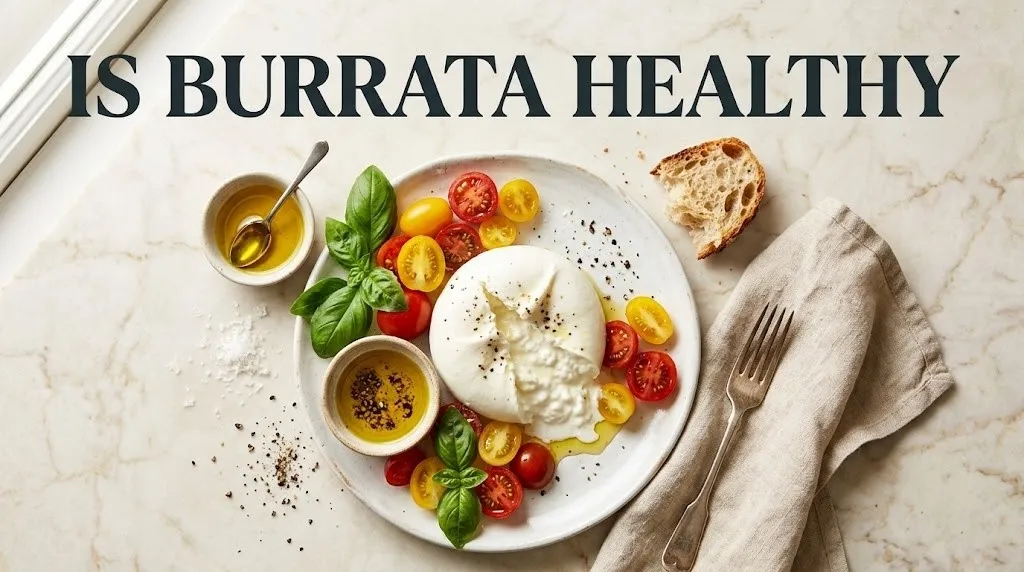
A traditional Caprese salad made with burrata instead of mozzarella, alongside ripe tomatoes, fresh basil, a drizzle of extra virgin olive oil, and a splash of balsamic vinegar, is an archetypal healthy burrata preparation. The tomatoes provide lycopene and vitamin C. The olive oil provides monounsaturated fat and polyphenols. The basil provides volatile oils and a small amount of vitamin K. The burrata provides protein and calcium. The meal is nutritionally complete, culturally authentic, and satisfying enough to prevent post-meal snacking.
Burrata on a bed of bitter greens (arugula, radicchio, endive) with roasted vegetables and a lemon-olive oil dressing is another high-fiber, high-vegetable preparation. The bitterness of the greens cuts through the richness of the burrata, providing flavor contrast that makes a smaller portion of cheese feel more substantial. Adding a lean protein such as grilled chicken or white beans creates a complete meal with the burrata as an accent rather than the caloric centerpiece.
Less healthy burrata preparations include burrata served with large amounts of refined carbohydrates (a full pizza topped with burrata, a pasta dish with a whole burrata ball on top) where the cheese adds calories to an already energy-dense base, or burrata served with cured meats (prosciutto-wrapped burrata, burrata on a charcuterie board heavy on salami and coppa) where the sodium and saturated fat from multiple sources accumulate.
| Burrata Pairing | Health Assessment | Why |
|---|---|---|
| Tomato, basil, olive oil salad | Excellent | Vegetable-forward, unsaturated fat, balanced |
| Bitter greens, roasted vegetables, lemon | Excellent | Fiber, phytonutrients, portion control |
| Grilled peaches, arugula, balsamic | Good | Fruit sugar moderated by greens and acid |
| Whole burrata ball on white pizza | Occasional | Refined carb base, high total calorie density |
| Prosciutto-wrapped burrata | Occasional | Processed meat sodium and saturated fat load |
People managing type 2 diabetes or insulin resistance should pair burrata with vegetables and protein and limit the refined carbohydrate accompaniment. The fat and protein in burrata slow carbohydrate absorption, which blunts the post-meal blood glucose response. A burrata and tomato salad with olive oil, eaten before any bread or pasta, creates a more favorable glucose curve than eating all components simultaneously.
Key Takeaway: The healthiest burrata meal pairs one to two ounces of the cheese with abundant vegetables, olive oil, and optionally a lean protein or legume. The vegetables do the heavy nutritional lifting. The burrata provides the satisfaction.
Is Burrata Pasteurized
Most burrata sold commercially in the United States is made from pasteurized milk and is safe for consumption by the general population including pregnant women. The FDA Pasteurized Milk Ordinance requires that any cheese sold interstate and aged fewer than 60 days be made from pasteurized milk. Burrata is a fresh cheese with a refrigerated shelf life of 5 to 10 days, well under the 60-day threshold. This regulation effectively mandates pasteurization for commercially distributed domestic burrata.
Imported Italian burrata may be pasteurized or unpasteurized depending on the producer. Burrata di Andria, a DOP product from Puglia, is traditionally made from raw cow’s milk and is imported under exceptions to the 60-day rule for certain traditional European cheeses. The label on imported burrata should indicate whether raw milk is used. Italian labeling law requires “latte crudo” (raw milk) to be stated on the package. If the label does not specify raw milk, the milk is pasteurized.
Restaurant burrata requires a specific inquiry because the menu rarely specifies pasteurization status. The question “Is your burrata made from pasteurized milk?” should be answerable by the kitchen. High-volume restaurants serving domestically sourced burrata are almost certainly serving pasteurized product. Small Italian restaurants importing DOP burrata from Puglia may be serving raw milk burrata, particularly if the menu emphasizes the DOP designation as a quality marker.
| Burrata Source | Pasteurization Status | Safe for Pregnancy? |
|---|---|---|
| Domestic US commercial (grocery store, standard restaurant) | Pasteurized (FDA requirement for interstate commerce) | Yes |
| Imported Italian DOP (specialty cheese shop, Italian restaurant) | May be raw milk (traditional) | Verify “latte crudo” label or ask |
| Farmers market / local producer | Varies | Ask producer directly |
| Heated on pizza or baked dish | Pasteurized by cooking heat if internal temp reaches 165°F | Yes (Listeria killed by heat) |
People who are immunocompromised for reasons other than pregnancy, including those on immunosuppressive medications, undergoing chemotherapy, or living with HIV, should apply the same precaution: consume only pasteurized burrata or burrata that has been heated thoroughly. Listeriosis is a rare but serious infection, and the risk is elevated in immunocompromised populations.
Key Takeaway: Domestically produced commercial burrata in the United States is made from pasteurized milk and is safe during pregnancy. Imported Italian DOP burrata may be raw milk and requires label verification or a direct inquiry.
Frequently Asked Questions About Burrata
Is burrata healthier than mozzarella?
Fresh mozzarella is marginally healthier than burrata because it contains 20 to 30 fewer calories and 1 to 2 grams less saturated fat per ounce with the same protein and similar calcium.
The difference is small enough that food preference should guide the choice for most people.
Burrata provides more vitamin A from the cream filling, and mozzarella provides a slightly better protein-to-calorie ratio.
Can I eat burrata if I’m lactose intolerant?
Most people with lactose intolerance can eat one to two ounces of burrata without symptoms because burrata contains only 1 to 2 grams of lactose per ounce.
For comparison, a cup of milk contains 12 to 13 grams of lactose.
People with severe lactose intolerance should test a half-ounce portion first or take a lactase enzyme supplement before eating.
Is burrata safe to eat during pregnancy?
Burrata made from pasteurized milk is safe to eat during pregnancy.
Most domestic US burrata is pasteurized per FDA requirements for fresh cheese sold across state lines.
Imported Italian DOP burrata may be made from raw milk and should be avoided during pregnancy unless the label confirms pasteurization.
How many calories are in a whole ball of burrata?
A whole ball of burrata weighs between 4 and 8 ounces depending on the producer and contains 360 to 880 calories.
A standard grocery store burrata ball is typically 4 ounces and contains 360 to 440 calories.
Splitting one ball between two to four people keeps the portion in the 1 to 2 ounce range that is easier to fit within a daily calorie and saturated fat budget.
Does burrata have more fat than mascarpone?
No, mascarpone contains more fat than burrata at 12 to 13 grams of fat per ounce compared to burrata’s 7 to 9 grams.
Mascarpone is made from cream thickened with acid and contains minimal protein, while burrata provides 5 to 6 grams of protein per ounce.
Burrata is the nutritionally more balanced choice of the two, providing protein and calcium alongside the fat.
Burrata is a food that rewards context. Eaten in a one to two ounce portion alongside vegetables and olive oil, it is a nutrient-dense component of a meal that supports satiety and satisfaction. Eaten in larger portions or paired primarily with refined carbohydrates and cured meats, it becomes a calorie-dense indulgence that occupies a bigger share of the daily saturated fat budget than most people realize. The cheese itself does not change. The context does.
Buy the best burrata you can find, ideally from a local producer using high-quality milk, and eat it within a day or two of purchase when the cream is still sweet and the mozzarella still tender. Serve it at room temperature so the interior is spoonable. Share it with at least one other person. Let it be the rich centerpiece of a vegetable-forward plate rather than a hidden calorie bomb on a pizza or a pasta dish where it blends into an already heavy meal.
The Italians who created burrata in Puglia did not eat a whole ball as a personal appetizer followed by a pasta course and a meat course. They ate a modest portion as part of a meal built around vegetables, legumes, and olive oil. That traditional usage pattern is the nutritional wisdom embedded in the culture. Replicate the pattern, and the question of whether burrata is healthy answers itself.