HealthyChildren.org is the official parenting and child health website of the American Academy of Pediatrics (AAP) , the professional organization representing 67,000 board-certified pediatricians in the United States. Every article on the site is written or reviewed by a practicing pediatrician. When you read about fever management, vaccine schedules, nutrition guidelines, or developmental milestones on HealthyChildren.org, you are reading information that reflects the consensus of the medical professionals who set the standard of care for children’s health in this country.
The AAP was founded in 1930 and has published the peer-reviewed journal Pediatrics since 1948. HealthyChildren.org launched as the organization’s public-facing digital platform to make pediatric expertise accessible to parents outside the exam room. The site reaches over 50 million parents annually, according to AAP usage data through 2025. It is not a startup. It is not a parenting blog. It is the digital voice of the organization your pediatrician belongs to, translating clinical guidance into plain language for the people who need it most: parents standing in the diaper aisle, pacing with a feverish toddler at 2 AM, or wondering whether a food is safe for their six-month-old.
This guide explains exactly what HealthyChildren.org is, who runs it, what you will find there, and how to navigate its most useful features including the symptom checker, ages and stages guides, nutrition resources, and immunization schedules. It also compares the site to other children’s health websites and explains why the AAP affiliation makes HealthyChildren.org the most authoritative free health resource available to parents in 2026.
What Is Healthy Children .org
HealthyChildren.org is a free, pediatrician-authored website providing evidence-based guidance on every aspect of child health from birth through young adulthood. The site is owned and operated by the American Academy of Pediatrics. Its content is governed by an editorial board of practicing pediatricians who review articles for medical accuracy, currency, and alignment with AAP policy. No advertising influences the content. The site is funded by the AAP, grants, and philanthropy, not by sponsors who sell baby products, formula, or pharmaceuticals.
The site launched in its current form in 2009 and has undergone multiple redesigns, most recently in 2024, to improve search functionality, mobile access, and the symptom checker tool. The content library includes over 2,000 articles in English and Spanish covering topics from breastfeeding and safe sleep to ADHD, anxiety, and college health. Each article carries a publication date and a medical review date. The reviewer is a named physician or AAP committee whose credentials are verifiable. This level of transparency is not standard across children’s health websites. It is the editorial standard of a medical society applying the same rigor to public education that it applies to its professional journal.
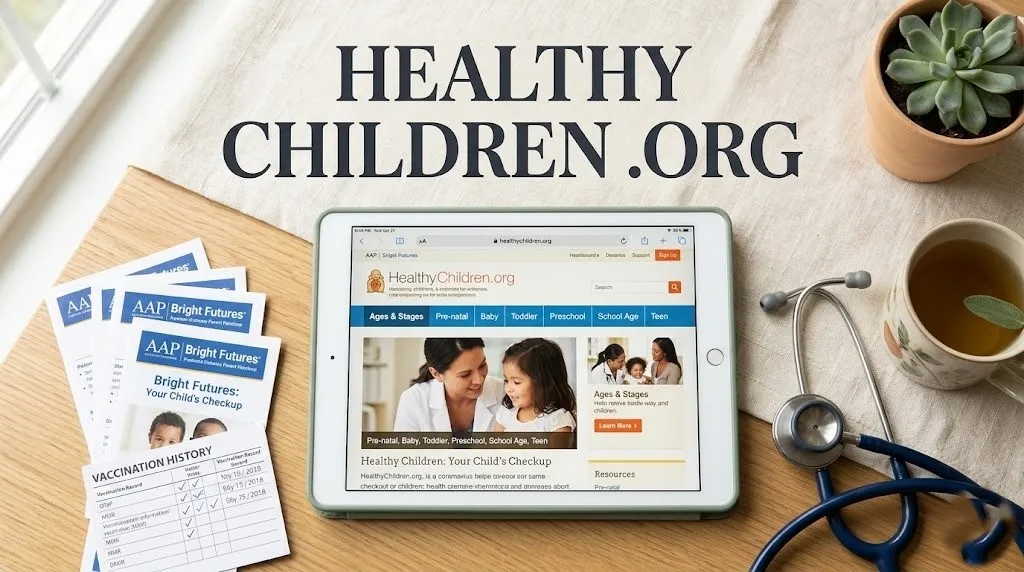
The site is organized around the AAP’s Bright Futures guidelines, the national standard for preventive pediatric care. Bright Futures defines the periodicity schedule for well-child visits, developmental screenings, immunizations, and anticipatory guidance from birth through age 21. HealthyChildren.org translates the Bright Futures recommendations into parent-facing articles organized by age, making it possible for a parent to look up exactly what to expect at the 4-month, 12-month, or 15-year visit before they walk into the pediatrician’s office.
| Site Feature | Description | Best For |
|---|---|---|
| Ages and Stages | Articles organized by developmental period from prenatal to young adult | Preparing for well-child visits, tracking development |
| Symptom Checker | Interactive tool for assessing childhood symptoms and deciding on care level | Late-night illness decisions, when to call the doctor |
| Healthy Living | Nutrition, fitness, sleep, oral health, and safety guidance | Daily parenting decisions and habit building |
| Immunizations | Complete vaccine schedule, safety information, and FAQs | Understanding and tracking childhood vaccines |
| Family Life | Articles on behavior, discipline, school, media use, and family dynamics | Behavioral and developmental concerns |
| Health Issues | Condition-specific information on common childhood illnesses and chronic conditions | Understanding a diagnosis, managing a condition |
A pediatrician should be consulted for any medical concern about a specific child. HealthyChildren.org is an informational resource that supports, but does not replace, the pediatrician-parent relationship. The site itself states this explicitly. The information is designed to complement the guidance a parent receives during a well-child visit or a sick visit, not to substitute for a physical examination, a diagnostic workup, or an individualized treatment plan.
Key Takeaway: HealthyChildren.org is the AAP’s free, pediatrician-reviewed parenting website. It translates Bright Futures preventive care guidelines into practical, age-specific articles for parents. It is the most authoritative children’s health website available to the public.
Healthy Children .org
The domain healthy children .org, with or without the space, resolves to the same AAP website. The space in the search query often reflects a user typing the URL into a search engine rather than an address bar, or dictating a voice search where the spoken phrase includes a natural pause. The site itself is the destination. The searcher is typically looking for the homepage, a specific article, or a specific tool within the site.
The site’s information architecture is built around the parent’s likely question, not around medical taxonomy. A parent searching for “when can my baby eat eggs” will find an article on introducing allergenic foods that references the AAP’s 2019 guidance update recommending early introduction of peanut and egg to reduce allergy risk. The article will explain the recommendation, cite the LEAP study published in the New England Journal of Medicine, and provide practical guidance on preparation and portion size. The same parent searching a general search engine might encounter blogs, forums, and commercial sites with outdated or contradictory advice. HealthyChildren.org’s content is the AAP’s official position, updated when the evidence changes.
The site includes tools beyond articles. The KidsDoc Symptom Checker is an interactive triage tool that allows parents to select their child’s age and symptoms and receive guidance on whether to call 911, go to the emergency department, call the pediatrician, or treat at home. The tool is based on the AAP’s clinical protocols and is updated by pediatric emergency medicine specialists. It is not a substitute for a doctor. It is a structured way to apply the same decision framework a pediatrician would use over the phone. The symptom checker is one of the site’s most visited features, particularly during respiratory virus season when parents are triaging coughs, fevers, and breathing concerns.
Healthy Children Org
The search “healthy children org” without the dot or space variation is the same navigational query. The searcher knows the name of the site and is using the shortest possible text to reach it. The absence of the dot in the query reflects search engine shorthand rather than confusion about the domain. The site’s search engine optimization ensures that any variation of the name resolves to the AAP’s homepage.
The site is structured so that parents can navigate by their child’s age or by topic. The age-based navigation, “Ages and Stages,” segments content into Prenatal, Baby (0 to 12 months), Toddler (1 to 3 years), Preschool (3 to 5 years), Grade School (5 to 12 years), Teen (12 to 18 years), and Young Adult (18 to 21 years). Each age section contains articles relevant to that developmental window: feeding, sleep, safety, development, behavior, and preventive care. A parent of a 6-month-old can find the 6-month well-child visit expectations, the vaccine schedule for that visit, guidance on starting solids, safe sleep recommendations, and car seat safety information, all specific to that age.
The topic-based navigation covers Healthy Living, Safety and Prevention, Family Life, and Health Issues. This structure serves parents who have a specific concern that crosses age groups: a food allergy diagnosis, a behavioral concern, a chronic condition like asthma or eczema. The article will be tagged with the relevant age ranges but organized under the health topic. The dual navigation structure, age and topic, means the same article can be reached through two different paths, whichever matches the parent’s mental model of the question.
Quick Tip:
- Bookmark the “Ages and Stages” landing page for your child’s current age bracket. The articles update as the AAP releases new guidance. The page becomes a personalized dashboard for preventive care information that changes as your child grows.
American Academy of Pediatrics Healthy Children
The phrase “American Academy of Pediatrics healthy children” combines the organization name with the website name, reflecting a searcher who knows the AAP publishes the site and is confirming the connection. The relationship between the AAP and HealthyChildren.org is direct and structural. HealthyChildren.org is not a sponsored project, a partner site, or a licensed brand. It is the AAP’s own digital platform, produced by the AAP’s Division of Digital Health and governed by the AAP’s editorial policies.
The AAP’s editorial process for HealthyChildren.org requires that every article be reviewed by a board-certified pediatrician with expertise in the article’s subject area. The reviewer’s name appears on the article. The article cites AAP policy statements, clinical reports, and Bright Futures guidelines where applicable. The publication date and last review date are displayed. This transparency allows parents to assess whether the information is current. A pediatric nutrition article from 2019 that has not been updated since may not reflect the 2025 USDA Dietary Guidelines or the AAP’s evolving position on food allergy introduction. HealthyChildren.org articles are subject to periodic review cycles, but parents should check the dates and prioritize recently reviewed content for rapidly evolving topics.
The AAP’s authority rests on its role as the standard-setter for pediatric care in the United States. AAP policy statements are the documents that define evidence-based pediatric practice. When the AAP recommends that infants sleep on their backs to reduce SIDS risk, that becomes the guidance your pediatrician gives you. When the AAP updates its screen time recommendations, your pediatrician’s anticipatory guidance reflects that update. HealthyChildren.org is the direct-to-parent channel for these same policy positions. The information on the site is not a simplified or watered-down version of AAP guidance. It is the AAP guidance written in plain language for a non-medical audience.
Key Takeaway: HealthyChildren.org is the AAP’s official public platform. Every article is reviewed by a pediatrician whose name appears on the page. The content reflects current AAP policy. The site is the most direct way for a parent to access AAP guidance without a medical library subscription.
Healthy Children Pediatrics
The phrase “healthy children pediatrics” may refer to the broader concept of pediatric health, or it may be a parent searching for a pediatric practice with “Healthy Children” in its name. Many pediatric practices in the United States use “Healthy Children Pediatrics” or similar branding. The phrase is not a direct reference to HealthyChildren.org, but the association exists because the AAP’s brand awareness makes the word pairing recognizable and trusted.
Pediatric practices that use the “Healthy Children” name are not affiliated with the AAP’s website unless they explicitly state that connection. The AAP does not franchise its branding to private practices. A pediatric office called “Healthy Children Pediatrics” in a suburban medical building is a separate entity from HealthyChildren.org. Parents who find a local practice with this name should evaluate its board-certified pediatricians and its patient reviews on their own merits, not based on the name’s similarity to the AAP website.
The broader concept of healthy children pediatrics encompasses the full scope of preventive and acute pediatric care. Board-certified pediatricians complete three years of residency after medical school and pass the American Board of Pediatrics certifying examination. They are trained to manage child health from birth through adolescence including growth and development, nutrition, immunizations, acute illness, chronic disease, and behavioral health. The AAP recommends a medical home model where every child has a consistent pediatrician or pediatric practice that coordinates their care. HealthyChildren.org supports this model by educating parents between visits.
| Term | Meaning | AAP Affiliation |
|---|---|---|
| HealthyChildren.org | AAP’s official parenting website | Directly owned and operated by AAP |
| American Academy of Pediatrics | Professional organization of 67,000+ pediatricians | The organization itself |
| Bright Futures | AAP’s preventive care guidelines | AAP publication |
| Healthy Children Pediatrics (practice name) | Common branding for private pediatric practices | No direct AAP affiliation unless stated |
| Board-certified pediatrician | Physician who passed ABP examination | Individual membership in AAP is common but not universal |
Parents looking for a pediatrician can use the AAP’s “Find a Pediatrician” tool on HealthyChildren.org. The tool searches a database of AAP member pediatricians by location. All results are board-certified or board-eligible pediatricians who are AAP members. This is distinct from a general search engine search for “pediatrician near me” which may return results for family medicine physicians, nurse practitioners, or practices with no pediatrician on staff.
The Healthy Child
“The healthy child” is a concept that underpins all of pediatric preventive care. The AAP’s Bright Futures guidelines are built around the healthy child, defining what preventive care, screening, and anticipatory guidance every child should receive to maximize the likelihood of healthy development. The concept is not about perfection. It is about providing the conditions, nutrition, safety, immunizations, developmental support, and healthcare access, that give every child the best chance at physical and mental health.
The healthy child concept is distinct from a focus on illness. Pediatric care in the Bright Futures model is not primarily about treating disease. It is about monitoring growth, screening for hidden problems, providing immunizations, and counseling parents on the daily decisions that shape a child’s health trajectory. The well-child visit schedule, 10 visits in the first two years, annual visits thereafter, is the structure within which this preventive care is delivered. HealthyChildren.org provides the parent-facing content that supports each of those visits.
The concept also encompasses the social determinants of child health. The AAP recognizes that housing stability, food security, caregiver mental health, and community safety affect child health outcomes as much as or more than direct medical care. HealthyChildren.org includes content on these topics, reflecting the AAP’s position that pediatricians should screen for social needs and connect families to resources. The healthy child is not just a medically cared-for child. It is a child whose environment supports health.
Healthy Pediatrics
“Healthy pediatrics” is a broad term that can refer to the practice of preventive pediatric medicine or to pediatric practices that brand themselves with the word “healthy.” The term is not a direct reference to HealthyChildren.org, but the search query may lead parents to the site because of the word association. HealthyChildren.org represents the practice of healthy pediatrics in its digital form: preventive, evidence-based, parent-partnered, and accessible.
The practice of healthy pediatrics in 2026 includes several domains that have expanded in recent years. Mental health screening and management has become a core pediatric responsibility. The AAP recommends universal screening for depression at ages 12 and up and for anxiety at ages 8 and up. HealthyChildren.org includes articles on recognizing anxiety, depression, and suicidal ideation in children and adolescents, written for parents who may be the first to notice changes in their child’s behavior. The site also addresses the pediatric mental health workforce shortage by providing guidance on when and how to seek specialty care.
Telehealth has become a permanent part of healthy pediatrics. The AAP has published guidance on appropriate telehealth use, including which conditions are suitable for virtual visits and which require an in-person examination. HealthyChildren.org includes articles that help parents decide whether their child’s symptoms warrant a telehealth visit, an in-person sick visit, or an emergency department visit. The information supports the parent’s role as the first triage decision-maker in their child’s healthcare.
Healthy Children’s Pediatrics
The possessive form “healthy children’s pediatrics” suggests a search for pediatric care that focuses on keeping children healthy rather than treating illness. The phrase may also be a search for a specific practice named “Healthy Children’s Pediatrics.” The concept aligns with the AAP’s Bright Futures preventive care model, which HealthyChildren.org translates for parents.
The site’s “Healthy Living” section is the digital equivalent of preventive pediatrics education. It covers nutrition for every age from breastfeeding through adolescent eating patterns. It addresses physical activity guidelines, screen time recommendations, sleep requirements, oral health, and sun safety. Each article is age-specific where relevant and cites the underlying AAP policy. A parent concerned about their child’s weight can find guidance on healthy eating patterns, physical activity, and the AAP’s position on weight stigma and body image. The information is designed to support the conversation that should also happen with the child’s pediatrician.
The site also covers safety and injury prevention, which is a core component of healthy pediatrics. Car seat guidelines, safe sleep recommendations, water safety, firearm safety, and poison prevention all have dedicated articles that are updated as evidence and product safety standards evolve. The AAP’s car seat recommendations, for example, changed in 2018 to recommend rear-facing as long as possible within the seat’s limits, a shift from the previous age-2 minimum. HealthyChildren.org reflects the current guidance with practical installation and selection advice.
Key Takeaway: HealthyChildren.org represents the practice of healthy pediatrics in digital form. Its content supports the Bright Futures preventive care model that defines what every child needs to maximize healthy development.
Healthy Children .org Ages and Stages
The Ages and Stages section of HealthyChildren.org is the site’s primary organizational framework, dividing content by developmental period from prenatal through young adulthood. Each age section provides the preventive care expectations, developmental milestones, feeding guidance, sleep recommendations, safety information, and common concerns for that specific developmental window. The content is aligned with the Bright Futures periodicity schedule, meaning the articles for each age correspond to what a pediatrician will cover at that age’s well-child visit.
The Prenatal section covers maternal health topics that affect the fetus, choosing a pediatrician, preparing for the hospital, and newborn care basics. The Baby section, covering birth through 12 months, is the most detailed because of the density of well-child visits and developmental changes in the first year. Articles cover breastfeeding, formula feeding, introducing solids, sleep safety including the Back to Sleep recommendation to reduce SIDS risk, car seat installation, immunizations at the 2, 4, 6, and 12-month visits, and developmental milestones including rolling, sitting, crawling, and walking.
The Toddler section, 1 to 3 years, addresses the transition to solid foods, picky eating, toilet training, language development, tantrums and discipline, and the 15, 18, 24, and 30-month well-child visits. The Preschool section, 3 to 5 years, covers school readiness, social development, nutrition for young children, and the annual well-child visit. The Grade School section, 5 to 12 years, addresses school performance, friendships, physical activity, nutrition for older children, and puberty onset. The Teen section, 12 to 18 years, covers adolescent development, mental health, substance use, driving safety, and the transition to adult healthcare.
| Age Section | Age Range | Key Topics |
|---|---|---|
| Prenatal | Conception to birth | Choosing a pediatrician, newborn preparation, maternal health |
| Baby | 0 to 12 months | Feeding, sleep safety, vaccines, milestones, colic, introducing solids |
| Toddler | 1 to 3 years | Picky eating, toilet training, language, tantrums, safety |
| Preschool | 3 to 5 years | School readiness, social skills, nutrition, sleep |
| Grade School | 5 to 12 years | School, friendships, activity, puberty onset, independence |
| Teen | 12 to 18 years | Mental health, driving, substances, sexual health, body image |
| Young Adult | 18 to 21 years | Transition to adult care, college health, independence |
Parents should check the Ages and Stages section before each well-child visit. The articles prepare the parent for what the pediatrician will ask, screen, and recommend. The parent can arrive with informed questions rather than trying to remember concerns in the 15-minute visit window.
Healthy Children .org Symptom Checker
The HealthyChildren.org Symptom Checker is an interactive tool that helps parents assess their child’s symptoms and determine the appropriate level of care: call 911, go to the emergency department, call the pediatrician, or treat at home. The tool is based on the same clinical protocols that pediatricians use when triaging symptoms over the phone. It is built and maintained by pediatric emergency medicine specialists at the AAP.
To use the symptom checker, the parent selects the child’s age range and the primary symptom from a list of common concerns: fever, cough, vomiting, diarrhea, ear pain, sore throat, rash, head injury, and more. The tool asks a series of branching questions about the symptom’s severity, duration, and associated signs. Based on the answers, it generates a care recommendation. The tool is designed to be conservative. When in doubt, it recommends calling the pediatrician or seeking emergency care. It is not designed to replace clinical judgment. It is designed to give parents a structured way to assess a situation when they are anxious, sleep-deprived, and unsure.
The symptom checker is most useful during the hours when pediatrician offices are closed. A parent with a febrile toddler at 11 PM can use the tool to assess whether the fever warrants an emergency department visit or can be managed at home until the pediatrician’s office opens. The tool accounts for age-specific risk factors. A fever in a 3-week-old is treated very differently from a fever in a 3-year-old. The symptom checker’s age-specific algorithms reflect those clinical distinctions.
The symptom checker also includes a “When to Call 911” section for symptoms that require immediate emergency response: difficulty breathing, unresponsiveness, seizures lasting more than 5 minutes, severe allergic reaction, and major trauma. This information is available as a standalone article as well as embedded in the symptom checker tool. Parents should familiarize themselves with the emergency symptoms before an emergency occurs. Reading the list at 2 PM on a Tuesday prepares the brain to recognize the symptoms at 2 AM on a Saturday.
Quick Tip:
- Save the AAP Symptom Checker to your phone’s home screen as a bookmark. In the moment of a sick child, finding the tool quickly matters. The direct URL is short, but a home screen icon eliminates the search step.
Healthy Children .org Nutrition
The nutrition content on HealthyChildren.org covers infant feeding, toddler nutrition, childhood eating patterns, adolescent nutrition, and special dietary considerations including food allergies, vegetarian diets, and sports nutrition. The content is authored or reviewed by pediatricians with expertise in nutrition and aligns with the USDA Dietary Guidelines for Americans and the AAP’s own nutrition policy statements.
Infant feeding guidance covers breastfeeding, formula feeding, and the introduction of solid foods. The AAP recommends exclusive breastfeeding for the first 6 months, continued breastfeeding alongside complementary foods for at least the first year, and the introduction of potentially allergenic foods (peanut, egg, cow’s milk, soy, wheat, tree nuts, shellfish, fish, sesame) starting around 6 months. The guidance on allergenic food introduction changed significantly in 2019 based on the LEAP study, which demonstrated that early introduction of peanut reduced peanut allergy risk by up to 86 percent in high-risk infants. HealthyChildren.org reflects the current guidance with practical articles on how to introduce each allergenic food safely.
Toddler and childhood nutrition articles address the practical challenges parents face: picky eating, food refusal, the division of responsibility in feeding, appropriate portion sizes, and limiting added sugar. The AAP recommends no added sugar for children under 2 years and no more than 25 grams of added sugar per day for children over 2, aligning with the American Heart Association pediatric recommendations. The articles offer strategies for implementing these limits without creating food conflict, including the Satter Division of Responsibility model where the parent decides what, when, and where food is served, and the child decides whether and how much to eat.
| Nutrition Topic | Key AAP Guidance | HealthyChildren.org Resource |
|---|---|---|
| Breastfeeding | Exclusive for 6 months, continue through 1 year+ | Articles on latch, supply, pumping, and returning to work |
| Formula feeding | Iron-fortified cow’s milk formula for first year | Articles on formula types, preparation, and safety |
| Introducing solids | Start around 6 months, include allergenic foods early | Age-specific guides with food preparation instructions |
| Added sugar | None under 2 years, less than 25g/day for 2+ | Articles on reading labels and reducing sugar |
| Food allergies | Early introduction for high-risk infants | Articles on LEAP study, introduction protocols, and recognition |
| Picky eating | Division of responsibility, avoid pressure and coercion | Articles with practical strategies and developmental context |
Parents of children with food allergies should read the food allergy articles carefully. The site covers the recognition of allergic reactions, the use of epinephrine auto-injectors, and the management of food allergies at school and social events. The guidance is practical and aligned with the AAP’s clinical report on food allergy management.
Healthy Children .org Immunizations
The immunizations section of HealthyChildren.org provides the AAP-endorsed childhood immunization schedule, vaccine-specific information articles, and answers to common vaccine safety questions. The schedule mirrors the CDC immunization schedule, which the AAP reviews and endorses annually. The schedule specifies which vaccines are recommended at which ages, from the hepatitis B birth dose through the adolescent HPV and meningococcal vaccines.
Vaccine-specific articles explain what each vaccine protects against, the disease it prevents, the vaccine’s safety profile, and the recommended dosing schedule. Articles cover the DTaP (diphtheria, tetanus, acellular pertussis), MMR (measles, mumps, rubella), inactivated poliovirus, varicella (chickenpox), hepatitis A and B, Haemophilus influenzae type b (Hib), pneumococcal conjugate, rotavirus, influenza, COVID-19, HPV, and meningococcal vaccines. Each article addresses the most common parent questions: why the vaccine is given at that age, what side effects to expect, and what the disease itself does to unvaccinated children.
The site addresses vaccine safety concerns directly and transparently. Articles discuss the vaccine development and testing process, the Vaccine Adverse Event Reporting System (VAERS), the Vaccine Safety Datalink, and the evidence regarding vaccines and autism, which has been exhaustively studied and found to have no causal association. The AAP’s position on vaccines is unequivocal: the recommended immunization schedule is the safest and most effective way to protect children from vaccine-preventable diseases. HealthyChildren.org communicates this position clearly without minimizing parent concerns.
The site also provides practical immunization resources: a printable immunization schedule, a vaccine tracker, and guidance on catching up if a child has fallen behind. The catch-up schedule is particularly relevant for children who missed vaccines during the COVID-19 pandemic, when well-child visit attendance dropped and many children fell behind on routine immunizations. The catch-up articles explain how to work with a pediatrician to create an individualized schedule that meets the child’s needs without unnecessary delay.
Key Takeaway: HealthyChildren.org’s immunization section provides the CDC-AAP approved vaccine schedule, vaccine-specific safety and efficacy information, and transparent discussion of vaccine concerns. The content is the AAP’s official position, communicated directly to parents.
Healthy Children .org Child Development
The child development content on HealthyChildren.org covers the full spectrum of developmental domains: gross motor, fine motor, language, cognitive, and social-emotional. The content is organized by age in the Ages and Stages section and by topic for specific developmental concerns. Each age section includes the developmental milestones that the AAP expects at that well-child visit, aligned with the Bright Futures periodicity schedule and the CDC developmental milestone checklists.
The AAP recommends developmental screening at the 9, 18, and 30-month well-child visits using a validated screening tool. The site explains what developmental screening is, how it differs from developmental surveillance, and what happens if a screening identifies a concern. Articles cover the next steps after a failed screen: referral to early intervention services (Part C of IDEA for children under 3), referral to the school district for evaluation (Part B of IDEA for children 3 and up), and referral to a developmental pediatrician or other specialist.
Specific developmental conditions have dedicated articles written in parent-accessible language: autism spectrum disorder, attention deficit hyperactivity disorder (ADHD), intellectual disability, cerebral palsy, speech and language disorders, and learning disabilities. Each article explains the condition, how it is diagnosed, evidence-based treatments, and how to advocate for the child at school and with healthcare providers. The articles emphasize that a developmental diagnosis is not a prediction. It is information that guides intervention, and early intervention improves outcomes across all developmental conditions.
The site also addresses the developmental impact of environmental factors: screen time, sleep, nutrition, toxic stress, and adverse childhood experiences (ACEs). The AAP’s 2016 policy statement on screen time, updated in subsequent years, recommends no screens for children under 18 months (except video calling), limited high-quality programming for children 18 to 24 months, and no more than 1 hour per day of high-quality programming for children 2 to 5 years. HealthyChildren.org provides practical guidance on implementing these limits and the developmental rationale behind them.
Is Healthy Children .org Trustworthy
HealthyChildren.org is the most trustworthy children’s health website available to the public because it is the official digital platform of the American Academy of Pediatrics, the professional organization that sets the standard of care for pediatric medicine in the United States. Every article is written or reviewed by a board-certified pediatrician. The content reflects current AAP policy and Bright Futures guidelines. The editorial process is transparent. The site is free of commercial influence. No advertiser, sponsor, or product manufacturer affects the content.
The trustworthiness of children’s health information online is a genuine concern. A 2024 study in the journal Pediatrics found that approximately 45 percent of children’s health content on social media platforms contained factual errors or misleading information. Parents who rely on social media, influencers, or unvetted websites for children’s health information risk encountering outdated, inaccurate, or commercially motivated advice. HealthyChildren.org eliminates that risk by applying the same editorial standards to its public content that the AAP applies to its professional publications.
The site carries the HONcode certification from the Health On the Net Foundation, an independent organization that certifies health websites for transparency, authority, and ethical information practices. The HONcode certification requires that the site disclose the credentials of its authors, cite its sources, and separate editorial content from any advertising. HealthyChildren.org’s HONcode certification is verifiable through the foundation’s website.
| Trustworthiness Factor | HealthyChildren.org | Typical Parenting Website |
|---|---|---|
| Content authorship | Board-certified pediatricians | Varies, often non-physician writers |
| Editorial review | AAP editorial board | May be reviewed by editor, not medical expert |
| Policy alignment | Direct AAP policy translation | May or may not align with professional guidance |
| Commercial influence | None, AAP-funded | Often ad-supported, sponsored content present |
| Source citations | AAP policy statements, peer-reviewed journals | Often absent or informal |
| HONcode certification | Yes | Rare |
A pediatrician is the right person to discuss a specific child’s health concern. HealthyChildren.org supports that conversation. It does not replace it. The site’s information should be used to understand a topic before the visit, to reinforce the guidance received during the visit, and to guide day-to-day parenting decisions that do not require a doctor’s input. When the site recommends calling a pediatrician, it means call a pediatrician. The symptom checker’s “call your pediatrician” result is not an invitation to keep Googling.
Key Takeaway: HealthyChildren.org is the most trustworthy children’s health website because it is the AAP’s official platform with physician-authored, policy-aligned, commercially independent content. The HONcode certification and transparent editorial process are verifiable markers of that trustworthiness.
Healthy Children .org vs WebMD
HealthyChildren.org and WebMD’s Children’s Health section serve different purposes and operate under different editorial models. HealthyChildren.org is the official website of a medical specialty society. Its content is written by pediatricians for parents and reflects the AAP’s consensus guidelines. WebMD is a commercial health information company whose children’s health content is written by health journalists and reviewed by physicians who may or may not be pediatricians.
The authority difference is significant. When HealthyChildren.org publishes guidance on introducing peanuts to infants, that guidance is the AAP’s official recommendation, the same recommendation your child’s pediatrician follows. When WebMD publishes an article on the same topic, it may summarize the AAP guidance accurately, or it may cite a mix of sources including individual studies that have not been incorporated into professional guidelines. The parent reading WebMD must evaluate whether the article reflects current consensus or a single study. The parent reading HealthyChildren.org knows the article reflects current AAP policy.
The content breadth differs. WebMD covers more topics and publishes more frequently. Its children’s health section includes articles on conditions, medications, supplements, and alternative therapies that may not be covered on HealthyChildren.org. The volume of content comes with variability in quality and alignment with professional guidelines. HealthyChildren.org is narrower but uniformly authoritative. The parent who wants a quick overview of a minor topic may find WebMD sufficient. The parent who wants the definitive, pediatrician-endorsed guidance on a core child health topic should use HealthyChildren.org.
| Feature | HealthyChildren.org | WebMD Children’s Health |
|---|---|---|
| Owner | American Academy of Pediatrics (non-profit) | Internet Brands (commercial) |
| Content authors | Board-certified pediatricians | Health journalists, reviewed by MDs |
| Editorial standard | AAP policy and Bright Futures | Editorial guidelines, mixed source quality |
| Commercial influence | None | Advertising and sponsored content |
| Symptom checker | AAP clinical protocol-based | General health information |
| Pediatric specificity | All content pediatric-specific | Children’s section within larger site |
| Funding | AAP, grants, philanthropy | Advertising, sponsored content |
Parents should use HealthyChildren.org as their primary source for pediatric guidance and use WebMD or other general health sites as supplementary reading with awareness that the content may not reflect current AAP policy. When the two sources conflict, HealthyChildren.org’s guidance is more likely to reflect the standard of care your pediatrician follows.
Frequently Asked Questions About Healthy Children .org
Who runs HealthyChildren.org?
HealthyChildren.org is run by the American Academy of Pediatrics, the professional organization representing 67,000 board-certified pediatricians in the United States.
The AAP was founded in 1930 and publishes the peer-reviewed journal Pediatrics.
The site’s content is governed by an AAP editorial board of practicing pediatricians who review all articles for medical accuracy.
Is HealthyChildren.org free to use?
Yes, HealthyChildren.org is completely free with no paywall, subscription, or registration required.
The site is funded by the AAP through membership dues, grants, and philanthropy, not through advertising or user fees.
All articles, tools including the symptom checker, and printable resources are available at no cost.
Does HealthyChildren.org have a symptom checker?
Yes, the site features the KidsDoc Symptom Checker, an interactive tool that helps parents assess their child’s symptoms and determine whether to call 911, go to the ER, call the pediatrician, or treat at home.
The tool is built on AAP clinical protocols and maintained by pediatric emergency medicine specialists.
It is designed for use when a pediatrician’s office is closed and a parent needs structured guidance.
How do I find my child’s immunization schedule on HealthyChildren.org?
Navigate to the Immunizations section under Healthy Living, or search “immunization schedule” directly on the site.
The schedule is organized by age and matches the CDC immunization schedule that the AAP endorses annually.
A printable PDF version is available for download, and the site includes a catch-up schedule for children who have fallen behind.
Can I trust HealthyChildren.org more than other parenting websites?
Yes, HealthyChildren.org is more trustworthy than general parenting websites because it is the official platform of the American Academy of Pediatrics with content written or reviewed by board-certified pediatricians.
The site has no commercial influence, carries HONcode certification, and reflects current AAP policy that your own pediatrician follows.
Other parenting websites may provide accurate information but lack the institutional authority and editorial rigor of a medical specialty society.
The internet is full of people telling you how to raise your child. Most of them are not pediatricians. HealthyChildren.org is different. It is the American Academy of Pediatrics speaking directly to you, without an appointment, without a copay, without an algorithm curating the most engaging rather than the most accurate answer. The site exists because the AAP recognized that parents were searching for health information and finding everything except the standard of care.
Bookmark the site. Use the Ages and Stages section before every well-child visit. Save the symptom checker to your phone’s home screen. Check the immunization schedule once a year. When you read something on social media that scares you about your child’s health, verify it on HealthyChildren.org before you act on it. The pediatrician who sees your child for 15 minutes every few months cannot answer every question in that window. The website can. It is the extension of that relationship into the hours and days between visits.
Trust the source that your pediatrician trusts. That is what healthy children .org is.