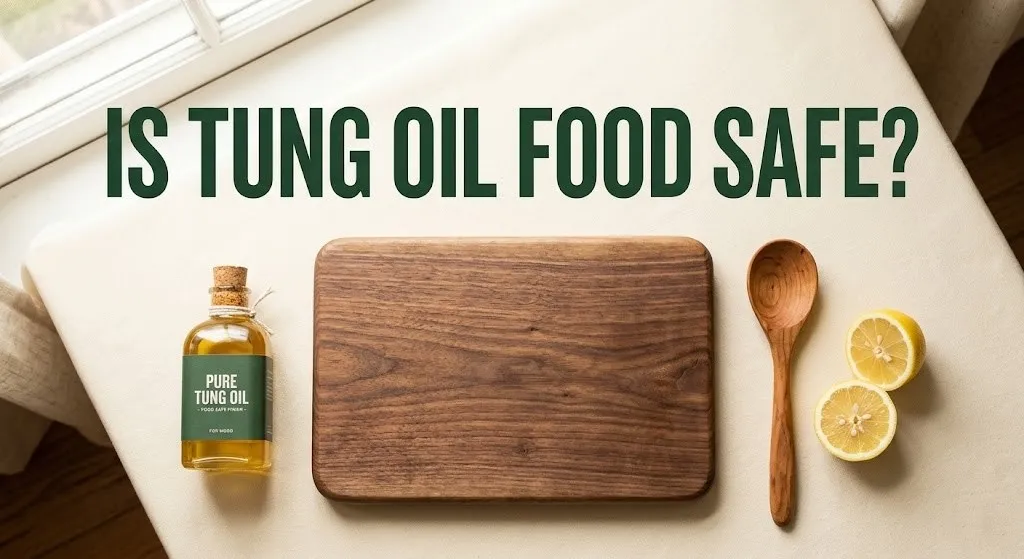
Pure, 100 percent tung oil is food safe once it has fully cured, but liquid tung oil is toxic, and products labeled “Tung Oil Finish” often contain heavy metal driers and chemical solvents that are never safe for food contact surfaces. The distinction between “pure tung oil” and “tung oil finish” is the most important piece of information in this entire guide. One is a natural, polymerizing oil pressed from the nut of the tung tree, Vernicia fordii, that has been used for centuries on wooden boats and kitchenware. The other is a chemical cocktail that may not contain any tung oil at all.
The U.S. Food and Drug Administration (FDA) provides guidance on food contact surfaces under 21 CFR 175.300, which governs resinous and polymeric coatings. Pure tung oil, once fully cured, falls within this regulatory framework as an inert polymeric film. The key word is “cured.” Polymerization is a chemical reaction in which the oil molecules cross-link with oxygen to form a solid, inert plastic. Uncured tung oil contains volatile organic compounds (VOCs) and unreacted fatty acids that are not safe to ingest.
This guide will teach you exactly how to identify pure tung oil, how to cure it properly, and why the can of “Tung Oil Finish” on your workbench might need to go in the hazardous waste bin instead of on your cutting board.
is tung oil food safe
Pure tung oil is food safe only after it has fully polymerized into a hard, inert film through a curing process that takes 15 to 30 days. Liquid tung oil is not food safe. It contains unreacted eleostearic acid and volatile organic compounds that can cause nausea, vomiting, and gastrointestinal distress if ingested before the oil has cured.
The chemistry of tung oil curing is a process of oxidation and cross-linking. Tung oil is a “drying oil,” which means it hardens through exposure to oxygen, not through evaporation. The primary fatty acid in tung oil is eleostearic acid, a conjugated linolenic acid with three double bonds. These double bonds react with oxygen in the air, forming covalent links between the oil molecules. The liquid oil transforms into a solid, plastic-like film. Once this reaction is complete, the oil is chemically inert, meaning it will not react with food, leach into water, or off-gas.
The toxicity of liquid tung oil is real. The tung nut contains toxic saponins and phorbol esters that are partially removed during commercial processing, but the raw oil can still cause severe skin and mucous membrane irritation. Never apply tung oil with bare hands. Do not use a tung oil-coated surface until it has fully cured.
| Tung Oil State | Food Safe? | Timeframe |
|---|---|---|
| Liquid (uncured) | No. Toxic. | N/A |
| Dry to touch | No. Curing incomplete. | 24 to 72 hours |
| Fully cured | Yes. Inert. | 15 to 30 days |
| Tung Oil Finish (product) | Never. Contains solvents and driers. | N/A |
is tongue oil food safe
“Tongue oil” is a common misspelling or mishearing of “tung oil,” and the same safety rules apply. There is no such substance as tongue oil. The searcher is asking about tung oil. The misspelling is so common that it warrants its own section.
The confusion likely arises from the phonetic similarity between “tung” and “tongue.” In woodworking circles, the mispronunciation is a running joke, but in the context of food safety, it can lead someone to search for the wrong term and find incorrect information. If you typed “tongue oil,” you meant “tung oil.”
The safety information is identical to the previous section. Pure tung oil is food safe when fully cured. Liquid tung oil is toxic. “Tung Oil Finish” products are never food safe. If you have a can that says “tongue oil,” it is a misspelled label or a counterfeit product.
- Spelling: Tung oil, not tongue oil.
- Origin: Pressed from the nut of the tung tree.
- Safety: Identical. Pure and cured is safe.
Key Takeaway: “Tongue oil” is a typo. The product is tung oil, and the food safety rules are identical regardless of how you spell it.
pure tung oil food safe
Pure tung oil is the only type of tung oil that can be considered food safe after curing. To verify purity, the product label must list a single ingredient: 100 percent tung oil. Any product that does not explicitly state “100 percent pure tung oil” on the label should be assumed to contain chemical additives that render it unsafe for food contact.
Identifying pure tung oil requires reading the fine print. The label should not list mineral spirits, naphtha, cobalt, manganese, or any “drier” compounds. These are added to speed the curing time but remain in the cured film. Heavy metal driers like cobalt and manganese are neurotoxic in sufficient quantities and have no place on a surface that touches food.
Pure tung oil has a distinctive smell. It is nutty, slightly sweet, and not harsh or solvent-like. If you open the can and smell petroleum distillates, you have a tung oil finish, not pure tung oil. The color is amber to light honey. The consistency is slightly thicker than vegetable oil. It cures slowly. A pure tung oil application takes 15 to 30 days to fully cure in a well-ventilated space. The slow cure is the trade-off for a completely natural, food-safe finish.
- Label: “100 percent pure tung oil.” No other ingredients.
- Smell: Nutty, not solvent-like.
- Color: Amber to light honey.
- Cure time: 15 to 30 days.
tung oil finish toxicity
Tung oil finish is toxic and should never be used on food contact surfaces. The term “Tung Oil Finish” is a marketing phrase that often describes a product containing zero tung oil. It is a wiping varnish made from linseed oil, alkyd resins, and heavy metal driers dissolved in mineral spirits. It is a completely different product from pure tung oil.
The deception in the wood finishing industry is well-documented. Products like Minwax Tung Oil Finish and Formby’s Tung Oil Finish do not contain pure tung oil. They are varnishes that use the name “tung oil” to evoke a natural, craftsman-like aesthetic while delivering a fast-curing, durable film. This film is excellent for furniture and is not safe for cutting boards, salad bowls, or wooden spoons.
The heavy metal driers in these finishes are the primary toxicity concern. Cobalt naphthenate and manganese naphthenate accelerate the curing of the varnish by catalyzing the oxidation reaction. These metals can migrate from the cured film into food, particularly acidic foods like tomatoes, citrus, and vinegar-based dressings. Chronic exposure to these metals can cause neurological and hepatic damage.
- Minwax Tung Oil Finish: Not food safe. Contains solvents and driers.
- Formby’s Tung Oil Finish: Not food safe. Contains alkyd resins.
- Waterlox: Contains tung oil but is a varnish blend. Not food safe.
Key Takeaway: If the label says “Tung Oil Finish” instead of “100 percent pure tung oil,” the product is a varnish and is toxic for food contact surfaces.
tung oil vs mineral oil food safe
Mineral oil is the safer and more foolproof choice for food contact surfaces because it never goes rancid, cures instantly, and is explicitly recognized as food safe by the FDA without a curing period. Pure tung oil offers superior water resistance and durability but requires a 15 to 30-day curing period and carries a risk of misuse if the wrong product is purchased.
Mineral oil is a petroleum distillate composed of saturated hydrocarbons. It is colorless, odorless, tasteless, and biologically inert. The FDA recognizes food-grade mineral oil as safe for direct food contact. It is the standard finish for butcher blocks, cutting boards, and wooden salad bowls. The oil does not polymerize. It remains liquid within the wood fibers and must be reapplied regularly, roughly once a month for a heavily used cutting board.
Tung oil polymerizes into a solid film. This film is more durable and water-resistant than mineral oil. A properly cured tung oil finish on a cutting board will last significantly longer between maintenance coats. The trade-off is the complexity. The cure takes weeks. The product can be misidentified. The risk of an allergic reaction, while small, is present.
| Feature | Pure Tung Oil | Mineral Oil |
|---|---|---|
| Source | Tung tree nut | Petroleum |
| Curing | Polymerizes (15 to 30 days) | Does not cure |
| Durability | High | Low |
| Maintenance | Rarely needed | Monthly reapplication |
| Foolproof? | No. Buy pure or risk toxicity. | Yes. Always food safe. |
| Allergy Risk | Possible (tree nut) | None |
tung oil cutting board
A tung oil cutting board is food safe if it was finished with 100 percent pure tung oil and was allowed to cure for at least 30 days before use. The board should have a matte, non-greasy surface that does not smell of oil. If the board feels sticky, smells like chemicals, or you are unsure of the product used, do not use it for food.
The application process for a tung oil cutting board is straightforward but requires patience. Sand the board to a smooth finish. Wipe on a thin coat of pure tung oil with a lint-free cloth. Let it absorb for 30 minutes. Wipe off the excess completely. The excess oil is the critical step. If you leave oil pooled on the surface, it will not cure and will form a sticky, gummy layer that is difficult to remove. Apply a second and third coat, repeating the process, allowing 24 hours between coats. Then, let the board cure for 15 to 30 days in a well-ventilated area.
The cured surface is safe for chopping, slicing, and serving. However, tung oil is not impervious to knife marks. A cutting board finished with tung oil will show cut marks over time. This is normal. The board can be refinished by sanding lightly and applying a fresh coat of pure tung oil, followed by the same curing period.
- Sand the board smooth. Remove all dust.
- Apply a thin coat of pure tung oil. Wipe off excess after 30 minutes.
- Repeat for 3 coats, 24 hours between each.
- Cure for 15 to 30 days in a ventilated area.
- The surface is ready when it is hard, matte, and odorless.
how to apply tung oil safely
Applying tung oil safely requires pure tung oil, a dust-free environment, lint-free cloths, and a designated curing space away from food preparation areas. Safety during application is about protecting yourself and ensuring the final product is safe for food contact.
Ventilation is non-negotiable. The uncured tung oil releases volatile organic compounds as it oxidizes. These VOCs are not as concentrated as the solvents in a tung oil finish, but they can still cause headaches, dizziness, and respiratory irritation. Apply the oil in a garage, workshop, or outdoor space with open air flow. Do not apply it in your kitchen.
Personal protection is straightforward. Wear nitrile gloves. Tung oil is a skin irritant and a sensitizer. Repeated skin contact can cause allergic dermatitis, even in people with no prior history of allergies. If you get oil on your skin, wash it off with soap and water immediately. Do not use solvent-based cleaners. Wear safety glasses. The risk of splashing oil into your eyes is low but real.
- Work in a well-ventilated area.
- Wear nitrile gloves and safety glasses.
- Dispose of oily rags by laying them flat to dry, not crumpled in a trash can. They can spontaneously combust.
- Store pure tung oil in a tightly sealed container away from heat sources.
Key Takeaway: Tung oil application is safe when you protect your skin, your lungs, and your workspace. The risk is not just the oil itself. It is the pile of oily rags that can catch fire.
best food safe wood finish 2026
The best food safe wood finishes in 2026 are pure tung oil, food-grade mineral oil, walnut oil, beeswax, and carnauba wax. The choice depends on the specific application, your tolerance for maintenance, and the time you have available for curing.
Walnut oil is a rising star in the food-safe finishing world. It is a drying oil, like tung oil, meaning it polymerizes and cures to a hard film. It is pressed from walnuts, making it a natural, food-grade product. It cures faster than tung oil, typically 5 to 10 days, and it does not have the same allergy risk for most people. However, those with walnut allergies must avoid it.
Beeswax and carnauba wax are not oils. They are solid waxes that are melted and mixed with an oil to create a paste. A blend of mineral oil and beeswax is the classic butcher block conditioner. The wax fills surface pores and provides a temporary water-resistant barrier. It must be reapplied regularly but is completely foolproof and immediately food safe.
| Finish | Food Safe? | Durability | Cure Time |
|---|---|---|---|
| Pure Tung Oil | Yes, when cured | High | 15 to 30 days |
| Mineral Oil | Yes, immediately | Low | None |
| Walnut Oil | Yes, when cured | Medium | 5 to 10 days |
| Beeswax Paste | Yes, immediately | Low to Medium | None |
Frequently Asked Questions About Tung Oil
Is tung oil safe to eat off of?
Yes, a surface finished with pure tung oil is safe to eat off of once fully cured.
The oil polymerizes into an inert, plastic-like film that will not leach into food.
The surface must be hard, matte, and odorless before use.
What is the difference between tung oil and tung oil finish?
Pure tung oil is 100 percent oil pressed from the tung nut.
Tung oil finish is a wiping varnish that may contain little or no actual tung oil, and includes chemical solvents and heavy metal driers.
Tung oil finish is never food safe.
How long does tung oil take to cure?
Pure tung oil takes 15 to 30 days to fully cure in a well-ventilated, warm environment.
High humidity slows the curing process.
The surface is food safe only after it is hard, matte, and odorless.
Can tung oil cause allergic reactions?
Yes, tung oil is pressed from a tree nut and can cause allergic reactions in people with tree nut allergies.
Fully cured tung oil is unlikely to trigger a reaction, but the liquid oil is a sensitizer.
Anyone with a tree nut allergy should use mineral oil or beeswax instead.
Is Watco tung oil food safe?
No, Watco tung oil is a tung oil finish, not pure tung oil.
It contains solvents and heavy metal driers that are toxic.
Never use Watco or any other tung oil finish on a food contact surface.
The answer to “is tung oil food safe” is a qualified yes. Pure, 100 percent tung oil, applied correctly and cured for a full month, produces a beautiful, durable, inert surface that is safe for food. The qualification is everything. The wrong product, the wrong application, or the wrong curing time, and you have created a toxic surface instead of a safe one.
If you are standing in the woodworking aisle right now, put down the can of “Tung Oil Finish.” Walk to the section with the pure oils. Find the bottle labeled “100 percent pure tung oil.” Buy that one. Apply it in thin coats. Wait 30 days.
If you need a cutting board tomorrow, use mineral oil. It is instantly safe. Tung oil is for the patient woodworker who can wait a month before slicing bread on the finished board. Both are food safe. One is just much, much easier.