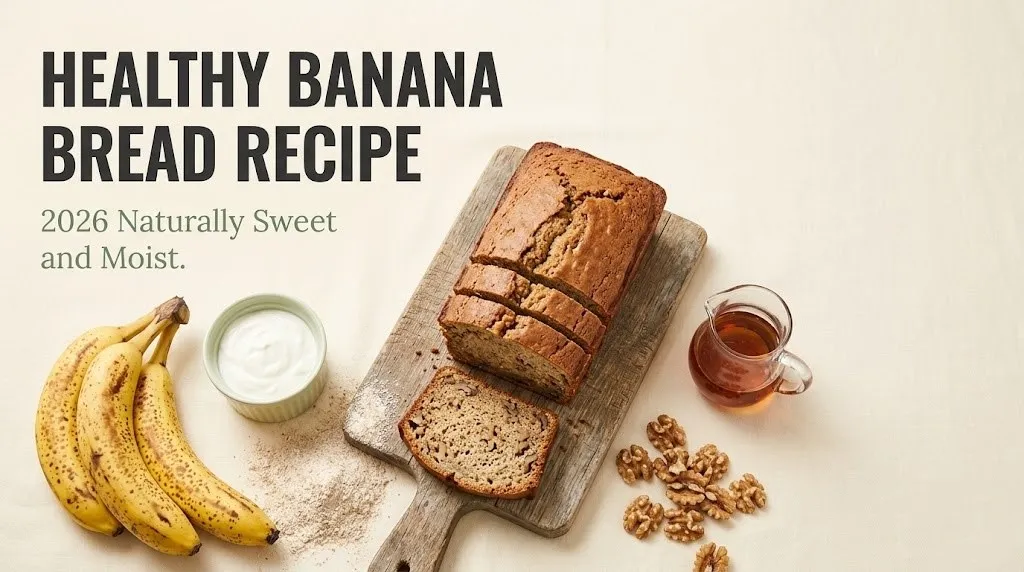
A healthy banana bread recipe swaps all-purpose flour for whole wheat flour, replaces most of the butter or oil with Greek yogurt or applesauce, and lets overripe bananas do the sweetening work that refined sugar usually does, producing a moist, tender loaf with more fiber, more protein, and less than half the added sugar of traditional recipes.
Banana bread is the baked good people feel least guilty about. It has fruit in the name. It uses up bananas that would otherwise go to waste. It passes as breakfast. But a traditional slice made with white flour, a stick of butter, and a cup of sugar is closer to cake than to a wholesome snack. The good news is that banana bread is one of the most forgiving recipes in baking. You can change almost everything about it and still produce a loaf that makes your kitchen smell like comfort.
The USDA Dietary Guidelines recommend that at least half of grain intake come from whole grains and that added sugars be limited to less than 10 percent of daily calories. Traditional banana bread fails both recommendations. This article gives you the recipe, the science behind why the healthy swaps work, and every variation you need to make banana bread that earns its place in a balanced eating pattern.
What Makes Traditional Banana Bread Unhealthy
Traditional banana bread is unhealthy because it is built on refined white flour, a full stick of butter or cup of oil, and a cup of granulated sugar, which together deliver a slice that is essentially cake with approximately 300 to 400 calories, 15 to 20 grams of fat, and 30 to 40 grams of added sugar.
A classic banana bread recipe from a 1950s cookbook reads like a pound cake formula with bananas added. One and three-quarter cups of all-purpose flour. One cup of granulated sugar. One half cup of butter. Two eggs. Three bananas. That is a cake batter. The bananas add moisture and flavor but do not offset the refined flour, saturated fat, and sugar load.
The nutritional breakdown of a single slice of traditional banana bread (one-twelfth of a loaf) looks like this:
| Nutrient | Traditional Banana Bread (1 slice) |
|---|---|
| Calories | 310 |
| Total Fat | 16g |
| Saturated Fat | 9g |
| Carbohydrates | 42g |
| Dietary Fiber | 1g |
| Total Sugars | 28g |
| Added Sugars | 20g |
| Protein | 4g |
The American Heart Association recommends limiting added sugars to 25 grams per day for women and 36 grams for men. One slice of traditional banana bread uses nearly an entire day’s added sugar allowance. The saturated fat from butter consumes a significant portion of the AHA’s 13-gram daily limit for a 2,000-calorie diet. The refined white flour provides calories without fiber, B vitamins, or the phytonutrients found in whole grain flour.
This does not mean banana bread is bad. It means traditional banana bread is a dessert that people have been mistakenly categorizing as a breakfast or snack food. The healthy version brings the nutritional profile in line with what a reasonable breakfast or snack should deliver.
Key Takeaway: Traditional banana bread is cake masquerading as a breakfast food. The sugar, refined flour, and butter in a single slice approach or exceed daily limits for added sugar and saturated fat.
Key Ingredient Swaps for Healthy Banana Bread
The three ingredient swaps that make banana bread healthier are replacing all-purpose flour with whole wheat flour, replacing most of the butter or oil with Greek yogurt or unsweetened applesauce, and reducing or eliminating added sugar by using very ripe bananas and a small amount of maple syrup or honey.
Each swap addresses a different nutritional weakness while maintaining the moist, tender crumb that makes banana bread satisfying.
Whole wheat flour for all-purpose flour. White flour is wheat that has been stripped of its bran and germ, removing the fiber, iron, and B vitamins. White whole wheat flour is a variety milled from white wheat berries rather than red; it has a milder flavor and lighter color than traditional whole wheat while providing the same fiber and nutrients. One cup of whole wheat flour contains approximately 12 to 15 grams of fiber compared to 3 grams in all-purpose flour. The USDA Dietary Guidelines specifically recommend making at least half of grain intake whole grain.
Greek yogurt for butter. Butter is approximately 80 percent fat, mostly saturated. Greek yogurt is thick, tangy, and high in protein. Replacing half the butter with Greek yogurt cuts saturated fat by roughly 40 percent while adding protein that traditional banana bread lacks. The moisture from yogurt also improves the bread’s texture and extends its shelf life.
Ripe bananas and minimal sweetener for refined sugar. A cup of very ripe mashed bananas contains approximately 14 to 16 grams of natural sugars, primarily fructose and glucose, along with fiber, potassium, and vitamin B6. The same volume of granulated sugar contains 200 grams of pure sucrose with no other nutrients. Bananas can replace a significant portion of the added sugar in a recipe because their sweetness intensifies as they ripen and starch converts to sugar.
Here is a comparison of the ingredient swaps for a standard loaf:
| Traditional Ingredient | Healthy Swap | Nutritional Impact |
|---|---|---|
| 1.75 cups all-purpose flour | 1.75 cups white whole wheat flour | Plus 8-10g fiber per loaf |
| 1/2 cup butter (1 stick) | 1/4 cup Greek yogurt plus 1/4 cup olive oil or melted coconut oil | Minus 40% saturated fat, plus protein |
| 1 cup granulated sugar | 3 tbsp maple syrup or honey (optional) | Minus 150g added sugar per loaf |
| 2 large eggs | 2 large eggs (keep) | Protein, structure |
Dietary Sensitivity Note: Whole wheat flour contains gluten. For gluten-free banana bread, use a blend of oat flour and almond flour. For dairy-free, replace Greek yogurt with unsweetened applesauce or dairy-free yogurt. For egg-free, use flax eggs.
Easy Healthy Banana Bread Recipe
This easy healthy banana bread recipe uses whole wheat flour, Greek yogurt, a small amount of maple syrup, and very ripe bananas to produce a moist, tender loaf that bakes at 350 degrees Fahrenheit for 50 to 60 minutes, yielding 12 slices at approximately 160 calories each.
This is the master recipe. It is tested, forgiving, and adaptable to the variations that follow in later sections.
Ingredients:
- 3 very ripe medium bananas, heavily spotted or nearly black (about 1.25 cups mashed)
- 1/4 cup plain Greek yogurt (2 percent or whole milk)
- 1/4 cup melted coconut oil or olive oil
- 3 tablespoons maple syrup or honey
- 2 large eggs, at room temperature
- 1 teaspoon vanilla extract
- 1 and 3/4 cups white whole wheat flour
- 1 teaspoon baking soda
- 1/2 teaspoon baking powder
- 1/2 teaspoon salt
- 1 teaspoon ground cinnamon (optional)
- 1/3 cup chopped walnuts or dark chocolate chips (optional)
Instructions:
- Preheat the oven to 350 degrees Fahrenheit. Grease a 9 by 5-inch loaf pan or line it with parchment paper with overhang for easy removal.
- In a large bowl, mash the bananas thoroughly with a fork or potato masher until mostly smooth with a few small lumps remaining.
- Whisk the Greek yogurt, melted oil, maple syrup, eggs, and vanilla into the mashed bananas until fully combined and smooth.
- In a separate bowl, whisk together the whole wheat flour, baking soda, baking powder, salt, and cinnamon if using.
- Pour the wet ingredients into the dry ingredients. Stir with a spatula just until no dry flour is visible. Small lumps are acceptable. Overmixing develops gluten and produces tough, dense bread.
- If using walnuts or chocolate chips, fold them in gently with a few strokes.
- Pour the batter into the prepared loaf pan and smooth the top. Sprinkle a few extra oats or chopped nuts on top for texture if desired.
- Bake for 50 to 60 minutes, until a toothpick inserted in the center comes out clean or with a few moist crumbs. The internal temperature should reach 200 to 205 degrees Fahrenheit.
- Let the bread cool in the pan for 10 minutes, then transfer to a wire rack to cool completely. Slicing while warm produces crumbly slices.
Quick Tip:
- The batter should be thick enough to hold its shape but not stiff. If your bananas were smaller and the batter seems dry, add a tablespoon of milk. If the batter seems too wet, add a tablespoon of flour. Banana size varies, and small adjustments prevent a loaf that is too dry or too gummy.
Healthy Banana Bread Nutrition Facts and Comparison
One slice of healthy banana bread made with the master recipe contains approximately 160 calories, 5 grams of protein, 7 grams of fat, 24 grams of carbohydrates, 3 grams of fiber, and only 3 grams of added sugar compared to 20 grams in a traditional slice.
Here is how the healthy version compares to traditional and store-bought banana bread:
| Nutrient (per slice, 1/12 loaf) | Traditional | Store-Bought (Starbucks) | Healthy Version |
|---|---|---|---|
| Calories | 310 | 420 | 160 |
| Protein | 4g | 5g | 5g |
| Total Fat | 16g | 21g | 7g |
| Saturated Fat | 9g | 8g | 3g |
| Carbohydrates | 42g | 52g | 24g |
| Dietary Fiber | 1g | 2g | 3g |
| Total Sugars | 28g | 30g | 11g |
| Added Sugars | 20g | 22g | 3g |
| Potassium | 150mg | 180mg | 230mg |
The healthy version cuts calories nearly in half, reduces saturated fat by two-thirds, and eliminates 85 percent of the added sugar. The potassium content rises because the recipe uses more banana relative to other ingredients. Potassium supports healthy blood pressure by counterbalancing sodium, and the NIH identifies bananas as one of the richest dietary sources. One slice of healthy banana bread provides approximately 5 percent of the daily potassium recommendation.
The protein increase from 5 grams in the traditional version to 5 grams may seem small in absolute terms, but it comes from structural changes, not from adding protein powder. The Greek yogurt adds casein and whey proteins that contribute to the bread’s structure and moisture while boosting the protein content.
The fiber increase from 1 gram to 3 grams per slice comes entirely from the whole wheat flour swap. Three grams of fiber per slice from a baked good is meaningful in a food environment where most muffins, quick breads, and breakfast pastries contain less than 1 gram.
Key Takeaway: The healthy banana bread cuts calories, saturated fat, and added sugar by more than half while doubling the fiber and maintaining the protein content. It is a genuine nutritional upgrade, not a marginal improvement.
Why Bananas Work as a Natural Sweetener in Bread
Overripe bananas can replace much of the added sugar in banana bread because their starch has converted to natural sugars during ripening, they contain moisture that tenderizes the crumb, and their pectin and fiber help retain that moisture during baking.
Bananas are a biological miracle for baking. They change chemically as they ripen in ways that directly serve the needs of a quick bread recipe. A green banana is approximately 70 to 80 percent starch and 1 to 2 percent sugar. A fully ripe banana with brown spots is approximately 20 to 30 percent starch and 15 to 20 percent sugar. The enzyme amylase breaks down long starch molecules into glucose, fructose, and sucrose. The fruit literally sweetens itself.
This matters for banana bread because sugar does more than sweeten. Sugar tenderizes the crumb by interfering with gluten formation. Sugar holds moisture and extends shelf life. Sugar contributes to browning through caramelization and the Maillard reaction. Bananas perform all of these functions. The natural sugars participate in browning and flavor development. The pectin and fiber hold water, keeping the crumb moist for days after baking. The fruit puree physically interferes with gluten development, tenderizing the crumb the same way fat does.
The ripeness of the bananas determines how much additional sweetener you need:
- Yellow bananas with a few spots: Moderate natural sweetness. Use 3 to 4 tablespoons of maple syrup or honey in the recipe.
- Bananas with extensive brown spots: High natural sweetness. Use 1 to 2 tablespoons of maple syrup or honey.
- Nearly black bananas: Maximum natural sweetness. Omit added sweetener entirely if desired.
The banana flavor intensifies with ripeness. If you want a strong banana flavor and maximum natural sweetness, let your bananas go fully black before baking. If you prefer a milder banana flavor, use yellow bananas with spots and a bit more maple syrup.
Dietary Sensitivity Note: Bananas have a moderate glycemic index, approximately 51 depending on ripeness. Riper bananas have a higher glycemic index. For people managing blood sugar, using slightly less ripe bananas (yellow with spots rather than black) and keeping the added sweetener minimal produces a bread with a lower glycemic impact.
Whole Wheat Flour vs White Flour in Banana Bread
Whole wheat flour makes banana bread healthier than white flour because it retains the bran and germ of the wheat kernel, providing fiber, B vitamins, iron, magnesium, and phytonutrients that are removed during the refining of white flour.
The difference between whole wheat and white flour is not marginal. It is the difference between a whole food ingredient and a refined one. When wheat is milled into white flour, the bran and germ are removed, taking with them approximately 25 percent of the protein, 80 percent of the fiber, and the majority of B vitamins, iron, magnesium, zinc, and phytonutrients. What remains is the starchy endosperm.
White whole wheat flour is the best choice for banana bread. It is milled from a lighter-colored wheat variety and has a milder, less bitter flavor than traditional red whole wheat. It provides the same fiber and nutrient content as regular whole wheat without the dense, heavy texture that sometimes turns people away from whole grain baking.
Here is how the flours compare nutritionally per cup:
| Nutrient (per cup) | All-Purpose Flour | Whole Wheat Flour | White Whole Wheat Flour |
|---|---|---|---|
| Calories | 455 | 408 | 408 |
| Protein | 13g | 16g | 16g |
| Dietary Fiber | 3g | 13g | 13g |
| Iron | 0.5mg | 3.5mg | 3.5mg |
| Magnesium | 22mg | 136mg | 136mg |
| Vitamin B6 | 0.05mg | 0.4mg | 0.4mg |
The fiber content is the most dramatic difference. Thirteen grams of fiber per cup in whole wheat versus 3 grams in all-purpose. Across a loaf of banana bread, the whole wheat version delivers approximately 10 to 12 additional grams of fiber. The Academy of Nutrition and Dietetics recommends 25 grams of fiber per day for women and 38 grams for men. A slice of whole wheat banana bread contributes 3 grams toward that target. A slice of white flour banana bread contributes less than 1 gram.
Whole wheat flour absorbs more liquid than white flour. The batter will be thicker than you are used to if you have only baked with white flour. This is normal. Do not add extra liquid. The moisture from the bananas and Greek yogurt is sufficient to hydrate the whole wheat flour and produce a tender crumb.
Quick Tip:
- If you are new to whole grain baking, start by replacing half the all-purpose flour with white whole wheat flour in your current banana bread recipe. Once you are comfortable with the flavor and texture, move to 100 percent whole wheat. This gradual transition is more successful than a sudden switch.
Greek Yogurt as a Butter and Oil Replacement
Greek yogurt replaces butter and oil in banana bread by providing moisture, tenderness, and a small amount of fat while adding protein and reducing the total fat and saturated fat by up to 40 percent without drying out the crumb.
Fat makes baked goods tender by coating flour proteins and preventing them from forming long gluten strands. The more fat in a recipe, the more tender and cake-like the result. Greek yogurt achieves a similar effect through a different mechanism. The water in yogurt turns to steam during baking, creating tiny air pockets that tenderize the crumb. The milk proteins interfere with gluten formation. The acidity reacts with baking soda to produce carbon dioxide, adding lift.
The standard swap is replacing half the butter or oil with Greek yogurt. For a recipe calling for 1/2 cup of butter, use 1/4 cup Greek yogurt plus 1/4 cup oil or melted butter. The yogurt provides the moisture and protein. The oil or butter provides the fat necessary for tenderness and flavor. Replacing all the fat with yogurt produces a bread that is too lean, with a texture closer to a dense muffin than a tender quick bread.
Here is the nutritional impact of the half-butter, half-yogurt swap:
| Fat Source | Calories | Total Fat | Saturated Fat | Protein |
|---|---|---|---|---|
| 1/2 cup butter | 810 | 92g | 58g | 1g |
| 1/4 cup oil plus 1/4 cup Greek yogurt | 560 | 60g | 12g | 6g |
| 1/2 cup unsweetened applesauce | 50 | 0g | 0g | 0g |
The combination of oil and Greek yogurt reduces calories by approximately 30 percent and saturated fat by 80 percent compared to all butter. The yogurt adds protein where none existed. The oil maintains the tender crumb that pure yogurt or pure applesauce cannot achieve alone.
Unsweetened applesauce is another fat replacement option. It works particularly well in banana bread because the banana flavor masks any subtle apple notes. Applesauce replaces fat at a 1:1 ratio. The result is a lower-calorie bread with a slightly denser, more muffin-like crumb. For the lightest texture, use the yogurt and oil combination. For the lowest calorie count, use applesauce.
Dietary Sensitivity Note: Greek yogurt is dairy. For dairy-free banana bread, replace the Greek yogurt with unsweetened applesauce, dairy-free yogurt, or mashed additional banana. Each option produces a slightly different texture. Applesauce is the most neutral.
Key Takeaway: Replacing half the fat in banana bread with Greek yogurt cuts saturated fat and calories significantly while adding protein. The combination of yogurt and oil produces a more tender crumb than either ingredient alone.
Healthy Banana Bread With No Added Sugar
Healthy banana bread with no added sugar relies entirely on the natural sweetness of very ripe bananas, using black bananas with completely converted starches, and optionally enhancing sweetness perception with vanilla, cinnamon, and a pinch of salt.
A no-added-sugar banana bread is the nutritional ideal of this recipe category. It contains zero grams of added sugar. All the sweetness comes from the bananas and the natural sugars in dairy if using Greek yogurt. The American Heart Association’s recommendation to limit added sugar is automatically met because there is nothing to limit.
The success of a no-added-sugar banana bread depends entirely on banana selection. The bananas must be black, or nearly black, on the outside. These bananas are at peak sugar content, with most of their starch converted to glucose, fructose, and sucrose. A black banana has approximately 15 to 18 grams of sugar per medium fruit, compared to 5 to 7 grams in a yellow banana.
If the bananas are not ripe enough, the bread will taste starchy and bland. The texture will be drier because there is less free sugar to hold moisture. The browning will be paler because there is less sugar to caramelize. Banana ripeness is not a preference in a no-added-sugar recipe. It is a requirement.
Additional strategies for enhancing sweetness perception without sugar:
- Vanilla extract compounds bind to sweetness receptors and amplify the signal. Use a full teaspoon.
- Cinnamon adds warmth and complexity that makes sweetness feel more present.
- A pinch of salt suppresses bitterness and makes sweet flavors more prominent.
- Toasted nuts add richness and crunch that create a more satisfying eating experience.
- Dark fruit like raisins or chopped dates add pockets of intense natural sweetness.
A no-added-sugar banana bread is less sweet than one made with maple syrup or honey. It is closer to a European-style breakfast bread than an American-style quick bread. Serve it toasted with a smear of almond butter or a few slices of fresh banana on top for a satisfying breakfast.
Dietary Sensitivity Note: A no-added-sugar banana bread still contains approximately 10 to 12 grams of natural sugar per slice from bananas. People with diabetes should count the carbohydrate content (approximately 22 to 24 grams per slice) and monitor their blood glucose response.
Gluten Free Healthy Banana Bread Recipe
Gluten free healthy banana bread uses a blend of oat flour and almond flour to replace wheat flour, producing a moist, tender loaf with more protein and healthy fats than wheat-based versions while remaining completely free of gluten.
Banana bread is one of the most forgiving baked goods for gluten-free adaptation. The bananas themselves provide enough moisture and binding power that the absence of gluten is less noticeable than in other baked goods. A properly formulated gluten-free banana bread is indistinguishable from wheat-based versions for most eaters.
The flour blend matters. A single gluten-free flour rarely works well on its own. Oat flour provides structure, fiber, and a neutral flavor. Almond flour provides moisture, tenderness, and healthy fats. Together they create a crumb that is moist and tender rather than gritty or gummy, the common failures of gluten-free baking.
Gluten free healthy banana bread recipe:
- 3 very ripe medium bananas, mashed
- 1/4 cup Greek yogurt or dairy-free alternative
- 1/4 cup melted coconut oil or olive oil
- 3 tablespoons maple syrup
- 2 large eggs
- 1 teaspoon vanilla extract
- 1 and 1/2 cups oat flour (certified gluten-free)
- 1/2 cup almond flour
- 1 teaspoon baking soda
- 1/2 teaspoon baking powder
- 1/2 teaspoon salt
- 1 teaspoon cinnamon (optional)
Instructions are the same as the master recipe. The batter will be slightly thicker due to the almond flour. Bake at 350 degrees Fahrenheit for 50 to 55 minutes. The internal temperature should reach 205 degrees Fahrenheit. Gluten-free baked goods often need a few extra minutes.
The nutritional profile shifts slightly from the wheat version. Almond flour adds healthy monounsaturated fats, vitamin E, and magnesium. Oat flour adds soluble fiber (beta-glucan) that the FDA recognizes as helping to lower cholesterol. The protein content rises to approximately 6 to 7 grams per slice.
Dietary Sensitivity Note: Oats are naturally gluten free but often cross-contaminated with wheat during processing. Use oats and oat flour labeled “certified gluten-free” if you have celiac disease. Almond flour is made from tree nuts and is not suitable for people with tree nut allergies.
Vegan Healthy Banana Bread Recipe
Vegan healthy banana bread replaces eggs with flax eggs, butter with coconut oil or olive oil, and Greek yogurt with unsweetened applesauce or mashed banana, producing a plant-based loaf that is just as moist and tender as the original.
Banana bread is the easiest baked good to veganize because the bananas already perform many of the functions that eggs and dairy provide in other recipes. The bananas add moisture (like butter), binding (like eggs), and sweetness (like sugar). With a few targeted swaps, the loaf is completely free of animal products.
Flax eggs replace chicken eggs at a ratio of 1 tablespoon ground flaxseed plus 2.5 tablespoons water per egg. Let the mixture sit for 5 minutes until it forms a gel. This gel mimics the binding properties of eggs and adds omega-3 fatty acids from the flaxseed.
Here is the vegan adaptation of the master recipe:
- Replace 2 eggs with 2 flax eggs (2 tbsp ground flaxseed plus 5 tbsp water)
- Replace 1/4 cup Greek yogurt with 1/4 cup unsweetened applesauce or mashed banana
- Replace honey with maple syrup (honey is not vegan)
- Use coconut oil or olive oil instead of butter
The texture of vegan banana bread is slightly denser than the egg version because flax eggs do not provide the same leavening lift that chicken eggs do. Adding an extra 1/4 teaspoon of baking powder compensates for this. The flavor is just as rich. The crumb is just as moist.
Nutritional changes in the vegan version:
- Cholesterol: Reduced to zero (plant-based ingredients contain no cholesterol)
- Saturated fat: Similar or slightly lower depending on oil choice
- Omega-3 fatty acids: Increased from flax eggs
- Fiber: Slightly increased from flax and applesauce
- Protein: Slightly lower without Greek yogurt
Dietary Sensitivity Note: The vegan version is free of dairy, eggs, and animal products. It is not automatically gluten free if made with whole wheat flour. For a vegan and gluten-free version, use the gluten-free flour blend in the previous section with flax eggs and applesauce.
High Protein Banana Bread With Protein Powder
High protein banana bread adds 10 to 15 grams of protein per slice by incorporating unflavored or vanilla protein powder into the dry ingredients, making it suitable as a post-workout snack or a more satiating breakfast option.
Standard banana bread, even the healthy version, contains 4 to 6 grams of protein per slice. That is reasonable for a snack but low for a meal replacement or post-workout recovery. Adding protein powder boosts each slice to 15 to 20 grams of protein, comparable to a protein bar but made from whole food ingredients.
Protein powder choices for banana bread:
- Whey protein isolate: Complete protein, blends invisibly, produces tender crumb. Best all-around choice.
- Plant protein blend (pea, rice, or blend): Works well, may be slightly drier. Add 1 tablespoon of extra moisture.
- Collagen peptides: Dissolves completely, adds no flavor, but is not a complete protein (lacks tryptophan). Good for skin and joint support.
The addition rate is 1 scoop (approximately 25 grams) per loaf. This adds roughly 20 to 25 grams of protein across the loaf, or about 2 grams per slice. For higher protein, use 2 scoops and reduce the flour by 1/4 cup to maintain the correct batter consistency.
High protein banana bread recipe modification:
- Reduce whole wheat flour to 1 and 1/2 cups
- Add 1 to 2 scoops (25 to 50 grams) unflavored or vanilla protein powder
- Add 2 tablespoons of milk or plant milk to compensate for the moisture-absorbing property of protein powder
- All other ingredients remain the same
The texture with added protein powder is slightly denser than the standard version. Protein powder absorbs moisture and reduces the rise. The additional milk and slightly reduced flour help maintain tenderness.
Quick Tip:
- Protein powder should be whisked thoroughly with the dry ingredients before adding the wet ingredients. Protein powder added directly to wet ingredients clumps and will not distribute evenly. Small lumps of unflavored protein powder survive baking and taste unpleasant.
Low Calorie Healthy Banana Bread
Low calorie healthy banana bread cuts the calorie count to approximately 120 to 140 per slice by replacing all added fat with unsweetened applesauce, using nonfat Greek yogurt, reducing the flour slightly, and relying entirely on banana sweetness with no added sugar.
The master recipe produces a 160-calorie slice. For someone in a calorie deficit, those 20 to 40 calories per slice matter over a week of breakfasts and snacks. The low calorie version makes every modification count without producing a dry, unsatisfying loaf.
Low calorie modifications:
- Replace the 1/4 cup oil with 1/4 cup unsweetened applesauce
- Use nonfat Greek yogurt instead of 2 percent or whole milk yogurt
- Reduce flour to 1 and 1/2 cups
- Add an extra 1/4 cup mashed banana for moisture
- Omit all added sweetener; use very ripe black bananas
The applesauce replaces fat at a 1:1 ratio. It provides moisture without calories. The tradeoff is tenderness. Fat-free banana bread is slightly more muffin-like than cake-like. It is still enjoyable. It is just a different texture expectation.
Nutrition per slice of low calorie healthy banana bread:
| Nutrient | Amount |
|---|---|
| Calories | 125 |
| Protein | 4g |
| Total Fat | 1.5g |
| Saturated Fat | 0.3g |
| Carbohydrates | 22g |
| Dietary Fiber | 3g |
| Sugars | 10g |
| Added Sugars | 0g |
Dietary Sensitivity Note: Very low-fat baked goods stale faster than those with some fat. Eat the low calorie banana bread within 2 days or slice and freeze on the day it is baked.
Diabetic-Friendly and Low Sugar Banana Bread
Diabetic-friendly banana bread uses whole wheat flour for fiber, yellow bananas with a few spots rather than black bananas for lower free sugar content, and no added sweetener, producing a slice with approximately 22 to 25 grams of carbohydrate that can fit within a diabetic meal plan when paired with protein and healthy fat.
Blood sugar management after eating banana bread depends on the total carbohydrate load, the fiber content, and the banana ripeness. The strategies that make banana bread more diabetic-friendly are specific and evidence-based.
Banana ripeness matters for blood sugar. Green bananas contain resistant starch, a type of carbohydrate that resists digestion in the small intestine and ferments in the colon, producing a lower blood glucose response. Yellow bananas have converted some resistant starch to sugar. Black bananas have converted nearly all of it. For diabetic-friendly banana bread, use yellow bananas with a few brown spots, not black bananas. The starch that remains will digest more slowly than free sugar.
Fiber blunts the glucose response. Whole wheat flour provides 3 grams of fiber per slice, more than the 1 gram in white flour versions. Additional fiber from flaxseed meal (1 tablespoon per loaf) or chia seeds adds soluble fiber that slows carbohydrate absorption.
The formula for diabetic-friendly banana bread:
- Use yellow bananas with a few spots (not black)
- Use 100 percent whole wheat flour
- Add 2 tablespoons ground flaxseed
- Omit all added sweetener
- Keep the Greek yogurt for protein
- Consider adding 1/4 cup chopped walnuts for healthy fat and additional glucose buffering
A slice of diabetic-friendly banana bread contains approximately 22 to 25 grams of carbohydrate and 3 to 4 grams of fiber. For someone counting carbohydrates for insulin dosing, this is roughly 1.5 carbohydrate servings.
Dietary Sensitivity Note: Individual blood glucose responses vary. The American Diabetes Association recommends checking blood sugar 90 to 120 minutes after eating to understand how specific foods affect you. A slice of banana bread eaten as part of a meal with additional protein and vegetables will produce a different glucose response than a slice eaten alone.
How to Store and Freeze Healthy Banana Bread
Healthy banana bread stays fresh at room temperature for 3 days wrapped tightly in plastic wrap, in the refrigerator for up to 1 week, and in the freezer for up to 3 months when sliced and individually wrapped, making it an ideal make-ahead breakfast or snack.
The higher moisture content of healthy banana bread from bananas and Greek yogurt means it stays fresh longer than traditional versions. It also means it can mold faster if not stored properly.
Room temperature storage: Cool the bread completely on a wire rack. Wrap the entire loaf or remaining slices tightly in plastic wrap, then in foil. Store at room temperature for up to 3 days. The plastic wrap prevents moisture loss. The foil blocks light.
Refrigerator storage: Refrigeration extends shelf life to about 1 week but can dry out the bread. Wrap tightly in plastic wrap and place in an airtight container. To serve, toast the slice or microwave for 15 to 20 seconds to restore moisture.
Freezer storage: This is the best method for meal prep. Slice the completely cooled loaf into individual portions. Wrap each slice in plastic wrap, then place all wrapped slices in a freezer-safe zip-top bag. Freeze for up to 3 months. To thaw, remove a slice from the freezer and let it sit at room temperature for 30 minutes, or microwave from frozen for 30 to 45 seconds.
Storage method summary:
| Method | Duration | Best Practice |
|---|---|---|
| Room temperature | 3 days | Wrap tightly in plastic wrap |
| Refrigerator | 1 week | Wrap tightly, toast before serving |
| Freezer (whole loaf) | 2 months | Wrap in plastic, then foil, then bag |
| Freezer (individual slices) | 3 months | Wrap individually, bag together |
Banana bread does not require refrigeration for food safety. It is a baked good with low water activity. The main concerns are staling and mold. Freezing on the day it is baked preserves the freshest texture.
Quick Tip:
- To thaw frozen banana bread quickly, microwave a wrapped slice for 30 seconds at 50 percent power, then let it sit for 1 minute. Unwrap and toast lightly. The texture is nearly identical to fresh.
Healthy Banana Bread Add-Ins and Flavor Variations
Healthy banana bread variations include blueberry lemon, dark chocolate walnut, spiced pumpkin, and cinnamon apple, each adding flavor and texture without compromising the nutritional profile when added in moderation.
Add-ins make banana bread feel like a different experience each time you bake it. The key is choosing add-ins that contribute nutrition rather than just sugar.
Nutrition-positive add-ins:
- Walnuts or pecans (1/3 cup chopped): Omega-3 fatty acids, magnesium, crunchy texture. Add 15 calories per slice.
- Dark chocolate chips (1/4 cup): Antioxidants from cocoa, satisfaction factor. Use 70 percent cacao or higher. Add 20 calories per slice.
- Blueberries (1/2 cup fresh or frozen): Vitamin C, fiber, antioxidants. Fold in gently to avoid streaking the batter purple. Add 10 calories per slice.
- Shredded zucchini (1/2 cup, squeezed dry): Moisture, vitamin A, fiber. Does not change the flavor. Add negligible calories.
- Pumpkin puree (replace 1/4 cup banana): Vitamin A, fiber, seasonal flavor. Add cinnamon, nutmeg, and ginger.
- Chia seeds or ground flaxseed (2 tablespoons): Omega-3s, fiber, lignans. Sprinkle on top or mix into the batter.
Flavor variations:
- Cinnamon swirl: Layer half the batter in the pan, sprinkle with 1 tablespoon cinnamon mixed with 1 teaspoon coconut sugar, add remaining batter, and swirl with a knife.
- Lemon blueberry: Add the zest of 1 lemon to the wet ingredients and fold in fresh blueberries.
- Gingerbread banana: Add 1 tablespoon molasses, 1 teaspoon ginger, 1/2 teaspoon cinnamon, and 1/4 teaspoon cloves.
- Tropical: Replace 1/4 cup banana with crushed pineapple (drained), add shredded coconut and macadamia nuts.
The add-ins should total no more than 3/4 cup per loaf. More than that interferes with the batter structure and produces a loaf that crumbles when sliced.
Dietary Sensitivity Note: Nuts and dairy-based chocolate are common allergens. Sunflower seeds replace walnuts for nut-free crunch. Dairy-free dark chocolate chips are widely available. Check labels for shared equipment warnings if allergies are severe.
Key Takeaway: Add-ins personalize banana bread without undoing its healthy profile. Choose nuts, seeds, dark chocolate, or fresh fruit. Limit total add-ins to 3/4 cup per loaf to maintain structure.
Frequently Asked Questions About Healthy Banana Bread
Can I make banana bread without any sugar at all?
Yes, you can make banana bread with no added sugar by using black, overripe bananas that have converted most of their starch to natural sugars.
The bread will be less sweet than traditional versions but still satisfying, especially with cinnamon and vanilla to enhance sweetness perception.
One slice of no-sugar banana bread contains approximately 10 to 12 grams of natural sugar from the bananas.
What is the healthiest flour for banana bread?
White whole wheat flour is the healthiest flour for banana bread because it provides 13 grams of fiber per cup and retains the bran and germ with their B vitamins, iron, and magnesium.
It has a milder flavor than traditional whole wheat, producing a lighter-tasting loaf.
For gluten-free banana bread, a blend of oat flour and almond flour provides fiber, protein, and healthy fats.
How many calories are in a slice of healthy banana bread?
A slice of healthy banana bread made with the master recipe contains approximately 155 to 175 calories per slice, one-twelfth of a standard loaf.
The low calorie variation with applesauce instead of oil contains approximately 120 to 140 calories per slice.
This compares to 300 to 420 calories in a slice of traditional or store-bought banana bread.
Is banana bread healthy for weight loss?
Healthy banana bread can fit into a weight loss eating plan as a 160-calorie snack or breakfast component that provides fiber and protein for satiety.
Portion control is the most important factor. Measure slices carefully and avoid adding butter or extra sweetener.
Pair a slice with Greek yogurt or a hard-boiled egg for a more filling breakfast that supports a calorie deficit.
Can I freeze healthy banana bread?
Yes, healthy banana bread freezes well for up to 3 months when sliced and individually wrapped in plastic wrap, then stored in a freezer-safe bag.
Thaw individual slices at room temperature for 30 minutes or microwave from frozen for 30 to 45 seconds.
The high moisture content from bananas and Greek yogurt helps the bread retain its texture after freezing better than traditional versions.
Banana bread is one of the most forgiving recipes in home baking. You can change the flour, cut the fat, eliminate the added sugar, and add protein, and you will still pull a fragrant, moist loaf out of the oven. The healthy version in this article is not a compromise. It is a genuinely good banana bread that happens to have more fiber, less saturated fat, and a fraction of the sugar of the traditional version.
Bake a loaf on Sunday. Slice it and freeze the slices individually. Pull one out each morning, toast it lightly, and eat it with a spoonful of almond butter or alongside a couple of scrambled eggs. That is a breakfast that earns its place in a healthy eating pattern.
The best banana bread is the one you make with bananas that are too spotty to eat out of hand, flour that still has its bran, and just enough sweetener to make it feel like a treat. That loaf is waiting for you. The bananas on your counter are ready.