
Acai (Euterpe oleracea) is genuinely nutritious as a whole food, delivering healthy fats, dietary fiber, and one of the highest measured antioxidant concentrations of any fruit. Whether an acai bowl is healthy depends almost entirely on what’s in it, because a restaurant acai bowl can range from a reasonable 300-calorie breakfast to a 900-calorie sugar-heavy dessert depending on the base, toppings, and portion.
The distinction between acai the fruit and acai as it’s served commercially matters enormously. The USDA FoodData Central data on unsweetened acai pulp shows approximately 70 calories per 100 grams with just 6 grams of natural sugar. Commercial sweetened acai puree packets used at most restaurants contain 14 to 22 grams of added sugar per 100 grams before any toppings are added.
This guide covers the actual nutrient profile of acai, how commercial bowls stack up nutritionally, which restaurant chains offer better options, how acai bowls compare to other breakfast choices, and the specific steps for building or ordering a bowl that delivers the nutritional benefits the fruit actually has.
Is Acai Healthy?
Acai (Euterpe oleracea) is healthy as a whole food, with a favorable fat profile, meaningful dietary fiber, and one of the highest antioxidant densities of any commonly consumed fruit, though its health benefits are often overstated in marketing relative to what the current research actually supports.
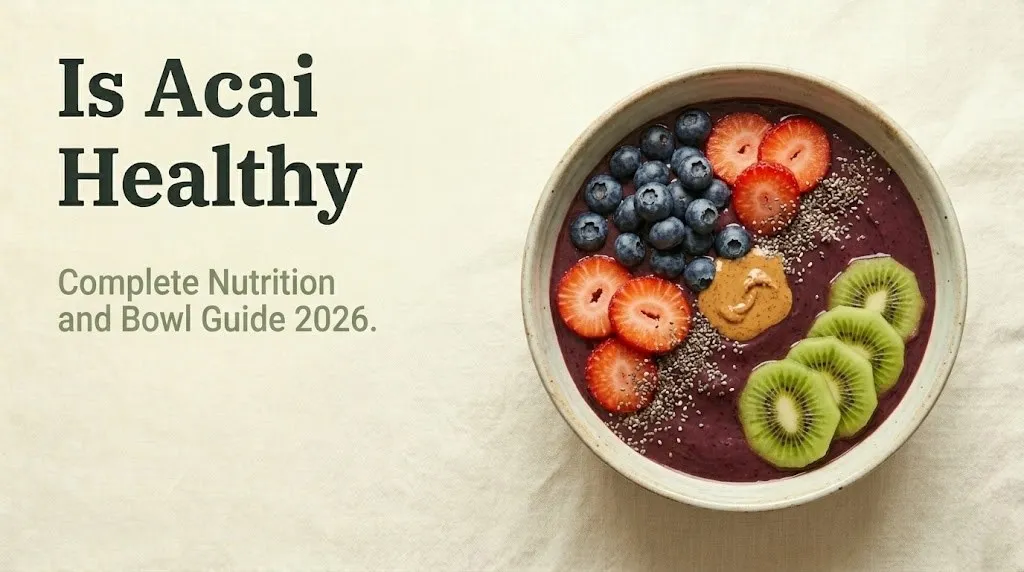
The berry grows on the açaí palm in the Amazon basin of Brazil and is rarely eaten fresh outside the region. Most people consume it as frozen pulp, freeze-dried powder, or in acai bowls. The nutrient profile of the unsweetened pulp is genuinely strong:
- Calories: approximately 70 per 100 grams, making it calorie-light for a fruit
- Fat: approximately 5 grams per 100 grams, primarily oleic acid (a monounsaturated fatty acid, the same primary fat in olive oil) and palmitic acid (a saturated fatty acid)
- Fiber: approximately 2 grams per 100 grams, supporting digestive regularity
- Sugar: approximately 6 grams per 100 grams (natural sugars, no added sugar in unsweetened pulp)
- Protein: approximately 1 gram per 100 grams, modest but present
The antioxidant story is real but frequently misrepresented. Acai contains anthocyanins, specifically cyanidin-3-glucoside and cyanidin-3-rutinoside, which are the pigments giving it its deep purple color. Research published in the Journal of Agriculture and Food Chemistry found that acai has an exceptionally high ORAC (Oxygen Radical Absorbance Capacity) value. However, ORAC measures antioxidant activity in a test tube, not in the human body. The degree to which dietary anthocyanins from acai translate to measurable antioxidant effects in human tissues is an active area of research with promising but not conclusive results.
People taking blood thinners including warfarin should discuss any significant dietary changes involving high-polyphenol foods with their prescribing physician, as some research suggests polyphenols may interact with anticoagulant metabolism at high intake levels.
Is Acai Bowl Healthy?
An acai bowl is healthy when it is built around an unsweetened acai base, controlled portions of whole food toppings, and a reasonable calorie ceiling of 400 to 550 calories for a standard serving. It is not inherently healthy just because it contains fruit.
The bowl format creates a nutritional wildcard. The acai pulp or puree is a small fraction of the total calories in a restaurant bowl. Granola, honey, coconut flakes, nut butter, and sweetened dried fruit toppings can each add 100 to 250 calories and 10 to 25 grams of sugar on top of a base that may already contain significant added sugar.
A commercially assembled acai bowl at a major chain restaurant typically contains:
| Component | Approximate Calories | Approximate Added Sugar |
|---|---|---|
| Sweetened acai puree base (200g) | 150 to 220 | 28 to 44g |
| Granola topping (1/3 cup) | 130 to 180 | 5 to 12g |
| Banana slices (1/2 banana) | 45 to 55 | 6 to 8g (natural) |
| Honey drizzle (1 tbsp) | 60 | 17g |
| Coconut flakes (2 tbsp) | 45 to 60 | 1 to 3g |
| Total (standard bowl) | 430 to 575 | 57 to 84g |
For context, the American Heart Association (AHA) recommends no more than 25 grams of added sugar per day for women and 36 grams for men. A standard commercial acai bowl can deliver more added sugar than the entire daily recommendation in a single meal.
People managing type 2 diabetes should approach restaurant acai bowls with significant caution, as the total glycemic load from sweetened base, banana, honey, and granola combined represents a substantial blood glucose challenge. Choosing unsweetened acai base with lower-glycemic toppings is the appropriate modification.
Are Acai Bowls Healthy?
Acai bowls are healthy when made from unsweetened acai pulp with controlled, whole-food toppings. Most commercial acai bowls as served at restaurant chains are not particularly healthy because of the added sugar in the sweetened puree base and high-calorie topping combinations.
The gap between the healthiest and least healthy versions of an acai bowl at the same restaurant can be enormous. The ingredient that creates the biggest difference is one most customers never ask about: whether the restaurant uses unsweetened acai packets (such as Sambazon Unsweetened, approximately 6 grams of sugar per 100-gram packet) or sweetened acai puree (approximately 14 to 22 grams of sugar per 100-gram packet).
Think of it like ordering a yogurt parfait. Plain Greek yogurt with fresh berries is a nutritionally sound breakfast. Vanilla-sweetened yogurt with granola, honey, and candy topping is a dessert that happens to sit in a yogurt bowl. Acai bowls span the same range, and the base ingredient makes most of the difference.
What makes an acai bowl healthy:
- Unsweetened acai base
- Total calories under 500 for a standard bowl
- Toppings that contribute protein and fiber (chia seeds, hemp seeds, plain nut butter)
- Minimal added sweeteners (no honey drizzle, no sweetened granola)
- Fresh fruit rather than dried fruit (which is more calorie-dense and sugar-concentrated)
What makes an acai bowl less healthy:
- Sweetened acai puree as the base
- Honey or agave drizzle adding 17 grams of added sugar per tablespoon
- Commercial granola with added sugar
- Sweetened coconut flakes
- Peanut butter or almond butter in portions above 1 tablespoon
Key Takeaway: The acai berry is nutritious. The bowl around it at most restaurants is where the nutrition story falls apart. The base ingredient (unsweetened vs. sweetened) is the single most important factor.
Is an Acai Bowl Healthy?
A single acai bowl is healthy or not based on three variables: whether the acai base is unsweetened, how many high-calorie toppings are added, and what portion size is served. Applying these three criteria to any specific bowl gives a much more useful answer than a blanket yes or no.
The portion question is underappreciated. Restaurant acai bowls are rarely small. A standard bowl at most chains contains 350 to 500 grams of total food, which is substantially more than the standard 100-gram serving size used in most nutritional analyses of acai. Evaluating an acai bowl by the per-100-gram nutritional data for acai pulp significantly underestimates what the actual meal delivers in calories and sugar.
A medium bowl from Playa Bowls, for example, can contain 450 to 650 calories depending on topping selection. That same calorie range describes a complete, nutritionally balanced lunch for many adults. Framing it as a light breakfast option doesn’t match the actual caloric reality.
According to the Academy of Nutrition and Dietetics, a nutritionally sound breakfast for a healthy adult should provide 20 to 35% of daily caloric needs, approximately 400 to 700 calories for someone eating 2,000 calories daily, alongside protein and fiber that sustain energy through the morning. An acai bowl can fit this framework when built correctly. Most restaurant versions arrive heavily weighted toward carbohydrates and sugar with minimal protein, which is a poor macronutrient structure for sustained morning energy regardless of calorie count.
People with fructose malabsorption should be cautious with large acai bowls, as the combination of fruit, honey, and high-fructose toppings can trigger gastrointestinal symptoms in individuals with this condition.
Acai Bowl Healthy
Calling an acai bowl healthy requires specifying which bowl, at what size, with which base and toppings, because the category spans an enormous nutritional range that the label “acai bowl” doesn’t capture on its own.
The marketing around acai bowls has historically conflated the nutritional benefits of the acai berry itself with the nutritional profile of the assembled commercial bowl. These are different things. The berry contributes anthocyanins, fiber, oleic acid, and modest calories. The bowl often contributes sweetened puree, refined-grain granola, honey, and fruit that together deliver a carbohydrate and sugar load that rivals a pastry.
That said, the bowl format has genuine potential as a vehicle for nutrition. When built thoughtfully, it can provide:
- Anthocyanins and polyphenols from the acai base, supporting antioxidant intake
- Dietary fiber from chia seeds (Salvia hispanica, approximately 10 grams of fiber per 28-gram serving) and fresh fruit
- Omega-3 fatty acids from hemp seeds (Cannabis sativa, hulled, approximately 2.7 grams of alpha-linolenic acid per 28-gram serving)
- Protein from nut butter or protein powder additions (approximately 7 to 8 grams per tablespoon of almond butter from Prunus dulcis)
The protein gap is the most consistent nutritional weakness of even well-made acai bowls. A bowl that delivers strong antioxidant and fiber content but only 8 to 12 grams of protein will not sustain energy levels as effectively as a breakfast built around a protein-forward base, particularly for people with active lifestyles or elevated protein needs.
Vegan and plant-based eaters should note that acai bowls can be made fully plant-based by using unsweetened plant-based milk (oat milk from Avena sativa, or almond milk from Prunus dulcis) in the blended base and selecting plant protein toppings like hemp seeds or a plant-based protein powder.
Are Acai Bowls Actually Healthy?
Acai bowls are actually healthy only when made from unsweetened acai, portioned reasonably, and topped with ingredients that contribute protein, fiber, and micronutrients rather than primarily adding sugar and refined carbohydrates.
The “actually” in this question reflects healthy skepticism, and that skepticism is warranted. Acai bowls have been marketed aggressively as a health food while many commercial versions are nutritionally closer to ice cream sundaes than to a nutrient-dense meal.
A 2022 consumer awareness report published by the Harvard T.H. Chan School of Public Health highlighted that fruit-based breakfast bowls at restaurants frequently exceed the recommended daily added sugar intake in a single serving, while being perceived by consumers as healthy due to their fruit content. The fruit framing creates a health halo that doesn’t always match the nutritional reality.
The honest answer is that acai bowls occupy a nutritional middle ground. The base ingredient has genuine health properties. The commercial assembly often undermines those properties through added sugar and calorie-dense toppings. The outcome depends on choices made at the point of ordering or preparation.
Reality check: what you’re actually getting at a major chain:
| Chain | Menu Item | Calories | Total Sugar | Protein |
|---|---|---|---|---|
| Jamba Juice | Acai Primo Bowl (medium) | 490 to 560 | 60 to 75g | 9 to 12g |
| Smoothie King | Vegan Acai Bowl (medium) | 580 to 650 | 65 to 80g | 8 to 11g |
| Playa Bowls | Original Acai Bowl (medium) | 480 to 640 | 55 to 75g | 8 to 12g |
| Oakberry | Classic Acai Bowl (small) | 300 to 380 | 35 to 48g | 6 to 9g |
All figures are estimates based on standard menu formulations as of 2025 to 2026. Nutritional data varies by size, location, and topping selection. Verifying through each chain’s current nutritional resources before ordering is the most accurate approach.
Key Takeaway: Most commercial acai bowls at major restaurant chains deliver 55 to 80 grams of total sugar per serving. That’s the real number behind the health halo, and it’s the reason “actually healthy” depends entirely on which specific bowl you order or make.
Are Acai Bowls Healthy for Breakfast?
Acai bowls can be a healthy breakfast choice when they contain adequate protein (at least 15 grams), a reasonable calorie count (under 500 calories), and minimal added sugar, but most commercial acai bowls fall short on protein and exceed recommended added sugar intake by a substantial margin.
A nutritionally effective breakfast should provide sustained energy through mid-morning without triggering a blood glucose spike and subsequent energy crash. The macronutrient structure for this is roughly: protein-anchored, with moderate complex carbohydrates and fat. Standard commercial acai bowls are predominantly carbohydrate-forward with minimal protein, which is the macronutrient structure most associated with mid-morning energy dips.
Acai bowl vs. other common breakfast options:
| Breakfast Option | Calories | Protein | Sugar | Fiber |
|---|---|---|---|---|
| Restaurant acai bowl (medium) | 480 to 600 | 8 to 12g | 55 to 75g | 5 to 8g |
| Overnight oats with berries | 350 to 420 | 12 to 18g | 15 to 22g | 6 to 10g |
| Greek yogurt parfait with granola | 350 to 450 | 18 to 24g | 20 to 32g | 4 to 7g |
| Avocado toast with 2 eggs | 400 to 500 | 18 to 24g | 3 to 5g | 8 to 12g |
| Smoothie with protein powder | 350 to 450 | 25 to 35g | 15 to 25g | 5 to 8g |
| Homemade acai bowl (optimized) | 350 to 430 | 14 to 20g | 18 to 28g | 8 to 12g |
The homemade optimized version is achievable. It uses unsweetened acai, a scoop of protein powder, chia seeds (Salvia hispanica), and fresh berries rather than sweetened granola and honey. That version competes favorably with any breakfast on this table. The restaurant version does not.
People following a low-carbohydrate dietary pattern for blood glucose management should treat restaurant acai bowls as incompatible with their daily carbohydrate targets unless they can custom-build with an unsweetened base and minimal fruit toppings.
Are Fruit Bowls Healthy?
Fruit bowls are healthy when they are built around whole, minimally processed fruit and controlled portions, but they vary enormously in nutritional quality depending on whether added sugars, sweetened bases, or calorie-dense toppings are included.
The “fruit bowl” category encompasses a broad range: a simple bowl of sliced melon, pineapple, and berries with nothing added is one of the purest whole-food meals available, delivering vitamins, minerals, fiber, and natural sugars without any processing. A commercial acai bowl, smoothie bowl, or parfait marketed as a “fruit bowl” may share the fruit category but not the nutritional simplicity.
Whole fruit is consistently supported by dietary research as a cornerstone of a healthy eating pattern. According to the USDA Dietary Guidelines for Americans (2020 to 2025), adults should consume 1.5 to 2 cups of fruit per day, and evidence consistently links fruit consumption to reduced risk of cardiovascular disease and type 2 diabetes when consumed as part of a balanced diet. The key phrase is whole fruit, which retains fiber that slows sugar absorption and moderates blood glucose response.
Fruit in blended, puree, or juice form delivers the same sugars without the same fiber structure, changing how the body processes the sugar load. A whole banana has a lower glycemic impact than blended banana in a smoothie bowl base, because intact cell walls slow the digestive process in ways that blending disrupts.
People following a ketogenic or very low-carbohydrate diet should be aware that even pure whole fruit bowls contain carbohydrates primarily from fructose and glucose, and may not fit their specific daily carbohydrate ceiling.
Why Are Acai Bowls Healthy?
Acai bowls can be healthy because the acai base provides polyphenols and healthy fats, whole food toppings can add fiber, protein, and micronutrients, and the meal format encourages eating mindfully from a bowl rather than grabbing convenience food. These properties exist when the bowl is built correctly.
The nutritional case for acai specifically rests on three properties. First, the anthocyanin content: research published in the Journal of Agriculture and Food Chemistry documented that Euterpe oleracea fruits contain high concentrations of cyanidin-based anthocyanins, which show antioxidant activity in laboratory settings. Second, the fat profile: the primary fat in acai is oleic acid, a monounsaturated fatty acid associated with cardiovascular health benefits in research examining the Mediterranean dietary pattern. Third, the fiber: unsweetened acai pulp provides dietary fiber that contributes to satiety and digestive regularity.
The bowl format adds potential through what you layer on top. Chia seeds (Salvia hispanica) contribute soluble fiber and omega-3 fatty acids (alpha-linolenic acid, ALA). Hemp seeds (Cannabis sativa, hulled) add complete plant protein. Fresh berries including blueberries (Vaccinium corymbosum) add additional anthocyanins and vitamin C (ascorbic acid). Together, these toppings can create a genuinely nutrient-rich meal.
Quick Tip:
- Add 1 tablespoon of almond butter (Prunus dulcis) for approximately 7 grams of protein and healthy fat without significant added sugar
- Use fresh fruit only, not dried fruit, to keep sugar concentrated from additional sources in check
- Add 1 tablespoon of chia seeds for 4 grams of fiber and omega-3 fatty acids
- People with a tree nut allergy should skip almond butter and use sunflower seed butter (from Helianthus annuus seeds) as a nut-free alternative
Key Takeaway: Acai bowls are healthy because of the acai berry’s polyphenols, healthy fat profile, and fiber, but these properties are only preserved when the commercial assembly doesn’t bury the fruit under added sugar, sweetened granola, and honey.
How Healthy Is an Acai Bowl?
The healthiness of an acai bowl is measured most accurately by four variables: total calories, added sugar content, protein content, and whether the base is unsweetened acai or sweetened puree. These four factors predict whether a specific bowl is a sound nutritional choice or a dessert.
Scoring any specific acai bowl against a practical health framework:
| Factor | Healthy Target | Average Restaurant Bowl | Homemade Optimized Bowl |
|---|---|---|---|
| Total calories | Under 500 | 480 to 650 | 350 to 430 |
| Added sugar | Under 15g | 40 to 70g | 5 to 15g |
| Protein | 15g or more | 8 to 12g | 14 to 20g |
| Fiber | 6g or more | 5 to 8g | 8 to 14g |
| Unsweetened base | Yes | Rarely | Yes |
The restaurant bowl fails on added sugar and protein by the most meaningful margins. The calorie count for restaurant bowls overlaps with the healthy target range for a meal, so calories alone don’t disqualify them. The sugar and protein structure is what makes the nutritional difference.
The healthiest acai bowl you can eat is one you make yourself using unsweetened frozen acai packets, an unsweetened plant-based or dairy milk base, a scoop of protein powder, and whole food toppings you select specifically. That bowl can achieve all five of the criteria in the “healthy target” column above.
Older adults over 65 who are managing weight and muscle mass should pay particular attention to the protein content of any acai bowl, as the typical 8 to 12-gram protein range is below the 1.0 to 1.2 grams per kilogram of body weight daily target recommended by research on protein intake for older adults, per the American Journal of Clinical Nutrition.
Acai Bowl Calories and Sugar
A restaurant acai bowl contains approximately 480 to 650 calories and 55 to 80 grams of total sugar in a standard medium serving, with the majority of both calories and sugar coming from the sweetened base and high-calorie toppings rather than from the acai berry itself.
The calorie distribution within a standard commercial acai bowl breaks down as follows. The sweetened acai puree base contributes roughly 150 to 220 calories and 28 to 44 grams of sugar before a single topping is added. Granola contributes 130 to 180 calories and 5 to 12 grams of sugar. Banana contributes 45 to 55 calories and 6 to 8 grams of natural sugar. A honey drizzle adds 60 calories and 17 grams of added sugar. Together, these standard components routinely push total sugar past the American Heart Association’s entire daily recommended limit for both men and women.
The sugar in commercial acai bowls matters differently depending on its source. Natural fruit sugars from banana and whole berries arrive with fiber, which moderates absorption rate. Added sugar from honey, sweetened acai puree, and sweetened granola enters the bloodstream more rapidly. Most commercial acai bowls contain both, making the total sugar figure a mix of these two sources.
People monitoring calorie intake for weight management should treat restaurant acai bowls in the 500 to 650 calorie medium size as a full meal rather than a snack or light option. Ordering a small size with fewer toppings brings the calorie count into a more manageable range of 300 to 400 calories.
Is Acai Bowl Good for Weight Loss?
An acai bowl can fit into a weight-loss eating plan when it is built from an unsweetened base with controlled toppings and stays within a 350 to 450 calorie target, but most commercial restaurant acai bowls are too high in sugar and calories to support weight loss goals without significant modification.
The challenge with acai bowls for weight loss is that they’re filling in a way that feels light. The cold, fruit-forward format doesn’t register the way a 600-calorie meal typically does when it arrives as a warm, savory plate. Research on perceived caloric density suggests that people systematically underestimate calories in fruit-based and cold meals compared to equivalent-calorie warm or savory meals. This misperception leads to consuming more calories than intended when eating acai bowls regularly as a weight-management strategy.
That said, the macronutrient profile can be adjusted to support weight loss specifically:
- Protein: increasing to 20 to 25 grams by adding protein powder reduces hunger recurrence and supports satiety between meals, per research in the American Journal of Clinical Nutrition on protein and satiety hormones
- Fiber: adding chia seeds (Salvia hispanica) and choosing fibrous toppings slows gastric emptying and extends satiety
- Sugar: switching to an unsweetened base and skipping honey and sweetened granola dramatically reduces the blood glucose spike that drives hunger back quickly after a high-sugar meal
- Portion: choosing small or medium sizes and treating the bowl as a complete meal rather than a snack prevents caloric overflow
People following a medically supervised very low-calorie diet should discuss whether acai bowls fit their specific daily calorie target, as even a well-built bowl typically represents 20 to 25% of a 1,500-calorie daily restriction.
Healthiest Acai Bowl to Order at Restaurants
The healthiest acai bowl to order at a restaurant is the smallest size available, built on an unsweetened acai base wherever the restaurant offers one, with fresh fruit and nut butter as primary toppings instead of granola and honey.
At the major chains as of 2026:
Jamba Juice: Request the acai bowl with no granola or reduced granola. Ask whether the base is sweetened or unsweetened. Adding a protein powder scoop improves the protein deficit. Choosing the small size reduces calories to approximately 300 to 380 calories.
Smoothie King: The Vegan Acai Bowl is the lightest-calorie option on the standard menu. Requesting no honey drizzle and substituting extra fresh berries for granola reduces sugar by approximately 20 to 30 grams per bowl.
Playa Bowls: The base is typically sweetened at standard locations. Request no honey, light or no granola, and extra fresh fruit. Choosing a small size reduces the calorie count to approximately 350 to 450 calories.
Oakberry: Generally uses one of the lighter base preparations among major chains. The smaller size options (Primo size) with fresh toppings sit at approximately 300 to 380 calories, making it one of the more manageable commercial options.
All nutritional estimates reflect standard menu formulations as of 2025 to 2026. Menus, formulations, and topping options change by location and season. Using each chain’s current nutrition calculator or speaking with staff about the base type and sugar content before ordering gives the most accurate picture for individual health needs.
People with celiac disease should confirm with the specific restaurant whether their granola and base ingredients are gluten-free, as cross-contamination risk in commercial kitchens is not eliminated by choosing naturally gluten-free ingredients.
How to Make Acai Bowl Healthier
The most effective way to make an acai bowl healthier is to switch to an unsweetened acai base, add a protein source, replace sweetened granola with chia seeds or hemp seeds, and limit or eliminate honey and sweetened toppings.
Making a nutritionally optimized acai bowl at home is achievable for anyone with a high-powered blender. The instructions below describe a process that requires basic equipment and preparation.
To make a healthier acai bowl at home:
- Place 2 unsweetened frozen acai packets (such as Sambazon Unsweetened, 200 grams total) in a high-powered blender. Let them soften for 3 to 5 minutes at room temperature before blending.
- Add 1/2 cup of unsweetened almond milk (from Prunus dulcis) or oat milk (from Avena sativa) to the blender. Use as little liquid as possible to keep the base thick; a thin base produces a smoothie, not a bowl.
- Add 1 scoop (approximately 25 grams) of an unflavored or vanilla protein powder to bring the protein total to approximately 20 to 25 grams per bowl.
- Blend on high for 20 to 30 seconds until smooth but still thick enough to hold toppings without them sinking. Stop and scrape down sides as needed.
- Pour into a wide bowl. The base should be the consistency of soft-serve ice cream.
- Top with: 1/2 cup fresh blueberries (Vaccinium corymbosum), 1 tablespoon chia seeds (Salvia hispanica), 1 tablespoon natural almond butter (Prunus dulcis, no added sugar), and a few fresh strawberry (Fragaria ananassa) slices. Skip honey, sweetened granola, and coconut flakes.
Each serving of this bowl contains approximately 350 to 400 calories, 20 to 25 grams of protein, 12 to 16 grams of dietary fiber, and 15 to 22 grams of total sugar (primarily from fruit), with no added sugar from the base.
People with a peanut allergy who want to use nut butter should confirm the almond butter facility is peanut-free, or substitute sunflower seed butter (from Helianthus annuus) as a safe, nut-free alternative with a similar fat and protein profile.
Frequently Asked Questions About Is Acai Healthy
Is acai actually healthy or is it just hype?
Acai (Euterpe oleracea) is genuinely nutritious as a whole food, providing anthocyanins, oleic acid, dietary fiber, and vitamin E that have documented properties in nutritional research.
The hype exceeds the current science on human health outcomes: most acai-specific clinical research is preliminary, small-scale, or conducted in cell cultures and animals rather than in controlled human trials.
The fruit is worth eating for its nutritional profile; it is not a cure for any condition, and the commercial bowls built around it are often less healthy than the berry itself.
How many calories are in an acai bowl?
A restaurant acai bowl contains approximately 480 to 650 calories in a standard medium size, depending on the base, toppings, and chain.
The range spans from approximately 300 calories for a small, lightly topped bowl to over 900 calories for a large bowl with granola, honey, nut butter, and multiple fruit toppings.
A homemade acai bowl built from an unsweetened base with controlled toppings can be kept to 350 to 430 calories with significantly less added sugar.
Are acai bowls good for weight loss?
Acai bowls can support weight loss when made from an unsweetened base, kept under 450 calories, and built with protein-rich toppings that extend satiety.
Most restaurant acai bowls are not well-suited to weight loss because of their high sugar content and calorie count, combined with a low protein profile that doesn’t sustain fullness through the morning.
Modifying a restaurant order to the smallest size with no honey, no sweetened granola, and added protein is the most practical adjustment for someone managing weight.
What is the healthiest acai bowl to order at a restaurant?
The healthiest restaurant acai bowl uses the smallest size, an unsweetened acai base if available, fresh fruit toppings, and minimal or no granola and honey.
Among major chains, Oakberry’s smaller size options and Jamba Juice with reduced granola and no honey drizzle tend to be the lower-sugar choices.
Using each chain’s nutrition calculator to build and preview your specific order before purchasing gives the most accurate nutritional picture for your specific combination.
Is acai bowl healthy for breakfast every day?
A carefully built acai bowl with an unsweetened base, adequate protein, and minimal added sugar can be a nutritionally sound daily breakfast for most healthy adults.
Eating a standard commercial restaurant acai bowl every day is not optimal because the cumulative added sugar intake would routinely exceed the American Heart Association’s daily recommendation of 25 grams for women and 36 grams for men.
Making acai bowls at home using unsweetened acai packets and whole food toppings is the most practical way to make this a genuinely healthy daily habit.
Closing
The acai berry is nutritious. The bowls sold at most restaurants are a different story. The base ingredient, not the topping choices, is where the nutritional quality is decided first. Ask whether the acai base is sweetened or unsweetened before you order, and that single question will tell you most of what you need to know about the bowl in front of you.
If you make acai bowls at home, use unsweetened acai packets, add a protein source, and skip the honey. That version genuinely earns the health reputation the category claims.
Restaurant or homemade, the goal is the same: let the fruit do the work and don’t bury it in sugar.