Healthy banana bread is a version of the classic loaf made by replacing refined flour, butter, and white sugar with whole grain flours, natural sweeteners, and lower-fat dairy options. Done right, it delivers a genuinely moist, flavorful loaf with more fiber, fewer added sugars, and a better nutritional profile than the standard recipe most people grew up with.
The standard banana bread recipe is far more indulgent than most people realize. A single slice of traditional banana bread can contain 200 to 300 calories, 10 to 14 grams of fat, and upward of 20 grams of added sugar. The Dietary Guidelines for Americans 2020-2025 recommend limiting added sugar to less than 10 percent of total daily calories, which is roughly 50 grams for a 2,000-calorie diet. One generous slice of the classic version can consume nearly half of that budget.
This guide covers everything from what actually makes banana bread healthier to the complete best recipe, a diabetic-friendly adaptation, high-protein variations, walnut additions, and proper storage. You’ll also find a full nutritional breakdown so you know exactly what you’re eating.
What Is Healthy Banana Bread?
Healthy banana bread is a quick bread made primarily from mashed ripe bananas, a whole grain or lower-glycemic flour, a natural sweetener, and a lower-saturated-fat binding agent in place of butter.
The word “healthy” carries real nutritional meaning here, not just marketing framing. Standard banana bread relies on all-purpose flour (a refined grain stripped of its bran and germ), white sugar, and a substantial amount of butter or vegetable oil. A healthier version replaces these with ingredients that contribute more dietary fiber, more micronutrients, and fewer free sugars.
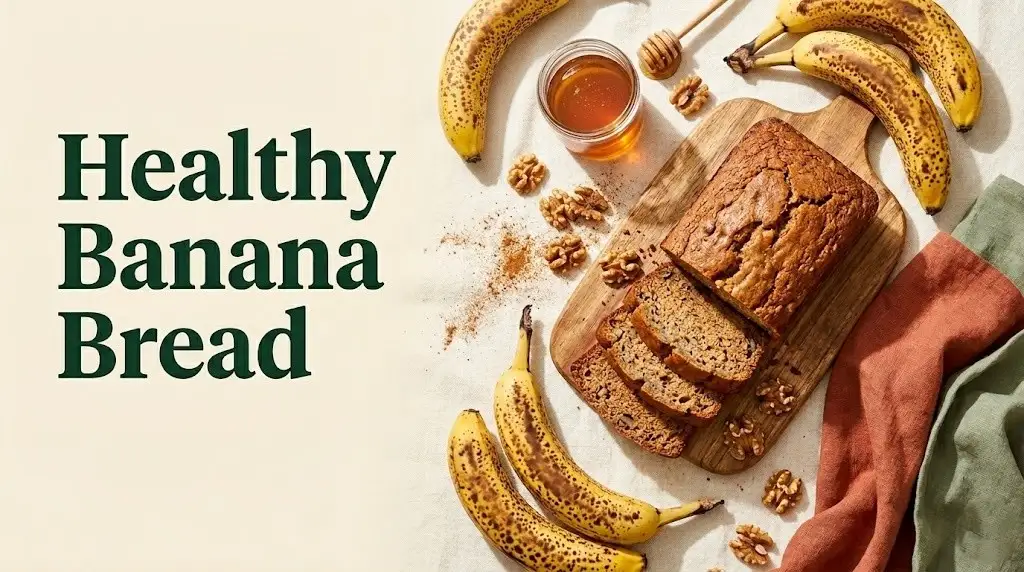
The bananas themselves are already doing a lot of nutritional work. According to USDA FoodData Central, one medium ripe banana (approximately 118 grams) contains approximately 422 milligrams of potassium, 0.4 milligrams of vitamin B6 (pyridoxine), 32 milligrams of magnesium, and 3 grams of dietary fiber. The banana is the ingredient you don’t need to fix. The surrounding recipe is where most of the improvements happen.
People with wheat allergies or celiac disease should note that most healthy banana bread recipes still contain gluten. Oat flour alternatives must be certified gluten-free to be safe for people with celiac disease.
| Standard Banana Bread | Healthy Banana Bread |
|---|---|
| All-purpose refined flour | Whole wheat or oat flour |
| White granulated sugar | Raw honey or pure maple syrup |
| Unsalted butter (1/2 cup) | Greek yogurt or applesauce |
| 2 whole eggs | 2 eggs or flaxseed egg |
| Minimal fiber | 2 to 3 grams fiber per slice |
What Makes Banana Bread Healthy?
Banana bread becomes genuinely healthier when the refined ingredients are replaced with versions that contain more fiber, fewer processed sugars, and less saturated fat per serving.
The three biggest nutritional levers are flour, sweetener, and fat source. Replacing all-purpose flour with whole wheat flour or oat flour adds measurable dietary fiber and B vitamins that are stripped away during the refining process. According to the Dietary Guidelines for Americans 2020-2025, whole grains should make up at least half of all grains consumed daily, and most Americans fall significantly short of this.
Switching from white sugar to raw honey or pure maple syrup does not eliminate sugar from the recipe. These are still free sugars and they still affect blood glucose. What they offer is a slightly lower glycemic response in some studies, plus trace minerals: raw honey contains small amounts of antioxidants and manganese, while pure maple syrup contains manganese and zinc. Neither is a health food in large quantities, but in the modest amounts used in banana bread, the swap represents a marginal improvement.
Replacing butter with Greek yogurt or unsweetened applesauce reduces saturated fat. The American Heart Association recommends limiting saturated fat to less than 6 percent of total daily calories, roughly 13 grams for a 2,000-calorie diet. Standard banana bread with 1/2 cup of butter delivers approximately 7 to 8 grams of saturated fat per slice. Greek yogurt brings that down substantially while adding protein and maintaining moisture.
Key dietary considerations include:
- People with tree nut allergies should omit walnuts or pecans from any variation
- Dairy-free bakers can replace Greek yogurt with unsweetened coconut yogurt or applesauce
- Vegans can use a flaxseed egg (1 tablespoon ground flaxseed plus 3 tablespoons water, rested for 5 minutes) in place of each whole egg
Healthy Banana Bread Calories and Macros Per Slice
A standard slice of healthy banana bread (approximately 60 grams, cut from a 10-slice loaf) contains roughly 130 to 165 calories, depending on the specific recipe and add-ins.
The exact macro profile shifts based on which flour and sweetener you choose. Whole wheat flour and oat flour both produce a slightly denser loaf with more fiber per slice than almond flour-based versions, which are higher in fat and lower in carbohydrates. There is no universally “best” version. The right choice depends on the baker’s nutritional goals.
Think of the different flour options like choosing between brown rice and quinoa. Both are improvements over white rice, but they have different macro profiles and serve different dietary goals.
| Ingredient Version | Calories/Slice | Protein (g) | Fat (g) | Carbs (g) | Fiber (g) | Sugar (g) |
|---|---|---|---|---|---|---|
| Standard recipe (all-purpose flour, butter, white sugar) | 220 to 270 | 3 | 9 to 12 | 34 to 38 | 0.8 | 18 to 22 |
| Whole wheat flour, honey, Greek yogurt | 135 to 160 | 5 | 2.5 | 26 to 30 | 2.5 to 3 | 11 to 14 |
| Oat flour, maple syrup, applesauce | 130 to 155 | 4 | 2 | 27 to 31 | 2 to 2.5 | 12 to 15 |
| Almond flour, honey, coconut oil | 185 to 210 | 6 | 11 to 13 | 18 to 22 | 3 | 10 to 12 |
Data estimated from USDA FoodData Central ingredient profiles. Actual values vary by specific brand and exact measurements used.
People with type 2 diabetes or those following a carbohydrate-controlled eating plan should note that even the healthier versions still contain 26 to 31 grams of carbohydrates per slice. Portion size management remains essential regardless of which version is made.
Key Takeaway: Healthy banana bread is genuinely different from standard banana bread in measurable nutritional ways. The main improvements come from flour, sweetener, and fat source, not from the bananas themselves, which are already nutrient-dense.
Whole Wheat Banana Bread Health Benefits
Whole wheat flour is the most accessible and research-supported upgrade you can make to a banana bread recipe.
Unlike all-purpose flour, which is milled to remove the bran and germ, whole wheat flour retains all three parts of the grain kernel: the bran, the germ, and the endosperm. This means it retains dietary fiber, B vitamins including thiamine (B1), riboflavin (B2), niacin (B3), and folate (B9), plus trace minerals including iron, zinc, and magnesium that are largely absent in refined flour.
Harvard T.H. Chan School of Public Health research indicates that diets higher in whole grains are consistently associated with lower risks of cardiovascular disease, type 2 diabetes, and certain digestive conditions. The mechanism isn’t a single compound. It’s the combined effect of fiber slowing glucose absorption, B vitamins supporting energy metabolism, and antioxidants present in the bran layer.
In practical baking terms, whole wheat flour produces a slightly denser, heartier crumb than all-purpose flour. Many bakers prefer a 50/50 split: half whole wheat, half oat flour. This gives a lighter texture while still capturing the fiber benefit.
According to the Dietary Guidelines for Americans 2020-2025, the recommended intake is at least 3 ounce-equivalents of whole grains per day for adults. A slice of whole wheat banana bread contributes approximately 0.5 to 0.75 ounce-equivalents depending on the recipe’s flour ratio.
People with wheat sensitivity (non-celiac gluten sensitivity) may tolerate whole wheat better than processed wheat products due to the intact fiber matrix, but those with diagnosed celiac disease must use certified gluten-free oat flour instead.
How to Make Banana Bread Healthy: The Best Ingredient Swaps
Making banana bread genuinely healthier comes down to five targeted ingredient decisions, each of which has a measurable impact on the final nutritional profile.
The goal isn’t to strip away everything enjoyable. A loaf that no one wants to eat isn’t a health win. The goal is to make swaps that improve the nutritional value without wrecking the texture or flavor that makes banana bread worth baking in the first place.
| Original Ingredient | Healthier Swap | What It Changes |
|---|---|---|
| All-purpose flour (1.5 cups) | Whole wheat or oat flour (1.5 cups) | Adds fiber, B vitamins, trace minerals |
| White sugar (3/4 cup) | Raw honey or maple syrup (1/3 cup) | Reduces added sugar by ~40%, adds trace minerals |
| Unsalted butter (1/2 cup) | Plain Greek yogurt (1/2 cup) | Cuts saturated fat, adds protein |
| 2 whole eggs | 2 whole eggs (or flaxseed eggs for vegan) | Flaxseed egg adds omega-3 fatty acids (alpha-linolenic acid) |
| Standard chocolate chips | 70% dark chocolate chips (2 tablespoons) | Reduces sugar, adds flavanols |
Reducing the sweetener quantity is possible because very ripe bananas (heavily spotted, soft) contain enough natural fructose and glucose to carry the sweetness of the loaf. You don’t need 3/4 cup of sugar when you have three extremely ripe bananas doing that work.
Quick Tip:
- Use bananas with fully blackened peels for maximum natural sweetness and the most pronounced banana flavor
- Mash bananas with a fork until no large chunks remain. Lumps bake into dense pockets
- If using Greek yogurt, choose full-fat or 2% for better moisture retention than fat-free versions
People following a low-FODMAP diet should note that ripe bananas are high in fructans at larger quantities. A single serving of banana bread using half a medium banana per slice typically falls within a low-FODMAP serving range, but individual tolerance varies.
Healthy Banana Bread with Honey: Does It Actually Make a Difference?
Using honey instead of white sugar in banana bread does reduce the refined sugar content, but the calorie difference per slice is modest and the health distinction requires context.
Raw honey contains approximately 64 calories per tablespoon and pure maple syrup contains approximately 52 calories per tablespoon, versus 48 calories per tablespoon for granulated white sugar. The calorie difference is small. What shifts more meaningfully is the volume used: because honey is sweeter and more flavorful than white sugar, most recipes that swap to honey use about 1/3 cup instead of 3/4 cup. That reduction in total sweetener volume is where the real calorie and sugar reduction comes from.
A 2019 review published in the journal Nutrients found that raw honey contains small amounts of phenolic acids and flavonoids with antioxidant activity. However, the concentrations present in a 1/3 cup of honey distributed across a 10-slice loaf are not nutritionally significant on a per-serving basis. The distinction between honey and white sugar at this scale is marginal from a strict nutrition standpoint.
The practical argument for honey and maple syrup is flavor depth. Both add a complexity that white sugar cannot replicate. Maple syrup in particular pairs exceptionally well with bananas, cinnamon, and walnuts. That flavor reward is a legitimate reason to use them, even if the health case alone is modest.
People with bee pollen allergies should exercise caution with raw honey. Individuals following a vegan diet should substitute pure maple syrup, as honey is not considered vegan by many definitions.
The Complete Recipe for Healthy Banana Bread
This is the base recipe. It uses whole wheat flour, Greek yogurt, raw honey, and very ripe bananas. It produces a moist, tender loaf with approximately 140 to 155 calories per slice.
Ingredients (makes 10 slices, one 9×5-inch loaf):
- 3 very ripe medium bananas (approximately 270g peeled weight), mashed
- 1.5 cups (180g) whole wheat flour
- 1/2 cup (120g) plain Greek yogurt (2% or full-fat)
- 1/3 cup (113g) raw honey or pure maple syrup
- 2 large eggs, room temperature
- 1 teaspoon (5g) pure vanilla extract
- 1 teaspoon (4g) baking soda (sodium bicarbonate)
- 1/2 teaspoon (2g) baking powder
- 1/2 teaspoon (1.5g) ground cinnamon (Cinnamomum verum)
- 1/4 teaspoon (1.5g) fine sea salt
- Optional: 1/2 cup (55g) chopped walnuts (Juglans regia)
To make this healthy banana bread:
- Preheat your oven to 350°F (175°C). Lightly grease a 9×5-inch loaf pan with cooking spray or a thin layer of coconut oil.
- In a large bowl, mash the bananas thoroughly with a fork until smooth. Very small lumps are acceptable, but aim for a mostly uniform puree.
- Add the Greek yogurt, honey, eggs, and vanilla extract to the mashed banana. Whisk until fully combined, about 30 seconds.
- In a separate medium bowl, whisk together the whole wheat flour, baking soda, baking powder, cinnamon, and salt.
- Pour the dry ingredients into the wet ingredients. Stir with a spatula or wooden spoon until just combined. Stop stirring the moment no dry flour is visible. Overmixing will tighten the gluten network and produce a tough, dense loaf.
- Fold in walnuts if using, with no more than 4 to 5 strokes.
- Pour the batter into the prepared loaf pan. Smooth the surface with the back of the spatula.
- Bake on the center rack for 55 to 65 minutes, or until a wooden toothpick inserted into the center comes out with only a few moist crumbs attached (not wet batter).
- Cool in the pan for 10 minutes, then transfer to a wire rack to cool for at least 20 minutes before slicing. Cutting too early releases steam and collapses the crumb structure.
Key Takeaway: The three most impactful swaps in any healthy banana bread recipe are whole grain flour for refined flour, a natural sweetener used in reduced quantity, and Greek yogurt or applesauce in place of butter. The bananas themselves are already nutritionally strong.
How to Keep Healthy Banana Bread Moist
Moisture in healthy banana bread comes from three sources: the bananas, the binding agent (Greek yogurt or applesauce), and the baking process itself.
The most common reason a healthy banana bread turns out dry is swapping out fat without replacing the moisture it provided. Butter contributes both flavor and a fat layer that coats the crumb and prevents it from drying out. When you remove butter, you must replace it with something that performs a similar moisture-retention function. Greek yogurt does this through its high water content and protein matrix. Applesauce does it through its fruit pectin and natural water content.
A second common cause of dryness is overbaking. Whole wheat and oat flours absorb more liquid than all-purpose flour, which means the batter starts out thicker and can dry out faster if left in the oven too long. Start checking at the 55-minute mark rather than waiting for the full time. The toothpick test is more reliable than visual color as a doneness indicator.
Quick Tip:
- Add 1 tablespoon of extra virgin olive oil or coconut oil to the batter if you’re using a very low-fat recipe and the loaf is turning out too dry
- Covering the loaf pan loosely with aluminum foil for the last 15 minutes of baking prevents over-browning without drying the interior
- Slightly under-ripe bananas contain more starch and less moisture. Always use bananas with heavy brown spotting for the moistest result
People who are monitoring sodium intake should note that baking soda contributes approximately 59 milligrams of sodium per 1/4 teaspoon. The full recipe uses 1 teaspoon, contributing approximately 236 milligrams of sodium across the loaf, or roughly 24 milligrams per slice.
Healthy Banana Walnut Bread: Nutrition Upgrade or Just Delicious?
Walnuts (Juglans regia) are one of the few additions to banana bread that genuinely improve its nutritional profile rather than just its flavor.
Walnuts are one of the best plant-based sources of alpha-linolenic acid (ALA), the plant form of omega-3 fatty acid. According to the American Heart Association, omega-3 fatty acids support cardiovascular health by helping to maintain healthy triglyceride levels. A 1-ounce (28-gram) serving of walnuts contains approximately 2.5 grams of ALA. Distributed across a 10-slice loaf using 1/2 cup (55 grams) of walnuts, each slice gains approximately 0.7 grams of ALA.
Walnuts also add protein, dietary fiber, and magnesium to each slice. A standard healthy banana walnut bread slice provides approximately 4 to 5.5 grams of protein, which is more satisfying than a plain banana bread slice eaten as a standalone breakfast.
The calorie addition matters. Each slice gains approximately 40 to 50 calories from the 1/2 cup of walnuts. For someone eating banana bread as part of a calorie-conscious eating plan, that addition is worth accounting for. For someone primarily interested in nutritional density and staying power, the trade is highly worthwhile.
| Nutrient Addition per Slice (from 1/2 cup walnuts across 10 slices) | Amount |
|---|---|
| Additional calories | 40 to 50 kcal |
| Additional protein | 1 to 1.5g |
| Additional ALA (omega-3) | approximately 0.7g |
| Additional dietary fiber | approximately 0.3g |
| Additional magnesium | approximately 12mg |
People with tree nut allergies must avoid walnuts entirely. Pecans (Carya illinoinensis) are a common substitution but carry the same tree nut allergen risk. Pumpkin seeds (pepitas) are a nut-free alternative that adds crunch and zinc without the allergen concern.
Healthy Banana Bread for Breakfast: Is It a Good Morning Option?
Healthy banana bread can work as a breakfast food, but the complete nutritional picture is worth examining before making it a daily morning habit.
A single slice of whole wheat honey banana bread with walnuts provides roughly 175 to 200 calories, 5 to 6 grams of protein, 2.5 to 3 grams of fiber, and 11 to 14 grams of sugar. Compare that to a bowl of oatmeal with sliced banana, which delivers a similar calorie count but considerably more fiber and less sugar per serving. The oatmeal wins on pure nutritional metrics.
That doesn’t mean banana bread can’t anchor a healthy breakfast. The difference is what you eat with it. Pairing a slice with 3/4 cup of plain Greek yogurt adds 12 to 15 grams of protein and calcium (approximately 150 milligrams). Pairing it with a hard-boiled egg adds 6 grams of protein and healthy fats. Either pairing transforms a moderate-protein snack into a more balanced meal.
Think of a standalone slice of banana bread like a good supporting actor. Impressive in the right setting, but not the whole show on its own.
According to the Academy of Nutrition and Dietetics, a balanced breakfast should include a source of protein, a source of complex carbohydrates, and ideally some dietary fiber. Healthy banana bread with walnuts and a protein pairing meets all three criteria.
People who are managing their weight should note that banana bread is easy to portion-distort. A “slice” from a home-baked loaf can range from 50 grams to 120 grams depending on how it’s cut. Weighing slices rather than estimating is the most reliable way to track what you’re actually eating.
Key Takeaway: Banana walnut bread adds genuine nutritional value through ALA omega-3 fatty acids and extra protein, making it a more satisfying and heart-supportive choice than plain banana bread for most people.
Quick Healthy Banana Bread Recipe: One Bowl, Under an Hour
This streamlined version of the recipe cuts prep time to under 15 minutes using a single bowl and skips any steps that don’t affect the final result.
The one-bowl method works for banana bread because the mixing process is minimal by design. Unlike a layer cake that needs thoroughly aerated butter and sugar, quick breads rely on chemical leavening (baking soda and baking powder) rather than mechanical aeration. You can mix everything in the same bowl without sacrificing texture, as long as you respect the “just combined” rule at the flour stage.
To make a quick healthy banana bread in one bowl:
- Preheat oven to 350°F (175°C). Grease a 9×5-inch loaf pan.
- Mash 3 very ripe bananas directly in a large bowl until mostly smooth.
- Add 1/2 cup Greek yogurt, 1/3 cup honey, 2 eggs, and 1 teaspoon vanilla extract. Whisk together for 20 seconds.
- Add 1.5 cups whole wheat flour, 1 teaspoon baking soda, 1/2 teaspoon baking powder, 1/2 teaspoon cinnamon, and 1/4 teaspoon salt directly to the same bowl.
- Stir until just combined. No white flour patches should remain, but 10 to 12 strokes is enough.
- Pour into prepared pan. Bake 55 to 60 minutes until a toothpick inserted in the center comes out with moist crumbs.
- Cool in pan 10 minutes, then on a rack for 20 minutes before slicing.
Total active time: approximately 15 minutes. Total time: 75 to 85 minutes including cooling.
People baking at high altitude (above 3,500 feet) should reduce baking soda to 3/4 teaspoon and increase oven temperature to 375°F (190°C) to compensate for lower air pressure, which affects chemical leavening performance.
Healthy Banana Bread Recipe for Diabetics: What You Need to Know
Banana bread can be part of an eating plan for people managing type 2 diabetes, but the standard version of even a “healthy” recipe requires specific modifications to make it genuinely appropriate.
The central issue is carbohydrate load and glycemic response. A very ripe banana has a glycemic index of approximately 51, classifying it as a moderate-GI food according to the American Diabetes Association. When combined with any flour in a baked loaf, the total carbohydrate content per slice becomes the more relevant metric than glycemic index alone. The American Diabetes Association emphasizes carbohydrate counting and total carbohydrate content per serving as the primary management tool for most people with diabetes.
A standard healthy banana bread slice made with whole wheat flour contains approximately 26 to 30 grams of carbohydrates per 60-gram slice. That represents a meaningful portion of many individuals’ per-meal carbohydrate targets. Reducing portion size to half a slice (approximately 30 grams) is one practical strategy.
For a lower-carbohydrate adaptation:
| Standard Healthy Swap | Diabetic-Friendly Swap | Carb Reduction |
|---|---|---|
| 1.5 cups whole wheat flour | 1 cup almond flour + 1/2 cup oat fiber | Reduces carbs by approx. 40% |
| 1/3 cup honey | 2 tablespoons pure maple syrup + 1/2 tsp cinnamon | Reduces added sugar by ~50% |
| 3 ripe bananas | 2 medium bananas (less ripe, more starch) | Lowers free sugar content |
| Standard slice (60g) | Half slice (30g) paired with protein | Lowers per-serving carb load |
People managing diabetes with medication or insulin should work with a registered dietitian or their treating provider to determine a serving size that fits their individual carbohydrate targets. General guidance here cannot replace individualized meal planning, particularly for people whose blood glucose response to baked goods varies significantly.
Cinnamon appears in several “blood sugar support” claims online. A 2013 review in the American Journal of Clinical Nutrition found modest evidence for ground cinnamon lowering fasting blood glucose in some people with type 2 diabetes, but the evidence is not strong enough to frame cinnamon as a therapeutic agent. Include it for flavor, not as a health intervention.
High Protein Banana Bread: How to Boost the Macros
Standard banana bread, even the healthier version, is not a high-protein food. A typical slice contains 3 to 5 grams of protein, which is comparable to a slice of whole grain toast and not particularly filling on its own.
Bumping protein to 8 to 12 grams per slice requires targeted ingredient additions. The most effective strategies are adding protein powder, increasing Greek yogurt, or incorporating nut butter into the batter.
Protein-boosting additions and their impact:
- 1/2 cup (45g) unflavored or vanilla whey protein powder or plant-based protein powder: adds approximately 15 to 18 grams of protein across the loaf, or 1.5 to 1.8 grams per slice. Reduce flour by 2 tablespoons when adding protein powder to maintain the correct moisture-to-dry ratio.
- Increasing Greek yogurt from 1/2 cup to 3/4 cup: adds approximately 3 to 4 grams of protein across the whole loaf, or 0.3 to 0.4 grams per slice. A modest boost, but it also improves moisture.
- Adding 3 tablespoons of natural almond butter or peanut butter to the wet ingredients: adds approximately 9 to 10 grams of protein across the loaf, plus monounsaturated fats. It does add approximately 150 to 160 calories to the full loaf, or 15 to 16 per slice.
- Using 3 eggs instead of 2: adds approximately 6 grams of protein total, or 0.6 grams per slice. Small improvement, but eggs also contribute vitamin D and choline.
A reasonable target for a high-protein banana bread is 8 to 10 grams of protein per 60-gram slice. Achieving this typically requires combining two of the strategies above: protein powder plus nut butter, or extra Greek yogurt plus three eggs.
People with peanut allergies must use sunflower seed butter (sunbutter) or tahini as alternatives to peanut butter or almond butter. Both work well in banana bread batter without significantly altering the flavor profile.
Key Takeaway: For people with type 2 diabetes or those managing blood sugar, the most effective adjustments to banana bread are reducing the total banana count, choosing almond flour over wheat flour, minimizing added sweetener, and controlling the portion size to 30 grams or half a standard slice.
Storing and Freezing Healthy Banana Bread
Healthy banana bread stores and freezes well, which makes it an excellent candidate for batch baking and weekly meal prep.
At room temperature, a fully cooled loaf wrapped tightly in plastic wrap or stored in an airtight container stays fresh for 2 to 3 days. The higher moisture content from Greek yogurt or applesauce means it can develop surface mold faster than a butter-based loaf if left uncovered in a warm kitchen. In the refrigerator, wrapped tightly, it lasts for 5 to 7 days. Cold refrigeration firms the crumb slightly. A 15-second microwave warm-up restores the texture before eating.
For freezing:
- Allow the loaf to cool completely on a wire rack. Never freeze a warm loaf. Internal steam condenses into ice crystals that damage the crumb structure.
- Slice the loaf into individual portions. Freezing sliced is far more practical than freezing whole.
- Wrap each slice individually in plastic wrap, then place all slices in a single zip-lock freezer bag. Removing individual slices without thawing the whole loaf is the main advantage of this method.
- Label the bag with the date. Healthy banana bread maintains quality in the freezer for up to 3 months.
- To thaw, remove a slice from the freezer and leave it at room temperature for 30 to 45 minutes, or microwave from frozen for 30 to 45 seconds until warm through.
According to the USDA Food Safety and Inspection Service, freezing does not kill bacteria but halts their growth. Always freeze banana bread within the safe window (within 3 days of baking at room temperature) rather than waiting until it’s close to spoiling.
People storing banana bread in humid climates should prioritize refrigeration over room-temperature storage, as ambient humidity accelerates mold growth on baked goods with high moisture content.
Frequently Asked Questions About Healthy Banana Bread
How many calories are in a slice of healthy banana bread?
A slice of healthy banana bread made with whole wheat flour, honey, and Greek yogurt contains approximately 130 to 165 calories per 60-gram slice.
The exact calorie count depends on whether walnuts or chocolate chips are included, which flour is used, and the slice thickness.
Almond flour versions run slightly higher at 185 to 210 calories per slice due to the higher fat content of almond flour, though they are lower in carbohydrates.
Can diabetics eat banana bread?
People with type 2 diabetes can eat banana bread in controlled portion sizes, but the standard recipe, even the healthier version, contains 26 to 30 grams of carbohydrates per slice and requires portion management.
The most practical adaptations are using almond flour, reducing the banana count from three to two, minimizing added sweetener, and pairing the bread with a protein source to blunt the blood glucose response.
A registered dietitian specializing in diabetes management can help determine whether and how banana bread fits into an individual’s specific carbohydrate targets, which vary considerably between people.
What flour is best for healthy banana bread?
Whole wheat flour is the best choice for most people because it adds measurable fiber, B vitamins, and trace minerals while producing a texture very close to all-purpose flour.
Oat flour is a good second option, producing a slightly lighter, more tender crumb, and is appropriate for people with wheat sensitivity when certified gluten-free.
Almond flour works well for low-carbohydrate or grain-free needs but produces a denser, moister loaf and cannot be substituted 1:1 for wheat-based flours without adjusting the liquid ratios.
Is honey better than sugar in banana bread?
Honey is a marginal improvement over white sugar in banana bread, primarily because most recipes that swap to honey use a smaller volume of it, which meaningfully reduces the total added sugar content.
From a pure calorie and sugar standpoint, honey contains similar caloric density to white sugar per tablespoon and both are classified as free sugars by the World Health Organization.
The real advantage is flavor: honey’s floral notes and maple syrup’s caramel depth reduce the need for large sweetener quantities, letting the banana’s natural sweetness carry more of the load.
Can you freeze healthy banana bread, and how long does it last?
Yes. Healthy banana bread freezes very well for up to 3 months when individually sliced, wrapped in plastic wrap, and stored in a sealed freezer bag.
Slice before freezing rather than freezing the whole loaf so you can thaw one portion at a time without defrosting the entire batch.
To thaw, leave a slice at room temperature for 30 to 45 minutes or microwave from frozen for 30 to 45 seconds.
The best healthy banana bread isn’t about deprivation. It’s about making three or four targeted ingredient decisions that produce a loaf with genuinely better nutritional value without sacrificing the moist, warm, banana-forward character that makes this bread worth baking.
Start with very ripe bananas, swap to whole wheat or oat flour, trade butter for Greek yogurt, and reduce your sweetener volume by half. That’s the entire framework. Everything else, walnuts, protein powder, cinnamon, is an optional upgrade.
Batch bake on a Sunday, slice and freeze, and you’ll have a measured, genuinely nutritious option ready throughout the week.