A wasp can live without food for a few days to several months, depending entirely on its caste, its access to water, and the ambient temperature. A worker wasp, the common yellow and black insect you see on your soda can, will survive only 2 to 4 days without a source of sugar. A queen wasp in hibernation, by contrast, can survive 6 to 9 months without eating, living off stored fat reserves in her body.
The critical distinction that determines a wasp’s survival is not just the presence of food. It is the presence of the right type of food. Adult wasps run on sugar, specifically nectar, fruit juices, and the sugary secretions produced by their own larvae. They cannot survive on the protein they hunt. The caterpillars and spiders they capture are fed to the larvae, not consumed by the adults themselves. An adult worker with access to a pile of dead insects but no sugar will starve.
This guide breaks down the exact fasting timelines for worker wasps, queen wasps, and hornets. It explains the unique metabolic biology that allows a queen to survive an entire winter without a single meal, and why a worker trapped in your window will be dead within 72 hours.
how long can a wasp live without food
A worker wasp can live without food for 2 to 4 days, while a queen wasp in hibernation can survive 6 to 9 months without eating. The vast difference is due to the metabolic demands of flight and the physiological state of diapause.
The worker wasp’s life is one of constant energy expenditure. She flies miles each day searching for prey to feed the colony’s larvae. Flight is the most energetically expensive activity in the animal kingdom, and a wasp’s flight muscles burn through sugar at an extraordinary rate. A worker wasp that cannot find nectar or a sugary food source will exhaust her glycogen reserves within hours. Once glycogen is depleted, she shifts to fat burning, but the fat reserves of a worker are minimal. Death follows within days.
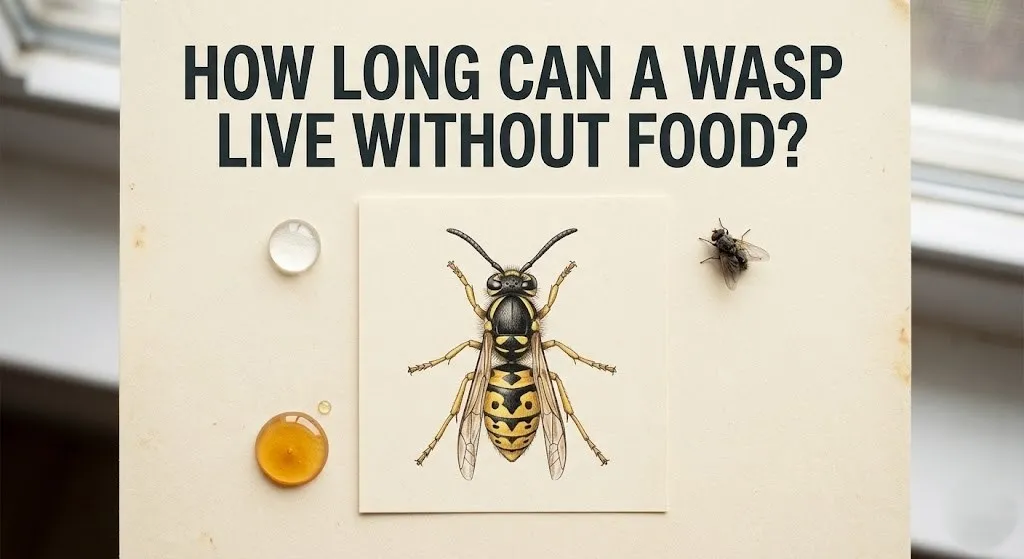
The queen wasp’s biology is entirely different. In late autumn, a mated queen wasp leaves her dying colony and searches for a sheltered location to hibernate, a process called diapause. She finds a crack in tree bark, a hollow stem, or a crevice in an attic. Her metabolism slows to a near-halt. Her body temperature drops to match the ambient temperature. She survives on fat reserves accumulated during the late summer and autumn, when she fed voraciously on nectar and sugary foods.
| Wasp Caste | Fasting Tolerance |
|---|---|
| Worker wasp | 2 to 4 days (active season) |
| Queen wasp | 6 to 9 months (hibernation) |
| Male drone | 1 to 3 days |
how long can wasps live without food
Wasps can live without food for 2 to 4 days as active workers and 6 to 9 months as hibernating queens. The plural phrasing asks about the entire colony or the species in general, and the answer applies universally across the common species of social wasps in the Vespidae family.
The colony structure of social wasps dictates the survival timeline of each individual. A worker wasp is expendable. Her biological purpose is to feed the larvae and defend the nest. She has no stored fat reserves, no evolutionary adaptation for long-term survival. When the food supply fails, she dies. The queen, by contrast, is the genetic future of the entire colony. She is built to survive. Her body is larger, her fat reserves are substantial, and her physiology is programmed for diapause.
The survival of the colony itself depends on the queen. When autumn arrives and the food supply dwindles, the worker wasps stop bringing food to the old queen. She dies. The colony collapses. The newly mated queens, the next generation, fly off to find hibernation spots. The entire colony structure is sacrificed to protect these few fertile queens.
- Workers: Die within days without sugar.
- Old queen: Dies in autumn when food dwindles.
- New queens: Survive the winter on stored fat.
Key Takeaway: The wasp colony is a disposable structure. Every worker dies in autumn. Only the hibernating queens survive to spring.
how long can a wasp survive without food
A wasp can survive without food for 2 to 7 days under optimal cool, humid conditions, but survival time drops to 24 to 48 hours in hot, dry environments. The phrase “survive without food” implies an extreme scenario, and the environment is the determining variable.
Temperature is the primary driver of wasp metabolism. At 70°F, a wasp’s resting metabolic rate is moderate. At 90°F, its metabolic rate roughly doubles. The wasp burns through its glycogen and fat reserves at an accelerated pace. A worker wasp trapped in a hot car on a summer day will be dead within hours. The same wasp trapped in a cool basement might last for a week.
Water is the secondary driver. A wasp that has access to water droplets can survive longer than a wasp that is completely deprived of both food and water. The water hydrates the hemolymph, the insect equivalent of blood, and allows the metabolic enzymes to continue functioning. A wasp without water becomes desiccated. Its exoskeleton, made of chitin, is permeable to water vapor. In a dry environment, the wasp loses water through its exoskeleton and dies of dehydration.
- Cool, humid: 5 to 7 days survival.
- Warm, dry: 1 to 3 days survival.
- Hot, dry: 24 to 48 hours survival.
how long can a wasp go without food
A wasp can go without food for a few days, and the question is functionally identical to the core survival question. The phrase “go without food” suggests a voluntary or circumstantial fast rather than a starvation scenario.
The wasp’s daily energy budget revolves around sugar. A worker wasp burns roughly 0.5 to 1 calorie per hour at rest and 5 to 10 calories per hour in active flight. A single drop of nectar or soda contains roughly 1 to 2 calories. A worker wasp needs to feed roughly every 2 to 4 hours during the active day to maintain her energy balance. If she cannot find a sugar source for an entire day, she has entered a significant energy deficit.
The wasp’s behavior changes when it is hungry. A hungry wasp becomes more aggressive and more persistent in its search for food. This is why wasps are so assertive at picnics and outdoor events in late summer. The natural nectar sources are dwindling, and the colony’s larvae, the source of the sugary secretion, are fewer in number. The workers are desperate for sugar.
- Daily energy needs: 0.5 to 1 cal per hour at rest.
- Flight energy: 5 to 10 cal per hour.
- Single sugar feeding: Provides 1 to 2 cal.
how long can a queen wasp live without food
A queen wasp can live without food for 6 to 9 months during hibernation. This is the most extreme fasting tolerance in the wasp life cycle. The queen’s body is a biological storage tank for the fat and glycogen she accumulated during the late summer.
The preparation for hibernation begins in autumn. The newly mated queen emerges from her natal nest and embarks on a feeding frenzy. She visits flowers, rotting fruit, and any other source of sugar she can find. Her body converts this sugar into fat, which is stored in her abdomen. By the time she enters her hibernation site, her abdomen is swollen with fat reserves.
During diapause, the queen’s metabolism drops to a fraction of her active rate. Her heart rate slows. She does not move. She does not fly. The fat in her abdomen is metabolized slowly, releasing just enough energy to keep her cells alive. This state persists for months. She emerges in spring, ravenous and lean, and immediately seeks nectar to replenish her depleted reserves. She then begins the solitary work of building a new nest and laying the first eggs.
- Autumn feeding: Accumulates fat reserves.
- Diapause metabolism: Fraction of active rate.
- Spring emergence: Depleted reserves, immediate need for nectar.
Key Takeaway: The queen wasp is a survival machine. Her 9-month fast is one of the most impressive metabolic feats in the insect world.
how long can hornets live without food
Hornets can live without food for 2 to 5 days as workers and 6 to 9 months as hibernating queens. Hornets are a type of wasp, the largest members of the Vespa genus. Their fasting tolerance is slightly longer than that of smaller wasps due to their larger body mass.
The size advantage of hornets is a matter of physics. A hornet worker is roughly twice the mass of a common yellow jacket worker. Her larger body stores more glycogen in the flight muscles and more fat in the abdomen. She can sustain flight for longer periods and survive fasting for an extra day or two compared to her smaller relatives.
Hornet queens follow the same hibernation strategy as other social wasps. The European hornet queen, Vespa crabro, and the bald-faced hornet queen, Dolichovespula maculata, both enter diapause in the autumn and emerge in the spring. Their larger size gives them a greater fat storage capacity, and they can survive at the upper end of the 6 to 9 month hibernation window.
- Worker hornet: 2 to 5 days without food.
- Hornet queen: 6 to 9 months in hibernation.
- Size advantage: Larger body mass extends fasting window.
how long can hornets live without food or water
Hornets can live without food or water for 1 to 2 days under typical conditions, significantly less than the 2 to 5 days they can survive without food alone. Water is the limiting factor. A hornet deprived of both food and water dies of dehydration, not starvation.
The chitinous exoskeleton of a hornet is a compromise between protection and water retention. It is a tough, lightweight armor that defends against predators and rivals. However, it is not perfectly impermeable. Water vapor escapes through the exoskeleton, particularly at the thin joints between body segments. In a dry environment, a hornet loses water continuously.
The hornet’s respiratory system accelerates water loss. Insects breathe through spiracles, small openings along the sides of their bodies that lead to a network of tracheae. When the spiracles are open for gas exchange, water vapor escapes. A hornet that is active and breathing heavily loses water rapidly. A hornet that is resting conserves water. A hornet without access to water for 48 hours will likely be dead.
- Without food: 2 to 5 days.
- Without food and water: 1 to 2 days.
- Dehydration mechanism: Water loss through exoskeleton and spiracles.
wasp metabolism and starvation
Wasp metabolism is an ectothermic, high-energy system optimized for flight, with a near-total reliance on carbohydrates for adult energy and a complete dependence on larval secretions for adult protein. The wasp metabolic system explains why the fasting timelines are so caste-dependent.
The adult wasp’s digestive system is a unique constraint. The junction between the thorax and the abdomen is so narrow, the famous “wasp waist,” that solid food particles cannot pass through. An adult wasp can only consume liquids. She drinks nectar, fruit juice, and the sugary saliva of her larvae. She cannot eat the solid protein of the insects she hunts. This means an adult wasp cannot “feed herself” in the conventional sense when prey is available.
The larval secretion, called trophallaxis, is the hidden key to wasp nutrition. When a worker wasp brings a chewed-up caterpillar to the nest, she feeds it to a larva. In return, the larva secretes a droplet of sugary, protein-rich liquid that the adult wasp consumes. This is the adult wasp’s protein source. An adult worker without access to larvae will eventually develop protein deficiency, even if sugar is abundant.
- Wasp waist: Adult wasps cannot eat solid food.
- Trophallaxis: Larval secretions provide adult protein.
- Sugar dependence: Flight is fueled entirely by carbohydrates.
Key Takeaway: A wasp can have a stomach full of sugar and still starve for protein. The larvae are the adults’ protein source, and without them, the adults slowly decline.
Frequently Asked Questions About Wasp Survival
Will a wasp starve if I trap it inside?
Yes, a wasp trapped inside a house with no access to sugar or water will starve or dehydrate within 2 to 4 days.
The wasp will become sluggish, stop flying, and eventually die near a window where it was trying to escape.
Providing a drop of sugar water will extend its life but will not allow it to survive indefinitely.
What do wasps eat?
Adult wasps eat primarily sugar, nectar, fruit juices, and the sugary secretions produced by their larvae.
They hunt insects and spiders to feed the larvae, not to feed themselves.
The protein they need comes from the larval trophallaxis, not from the prey directly.
Do wasps die in the winter?
Yes, nearly all wasps in a colony die in the winter, including the old queen and all the workers.
The only survivors are the newly mated queens, which hibernate in sheltered locations.
In spring, these queens emerge to build new nests.
How long can a queen wasp live?
A queen wasp can live for up to 12 months, which includes roughly 9 months of hibernation and 3 months of nest building and egg laying.
The hibernation period is the most metabolically impressive phase of her life.
She emerges in spring with depleted reserves and must find nectar immediately.
Are hornets more resilient than wasps?
Hornets are slightly more resilient than smaller wasps due to their larger body mass.
A hornet worker can survive a day or two longer without food than a common yellow jacket.
The hibernation biology of hornet queens is identical to that of other social wasps.
The wasp on your windowsill is not a survivor. It is a specialist, a flying machine designed for a very specific set of conditions. It needs sugar every few hours. It needs water every day. It needs its colony, its larvae, its nest. Away from those supports, it is fragile.
The wasp that emerges in spring, the queen who slept through the winter in a crack in your siding, is a different creature entirely. She is a biological storage tank, a vessel for the genetic future of her entire species. She has not eaten in months. She will not eat for weeks more. She will build a nest, lay eggs, and found a colony on the energy she stored last autumn.
The answer to how long a wasp can live without food depends on which wasp you are asking. The worker? A few days. The queen? Almost a year. The difference is the difference between a sprinter and a hibernating bear.