Most kittens can safely start eating adult cat food at 12 months of age. Before that milestone, their growing bodies require a specialized diet that adult-formula food simply cannot provide at adequate levels.
The difference isn’t just marketing. According to the Association of American Feed Control Officials (AAFCO), kitten formulas must meet distinct nutritional minimums for protein, fat, and key amino acids that adult maintenance formulas are not required to match. Getting this transition timing wrong carries real nutritional consequences.
This guide covers what kitten food actually is, the precise age milestones for switching to dry or hard food, the specific nutrients involved, how to execute a smooth transition, and which cats need a different timeline entirely. By the end, you’ll know exactly what to feed, when to change it, and what to watch for.
What Is Kitten Food?
Kitten food is a specially formulated diet designed to meet the accelerated nutritional demands of a cat during its growth phase, from birth through approximately 12 months.
It’s not simply adult cat food with different packaging. Kitten formulas are engineered to deliver higher concentrations of protein, fat, calcium, phosphorus, and critical amino acids like taurine and arginine than adult maintenance formulas. These nutrients fuel rapid bone growth, muscle development, organ maturation, and neurological development during the first year of life.
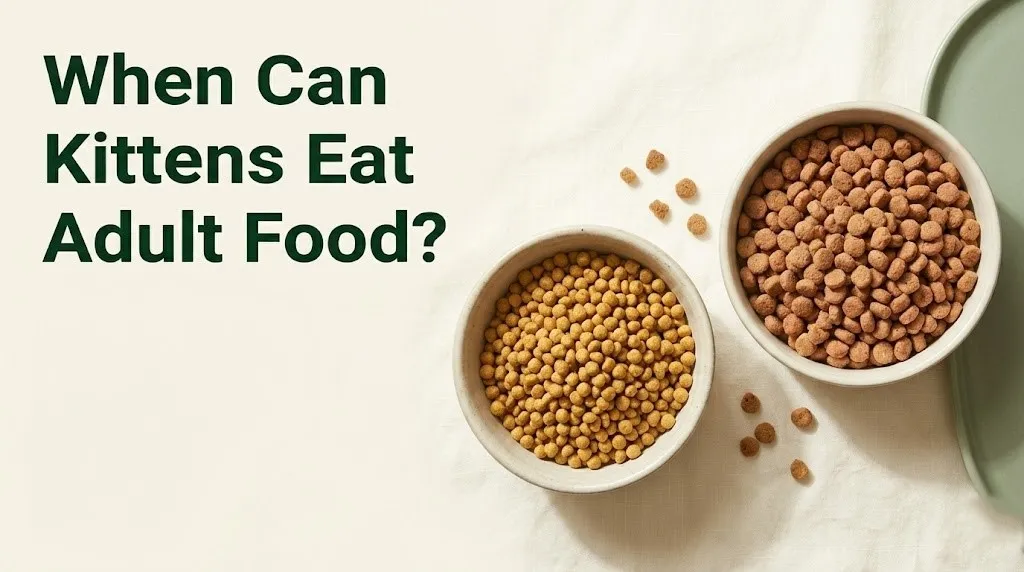
Under AAFCO labeling rules, a product must carry a nutritional adequacy statement to be sold as kitten food. That statement reads either “formulated to meet the nutritional levels established by the AAFCO Cat Food Nutrient Profiles for growth” or an equivalent claim based on feeding trials. If a bag doesn’t carry this statement for the “growth” or “all life stages” category, it is not appropriate as the primary food for a kitten.
Wet and dry kitten formulas both exist. Neither is universally superior. What matters far more than format is whether the product carries the correct AAFCO life stage designation.
Key differences between kitten food and adult food:
| Nutrient Category | Kitten Formula (AAFCO Minimum) | Adult Maintenance Formula (AAFCO Minimum) |
|---|---|---|
| Crude Protein (dry matter basis) | 30% | 26% |
| Crude Fat (dry matter basis) | 9% | 9% |
| Calcium | 0.8% | 0.6% |
| Phosphorus | 0.6% | 0.5% |
| DHA (docosahexaenoic acid) | Required | Not required |
| Taurine (dry food) | 0.1% | 0.1% |
| Taurine (wet food) | 0.2% | 0.2% |
When Can Kittens Eat Adult Food?
Kittens can eat adult food when they have reached 12 months of age and completed their primary growth phase.
The 12-month mark is the standard guideline from most veterinary organizations, including the American Animal Hospital Association (AAHA). At this point, the majority of domestic cat breeds have finished their fastest growth window. Their caloric needs per pound of body weight drop, their bones have largely calcified, and their organs no longer require the accelerated nutrient delivery that kitten food provides.
Before 12 months, feeding adult maintenance food as a primary diet risks nutritional shortfalls. The biggest risk isn’t protein, which many adult formulas still deliver at adequate levels. The bigger risks are DHA for neurological development and the precise calcium-to-phosphorus ratio required for proper skeletal formation in young cats. Adult food doesn’t have to meet the same minimums on either front.
One important note: switching at exactly 12 months isn’t a rigid cliff. A kitten that is healthy, growing normally, and thriving on kitten food at 11.5 months doesn’t need to be rushed. The transition can begin comfortably anywhere between 10 and 14 months for average-sized breeds, done gradually over 7 to 10 days.
At What Age Can Kittens Eat Adult Food?
The recommended age for kittens to transition to adult cat food is 12 months for most breeds.
This is the consistent recommendation across the AVMA, AAHA, and most board-certified veterinary nutritionists. It aligns with the biological reality that domestic cats complete approximately 75 percent of their total growth by 6 months, with the remaining 25 percent occurring between 6 and 12 months.
That second half of the growth window is the one most owners underestimate. Between months 6 and 12, the kitten’s skeleton is still mineralizing, muscle mass is still being laid down, and in female cats who haven’t been spayed, reproductive system development may still be active. All of these processes rely on nutrient densities that adult food doesn’t have to provide.
The table below shows how the general age-based guidance breaks down by life stage:
| Age Range | Appropriate Food Category | Notes |
|---|---|---|
| 0 to 4 weeks | Mother’s milk or kitten milk replacer | No solid food |
| 4 to 8 weeks | Wet kitten food (softened) | Weaning period begins |
| 8 weeks to 12 months | Kitten formula (wet or dry) | Primary growth phase |
| 12 months (most breeds) | Begin transition to adult food | 7 to 10 day gradual switch |
| 12 to 18 months (large breeds) | Continue kitten food or “all life stages” formula | Consult a vet for timing |
When Does a Kitten Start Eating Cat Food?
Kittens start eating solid cat food during the weaning period, which begins at approximately 3 to 4 weeks of age.
Before that, they rely entirely on their mother’s milk or a commercially formulated kitten milk replacer (KMR). Mother’s milk provides the exact nutritional profile a neonatal cat needs, including passive immunity from maternal antibodies. No solid food product can replicate this completely during the first three weeks.
Between weeks 3 and 4, kittens develop enough motor coordination and dental development to begin exploring soft food. At this stage, the right introduction is wet kitten food mixed with a small amount of warm water or KMR to create a thin, smooth paste. This lowers the physical barrier to eating while still delivering the caloric density their bodies need.
By 6 to 8 weeks, most kittens are eating solid kitten food without needing it softened. This is generally the earliest age at which kittens are adopted into new homes, and at that point, a quality wet or dry kitten formula is the appropriate primary food.
Quick Tip:
- Introduce solid food at 3 to 4 weeks by offering a small amount of wet kitten food thinned with warm water.
- Never feed cow’s milk to kittens. Most cats are lactose intolerant, and cow’s milk does not replicate the nutritional profile of cat milk or KMR.
- If a kitten refuses solid food past 5 weeks, a veterinarian should assess for underlying issues.
Key Takeaway: Kittens begin solid food around 3 to 4 weeks during weaning, but kitten formula remains the required diet all the way through 12 months for most breeds.
When Can Kittens Start Eating Hard Food?
Kittens can typically begin eating hard dry food, or kibble, between 6 and 8 weeks of age, once their deciduous (baby) teeth are sufficiently developed.
Before 6 weeks, kittens lack the jaw strength and dental development to manage dry kibble safely. Feeding hard food too early risks the kitten swallowing pieces whole without adequate chewing, which can cause choking or digestive distress.
Between 4 and 6 weeks, if you’re introducing solid food during weaning, the right approach is to soften dry kibble in warm water until it reaches an oatmeal-like consistency. This gives the kitten access to the nutritional content of the kibble while the texture remains manageable. Within two to three weeks, you can reduce the water content progressively until the kitten is eating dry food comfortably.
Breed plays a role here too. Flat-faced breeds like Persians and Exotic Shorthairs sometimes struggle with standard kibble shapes due to their jaw anatomy. Brands including Royal Canin make breed-specific kibble shapes designed to make picking up and chewing easier for brachycephalic cats. If your kitten is a flat-faced breed and is struggling with dry food even after 8 weeks, mention it to your veterinarian before assuming it’s a behavioral issue.
When Can Cats Start Eating Dry Food?
Cats can start eating dry food in earnest from around 8 weeks old, provided the kibble is appropriately sized for a kitten’s small jaw and teeth.
The key factor isn’t age alone. It’s the combination of dental development, jaw strength, and digestive maturity that determines whether dry food is appropriate. All three are generally sufficient by 8 weeks in most healthy kittens.
Dry food offers some practical advantages for owners. It’s easier to store, more economical per serving, and doesn’t spoil within hours of being set out the way wet food does. Many veterinary nutritionists note, however, that wet food provides one benefit dry food cannot: a significantly higher moisture content. A cat eating exclusively dry food drinks less water overall than a cat eating wet food, which can affect long-term urinary tract health.
A mixed approach, combining wet and dry kitten food, is a practical middle ground that many veterinary professionals recommend. It supports hydration while keeping feeding practical for owners with busy schedules.
Dry vs. wet kitten food comparison:
| Factor | Dry Kitten Kibble | Wet Kitten Food |
|---|---|---|
| Moisture content | 6 to 10% | 70 to 80% |
| Caloric density per gram | Higher | Lower |
| Cost per feeding | Generally lower | Generally higher |
| Shelf life once opened | Days to weeks (sealed bag) | 24 to 48 hours (refrigerated) |
| Palatability for picky kittens | Variable | Generally higher |
| Dental benefits | Some mechanical benefit claimed | Minimal mechanical benefit |
| Hydration contribution | Minimal | Substantial |
What Age Can Cats Eat Dry Food?
Cats can eat dry food at any age past 8 weeks, provided it’s an age-appropriate formula carrying the correct AAFCO life stage designation.
The phrase “dry food” doesn’t mean “adult food.” Dry food comes in kitten formulas, adult formulas, senior formulas, and breed-specific formulas. The format (wet vs. dry) and the life stage (kitten vs. adult) are two separate decisions. A kitten eating dry food should still be eating a dry food product labeled for growth or all life stages until they reach 12 months.
One thing worth knowing: caloric density differs between wet and dry formats. A quarter cup of dry kitten kibble typically delivers roughly 100 to 120 calories. A 3-ounce can of wet kitten food delivers roughly 70 to 100 calories. If you’re switching between formats or mixing them, adjust total portion size accordingly to avoid unintentional overfeeding, which is more common than most owners expect.
According to the AAHA Senior Care Guidelines, appropriate food type at each life stage matters more than format preference. Choosing the right life stage label matters at 8 weeks, at 12 months, and again at 7 years when cats enter their senior phase.
Key Takeaway: Dry food format and life stage formula are two separate choices. A kitten can eat dry food from 8 weeks, but it must still be a kitten-specific or “all life stages” formula until 12 months.
Kitten Food vs. Adult Cat Food: What’s Actually Different?
The core difference between kitten food and adult cat food is caloric density, amino acid concentration, and the inclusion of DHA as a required nutrient.
Think of the difference like the gap between a meal for a teenager in peak growth and a meal for a healthy adult at rest. The teenager needs more of almost everything per pound of body weight, not because they’re eating more volume, but because every calorie has to do more metabolic work. Kitten food is built on the same principle.
Specific differences that AAFCO standards require:
- Kitten formulas must contain DHA, an omega-3 fatty acid essential for brain and vision development. Adult maintenance formulas have no DHA requirement.
- Protein minimums are higher in kitten formulas: 30 percent on a dry matter basis versus 26 percent for adult food.
- Calcium and phosphorus levels are higher in kitten formulas to support rapid bone mineralization during the first year.
- Caloric density is generally 25 to 40 percent higher in kitten formulas than adult maintenance formulas per cup, supporting the higher energy demands of growth.
One category worth knowing about is the “all life stages” designation. A product carrying this AAFCO label has been formulated to meet kitten nutritional requirements, the most demanding standard. It is genuinely appropriate for kittens, not a marketing compromise. Many multi-cat households use “all life stages” food to simplify feeding when they have cats of different ages.
Taurine and the Key Nutrients Found Only in Kitten Food
Taurine is the single most important nutrient to understand when feeding a kitten or switching to adult food.
Unlike most mammals, cats cannot synthesize adequate taurine on their own from other amino acids. This makes taurine an essential amino acid for cats, one they must consume through diet. A 2017 review in the Journal of Animal Physiology and Animal Nutrition confirmed that taurine deficiency in cats leads to dilated cardiomyopathy (DCM), a serious and potentially fatal weakening of the heart muscle, as well as central retinal degeneration, which can cause permanent blindness.
Both kitten and adult cat food formulas are required by AAFCO to contain minimum taurine levels (0.1% in dry food, 0.2% in wet food). So taurine itself isn’t the primary gap between kitten and adult food. The larger gap lies in these nutrients:
- DHA (docosahexaenoic acid): Required in kitten formulas. Not required in adult food. Supports brain and retinal development during the critical first year.
- Arginine: An essential amino acid for cats. Kitten formulas maintain higher arginine concentrations to support the urea cycle and rapid protein synthesis during growth.
- Arachidonic acid: An omega-6 fatty acid cats cannot produce in sufficient quantities on their own. Required in kitten formulas. Supports healthy skin, coat, and cell membrane function.
- Calcium and phosphorus at a specific ratio: Kitten formulas maintain a calcium-to-phosphorus ratio designed for skeletal development. Adult food does not have to meet this ratio.
For kittens with any history of heart issues or those from breeds known for cardiac concerns (like Maine Coons and Ragdolls), a veterinary nutritionist should evaluate diet specifics. Breed predisposition to hypertrophic cardiomyopathy (HCM) is separate from taurine-related DCM, but nutrition still matters.
When Can Kittens Start Eating Cat Food After Weaning?
After weaning, kittens can eat solid cat food beginning at approximately 6 to 8 weeks old, when they transition from softened food to standard kitten formula textures.
Weaning is a gradual process, not a single day switch. It typically begins at 3 to 4 weeks when a kitten shows interest in solid food and continues through weeks 6 to 8, when the kitten is fully independent of its mother’s milk or milk replacer. During this window, the digestive system is maturing rapidly. Introducing solid food too abruptly can cause diarrhea, weight loss, or refusal to eat.
The post-weaning stage (6 to 12 months) is when consistent, properly formulated kitten food matters most. This is the phase of highest relative growth rate, highest protein demand, and highest caloric need per pound of body weight in a cat’s entire life.
Kittens who are orphaned or separated from their mothers before 4 weeks require kitten milk replacer (KMR) from a bottle or syringe, not solid food and not cow’s milk. Cow’s milk causes diarrhea in most kittens because cats lack the lactase enzyme needed to digest lactose efficiently. Any orphaned kitten under 4 weeks should be assessed by a veterinarian or placed with a rescue organization experienced in neonatal cat care.
Key Takeaway: After weaning, kittens move to standard kitten formula between 6 and 8 weeks. The 6-to-12-month window is the highest-demand nutritional period in a cat’s life, making consistent kitten-appropriate food non-negotiable during this phase.
How to Transition Kittens From Kitten Food to Adult Food
The correct way to transition a kitten to adult food is a 7-to-10-day gradual blend, starting with a small proportion of adult food mixed into the existing kitten formula and slowly increasing the ratio.
Abrupt food changes at any age can trigger gastrointestinal upset in cats, including vomiting, loose stool, and food refusal. Cats have more sensitive digestive systems than dogs in this regard. The gradual approach gives the gut microbiome and digestive enzymes time to adapt to the new formulation.
To transition a kitten to adult cat food:
- On days 1 to 2, mix 75% kitten food with 25% adult food by volume. Serve this blend at the kitten’s normal meal times and in the normal amount.
- On days 3 to 4, shift to a 50/50 blend of kitten and adult food. Monitor for any loose stool, vomiting, or reduced appetite.
- On days 5 to 6, move to 25% kitten food and 75% adult food. If the kitten is eating normally with no digestive signs, continue.
- On day 7, offer 100% adult food as the primary diet. If at any earlier stage the kitten showed consistent digestive upset, slow the transition by adding two to three extra days at the current blend ratio.
- If the kitten refuses the new food for more than 48 hours or shows repeated vomiting, return to kitten food and consult a veterinarian before trying again.
This schedule applies to switching between wet kitten and wet adult food, dry kitten and dry adult food, or any combination. If you’re also switching format (from wet to dry) at the same time as switching life stage, handle one change at a time to identify which factor is causing any digestive response.
How Long Does It Take to Transition a Kitten to Adult Food?
The transition from kitten food to adult cat food takes a minimum of 7 days for most kittens, and up to 14 days for cats with sensitive stomachs or strong food preferences.
Seven days is the minimum that most veterinary guidelines suggest for any cat food change. It allows the intestinal bacteria to adjust to a new nutrient profile without triggering inflammation or dysbiosis (a disruption of the gut microbial balance).
Some cats, particularly those who have been eating the same food since kittenhood without variation, develop strong textural and flavor preferences. These cats may resist any new food initially. In those cases, extending the transition to 10 to 14 days and using a highly palatable adult formula (one with a similar protein source to the kitten food they know) reduces refusal rates.
Transition timeline at a glance:
| Day Range | Kitten Food % | Adult Food % | What to Watch |
|---|---|---|---|
| Days 1 to 2 | 75% | 25% | Normal appetite and stool |
| Days 3 to 4 | 50% | 50% | Any loose stool or vomiting |
| Days 5 to 6 | 25% | 75% | Food refusal or changes in energy |
| Day 7 onward | 0% | 100% | Stable digestion, normal appetite |
| If sensitive (extended) | Slow each phase by 2 to 3 extra days | Use same protein source in adult formula |
Signs Your Kitten Is Ready to Switch to Adult Cat Food
The clearest sign that your kitten is ready to switch to adult food is reaching 12 months of age with a healthy body weight and no ongoing medical conditions.
Age is the primary marker, but body condition also matters. A kitten that has reached 12 months but remains underweight or is recovering from illness may benefit from staying on kitten food longer, which your veterinarian can confirm. A kitten that is significantly overweight at 10 months may need to begin the transition earlier to reduce caloric intake, again ideally with veterinary input.
Beyond age and weight, these behavioral and physical markers indicate readiness:
- Steady, appropriate weight gain has plateaued. The kitten is no longer visibly growing week to week and is maintaining a stable weight.
- Body condition score is appropriate. You can feel but not see the ribs. The waist is visible from above. No visible fat deposits over the spine or hips.
- Spay or neuter status has been addressed. Spayed and neutered cats have reduced caloric needs post-surgery. Many veterinary nutritionists recommend transitioning to adult food slightly earlier in these cats (around 10 to 11 months) or choosing an adult formula designed for spayed/neutered cats, which is lower in calories.
- No active health issues requiring special kitten-formula nutrient density.
The AAHA notes in its nutrition guidelines that body condition scoring is one of the most reliable tools for assessing appropriate life stage transitions in cats, more reliable than age alone for animals whose growth rates vary.
Key Takeaway: Age 12 months is the right time for most kittens, but body condition, spay or neuter status, and any ongoing health issues all affect the precise timing; a quick conversation with your vet before making the switch is worth it.
Large Breed Kittens and the Food Transition Timeline
Large breed cats like Maine Coons, Norwegian Forest Cats, Ragdolls, and Siberian cats do not finish growing at 12 months and require kitten-appropriate nutrition for longer than average-sized breeds.
Most large domestic cat breeds reach their adult size between 18 and 24 months. The growth period for a Maine Coon, for example, extends nearly twice as long as that of a smaller breed like a Siamese or a domestic shorthair. During those extra months, their skeletal and muscular development continues at a rate that demands the higher protein, calcium, phosphorus, and caloric density of kitten food.
Switching a large breed kitten to adult maintenance food at 12 months means cutting their nutrient delivery at roughly the midpoint of their growth period. The consequence isn’t always visible immediately. But the American Animal Hospital Association’s feline nutrition guidance notes that under-nutrition during the extended growth phase of large breeds can affect muscle mass development and long-term joint health.
Large vs. standard breed transition timing:
| Breed Category | Examples | Recommended Food Transition Age |
|---|---|---|
| Average domestic breeds | Domestic Shorthair, Siamese, Abyssinian | 12 months |
| Medium-large breeds | British Shorthair, Scottish Fold | 12 to 14 months |
| Large breeds | Maine Coon, Ragdoll, Norwegian Forest Cat | 18 to 24 months |
| Giant breeds | Savannah (F1, F2 generations) | Consult a vet; growth is highly variable |
If your cat is a large or giant breed, the timing of the food transition is a specific question to raise with your veterinarian at the 12-month wellness visit, rather than defaulting to the standard guideline.
Is Adult Cat Food Bad for Kittens?
Adult cat food is not toxic to kittens, but feeding it as a primary diet before 12 months can cause genuine nutritional shortfalls that affect development.
“Bad” is the wrong framing here. A kitten that accidentally eats a few pieces of adult kibble will be completely fine. The concern is cumulative: a kitten fed exclusively adult maintenance food throughout its first year may not receive adequate DHA for brain and retinal development, may not get sufficient calcium and phosphorus at the right ratio for skeletal formation, and may miss the higher protein density needed to support rapid muscle growth.
The most clinically documented risk of feeding adult food to kittens over an extended period is related to taurine intake relative to caloric load. Because adult food is less calorically dense, a growing kitten eating adult food to meet its caloric needs may consume it in higher volumes, which can offset some nutrient gaps. But this is not a reliable safety mechanism and does not address the DHA gap, which has no compensating workaround in adult formulas.
One practical exception: foods carrying the AAFCO “all life stages” designation are formulated to meet kitten nutritional requirements. These products are not adult food in disguise. They meet the highest standard AAFCO tests against: the growth/reproduction category. If your household has cats of multiple ages, “all life stages” food is a genuinely appropriate option for the kittens in your home, not a compromise.
If you’re unsure whether the food you’re currently feeding meets kitten requirements, check the nutritional adequacy statement on the label. Any food appropriate for kittens will say “growth” or “all life stages” in that statement. If it says “adult maintenance” or “maintenance” only, it is not appropriate as a primary food for a kitten under 12 months.
Key Takeaway: Adult maintenance food isn’t poisonous to kittens, but feeding it exclusively before 12 months creates real nutritional gaps around DHA, protein density, and calcium ratios that can affect long-term development. “All life stages” food is the one exception.
Frequently Asked Questions About When Kittens Can Eat Adult Food
Can I give my 8-month-old kitten adult cat food?
An 8-month-old kitten is still in its active growth phase and should not be switched to adult food yet.
Most veterinary guidelines, including those from the AAHA, recommend waiting until 12 months before transitioning average-sized kittens to adult maintenance food.
If your kitten is eating adult food occasionally by accident, that won’t cause harm, but it should not be the primary diet at this stage.
What happens if a kitten eats adult cat food too early?
Eating adult cat food occasionally won’t harm a kitten, but using it as the primary diet before 12 months risks nutritional shortfalls.
The main gaps are DHA (required in kitten formulas but not adult food), lower protein density, and reduced calcium and phosphorus relative to what a growing cat needs.
Over the full first year, these gaps can affect brain development, skeletal formation, and muscle mass.
Is it okay to feed a kitten “all life stages” cat food?
Yes, food labeled “all life stages” by AAFCO meets kitten nutritional requirements and is appropriate as a primary diet for kittens.
This label indicates the food has been formulated or tested to meet the highest AAFCO standard, which is the growth and reproduction category.
It’s a practical option for multi-cat households where kittens and adults need to eat from the same bowl.
How do I switch my kitten to dry food without causing stomach problems?
Switch gradually over 7 to 10 days, starting with 75% of the current food and 25% of the new dry food by volume.
Increase the proportion of new food every two days while watching for loose stool, vomiting, or appetite changes.
If digestive upset occurs, slow down the pace and hold at the current ratio for an extra two to three days before moving forward.
Do indoor kittens need a different food transition timeline than outdoor kittens?
Indoor and outdoor kittens follow the same basic transition timeline of 12 months for most breeds.
Activity level does affect caloric needs, though: outdoor kittens typically burn more calories and may benefit from staying on higher-calorie kitten food through the full 12 months, while indoor kittens who are already gaining weight faster than expected might need portion control earlier.
This is worth discussing with your veterinarian at the 12-month wellness visit.
Wrapping Up
Most kittens are ready for adult food at 12 months old. Large breeds need more time. Spayed or neutered kittens may need the switch slightly earlier. “All life stages” formulas work for both groups.
The transition itself is straightforward: seven days, a gradual blend, and close attention to appetite and digestion. The only real mistake is rushing it or skipping it entirely.
When you get to the 12-month mark, check the label on whatever adult food you’re considering. If it says “growth” or “all life stages” in the nutritional adequacy statement, it works for kittens too. If it says “maintenance,” it’s time to make the switch.