Good healthy snacks for weight loss combine protein, fiber, and fat to manage hunger between meals. This guide covers 25 specific options, organized by nutrient profile, portability, and food type.
Snacks account for at least 20% of daily calories for many American adults. Registered dietitians citing that figure through TODAY Health confirm that what you eat between meals shapes your overall nutritional picture as much as any single meal. Choosing strategically turns snacking into a tool, not a setback.
This article covers the criteria for a useful weight-loss snack, the top 25 picks with calorie and macro data, and grab-and-go options for busy days. You will also find guidance on reading packaged snack labels and building a weekly snack prep plan. Every section answers a specific question most snacking guides leave out.
Healthy Snacks for Weight Loss: What Actually Works
Good healthy snacks for weight loss work through three mechanisms: slowing digestion, triggering satiety hormones, and stabilizing blood glucose between meals. These are measurable physiological effects, not marketing language.
Protein takes longer to digest than refined carbohydrates. That delayed digestion keeps hunger signals quieter for longer. A 2016 review in the journal Advances in Nutrition found that pairing protein and fiber at snack time consistently reduced overall daily calorie intake in study participants.
Think of dietary fiber like a slow-release traffic regulator for your digestive system. The more soluble fiber present when you eat, the more steadily food moves through and the longer before hunger returns. Soluble fiber, found in oats (Avena sativa), apples (Malus domestica), and chia seeds (Salvia hispanica), forms a gel-like substance in the digestive tract that physically slows gastric emptying.
Monounsaturated fat, found in almonds (Prunus dulcis), avocado, and walnuts, increases satiety hormone levels after eating. The Academy of Nutrition and Dietetics notes that including healthy fat with snacks improves overall diet satisfaction and long-term dietary adherence. Fat alone does not make a snack weight-loss-friendly, but fat combined with protein and fiber does.
One practical note for any reader managing type 2 diabetes, cardiovascular disease, or a medically supervised elimination diet: the general snack guidance in this article applies to healthy adults. Individual calorie targets, carbohydrate limits, and fat allowances differ significantly based on clinical context, and a registered dietitian familiar with your health history is the right person to confirm snack choices within those conditions.
Quick Tip:
- Aim for at least 5 grams of protein per snack serving to support satiety
- Look for at least 2 grams of dietary fiber per serving to slow digestion
- Keep snack calories between 100 and 250 for most adults on a calorie-reduction eating plan
What Are Healthy Snacks for Weight Loss?
Healthy snacks for weight loss are foods with a high ratio of nutrients to calories, delivering protein, fiber, or beneficial fats without a large calorie cost.
The phrase gets used loosely in food marketing. A product labeled “natural,” “low-fat,” or “organic” is not automatically useful for weight management. What matters are the actual numbers on the label: grams of protein, grams of fiber, grams of added sugar, and total calories per the stated serving size.
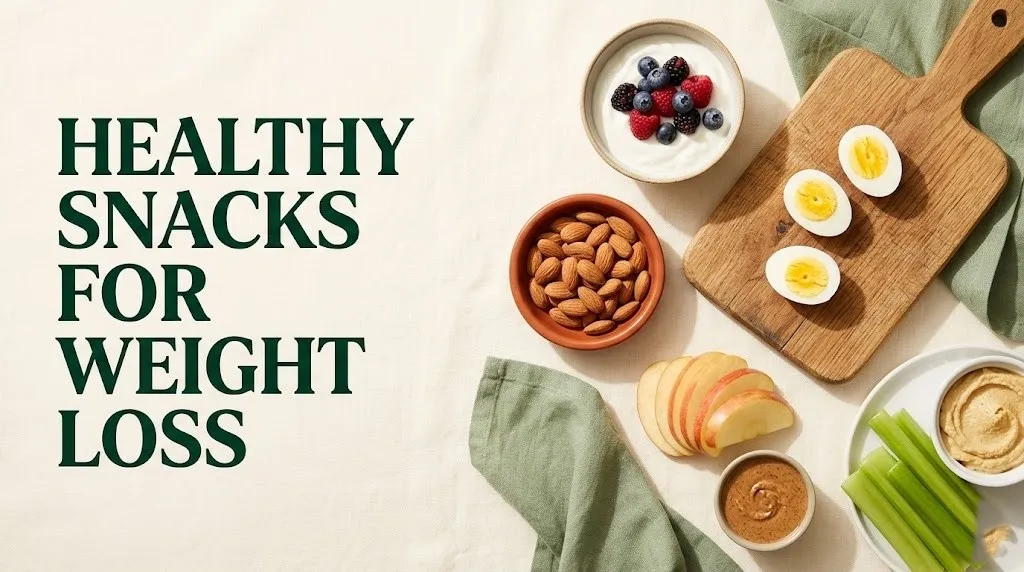
A useful framework comes from the USDA Dietary Guidelines for Americans (2020-2025), which centers on nutrient density, meaning foods that deliver vitamins, minerals, fiber, or protein relative to their calorie content. A “baked” chip can still be nutrient-poor and calorie-dense per realistic serving. An apple with a tablespoon of almond butter delivers 4.5 grams of fiber, 4 grams of protein, and 185 calories, making it genuinely nutrient-dense by that definition.
Serving size accuracy is as important as food selection. Almonds have an excellent nutrient profile, but eating two ounces instead of one doubles the calorie load from approximately 164 to 328 calories. The food is not the problem; the unmeasured portion is.
The distinction between snacks that support weight loss and snacks that work against it often comes down to label literacy and portion awareness. Choosing a good food category is step one. Reading what a serving actually contains is step two, and that step gets skipped far too often.
What Is Considered a Healthy Snack?
A healthy snack for weight management contains at least 5g of protein or 3g of fiber per serving, stays under 200 calories, and delivers fewer than 6g of added sugar.
These thresholds are not arbitrary. They reflect published guidance from the Academy of Nutrition and Dietetics and match the parameters used by registered dietitian-reviewed platforms like EatingWell and the Cleveland Clinic. Using these numbers gives you a portable benchmark that works whether you are evaluating a whole food or a packaged product.
The table below shows how common snacks compare against those three criteria, using USDA FoodData Central data:
| Snack | Calories | Protein | Fiber | Added Sugar |
|---|---|---|---|---|
| Plain nonfat Greek yogurt (3/4 cup, 170g) | 100 | 17g | 0g | 0g |
| Almonds, unsalted (1 oz, 28g) | 164 | 6g | 3.5g | 0g |
| Apple + 1 tbsp almond butter | 185 | 4g | 5g | 0g |
| Edamame, shelled (1 cup) | 189 | 18g | 8g | 0g |
| Baby carrots + 2 tbsp hummus | 120 | 4g | 5g | 0g |
| Low-fat string cheese + small pear | 180 | 7g | 5g | 0g |
| Hard-boiled egg + celery sticks | 95 | 7g | 1g | 0g |
Those following a vegan diet can replace Greek yogurt with unsweetened soy-based yogurt, providing approximately 6-8g of protein per serving. The protein content is lower, so pairing it with roasted edamame (Glycine max) or a tablespoon of ground chia seeds (Salvia hispanica) brings the snack closer to the 5g protein target. Individuals on a low-sodium diet should verify the sodium content on string cheese and hummus products before including them regularly.
Key Takeaway: A snack earns its place in a weight-loss eating plan through its nutrient-to-calorie ratio. Protein, fiber, and added sugar are the three label numbers that cut through all the marketing noise.
Best Healthy Snacks for Weight Loss in 2026
The best healthy snacks for weight loss rank highest on satiety per calorie: plain Greek yogurt, hard-boiled eggs, edamame, almonds, and low-fat cottage cheese consistently top evidence-based lists from registered dietitian sources.
Below is a full table of 25 top picks with their approximate nutritional profile per standard serving. All values are based on USDA FoodData Central data and reflect unseasoned, minimally processed versions unless otherwise noted.
| Snack | Standard Serving | Calories | Protein | Fiber |
|---|---|---|---|---|
| Plain nonfat Greek yogurt | 3/4 cup (170g) | 100 | 17g | 0g |
| Hard-boiled eggs | 2 large | 140 | 12g | 0g |
| Edamame, shelled (Glycine max) | 1 cup | 189 | 18g | 8g |
| Low-fat cottage cheese | 1/2 cup (113g) | 90 | 13g | 0g |
| Almonds, unsalted (Prunus dulcis) | 1 oz (28g) | 164 | 6g | 3.5g |
| Walnuts, unsalted | 1 oz (28g) | 185 | 4g | 2g |
| Apple + 1 tbsp peanut butter | 1 medium + 1 tbsp | 185 | 5g | 5g |
| Baby carrots + hummus | 1 cup + 2 tbsp | 120 | 4g | 5g |
| Celery + 1 tbsp almond butter | 2 stalks + 1 tbsp | 115 | 4g | 3g |
| Air-popped popcorn | 3 cups | 93 | 3g | 3.5g |
| Chia seed pudding, unsweetened almond milk | 1/2 cup | 150 | 5g | 10g |
| Roasted chickpeas (Cicer arietinum) | 1/2 cup (82g) | 130 | 7g | 6g |
| Low-fat string cheese | 1 stick (28g) | 80 | 7g | 0g |
| Sliced cucumber + tzatziki | 1 cup + 2 tbsp | 90 | 3g | 1g |
| Oat cakes + 1/4 avocado | 2 cakes | 175 | 4g | 5g |
| Pumpkin seeds, unsalted (Cucurbita pepo) | 1 oz (28g) | 151 | 9g | 1.7g |
| Turkey slices, no added nitrates | 3 oz (85g) | 105 | 18g | 0g |
| Kale chips, oil-baked | 1 cup | 50 | 2g | 1g |
| Dark chocolate (70%+ cacao) + 10 almonds | 1 oz chocolate + 10 almonds | 210 | 5g | 4g |
| Small banana + 1 tbsp tahini | 1 small + 1 tbsp | 180 | 4g | 4g |
| Nonfat ricotta + sliced pear | 1/4 cup + 1/2 pear | 130 | 8g | 3g |
| Tuna pouch, low-sodium, in water | 1 pouch (74g) | 80 | 17g | 0g |
| Mixed berries | 1 cup | 70 | 1g | 3.5g |
| Rice cakes + 1 tbsp nut butter | 2 cakes + 1 tbsp | 180 | 5g | 2g |
| Boiled edamame in pod | 1 cup (in pod) | 95 | 8g | 4g |
For those with tree nut allergies, replace almond, walnut, and cashew-based snacks with pumpkin seeds (Cucurbita pepo) or sunflower seeds (Helianthus annuus). Both deliver a comparable fat-protein combination without the tree nut allergen.
Healthy Snacks to Help Lose Weight: The Science
Specific snacks help with weight loss by triggering satiety hormones, slowing gastric emptying, and reducing the calorie intake that follows a hunger spike.
Protein stimulates the release of two key appetite-suppressing hormones: peptide YY (PYY) and glucagon-like peptide-1 (GLP-1). Both signal fullness to the brain. A study published in The American Journal of Clinical Nutrition found that higher protein intake reduced late-afternoon hunger and decreased evening calorie consumption in adults following a calorie-controlled diet.
Think of a protein-rich snack like a slow-burning hardwood log on a fire versus the paper kindling of a sugary snack. Both provide energy, but one sustains it far longer before the next piece is needed. That sustained energy translates directly into fewer unplanned calories consumed before the next meal.
Soluble fiber, particularly beta-glucan from oats (Avena sativa) and pectin from apples (Malus domestica), forms a gel-like substance in the stomach. This physically slows digestion and delays the return of hunger signals. Soluble fiber also blunts the post-meal glucose rise, which reduces the appetite-driving blood sugar crash that follows high-sugar snacks.
Roasted chickpeas (Cicer arietinum) offer one of the stronger evidence bases among snack foods. A 2016 systematic review in The American Journal of Clinical Nutrition found that eating three-quarters of a cup of legumes daily was associated with close to one pound of weight loss over six weeks, independent of other dietary changes. That effect appears linked to both their soluble fiber and moderate protein content working together.
Healthy Snacks for Belly Fat Loss
No single snack directly targets belly fat; however, snacks that reduce total calorie intake and lower chronic dietary inflammation are associated with reductions in visceral fat over time.
Visceral fat is the fat stored around internal organs in the abdominal cavity, distinct from subcutaneous fat directly under the skin. The American Heart Association (AHA) notes that diets high in refined carbohydrates and added sugars are associated with increased visceral fat accumulation over time. Replacing sugar-heavy snack choices with fiber-and-protein options addresses both the calorie surplus and the inflammatory dietary pattern linked to visceral fat gain.
Snacks particularly relevant for this goal include:
- Walnuts: provide alpha-linolenic acid (ALA), a plant-based omega-3 fatty acid. Research published in Diabetes, Obesity and Metabolism associates regular walnut consumption with reduced markers of abdominal adiposity in adults.
- Chia seeds (Salvia hispanica): deliver 10g of dietary fiber per 2-tablespoon (28g) serving, along with ALA. Fiber intake is independently associated with reduced waist circumference across multiple dietary intervention studies.
- Celery: approximately 6 calories per medium stalk, with high water content. Useful for volume eating without meaningful calorie contribution.
- Edamame (Glycine max): 18g protein and 8g fiber per cup. One of the highest protein-to-calorie ratios of any plant-based snack.
- Air-popped popcorn: 93 calories per 3 cups, with 3.5g fiber. Provides high eating volume for a low calorie cost.
People managing irritable bowel syndrome (IBS) should note that legumes and raw brassica vegetables, while high in fiber, can trigger gastrointestinal symptoms in that population. A registered dietitian familiar with your specific IBS subtype can identify appropriate high-fiber alternatives.
Key Takeaway: Snacks do not burn belly fat directly. The mechanism is calorie displacement: protein and fiber reduce total daily intake, and a consistent calorie deficit over time reduces body fat, including visceral fat in the abdominal area.
Healthy Snacks When Dieting on a Calorie Deficit
When eating in a calorie deficit, healthy snacks serve one specific purpose: they prevent the hunger spikes that cause unplanned overeating at the next meal.
Dieting on a 1,200-1,500 calorie daily plan creates long gaps between meals where blood glucose naturally falls and hunger becomes difficult to manage through willpower alone. A 100-200 calorie snack placed between lunch and dinner can prevent a 400-600 calorie overcompensation at the evening meal. That arithmetic alone makes strategic snacking worth the calorie allocation.
Timing is not optional. The Academy of Nutrition and Dietetics recommends placing snacks approximately 3 to 4 hours after the previous meal, when natural satiety from that meal has declined but the next meal is not yet imminent. Snacking from boredom or habit rather than actual hunger adds calories without delivering the hunger-prevention benefit.
Protein earns priority when dieting. Research reviewed in Nutrition and Metabolism found that protein reduces the hunger hormone ghrelin more effectively than equivalent calories from fat or carbohydrate. That means a 150-calorie protein-forward snack suppresses appetite more effectively than a 150-calorie fat-forward or carbohydrate-forward snack of identical calorie value.
| Snack Strategy | Best For | Example |
|---|---|---|
| High protein, low calorie | Maintaining a calorie deficit | Cottage cheese, 1/2 cup: 90 cal, 13g protein |
| High fiber, high volume | Hunger management with minimal calories | Air-popped popcorn, 3 cups: 93 cal, 3.5g fiber |
| Protein + fat combo | Sustained energy between meals | Hard-boiled egg + 5 almonds: approx. 135 cal |
| Portable, no prep needed | Busy workdays | String cheese + small apple: approx. 165 cal |
People following very low-calorie diets (below 1,200 calories daily) should do so only under medical supervision. Snack allocation within those plans requires specific professional guidance, as the calorie math changes significantly.
Healthy Grab and Go Snacks That Actually Satisfy
Healthy grab and go snacks are pre-portioned, portable foods requiring no preparation at the moment of eating and delivering enough protein or fiber to prevent hunger for at least two hours.
The failure pattern with grab-and-go snacking is reactive choice: reaching for whatever is available when hunger arrives. Vending machines, gas station shelves, and airport concessions stock primarily ultra-processed options with high added sugar and low protein. The only reliable defense is having a better option already with you.
Best grab-and-go snacks, organized by refrigeration requirement:
No refrigeration needed (shelf-stable):
- Unsalted almonds, pre-portioned to 1 oz (28g) per bag: 164 calories, 6g protein, 3.5g fiber
- Roasted chickpea pouches: target fewer than 150mg sodium per serving; look for single-ingredient versions
- Individual nut butter packets (almond or peanut): pair with any piece of whole fruit for a balanced snack
- Pumpkin seeds (Cucurbita pepo): ideal for those with tree nut allergies; 151 calories and 9g protein per ounce
- Low-sodium tuna pouches: 74g pouch provides 17g protein at 80 calories; no refrigeration required
Requires brief chilling (insulated lunch bag or ice pack):
- Plain Greek yogurt cups: single-serve, target under 6g added sugar per container
- Low-fat string cheese: 7g protein per stick, 80 calories
- Pre-boiled eggs: keep in shell until eating; stay safe refrigerated for up to 5 days
- Cottage cheese cups: single-serve containers, approximately 90-100 calories per half-cup
People following halal or kosher dietary standards should verify product certifications on string cheese, yogurt, and tuna products before purchasing regularly. Most major brands offer certified options, but sourcing and processing varies by manufacturer, region, and production batch.
Easy Healthy On the Go Snacks for Busy People
The easiest healthy on the go snacks are whole foods requiring no cutting, cooking, or cold storage: a handful of nuts, a piece of whole fruit, or a single-serve protein pouch.
That combination works in almost any setting. A medium apple (Malus domestica) provides 4.5 grams of dietary fiber and 95 calories with no preparation whatsoever. Paired with a single-serve almond butter packet (approximately 100 calories, 3g protein, 1g fiber), it becomes a balanced 195-calorie snack with all three satiety macronutrients present.
The mistake most people make is treating on-the-go snacking as an afterthought. When you leave home without a plan, you eat whatever is in front of you. Building a small portable daily snack kit takes roughly 5 minutes on a weekday morning and eliminates most reactive snacking situations.
What to include in a basic portable daily snack kit:
- 1 piece of whole fruit (apple, banana, pear, or clementines)
- 1 pre-portioned protein source (string cheese, nut butter packet, tuna pouch, or hard-boiled egg)
- 1 dry crunch option (unsalted nut mix, roasted chickpea pouch, or small rice cake pack)
- A water bottle (hunger and thirst signals overlap far more than most people recognize)
Those managing celiac disease or non-celiac gluten sensitivity should check labeling carefully on any packaged grain-based snacks, including rice cakes and chickpea products. Cross-contamination with wheat-processing facilities is a documented issue with certain brands, and the disclosure language varies by manufacturer.
Key Takeaway: The best on-the-go snacking strategy is not about finding a perfect food; it is about reducing the friction between you and a reasonable choice. A portable snack kit built in 5 minutes solves nearly every unplanned hunger situation.
Healthy Snack Boxes for Adults: What to Look For
Healthy snack boxes for adults are subscription or curated delivery services providing pre-selected, portioned snacks to your home or office on a recurring schedule.
They offer genuine value for people who struggle with consistent snack planning. Pre-portioning removes one of the most common calorie-management failure points, and variety across a subscription prevents the boredom that drives snack-plan abandonment. The main risk is buying a box based on front-of-package marketing claims rather than the actual nutrition data inside.
The Academy of Nutrition and Dietetics recommends evaluating any snack product primarily by its protein and fiber content, not by front-of-package wellness language. Labels like “keto-friendly,” “clean,” “plant-based,” or “all-natural” describe a sourcing or formulation approach; they do not guarantee useful calorie, protein, or fiber numbers for weight management. The actual nutrition panel is the only reliable guide.
What to evaluate when choosing a healthy snack box:
| What to Prioritize | What to Avoid |
|---|---|
| At least one item per box with 7g+ protein per serving | Boxes where most items list sugar in the first three ingredients |
| Items with fiber at or above 2g per serving | “Low-fat” items that compensate with added sugar |
| Snacks under 250 calories per single serving | Items with sodium above 300mg per serving |
| Minimal ingredient lists (five ingredients or fewer) | Boxes marketed heavily on flavor variety rather than nutritional content |
| Clearly disclosed allergen information per item | Boxes without individual product nutrition panels |
People with food allergies (peanuts, tree nuts, gluten, dairy) must read individual product labels within any subscription box. Cross-contamination risk disclosure varies by manufacturer, and a box-level allergen statement does not cover every item inside.
Healthy Snacks with Yogurt for Weight Loss
Greek yogurt is one of the highest-protein, lowest-calorie snack bases available, delivering approximately 15-17 grams of protein per 3/4-cup (170g) serving at roughly 100-130 calories.
That protein-to-calorie ratio is unusually favorable. A comparable serving of regular (unstrained) yogurt provides only 5-8g of protein for a similar calorie count. The straining process used to produce Greek yogurt removes much of the liquid whey, concentrating both protein and minerals like calcium and phosphorus.
Plain, nonfat Greek yogurt is the most effective base for weight-loss snacking. Flavored varieties often contain 15-25g of added sugar per container, which adds significant calorie load and eliminates the blood glucose stability benefit. Flavor additions are better made at home: a half-cup of mixed berries adds 3-4g of fiber and natural sweetness; a teaspoon of cinnamon has negligible calories but substantial flavor impact.
Yogurt-based snack variations by protein content per serving:
| Yogurt Snack | Serving | Protein | Fiber | Notable Nutrient |
|---|---|---|---|---|
| Plain nonfat Greek yogurt | 3/4 cup (170g) | 17g | 0g | Calcium, B12 |
| Greek yogurt + 1 tbsp chia seeds | 3/4 cup + 1 tbsp | 18.5g | 2.5g | ALA omega-3 |
| Greek yogurt + 1/2 cup mixed berries | 3/4 cup + 1/2 cup | 17g | 4.5g | Vitamin C, antioxidants |
| Greek yogurt + 1/2 oz walnuts | 3/4 cup + 1/2 oz | 19g | 1g | Monounsaturated fat, ALA |
| Unsweetened soy yogurt (dairy-free) | 3/4 cup | 6-8g | 0g | Lower protein; vegan option |
Those with lactose intolerance may tolerate plain Greek yogurt in moderate portions due to reduced lactose from the straining process. Individuals with a milk protein allergy (casein or whey allergy, distinct from lactose intolerance) should avoid all dairy-based yogurt and use a soy or pea-protein alternative instead.
Key Takeaway: Greek yogurt earns its weight-loss snack status through its unusually high protein-to-calorie ratio. Plain varieties are the only ones worth using; adding your own fruit or seeds keeps added sugar at zero while building fiber into the snack.
Weight Loss Diet Healthy Snacks: Making It All Fit
Healthy snacks integrate into a weight-loss eating plan by being budgeted into your daily calorie target, not added on top of it.
This distinction matters more than the snack choice itself. A person eating 1,400 calories per day for weight management should allocate roughly 150-200 calories per snack and plan for one to two snacks daily within that total. Eating a 200-calorie snack while keeping all previous meals identical adds 200 calories to the day rather than supporting the deficit.
The USDA Dietary Guidelines for Americans recommend that snacks contribute to daily nutrient targets, not merely fill calorie gaps. That means using snack time to address nutrients potentially missing from main meals: calcium from yogurt, iron from pumpkin seeds, potassium from banana, vitamin C from bell pepper strips. A snack that patches a genuine nutritional gap works harder than one that simply duplicates what meals already provide.
A practical daily calorie framework for weight management:
| Meal or Snack | Suggested Calorie Range | Primary Nutritional Role |
|---|---|---|
| Breakfast | 300-400 calories | Protein and fiber foundation for the morning |
| Morning snack (optional) | 100-150 calories | Blood glucose bridge if breakfast was early |
| Lunch | 400-500 calories | Largest calorie meal for many people |
| Afternoon snack | 150-200 calories | Hunger prevention before the evening meal |
| Dinner | 350-450 calories | Protein-centered, moderate carbohydrate |
People on GLP-1 receptor agonist medications (commonly prescribed for type 2 diabetes and weight management) often experience significantly reduced appetite. Standard snack-timing and snack-frequency guidance may not apply, and their prescribing clinician should be involved in any snack plan adjustments.
How to Plan Healthy Snacks for Weight Loss
Planning healthy snacks for weight loss means deciding what to eat, in what quantities, and at what time before hunger makes the decision for you.
Hunger-driven food decisions consistently favor high-calorie, high-sugar options. Research published in the journal Appetite confirms this is a documented behavioral pattern in food decision-making, not a personal failing. Building a snack plan moves the decision out of a moment of acute hunger and into a moment of calm, rational planning.
Think of building a snack plan like programming a GPS route before you leave home: you make the smart navigation decision before you are in unfamiliar territory trying to figure it out under pressure.
To set up a full week of planned snacks in one session:
- Choose three to four snack options for the week. Variety maintains adherence; monotony causes abandonment.
- Portion nuts and seeds into 1-oz reusable containers. A small kitchen scale costs roughly the same as two vending machine visits.
- Hard-boil six to eight eggs on Sunday. Store unpeeled in the refrigerator; they keep safely for 5 days. Peel only immediately before eating.
- Pre-wash and cut vegetables. Carrots, celery, and bell pepper strips stored in airtight containers with a small lidded cup of hummus stay fresh for 3-4 days.
- Pre-portion Greek yogurt into individual containers if purchasing in bulk. Add fruit and seeds fresh at snack time to maintain texture.
- Label each container with calorie counts if tracking macros with a food diary or app.
- Assign a dedicated shelf or drawer in your refrigerator and pantry specifically for snacks. Visibility reduces the likelihood of defaulting to less structured options.
People following a vegan diet can substitute hard-boiled eggs with roasted edamame (Glycine max) or seasoned pumpkin seeds as portable protein sources. Both require similar minimal prep and hold well refrigerated for the full week.
On the Go Snacks: Keeping Them Healthy Away from Home
The best on the go healthy snacks for work and travel require no refrigeration, no utensils, and under two minutes to eat, while still delivering meaningful protein or fiber.
Most travel snacking fails because people overestimate their willingness to prepare food in inconvenient settings. An airport terminal, hotel room, or car does not support snack preparation. Your away-from-home snack options need to be as immediately accessible as the vending machine option they replace.
Best no-refrigeration, no-prep travel snack options:
- Individual nut packs (1 oz): Long shelf life, immediate satiety. Most convenience stores carry pre-portioned options. Target unsalted varieties.
- Low-sodium roasted chickpea pouches: 130 calories, 7g protein, 6g fiber per half-cup serving. Shelf-stable for months.
- Single-serve tuna pouches (low-sodium, in water): 80 calories and 17g protein per 74g pouch. Edible without utensils with rice cakes or crackers.
- Whole fruit (apple, banana, clementines, pear): Zero prep, no refrigeration needed. The most portable fresh option available.
- Rice cakes + individual nut butter packet: Two rice cakes with one peanut butter packet totals approximately 165 calories with 5g protein.
- Dark chocolate (70%+ cacao) + nut pack: One ounce of dark chocolate with an almond pack provides approximately 210 calories and 5g protein. The fat-sugar combination is more satiating than either component alone.
For long-haul air travel specifically, packing snacks in your carry-on prevents dependence on high-cost, high-calorie terminal or in-flight food options. Most whole foods and sealed pouches pass security screening without issue; confirm current screening guidelines with your carrier if traveling internationally.
Easy Healthy Grab and Go Snacks to Prep on Sunday
The easiest healthy grab and go snacks are those prepared in a single 15-20 minute session at the start of the week, stored in ready-to-grab individual portions.
Prep-ahead snacking solves the most persistent obstacle to eating well between meals: friction. When a nutritious option is as physically easy to grab as a processed alternative, it becomes the default choice. That shift does not require motivation; it requires one well-organized 20-minute Sunday session.
To set up a week of grab-and-go snacks for one person:
- Hard-boil 6 to 8 eggs. Bring water to a boil, lower eggs in gently, cook for exactly 10 minutes, then transfer immediately to an ice bath for 5 minutes. Store in the shell in the refrigerator. Shelf life: 5 days. Each egg provides 6g protein and 70 calories.
- Portion almonds into 14 individual 1-oz (28g) bags. Use a kitchen scale and small resealable bags or reusable silicone pouches. Each portion: 164 calories, 6g protein, 3.5g fiber. This covers two snacks per day for the full week.
- Pre-cut vegetable strips. Wash and cut 4 celery stalks, 2 medium bell peppers, and 3 large carrots. Store in a lidded container with a small separate cup of hummus. Shelf life: 4 days.
- Pre-portion Greek yogurt into 5 individual containers (3/4 cup, 170g each). Seal and refrigerate. Add berries and chia seeds fresh at snack time to preserve texture. Shelf life: up to 5 days.
- Assemble fruit bags. Wash and dry 2 cups of grapes, separate into 5 individual 1-cup portions. Store in resealable bags. Each portion: approximately 62 calories and 1.4g of fiber.
Those following a low-carbohydrate eating plan can replace fruit portions with cucumber slices, extra celery, or a second portion of roasted pumpkin seeds.
Key Takeaway: Prep-ahead snacking is less about motivation and more about kitchen architecture. When the healthy snack is already portioned and in front of you, it stops being a decision and starts being just what you eat.
Frequently Asked Questions About Healthy Snacks for Weight Loss
How many calories should a healthy snack for weight loss have?
A healthy snack for weight loss typically contains between 100 and 250 calories per serving. The right number depends on your total daily calorie target; on a 1,400-calorie daily plan, two snacks of 150-175 calories each leave adequate room for three balanced meals. Snacks above 250 calories begin displacing nutrition from meals without providing the equivalent satiety benefit of a complete meal.
What are the best healthy snacks to eat at night for weight loss?
The best evening snacks for weight loss are high in protein and low in added sugar: plain Greek yogurt, low-fat cottage cheese, or a small handful of unsalted almonds all qualify. Research published in the British Journal of Nutrition associates protein consumed in the evening with overnight muscle protein synthesis, which supports lean body mass during weight loss. Keep evening snacks under 150 calories and avoid high-refined-carbohydrate options, which can increase nighttime hunger through subsequent glucose fluctuation.
Are healthy snack boxes worth buying if you are trying to lose weight?
Healthy snack boxes are worth the investment if they consistently replace convenience-store or vending-machine snacking and if the items inside meet the 5g protein or 3g fiber per serving threshold. They are far less useful if the box primarily contains flavored nut mixes, granola bars, or products where sugar is listed among the first three ingredients. Check the individual nutrition panel of each item before subscribing to a service, not just the overall box description or brand positioning.
What are the best grab-and-go healthy snacks that don’t need refrigeration?
The best shelf-stable, no-refrigeration grab-and-go snacks are unsalted almonds or mixed nuts (1-oz portions), roasted chickpea pouches, no-added-sugar nut butter packets, low-sodium tuna pouches, and whole fruit like apples, bananas, or clementines. All five provide meaningful protein and fiber without cold storage and can be packed in a bag or desk drawer for the full workday. Pre-portioning nuts at home on Sunday is the most cost-effective version of this approach.
Can eating healthy snacks actually help you lose weight, or do they slow progress?
Healthy snacks support weight loss indirectly by preventing the extreme hunger that leads to overeating at main meals. They do not directly cause fat loss, but they reduce calorie surplus by keeping appetite under control across the full day. A 2016 review in Advances in Nutrition found that protein-and-fiber-rich snacks consistently reduced overall daily calorie intake in controlled dietary studies, making them a net positive in a structured weight-management eating plan.
The single most practical shift you can make right now is moving from reactive snacking to prepared snacking. Choose three options from the table in this article, buy them this week, and portion them before Monday morning.
Start with one no-prep option, one protein-forward option, and one that travels easily. Those three categories cover the vast majority of real-world snacking situations most people actually face.