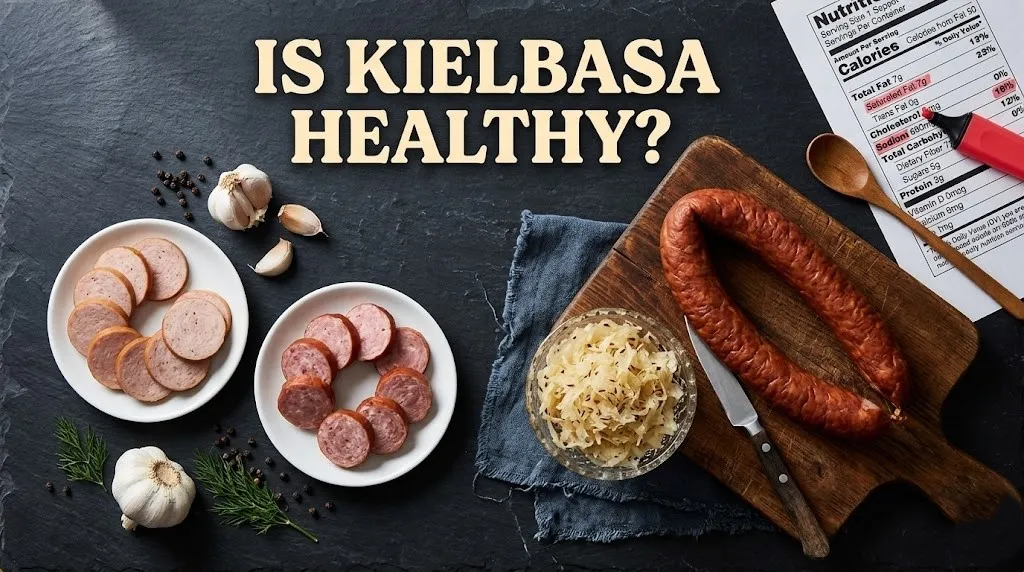
Kielbasa is not healthy as a dietary staple. It is a processed meat, high in saturated fat and sodium, and classified by the World Health Organization as a Group 1 carcinogen. A 2-ounce serving of traditional pork kielbasa contains roughly 180 to 200 calories, 16 grams of fat, and 500 to 700 milligrams of sodium.
The American Heart Association recommends limiting saturated fat to 5 to 6 percent of daily calories and sodium to 2,300 milligrams. A single serving of kielbasa delivers a third of the daily sodium limit and a quarter of the saturated fat limit. This is before the side dishes.
We will walk through the exact nutritional profile, the cancer risk in plain language, the leaner alternatives available in 2026, and the traditional pairing with sauerkraut that may partially offset some of the health concerns. This is not a condemnation. It is a risk assessment so you can make an informed choice.
Is Kielbasa Healthy
No, kielbasa is not healthy as a regular, daily food. It is a cured, smoked sausage made from pork, beef, or a combination, heavily seasoned with salt and garlic. The processing methods, smoking, curing, and salting, create the flavor but also create the health concerns.
The health evaluation depends on frequency and portion size. A 2-ounce serving of kielbasa once a month in a soup or stew is a minor dietary event. A 6-ounce kielbasa sandwich three times a week is a significant contributor to saturated fat and sodium intake.
Kielbasa is not devoid of nutrition. It provides high-quality protein, B vitamins, zinc, and iron. The problem is the accompanying sodium, saturated fat, and preservatives. The nutritional positives come with a heavy negative payload.
Is Polish Sausage Healthy
Polish sausage, which is the English translation of kielbasa, is subject to the same health evaluation. The product is identical. Whether the label reads “kielbasa” or “Polish sausage,” it is a smoked, cured pork or pork-and-beef product with the same nutritional profile.
The terminology varies by region and brand. In the United States, “Polish sausage” often refers to a thicker, coarser-ground link than the U-shaped kielbasa. The ingredient list and nutritional profile are nearly identical. The health evaluation does not change with the name.
The cultural context matters. Kielbasa is a traditional food of Poland and the Polish diaspora, served at holidays and family gatherings. It is not an everyday food in its cultural context. The traditional use pattern, occasional and celebratory, is healthier than the modern pattern of daily consumption.
Key Takeaway: Kielbasa and Polish sausage are the same food with the same health profile; the traditional occasional consumption pattern is healthier than making it a daily staple.
Is Kielbasa Sausage Healthy
Kielbasa sausage is healthy only in the context of an overall diet rich in vegetables, whole grains, and legumes. A plate of kielbasa, sauerkraut, and boiled potatoes is nutritionally incomplete. A bowl of vegetable soup with small slices of kielbasa for flavor and a chunk of whole-grain bread is a reasonable meal.
The term “kielbasa sausage” is redundant, as kielbasa translates directly to “sausage” in Polish. The redundancy on labels often signals a product that blends the Polish tradition with American processing methods. Read the ingredient list carefully on products labeled “kielbasa sausage.”
The processing method matters more than the name. A traditionally smoked kielbasa from a small Polish butcher may contain fewer additives than a mass-produced, liquid-smoke-flavored product from a national brand. The shorter the ingredient list, the better, even within the category of processed meat.
Are Polish Sausages Healthy
Polish sausages as a category are not healthy. They are processed, cured meats with similar nutritional profiles across brands and styles. The specific sausage names, kielbasa, kabanosy, wiejska, krakowska, vary in shape, texture, and seasoning but share the core processing methods.
Kabanosy, thin, dry, smoked pork sticks, are leaner than standard kielbasa but higher in sodium per ounce. Krakowska, a coarse, pressed sausage, is similar in fat content but often lower in water, meaning the calorie density is higher. The variation within the category does not produce a “healthy” Polish sausage.
The Academy of Nutrition and Dietetics recommends that processed meats, including Polish sausages, be consumed infrequently and in small portions. The recommendation is not specific to kielbasa. It applies to the entire category of cured, smoked, and salted meats.
Kielbasa Nutrition Facts
A standard 2-ounce, 56-gram serving of pork kielbasa contains 180 to 200 calories, 16 grams of fat including 6 grams of saturated fat, 7 grams of protein, 2 grams of carbohydrate, and 500 to 700 milligrams of sodium.
The protein content is biologically complete, containing all nine essential amino acids. The fat is roughly 40 percent saturated, 45 percent monounsaturated, and 15 percent polyunsaturated. The micronutrients include vitamin B12, zinc, thiamine, and heme iron, which is more bioavailable than plant-based iron.
Turkey kielbasa reduces the fat to 8 to 10 grams per serving and the calories to 120 to 140. The sodium remains high, typically 450 to 600 milligrams. A leaner animal protein does not solve the sodium problem.
| Nutrient | Pork Kielbasa (2 oz) | Turkey Kielbasa (2 oz) | Chicken Breast (2 oz) |
|---|---|---|---|
| Calories | 190 | 130 | 90 |
| Total Fat | 16g | 9g | 2g |
| Saturated Fat | 6g | 2g | 0.5g |
| Protein | 7g | 10g | 17g |
| Sodium | 550mg | 500mg | 45mg |
How Many Calories in Kielbasa
A 2-ounce serving of pork kielbasa contains 180 to 200 calories. This is the calorie count for a piece roughly the length of an adult thumb. The calorie density is high because of the fat content.
A typical kielbasa link sold in U.S. supermarkets is 12 to 16 ounces. One link contains 6 to 8 servings. A person eating an entire link on a bun is consuming 1,100 to 1,600 calories from the sausage alone. The serving size printed on the package is disconnected from real-world consumption patterns.
The calorie count for a typical meal including kielbasa is instructive. A kielbasa sandwich with mustard on a white roll is roughly 500 to 600 calories. A kielbasa skillet with potatoes, bell peppers, and onions is 500 to 700 calories per plate. The kielbasa is the most calorie-dense component in both meals.
Is Kielbasa Bad for You
Kielbasa is bad for you in large, frequent amounts, and it is associated with a small but real increase in colorectal cancer risk when consumed regularly. The WHO’s International Agency for Research on Cancer (IARC) classified processed meat as a Group 1 carcinogen in 2015, placing it in the same category as tobacco and asbestos.
The category is based on the strength of the evidence, not the magnitude of the risk. Tobacco increases lung cancer risk by 2,000 to 3,000 percent. Processed meat increases colorectal cancer risk by roughly 18 percent for every 50 grams consumed daily. A 2-ounce serving is 56 grams. The daily kielbasa eater has a higher risk. The monthly kielbasa eater has a negligible risk increase.
The mechanism involves the formation of N-nitroso compounds, polycyclic aromatic hydrocarbons (PAHs), and heterocyclic amines (HCAs) during the curing, smoking, and high-heat cooking of meat. These compounds damage the DNA of cells lining the colon over time. The risk is cumulative and dose-dependent.
Is Kielbasa Processed Meat
Yes, kielbasa is a processed meat. It fits the WHO definition of meat that has been transformed through salting, curing, fermentation, smoking, or other processes to enhance flavor or improve preservation.
The curing process typically involves sodium nitrate or sodium nitrite. These compounds are responsible for the pink color, the characteristic cured flavor, and the inhibition of Clostridium botulinum growth. During digestion, nitrites can form N-nitroso compounds, which are the likely carcinogenic agents.
“Uncured” kielbasa is a labeling misnomer. These products use celery powder, which is naturally high in nitrates, instead of synthetic sodium nitrate. The chemical result is identical. The nitrates convert to nitrites during processing. “Uncured” kielbasa is still processed meat with the same cancer risk profile.
Key Takeaway: Kielbasa is a Group 1 carcinogen per the WHO, meaning the evidence is strong; the absolute risk is small for occasional consumption and larger for daily consumption.
Is Turkey Kielbasa Healthy
Turkey kielbasa is healthier than pork kielbasa in terms of total fat and saturated fat. It is not healthy in an absolute sense. A 2-ounce serving of turkey kielbasa contains 120 to 140 calories, 8 to 10 grams of fat, 2 grams of saturated fat, and still 450 to 600 milligrams of sodium.
The sodium problem persists across all poultry-based sausages. The salt is not just for flavor. It is a functional ingredient for binding the lean meat proteins and inhibiting bacterial growth. Turkey kielbasa needs similar sodium levels to achieve a similar texture and shelf life.
Turkey kielbasa is a harm-reduction choice, not a health food. Someone eating kielbasa twice a week who switches from pork to turkey reduces their saturated fat intake by roughly 16 grams per week. This is a meaningful improvement without requiring the person to abandon the food they enjoy.
Healthy Kielbasa Brands
The healthiest kielbasa brands in 2026 are those with the shortest ingredient lists, the lowest sodium, and no synthetic nitrates or nitrites. Applegate Organics, Wellshire Farms, and Pederson’s Natural Farms lead the category.
Applegate’s turkey kielbasa contains 130 calories, 8 grams of fat, and 480 milligrams of sodium per serving. The ingredient list is fully recognizable: turkey, water, salt, spices, garlic, and celery powder. No synthetic nitrates. No fillers.
Boar’s Head offers a lower-sodium pork kielbasa with 400 milligrams of sodium per serving, roughly 25 percent less than standard brands. It is still a processed pork product with 16 grams of fat per serving. It is a modest improvement, not a transformation.
| Brand | Protein Source | Sodium (per 2 oz) | Notable Features |
|---|---|---|---|
| Applegate Organic Turkey | Turkey | 480mg | No synthetic nitrates |
| Wellshire Farms | Pork | 520mg | No antibiotics, no MSG |
| Pederson’s Natural | Pork | 420mg | Whole30 approved, no sugar |
| Tofurky Plant-Based | Soy/Wheat | 450mg | Vegan, 0mg cholesterol |
Kielbasa and Sauerkraut Healthy
Kielbasa and sauerkraut is a traditional pairing with a genuine nutritional synergy. The sauerkraut provides probiotics, fiber, and vitamin C. The kielbasa provides protein and fat. The sauerkraut partially offsets some of the nutritional negatives of the kielbasa.
Sauerkraut is fermented cabbage. It contains lactic acid bacteria, including Lactobacillus plantarum, that survive in the gut and contribute to microbial diversity. A 2014 study in the journal Cell found that fermented foods increase gut microbiome diversity and reduce inflammatory markers.
The fiber in sauerkraut, roughly 2 grams per half-cup, slows the digestion of the kielbasa fat and protein. The vitamin C in the cabbage, preserved by the fermentation process, enhances the absorption of the heme iron in the kielbasa. The pairing is nutritionally smarter than kielbasa with a white bun or mashed potatoes.
Is Kielbasa Good for Weight Loss
Kielbasa is not good for weight loss. It is a calorie-dense, high-fat food that contributes a large number of calories relative to its physical volume. A 2-ounce serving is small to the eye and heavy on the calorie count.
A weight-loss eating plan benefits from high-volume, low-calorie foods that create satiety. Vegetables, legumes, and lean proteins fit this description. Kielbasa is the opposite. It is low-volume and high-calorie, with a poor satiety-to-calorie ratio.
A person losing weight can still eat kielbasa occasionally. A thin slice or two in a large pot of bean soup or lentil stew adds flavor and satisfaction without dominating the calorie count. The kielbasa is a seasoning, not the main ingredient. This is the weight-loss-compatible way to include it.
How to Make Kielbasa Healthy
Kielbasa cannot be made healthy, but it can be made healthier by controlling the portion, the cooking method, and the accompaniments. A thin, 1-ounce slice of kielbasa, diced and sauteed with a large volume of cabbage, onions, and apple, becomes a vegetable-forward meal where the sausage is a flavoring.
To prepare a healthier kielbasa meal:
- Slice 2 ounces of turkey kielbasa into thin half-moons.
- Saute the kielbasa in a non-stick skillet over medium heat until lightly browned. Remove and set aside.
- Add 4 cups of shredded cabbage, 1 sliced onion, and 1 diced apple to the same skillet with 1 tablespoon of olive oil.
- Saute for 8 to 10 minutes until the cabbage is wilted and golden.
- Return the kielbasa to the skillet, toss to combine, and serve with a dollop of whole-grain mustard.
Avoid charring or blackening kielbasa over an open flame. High-heat cooking produces heterocyclic amines on the surface of the meat. A gentle saute or a simmer in liquid produces fewer carcinogenic compounds than grilling or pan-frying to a dark crust.
Kielbasa vs Chicken Breast Nutrition
A 2-ounce serving of skinless chicken breast contains 90 calories, 2 grams of fat, 0.5 grams of saturated fat, 17 grams of protein, and 45 milligrams of sodium. The same serving of pork kielbasa contains 190 calories, 16 grams of fat, 6 grams of saturated fat, 7 grams of protein, and 550 milligrams of sodium.
The chicken breast has more than double the protein and a fraction of the fat and sodium. This comparison is the clearest illustration of the nutritional cost of processed meat. The chicken breast is a whole food. The kielbasa is a processed product.
The comparison is not fair in a culinary sense. Kielbasa is not eaten as a plain protein source. It is eaten for its smoky, savory, satisfying flavor. The chicken breast does not replace that experience. The turkey kielbasa, with half the fat but still the smoke and the garlic, is the closer substitute.
Plant Based Kielbasa Healthy
Plant-based kielbasa is healthier than pork kielbasa in terms of saturated fat and cholesterol. It is not necessarily lower in sodium. A 2-ounce serving of Tofurky plant-based kielbasa contains 130 calories, 7 grams of fat, 0 grams of saturated fat, 14 grams of protein, and 450 milligrams of sodium.
The protein comes from vital wheat gluten and tofu. The fat comes from canola or sunflower oil. The sodium is comparable to meat-based kielbasa. The cancer risk associated with processed meat does not apply, as the WHO classification is specific to mammalian meat, not plant proteins.
Plant-based kielbasa is a harm-reduction choice for someone who wants the kielbasa experience without the saturated fat and the processed-meat cancer risk. It is still a processed food with a long ingredient list. It is healthier than pork kielbasa on the metrics of fat and carcinogen exposure. It is not healthier than a whole food.
Key Takeaway: Plant-based kielbasa solves the saturated fat and cancer risk problems but does not solve the sodium problem; it is a meaningful step down in health risk for the regular kielbasa eater.
Frequently Asked Questions About Kielbasa
Is kielbasa bad for your heart?
Kielbasa is bad for heart health when eaten regularly due to its high saturated fat and sodium content.
A 2-ounce serving contains 6 grams of saturated fat and 550 milligrams of sodium.
The American Heart Association recommends limiting both, making kielbasa a food to eat infrequently for heart health.
Can you eat kielbasa on a diet?
You can eat kielbasa on a diet in small, infrequent portions.
A 2-ounce serving provides 190 calories, mostly from fat, with modest protein.
Use thin slices as a flavoring in vegetable-heavy dishes rather than eating a whole link.
Is turkey kielbasa healthier than pork?
Turkey kielbasa is healthier than pork kielbasa because it contains half the total fat and one-third the saturated fat.
The sodium content is similar, typically 450 to 500 milligrams per serving.
The switch from pork to turkey is a meaningful health improvement for regular kielbasa eaters.
What is the healthiest sausage to eat?
Chicken sausage, turkey sausage, and plant-based sausages are the healthiest options.
Look for brands with recognizable ingredients, no synthetic nitrates, and sodium under 500 milligrams per serving.
No sausage is a health food, but poultry and plant-based options reduce the saturated fat and cancer risk.
Does cooking method affect how healthy kielbasa is?
Yes, gentle cooking methods like simmering or light sauteing are healthier than high-heat grilling or charring.
High-heat cooking creates heterocyclic amines and polycyclic aromatic hydrocarbons on the meat surface.
Avoid blackening or charring kielbasa to reduce exposure to these carcinogenic compounds.
Kielbasa is a delicious, culturally significant food that belongs in the “occasional” category. It is not a vegetable. It is not a lean protein. It is a processed meat with documented health risks that are small for the monthly eater and meaningful for the daily eater.
Eat it on holidays. Eat it in a soup with a mountain of cabbage. Choose the turkey version if you eat it often. The sauerkraut on the side is your nutritional ally, a fermented, fiber-rich counterweight to the smoke and the salt.
The question is not whether kielbasa is healthy. It is not. The question is whether you want to eat it anyway, knowing the risks, in a portion and a frequency that makes sense for your life. That is your decision to make, and now you have the numbers to make it.