A healthy banana bread recipe delivers all the texture and flavor of the classic loaf while cutting refined sugar, replacing white flour with whole grain alternatives, and keeping each slice in a realistic calorie range. This version tastes like banana bread, not a compromise.
The difference between traditional and healthy banana bread is not just calories. Traditional store-bought banana bread is high in calories, carbs, and added sugar while being low in protein and fiber, yet even richer recipes still provide meaningful amounts of key vitamins and minerals depending on the ingredients used. Building a healthier version means making intentional swaps that improve the nutritional profile without wrecking the texture.
This article covers every ingredient choice, the food science behind what actually goes wrong when healthy banana bread fails, a complete base recipe with real measurements, full macro comparisons, and guidance for gluten-free, vegan, high-protein, and lower-sugar versions. Difficulty varies by baking experience, but most home bakers with a loaf pan and a mixing bowl will find this achievable.
Banana Bread Recipe Healthy: What Makes It Actually Better?
A healthy banana bread recipe is meaningfully different from a traditional one when it reduces refined sugar, increases dietary fiber, uses a better fat source, and avoids processed white flour, while still producing a tender, moist crumb.
The word “healthy” gets used loosely in the baking space. For this article, it means a specific set of ingredient decisions: whole grain flour instead of all-purpose white flour, a natural sweetener in reduced quantity, a moderate amount of a quality fat, and ripe bananas doing most of the sweetening work.
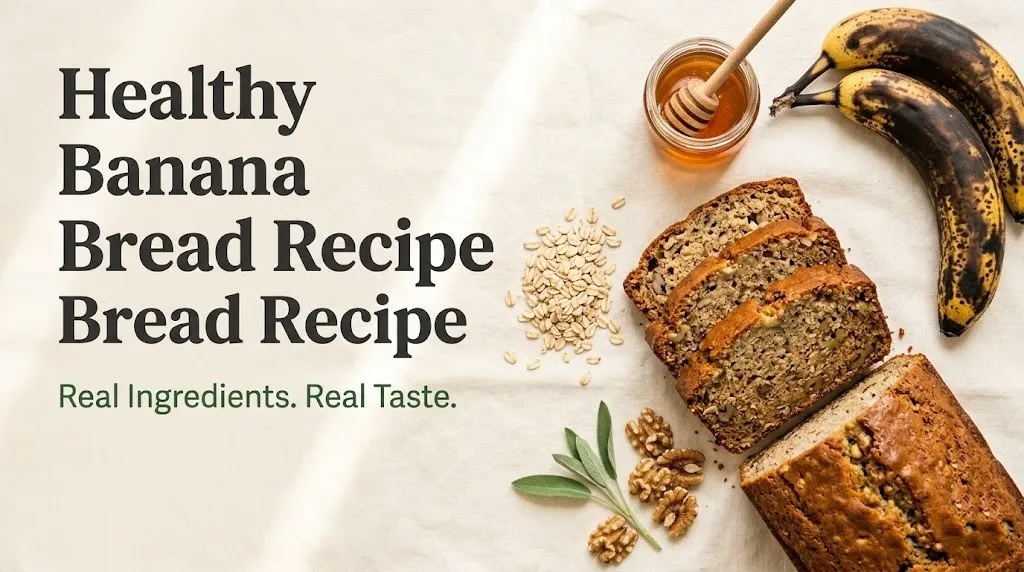
The result is a loaf with more dietary fiber, more vitamin B6 (pyridoxine), a lower glycemic response than a white flour version, and fewer grams of added sugar per slice. According to USDA FoodData Central (2024), bananas provide a balanced combination of carbohydrates, fiber, vitamins, and minerals. Using enough of them reduces reliance on added sweeteners significantly.
No healthy banana bread recipe eliminates all sugar. Bananas contain naturally occurring sucrose, glucose, and fructose. The sugar content of bananas comes from a combination of sucrose, glucose, and fructose. The goal is to manage total sugar load, not eliminate sweetness.
Quick Tip:
- “Healthy” in baking should mean specific improvements, not just lower calories.
- Replacing white flour with whole wheat or oat flour adds fiber and moderates the glycemic response.
- Ripe bananas eliminate the need for most added sweetener when used at 1.5 to 2 cups mashed.
Is Banana Bread Healthy?
Banana bread can be a nutritious option when made with whole grain flour, minimal added sweetener, and a moderate amount of quality fat, but traditional recipes are calorie-dense and low in protein and fiber.
The honest answer is that it depends entirely on the recipe. Traditional banana breads are made with ingredients such as white flour, sugar, and oil, which makes this dish often high in calories, carbs, and added sugar. A standard store-bought slice can deliver over 300 kcal, with minimal fiber and less than 3g protein per serving.
A homemade healthy version, built around whole wheat flour, ripe bananas, a modest amount of honey or maple syrup, and a moderate fat source, brings that slice down to 160 to 200 kcal with 2 to 3g fiber and a lower sugar load. That is a material difference, not a marketing claim.
Think of it like the difference between a bowl of instant oatmeal with three sugar packets and a bowl made with rolled oats, half a banana, and a teaspoon of honey. The base ingredient is similar, but every other decision changes the nutritional outcome.
You can certainly include banana bread in a healthy diet, but whether it counts as a nutritious choice depends on the ingredients used. Made well, a slice at breakfast alongside eggs or Greek yogurt is a reasonable carbohydrate source. Eaten as a large, buttery wedge, it functions more like dessert.
Healthy Banana Bread Ingredients: What to Use and Why
The healthiest banana bread ingredients are overripe bananas, a whole grain flour, a liquid natural sweetener in reduced quantity, a moderate amount of a quality fat, one or two eggs (or a flax egg), baking soda, salt, and vanilla extract.
Each ingredient plays a specific role. Swapping any one of them without understanding that role is where most healthy banana bread goes wrong.
Core ingredients and their nutritional function:
- 3 to 4 very ripe bananas (about 1.5 cups mashed): Primary moisture source, natural sweetener, and the source of potassium and vitamin B6 (pyridoxine). One medium ripe banana provides about 110 calories, 1 gram protein, 28 grams carbohydrate, 3 grams fiber, and 450 mg potassium.
- 1.75 cups whole wheat flour or oat flour: Adds dietary fiber, B vitamins (thiamine, niacin, folate), and a lower glycemic response compared to all-purpose flour.
- 1/4 to 1/3 cup honey or pure maple syrup: Provides sweetness with some trace minerals. Both are still caloric sweeteners; the goal is using less of them, not treating them as “free.”
- 1/4 cup canola oil, extra-virgin olive oil, or melted coconut oil: Provides fat for moisture and crumb structure.
- 2 large eggs (or 2 flax eggs): Provide protein and structure. Egg whites contribute protein; yolks add richness and emulsify the batter.
- 1 teaspoon baking soda (sodium bicarbonate): The primary leavener. It reacts with the acids in bananas and any acidic ingredients to produce carbon dioxide, creating rise.
- 1/2 teaspoon fine salt: Enhances every other flavor in the loaf.
- 1 teaspoon vanilla extract: Adds depth without calories.
People with a tree nut allergy should be cautious with almond flour versions and any recipe calling for walnuts as a mix-in. Egg-free bakers can use a flax egg: 1 tablespoon ground flaxseed (ground linseed) combined with 3 tablespoons water, rested 5 minutes until gel forms.
Key Takeaway: The quality of your bananas matters more than any other single ingredient. Very ripe bananas, with heavily blackened skins, are the natural sweetener doing most of the work in a healthy banana bread.
Why Use Overripe Bananas in Banana Bread?
Overripe bananas are better for banana bread because starch converts to sugar as a banana ripens, producing natural sweetness that reduces the need for added sugar without adding processed ingredients.
This is food science, not preference. The carb composition of bananas changes drastically during ripening: the main component of unripe bananas is starch, and green bananas contain around 70% starch measured in dry weight. As that starch converts, the banana becomes sweeter, softer, and more moisture-dense, all of which benefit the loaf.
A ripe banana with black spots or a fully blackened peel can contain two to three times the natural sweetness of a pale yellow one. This means you can reduce your added honey or maple syrup by up to half compared to using barely-ripe bananas.
Interestingly, the starch-to-sugar content of bananas can change depending on the relative ripeness of the fruit, and bananas contain resistant starch and prebiotic dietary fibers, which may benefit gastrointestinal health in less-ripe forms. In a baked loaf, the fully ripe banana contributes natural sweetness most efficiently.
If your bananas are yellow but not yet spotted, you can ripen them in two ways: place them unpeeled on a parchment-lined baking sheet at 300°F (149°C) for 15 to 20 minutes until the skin turns black and the flesh is soft. Alternatively, leave unpeeled bananas at room temperature for 3 to 5 days. Both produce a baking-ready banana.
People with fructose malabsorption should note that riper bananas contain more free fructose. If fructose sensitivity is a concern, using bananas at the yellow-with-few-spots stage reduces the fructose load, though the loaf will require slightly more added sweetener to compensate.
Healthy Banana Bread with Whole Wheat Flour
Whole wheat flour is the standard flour swap in a healthy banana bread recipe because it retains the bran and germ of the wheat kernel, providing more dietary fiber, B vitamins, and iron than refined all-purpose flour, while behaving similarly enough to all-purpose flour to require only minor recipe adjustments.
Using whole wheat flour instead of white flour adds fiber and nutrients that help with satiety, even if the calorie difference is minimal: one cup of whole wheat flour contains approximately 407 calories, compared to 455 calories for white flour. The calorie reduction is small. The fiber increase is the real nutritional payoff.
White whole wheat flour is a softer, milder-flavored variety of whole wheat flour milled from a different strain of wheat (white wheat versus red wheat). It is 100% whole grain but produces a lighter, less dense loaf than standard whole wheat flour, making it an excellent choice for banana bread where a tender crumb matters.
According to the USDA Dietary Guidelines for Americans 2020-2025, at least half of all grain servings should come from whole grains. A slice of whole wheat banana bread contributes to that recommendation in a way a white flour version does not.
One practical note: whole wheat flour absorbs slightly more moisture than all-purpose. If you find your loaf is too dense with whole wheat flour, reduce the flour by 2 tablespoons per cup, or add 2 tablespoons of extra liquid (water, milk, or plant-based milk) per cup used. This adjustment prevents a dry, heavy crumb.
People with celiac disease or non-celiac gluten sensitivity cannot use standard wheat-based whole wheat flour. Options are covered in the gluten-free section below.
Healthy Banana Bread with Oat Flour or Almond Flour
Oat flour and almond flour are the two most practical whole-food flour alternatives for healthy banana bread, each producing a distinct texture and nutritional profile worth understanding before you swap.
Oat flour is made from rolled oats (Avena sativa) ground into a fine powder. It is mild in flavor, naturally gluten-free if made from certified gluten-free oats, and produces a slightly lighter, more cake-like crumb than whole wheat flour. Calorie output for an oat or almond flour banana bread lands at approximately 180 to 220 kcal per slice, depending on the fat used, which is comparable to whole wheat versions. Oat flour absorbs moisture differently from wheat flour. When substituting, use approximately 1.25 cups of oat flour for every 1 cup of whole wheat flour called for in a recipe. The batter will look slightly looser, which is normal.
Almond flour (finely ground blanched almonds) produces a denser, moister loaf with more fat and protein per slice than wheat-based versions. It is naturally gluten-free and suitable for grain-free eating patterns. The caloric density is higher due to the fat in almonds: expect roughly 200 to 250 kcal per slice depending on the recipe. Almond flour cannot be substituted 1:1 for wheat or oat flour; it behaves differently because it lacks gluten structure entirely. Recipes specifically designed around almond flour, rather than those with a straight swap from wheat, produce the best results.
| Flour Type | Approx. kcal/slice | Fiber per Slice | Protein per Slice | Gluten-Free? |
|---|---|---|---|---|
| White all-purpose | 200-230 | ~0.5g | ~3g | No |
| Whole wheat | 185-210 | ~2-3g | ~4g | No |
| Oat flour (GF certified) | 180-220 | ~2g | ~3g | Yes |
| Almond flour | 200-250 | ~1.5g | ~5g | Yes |
Note: These are approximate values based on a standard 60g slice. Actual values vary by recipe.
Simple Healthy Banana Bread: The Base Recipe
This healthy banana bread base recipe uses whole wheat flour, ripe bananas, pure maple syrup, canola oil, eggs, baking soda, and a few pantry staples to produce a moist, tender loaf with approximately 170 to 200 kcal per slice.
Getting this loaf right requires accurate measuring, correctly ripe bananas, and the discipline to stop mixing when the batter is just combined. Those three things solve 90 percent of failed healthy banana bread attempts.
Ingredients (yields 12 slices from a 9×5 inch loaf pan):
- 3 to 4 very ripe bananas (approximately 1.5 cups mashed, about 340g)
- 2 large eggs
- 1/4 cup (60ml) canola oil or extra-virgin olive oil
- 1/4 cup (80g) pure maple syrup or raw honey
- 1 teaspoon vanilla extract
- 1 3/4 cups (210g) white whole wheat flour or standard whole wheat flour
- 1 teaspoon baking soda
- 1/2 teaspoon fine sea salt
- 1 teaspoon ground cinnamon (Ceylon cinnamon preferred)
- Optional: 1/3 cup (35g) chopped walnuts or dark chocolate chips (70% cacao or higher)
To make this healthy banana bread:
- Preheat your oven to 350°F (177°C). Lightly grease a 9×5 inch loaf pan and line the bottom with parchment paper.
- In a large mixing bowl, mash the ripe bananas with a fork until almost fully smooth. A few small lumps are acceptable; they add moisture pockets to the baked loaf.
- Whisk in the eggs one at a time, then add the canola oil, maple syrup, and vanilla extract. Whisk until the wet mixture is uniform.
- Add the whole wheat flour, baking soda, salt, and cinnamon directly over the wet ingredients. Fold with a rubber spatula until no dry flour streaks remain. Do not whisk. Stop mixing the moment the flour is incorporated.
- Fold in any optional mix-ins (walnuts or chocolate chips) with two or three more strokes.
- Pour the batter into the prepared loaf pan. Spread it evenly to the edges.
- Bake at 350°F (177°C) for 55 to 65 minutes, until the top is deep golden brown and a toothpick inserted into the center comes out clean or with just a few moist crumbs attached.
- Cool in the pan for 10 minutes, then transfer to a wire rack. Do not slice until the loaf has cooled for at least 20 more minutes. Cutting too early causes the center to collapse.
Key Takeaway: The most common banana bread failure is overmixing once the flour goes in. Fold, do not whisk, and stop as soon as no dry streaks remain.
How Many Calories in Healthy Banana Bread?
A healthy homemade banana bread slice weighing approximately 60 grams contains roughly 160 to 200 kcal, depending on the fat source, the amount of added sweetener, and any mix-ins.
The calorie range matters because no two “healthy” recipes are the same. Calorie output varies by recipe style: classic with butter comes in at 200 to 230 kcal per slice; with canola or coconut oil, 210 to 250 kcal; low-sugar versions, 150 to 180 kcal; and whole wheat versions, around 200 kcal with higher fiber. Substitutions genuinely change the number.
Here is a direct comparison between a traditional banana bread slice and a healthy version using the base recipe above:
| Nutrient | Traditional Banana Bread (per 60g slice) | Healthy Whole Wheat Version (per 60g slice) |
|---|---|---|
| Calories | 220-260 kcal | 165-200 kcal |
| Total Fat | 9-12g | 5-7g |
| Saturated Fat | 3-5g | 0.5-1g (with canola oil) |
| Total Carbohydrates | 32-40g | 28-33g |
| Dietary Fiber | 0.5-1g | 2-3g |
| Total Sugar | 16-22g | 9-14g |
| Protein | 2-3g | 3-5g |
Source: Figures derived from USDA FoodData Central nutrient data, cross-referenced with published recipe macro cards.
Most homemade recipes yield slices weighing 55 to 70 grams. On average, one slice provides around 200 calories, though richer recipes may exceed 250 kcal. Baking mini loaves or muffins naturally controls portion size without requiring calorie counting at the table.
People eating banana bread as part of a calorie-conscious plan should weigh slices on a kitchen scale rather than eyeballing them. Slice thickness varies dramatically by how you cut, and a “one slice” serving can range from 50g to 90g depending on the cut.
Healthy Banana Bread No Sugar or Lower Sugar
Healthy banana bread with no added sugar relies entirely on the natural sweetness of overripe bananas and, optionally, small amounts of natural zero-calorie sweeteners to reach a palatable level of sweetness without refined sugar or liquid natural sweeteners.
The practical reality: truly no-added-sugar banana bread made with 1.5 cups of very ripe mashed bananas produces a mildly sweet, moist loaf that satisfies as a breakfast item. It will not taste like a coffee shop banana bread slice, and that is a clear-eyed expectation to set.
To reduce or eliminate added sweetener:
- Use 4 fully blackened bananas instead of 3. The extra banana adds sweetness, moisture, and roughly 25g of natural carbohydrates spread across 12 slices.
- Add 1/2 teaspoon of pure vanilla extract beyond the standard amount. Vanilla enhances perceived sweetness without adding sugar.
- Include 1 teaspoon Ceylon cinnamon (Cinnamomum verum). Cinnamon amplifies the sweet flavor signals in the loaf without contributing calories from sugar.
- Use 2 tablespoons of unsweetened applesauce alongside the bananas as a flavor-boosting moisture source.
For bakers who need some sweetener but want less refined sugar, monk fruit sweetener (luo han guo extract) and erythritol are both non-nutritive options that bake reasonably well in quick bread applications. They do not caramelize like sugar, so the top crust will be paler than with honey or maple syrup.
People following a very low-carbohydrate or ketogenic eating pattern should note that even a no-added-sugar whole wheat banana bread still provides approximately 25 to 30g of net carbohydrates per slice from the bananas and flour. Almond flour or coconut flour with a non-nutritive sweetener reduces this significantly.
Healthy Banana Bread with Greek Yogurt
Adding plain Greek yogurt to healthy banana bread increases the protein content per slice, adds moisture without additional fat, and helps produce a more tender crumb through the mild acidity of the yogurt activating the baking soda.
Greek yogurt is one of the most effective single swaps for improving the nutritional profile of banana bread without affecting the recipe’s core flavor. A standard recipe using 1/3 cup (75g) plain nonfat Greek yogurt adds approximately 8g of protein to the entire loaf, meaning roughly 0.5 to 1g additional protein per slice, plus calcium and B vitamins.
The acidity in Greek yogurt reacts with baking soda (sodium bicarbonate) to produce additional leavening, which can help produce a taller, lighter loaf than oil-only versions. This is the same principle behind using buttermilk in traditional quick breads.
To incorporate Greek yogurt:
- Replace half the oil (about 2 tablespoons) with 3 tablespoons of plain nonfat or low-fat Greek yogurt.
- Whisk the yogurt directly into the wet ingredient mixture alongside the eggs, remaining oil, and maple syrup.
- Do not substitute flavored or sweetened yogurt, as these add significant sugar.
According to the Academy of Nutrition and Dietetics, incorporating protein sources into carbohydrate-rich snacks or baked goods can moderate the post-meal blood glucose response and increase satiety between meals. Greek yogurt in banana bread achieves both without requiring protein powder or other supplements.
Individuals with dairy allergies can substitute coconut yogurt (plain, unsweetened) in equal amounts. The protein contribution will be lower, but the moisture and acidity effects on the batter are similar.
Key Takeaway: Greek yogurt does double duty in banana bread: it adds protein and its mild acidity helps the baking soda work better, producing a taller, lighter loaf than oil alone.
Healthy Banana Bread Gluten Free and Vegan Options
Healthy banana bread can be made fully gluten-free using certified gluten-free oat flour, almond flour, or a quality 1:1 gluten-free baking blend, and fully vegan by replacing eggs with flax eggs and using plant-based milk or coconut yogurt instead of dairy.
These two adaptations are independent of each other. A recipe can be one or both, depending on dietary needs.
For gluten-free banana bread:
- Use 2 cups certified gluten-free oat flour in place of whole wheat flour (the ratio is approximately 1.25 cups oat flour per 1 cup whole wheat flour, rounded up for the full recipe).
- Alternatively, use a 1:1 gluten-free baking flour blend containing xanthan gum in equal measure to the whole wheat flour called for.
- Do not use coconut flour as a direct substitute. Coconut flour absorbs dramatically more liquid than any other flour. It requires a dedicated recipe designed around its properties.
- Almond flour works, but also requires a purpose-built recipe.
For vegan banana bread:
- Replace each large egg with 1 flax egg: 1 tablespoon finely ground flaxseed (ground linseed) plus 3 tablespoons room-temperature water. Stir and let sit for 5 minutes until a gel forms.
- Replace any Greek yogurt with plain unsweetened coconut yogurt in equal measure.
- Use pure maple syrup rather than honey as the sweetener.
| Dietary Need | Swap | Notes |
|---|---|---|
| Gluten-free | Certified GF oat flour (1.25:1 ratio) | Check oat certification; cross-contamination risk is real |
| Vegan (egg-free) | Flax egg (1 tbsp ground flax + 3 tbsp water each) | Slightly denser texture |
| Dairy-free | Coconut yogurt (unsweetened, plain) | Lower protein than Greek yogurt |
| Nut-free | Omit walnuts; use dark chocolate chips | Verify chocolate chip nut-free status |
People with celiac disease should verify that their oat flour is certified gluten-free and produced in a dedicated gluten-free facility, as oats are frequently cross-contaminated during conventional processing.
High Protein Banana Bread
High protein banana bread is made by adding a concentrated protein source such as plain protein powder, Greek yogurt, or almond butter to the standard base recipe, targeting approximately 8 to 10g protein per slice compared to the 3 to 5g of a standard healthy version.
Standard banana bread is not a high-protein food. The eggs and flour provide modest protein, but the base recipe delivers only about 3 to 5g per slice. For athletes, people in active weight management, or anyone trying to increase daily protein intake, boosting that number meaningfully requires deliberate additions.
Options for increasing protein per slice:
- Unflavored or vanilla whey protein powder (Lactalbumin whey): Replace 1/4 cup of flour with 1/4 cup (approximately 28g) of whey protein powder. This adds roughly 20 to 22g protein to the whole loaf, or about 1.5 to 2g per slice. Start with a smaller substitution; replacing too much flour with protein powder produces a dry, rubbery texture.
- Plain pea protein powder: Works the same way for vegan versions. Pea protein is slightly grainier in texture; compensate with 1 tablespoon additional liquid per 1/4 cup substituted.
- 2 tablespoons of natural almond butter or peanut butter (Arachis hypogaea): Adds protein, fat, and a nutty flavor. Whisk into the wet ingredients before combining with dry.
- An additional egg: Simply adding a third egg to the standard two-egg base recipe adds approximately 6g protein to the entire loaf at minimal cost.
Quick Tip:
- Do not replace more than 1/4 cup of flour with protein powder; beyond that, texture degrades noticeably.
- Vanilla-flavored protein powder eliminates the need for added vanilla extract in the recipe.
- Pairing a standard slice with 2 tablespoons of natural peanut butter adds 7 to 8g protein at the point of eating, which is a faster fix than modifying the recipe itself.
Can Diabetics Eat Banana Bread?
People managing type 2 diabetes can eat banana bread in controlled portions, particularly when it is made with whole grain flour, minimal added sugar, and paired with a protein source to moderate the glycemic response.
This is a nuanced answer, not a blanket yes or no. The glycemic index (GI) of banana bread made with wheat flour is approximately 54, which places it in the moderate-GI category on the standard 1 to 100 scale. Whole wheat and oat flour versions land in this range. White flour versions test higher.
Both pectin and resistant starch in bananas moderate the rise in blood sugar after a meal. Using very ripe bananas in combination with whole grain flour produces a loaf with a more moderate glycemic response than the GI alone suggests, because the fiber in the flour and the pectin from the bananas both slow digestion.
Practical guidance for people with diabetes who want to include banana bread:
- Keep portions to one slice (approximately 60g) rather than two.
- Pair the slice with a protein source: two boiled eggs, plain Greek yogurt, or a tablespoon of natural nut butter. Protein eaten alongside carbohydrates moderates the speed of blood glucose rise.
- Opt for the no-added-sugar version using extra-ripe bananas, Ceylon cinnamon, and vanilla.
- Use whole wheat or certified gluten-free oat flour rather than white or all-purpose flour.
Anyone managing diabetes with medication or monitoring blood glucose closely should discuss specific foods, portions, and meal timing with their registered dietitian or healthcare provider, as individual glycemic responses to the same food can vary considerably from person to person based on medication, gut microbiome composition, physical activity, and overall dietary pattern.
Key Takeaway: Banana bread is not off-limits for people watching blood sugar, but portion size, flour choice, and pairing it with protein are the three levers that make a meaningful difference in the glycemic response.
Why Is My Healthy Banana Bread Dense?
Healthy banana bread turns out dense most commonly because of one of four problems: underbaked center, too much whole wheat flour relative to liquid, overmixed batter causing gluten to tighten, or bananas that were not ripe enough to provide sufficient moisture and natural sweetness.
Each of these has a specific fix, and diagnosing the right one saves a lot of wasted baking.
Common causes and solutions:
- Overmixing: Overmixing will create more gluten in your batter which leads to a tougher bread; a tender and moist result requires restraint once the wet and dry ingredients meet. Fold the flour in with a spatula, not a whisk, and stop at the point of no dry streaks.
- Underripe bananas: Pale yellow bananas provide insufficient starch-to-sugar conversion, less moisture, and less of the natural binding properties of ripe fruit. Use bananas that are heavily spotted brown to fully black on the skin.
- Too much flour: Measuring flour by scooping the cup directly into the bag compacts the flour, adding up to 20 to 30% more than the recipe intends. Use the spoon-and-level method: spoon flour into the measuring cup and level off with a straight edge. Better still, weigh it: 1 cup whole wheat flour = approximately 120g.
- Underbaking: Banana bread will continue to bake as it cools, so it is okay if it is slightly underdone when you take it out of the oven; a knife inserted into the middle should come out mostly clean. However, if the center is wet or gummy after cooling, it was underbaked. Return the loaf (uncovered) to the oven at 325°F (163°C) for 10 to 15 more minutes.
- Expired leavening: Baking soda older than 6 months loses potency. Test by dropping half a teaspoon into hot water. If it does not bubble vigorously, buy a new container.
How to Store and Freeze Banana Bread
Banana bread stays fresh at room temperature in an airtight container for 2 to 3 days, in the refrigerator for up to 1 week, and in the freezer for up to 3 months without losing flavor or texture.
Room temperature storage works well for standard plain loaves without fresh fruit, cream cheese, or custard-style add-ins. Wrap the loaf in plastic wrap or beeswax wrap, place it in an airtight container, and store it away from direct sunlight. Banana bread will keep at room temperature for 3 to 5 days in an airtight container, depending on the recipe and ambient temperature.
Refrigeration extends shelf life but tends to dry out the crumb. If refrigerating, slice the loaf first and place the slices in an airtight container with parchment paper between each slice. Bring a slice to room temperature for 10 to 15 minutes before eating, or warm it in a toaster or toaster oven for 2 to 3 minutes at 300°F (149°C) to restore texture.
For freezing:
- Allow the loaf to cool completely, at least 2 hours at room temperature.
- Slice the entire loaf before freezing. Pre-slicing lets you pull individual servings without thawing the whole loaf.
- Wrap each slice individually in plastic wrap, then place all slices in a freezer-safe zip-close bag or airtight container.
- Label the bag with the date and flour type if you are testing variations.
- Freeze flat for the first hour, then store upright to save space. Frozen banana bread keeps for up to 3 months. Allow slices to thaw to room temperature before serving, or toast directly from frozen for 3 to 4 minutes.
Quick Tip:
- Slice before freezing. Pulling out one slice at a time is the most practical approach for daily use.
- Pre-wrapped individual slices go directly from freezer to toaster. No thawing needed.
- Avoid freezing loaves with fresh fruit add-ins; the moisture released during thawing makes the crumb gummy.
Frequently Asked Questions About Healthy Banana Bread
What makes banana bread healthy instead of a dessert?
A banana bread recipe shifts from dessert toward a nutritious baked good when it uses whole grain flour, minimal added sweetener, a quality fat in moderate quantity, and enough ripe bananas to provide natural sweetness.
The nutritional markers that distinguish it are higher dietary fiber, lower added sugar, and a better protein-to-calorie ratio than a traditional white flour version.
Pairing a slice with a protein source like Greek yogurt or eggs further positions it as a balanced breakfast or snack rather than a dessert item.
Can I make healthy banana bread without sugar?
Yes, banana bread can be made with no added sugar by using 4 very ripe, heavily blackened bananas as the sole sweetener, enhanced by vanilla extract and Ceylon cinnamon to amplify perceived sweetness.
The result is mildly sweet and moist, but will not taste identical to a version sweetened with honey or maple syrup.
Monk fruit sweetener or erythritol can be added in small amounts (1 to 2 tablespoons) to increase sweetness without adding sugar calories.
How do I make banana bread moist without butter or oil?
Replacing butter or oil entirely with unsweetened applesauce (1:1 by volume) produces a low-fat loaf that stays moist due to the pectin and water content in the applesauce.
A third option is using plain nonfat Greek yogurt to replace half the fat, which adds moisture through the yogurt’s water content while contributing protein and acidity for a better crumb.
Using enough ripe bananas, at least 1.5 cups mashed, is the non-negotiable foundation of moisture in any fat-reduced version.
What flour is best for healthy banana bread?
White whole wheat flour is the most practical choice because it provides the fiber and nutrient profile of whole grain wheat in a milder, less dense form that produces a tender loaf closest to the traditional result.
Certified gluten-free oat flour is the best option for gluten-free bakers, requiring a ratio of approximately 1.25 cups oat flour per 1 cup whole wheat flour.
Almond flour produces a grain-free, higher-fat option but requires a dedicated recipe rather than a direct substitution.
How long does healthy banana bread last?
Healthy banana bread lasts 2 to 3 days at room temperature in an airtight container, up to 1 week in the refrigerator, and up to 3 months in the freezer when sliced and wrapped individually before freezing.
Refrigeration extends shelf life but dries out the crumb; restoring texture in a toaster at 300°F for 2 to 3 minutes brings back the fresh-baked quality.
Loaves with add-ins that require refrigeration (cream cheese, custard layers, fresh fruit) should be refrigerated immediately and eaten within 3 to 4 days.
Closing
A good healthy banana bread slice is not about sacrifice. It is about choosing ingredients that do more work: whole grain flour with real fiber, ripe bananas that sweeten naturally, a modest pour of oil or a spoon of Greek yogurt. The result holds up at breakfast, packs well, and keeps in the freezer for weeks.
Make the base recipe once, adjust the sweetener to your taste, and freeze half the loaf in pre-sliced portions. That one baking session covers you for three weeks of real breakfasts without reaching for something processed.
The most important thing you can do is use the ripest bananas you can find. Everything else is adjustable.