Mac and cheese is not a health food in its standard boxed form, but it is not nutritionally worthless either, and the honest answer depends entirely on which version you eat, how much you serve, and what else is on your plate. The difference between a 600-calorie bowl of Kraft from the stovetop and a well-built homemade version with whole wheat pasta and real sharp cheddar is not trivial.
The question matters because mac and cheese is one of the most consumed comfort foods in the United States. The USDA Economic Research Service reports that cheese consumption per capita in the U.S. has climbed steadily over recent decades, and pasta-based dishes remain among the most common weeknight meals across age groups. What goes into that bowl has real nutritional consequences.
This guide breaks down the actual nutrition data, compares boxed versus homemade versus restaurant versions, addresses specific health concerns including blood sugar, sodium, and saturated fat, and gives you concrete tools to make a version that fits your goals without sacrificing the thing that makes mac and cheese worth eating.
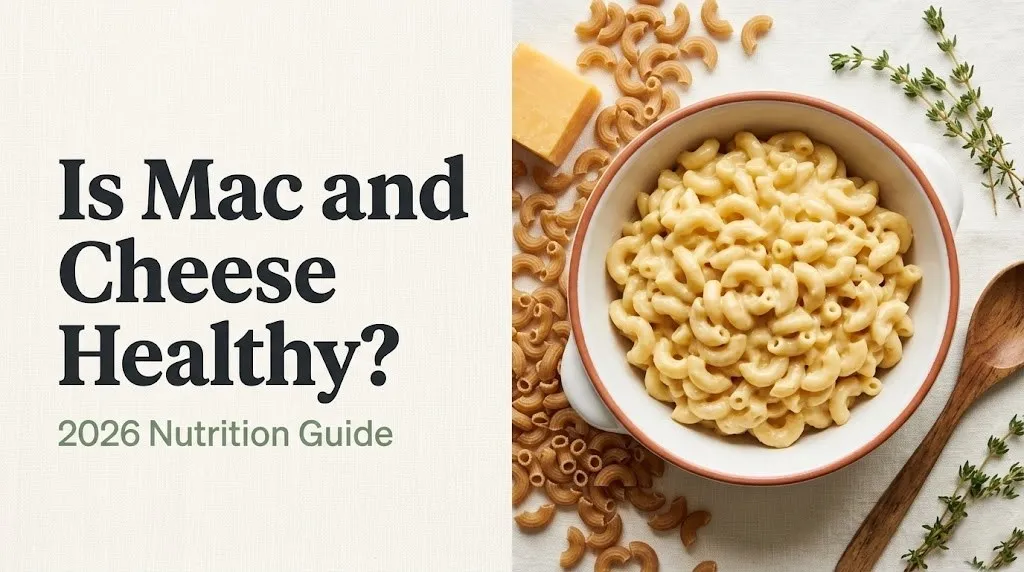
Is Mac and Cheese Healthy?
Mac and cheese is not inherently healthy or unhealthy; its nutritional value depends on the ingredients, preparation method, and portion size. Standard boxed versions are high in refined carbohydrates, saturated fat, and sodium. Homemade versions using whole grain pasta, real cheese, and controlled portions occupy a meaningfully different nutritional category.
The dish at its core is pasta and cheese sauce. Pasta contributes carbohydrates, B vitamins, and some protein. Cheese contributes calcium, fat, protein, and sodium. Neither ingredient is problematic in reasonable amounts. The concern with most commercial and restaurant versions is the combination of refined grains, excessive sodium, and saturated fat delivered in calorie-dense portions.
A useful frame here: think of mac and cheese the way you would think of pizza. Pizza made on whole grain dough with moderate cheese and vegetables is a different food, nutritionally speaking, than a deep-dish with processed meat. Mac and cheese follows the same logic. The category name does not determine the nutritional value; the actual ingredients do.
The Academy of Nutrition and Dietetics consistently emphasizes that no single food determines dietary health. What matters is the overall pattern of eating, serving size context, and the quality of ingredients in a given preparation.
Quick Tip:
- Judge mac and cheese by its specific version, not by the category name.
- Check sodium and saturated fat on the label before assuming a “natural” brand is nutritionally superior.
- Pairing any version with vegetables and a lean protein source meaningfully improves the nutritional balance of the meal.
Mac and Cheese Nutrition Facts Per Serving
A standard serving of prepared boxed mac and cheese (approximately 1 cup or 240g) provides roughly 350 to 420 calories, depending on how much butter and milk are added during preparation. That single cup figure is modest, but most people serve significantly more than one cup.
The nutritional composition of that standard serving includes refined elbow macaroni made from enriched semolina (Triticum durum, durum wheat), a powdered or liquid cheese product, and added butter or margarine. Enrichment restores some of the B vitamins lost during flour refining, specifically riboflavin (vitamin B2), thiamin (vitamin B1), niacin (vitamin B3), and folic acid. Iron is also typically added.
What the enrichment process does not restore is dietary fiber. Refined semolina pasta contains less than 1 gram of fiber per cup of cooked pasta. That matters because fiber slows glucose absorption, supports satiety, and is chronically under-consumed in the American diet according to the USDA Dietary Guidelines for Americans 2020-2025.
People with celiac disease or wheat allergy cannot eat standard mac and cheese due to the gluten content of semolina pasta. Lactose-intolerant individuals may tolerate aged cheddar better than processed cheese powder, since aging reduces lactose content, but this varies by individual.
| Nutrient | Boxed Mac & Cheese (1 cup prepared) | Homemade (1 cup, whole wheat pasta + cheddar) |
|---|---|---|
| Calories | 370 to 420 | 320 to 380 |
| Carbohydrates | 47 to 53g | 38 to 44g |
| Protein | 9 to 12g | 14 to 18g |
| Total Fat | 13 to 17g | 12 to 16g |
| Dietary Fiber | under 2g | 4 to 6g |
| Sodium | 570 to 740mg | 220 to 400mg |
| Calcium | 200 to 280mg | 280 to 380mg |
Mac and Cheese Calories and Macros
Mac and cheese delivers 350 to 750 calories per serving depending on the version, with restaurant and baked versions typically at the higher end of that range. The caloric spread is wide enough that treating all mac and cheese as the same caloric entity is a real nutritional error.
The macronutrient split in a standard boxed serving skews heavily toward carbohydrates, which account for roughly 50 to 55% of total calories. Fat contributes approximately 30 to 37%, and protein covers the remaining 10 to 14%. That ratio means mac and cheese delivers relatively modest protein for its calorie load, particularly compared to other pasta dishes built around legume-based sauces or added lean protein.
Caloric density is the more useful lens here. One cup of mac and cheese at 400 calories is calorie-dense relative to its volume, meaning it does not occupy as much stomach space per calorie as a bowl of vegetable soup or a salad with the same calorie count. This is not a flaw unique to mac and cheese; it is a characteristic of most pasta dishes cooked with fat and cheese.
For people tracking macros for body composition goals, the protein-to-calorie ratio of standard mac and cheese is suboptimal. Adding 150g of cooked chicken breast to a one-cup serving increases protein to approximately 35 to 38 grams without a proportional increase in calories, making the overall meal considerably more balanced.
The American Heart Association recommends that saturated fat account for no more than 5 to 6% of total daily calories. For a 2,000-calorie diet, that is roughly 11 to 13 grams of saturated fat per day. A single serving of boxed mac and cheese can deliver 5 to 8 grams of saturated fat, depending on how much butter is added.
Mac and Cheese Protein and Calcium Content
Mac and cheese provides a modest but real amount of protein and calcium, making it more nutritionally useful than its reputation as empty comfort food suggests. A standard one-cup serving delivers 9 to 12 grams of protein from boxed versions and 14 to 18 grams from homemade versions using higher-quality cheese.
The protein in mac and cheese comes primarily from the cheese component. Cheddar, a firm cow’s-milk cheese, contains casein protein, a slow-digesting dairy protein that contributes to satiety more gradually than fast-digesting proteins like whey. For a snack or light meal context, that slow digestion profile is modestly useful, though the calorie cost per gram of protein is higher than from leaner protein sources.
Calcium is the genuinely standout nutrient in mac and cheese. A one-cup serving provides approximately 200 to 380mg of calcium (depending on preparation), which represents 15 to 30% of the recommended daily intake for adults, according to the National Institutes of Health (NIH) Office of Dietary Supplements. Calcium supports bone mineral density, muscle contraction, nerve transmission, and normal blood clotting.
Cheese is one of the most bioavailable dietary sources of calcium. The fat content in cheese actually aids in the absorption of fat-soluble vitamins present in the meal. People avoiding dairy entirely miss this calcium source and need to replace it through fortified plant-based alternatives or calcium-rich vegetables like kale (Brassica oleracea var. sabellica) and bok choy (Brassica rapa subsp. chinensis).
| Protein Source in Mac & Cheese | Protein per Cup (approx.) | Calcium per Cup (approx.) |
|---|---|---|
| Boxed (processed cheese powder) | 9 to 12g | 200 to 250mg |
| Homemade (sharp cheddar) | 14 to 18g | 300 to 380mg |
| Plant-based cheese version | 8 to 11g | Varies widely by brand |
| Added chicken breast (150g) | Adds 30g | Minimal additional |
Key Takeaway: Mac and cheese is not nutritionally empty; it delivers real calcium and moderate protein, but the protein-to-calorie ratio improves considerably when you build it with real cheese and add a lean protein source.
Mac and Cheese Sodium and Saturated Fat
The most legitimate nutritional concern with mac and cheese is its sodium and saturated fat content, particularly in boxed and restaurant versions. A single prepared cup of Kraft Original Mac & Cheese contains approximately 570mg of sodium before any salt is added at the table. Many households add salt to the cooking water and to the finished dish, pushing that figure considerably higher.
The American Heart Association (AHA) recommends no more than 2,300mg of sodium per day for most adults, with an ideal target of 1,500mg per day for people with high blood pressure or cardiovascular disease risk. A single serving of boxed mac and cheese can represent 25 to 38% of the daily AHA maximum in one bowl. Eating a full two-cup portion, which is not unusual, doubles that exposure.
Saturated fat comes primarily from the cheese and butter components. Cheese contains naturally occurring saturated fatty acids, primarily palmitic acid and stearic acid. The AHA links consistently high saturated fat intake to elevated LDL cholesterol (low-density lipoprotein cholesterol), a well-documented cardiovascular risk factor. One cup of boxed mac and cheese prepared with butter contributes approximately 5 to 8 grams of saturated fat.
People managing hypertension or heart disease should be particularly mindful of these numbers. Reducing butter by half in boxed preparations, using lower-sodium cheese varieties, or choosing brands with reduced-sodium formulations can cut sodium by 150 to 250mg per serving without eliminating the dish entirely.
The lactose-intolerant person’s situation differs by preparation. Aged cheddar used in homemade versions contains very low residual lactose. Processed cheese powder in boxed products may contain added dairy solids with higher lactose content; individual response varies.
Is Boxed Mac and Cheese Healthy?
Boxed mac and cheese is not a healthy everyday food, primarily because it meets the definition of an ultra-processed food under the NOVA food classification system, which was developed by researchers at the University of São Paulo. NOVA Group 4 (ultra-processed) products are characterized by the inclusion of industrial ingredients not typically found in home kitchens, such as artificial flavors, color additives, emulsifiers, and processed dairy ingredients.
A 2019 study published in the British Medical Journal (BMJ) followed over 100,000 adults and found that a 10% increase in the proportion of ultra-processed food in the diet was associated with a 12% higher risk of cardiovascular disease and an 11% higher risk of cerebrovascular disease. This does not mean one box of Kraft causes heart disease. It means regularly eating a diet dominated by ultra-processed products carries measurable risk over time.
Kraft Original Mac & Cheese uses enriched pasta and a cheese sauce packet containing processed cheese, whey protein concentrate, modified food starch, and artificial colors including annatto extract and paprika extract for color. These are legal, FDA-approved food ingredients. Whether they belong in your regular rotation is a dietary pattern question, not a single-food verdict.
Brands marketed as “natural” alternatives, such as Annie’s Homegrown mac and cheese, use organic pasta and real cheddar powder rather than artificial colors. They are still packaged, shelf-stable, processed products. Annie’s prepared version contains approximately 410 calories and 570mg sodium per cup, comparable to Kraft in those key metrics. The ingredient quality is higher, but the nutritional profile is not dramatically different at the macro level.
| Brand | Calories (1 cup prepared) | Sodium (mg) | Protein (g) | Saturated Fat (g) |
|---|---|---|---|---|
| Kraft Original | 370 to 420 | 570 to 600 | 9 to 10 | 5 to 7 |
| Annie’s White Cheddar | 400 to 430 | 540 to 580 | 10 to 11 | 5 to 7 |
| Velveeta Shells & Cheese | 360 to 410 | 820 to 870 | 11 to 12 | 6 to 8 |
| Banza Chickpea Mac | 330 to 370 | 310 to 360 | 16 to 18 | 4 to 5 |
Is Homemade Mac and Cheese Healthier?
Homemade mac and cheese is meaningfully healthier than boxed versions when it is made with whole grain or legume-based pasta, real aged cheese, and controlled amounts of added fat. The nutritional gap between well-built homemade and standard boxed mac and cheese is not marginal; it is substantial across sodium, fiber, protein quality, and ingredient integrity.
When you make mac and cheese from scratch using whole wheat elbow macaroni, sharp aged cheddar, and a simple roux-based sauce with low-sodium milk, you control every variable. A one-cup serving can deliver 4 to 6 grams of dietary fiber, 14 to 18 grams of protein, and under 300mg of sodium before any additions. Compare that to the boxed standard and the difference is meaningful.
The technique matters too. A basic béchamel sauce (butter, flour, milk, cheese) built correctly requires no processed thickeners, emulsifiers, or flavor additives. The critical step is using low heat when adding cheese to prevent the sauce from breaking and turning grainy. Adding cheese gradually off direct heat, in small handfuls, produces a smooth, cohesive sauce without the processing that boxed products rely on.
Homemade also gives you control over cheese selection. Pecorino Romano (a hard Italian sheep’s-milk cheese) adds intense flavor with less volume required, which naturally reduces saturated fat and calories per serving. Gruyère melts exceptionally smoothly. Blending two or three cheeses with varying fat contents and flavor intensities produces a sauce that satisfies with a smaller portion.
People with dairy allergies can build a homemade version using cashew cream sauce or a roasted butternut squash base, which genuinely replicates the creaminess of a cheese sauce without dairy, though the calcium and protein profiles differ substantially from the real-cheese version.
Key Takeaway: Homemade mac and cheese made with real cheese, whole grain pasta, and controlled sodium is in a completely different nutritional category than boxed products; the extra 20 minutes of preparation produces a measurably better meal.
Mac and Cheese Glycemic Index and Blood Sugar
Mac and cheese made with refined semolina pasta has a glycemic index (GI) of approximately 45 to 60, placing it in the low-to-moderate range, which may seem counterintuitive given its high carbohydrate content. The fat and protein from the cheese sauce slow glucose absorption enough to moderate the postprandial (after-eating) blood sugar rise compared to plain pasta eaten alone.
Harvard T.H. Chan School of Public Health research on glycemic load and dietary patterns consistently shows that the fat and protein content of a meal, not just the carbohydrate source in isolation, determines the actual blood sugar response. The cheese component of mac and cheese contributes to this moderating effect.
That said, the GI picture improves meaningfully with pasta type. Whole wheat pasta has a GI of approximately 37 to 45. Chickpea-based pasta (such as Banza) has a GI of approximately 35 to 40 and delivers substantially more fiber and protein per serving. Switching the pasta base is the single highest-impact change you can make to the glycemic profile of mac and cheese.
Cooking method also affects the GI of pasta. Al dente pasta (cooked to slight firmness, typically 8 to 10 minutes for elbow macaroni) has a lower GI than overcooked, very soft pasta. The starch structure in al dente pasta is less fully gelatinized, which slows enzymatic breakdown and glucose release. This applies to both boxed and homemade preparation. Cooking your pasta to slightly firm rather than fully soft is a free, zero-ingredient improvement to the glycemic response of any pasta dish.
Quick Tip:
- Cook pasta to al dente (firm to bite) to lower the glycemic impact without changing the recipe.
- Swap refined semolina pasta for chickpea or whole wheat pasta to increase fiber and lower GI.
- Adding a side of non-starchy vegetables like broccoli or spinach further buffers the blood sugar response of the meal.
Is Mac and Cheese Healthy for Weight Loss?
Mac and cheese can fit into a weight-loss eating plan in controlled portions, but its caloric density makes it a food that requires active portioning rather than casual serving. At 350 to 420 calories per cup, a typical two-cup serving delivers 700 to 840 calories before any additions, which is a large share of most people’s daily calorie targets.
The key variable for weight management is caloric balance: total calories consumed relative to total calories expended. Mac and cheese does not uniquely cause weight gain. Eating too many calories from any source does. What makes mac and cheese a weight-management challenge is that its caloric density is high relative to its satiety potential, particularly in the boxed form with low fiber and moderate protein.
There are practical ways to eat mac and cheese within a weight-loss framework without eliminating it. Reducing the portion to three-quarters of a cup and pairing it with 2 cups of steamed broccoli adds volume, fiber, and micronutrients while keeping the total calorie count at a reasonable level. The broccoli’s fiber and water content produces satiety signals that a small bowl of mac and cheese alone would not generate.
Protein content is also worth engineering deliberately. Adding cooked lentils (Lens culinaris) or white beans (Phaseolus vulgaris) to mac and cheese raises protein and fiber significantly without the calorie cost of added meat. One-third cup of cooked lentils adds approximately 6 grams of protein and 5 grams of fiber for only about 75 calories.
People following structured calorie-deficit diets should note that Banza chickpea mac and cheese delivers approximately 16 to 18 grams of protein per cup compared to 9 to 12 grams in standard boxed products, making it a more satiating option for the same approximate calorie expenditure.
Mac and Cheese and Diabetes
People with type 2 diabetes can eat mac and cheese but need to manage portion size, pasta type, and overall meal composition carefully to avoid sharp postprandial blood glucose elevations. Mac and cheese is not forbidden for people with diabetes; it requires the same intentional portion and pairing strategy as any other carbohydrate-containing food.
The American Diabetes Association (ADA) recommends that people with diabetes focus on total carbohydrate load per meal rather than eliminating specific foods. A standard one-cup serving of mac and cheese contains 47 to 53 grams of carbohydrates, which is a substantial carbohydrate load within a typical 45 to 60 gram per meal target for many adults managing type 2 diabetes. A smaller serving of half a cup paired with non-starchy vegetables and a protein source keeps the carbohydrate total more manageable.
Switching to chickpea pasta or lentil pasta is the single most practical strategy for people with diabetes eating mac and cheese. These pasta alternatives deliver more dietary fiber and protein per serving, both of which slow glucose absorption. The glycemic response to chickpea pasta is measurably lower than to refined semolina pasta in research measuring postprandial glucose.
Individual blood glucose response varies based on medication, activity level, baseline insulin sensitivity, and total meal composition. People managing diabetes with insulin or medication should work with a registered dietitian or their treating physician to establish specific carbohydrate targets per meal that fit their individual management plan. A general article can identify the right direction; the specific numbers belong in a clinical conversation.
| Mac & Cheese Version | Carbs per Cup | Fiber per Cup | Approx. GI | Diabetes-Friendliness |
|---|---|---|---|---|
| Boxed (refined pasta) | 47 to 53g | under 2g | 50 to 60 | Lower priority |
| Whole wheat homemade | 38 to 44g | 4 to 6g | 37 to 45 | Moderate, with portions |
| Chickpea pasta (Banza) | 32 to 38g | 5 to 8g | 35 to 40 | Better option |
| Lentil pasta version | 35 to 42g | 5 to 7g | 30 to 40 | Better option |
Key Takeaway: Mac and cheese is a manageable food for people with diabetes when portion size is reduced, pasta type is upgraded to a legume base, and the meal includes a non-starchy vegetable and protein source to buffer blood sugar response.
Mac and Cheese and High Blood Pressure
Mac and cheese, especially in boxed form, is a high-sodium food that people managing hypertension (high blood pressure) should approach with clear awareness of the numbers. A single prepared cup contains 570 to 870mg of sodium, depending on brand and preparation, before any added salt. That is a large portion of the 1,500 to 2,300mg daily sodium limit recommended by the American Heart Association for adults managing blood pressure.
Sodium’s role in blood pressure regulation works through fluid balance. Higher sodium intake causes the kidneys to retain more water, increasing blood volume and, with it, the pressure exerted on artery walls. The AHA has consistently identified sodium reduction as one of the most evidence-backed dietary interventions for reducing blood pressure in adults who are sodium-sensitive.
The practical path for people with hypertension who want to include mac and cheese in their diet is threefold. First, prepare it from scratch using low-sodium or unsalted cheese and skip the salt in the cooking water. Second, use a smaller portion as part of a larger meal anchored by vegetables and lean protein. Third, avoid high-sodium additions like processed meats, canned vegetables with salt, or salty condiments in the same meal.
Reduced-sodium cheddar is available at most major grocery retailers and contains approximately 30 to 40% less sodium than standard cheddar. Using it in a homemade version can bring the sodium content of a one-cup serving down to under 200mg, which is a dramatically different nutritional profile than any boxed option.
Quick Tip:
- Use unsalted butter and low-sodium cheddar in homemade versions.
- Skip adding salt to the pasta water entirely; the cheese sauce provides sufficient salinity.
- Check the Nutrition Facts panel on any boxed product for sodium content before buying, not after.
Mac and Cheese for Kids
Mac and cheese is one of the most widely accepted foods among children and can serve as a reasonable vehicle for nutrients children need, including calcium, protein, and B vitamins, when the version served is thoughtfully prepared. The concern is that heavily processed boxed versions served as a dietary staple displace more nutritionally varied foods over time.
The USDA Dietary Guidelines for Americans recommends that children consume a variety of whole grains, and refined-pasta-based mac and cheese does not contribute to that variety. Replacing standard pasta with whole wheat or chickpea varieties is one of the most effective nutritional upgrades for kid-oriented mac and cheese, and in a well-seasoned sauce, most children do not notice the difference in texture or taste.
The sodium concern applies to children too. The AHA notes that children’s sodium needs are lower than adults’: children aged 2 to 3 should consume no more than 1,200mg of sodium per day, while those aged 4 to 8 have a limit of 1,500mg per day. A single serving of boxed mac and cheese delivers 570 to 600mg, which represents nearly half the daily limit for a young child.
A smarter approach is to use mac and cheese as a base for nutrient density. Blending cooked butternut squash (Cucurbita moschata) or steamed cauliflower (Brassica oleracea var. botrytis) into a cheddar sauce is a technique that has been tested in numerous home kitchens and food science contexts. It adds beta-carotene (provitamin A), fiber, and vitamin C while the cheese flavor remains dominant. Children with vegetable aversions are particularly good candidates for this approach.
Children with cow’s milk protein allergy cannot eat standard mac and cheese and require a carefully formulated plant-based alternative. The calcium content of plant-based mac and cheese versions varies widely; reading the label for fortified calcium content is the relevant step for parents managing this allergy.
How to Make Mac and Cheese Healthier
Making mac and cheese healthier means upgrading the pasta, controlling the cheese sauce, managing sodium, and adding vegetables or protein to improve the overall nutritional balance of the dish. No single change is required; even one or two of these modifications produces a measurably better meal.
To build a healthier mac and cheese from scratch:
- Start with 8 ounces (225g) of whole wheat or chickpea elbow macaroni. Cook to al dente per package instructions, typically 8 to 9 minutes in unsalted boiling water. Reserve half a cup of pasta cooking water before draining.
- In a medium saucepan over medium heat, melt 1 tablespoon (14g) of unsalted butter. Whisk in 1 tablespoon (8g) of all-purpose flour and cook for 60 seconds to eliminate raw flour taste.
- Gradually whisk in 1 cup (240ml) of low-fat milk and half a cup (120ml) of low-sodium chicken or vegetable broth. Cook, stirring constantly, until the mixture thickens, approximately 3 to 4 minutes.
- Remove from heat. Add 1 cup (113g) of freshly shredded sharp aged cheddar in small handfuls, stirring between additions. Do not return to heat; residual warmth melts the cheese without causing the sauce to break. Add 1 teaspoon (5ml) of Dijon mustard and a pinch of smoked paprika for depth.
- Combine the sauce with the drained pasta. Add reserved pasta water by the tablespoon if needed to reach the desired consistency.
- Stir in 1 cup (90g) of steamed broccoli florets and optionally half a cup (80g) of cooked white beans for added fiber and protein.
- Serve in three-quarter cup portions as a side dish or one-cup portions as a main, alongside a green salad.
This version yields approximately 280 to 330 calories per cup, 15 to 18 grams of protein, 4 to 6 grams of fiber, and under 300mg of sodium, depending on exact cheese choice.
Healthy Mac and Cheese Substitutes and Swaps
The most effective substitutions in mac and cheese target the two biggest nutritional weaknesses: the refined carbohydrate base and the high sodium, high saturated fat sauce. Each swap below is independently useful; combined, they produce a dish with a substantially better nutritional profile.
Pasta substitutions:
- Whole wheat elbow macaroni: Increases fiber from under 2g to approximately 4 to 6g per cup. Slightly nuttier flavor that works well with sharp cheeses.
- Chickpea pasta (Banza): Increases protein to approximately 14 to 18g per cup, increases fiber, lowers glycemic index. Closest texture match to standard pasta.
- Lentil pasta (e.g., Tolerant Foods red lentil pasta): Similar protein and fiber profile to chickpea pasta. Earthy flavor suits stronger cheeses like Gruyère or aged cheddar.
- Zucchini noodles (Cucurbita pepo) or cauliflower: Lower calorie, high water content, not a structural pasta substitute but useful as a volume extender in the bowl.
Cheese sauce substitutions:
- Blended cottage cheese (1% fat): Replaces part of the heavy cream or milk in the sauce. One cup of 1% cottage cheese adds approximately 28 grams of protein to the sauce base.
- Plain Greek yogurt: Adds creaminess and protein. Use as a partial butter or cream replacement. Stir in off heat to prevent curdling.
- Nutritional yeast (Saccharomyces cerevisiae, deactivated): Adds a cheesy, umami flavor with no dairy. Contains naturally occurring B vitamins including vitamin B12 in fortified versions.
- Roasted butternut squash puree: Replaces up to half the cheese sauce volume with a naturally sweet, creamy base that contributes beta-carotene, potassium, and fiber.
- Reduced-sodium sharp cheddar: Matches the flavor intensity of standard cheddar with 30 to 40% less sodium per ounce.
| Swap | Benefit | Best Used With |
|---|---|---|
| Chickpea pasta | +protein, +fiber, lower GI | Any cheese sauce style |
| Whole wheat pasta | +fiber, lower GI | Sharp, aged cheeses |
| Cottage cheese in sauce | +protein, lower fat | Mild cheese blends |
| Butternut squash puree | +beta-carotene, lower calorie density | Sharp cheddar, smoked cheese |
| Nutritional yeast | Dairy-free umami depth | Plant-based versions |
| Reduced-sodium cheddar | Lower sodium | All homemade versions |
Key Takeaway: Swapping the pasta base to chickpea or whole wheat and replacing part of the cheese sauce with cottage cheese or butternut squash puree produces a version of mac and cheese with meaningfully better fiber, protein, and sodium numbers without eliminating what makes the dish satisfying.
Plant-Based and Whole Wheat Mac and Cheese Options
Plant-based mac and cheese and whole wheat mac and cheese have both matured considerably as product categories, and the best versions in each category genuinely deliver on both taste and nutrition. The key is knowing which products and techniques actually work.
Whole wheat mac and cheese using standard boxed brands is limited; few major brands offer a whole wheat pasta option in their boxed line. Barilla Whole Grain pasta is widely available and works well in homemade preparations. It contains approximately 6 grams of fiber and 7 grams of protein per 2-ounce (56g) dry serving, compared to standard semolina pasta’s 1 to 2 grams of fiber and 7 grams of protein for the same dry weight. The whole grain version does not require any adjustment to cooking technique.
Plant-based mac and cheese ranges from nutritionally reasonable to nutritionally thin depending on the product. The cheese sauce alternative is the hardest element to replicate well. Commercially produced plant-based mac and cheese products (such as those from Daiya or Annie’s vegan line) use a combination of modified starch, vegetable oils, and flavoring to approximate a cheese sauce. These are calorie-equivalent to standard boxed versions but often deliver less calcium and protein unless specifically fortified.
A homemade plant-based version built on cashew cream (blended soaked raw cashews with water, nutritional yeast, lemon juice, and garlic) produces a far superior sauce, both in flavor and nutrition. Cashews contribute healthy monounsaturated and polyunsaturated fats, and nutritional yeast adds B vitamins and protein alongside umami depth.
People following a vegan diet should check the calcium content of any plant-based mac and cheese product carefully. The calcium in standard mac and cheese comes primarily from dairy cheese; plant-based versions may contain little or no calcium unless the product is specifically fortified. The NIH Office of Dietary Supplements recommends adults aged 19 to 50 consume 1,000mg of calcium per day, which requires intentional sourcing when dairy is excluded entirely.
| Version | Protein (per cup) | Fiber (per cup) | Calcium | Vegan? | Gluten-Free? |
|---|---|---|---|---|---|
| Standard boxed (Kraft) | 9 to 12g | under 2g | 200 to 250mg | No | No |
| Whole wheat homemade | 14 to 18g | 4 to 6g | 300 to 380mg | No | No |
| Chickpea pasta + cheddar | 16 to 20g | 5 to 8g | 280 to 350mg | No | Yes |
| Cashew cream + nutritional yeast | 10 to 14g | 4 to 6g | Low unless fortified | Yes | Depends on pasta |
| Daiya plant-based boxed | 8 to 10g | 2 to 3g | Varies by formulation | Yes | Some varieties |
Frequently Asked Questions About Mac and Cheese Nutrition
Is mac and cheese healthy to eat regularly?
Eating mac and cheese regularly is not recommended in its standard boxed form, given the high sodium, saturated fat, and refined carbohydrate content.
Homemade versions made with whole grain pasta, real cheese, and controlled portions are more suitable for frequent consumption within a balanced diet.
The Academy of Nutrition and Dietetics consistently recommends variety in grain and protein sources as the more practical long-term nutrition standard.
How many calories are in a serving of mac and cheese?
A standard one-cup serving of prepared boxed mac and cheese contains approximately 350 to 420 calories, depending on how much butter and milk are added.
Restaurant versions often run 600 to 900 calories or more per serving, based on larger portions and richer sauces.
Homemade versions made with whole wheat pasta and reduced-fat techniques typically fall in the 280 to 380 calorie per cup range.
Can I eat mac and cheese and still lose weight?
Yes, mac and cheese can be part of a calorie-controlled weight-loss eating plan when portion size is actively managed.
A three-quarter cup serving paired with non-starchy vegetables and a lean protein source keeps the meal under 500 calories.
Switching to a chickpea pasta version adds protein and fiber, both of which increase satiety and support appetite management over time.
Is homemade mac and cheese better for you than boxed?
Homemade mac and cheese made with real cheese and whole grain pasta is nutritionally superior to boxed versions across sodium, fiber, protein quality, and ingredient integrity.
A homemade cup can deliver under 300mg of sodium compared to 570 to 870mg in standard boxed products.
The absence of processed additives, artificial colors, and industrial thickeners also removes the characteristics that classify boxed mac and cheese as an ultra-processed food under the NOVA system.
Is mac and cheese okay for people with diabetes?
People with type 2 diabetes can eat mac and cheese, but standard boxed versions present a high carbohydrate load of 47 to 53 grams per cup, which requires careful portioning.
Switching to chickpea or lentil pasta reduces the glycemic impact and increases fiber and protein, both of which slow blood glucose absorption.
People managing diabetes with medication or insulin should work with a registered dietitian to establish appropriate carbohydrate targets per meal that account for their individual treatment plan.
The Real Answer on Mac and Cheese
Mac and cheese is not the problem food it is sometimes labeled, and it is not the guilt-free comfort food the internet occasionally tries to make it. Its nutritional value depends entirely on what goes into it and how much of it you eat.
Build it from whole grain or chickpea pasta, use real aged cheese, control the sodium, and pair it with vegetables and protein. That version fits into a health-conscious diet without apology. A box of Kraft once a week is not going to undermine your health; making it a daily anchor of your eating pattern, in large portions, is where the numbers start to add up in the wrong direction.
The most practical thing you can do is upgrade one variable at a time. Start with the pasta.