Octopus is a very healthy seafood choice that delivers lean, complete protein with exceptional levels of iron, vitamin B12, and selenium while being naturally low in fat and calories, making it one of the most nutrient-dense animal proteins available.
Octopus sits at the intersection of adventurous eating and sound nutrition. It is not as familiar as salmon or shrimp. It looks unusual on a plate. Its tentacles and suction cups can be intimidating. But from a nutritional standpoint, octopus outperforms most of the seafood people eat regularly. It is leaner than salmon. It has more iron than beef. It delivers more vitamin B12 than almost anything else in the ocean.
The Academy of Nutrition and Dietetics identifies seafood as a nutrient-dense protein source that should be included in a healthy eating pattern at least twice per week. Octopus fits that recommendation and then some. This article breaks down exactly what is in a serving of octopus, what the research says about its health effects, and how it compares to the other seafood on your plate.
What Is Octopus as Food
Octopus is a cephalopod mollusk eaten in Mediterranean, East Asian, and coastal cuisines worldwide, valued for its firm, tender meat that absorbs marinades well and its nutritional profile as a lean, high-protein seafood.
The common octopus (Octopus vulgaris) is the species most frequently eaten. It is caught wild in the Atlantic, Pacific, and Mediterranean. Octopus farming is in its infancy but growing. Most octopus on the market is wild-caught.
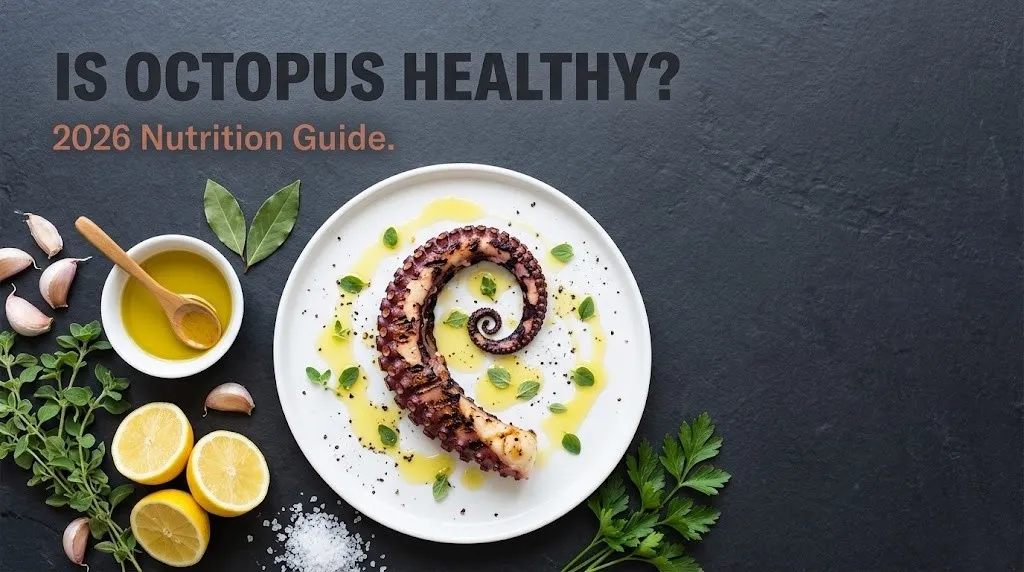
Octopus is not a new food. It has been a staple in Greek, Spanish, Portuguese, Italian, Japanese, and Korean cooking for centuries. Grilled octopus with olive oil and lemon is a classic Mediterranean dish. Takoyaki, battered octopus balls, is Japanese street food. Nakji bokkeum, stir-fried spicy octopus, is a Korean staple. Octopus ceviche and salad appear throughout Latin American coastal cuisines.
The entire animal is edible except for the beak, eyes, and internal organs. The tentacles are the most commonly served part. The head (mantle) is also eaten, often sliced into rounds. Octopus must be cooked properly, either quickly at high heat or slowly through braising, to transform its connective tissue into tender meat.
Dietary Sensitivity Note: Octopus is a mollusk, classified as shellfish. People with shellfish allergy should exercise caution. Mollusk allergy is distinct from crustacean allergy (shrimp, crab, lobster), but cross-reactivity is possible. Consult an allergist.
Octopus Nutrition Facts and Calories
A 3-ounce cooked serving of octopus contains approximately 139 calories, 25 grams of protein, 1.8 grams of fat, less than 1 gram of saturated fat, and 3.7 grams of carbohydrates, along with exceptional levels of iron, vitamin B12, and selenium.
Here is the full nutritional profile:
| Nutrient (per 3 oz cooked) | Amount | % Daily Value |
|---|---|---|
| Calories | 139 | — |
| Protein | 25g | 50% |
| Total Fat | 1.8g | 2% |
| Saturated Fat | 0.4g | 2% |
| Cholesterol | 82mg | 27% |
| Carbohydrates | 3.7g | 1% |
| Iron | 8.2mg | 46% |
| Vitamin B12 | 30mcg | 1,250% |
| Selenium | 76mcg | 138% |
| Copper | 0.6mg | 67% |
| Phosphorus | 237mg | 19% |
| Zinc | 2.9mg | 26% |
| Sodium | 391mg | 17% |
The protein-to-calorie ratio is outstanding. Twenty-five grams of protein for 139 calories makes octopus one of the most efficient protein sources available. The Academy of Nutrition and Dietetics identifies lean protein as a key component of a balanced diet that supports muscle maintenance and satiety.
The micronutrient profile is what separates octopus from other lean proteins. The iron, B12, and selenium levels are exceptional. These are discussed in detail in the sections below.
The fat content is negligible. Octopus is not a significant source of omega-3 fatty acids compared to fatty fish like salmon or sardines. A serving provides approximately 250 to 300 milligrams of combined EPA and DHA, about a quarter of what a serving of salmon provides. Octopus is a lean protein source first and an omega-3 source second.
Key Takeaway: A 3-ounce serving of octopus delivers 25 grams of protein for 139 calories with negligible fat and exceptional levels of iron, B12, and selenium.
Is Octopus Healthy
Octopus is a very healthy food because it provides complete, lean protein with an exceptional micronutrient profile including iron, vitamin B12, and selenium, while being naturally low in calories, fat, and saturated fat, and containing a moderate amount of heart-healthy omega-3 fatty acids.
The answer to “is octopus healthy” is a clear yes, with qualifications around cholesterol and sodium that are discussed below. The nutritional strengths of octopus far outweigh its potential concerns for most people.
What makes octopus a healthy choice:
- Complete protein with all essential amino acids at 25 grams per serving with only 1.8 grams of fat
- Exceptional iron content at 8.2 milligrams per serving (46 percent DV), making it one of the richest dietary sources of heme iron
- Extraordinary vitamin B12 at 30 micrograms per serving (1,250 percent DV), exceeding daily needs many times over
- Selenium at 76 micrograms (138 percent DV), supporting antioxidant function and thyroid health
- Low mercury classification by the FDA, making it safe for regular consumption
- Low calorie density at 139 calories per serving
What requires awareness:
- Cholesterol at 82 milligrams per serving. The USDA Dietary Guidelines removed the 300-milligram daily limit in 2015, recognizing that dietary cholesterol has less impact on blood cholesterol than saturated fat. Octopus is very low in saturated fat. The cholesterol content is not a concern for most people.
- Sodium at 391 milligrams per serving naturally. Octopus from the ocean contains sodium from seawater. Preparation methods can add significant sodium. This is manageable.
- Allergen potential as a mollusk shellfish
Dietary Sensitivity Note: The cholesterol in octopus is a frequently misunderstood topic. See the dedicated section below for a full explanation.
Health Benefits of Eating Octopus
Eating octopus supports muscle maintenance through high-quality protein, helps prevent iron-deficiency anemia through heme iron, supports nerve function and red blood cell formation through exceptional B12 levels, and provides antioxidant protection through selenium.
The health benefits of octopus are directly linked to its specific nutrient content. This is not a food with vague wellness claims. It is a food with measurable nutrients that perform specific functions.
Protein supports muscle maintenance and satiety. Twenty-five grams of complete protein per serving provides all nine essential amino acids in proportions the body can use efficiently. The branched-chain amino acids (leucine, isoleucine, valine) support muscle protein synthesis. The protein content promotes satiety, making octopus a filling meal component despite its low calorie count.
Iron prevents anemia and supports oxygen transport. Octopus contains heme iron, the form found in animal foods that is absorbed two to three times more efficiently than the non-heme iron in plants. The 8.2 milligrams of iron per serving represents nearly half the daily requirement. The NIH identifies iron as essential for hemoglobin formation and oxygen delivery to tissues. Iron deficiency is the most common nutrient deficiency worldwide, affecting approximately 30 percent of women of reproductive age.
Vitamin B12 supports nerve function and DNA synthesis. The 30 micrograms of B12 per serving is extraordinary. B12 is required for the formation of the myelin sheath that insulates nerve cells and for the maturation of red blood cells. Deficiency causes fatigue, neurological symptoms, and megaloblastic anemia. B12 is found almost exclusively in animal foods, making octopus particularly valuable for people who eat limited meat.
Selenium supports antioxidant defenses and thyroid function. Seventy-six micrograms of selenium provides more than the full daily requirement. Selenium is a cofactor for glutathione peroxidase, an antioxidant enzyme that protects cells from oxidative damage. It is also required for the conversion of thyroid hormone T4 to the active T3 form.
Key Takeaway: Octopus delivers specific, measurable health benefits through its protein, iron, B12, and selenium content. These are not marketing claims. They are nutrients with documented physiological functions.
Octopus Protein and Amino Acid Profile
Octopus provides 25 grams of complete protein per 3-ounce serving with all nine essential amino acids, making it comparable to chicken breast and superior to most seafood in protein density per calorie.
Protein quality is determined by two factors: the amino acid profile and digestibility. Animal proteins are generally complete and highly digestible. Octopus is no exception.
Here is how octopus protein compares to other common sources:
| Food (3 oz cooked) | Calories | Protein | Protein per 100 Calories |
|---|---|---|---|
| Octopus | 139 | 25g | 18g |
| Chicken breast | 140 | 26g | 18.6g |
| Salmon (wild) | 155 | 22g | 14.2g |
| Shrimp | 84 | 20g | 23.8g |
| Beef (sirloin) | 180 | 26g | 14.4g |
| Tofu (firm) | 70 | 8g | 11.4g |
Octopus and chicken breast are nearly identical in protein efficiency. Eighteen grams of protein per 100 calories is excellent. The Academy of Nutrition and Dietetics recommends approximately 0.8 grams of protein per kilogram of body weight for the average adult. A 150-pound adult needs about 55 grams per day. One serving of octopus provides nearly half that.
The amino acid profile includes all essential amino acids. Octopus is particularly rich in lysine, an amino acid often limiting in grain-based diets, and leucine, the branched-chain amino acid that directly stimulates muscle protein synthesis.
Dietary Sensitivity Note: Octopus is a complete protein suitable for omnivorous, pescatarian, and Mediterranean eating patterns. It is not suitable for vegetarian or vegan diets.
Iron and Vitamin B12 in Octopus
Octopus is one of the richest dietary sources of both iron and vitamin B12, providing 46 percent of the daily iron requirement and over 1,200 percent of the daily B12 requirement in a single 3-ounce serving.
These two nutrients are where octopus separates itself from nearly every other animal protein. The iron and B12 content is not just good. It is exceptional.
Iron in octopus (8.2mg per serving, 46% DV):
- Heme iron from animal tissue is absorbed at a rate of 15 to 35 percent, compared to 2 to 20 percent for non-heme iron from plants
- Iron is the central atom in hemoglobin, the protein that carries oxygen in red blood cells
- Iron deficiency causes fatigue, weakness, pale skin, and impaired cognitive function
- Women of reproductive age, pregnant individuals, and vegetarians are at highest risk for iron deficiency
- Octopus provides more iron per serving than beef (2.5mg), chicken (0.5mg), or salmon (0.5mg)
Vitamin B12 in octopus (30mcg per serving, 1,250% DV):
- B12 is required for DNA synthesis, red blood cell formation, and neurological function
- It is found almost exclusively in animal foods
- Deficiency causes megaloblastic anemia, fatigue, peripheral neuropathy, and cognitive changes
- Older adults, people taking metformin, and those with gastrointestinal disorders are at higher risk for B12 deficiency
- The extraordinary B12 content in octopus means one serving provides more than a week’s requirement
The combination of high iron and high B12 makes octopus particularly valuable for preventing and addressing anemia. Iron provides the raw material for hemoglobin. B12 supports the red blood cell maturation process. Together they address two different potential causes of anemia.
Dietary Sensitivity Note: The high iron content of octopus may be beneficial for people with iron deficiency but should be considered by those with hemochromatosis, a condition of iron overload. Consult your healthcare provider.
Is Octopus High in Cholesterol
Octopus contains 82 milligrams of cholesterol per 3-ounce serving, which is moderate but no longer considered a dietary concern by major health organizations because dietary cholesterol has minimal impact on blood cholesterol levels for most people compared to saturated fat, of which octopus has almost none.
This is the question that worries people about octopus. The cholesterol concern is largely outdated. Here is the context.
The USDA Dietary Guidelines for Americans removed the 300-milligram daily cholesterol limit in 2015. The current guidance states that dietary cholesterol is not a nutrient of concern for overconsumption. The American Heart Association’s 2019 science advisory on dietary cholesterol concluded that dietary cholesterol has a relatively small effect on blood LDL cholesterol compared to saturated fat.
Octopus is extremely low in saturated fat at 0.4 grams per serving. The saturated fat in the overall diet is the primary dietary driver of elevated blood cholesterol. Foods high in cholesterol and low in saturated fat, like octopus, shrimp, and eggs, are no longer considered problematic for heart health in moderate amounts.
Here is how cholesterol content compares across foods:
| Food (3 oz) | Cholesterol | Saturated Fat |
|---|---|---|
| Octopus | 82mg | 0.4g |
| Shrimp | 160mg | 0.3g |
| Chicken breast | 73mg | 0.6g |
| Salmon | 55mg | 1.8g |
| Beef sirloin | 75mg | 3.5g |
| Egg (1 large) | 186mg | 1.6g |
Octopus has a similar cholesterol profile to chicken breast. The saturated fat is lower than nearly every comparison food. Current evidence does not support limiting octopus consumption due to cholesterol concerns.
Dietary Sensitivity Note: Individuals with familial hypercholesterolemia or those specifically advised by their physician to limit dietary cholesterol should follow their doctor’s guidance.
Key Takeaway: Octopus contains dietary cholesterol but almost no saturated fat. Current dietary guidelines no longer restrict dietary cholesterol. The cholesterol in octopus is not a health concern for most people.
Sodium Content in Octopus
Octopus naturally contains approximately 391 milligrams of sodium per 3-ounce serving because it lives in seawater, and preparation methods like boiling in salted water or adding soy sauce or salt during cooking can significantly increase the sodium content of the final dish.
The sodium in octopus comes from two sources: the natural sodium in the animal’s tissues from living in seawater, and the sodium added during cooking and seasoning.
| Preparation Method | Approximate Sodium (3 oz) |
|---|---|
| Plain boiled octopus (unsalted water) | 250-350mg |
| Commercially prepared octopus | 350-500mg |
| Grilled octopus with olive oil and salt | 500-700mg |
| Octopus in soy-based marinade | 700-1,000mg |
| Fried calamari-style octopus | 600-900mg |
The American Heart Association recommends limiting sodium to 2,300 milligrams per day, with an ideal target of 1,500 milligrams. Plain octopus at 300 to 400 milligrams per serving fits easily within these limits. Octopus prepared with soy sauce, heavy salting, or commercial marinades can use a much larger portion of the sodium budget.
For sodium-conscious eating:
- Poach or boil octopus in unsalted water with aromatics (bay leaf, garlic, peppercorns) rather than salt
- Grill or sear with olive oil and a squeeze of lemon instead of salt-heavy marinades
- Use herbs, lemon zest, and smoked paprika for flavor instead of soy sauce
- Ask at restaurants whether octopus is brined or pre-salted before cooking
Dietary Sensitivity Note: People with hypertension or on sodium-restricted diets should be mindful of preparation methods. Plain grilled octopus with lemon is a low-sodium option. Octopus in soy-based sauces should be limited.
Octopus vs Other Seafood Nutrition Comparison
Octopus is leaner than salmon, higher in iron than beef, and comparable in protein to chicken breast, making it one of the most nutrient-dense seafood options available, particularly strong in iron, B12, and selenium compared to shrimp, squid, and most fish.
Here is how octopus compares to the seafood and proteins it competes with on a plate:
| Nutrient (3 oz cooked) | Octopus | Squid | Shrimp | Salmon | Chicken Breast |
|---|---|---|---|---|---|
| Calories | 139 | 156 | 84 | 155 | 140 |
| Protein | 25g | 26g | 20g | 22g | 26g |
| Total Fat | 1.8g | 2.6g | 1.0g | 7g | 3g |
| Saturated Fat | 0.4g | 0.7g | 0.3g | 1.5g | 0.9g |
| Cholesterol | 82mg | 260mg | 160mg | 55mg | 73mg |
| Iron | 8.2mg | 0.9mg | 0.3mg | 0.5mg | 0.5mg |
| Vitamin B12 | 30mcg | 5mcg | 1.5mcg | 4.5mcg | 0.3mcg |
| Selenium | 76mcg | 76mcg | 36mcg | 40mcg | 28mcg |
| Omega-3 (EPA+DHA) | 250mg | 300mg | 100mg | 1,500mg | 40mg |
Octopus is the clear winner on iron and B12. It matches squid and chicken on protein. It falls behind salmon on omega-3s. The choice between octopus and other seafood depends on what nutrients you need.
Choose octopus when you want maximum iron and B12 with lean protein. Choose salmon when you want maximum omega-3s. Choose shrimp when you want the lowest calorie count. All are healthy choices with different nutritional strengths.
Key Takeaway: Octopus is the best seafood choice for iron and B12. It is comparable to chicken breast for lean protein. It has less omega-3 than fatty fish but more than most other animal proteins.
Is Octopus Healthy for Weight Loss
Octopus is an excellent food for weight loss because it provides 25 grams of satiating protein for only 139 calories with almost no fat, making it one of the most filling foods per calorie available.
Weight loss requires a sustained calorie deficit. Foods that help achieve that deficit are high in protein, low in calorie density, and satiating. Octopus excels on all three criteria.
The protein content of 25 grams per serving triggers satiety hormones including GLP-1 and PYY. A 2019 study in the journal Obesity found that meals with at least 25 grams of protein reduced post-meal hunger compared to lower-protein meals matched for calories. A serving of octopus meets this threshold alone.
The calorie density is very low. At 139 calories for a 3-ounce serving, octopus can anchor a meal that stays under 400 to 500 calories while providing enough protein to maintain muscle during a calorie deficit. Compare this to a 3-ounce serving of beef sirloin at 180 calories or a breaded and fried portion of calamari at 250 to 350 calories.
For weight loss, prepare octopus simply. Grill it with olive oil spray and lemon. Serve it over a large salad or with roasted vegetables. Avoid fried octopus dishes and heavy oil-based marinades, which can double the calorie content.
Dietary Sensitivity Note: The cooking method determines whether octopus remains a weight-loss-friendly food. Grilled, boiled, or steamed octopus is lean. Fried octopus is not.
Octopus on the Mediterranean Diet
Octopus fits naturally into the Mediterranean diet as a lean seafood protein that is traditionally prepared with olive oil, lemon, garlic, and herbs, aligning with the diet’s emphasis on seafood, healthy fats, and plant-based accompaniments.
The Mediterranean diet, widely studied for its cardiovascular benefits, recommends seafood at least twice per week. Octopus is a classic protein in Greek, Spanish, Italian, and coastal Mediterranean cuisines. Grilled octopus with olive oil, lemon, and oregano is a textbook Mediterranean dish.
The Cleveland Clinic identifies the Mediterranean diet as one of the most evidence-supported eating patterns for heart health. Octopus fits the diet’s guidelines: lean protein, low saturated fat, prepared with olive oil and vegetables.
A Mediterranean-style octopus meal:
- 3 ounces grilled octopus
- Drizzle of extra-virgin olive oil
- Squeeze of fresh lemon
- Sprinkle of dried oregano and sea salt
- Served alongside a salad of tomatoes, cucumber, red onion, and olives
- Small portion of boiled potatoes or crusty whole-grain bread
Dietary Sensitivity Note: The Mediterranean diet is flexible. Octopus works within it as a lean protein. The olive oil and vegetables served alongside are as important as the octopus itself.
Mercury and Heavy Metals in Octopus
Octopus is classified as a low-mercury seafood by the FDA, making it safe for regular consumption including during pregnancy, with a recommended intake of 2 to 3 servings per week.
Mercury is the primary heavy metal concern with seafood. Large, long-lived predatory fish like tuna, shark, and swordfish accumulate mercury in their tissues over time. Octopus is a short-lived mollusk that feeds low on the food chain. It does not accumulate significant mercury.
The FDA classifies octopus in the “Best Choices” category for mercury, meaning it contains less than 0.15 parts per million of mercury. This is the same category as salmon, shrimp, and sardines. The recommendation for this category is 2 to 3 servings per week for all adults, including pregnant and breastfeeding individuals.
| Seafood | FDA Mercury Category | Servings per Week |
|---|---|---|
| Octopus | Best Choices (lowest) | 2-3 |
| Salmon | Best Choices (lowest) | 2-3 |
| Shrimp | Best Choices (lowest) | 2-3 |
| Canned tuna (light) | Good Choices (moderate) | 1 |
| Albacore tuna | Good Choices (moderate) | 1 |
| Swordfish | Choices to Avoid (high) | 0 |
Heavy metals other than mercury, including cadmium and lead, have been detected at very low levels in octopus. A 2022 study in the journal Foods found that heavy metal levels in commercially available octopus were well below safety thresholds established by the European Food Safety Authority.
Dietary Sensitivity Note: The FDA recommends that pregnant and breastfeeding individuals eat 2 to 3 servings of low-mercury seafood per week. Octopus qualifies.
Shellfish Allergy and Octopus Safety
Octopus is a mollusk shellfish and can trigger allergic reactions in people with shellfish allergy, though mollusk allergy is distinct from crustacean allergy, and some people allergic to shrimp and crab can tolerate octopus and squid.
Shellfish allergy is one of the most common food allergies in adults. It is important to distinguish between the two categories:
- Crustaceans: Shrimp, crab, lobster, crayfish
- Mollusks: Octopus, squid, clams, mussels, oysters, scallops
The allergenic proteins in crustaceans and mollusks are different. Someone allergic to shrimp is not automatically allergic to octopus. However, cross-reactivity is possible. The American College of Allergy, Asthma and Immunology recommends that people with shellfish allergy consult their allergist before trying mollusks if they have only previously reacted to crustaceans.
Octopus allergy symptoms are the same as other food allergies: hives, itching, swelling, difficulty breathing, gastrointestinal distress, and in severe cases, anaphylaxis. Anyone with a known octopus allergy should avoid it completely.
Dietary Sensitivity Note: Octopus is often prepared in restaurants alongside shrimp and other shellfish. Cross-contamination is possible. Inform the kitchen of your allergy.
Healthiest Ways to Cook Octopus
The healthiest ways to cook octopus are boiling or braising until tender, then finishing on the grill or in a hot pan with minimal oil, which produces tender, flavorful octopus without adding significant fat, calories, or sodium.
Octopus requires specific cooking technique to be tender. The connective tissue is tough and must be broken down by either long, slow cooking or a brief high-heat sear after tenderizing. Here is how different methods affect nutrition:
| Cooking Method | Calories (3 oz) | Fat Added | Sodium | Texture |
|---|---|---|---|---|
| Boiled or braised | 139 | 0g | Variable | Tender |
| Grilled (after tenderizing) | 160 | 2-3g (from oil brush) | Variable | Charred exterior, tender interior |
| Pan-seared | 165 | 3-4g | Variable | Crisp exterior |
| Fried | 250-350 | 12-18g | High | Crispy coating, tender inside |
| Marinated and grilled | 170 | 3-5g | High (from marinade) | Flavorful, tender |
The classic technique: Simmer octopus in water with aromatics (bay leaf, garlic, peppercorns, wine cork if available) for 45 to 90 minutes depending on size, until a knife slides in easily. Drain and cool. The octopus can be refrigerated at this stage for up to 2 days. When ready to serve, brush with olive oil, season lightly, and grill or sear over high heat for 2 to 3 minutes per side until charred and heated through.
The quick method (for small octopus): Tenderize by massaging with salt or dipping in boiling water three times. Then grill or sear over high heat for 3 to 4 minutes per side. This works for very small octopus but is less reliable than braising.
Dietary Sensitivity Note: The braising liquid is flavorful and can be used as a base for soup or sauce, capturing water-soluble nutrients that leach from the octopus.
How to Buy, Store, and Prepare Octopus
Buy octopus fresh or frozen from a reputable fishmonger, store fresh octopus in the coldest part of the refrigerator and cook within 1 day, or store frozen for up to 3 months, and tenderize by braising before grilling or searing for the best texture.
Buying octopus:
- Fresh octopus should smell like the ocean, not fishy or ammonia-like
- The flesh should be firm and moist, not slimy or dull
- Frozen octopus is often pre-tenderized during freezing. It is an excellent option and may be more tender than fresh.
- Look for octopus from sustainable fisheries. The Monterey Bay Aquarium Seafood Watch provides guidance.
Storing octopus:
- Fresh octopus: Refrigerate at 32 to 38 degrees Fahrenheit. Use within 1 day.
- Cooked octopus: Refrigerate in an airtight container for up to 3 days.
- Frozen octopus: Freeze at 0 degrees Fahrenheit or below. Use within 3 months. Thaw overnight in the refrigerator.
Preparing octopus:
- If the octopus has not been cleaned, remove the beak, eyes, and internal organs. Your fishmonger can do this.
- Rinse under cold water.
- Tenderize by braising in water or court-bouillon with aromatics until a knife slides in easily, 45 to 90 minutes.
- Cool in the cooking liquid to retain moisture.
- Cut tentacles from the head. Slice the head into rings if desired.
- Grill, sear, or use in salads, pastas, or grain bowls.
Quick Tip:
- A wine cork added to the braising liquid is a traditional Mediterranean practice. The enzymes in cork are said to help tenderize the octopus. The evidence is anecdotal, but the tradition persists in many kitchens.
Key Takeaway: Braise octopus until tender, then grill or sear for the best combination of texture and flavor. Frozen octopus is often more tender than fresh.
Frequently Asked Questions About Octopus
Is octopus healthier than chicken?
Octopus and chicken breast are nutritionally comparable in protein and calories, with octopus being significantly higher in iron, B12, and selenium.
Chicken breast is slightly higher in protein per calorie (18.6g vs 18g per 100 calories).
Octopus is the better choice for iron and B12. Chicken is slightly leaner. Both are healthy.
Is octopus high in cholesterol?
Octopus contains 82 milligrams of cholesterol per serving, which is moderate but not a health concern because dietary cholesterol has minimal impact on blood cholesterol for most people.
The saturated fat content of octopus is extremely low at 0.4 grams per serving.
Current dietary guidelines do not restrict dietary cholesterol for the general population.
Can I eat octopus every day?
Octopus is safe to eat 2 to 3 times per week as part of a varied diet, consistent with FDA recommendations for low-mercury seafood.
Eating octopus every day could lead to excessive intake of certain micronutrients, particularly selenium and copper, though toxicity from food alone is unlikely.
Variety in protein sources is recommended by the Academy of Nutrition and Dietetics.
Is octopus good for iron deficiency?
Octopus is an excellent food for preventing and addressing iron deficiency because it provides 8.2 milligrams of heme iron per serving, 46 percent of the daily value.
Heme iron from animal foods is absorbed more efficiently than non-heme iron from plants.
The B12 in octopus also supports red blood cell formation, addressing another potential cause of anemia.
Is grilled octopus healthier than fried calamari?
Yes, grilled octopus is significantly healthier than fried calamari because it eliminates the breading and frying oil that add 10 to 15 grams of fat and 100 to 200 calories.
Grilled octopus prepared with olive oil and lemon is a lean protein dish with minimal added fat.
Fried calamari is an indulgent preparation that should be enjoyed occasionally rather than as a regular choice.
Octopus is one of the most nutrient-dense foods in the ocean. It delivers complete protein with virtually no fat, exceptional iron for blood health, extraordinary B12 for nerve function, and selenium for antioxidant protection. It is low in mercury, fits the Mediterranean diet, and works for weight loss, keto, and balanced eating patterns.
The cholesterol concern is outdated. The sodium depends on how you prepare it. The allergy risk is real for shellfish-allergic individuals. For everyone else, octopus is a healthy seafood that deserves a place alongside salmon, shrimp, and the other proteins in your rotation.
Grill it with olive oil and lemon. Serve it over a salad of tomatoes and herbs. Eat it the way the Mediterranean has for centuries: as a lean, flavorful protein that makes the vegetables around it taste better. That is octopus at its best.