A healthy donut recipe replaces the refined white flour, deep-frying oil, and sugar-dense glaze of traditional donuts with whole wheat flour for fiber, Greek yogurt for protein and moisture, and baking instead of frying, producing a soft, tender donut at 130 to 155 calories with 4 to 6 grams of protein and a fraction of the fat and sugar of a standard fried glazed donut.
A traditional glazed donut from a chain shop is a nutritional wreck. Fried in oil. Made from refined white flour. Coated in a sugar glaze that hardens into a sweet shell. A single donut delivers 250 to 400 calories, 15 to 25 grams of fat, and 20 to 30 grams of sugar. It is a dessert that people have been mistakenly categorizing as a breakfast food.
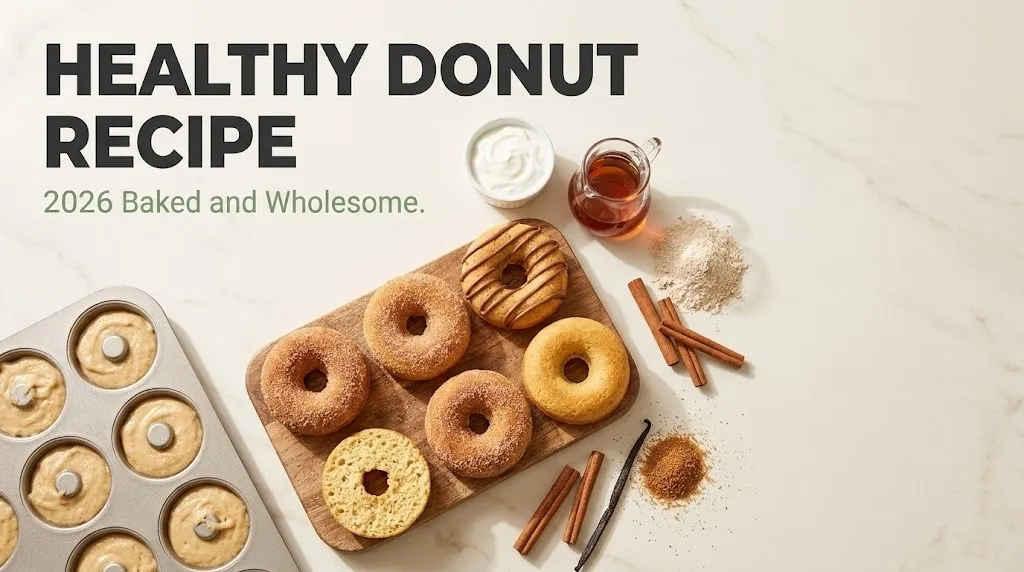
A healthy homemade donut is a different thing entirely. It is a small baked cake in the shape of a ring, made from whole grain flour, moistened with Greek yogurt, sweetened lightly, and finished with a dusting of cinnamon sugar or a thin glaze. It satisfies the craving for a donut without the sugar crash and grease. This article gives you the master recipe, the nutritional comparison, and every variation you need.
What Makes Traditional Donuts Unhealthy
Traditional donuts are unhealthy because they are made from refined white flour, deep-fried in oil that adds 15 to 25 grams of fat per donut, and coated in a sugar glaze that contributes 15 to 25 grams of added sugar, delivering a total of 250 to 400 calories with almost no fiber, protein, or micronutrients.
A standard glazed donut from a major chain breaks down like this:
| Nutrient | Glazed Donut (1) | Chocolate Frosted | Jelly Filled |
|---|---|---|---|
| Calories | 260 | 370 | 340 |
| Total Fat | 14g | 20g | 18g |
| Saturated Fat | 6g | 9g | 8g |
| Carbohydrates | 31g | 43g | 40g |
| Dietary Fiber | 0.5g | 0.5g | 1g |
| Sugars | 16g | 24g | 20g |
| Added Sugars | 14g | 22g | 18g |
| Protein | 3g | 4g | 4g |
The American Heart Association recommends limiting added sugars to 25 grams per day for women and 36 grams for men. A single chocolate frosted donut consumes nearly an entire day’s sugar allowance. The fat comes from the frying oil, which in many commercial operations is partially hydrogenated and contains trans fats, the most harmful type of fat for cardiovascular health.
The refined white flour provides calories without fiber, B vitamins, or minerals. The frying oil is absorbed into the dough, adding significant fat and calories without satiety. The sugar glaze is pure sucrose that spikes blood glucose. The result is a food that tastes good for the 90 seconds it takes to eat and offers nothing nutritionally beyond that.
Key Takeaway: A traditional fried glazed donut is a sugar-and-fat delivery vehicle made from refined ingredients with negligible nutritional value. The healthy version is a different food in the same shape.
Key Ingredient Swaps for Healthy Donuts
The three ingredient swaps that make donuts healthier are replacing all-purpose flour with whole wheat flour or oat flour, replacing butter or oil with Greek yogurt for moisture and protein, and replacing the sugar-heavy glaze with a light cinnamon sugar coating or a thin drizzle of maple glaze.
Each swap addresses a different nutritional weakness.
Whole wheat flour for all-purpose flour. White flour is stripped of the bran and germ, removing fiber, B vitamins, and iron. White whole wheat flour provides the same fiber and nutrients with a milder flavor. Oat flour is naturally sweet and gluten free. Both add 2 to 3 grams of fiber per donut.
Greek yogurt for butter and oil. Traditional donut batter contains melted butter or oil. Greek yogurt provides moisture and tenderness without the saturated fat. A half-cup of Greek yogurt replaces a quarter-cup of oil, cutting 50 grams of fat and 450 calories from the batch while adding 12 grams of protein.
Light sweetener and baked instead of fried. The donuts are baked in a donut pan, eliminating the frying oil entirely. The sweetener is reduced to 3 to 4 tablespoons of maple syrup or honey for the entire batch. The topping is a light brush of melted butter and a dusting of cinnamon sugar, adding about 30 calories per donut rather than the 100 to 150 calories of a full sugar glaze.
Here is how the ingredient swaps compare:
| Traditional Ingredient | Healthy Swap | Nutritional Impact |
|---|---|---|
| 2 cups all-purpose flour | 2 cups white whole wheat flour | Plus 10-12g fiber per batch |
| 1/4 cup oil or melted butter | 1/2 cup Greek yogurt | Minus 50g fat, plus 12g protein |
| Deep frying | Baking in donut pan | Minus 15-25g fat per donut |
| Sugar glaze | Cinnamon sugar dusting | Minus 12-18g added sugar per donut |
| 1/2 cup sugar in batter | 3 tbsp maple syrup | Minus 80g sugar per batch |
Dietary Sensitivity Note: Whole wheat flour contains gluten. For gluten free, use certified gluten-free oat flour or a 1:1 gluten-free baking blend. Greek yogurt contains dairy. Use applesauce or dairy-free yogurt for dairy-free donuts.
Healthy Baked Donuts Master Recipe
This healthy baked donuts master recipe uses white whole wheat flour, Greek yogurt, maple syrup, and a light cinnamon sugar coating to produce 12 soft, tender donuts at approximately 140 calories each, ready in under 30 minutes.
Ingredients:
- 2 cups white whole wheat flour
- 1 teaspoon baking powder
- 1/2 teaspoon baking soda
- 1/4 teaspoon salt
- 1 teaspoon ground cinnamon (optional)
- 1/2 cup plain Greek yogurt (2 percent or whole milk)
- 1/4 cup maple syrup
- 2 large eggs, at room temperature
- 3 tablespoons melted coconut oil or butter
- 1 teaspoon vanilla extract
- 1/4 cup milk (any kind)
For the topping:
- 1 tablespoon melted butter or coconut oil
- 2 tablespoons coconut sugar or granulated sugar mixed with 1/2 teaspoon cinnamon
Instructions:
- Preheat oven to 350 degrees Fahrenheit. Grease a 12-cavity donut pan thoroughly with cooking spray or oil.
- In a large bowl, whisk together the flour, baking powder, baking soda, salt, and cinnamon.
- In a separate bowl, whisk together the Greek yogurt, maple syrup, eggs, melted oil, vanilla, and milk until smooth.
- Pour the wet ingredients into the dry ingredients. Stir with a spatula just until combined and no dry flour is visible. Small lumps are acceptable. Do not overmix. Overmixing develops gluten and produces tough donuts.
- Transfer the batter to a piping bag or a zip-top bag with the corner snipped off. Pipe the batter into the prepared donut pan cavities, filling each about two-thirds full. The batter will rise.
- Bake for 10 to 12 minutes, until the donuts spring back when lightly touched and a toothpick inserted into the thickest part comes out clean.
- Let the donuts cool in the pan for 5 minutes, then transfer to a wire rack.
- While the donuts are still warm, brush each lightly with melted butter and dip or sprinkle with the cinnamon sugar mixture.
Nutrition per donut (1 of 12, with topping): Approximately 140 calories, 5g protein, 5g fat, 1.5g saturated fat, 20g carbohydrates, 2g fiber, 5g sugar, 3g added sugar.
Quick Tip:
- If you do not have a piping bag, spoon the batter into the donut pan and smooth with the back of a spoon. A piping bag produces neater donuts but is not required.
Healthy Donuts Nutrition Facts and Comparison
One healthy baked donut contains approximately 130 to 155 calories, 4 to 6 grams of protein, and 3 to 5 grams of added sugar, compared to 250 to 400 calories, 3 to 4 grams of protein, and 14 to 24 grams of added sugar in a traditional fried glazed donut.
Here is how the healthy version compares:
| Nutrient (per donut) | Traditional Glazed | Healthy Baked | Healthy No Sugar Topping |
|---|---|---|---|
| Calories | 260 | 140 | 120 |
| Protein | 3g | 5g | 5g |
| Total Fat | 14g | 5g | 4g |
| Saturated Fat | 6g | 1.5g | 1g |
| Carbohydrates | 31g | 20g | 18g |
| Dietary Fiber | 0.5g | 2g | 2g |
| Added Sugars | 14g | 3g | 0g |
The protein increase from 3 grams to 5 grams comes from the Greek yogurt and eggs. This is a modest absolute difference but a meaningful relative improvement, nearly doubling the protein content.
The fat reduction from 14 grams to 5 grams is the most dramatic change. Eliminating the deep-frying step removes approximately 100 calories and 10 grams of fat per donut. The small amount of fat in the baked version comes from the coconut oil or butter in the batter and the light coating.
The added sugar drops from 14 grams to 3 grams. The maple syrup in the batter contributes a small amount of sugar distributed across 12 donuts. The cinnamon sugar topping adds a modest amount. For zero added sugar, omit the topping entirely or use a zero-calorie sweetener.
Key Takeaway: The healthy baked donut has half the calories, one-third the fat, double the protein, and a fraction of the added sugar of a traditional fried donut.
Baked vs Fried Donuts
Baked donuts are significantly healthier than fried donuts because they eliminate the 10 to 15 grams of frying oil absorbed by each donut during deep frying, which removes approximately 100 to 150 calories and the trans fats or degraded vegetable oils that come with commercial frying.
The difference between baked and fried donuts is not marginal. It is the single largest nutritional lever in donut making.
| Factor | Fried Donut | Baked Donut |
|---|---|---|
| Cooking method | Submerged in 350-375 degree oil | Baked in 350 degree oven |
| Fat absorbed | 10-15g per donut | None beyond batter ingredients |
| Calories from frying | 90-140 per donut | 0 |
| Trans fat risk | Yes (from degraded frying oil) | No |
| Texture | Crisp exterior, fluffy interior | Soft, cake-like |
| Equipment needed | Deep fryer or heavy pot | Donut pan or muffin tin |
Frying oil is absorbed into the dough as the donut cooks. The hot oil causes water in the batter to vaporize, creating steam that pushes outward. As the donut cools, the interior pressure drops and oil is drawn into the spaces left by the escaping steam. A fried donut is literally soaked in oil. That is what makes it taste good. It is also what makes it a nutritional problem.
Baked donuts rely on chemical leaveners (baking powder and baking soda) for their rise. The texture is different. Baked donuts are softer and more cake-like. They lack the crisp, greasy crust of a fried donut. They are closer to a muffin baked in a ring shape. That is a fair description of what a healthy donut is: a whole grain muffin in donut form.
Dietary Sensitivity Note: Baked donuts eliminate the risk of trans fats from degraded frying oil. If you prefer fried donuts occasionally, frying at home in fresh oil and eating them immediately is safer than consuming commercially fried donuts made with repeatedly heated oil.
Whole Wheat Flour and Greek Yogurt in Healthy Donuts
Whole wheat flour adds fiber, B vitamins, and minerals to healthy donuts while Greek yogurt provides protein, moisture, and tenderness that replaces much of the butter or oil in traditional recipes.
These two ingredients are the foundation of healthy donut making. Understanding what they do helps you adapt other recipes.
Whole wheat flour contains the entire wheat kernel: bran, germ, and endosperm. The bran provides insoluble fiber. The germ provides vitamin E, B vitamins, and healthy fats. The endosperm provides the starch and protein that form the structure of the donut. White whole wheat flour is milled from a lighter wheat variety. It has the same nutritional profile as regular whole wheat but a milder flavor that works well in donuts.
Greek yogurt is made by straining whey from fermented milk. The result is thick, tangy, and high in protein. In donut batter, the water in the yogurt turns to steam during baking, creating rise and tenderness. The milk proteins interfere with gluten formation, keeping the crumb soft. The acidity reacts with baking soda, adding lift. The fat content, even in nonfat Greek yogurt, is sufficient to contribute richness.
The combination of whole wheat flour and Greek yogurt in a 2-to-1/2-cup ratio produces a donut batter that bakes into a soft, tender crumb without the need for cups of oil or butter. The donuts are moist but not greasy, tender but not crumbly.
Dietary Sensitivity Note: Whole wheat flour contains gluten. Greek yogurt contains dairy. For gluten-free and dairy-free adaptations, see the dedicated sections below.
Best Natural Sweeteners for Healthy Donuts
The best natural sweeteners for healthy donuts are maple syrup for flavor, honey for moisture, coconut sugar for a granulated option, and mashed banana or applesauce for reducing or eliminating added sweetener entirely.
The sweetener strategy is to use less sweetener overall and to choose sweeteners that contribute flavor beyond just sweetness.
| Sweetener | Calories per Tbsp | Best For |
|---|---|---|
| Maple syrup | 52 | Classic donut flavor, moisture |
| Honey | 64 | Floral sweetness, moisture |
| Coconut sugar | 45 | Granulated, 1:1 sugar substitute |
| Mashed banana | 25 | Replacing sweetener and fat |
| Monk fruit/erythritol | 0 | Zero-calorie, diabetic friendly |
The batter for 12 donuts uses only 3 to 4 tablespoons of maple syrup. Distributed across the batch, this is about 1 teaspoon of maple syrup per donut, contributing approximately 4 grams of sugar. The majority of the sweetness comes from the natural sugars in the flour and dairy, plus the perception of sweetness from vanilla and cinnamon.
For the topping, a cinnamon sugar dusting uses 2 tablespoons of sugar for the entire batch. That is about half a teaspoon of sugar per donut. For a thinner coating that still provides flavor, brush the donuts with milk or a small amount of melted butter and dust with cinnamon alone, skipping the sugar.
Dietary Sensitivity Note: Maple syrup and coconut sugar are vegan. Honey is not. Monk fruit and erythritol are zero-calorie and suitable for diabetic-friendly baking.
How to Make Healthy Donuts Without a Donut Pan
Make healthy donuts without a donut pan by using a muffin tin with small balls of aluminum foil in the center to create the hole, piping the batter in rings on a parchment-lined baking sheet, or baking the batter as muffins and calling them donut muffins.
A donut pan is a single-purpose kitchen tool. Not everyone has one. Here are three methods that produce donut-shaped or donut-adjacent results without one.
Foil-in-muffin-tin method:
- Grease a 12-cup muffin tin.
- Tear off 12 small squares of aluminum foil, about 4 inches each.
- Roll each square into a ball roughly the size of a marble.
- Place one foil ball in the center of each muffin cup.
- Pipe or spoon batter around the foil ball, filling the cup about two-thirds full.
- Bake as directed. Remove the foil balls after cooling.
Piped ring method:
- Line a baking sheet with parchment paper.
- Transfer the batter to a piping bag with a large round tip or a zip-top bag with the corner cut off.
- Pipe rings of batter onto the parchment, about 3 inches in diameter.
- Bake as directed. The donuts will be slightly flatter than pan-baked donuts but will hold their shape.
Donut muffin method:
- Grease a standard muffin tin.
- Fill each cup about two-thirds full with batter.
- Bake as directed, adding 2 to 3 minutes to the baking time.
- Brush the muffin tops with butter and cinnamon sugar.
- Call them donut muffins. They taste the same.
The foil method produces the most authentic donut shape. The piped ring method produces the flattest donuts but the clearest ring shape. The muffin method is the easiest and produces the most reliable texture.
Quick Tip:
- Whatever method you use, do not overfill. The batter needs room to rise. Two-thirds full is the rule for all donut and muffin baking.
Gluten Free Healthy Donuts Recipe
Gluten free healthy donuts use a blend of certified gluten-free oat flour and almond flour to replace wheat flour, producing a tender, moist donut with more protein and healthy fats than the wheat-based version.
Oat flour provides the structure and a naturally sweet flavor. Almond flour adds moisture, protein, and tenderness. Together they create a donut that holds together without gluten and tastes better than most gluten-free baked goods.
Gluten free healthy donuts (makes 12):
Ingredients:
- 1 and 1/2 cups certified gluten-free oat flour
- 1/2 cup almond flour
- 1 teaspoon baking powder
- 1/2 teaspoon baking soda
- 1/4 teaspoon salt
- 1 teaspoon cinnamon (optional)
- 1/2 cup Greek yogurt or dairy-free yogurt
- 1/4 cup maple syrup
- 2 large eggs
- 3 tablespoons melted coconut oil
- 1 teaspoon vanilla extract
- 1/4 cup milk or plant milk
Instructions: Follow the master recipe. The batter will be slightly thicker due to the almond flour. Bake at 350 degrees Fahrenheit for 11 to 13 minutes.
Nutrition per donut: Approximately 150 calories, 5g protein, 7g fat, 17g carbohydrates, 2g fiber.
Dietary Sensitivity Note: Oats must be certified gluten-free to avoid cross-contamination. Almond flour contains tree nuts. For nut-free gluten-free donuts, use all oat flour and add 2 extra tablespoons of milk to compensate for the moisture the almond flour would have provided.
Vegan Healthy Donuts Recipe
Vegan healthy donuts replace the egg with a flax egg, the Greek yogurt with applesauce or dairy-free yogurt, and use maple syrup and coconut oil for a completely plant-based donut that is just as tender as the original.
Flax eggs work well in donut batter because the structure comes from the flour and chemical leaveners more than from eggs. The result is a slightly denser donut that is still soft and satisfying.
Vegan healthy donuts (makes 12):
Ingredients:
- 2 flax eggs (2 tbsp ground flaxseed plus 5 tbsp water, set for 5 minutes)
- 2 cups white whole wheat flour
- 1 teaspoon baking powder
- 1/2 teaspoon baking soda
- 1/4 teaspoon salt
- 1 teaspoon cinnamon
- 1/2 cup unsweetened applesauce or dairy-free yogurt
- 1/4 cup maple syrup
- 3 tablespoons melted coconut oil
- 1 teaspoon vanilla extract
- 1/4 cup plant milk (oat, almond, or soy)
Instructions: Prepare the flax eggs first. Proceed with the master recipe. Bake at 350 degrees Fahrenheit for 12 to 14 minutes, slightly longer than the egg version.
Nutrition per donut: Approximately 130 calories, 3g protein, 4.5g fat, 20g carbohydrates, 2g fiber.
Dietary Sensitivity Note: These donuts are vegan when made with maple syrup. All ingredients are plant-based. For gluten-free vegan donuts, use the gluten-free flour blend with flax eggs and applesauce.
Healthy Donuts With No Added Sugar
Healthy donuts with no added sugar use very ripe mashed banana for sweetness, cinnamon and vanilla to enhance sweetness perception, and omit the sugar topping entirely, producing a donut with approximately 110 calories and zero grams of added sugar.
A no-added-sugar donut is a breakfast pastry that crosses over into healthy snack territory. The sweetness comes from the banana, the natural milk sugars in the yogurt, and the perception enhancement from cinnamon and vanilla.
No-added-sugar healthy donuts (makes 12):
Ingredients:
- 1/2 cup mashed very ripe banana (about 1 large, heavily spotted)
- 1/2 cup Greek yogurt
- 2 large eggs
- 3 tablespoons melted coconut oil
- 2 teaspoons vanilla extract
- 2 cups white whole wheat flour
- 1 teaspoon baking powder
- 1/2 teaspoon baking soda
- 1/4 teaspoon salt
- 2 teaspoons cinnamon
- 1/4 cup milk
Instructions: The banana replaces the maple syrup. Follow the master recipe. Bake at 350 degrees Fahrenheit for 10 to 12 minutes. Brush with milk and dust with cinnamon instead of cinnamon sugar.
Nutrition per donut: Approximately 110 calories, 4g protein, 4g fat, 16g carbohydrates, 2g fiber, 2g sugar, 0g added sugar.
Dietary Sensitivity Note: These donuts contain natural sugars from banana and dairy but no added sugars. People with diabetes should count approximately 16 grams of carbohydrate per donut.
Key Takeaway: Very ripe banana can replace all added sweetener in donuts, producing a lightly sweet, spiced donut with zero grams of added sugar.
High Protein Healthy Donuts
High protein healthy donuts add a scoop of unflavored or vanilla protein powder to the dry ingredients, boosting the protein content from 5 grams to 8 to 10 grams per donut for a more satiating breakfast or post-workout snack.
Standard healthy donuts provide about 5 grams of protein. For someone wanting a more substantial breakfast pastry, adding protein powder makes these donuts work harder.
Modifications to the master recipe:
- Reduce flour to 1 and 3/4 cups
- Add 1 scoop (25g) vanilla or unflavored protein powder
- Add 1 to 2 extra tablespoons milk to compensate for the moisture-absorbing protein powder
Protein options:
- Whey protein: Complete, blends invisibly, best texture
- Plant protein blend: Works well, may be slightly drier
- Collagen peptides: Dissolves completely, adds protein but not complete
Nutrition per donut (with whey protein): Approximately 150 calories, 8g protein, 5g fat, 19g carbohydrates, 2g fiber.
Dietary Sensitivity Note: Whey contains dairy. Plant protein is dairy-free. Collagen is not vegetarian or vegan.
Healthy Donut Recipe for Kids
Healthy donuts for kids use the master recipe with a fun topping approach: a thin yogurt glaze colored naturally, rainbow sprinkles made without artificial dyes, or a cinnamon sugar coating that tastes like a churro.
Kids care about two things: does it taste good, and does it look fun. The nutritional upgrades in the master recipe, whole wheat flour, Greek yogurt, less sugar, are invisible to a child. The flavor and the topping are what sell the donut.
Kid-friendly topping ideas:
- Cinnamon sugar: The most reliable kid-pleaser
- Yogurt glaze: Mix 1/4 cup powdered sugar with 1 to 2 tablespoons Greek yogurt and a drop of vanilla. Drizzle over cooled donuts
- Chocolate drizzle: Melt 2 tablespoons dark chocolate chips with 1/2 teaspoon coconut oil. Drizzle with a fork
- Naturally colored sprinkles: Look for brands that use vegetable extracts instead of artificial dyes
- Freeze-dried fruit powder: Crush freeze-dried strawberries or raspberries into a powder and sprinkle over a thin yogurt glaze
The donuts themselves are the same recipe. The toppings make them kid-friendly. A yogurt glaze adds about 20 calories per donut. A chocolate drizzle adds about 15 calories. These are modest additions that make the donuts feel like a treat.
Dietary Sensitivity Note: For a classroom or birthday party where allergies are a concern, use the gluten-free and dairy-free adaptations. Nut-free sprinkles are widely available.
Healthy Donut Flavor Variations and Toppings
Healthy donut flavor variations include chocolate, blueberry, pumpkin spice, apple cinnamon, and lemon poppy seed, each adding flavor and nutrition through whole food ingredients rather than artificial flavorings.
The master batter is a blank canvas. With a few additions, you can produce a dozen different donut flavors.
Flavor variations (add to the master recipe):
Chocolate donuts: Replace 1/4 cup of the flour with unsweetened cocoa powder. Add 1 extra tablespoon maple syrup and 1 extra tablespoon milk. The cocoa absorbs liquid.
Blueberry donuts: Fold 3/4 cup fresh or frozen blueberries into the batter gently. Do not overmix or the berries will bleed purple streaks.
Pumpkin spice donuts: Replace the Greek yogurt with pumpkin puree. Add 2 teaspoons pumpkin pie spice. Reduce milk to 2 tablespoons.
Apple cinnamon donuts: Add 1/2 cup finely diced apple and 1 extra teaspoon cinnamon. Reduce milk slightly to compensate for the apple moisture.
Lemon poppy seed donuts: Add zest of 1 lemon and 2 tablespoons poppy seeds. Replace vanilla with 1/2 teaspoon lemon extract.
Banana nut donuts: Replace Greek yogurt with mashed banana. Fold in 1/4 cup chopped walnuts.
Topping options by calories added per donut:
| Topping | Calories Added |
|---|---|
| Cinnamon dusting (no sugar) | 0 |
| Cinnamon sugar (1/2 tsp) | 15 |
| Yogurt glaze drizzle | 20 |
| Dark chocolate drizzle | 15 |
| Crushed freeze-dried fruit | 5 |
| Chopped nuts | 25 |
| Toasted coconut | 20 |
Dietary Sensitivity Note: Nuts are common allergens. Seeds (pumpkin, sunflower) provide similar crunch without nuts.
Key Takeaway: The master donut batter is a blank canvas. Cocoa, fruit, spices, and citrus create distinct flavors. Toppings add personality without undoing the healthy profile.
How to Store and Keep Healthy Donuts Fresh
Healthy baked donuts stay fresh at room temperature for 2 to 3 days in an airtight container, in the refrigerator for up to 5 days, and in the freezer for up to 3 months when individually wrapped, making them a practical make-ahead breakfast or snack.
The high moisture content from the Greek yogurt keeps these donuts soft longer than traditional baked goods. The lack of frying oil means they will not develop off-flavors from oil degradation.
Storage methods:
| Method | Duration | Best Practice |
|---|---|---|
| Room temperature | 2-3 days | Airtight container, layer with parchment |
| Refrigerator | 5 days | Airtight container, warm before eating |
| Freezer (baked) | 3 months | Wrap individually, bag together |
| Freezer (unbaked batter) | 1 month | Pipe into donut pan, freeze solid, transfer to bag |
To reheat: Microwave a donut for 10 to 15 seconds. The heat restores the soft, tender texture. A toaster oven at 300 degrees Fahrenheit for 3 to 4 minutes also works and crisps the exterior slightly.
Do not glaze or top donuts before freezing. The glaze will absorb moisture and become tacky. Freeze donuts plain and add toppings after thawing and reheating.
Quick Tip:
- Freeze donuts on the day they are baked. Baked goods frozen at peak freshness taste better after thawing than those frozen after sitting on the counter for a day.
Frequently Asked Questions About Healthy Donuts
Are baked donuts healthier than fried donuts?
Yes, baked donuts are significantly healthier than fried donuts because they eliminate the 10 to 15 grams of frying oil absorbed by each fried donut.
A baked donut contains roughly 140 calories compared to 260 to 400 calories in a fried donut.
Baking also eliminates the trans fats and degraded oils that come with commercial deep frying.
Can I make healthy donuts without a donut pan?
Yes, you can make healthy donuts without a donut pan by using a muffin tin with foil balls in the center to create holes, piping rings onto a parchment-lined baking sheet, or baking the batter as donut muffins.
The foil-in-muffin-tin method produces the most authentic donut shape without special equipment.
Donut muffins taste identical and are the easiest method.
How many calories are in a healthy baked donut?
A healthy baked donut made with the master recipe contains approximately 130 to 155 calories.
This compares to 260 to 400 calories in a traditional fried glazed donut.
The calorie reduction comes primarily from baking instead of frying and using less sugar.
What is the healthiest flour for donuts?
White whole wheat flour is the healthiest flour for donuts because it provides fiber, B vitamins, and minerals while maintaining a mild flavor.
Oat flour is the healthiest gluten-free option, adding soluble beta-glucan fiber.
Almond flour adds protein and healthy fats but is calorie-dense.
Can healthy donuts be frozen?
Yes, healthy baked donuts freeze well for up to 3 months when individually wrapped in plastic and stored in a freezer-safe bag.
Thaw at room temperature for 30 minutes or microwave from frozen for 15 to 20 seconds.
Freeze donuts without glaze or toppings and add them after thawing for the best texture.
A donut is a shape, not a nutritional destiny. A ring of fried white flour coated in sugar glaze is the version that gave donuts their bad reputation. A ring of whole wheat batter baked with Greek yogurt and dusted with cinnamon sugar is a different food wearing the same shape. It is a muffin that happens to have a hole in the middle. It is a breakfast pastry you can feel good about.
Bake a batch on Sunday. Freeze half. Pull one out each morning, warm it for 15 seconds, and eat it with coffee. That is a donut ritual that fits a healthy life. The donut does not need to be a guilty pleasure. It just needed a better recipe. Now you have one.