Sorbet can be a healthy dessert choice when it is made primarily from real fruit and eaten in a reasonable portion size, but many commercial sorbets are closer to frozen sugar water with fruit flavoring than a genuinely nutritious food. The healthiness of sorbet depends almost entirely on its ingredient list. A sorbet made from mango puree, water, and a small amount of cane sugar is a different product from one made with high fructose corn syrup, artificial flavors, and stabilizers as the primary ingredients.
The American Heart Association recommends that women consume no more than 25 grams of added sugar per day and men no more than 36 grams. A standard half-cup serving of commercial sorbet often contains 20 to 30 grams of sugar, most of it added rather than naturally occurring from fruit. This single serving can use up an entire day’s added sugar allowance. The sugar question is the central tension in the sorbet health conversation. It is fruit-based, it is fat-free, it is dairy-free, and it can still be a sugar bomb.
This article breaks down exactly what is in sorbet, how it compares to ice cream and other frozen desserts, what the sugar numbers mean for your health, who benefits most from choosing sorbet, and how to pick a genuinely good one from the freezer aisle. You will learn how to read a sorbet label in under ten seconds, when homemade sorbet is worth the effort, and what people with diabetes or weight loss goals need to know before scooping.
Is sorbet healthy
Sorbet is conditionally healthy depending on three factors: the ingredient quality, the total sugar per serving, and how it fits into your overall eating pattern. A sorbet made from real strawberry puree, water, and minimal added sugar can be a reasonable dessert. A sorbet made from water, high fructose corn syrup, and natural flavors is a highly processed sugary treat with no meaningful nutritional advantage over soda. The word “sorbet” on the label guarantees nothing about nutritional quality.
The nutritional upside of sorbet comes from what it lacks. Traditional sorbet contains zero grams of fat, zero milligrams of cholesterol, and no dairy. For someone avoiding saturated fat for heart health or avoiding dairy due to lactose intolerance or milk allergy, sorbet provides a frozen dessert option that ice cream and gelato cannot match. Sorbet made with real fruit puree retains some of the water-soluble vitamins, particularly vitamin C, and small amounts of potassium from the original fruit. These nutrients are present in modest quantities but are not zero.
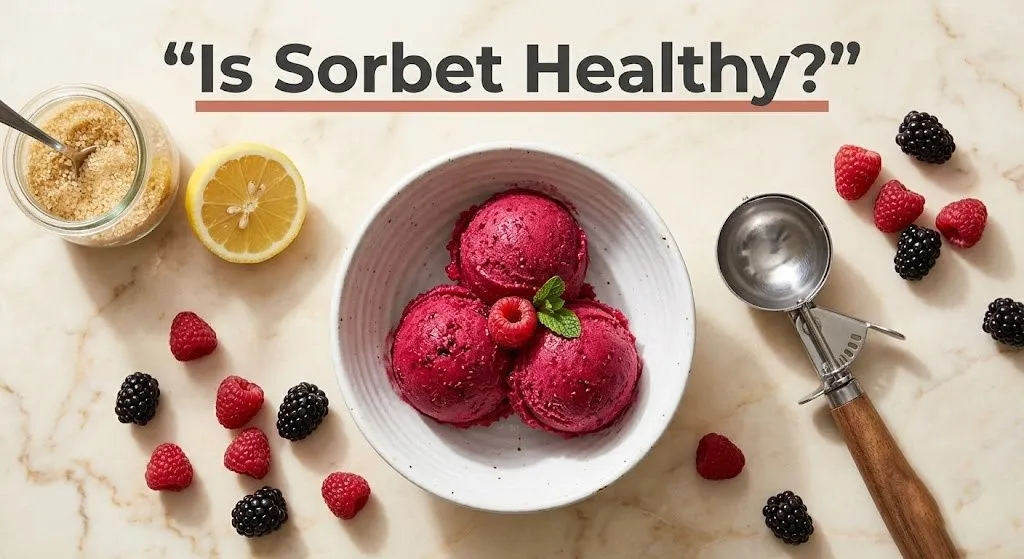
The nutritional downside is straightforward. Sorbet is essentially sugar and water frozen together. Without protein, fat, or fiber to slow digestion, the sugar in sorbet hits the bloodstream rapidly. This causes a quick blood glucose spike followed by a corresponding insulin response. For most healthy people eating sorbet as an occasional dessert after a mixed meal, this metabolic sequence is unremarkable. For someone with insulin resistance or eating sorbet on an empty stomach, the blood sugar impact is measurably higher than the same calories from whole fruit.
Key Takeaway: Sorbet is healthy only when the ingredient list is short and fruit-forward and the portion fits within your daily added sugar budget.
Are sorbets healthy
Sorbets as a category range from genuinely fruit-based frozen desserts to ultra-processed sugar syrups with fruit flavoring, so the question has no single answer. Some sorbets are healthy. Many are not. The variation across brands and product lines is wide enough that treating all sorbets as nutritionally equivalent leads to poor choices. A Talenti Roman Raspberry Sorbet and a generic store-brand rainbow sorbet share a name but have different ingredient philosophies.
The sorbets most likely to be healthy share a recognizable pattern on the nutrition label. The ingredient list starts with fruit puree or fruit juice, not water. The added sugar appears after the fruit, not before it. The total ingredient count stays under five to seven recognizable items. These sorbets deliver real fruit flavor, some retained micronutrients from the fruit, and a sugar content that includes naturally occurring fruit sugars alongside whatever was added during production. They taste intensely of the named fruit because that fruit is actually present in quantity.
Mass-market sorbets in plastic tubs at the grocery store often reverse this pattern. Water is the first ingredient. Sugar or corn syrup appears second or third. Fruit juice concentrate provides color and a hint of flavor. Stabilizers like guar gum and locust bean gum create the smooth texture that fruit puree would provide naturally. These sorbets are not fraudulent. They are inexpensive frozen desserts built to a price point. They are not nutritionally equivalent to fruit-forward sorbets, and treating them as the same category does a disservice to honest product labeling.
Quick Tip:
- A healthy sorbet has fruit as the first ingredient, not water or sugar.
- Count the ingredients. Under seven items is a good sign. Over twelve is a red flag.
Key Takeaway: The sorbet category spans from fruit-based to sugar-water-based products. The ingredient list tells you which one you are holding.
Sorbet nutrition facts
Sorbet nutrition facts vary by brand and flavor, but a standard half-cup serving of commercial fruit sorbet typically contains 110 to 150 calories, 0 grams of fat, 0 to 1 grams of protein, and 26 to 35 grams of total carbohydrates. Of those carbohydrates, 20 to 30 grams are sugars. The remaining carbohydrates are from the fruit base. Sorbet provides small amounts of vitamin C and potassium when real fruit is used, typically 2% to 10% of the Daily Value per serving.
The absence of fat and protein is both an advantage and a disadvantage. On the advantage side, sorbet is significantly lower in calories per serving than premium ice cream, which can deliver 300 to 400 calories per half-cup due to its high butterfat content. For someone counting calories, sorbet provides a frozen dessert experience for fewer total calories. On the disadvantage side, fat and protein slow gastric emptying and blunt the blood sugar response. Sorbet’s rapid digestion means the sugar arrives in the bloodstream quickly, and satiety from a serving of sorbet is shorter-lived than satiety from a serving of full-fat ice cream.
The micronutrient content of sorbet depends on the fruit base. A mango sorbet made with real mango puree may provide 15% to 20% of the Daily Value for vitamin C and modest potassium. A lemon sorbet can provide similar vitamin C levels. Berry sorbets made with real berries retain some of the polyphenol antioxidants from the original fruit, though processing and freezing reduce these levels compared to fresh or frozen whole berries. A sorbet flavored with “natural flavors” rather than real fruit provides essentially no micronutrients beyond the sugar energy itself.
Key Takeaway: Sorbet’s nutrition profile is defined by what it lacks (fat, protein) as much as by what it contains (sugar, possibly some vitamin C).
Sorbet vs ice cream health
Sorbet and ice cream represent different nutritional tradeoffs rather than a clear winner-loser relationship. Sorbet wins on calorie density, saturated fat content, and cholesterol. A half-cup of fruit sorbet contains 110 to 150 calories and 0 grams of saturated fat. The same portion of premium vanilla ice cream contains 250 to 350 calories and 10 to 15 grams of saturated fat, which is half to three-quarters of the American Heart Association’s recommended daily limit. For cardiovascular health, sorbet is the objectively better choice.
Ice cream wins on protein, calcium, and blood sugar response. A half-cup of ice cream provides 3 to 5 grams of protein, 10% to 15% of the Daily Value for calcium, and a slower, more gradual blood sugar curve due to the fat and protein buffering the carbohydrate absorption. Sorbet provides no protein, minimal calcium, and a faster glucose spike. For a child who needs calories and calcium or an athlete looking for a post-workout recovery treat with some protein, ice cream has nutritional advantages sorbet cannot match.
The saturated fat in ice cream is the variable that most strongly determines the health comparison. Full-fat premium ice creams carry the highest saturated fat load. Light ice creams, frozen yogurt, and reduced-fat ice creams narrow the fat gap with sorbet while retaining some protein and calcium. A light vanilla ice cream with 4 grams of saturated fat per serving splits the difference between full-fat ice cream and sorbet. For someone trying to reduce saturated fat without eliminating dairy, light ice cream may be a better middle path than either extreme.
| Nutrient (per 1/2 cup) | Fruit Sorbet | Premium Ice Cream | Light Ice Cream |
|---|---|---|---|
| Calories | 110-150 | 250-350 | 130-170 |
| Total Fat | 0g | 15-22g | 3-5g |
| Saturated Fat | 0g | 10-15g | 2-4g |
| Protein | 0-1g | 3-5g | 3-4g |
| Total Sugar | 20-30g | 20-28g | 15-20g |
| Calcium (%DV) | 0% | 10-15% | 8-12% |
Key Takeaway: Sorbet beats ice cream on calories and saturated fat. Ice cream beats sorbet on protein, calcium, and blood sugar stability.
Is sorbet healthier than ice cream
Sorbet is healthier than ice cream only if your primary health concern is reducing saturated fat intake, managing cholesterol, or avoiding dairy due to allergy or intolerance. For those specific health priorities, the zero saturated fat and zero cholesterol profile of sorbet makes it clearly superior. The American Heart Association’s emphasis on limiting saturated fat to 5% to 6% of daily calories supports choosing sorbet over premium ice cream for people actively managing blood cholesterol levels.
For weight management, the answer is less clear than the calorie comparison suggests. Sorbet has fewer calories per serving, but the satiety difference matters. The fat and protein in ice cream trigger satiety hormones that sorbet does not. A person who eats 150 calories of sorbet may feel hungry again sooner than someone who ate 250 calories of ice cream and feels satisfied. If the sorbet eater reaches for additional food an hour later, the calorie savings disappear. Weight management is about total daily intake, not single-food comparisons.
For overall metabolic health, the rapid sugar absorption from sorbet is a genuine concern that complicates the “healthier” designation. Ice cream’s fat content delays gastric emptying, producing a more gradual blood sugar curve. Sorbet’s sugar arrives quickly and can spike blood glucose, particularly when eaten alone as a snack rather than after a mixed meal. The Academy of Nutrition and Dietetics notes that pairing carbohydrates with protein and fat improves glycemic response, a strategy that sorbet alone cannot execute because it contains neither. Eaten after a balanced meal, this difference shrinks. Eaten on an empty stomach, sorbet’s glycemic disadvantage is real.
Key Takeaway: Sorbet is healthier for cardiovascular and dairy-avoidance goals. Ice cream is not automatically worse for weight or blood sugar when satiety and absorption rate are considered.
Sorbet calories vs ice cream
Sorbet consistently provides fewer calories per serving than premium ice cream, with a standard half-cup of fruit sorbet delivering 110 to 150 calories compared to 250 to 350 calories for the same volume of full-fat ice cream. The calorie difference exists because fat contains 9 calories per gram while carbohydrates contain 4 calories per gram. Removing the butterfat from frozen dessert drops the calorie density substantially. This math is reliable across brands and flavors.
The calorie comparison changes when sorbet is measured against light ice cream or frozen yogurt. Light vanilla ice cream often lands in the 130 to 170 calorie range per half-cup, which overlaps with the upper end of sorbet’s calorie range. Some frozen yogurts come in at 100 to 140 calories per half-cup, edging below many sorbets. The calorie advantage of sorbet is strongest when compared to super-premium ice creams with high butterfat content. Against lower-fat frozen desserts, the calorie gap narrows or disappears.
Portion size is where the calorie comparison gets complicated in real life. Sorbet is less satiating than ice cream, which leads many people to pour a larger bowl. A one-cup serving of sorbet at 220 to 300 calories exceeds the calories in a half-cup of premium ice cream. The calories per serving only matter if the serving size stays consistent. Restaurants and scoop shops often serve sorbet in the same large portions as ice cream, erasing the calorie advantage entirely. At home, measuring a true half-cup serving is the only way to realize sorbet’s calorie benefit.
Key Takeaway: Sorbet has fewer calories per equal volume than full-fat ice cream, but the calorie advantage depends on measuring portions and comparing to the right alternative.
Sorbet sugar content
Sorbet sugar content typically ranges from 20 to 30 grams per half-cup serving, a quantity that represents most or all of the American Heart Association’s daily added sugar recommendation for women and a substantial portion for men. The total sugar number on the nutrition facts panel includes both naturally occurring sugars from fruit and sugars added during manufacturing. Current FDA labeling rules require added sugars to be listed separately, which lets you see how much sugar the fruit provided versus how much the manufacturer poured in.
A raspberry sorbet made primarily from fruit puree might contain 22 grams of total sugar with only 8 grams of added sugar. The remaining 14 grams are intrinsic fruit sugars from the raspberries. A lemon sorbet made from water, sugar, and lemon juice concentrate might contain 28 grams of total sugar with 26 grams of added sugar. These two sorbets have similar total sugar numbers on the label but completely different nutritional stories. The raspberry version delivers actual fruit content alongside its sugar. The lemon version delivers a sugar syrup with lemon flavoring.
Sugar in sorbet serves functional purposes beyond sweetness. Sugar lowers the freezing point of water, preventing sorbet from freezing into a solid block of ice. It creates the scoopable, smooth texture that defines properly made sorbet. Reducing sugar in sorbet without adjusting the formula produces a hard, icy product. Commercial manufacturers use stabilizers and additional processing techniques to maintain texture at lower sugar levels. Artisanal sorbet makers balance sugar precisely for texture and flavor simultaneously. This functional requirement explains why genuinely low-sugar sorbet is rare.
Key Takeaway: Sorbet sugar ranges from 20 to 30 grams per serving, and the added sugar line on the label distinguishes fruit-forward sorbets from sugar-water sorbets.
Does sorbet have added sugar
Most commercial sorbet contains added sugar, often in substantial quantities, because sugar is functionally necessary for proper sorbet texture as well as sweetness. The FDA’s updated Nutrition Facts label requires manufacturers to list added sugars separately from total sugars, making this information directly visible. A sorbet label showing 24 grams total sugar and 18 grams added sugar tells you that only 6 grams of sugar came from the fruit itself. The rest was added during production.
The types of added sugar in sorbet vary by brand and price point. Premium sorbets typically use cane sugar, sometimes in liquid invert form to improve texture. Mass-market sorbets may use corn syrup, high fructose corn syrup, or a blend of sweeteners. Corn syrup in sorbet functions as a texture agent as well as a sweetener because its glucose content interferes with ice crystal formation more effectively than sucrose alone. The presence of corn syrup on an ingredient list does not automatically mean the sorbet is lower quality. It means the manufacturer prioritized a specific texture profile.
Sorbet without any added sugar exists but is uncommon. These products rely entirely on the natural sugars in very ripe fruit puree, often concentrated through cooking or freeze concentration to achieve sufficient sweetness and freezing point depression. The result is a sorbet with a softer texture than the sugar-added version and a more intensely fruity flavor. The total sugar content may still be 18 to 22 grams per serving, all of it from fruit. The USDA FoodData Central database confirms that even unsweetened fruit puree concentrates natural sugars by removing water, so the sugar density per serving is comparable to sweetened sorbet even when no sugar is added during manufacturing.
Key Takeaway: Added sugar is present in most sorbets, but the FDA label now separates added from natural sugars so you can see exactly what you are eating.
Sorbet glycemic index
The glycemic index of sorbet is moderately high, typically falling in the range of 65 to 80 depending on the fruit base and the ratio of glucose to fructose in the sweetener blend. This places sorbet in the medium to high glycemic index category, above whole fruit but generally below pure glucose or soda. Sorbets made with high-fructose corn syrup may have a slightly lower glycemic index than those made with cane sugar because fructose has a lower GI than glucose, though fructose metabolism carries its own health concerns.
The glycemic load, which accounts for both the glycemic index and the actual carbohydrate portion size, provides a more practical measure of blood sugar impact. A half-cup serving of sorbet with 30 grams of carbohydrates and a glycemic index of 70 has a glycemic load of approximately 21. The Harvard T.H. Chan School of Public Health classifies glycemic loads above 20 as high. This means a standard sorbet serving can produce a meaningful blood glucose elevation, particularly when consumed alone without protein, fat, or fiber to slow absorption.
The type of fruit in the sorbet influences the glycemic response. Mango and banana sorbets tend to have higher natural sugar content and faster absorption. Berry sorbets, particularly raspberry and blackberry, contain more fiber and produce a somewhat slower glucose curve. The processing method matters as well. Sorbet made from whole fruit puree retains some of the fiber and cellular structure of the original fruit, slowing sugar absorption slightly. Sorbet made from clarified fruit juice without pulp absorbs as rapidly as any sugar-sweetened beverage. The presence of visible fruit fiber or pulp in the sorbet is a proxy for a modestly better glycemic profile.
Key Takeaway: Sorbet has a medium to high glycemic index and a glycemic load around 21 per serving, meaning it can spike blood sugar when eaten alone.
Sorbet for diabetics
Sorbet is a food that people with diabetes or insulin resistance need to approach with portion awareness and carbohydrate counting, not a food that is automatically off-limits. A half-cup serving of sorbet contains approximately 30 grams of carbohydrates, equivalent to two carbohydrate exchanges in the American Diabetes Association’s meal planning system. This fits within a diabetes eating plan when accounted for as part of the meal’s total carbohydrate budget. It is not a free food. It is a deliberate carbohydrate choice.
Pairing sorbet with a mixed meal reduces its glycemic impact compared to eating it alone as a snack. When sorbet follows a meal containing protein, fat, and fiber, the existing stomach contents slow gastric emptying. The sugar from the sorbet enters the bloodstream over a longer period, producing a lower peak blood glucose. A small scoop of sorbet after a dinner of grilled fish, vegetables, and whole grains will produce a different glucose curve than a bowl of sorbet eaten by itself at 3 p.m.
The American Diabetes Association emphasizes that the total amount of carbohydrate consumed matters more than the type of sugar for blood glucose management. Sorbet sweetened with cane sugar and sorbet sweetened with honey or agave will have similar carbohydrate totals and similar glycemic effects. The more relevant choice for blood sugar control is between sorbet and whole fresh fruit. A cup of fresh strawberries provides 12 grams of carbohydrates, fiber, and water. A half-cup of strawberry sorbet provides 28 grams of carbohydrates with no fiber. The whole fruit is the better blood sugar choice, but sorbet can be an occasional substitute when the carbohydrate content is tracked.
Key Takeaway: Sorbet can fit into a diabetes eating plan when the 30 grams of carbohydrates per serving are counted and the sorbet is paired with a mixed meal.
Is sorbet good for weight loss
Sorbet can be a weight-loss-compatible dessert when portioned correctly, but it is not a weight loss food. The 110 to 150 calories in a half-cup serving fits within a calorie deficit eating plan for most people. Choosing sorbet instead of 300-calorie premium ice cream creates a calorie savings that supports weight loss over time. The zero-fat profile of sorbet keeps the calorie density lower than dairy-based frozen desserts, which makes it easier to fit into a daily calorie budget.
The satiety limitation of sorbet undercuts its usefulness for weight management. Sorbet provides sugar energy without the protein, fat, or fiber that trigger fullness signals from the gut to the brain. A person who ends a meal with sorbet may feel satisfied in the moment and then experience a return of hunger or sugar cravings 60 to 90 minutes later as blood glucose drops. This post-dessert hunger cycle can lead to additional evening snacking that erases the calorie savings from choosing sorbet over ice cream. Weight loss depends on total daily calorie intake, not on the calorie count of a single food at a single meal.
The behavioral aspect of weight loss matters here. Some people can eat a measured half-cup of sorbet, feel satisfied, and stop. Others find that sorbet’s light texture and sweet flavor trigger a desire for a second and third scoop. A full bowl of sorbet providing 300 to 400 calories is not a weight loss food. It is a high-sugar indulgence. Honestly assessing your own eating patterns determines whether sorbet supports your weight goals or undermines them.
Key Takeaway: Sorbet’s calorie count fits weight loss plans, but its lack of satiety can trigger additional eating that cancels the calorie advantage.
Is sorbet dairy free
Traditional sorbet is completely dairy free by definition. Authentic sorbet consists of fruit puree or juice, water, and sugar, with no milk, cream, butterfat, or milk-derived ingredients. This distinguishes sorbet from sherbet, which contains dairy, and from ice cream and gelato, which are dairy-heavy. For the estimated 36% of American adults who experience lactose malabsorption, as reported by the National Institutes of Health, sorbet provides a frozen dessert that does not trigger digestive symptoms.
The dairy-free status of sorbet is reliable but not guaranteed. Manufacturers sometimes add whey protein or milk solids to improve texture, turning the product into something closer to sherbet. Some sorbet products are produced on shared equipment that also processes milk-based ice creams, creating cross-contamination risk for people with severe milk allergies. A sorbet that is dairy-free by recipe may not be safe for someone with an anaphylactic milk allergy if the manufacturer does not maintain dedicated dairy-free production lines.
Checking the label for dairy ingredients and the allergen statement is the only way to confirm dairy-free status. The FDA requires milk to be declared as a major food allergen, either in the ingredient list in parentheses or in a “Contains: Milk” statement. A sorbet without milk in the ingredient list and without a milk allergen warning is dairy-free. Many brands now voluntarily label their sorbets as dairy-free or vegan to capture this consumer segment. The “dairy-free” claim on the front of the package is regulated by the FDA and is more reliable than the word “sorbet” alone.
Key Takeaway: Traditional sorbet is dairy-free by recipe, but check the allergen statement if you have a milk allergy because shared equipment is common.
Is sorbet vegan
Most sorbet is vegan, consisting entirely of plant-based ingredients: fruit, sugar, and water. The absence of eggs, dairy, honey, and gelatin makes sorbet compatible with a vegan diet in its pure form. This plant-based composition is what makes sorbet one of the few widely available frozen desserts that vegans can eat without seeking out specialty products. Restaurant dessert menus often feature sorbet as the default vegan option for this reason.
Exceptions to sorbet’s vegan status exist and catch vegans by surprise. Some sorbet manufacturers use refined cane sugar processed with bone char filtration, a method that uses animal-derived carbon to whiten sugar. The sugar itself contains no animal products, but the processing aid is animal-derived. Vegans who avoid bone-char-processed sugar look for sorbets made with organic sugar, beet sugar, or unrefined cane sugar, none of which use bone char. The ingredient list does not reveal this distinction, so contacting the manufacturer is necessary for strict vegans.
Other non-vegan additions to watch for include honey as a sweetener, egg whites as a texture stabilizer, and gelatin or isinglass as clarifying agents. These ingredients are uncommon in commercial sorbet but appear in some artisanal or restaurant-made versions. Cochineal extract or carmine, a red food coloring derived from insects, sometimes appears in raspberry or strawberry sorbets. Vegan-certified sorbets with a recognized vegan logo eliminate the guesswork. Without certification, the ingredient list remains the most reliable guide.
Key Takeaway: Sorbet is naturally vegan, but bone-char-processed sugar, honey, and insect-derived colorings create exceptions that require label verification.
Sorbet ingredients list
A sorbet ingredients list in its simplest form contains three items: fruit puree, water, and sugar. This short list describes traditional French sorbet as it was made for centuries before industrial production introduced stabilizers, emulsifiers, and artificial flavors. When you find a sorbet with this ingredient profile, you are holding a product that is effectively homemade sorbet scaled for commercial production. These sorbets freeze harder and melt faster than stabilized versions, but they taste more intensely of real fruit.
Commercial sorbet at scale often includes a longer list of functional ingredients. Guar gum, locust bean gum, and carrageenan are seaweed and seed-derived thickeners that improve texture and slow ice crystal growth during storage and distribution. Pectin, the same fiber that sets jam, provides body and reduces iciness. Citric acid brightens fruit flavor and acts as a preservative. Natural flavors can mean concentrated fruit extracts or completely synthetic flavor compounds, depending on the manufacturer. None of these ingredients are dangerous, but they signal a product that required processing aids to achieve its final form.
Sorbet labeled with fruit juice concentrate rather than fruit puree as the primary fruit ingredient is a different category of product. Juice concentrate provides sugar and fruit flavor at lower cost than whole fruit puree, but it contains none of the fruit’s fiber or cellular structure. Sorbet made from concentrate tastes simpler and has a thinner mouthfeel. The color is often boosted with fruit and vegetable juice concentrates or annatto extract. Recognizing the difference between “strawberry puree” and “strawberry juice concentrate” on the label helps you understand whether you are buying a fruit-based or juice-based sorbet.
Quick Tip:
- Look for fruit puree as the first ingredient, not water and not juice concentrate.
- Shorter ingredient lists generally indicate less processing and more actual fruit.
Key Takeaway: Sorbet ingredients range from three items (fruit, water, sugar) to fifteen items with stabilizers and flavorings. Shorter lists mean more fruit.
Is sorbet ultra processed
Many commercial sorbets qualify as ultra-processed foods under the NOVA food classification system, which categorizes foods based on the extent and purpose of industrial processing. A sorbet containing high fructose corn syrup, stabilizers, artificial flavors, and synthetic colors falls into the ultra-processed category. These products are formulations of industrial ingredients rather than modified versions of whole foods. The processing is designed to create a shelf-stable, consistently textured, low-cost product.
Not all sorbet is ultra-processed. Artisanal sorbets made with fruit puree, cane sugar, and water, with no additional functional ingredients, are processed foods under the NOVA system but not ultra-processed. They are whole-food ingredients that have been combined, pureed, and frozen. The distinction matters because epidemiological research has associated high consumption of ultra-processed foods with increased risks of cardiovascular disease, type 2 diabetes, and all-cause mortality. A 2024 study published in the British Medical Journal reinforced this association with a large prospective cohort.
The practical question is whether occasional sorbet consumption contributes meaningfully to the health risks associated with ultra-processed food patterns. A single serving of ultra-processed sorbet once a week after an otherwise whole-food diet is not the same exposure as a diet built around ultra-processed foods at every meal. The Academy of Nutrition and Dietetics emphasizes that overall dietary pattern matters more than the processing classification of any single food. Sorbet as an occasional treat in a diet rich in whole foods presents a different risk profile than daily sorbet as part of a heavily processed diet.
Key Takeaway: Mass-market sorbets with stabilizers and added flavors are ultra-processed, but occasional consumption within a whole-food diet pattern minimizes the health risk.
Fruit sorbet benefits
Fruit sorbet made with real fruit puree retains some of the nutritional benefits of the original fruit, including water-soluble vitamins, minerals, and antioxidant compounds. A sorbet made primarily from mango puree provides vitamin C as ascorbic acid, vitamin A as beta-carotene, and modest potassium. A berry sorbet made from raspberry or blackberry puree delivers anthocyanin antioxidants and ellagic acid, compounds studied for their anti-inflammatory properties. These nutrients survive freezing better than they survive high-heat processing, making sorbet a reasonable carrier for fruit nutrients.
The hydration benefit of fruit sorbet is underappreciated. Sorbet is roughly 65% to 70% water by weight, and that water comes packaged with fruit-derived electrolytes and sugar that enhance water absorption in the small intestine. The World Health Organization’s oral rehydration formula uses a specific glucose-to-sodium ratio because sugar actively transports water across the intestinal wall. Fruit sorbet, eaten slowly, contributes to fluid intake in a way that dry, fat-based desserts do not. On a hot day, sorbet hydrates while it satisfies a dessert craving.
The antioxidant content of fruit sorbet varies dramatically by fruit type and processing method. Deeply pigmented fruits like black raspberries, black currants, and tart cherries contain higher antioxidant levels than lighter fruits like pear or apple. A sorbet made from dark berries and minimally processed provides more antioxidant capacity than a sorbet made from lemon juice and sugar. The health benefit of fruit-derived antioxidants is real but modest at sorbet portion sizes. A half-cup of berry sorbet provides a small fraction of the antioxidants in a cup of fresh berries. Treating sorbet as a fruit serving replacement overstates its nutritional contribution.
Key Takeaway: Real fruit sorbet retains vitamin C, potassium, and antioxidants from the source fruit, plus hydration from its high water content.
How to choose healthy sorbet
Choosing a healthy sorbet at the grocery store requires reading three specific lines on the package in sequence: the ingredient list, the added sugar line, and the serving size. Start with the ingredient list. The first ingredient should be fruit puree or fruit, not water, sugar, or corn syrup. The list should be short enough to read in under ten seconds. If you cannot pronounce half the ingredients or the list fills half the side panel, put the sorbet back.
Check the added sugar line on the nutrition facts panel. A sorbet with 8 grams or less of added sugar per half-cup serving is a genuinely fruit-forward product. Sorbets with 15 grams or more of added sugar are candy-level sweet. The total sugar number matters less than the added sugar number because fruit brings its own sugar to the party. A mango sorbet with 22 grams of total sugar and 6 grams of added sugar is fruit-based. A lemon sorbet with 22 grams of total sugar and 20 grams of added sugar is sugar-water flavored with lemon. Same total sugar. Completely different products.
Confirm the serving size before comparing calories or sugar across brands. Some sorbet labels use a half-cup serving. Others use two-thirds of a cup or 100 grams. A sorbet that appears lower in sugar per serving might simply be using a smaller serving size for the nutrition panel. Convert everything to a per-half-cup basis for accurate comparison. The healthiest sorbet in the freezer case is the one with the shortest ingredient list, the lowest added sugar, and the most recognizable fruit content. Price often correlates with quality here. A premium sorbet at seven dollars a pint is expensive compared to a three-dollar quart, but the ingredient quality difference is visible on the label.
| What to Check | Healthy Indicator | Warning Sign |
|---|---|---|
| First Ingredient | Fruit puree or fruit | Water, sugar, corn syrup |
| Added Sugar | Under 8g per 1/2 cup | Over 15g per 1/2 cup |
| Ingredient Count | 3 to 7 items | 12+ items |
| Fruit Form | Puree, whole fruit | Juice concentrate, natural flavors |
| Serving Size | Consistent 1/2 cup | Smaller serving to hide sugar |
Key Takeaway: The healthiest sorbet has fruit as the first ingredient, a short ingredient list, and under 8 grams of added sugar per serving.
Homemade sorbet healthy
Homemade sorbet is the healthiest version of sorbet because you control the ingredient list, the sugar quantity, and the fruit quality with no need for stabilizers or preservatives. A basic homemade sorbet requires only frozen fruit and a food processor or high-powered blender. Frozen mango chunks blended with a small amount of water or unsweetened plant milk create a soft-serve consistency sorbet with no added sugar, no stabilizers, and all the fiber of the original fruit intact. The fiber, which commercial sorbet processing removes, slows sugar absorption and increases satiety.
The technique for homemade sorbet affects both texture and nutrition. Blending frozen fruit directly produces the highest fiber content and the most whole-food nutritional profile. It also produces a sorbet best eaten immediately because it freezes solid when returned to the freezer. Adding a tablespoon of vodka or another neutral spirit lowers the freezing point without adding sugar, creating a scoopable texture that holds in the freezer. The alcohol is minimal per serving and undetectable in flavor. A tablespoon of honey or maple syrup achieves the same texture improvement with some added sugar.
Homemade sorbet works with almost any fruit, but high-pectin fruits like mango, peach, and berries produce the creamiest texture. Watery fruits like watermelon and citrus make icier sorbets that benefit from a sugar or alcohol addition for texture. The cost of homemade sorbet is lower than premium commercial sorbet, and the nutritional quality is substantially higher because the whole fruit, including its fiber and full micronutrient load, becomes the dessert. The tradeoff is the need for a food processor and the willingness to eat the sorbet shortly after making it or accept a firmer frozen texture.
Key Takeaway: Homemade sorbet from blended frozen fruit eliminates added sugar and retains fruit fiber, making it nutritionally superior to any commercial sorbet.
Frequently Asked Questions About Sorbet
Is sorbet healthier than ice cream?
Sorbet is healthier than ice cream for reducing saturated fat and calorie intake, but ice cream provides more protein, calcium, and better satiety.
A half-cup of sorbet contains 0 grams of saturated fat compared to 10 to 15 grams in premium ice cream.
The health comparison depends on whether your goal is reducing fat or getting more protein and calcium from your dessert.
Can people with diabetes eat sorbet?
People with diabetes can eat sorbet when they count the approximately 30 grams of carbohydrates per half-cup serving as part of their meal plan.
Pairing sorbet with a mixed meal containing protein and fat slows sugar absorption and produces a more gradual blood glucose response.
Whole fresh fruit is a better blood sugar choice than sorbet because the fiber content slows digestion further.
Is all sorbet dairy free and vegan?
Traditional sorbet is dairy free and vegan, containing only fruit, water, and sugar.
Some commercial sorbets add whey protein or are made on shared dairy equipment, creating cross-contamination risk.
Check the ingredient list for milk products and the allergen statement for milk warnings to confirm dairy-free status.
Does sorbet have too much sugar?
Most commercial sorbets contain 20 to 30 grams of total sugar per half-cup serving, with much of it from added sugar rather than fruit.
The American Heart Association recommends limiting added sugar to 25 grams daily for women and 36 grams for men.
A single serving of sorbet can use most or all of that daily added sugar allowance.
What is the healthiest type of sorbet?
The healthiest sorbet is made from fruit puree as the first ingredient, has a short ingredient list under seven items, and contains less than 8 grams of added sugar per serving.
Homemade sorbet from blended frozen fruit with no added sugar is nutritionally superior to any commercial option because the whole fruit fiber remains intact.
Berry-based sorbets provide the most antioxidants per serving compared to citrus or tropical fruit sorbets.
Sorbet occupies an honest middle ground in the frozen dessert world. It is better for you than premium ice cream on the metrics of calories, saturated fat, and cholesterol. It is worse for you than a bowl of fresh fruit. For people avoiding dairy, it is a genuine solution rather than a compromise. For people managing blood sugar, it is a carbohydrate source that needs to be counted like any other.
The single most practical thing you can do is read the ingredient list before you buy. Fruit as the first ingredient. A short, recognizable list. Added sugar under 8 grams per serving. That sorbet is a reasonable dessert for a healthy eating pattern. The sugar-water sorbet with a dozen stabilizers is fine as an occasional treat. It is not health food, and the label has been telling you that all along if you knew where to look.