Swiss cheese is one of the healthiest widely available cheeses, offering more protein per ounce than cheddar, less sodium than American cheese, and a significant dose of vitamin B12 that is a direct byproduct of its unique fermentation process. You are not getting a free pass to eat unlimited quantities, but if you are choosing a cheese to keep in regular rotation, Swiss earns its reputation as a smarter pick. It balances nutrient density with a moderate calorie load better than most of the deli case competition.
The average American eats roughly 40 pounds of cheese per year, according to USDA Economic Research Service data. Cheese is the single largest source of saturated fat in the standard American diet, contributing about 8.5 percent of total calories from saturated fat, according to a 2023 analysis from the Harvard T.H. Chan School of Public Health. Swapping even a portion of that intake from higher-fat, higher-sodium cheeses to Swiss could meaningfully shift daily saturated fat and sodium numbers without giving up the food entirely.
This article examines Swiss cheese through the lens of a nutrition researcher who has also stood in a grocery store aisle comparing labels. You will learn exactly what makes Swiss different from other cheeses, how its nutrient profile stacks up against cheddar and mozzarella, which variations like Baby Swiss and Lacey Swiss change the health equation, and who genuinely needs to limit or avoid it.
is swiss cheese healthy
Swiss cheese is a nutrient-dense food that qualifies as a healthy choice when eaten in appropriate portions, particularly because it delivers high-quality protein, bioavailable calcium, and exceptional vitamin B12 with less sodium than nearly every other aged cheese. The word “healthy” applies here in the context of whole-food dairy within a balanced eating pattern, not as a license to eat unlimited quantities.
A single 1-ounce slice of Swiss cheese, roughly the size of a standard sandwich slice, contains 106 calories, 7.5 grams of protein, and 7.8 grams of total fat. The protein-to-calorie ratio is notably strong. You get about 7 grams of protein for every 100 calories, which puts Swiss in the same efficiency range as an egg. Most cheeses deliver 5 to 6 grams of protein per 100 calories. This matters for anyone trying to hit higher protein targets without overshooting their calorie budget.
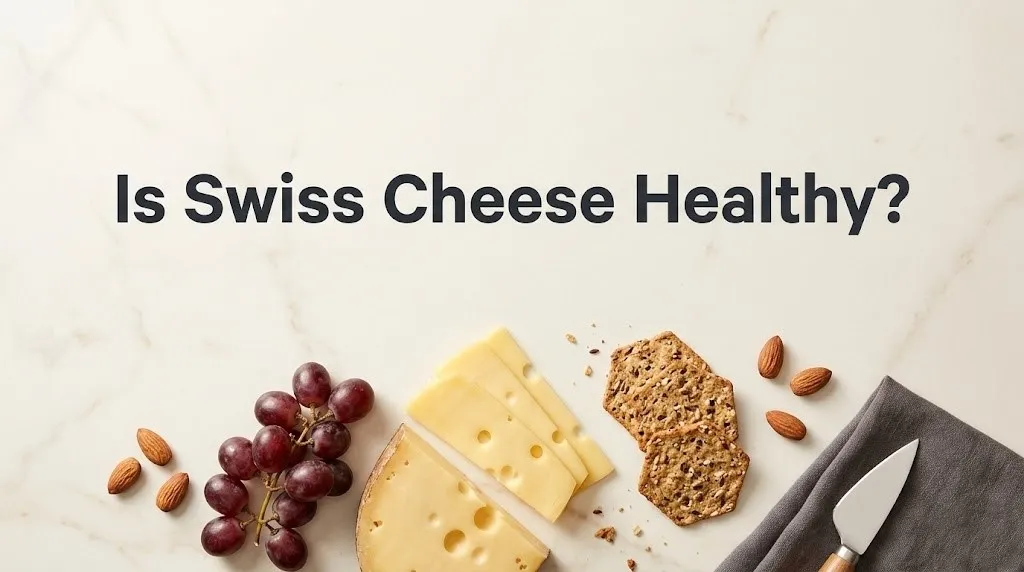
The Academy of Nutrition and Dietetics recognizes cheese as a nutrient-dense food that can fit into healthy dietary patterns, including the Mediterranean diet and the DASH diet. The key is portion awareness. A serving of cheese is 1 to 1.5 ounces, roughly the size of your thumb or a pair of dice. At that serving size, Swiss cheese contributes meaningful amounts of calcium, phosphorus, and vitamin B12 without dominating the day’s saturated fat allowance.
what is swiss cheese
Swiss cheese, in the American marketplace, refers to a family of semi-hard cow’s milk cheeses inspired by traditional Swiss Emmental but produced with a faster aging process and a milder flavor profile. The defining visual characteristic is the holes, properly called eyes, which are created by carbon dioxide gas produced by the bacterium Propionibacterium freudenreichii during the warm fermentation phase.
The production process follows a specific sequence. Milk is cultured with thermophilic starter bacteria including Streptococcus thermophilus and Lactobacillus helveticus, which acidify the curd. Rennet is added to coagulate the milk. The curds are cut, heated, pressed into forms, and brined. Then comes the defining step: the cheese wheels are moved to a warm room at roughly 70 to 75 degrees Fahrenheit for several weeks. During this warm phase, P. freudenreichii consumes lactate produced by the starter bacteria and releases carbon dioxide, propionic acid, and acetic acid. The gas becomes trapped in the pliable curd matrix, forming the characteristic eyes.
Propionic acid gives Swiss its slightly sweet, nutty flavor and also functions as a natural antimicrobial. The same bacterium is used as a commercial preservative in baked goods under the name calcium propionate. Its presence in Swiss cheese means the cheese has a longer safe shelf life at room temperature than many other semi-hard cheeses, though refrigeration is still recommended by the USDA for quality and maximum safety.
swiss cheese nutrition facts
A 1-ounce (28-gram) slice of standard Swiss cheese provides 106 calories, 7.5 grams of protein, 7.8 grams of total fat, 5 grams of saturated fat, 1.5 grams of carbohydrate, 0 grams of fiber, and 0.4 grams of naturally occurring sugar. The sodium content sits at just 53 milligrams per ounce, a number that stands out dramatically against other aged cheeses. Vitamin B12 registers at 1.0 microgram per ounce, which is 42 percent of the Daily Value.
The calcium content is 221 milligrams per ounce, covering 17 percent of the Daily Value for adults. Swiss cheese’s phosphorus content of 188 milligrams per ounce supports the calcium-phosphorus partnership required for bone mineralization. The National Institutes of Health Office of Dietary Supplements identifies phosphorus as equally important to calcium for bone health, and dairy products provide it in a highly absorbable form.
Vitamin A appears at 233 IU per ounce, mostly as retinol, the preformed active version the body can use directly. This is about 8 percent of the Daily Value. The fat-soluble vitamins in cheese, including A, D, E, and K2, are present in modest amounts and are better absorbed when eaten with the fat matrix that naturally contains them, as opposed to being taken as isolated supplements.
| Nutrient | Amount per 1 oz (28g) | Percent Daily Value |
|---|---|---|
| Calories | 106 | N/A |
| Protein | 7.5 g | 15% |
| Total Fat | 7.8 g | 10% |
| Saturated Fat | 5.0 g | 25% |
| Sodium | 53 mg | 2% |
| Calcium | 221 mg | 17% |
| Phosphorus | 188 mg | 15% |
| Vitamin B12 | 1.0 mcg | 42% |
| Vitamin A | 233 IU | 8% |
how healthy is swiss cheese
Swiss cheese ranks in the top tier of cheeses for overall healthfulness because it combines high protein, moderate calories, excellent vitamin B12, low sodium, and negligible lactose in a single food that is widely available and requires no preparation. The question is not whether Swiss is healthy in absolute terms. The question is how it compares to other dietary choices you could make with the same 100 calories.
Against other cheeses, Swiss wins on sodium. Cheddar contains 174 milligrams of sodium per ounce. American cheese, a processed product, contains roughly 400 milligrams. Mozzarella, often cited as the healthiest cheese, contains about 175 milligrams. Swiss, at 53 milligrams, is the clear low-sodium winner among commonly sold cheeses. For anyone following the DASH diet or monitoring blood pressure, this difference is not trivial. A two-slice sandwich made with Swiss instead of American cheese saves nearly 700 milligrams of sodium.
Swiss also wins on vitamin B12. The P. freudenreichii fermentation produces B12 as a metabolic byproduct, elevating Swiss above cheeses that use only standard lactic acid bacteria. One ounce covers nearly half the daily requirement. This makes Swiss particularly valuable for older adults, who have higher rates of B12 malabsorption due to reduced stomach acid production, and for people reducing their red meat intake who may see their B12 status dip.
Key Takeaway: Swiss cheese earns its health halo through an unusual combination of low sodium, high protein, and bacterially produced vitamin B12 that no other common cheese replicates at the same level.
is swiss cheese heart healthy
Swiss cheese is more compatible with a heart-healthy eating pattern than most other cheeses because of its markedly lower sodium content and its reasonable saturated fat level, though it is not a low-saturated-fat food and should still be eaten in measured portions. The American Heart Association recommends limiting saturated fat to no more than 5 to 6 percent of total daily calories, which translates to roughly 13 grams for a 2,000-calorie diet. One ounce of Swiss uses 5 grams of that allowance.
The sodium advantage is equally important for cardiovascular health. The AHA recommends an ideal limit of 1,500 milligrams of sodium per day for most adults, with an upper limit of 2,300 milligrams. A single slice of American cheese at 400 milligrams consumes more than a quarter of the ideal daily limit. A slice of Swiss at 53 milligrams barely registers. Over weeks and months of sandwiches, omelets, and snacks, that difference adds up to a measurable impact on total sodium load.
Research on dairy fat and cardiovascular outcomes has grown more nuanced over the past decade. A 2024 systematic review published in the American Journal of Clinical Nutrition examined dairy consumption and cardiovascular disease risk and found that fermented dairy products, including cheese, were not associated with increased cardiovascular risk in the same way that equivalent amounts of saturated fat from unfermented sources like butter appeared to be. The fermentation process, the protein matrix, and the calcium content may all modify how cheese fat is metabolized. This is not a green light for unlimited cheese, but it does suggest that cheese and butter are not metabolically interchangeable.
swiss cheese healthy
Swiss cheese fits the definition of a healthy food because it provides essential nutrients including complete protein, calcium, phosphorus, and vitamin B12 in a form the body absorbs efficiently, while carrying fewer of the nutritional liabilities that burden other popular cheeses. The case for Swiss being healthy rests on what it has and what it does not have.
What it has: all nine essential amino acids in a complete protein package, highly bioavailable calcium paired with phosphorus in the ideal ratio for bone mineralization, and bacterially synthesized B12 that vegans, vegetarians, and older adults often struggle to obtain from other sources. A 2021 study in the Journal of Nutrition examined protein digestibility-corrected amino acid scores and confirmed that dairy proteins score at or near the top of the scale, meaning the body actually uses the protein Swiss delivers.
What it does not have: excess sodium, added sugars, carbohydrate fillers, or the long list of emulsifiers and preservatives found in processed cheese products. A slice of Swiss is milk, cultures, rennet, and salt. The ingredient panel for a standard American cheese single runs multiple lines and includes sodium citrate, calcium phosphate, sorbic acid, and annatto coloring. Whole-food ingredient simplicity matters, and Swiss delivers it.
is swiss healthy
The shorthand question “is Swiss healthy” refers to the entire category of Swiss-style cheeses, and the answer is yes, with the qualification that specific varieties within the Swiss family have slightly different nutritional profiles. Traditional aged Swiss, Baby Swiss, Lacey Swiss, and imported Emmental or Jarlsberg all share the core benefits of the category but differ in fat content, moisture, and sodium.
Jarlsberg, a Norwegian cheese made with a similar bacterial culture, deserves a mention because it is often shelved alongside Swiss and shares the holey appearance. Jarlsberg contains slightly more protein, about 8 grams per ounce, and is often marketed with a specific strain of P. freudenreichii that produces elevated levels of vitamin K2, specifically menaquinone-7. The Norwegian dairy cooperative TINE has published research on Jarlsberg’s K2 content, noting that the cheese contains approximately 70 micrograms of vitamin K2 per 100 grams, though this varies by batch. Vitamin K2 is important for directing calcium into bone rather than arterial walls.
Emmental, the original Swiss cheese from the Emme Valley in Switzerland, is made from raw milk and aged longer, developing a more pronounced nutty flavor and a firmer texture. Its nutritional profile is similar to domestic Swiss but with slightly more fat, roughly 8.5 grams per ounce, and a stronger concentration of the bioactive peptides that develop during extended proteolysis. These peptides have been studied in vitro for potential blood pressure-lowering effects, though real-world dietary intake levels are far below pharmacological doses.
is baby swiss cheese healthy
Baby Swiss cheese is a healthier choice for people seeking a milder flavor and a softer texture than traditional Swiss, but it contains slightly more moisture and marginally less protein per ounce due to a shorter aging period. The nutritional trade-offs are small enough that your preference for taste and texture can drive the decision without sacrificing health benefits.
Baby Swiss was developed in the 1960s by Alfred Guggisberg in Ohio. It uses whole milk rather than the partly skimmed milk used in some traditional Swiss production, and it ages for only a few weeks instead of several months. The shorter aging means the P. freudenreichii bacteria have less time to consume lactate and produce gas, so the eyes in Baby Swiss are smaller and more numerous. The flavor is buttery and mild, lacking the slight sharpness of aged Swiss.
Nutritionally, Baby Swiss contains about 100 to 110 calories per ounce, 7 grams of protein, and 8 grams of fat. The moisture content is higher, around 43 percent versus 37 percent in aged Swiss. This higher water content means slightly less nutrient density per ounce, but the difference is within 10 percent across all major nutrients. Baby Swiss is an especially good entry point for children or adults who find the nutty sharpness of traditional Swiss off-putting and might otherwise reject cheese as a calcium and protein source entirely.
| Type | Calories | Protein | Fat | Sodium | Aging Time |
|---|---|---|---|---|---|
| Traditional Swiss | 106 | 7.5 g | 7.8 g | 53 mg | 3-6 months |
| Baby Swiss | 100-110 | 7 g | 8 g | 55 mg | 4-6 weeks |
| Lacey Swiss | 90-100 | 8 g | 6 g | 45 mg | 2-4 weeks |
is lacey swiss cheese healthy
Lacey Swiss cheese is arguably the healthiest commercially available Swiss variety because it is made from reduced-fat milk, producing a cheese with less total fat and more protein per ounce than traditional Swiss while retaining the characteristic nutty flavor. The lacy appearance, numerous small holes and a softer body, comes from a slightly different culturing and cutting process.
Lacey Swiss is made from low-fat or partly skimmed milk. The fat content drops to roughly 5 to 6 grams per ounce, and the protein rises to 8 to 9 grams per ounce. This pushes the protein-to-fat ratio above 1.5, which is exceptional for a cheese that still melts and tastes like cheese. The calcium content remains equivalent to full-fat Swiss because calcium resides in the water phase of milk, not the fat phase.
The lower fat content also means fewer calories. Lacey Swiss clocks in at roughly 90 calories per ounce, about 15 percent less than traditional Swiss. For a person eating cheese daily, that difference saves roughly 5,800 calories per year, equivalent to about 1.6 pounds of body fat, assuming no other dietary changes. This calorie differential is not dramatic enough to build a weight-loss plan around, but it supports the argument for choosing Lacey Swiss if you prefer its texture and are watching total energy intake.
swiss cheese lactose content
Swiss cheese contains approximately 0.1 to 0.4 grams of lactose per ounce, a negligible amount that makes it well tolerated by most people with lactose intolerance. The combination of bacterial fermentation, whey removal during curd processing, and aging virtually eliminates the lactose that was present in the original milk.
During the first stage of cheesemaking, the starter bacteria consume lactose as their primary fuel source, converting it to lactic acid. Much of the remaining lactose drains away with the liquid whey when the curds are separated. The warm aging phase gives P. freudenreichii additional time to metabolize any residual lactose. By the time the cheese reaches the retail shelf, the lactose content is functionally zero for most practical dietary purposes.
The National Institutes of Health estimates that 65 percent of the global adult population has some degree of lactose malabsorption, with rates varying dramatically by ancestry. People of East Asian, West African, and Southern European descent have the highest prevalence. For many of these individuals, hard aged cheeses like Swiss, Parmesan, and aged cheddar are the only dairy products they can consume without symptoms. If you have been avoiding cheese because of lactose intolerance, starting with a small portion of Swiss and assessing your tolerance is a reasonable approach.
Quick Tip for Lactose-Sensitive Individuals:
- Start with a half-ounce portion of Swiss cheese on a day when you have no other dairy.
- Aged Swiss, Parmesan, and extra-sharp cheddar contain the least lactose.
- Avoid processed cheese spreads and cheese sauces, which often add whey or milk solids that raise the lactose content.
swiss cheese sodium content
Swiss cheese contains 53 milligrams of sodium per 1-ounce slice, which is dramatically lower than nearly every other cheese commonly sold at the deli counter. This number positions Swiss as the clear choice for anyone following a reduced-sodium eating pattern, including the DASH diet, or managing hypertension.
The low sodium is a result of the brining process rather than a deliberate health positioning by cheesemakers. Traditional Swiss cheese is brined in a saturated salt solution for a shorter period than harder, longer-aged cheeses like Parmesan or Romano, which soak for days and accumulate far more sodium. Parmesan contains roughly 390 milligrams of sodium per ounce. Romano hits 450 milligrams. Even mozzarella, a fresh cheese with no aging, contains 175 milligrams per ounce. Swiss sits at less than a third of mozzarella’s number.
This matters because cheese is the third-largest source of dietary sodium in the American food supply, behind breads and processed meats, according to the CDC. A sandwich made with two slices of Swiss instead of two slices of American processed cheese saves roughly 694 milligrams of sodium. That is nearly half the AHA’s ideal daily limit, removed from a single meal without any perceptible difference in eating experience.
| Cheese Type | Sodium per 1 oz | Sodium per 2 oz (typical sandwich) |
|---|---|---|
| Swiss | 53 mg | 106 mg |
| Fresh Mozzarella | 175 mg | 350 mg |
| Cheddar | 174 mg | 348 mg |
| Provolone | 210 mg | 420 mg |
| American (processed) | 400 mg | 800 mg |
| Parmesan | 390 mg | 780 mg |
Key Takeaway: Swiss cheese is not just lower in sodium than other cheeses; it is in a different category entirely, making it the default smart pick for anyone with blood pressure concerns who still wants cheese in their life.
swiss cheese vs other cheeses nutrition
Swiss cheese outperforms cheddar, American cheese, provolone, and mozzarella on the combined metrics of protein density, sodium content, and vitamin B12 concentration, making it the best all-around nutritional choice among widely available deli cheeses. Mozzarella wins on total fat and calories but falls short on flavor intensity per ounce, which can lead to using more of it.
The table below compares a 1-ounce serving of six common cheeses across the metrics that matter most for everyday health. Swiss leads in protein efficiency and B12 while posting the lowest sodium. Mozzarella, particularly part-skim, edges ahead on total fat and saturated fat but delivers less protein per ounce. Cheddar is the most calorie-dense option with no compensating nutritional advantage.
Choosing Swiss over cheddar for daily cheese consumption would reduce saturated fat intake by roughly 1 gram per ounce and sodium by 121 milligrams per ounce. Over a year of eating 2 ounces of cheese per day, that swap saves approximately 730 grams of saturated fat and 88,000 milligrams of sodium. Numbers that large make the point better than any adjective.
| Cheese (1 oz) | Calories | Protein | Total Fat | Saturated Fat | Sodium | B12 (%DV) |
|---|---|---|---|---|---|---|
| Swiss | 106 | 7.5 g | 7.8 g | 5.0 g | 53 mg | 42% |
| Part-Skim Mozzarella | 72 | 7 g | 4.5 g | 2.9 g | 175 mg | 15% |
| Cheddar | 114 | 7 g | 9.4 g | 6.0 g | 174 mg | 14% |
| Provolone | 98 | 7 g | 7.5 g | 4.8 g | 210 mg | 15% |
| American (processed) | 102 | 5 g | 8.5 g | 5.3 g | 400 mg | 8% |
| Parmesan | 110 | 10 g | 7.3 g | 4.4 g | 390 mg | 20% |
who should avoid swiss cheese
People with a confirmed dairy allergy, those taking monoamine oxidase inhibitor (MAOI) antidepressant medications, and individuals with severe hypertension who have been prescribed a sodium intake below 1,500 milligrams daily by their physician should avoid or strictly limit Swiss cheese. These are specific, narrow categories, not broad warnings.
A dairy allergy is an immune response to the proteins casein and whey. It is distinct from lactose intolerance and cannot be bypassed by choosing aged or fermented cheeses. Even trace amounts of milk protein can trigger reactions ranging from hives to anaphylaxis in sensitized individuals. Swiss cheese contains the full complement of milk proteins and is categorically unsafe for anyone with a true dairy allergy. The FDA requires milk to be declared as a major food allergen on all packaged cheese products.
Aged cheeses including Swiss contain tyramine, a naturally occurring compound formed during protein breakdown. Tyramine can trigger severe hypertensive crises in people taking MAOI medications, a class of antidepressants that includes phenelzine, tranylcypromine, and isocarboxazid. The interaction is well documented in clinical literature and requires complete avoidance of aged cheeses. People taking newer antidepressant classes like SSRIs do not face this restriction, but anyone on psychiatric medication should verify with their prescribing provider whether dietary tyramine restrictions apply to their specific prescription.
People with severe, medication-resistant hypertension who have been placed on a very low sodium diet below 1,500 milligrams per day may need to account for the 53 milligrams per slice that Swiss contributes. For most people with hypertension, Swiss is an excellent choice because of its low sodium relative to other cheeses. Only those at the strictest end of clinical sodium restriction need to treat it as a food to avoid.
Who should exercise caution with Swiss cheese:
- Individuals with confirmed milk protein allergy (complete avoidance required)
- People taking MAOI antidepressants (tyramine interaction risk)
- Those with severe hypertension on physician-prescribed sodium limits below 1,500 mg daily
- People who experience migraines triggered by tyramine-containing foods
- Anyone with a diagnosed sensitivity to histamine, as aged cheeses contain moderate levels
Key Takeaway: Swiss cheese is safe and nutritionally beneficial for the large majority of adults, but the specific groups listed above face genuine risks that go beyond “everything in moderation” and require actual avoidance.
Frequently Asked Questions About Swiss Cheese
Is Swiss cheese healthier than cheddar?
Swiss cheese is generally a healthier choice than cheddar because it contains roughly the same protein with less saturated fat and roughly 70 percent less sodium per ounce.
Swiss also delivers nearly three times the vitamin B12 due to the unique bacterial cultures used in its production.
Cheddar is still a nutritious whole food, but Swiss wins the direct nutritional comparison on multiple fronts.
Can I eat Swiss cheese if I have high blood pressure?
Swiss cheese is one of the best cheese choices for people managing high blood pressure because it contains only 53 milligrams of sodium per ounce, far less than cheddar, American cheese, or mozzarella.
The DASH diet specifically includes low-sodium cheese as an acceptable calcium and protein source.
Monitor your total daily sodium from all sources and keep your cheese portion to 1 to 2 ounces.
Does Swiss cheese have a lot of lactose?
Swiss cheese contains less than 0.5 grams of lactose per ounce, making it a low-lactose food that most people with lactose intolerance can eat without symptoms.
The fermentation and aging process consumes virtually all the lactose present in the original milk.
Always test your own tolerance with a small portion first if you have a known sensitivity.
Is Baby Swiss as healthy as regular Swiss?
Baby Swiss is nearly nutritionally identical to regular aged Swiss, with only slightly more moisture and marginally less protein per ounce due to its shorter aging time.
The differences are small enough that taste and texture preference can guide your choice.
Both varieties share the same low-sodium and high-B12 benefits.
Is Swiss cheese good for weight loss?
Swiss cheese can support a weight loss eating plan because its high protein content of 7.5 grams per ounce promotes satiety and helps preserve lean body mass during a calorie deficit.
At 106 calories per ounce, it fits easily into most calorie-controlled diets when portioned carefully.
Pair it with fiber-rich foods like apple slices or whole-grain crackers to extend fullness between meals.
Swiss cheese is the cheese you choose when you want the nutritional upside of dairy without the sodium load that makes most cheeses a food you have to nervously track. It is not a health food in the way kale is a health food, but within the category of aged cheeses, it sits at or near the top of the list by every objective measure that matters for long-term health.
The practical move is to make Swiss your default sandwich and snack cheese, keeping a block in the refrigerator next to whatever specialty cheese you buy for recipes and entertaining. One ounce with an apple or a few whole-grain crackers is a genuinely nutritious snack that holds you over between meals.
Pay attention to the type of Swiss you are buying. Lacey Swiss gives you the most protein for the fewest calories. Traditional aged Swiss gives you the strongest flavor per ounce, which can actually help you use less. Baby Swiss is the friendliest introduction if you are switching from milder cheeses. All of them beat the processed singles and the sodium-heavy aged options sitting next to them on the shelf.