Ripe bananas are one of the most practical ingredients for healthy home cooking: they add natural sweetness, moisture, and a solid nutritional profile to everything from bars to smoothies without requiring added sugar. If you’ve got a bunch going spotty on your counter, this guide covers exactly what to do with them, backed by real nutrition science and actual kitchen-tested recipes.
Bananas are among the most consumed fruits worldwide, and according to USDA FoodData Central, one medium ripe banana (approximately 118 grams) delivers 105 calories, 3.1 grams of dietary fiber, 422 milligrams of potassium, and roughly 25% of the Daily Value for vitamin B6 (pyridoxine). That’s a genuinely useful nutritional package for a fruit that costs less than a dollar.
This article explains the nutritional difference between ripe and overripe bananas, gives you macro-complete healthy recipes, covers who should be cautious with high banana consumption, and addresses the most common questions people have before they start baking.
Healthy Recipes With Ripe Bananas
Ripe bananas work as a natural sweetener, fat replacer, and binder in dozens of healthy recipes, from oat bars to pancakes to one-ingredient frozen desserts.
The reason ripe bananas are so useful in healthy baking comes down to their sugar profile. As a banana ripens, its resistant starch content decreases while its fructose and glucose content increases. The Academy of Nutrition and Dietetics notes that resistant starch in underripe bananas acts like dietary fiber, slowing digestion. By the time a banana is fully ripe (yellow with brown spots), that starch has mostly converted, making the fruit sweeter, softer, and easier to mash into batter.
That sweetness is what lets you cut or eliminate added sugar in recipes. A single ripe banana adds the equivalent sweetness of roughly 2 to 3 tablespoons of sugar in a baked good, depending on its ripeness level and size.
Here are the core categories of healthy ripe banana recipes covered in this guide:
- Oat-based bars and energy bites (high fiber, portable, low added sugar)
- Banana pancakes and waffles (protein-forward when paired with eggs or Greek yogurt)
- Smoothies and smoothie bowls (quick, nutrient-dense, no baking required)
- Baked banana bread and muffins (whole grain flour versions, reduced sugar)
- Frozen banana “nice cream” (one-ingredient, no dairy, no added sugar)
- Banana overnight oats (meal-prep friendly, high fiber)
Each recipe type works differently in terms of macros, preparation time, and suitability for specific dietary goals. The sections below break each one down with real measurements and nutrient context.
| Recipe Category | Approx. Calories per Serving | Key Nutrient Benefit | Prep Time |
|---|---|---|---|
| Oat-based bars | 120 to 145 | Fiber, slow-release carbs | 10 min + 22 min bake |
| Banana pancakes | 130 to 170 per 2 pancakes | Protein (with eggs) | 10 min + 8 min cook |
| Smoothies | 200 to 280 | Potassium, vitamin B6 | 5 min |
| Banana nice cream | 105 | Low calorie, no added sugar | 5 min + 2 hr freeze |
| Overnight oats | 280 to 340 | Fiber, beta-glucan | 5 min + overnight |
What to Make With Ripe Bananas Healthy
The best things to make with ripe bananas for health goals are recipes that use the banana’s natural sugar content to reduce or eliminate added sweeteners while pairing the banana with fiber, protein, or healthy fats.
Ripe bananas shine most when they’re the primary sweetener in a recipe, not just a flavoring. Pairing them with whole rolled oats, almond butter or peanut butter, chia seeds, or Greek yogurt creates a macronutrient balance that the banana alone can’t provide.
Think of a ripe banana in a recipe the way you’d think of a ripe tomato in a sauce: its flavor intensifies, its texture softens, and it does work that a less-ripe version simply can’t. The banana brings the sweet; the other ingredients bring the staying power.
Here’s a practical framework for what to make based on what you have available:
- Banana + oats only: Two-ingredient banana oat cookies (approximately 85 calories each, 2g fiber)
- Banana + oats + nut butter: Banana oat bars with almond butter (120 to 145 calories per bar, 4g fiber, 3g protein)
- Banana + eggs: Two-ingredient pancakes (130 calories per 2 pancakes, 6g protein)
- Banana + Greek yogurt + frozen fruit: Smoothie bowl (230 to 280 calories, 12 to 15g protein)
- Frozen banana only: Nice cream (105 calories, 0g added sugar, 3g fiber)
For people watching portion sizes, the two-ingredient options (banana plus one other ingredient) are the most calorie-controlled and require the fewest decisions when energy is low.
Healthy Recipes With Overripe Bananas
Overripe bananas (brown-peeled, very soft, intensely sweet) are actually better for most healthy recipes than yellow-ripe ones, because their higher natural sugar content eliminates the need for any added sweetener.
A banana is considered overripe when its peel is more than 50% brown or fully brown. At this stage, the fruit’s fructose and glucose content peaks. Its glycemic index also increases, reaching approximately GI 62 in very overripe bananas compared to roughly GI 51 for a ripe yellow banana, according to data referenced by Harvard T.H. Chan School of Public Health.
This is relevant for anyone monitoring blood sugar: overripe bananas raise blood glucose more quickly than underripe ones, even though the calorie count stays similar.
For healthy baking, though, overripe bananas are the standard. They mash more smoothly, integrate into batter without lumps, and don’t require the recipe to compensate with added sweetener.
Key differences by ripeness stage:
| Ripeness Stage | Peel Appearance | Glycemic Index (approx.) | Best Use |
|---|---|---|---|
| Underripe | Green to yellow | GI 42 to 44 | Sliced in salads, eaten raw |
| Ripe | Yellow with spots | GI 51 | Eating fresh, smoothies |
| Overripe | Mostly brown | GI 58 to 62 | Baking, bars, nice cream |
| Very overripe | All brown, very soft | GI 62+ | Best for baking; high sweetness |
People with type 2 diabetes or impaired glucose tolerance should account for this glycemic range when including overripe bananas in recipes, especially if consuming more than one serving in a sitting.
Key Takeaway: Ripe and overripe bananas aren’t interchangeable in terms of glycemic response; the browner the banana, the sweeter and higher-GI it becomes, which matters most for blood sugar management but works beautifully for reducing added sugar in baked recipes.
Healthy Ways to Use Ripe Bananas
Beyond baking, ripe bananas work across meal types: as a pre-workout snack, a smoothie base, a natural oatmeal sweetener, a pancake batter ingredient, and a frozen dessert.
The most underrated healthy use is freezing ripe bananas before they go to waste. Peel them, slice into chunks, freeze on a parchment-lined tray for 2 hours, then transfer to a sealed bag. They keep for up to 3 months and go straight from freezer to blender.
Here are practical, non-baking uses for ripe bananas:
- Mash into overnight oats instead of honey or maple syrup (saves approximately 45 to 60 calories per serving versus using 1 tablespoon of maple syrup)
- Slice onto Greek yogurt with a pinch of cinnamon (a combination that adds fiber, potassium, and 12g protein from the yogurt)
- Blend into a pre-workout smoothie with oat milk and peanut butter for quick-digesting carbohydrates plus sustained energy from fat and protein
- Freeze and blend alone for one-ingredient banana nice cream
- Mash into oatmeal while cooking for natural sweetness with no added sugar
According to the American Heart Association, foods high in potassium help offset the effects of sodium on blood pressure. One medium banana covers approximately 9% of the Daily Value for potassium, making it a genuinely useful addition to an eating pattern focused on cardiovascular health.
Healthy Baking With Bananas
Healthy baking with bananas relies on using the fruit to replace added sugar, reduce fat, or swap out eggs, making the final product lower in refined ingredients without sacrificing texture.
Banana serves three functional roles in baking:
As a sweetener: Replaces granulated sugar or maple syrup. One large ripe banana substitutes for approximately 1/3 cup of sugar in most baked goods.
As a fat replacer: Replaces butter or oil in muffins and quick breads. Substitute 1/4 cup mashed banana for 1/4 cup oil in most muffin recipes. Expect a denser, moister crumb.
As a binder: In vegan recipes, one medium mashed banana replaces one egg in most baked goods (works best in dense textures like muffins and bars, less reliably in cakes that need lift).
The most common healthy baking mistake is using a banana that isn’t ripe enough. An underripe banana won’t mash smoothly, won’t integrate into batter evenly, and won’t contribute enough sweetness to offset the absence of added sugar. Wait until the peel is heavily spotted.
For people baking gluten-free, banana pairs particularly well with oat flour (certified gluten-free) or almond flour. Oat flour absorbs banana’s moisture well and produces a chewier result; almond flour produces a denser, more cake-like texture with a higher fat content (approximately 14g fat per 1/4 cup, mostly from monounsaturated fats).
Note for people with celiac disease: verify that your oat flour is certified gluten-free, as cross-contamination in standard oat processing is common.
Healthy Banana Recipes Easy
The most achievable healthy banana recipes require three to five ingredients and under 30 minutes from counter to table, no mixer or special equipment needed.
These are the four recipes that consistently work for first-time healthy bakers:
1. Two-Ingredient Banana Oat Cookies
- 2 ripe bananas, mashed
- 1 cup (90g) whole rolled oats
- Optional add-ins: a pinch of cinnamon, a handful of dark chocolate chips, or 2 tablespoons of raisins
To make:
- Preheat oven to 350°F (177°C).
- Mash bananas in a bowl until smooth.
- Stir in oats until fully combined.
- Drop rounded tablespoons onto a parchment-lined baking sheet.
- Bake 12 to 14 minutes until set and lightly golden on the bottom.
- Cool on the pan for 5 minutes before transferring.
Yield: 12 to 14 small cookies. Approximately 55 calories each with no add-ins.
2. One-Ingredient Banana Nice Cream
Blend 3 frozen ripe bananas in a food processor until smooth and creamy (approximately 2 to 3 minutes, scraping sides as needed). Serve immediately for soft-serve texture or freeze 30 minutes for scoopable ice cream. Approximately 105 calories per serving (1/3 of batch).
3. Banana Egg Pancakes
- 1 ripe banana
- 2 large eggs
Mash the banana, whisk with eggs, cook in a lightly oiled pan over medium heat for 2 to 3 minutes per side. Makes 4 small pancakes, approximately 60 calories each.
4. Banana Peanut Butter Smoothie
Blend 1 ripe banana, 1 tablespoon natural peanut butter, 1 cup unsweetened almond milk, and 1/2 cup ice. Approximately 220 calories, 6g protein, 4g fiber.
Key Takeaway: The easiest healthy banana recipes require nothing more than a bowl, a fork, and a baking sheet, and they deliver real nutritional value without added sugar when you start with a properly ripe banana.
Healthy Recipes Using Ripe Bananas
Ripe bananas work across breakfast, snacks, and dessert categories, making them one of the most versatile fruits in a health-focused kitchen.
The most nutritionally useful approach is pairing the banana’s natural carbohydrates with a protein or fat source in every recipe. This combination slows glucose absorption, which the Harvard T.H. Chan School of Public Health identifies as a key strategy for maintaining steadier blood sugar after eating.
A banana alone has a moderate glycemic load. Pair it with nut butter, eggs, Greek yogurt, or seeds, and the glycemic impact of the meal as a whole drops meaningfully.
Here’s how ripe bananas fit into a full day of eating:
| Meal Slot | Recipe Idea | Approx. Calories | Primary Macros |
|---|---|---|---|
| Breakfast | Banana overnight oats | 300 to 340 | 10g protein, 8g fiber |
| Breakfast | Banana egg pancakes (2 eggs + 1 banana) | 240 to 260 | 12g protein |
| Snack | Banana oat bar (see bars section) | 120 to 145 | 4g fiber, 4g protein |
| Snack | Frozen banana nice cream | 105 | 3g fiber, 0g added sugar |
| Smoothie | Banana Greek yogurt smoothie | 250 to 280 | 15g protein |
| Dessert | Two-ingredient banana oat cookies (3 pieces) | 165 | 3g fiber |
For people following a plant-based eating pattern, the frozen banana nice cream and the banana oat bars are two of the most reliable go-to options because they require no animal products and no specialized ingredients.
Healthy Banana Bars Recipe
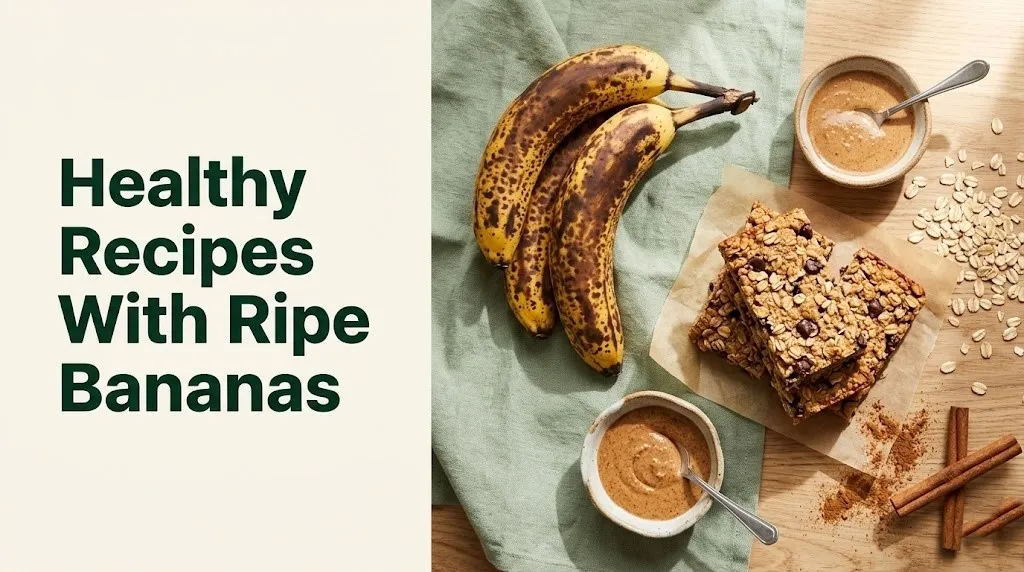
Healthy banana bars are made by combining mashed ripe bananas with rolled oats, a nut butter, and optional add-ins, then baking until set. No flour, no refined sugar, and no butter required.
This is the most requested recipe in this category, so here’s a fully detailed version with real measurements, timing, and macros.
Healthy Banana Oat Bars
Ingredients (makes 12 bars):
- 3 large very ripe bananas (approximately 340g mashed, about 1.5 cups)
- 2 cups (180g) whole rolled oats (certified gluten-free if needed)
- 1/4 cup (65g) almond butter or natural peanut butter (no added sugar)
- 1 teaspoon cinnamon
- 1/4 teaspoon fine sea salt
- Optional add-ins: 2 tablespoons dark chocolate chips (70% cacao or higher), 2 tablespoons pumpkin seeds, or 1/4 cup fresh or frozen blueberries
Instructions:
- Preheat oven to 350°F (177°C). Line an 8×8 inch (20x20cm) baking pan with parchment paper.
- Mash bananas thoroughly in a large bowl until no large chunks remain. This step determines the final texture: lumpy mash equals uneven bars.
- Add almond butter, cinnamon, and salt. Stir until fully combined.
- Fold in rolled oats and any optional add-ins. The mixture should be thick, sticky, and hold its shape when pressed.
- Transfer mixture to the lined pan. Press firmly and evenly into an approximately 3/4-inch-thick layer using the back of a spoon or a wet hand.
- Bake 22 to 25 minutes until the top is set, the edges are lightly golden, and a toothpick inserted in the center comes out with moist crumbs (not wet batter).
- Cool in the pan for 15 minutes before lifting out and slicing into 12 even bars.
- Store in an airtight container at room temperature for 2 days, refrigerated for 5 days, or frozen for up to 3 months.
Approximate nutrition per bar (without add-ins):
| Nutrient | Per Bar |
|---|---|
| Calories | 125 |
| Carbohydrates | 19g |
| Dietary Fiber | 2.5g |
| Protein | 3g |
| Fat | 4g |
| Potassium | ~140mg |
| Added Sugar | 0g |
For a nut-free version suitable for school lunches or those with tree nut allergies, replace almond butter with sunflower seed butter in equal amounts. The flavor profile changes slightly (sunflower seed butter has a more neutral, mildly savory taste) but the texture stays consistent.
Banana Bars Healthy
Banana bars qualify as genuinely healthy when their ingredient list is built around whole foods: oats, nut butter, ripe banana, and nothing refined or added unnecessarily.
The word “healthy” gets overused on packaged foods and recipe blogs. For banana bars specifically, here’s a clear framework for evaluating whether a recipe earns the label:
A healthy banana bar:
- Uses 0g added sugar (sweetness comes entirely from the ripe banana)
- Contains at least 2g dietary fiber per bar
- Uses whole rolled oats or another whole grain as the base (not white flour)
- Uses a nut or seed butter for fat (monounsaturated and polyunsaturated fats rather than saturated)
- Has a caloric density of 100 to 160 calories per bar for a standard 12-bar batch from an 8×8 pan
A less healthy “banana bar”:
- Contains added sugar, honey, or maple syrup despite already using ripe bananas
- Uses white flour as the primary dry ingredient
- Includes chocolate chips or mix-ins that significantly increase calories without adding nutritional density
According to the USDA Dietary Guidelines for Americans 2020-2025, most adults benefit from shifting toward whole-grain foods and reducing added sugar intake to less than 10% of total daily calories. A well-made banana oat bar contributes to both of those goals in a single snack.
People monitoring carbohydrate intake should note that even a “healthy” banana bar contains approximately 19g of carbohydrates per serving, primarily from oats and the natural sugars in the banana. One bar fits comfortably into most eating patterns; consuming three or four bars in a sitting changes the carbohydrate calculation considerably.
Key Takeaway: A banana bar earns the “healthy” label specifically when it contains zero added sugar, uses whole oats as the base, and gets its fat from a nut or seed butter — and that combination is genuinely achievable in about 30 minutes.
Easy Healthy Banana Recipes
Easy healthy banana recipes are reliable when they require five ingredients or fewer, use no-mixer techniques, and produce results that keep well in the fridge or freezer for later in the week.
For people who don’t cook often or don’t enjoy baking, the easiest entry points are recipes that involve no heat at all:
No-bake banana options:
- Banana nut butter bites: Slice a ripe banana into rounds, spread each round with 1/4 teaspoon almond butter, and top with a dark chocolate chip. Approximately 12 to 14 bites from one banana, roughly 10 to 12 calories each.
- Banana yogurt parfait: Layer 1/2 cup plain Greek yogurt with 1 sliced ripe banana and 2 tablespoons of granola (look for granola under 6g added sugar per serving). Approximately 250 to 280 calories, 15g protein.
- Banana chia pudding base: Mash 1/2 ripe banana into 1 cup unsweetened almond milk mixed with 3 tablespoons chia seeds. Refrigerate overnight. Serves 1. Approximately 220 calories, 7g fiber, 5g protein.
These three options require no oven, no stovetop, and roughly 5 minutes of active preparation.
For people with very limited time during the week, the banana chia pudding is the most practical: it takes 5 minutes on Sunday night and produces a ready-to-eat breakfast for Monday morning.
Healthy Recipe With Bananas
A healthy recipe with bananas balances the fruit’s natural carbohydrate content with a protein or fat source and builds around whole, minimally processed ingredients rather than using the banana as a minor add-on to an otherwise sugar-heavy recipe.
Bananas work in both sweet and savory contexts, though the sweet applications are far more common. The savory option worth knowing: mashed ripe banana adds moisture and a very subtle sweetness to grain bowls or stirred into unsweetened nut-based sauces, where it rounds out acidity.
The key to using banana in recipes effectively is knowing its moisture content. A mashed medium banana contributes approximately 1/3 cup of moisture to a batter. In recipes that also call for oil, butter, or yogurt, this moisture content affects the final texture. If you’re adapting a conventional recipe to include banana as a fat replacer, reduce the oil or butter by roughly 25 to 30% and test for texture.
A study published in the Journal of Nutrition found that incorporating fruit into baked goods as a sugar substitute reduced overall added sugar content by up to 40% without meaningfully affecting consumer taste preferences in tested samples. That research supports what experienced banana bread bakers already know from testing: ripe banana adds enough sweetness that most recipes don’t need the full sugar measurement the original calls for.
For people following a vegan eating pattern, banana serves as both the egg replacer and the sweetener in many recipes, which reduces the ingredient list and the cost per batch.
Healthy Banana Recipe Ideas
The most useful healthy banana recipe ideas fit into specific lifestyle contexts: fast weekday breakfasts, batch-cookable snacks, post-workout recovery options, and kid-friendly treats without added sugar.
Here are ideas organized by use case:
For fast weekday mornings (under 10 minutes active time):
- Banana mashed into 1/2 cup dry oats cooked with water plus a spoonful of peanut butter on top
- Banana sliced into plain Greek yogurt with a tablespoon of hemp seeds (approximately 4g additional protein from hemp seeds)
- Frozen banana blended with 1/2 cup cold brew coffee and 1/4 cup oat milk for a no-added-sugar morning smoothie
For batch-cooked weekly snacks:
- The banana oat bars from the bars section (make on Sunday, keeps 5 days refrigerated)
- Banana bran muffins: Combine 1 cup (90g) oat bran, 2 ripe bananas (mashed), 2 eggs, 1/2 cup plain yogurt, 1 teaspoon baking powder, and 1/2 teaspoon cinnamon. Fill a 12-cup muffin tin lined with paper liners. Bake at 375°F (190°C) for 18 to 20 minutes. Approximately 90 to 100 calories per muffin.
For post-workout recovery:
- Banana blended with 1 cup low-fat milk or unsweetened soy milk and 1 tablespoon natural peanut butter provides quick carbohydrates for glycogen replenishment plus protein for muscle repair
For children or picky eaters:
- Two-ingredient banana oat cookies (see the easy recipes section) or sliced banana with a nut butter dip work reliably across age groups and require no explanation
Key Takeaway: Matching a banana recipe idea to a specific use case (fast mornings, batch prep, post-workout, kids’ snacks) makes the decision much easier and ensures the recipe you choose actually gets made instead of forgotten.
What to Do With Overripe Bananas Healthy
When bananas turn fully brown, the single best healthy action is to freeze them immediately if you’re not baking today, or use them in a recipe that day while they’re at peak sweetness.
A fully brown banana is not spoiled. The peel darkens due to enzymatic browning and ethylene gas production during ripening. The fruit inside remains safe, edible, and sweet until it becomes visibly moldy, emits a fermented smell, or develops a liquid interior. At the very-overripe stage, the banana’s texture is too soft for slicing but ideal for mashing.
Here’s a priority order for what to do with overripe bananas, starting with the option requiring the least planning:
- Freeze for later (takes 5 minutes; bananas keep up to 3 months in a sealed bag; label with the date)
- Make banana nice cream immediately (blend frozen or very soft overripe bananas; serve right away)
- Bake banana oat bars (35 minutes total; makes 12 servings for the week)
- Make two-ingredient cookies (15 minutes total; 12 to 14 cookies)
- Add to a smoothie fresh (no freezing needed; use that day)
If you regularly have overripe bananas and no time to bake, set up a dedicated “banana bag” in your freezer. Peel overripe bananas, break them in half, add to the bag, and freeze. Within a few weeks you’ll have enough for any recipe without ever needing a same-day commitment.
Old Banana Recipes Healthy
Old bananas (ones that have been sitting past peak ripeness) are nutritionally intact and safe to use in healthy recipes as long as the fruit inside hasn’t fermented, gone moldy, or developed an off smell.
“Old” and “overripe” are often used interchangeably in recipe contexts, but there’s a practical distinction. Overripe means the banana ripened fully and is at its sweetest point. Old means it may have been sitting at that point for several days beyond that. The interior is still usable in most cases, but check for:
- Off smell: A strongly alcoholic or vinegary scent suggests fermentation; discard those.
- Mold on the fruit flesh (not just the peel): Discard.
- Liquid-filled interior: The fruit has broken down past usability; discard.
If the interior is soft but intact, smells sweet, and shows no mold, it’s perfectly appropriate for baking. Old bananas actually perform better in recipes than fresh ones for most baking purposes, because their higher moisture content and peak sweetness reduce the need for added liquid or sugar.
Best healthy recipes for very old bananas:
- Banana oat bars (the high-moisture content of old bananas improves the bar’s texture)
- Banana nice cream (old bananas produce a creamier, more intensely banana-flavored result)
- Banana bran muffins (moisture from old bananas keeps muffins from drying out during baking)
- Frozen banana smoothie packs (freeze the old banana now in smoothie-sized portions to blend later)
People often feel unnecessary guilt about old bananas. The most sustainable food habit is knowing that a brown banana isn’t waste: it’s a future ingredient.
Healthy Recipe for Ripe Bananas
The single most versatile healthy recipe for ripe bananas is the banana oat bar, because it works with any level of ripeness from yellow-spotted to fully brown, requires no equipment beyond a bowl and a pan, produces 12 servings, and stores well.
If you want a recipe framework that adapts to whatever you have available, here’s the core banana recipe formula:
The Adaptable Banana Base Recipe:
- 2 to 3 ripe bananas (mashed): provides sweetness and moisture
- 1.5 to 2 cups whole rolled oats or oat flour: provides structure and fiber
- 1 binding agent: 1 egg OR 1 tablespoon chia seeds soaked in 3 tablespoons water (vegan option)
- 1 fat source: 2 to 3 tablespoons almond butter, peanut butter, or sunflower seed butter
- Seasoning: 1/2 to 1 teaspoon cinnamon, pinch of salt
- Optional: 1/4 cup dark chocolate chips, pumpkin seeds, blueberries, or shredded unsweetened coconut
This base formula works for bars (press into a pan and bake at 350°F/177°C for 22 to 25 minutes), cookies (drop by the tablespoon and bake 12 to 14 minutes), or muffins (fill lined muffin cups two-thirds full and bake at 375°F/190°C for 18 to 20 minutes).
The chia seed egg replacement is the most useful substitution for people following a vegan or egg-free eating pattern. Combine 1 tablespoon chia seeds with 3 tablespoons water, stir, and let sit for 5 minutes until it gels. Use in place of one egg in the batter.
Healthy Recipes With Old Bananas
Old bananas are the most practical ingredient in healthy zero-waste cooking because they’ve developed maximum natural sweetness, which means they do the most work in eliminating added sugar from recipes.
The practical challenge with very old bananas is that their texture makes them look uninviting. The peel is black. The fruit inside is almost liquid-soft. Most people throw them away at this point. That’s a missed opportunity.
For the recipes where old bananas perform best, here’s a targeted list with preparation notes:
| Recipe | Why Old Bananas Work Well | Key Note |
|---|---|---|
| Banana nice cream | Highest sweetness = most intense flavor | Freeze first, then blend from frozen |
| Banana oat bars | Extra moisture creates a fudgier bar | Reduce any added liquid in recipe by 1 to 2 tablespoons |
| Banana bran muffins | Moisture prevents dryness during baking | Check 2 minutes early; old bananas increase moisture, can slow baking |
| Banana smoothie | Strong flavor carries through other ingredients | No ice needed; fruit is already very cold if frozen |
| Banana chia pudding base | Rich flavor with no added sugar needed | Mash directly into the pudding mixture; no blending required |
A note on potassium for a specific group: people with chronic kidney disease are often prescribed potassium-restricted diets by their nephrologist. Very ripe bananas contain approximately 422mg of potassium per medium fruit. If potassium restriction applies to your situation, discuss banana consumption with your renal dietitian before incorporating these recipes regularly. This is genuinely condition-specific guidance, not a general caution.
Key Takeaway: Old and overripe bananas are better for virtually every healthy baking application than fresh ones, because their peak sugar content does the sweetening work and their high moisture content keeps baked goods from drying out.
Frequently Asked Questions About Healthy Ripe Banana Recipes
Are ripe bananas healthier than unripe bananas?
Neither is objectively “healthier” — they have different nutritional profiles that suit different needs.
Unripe bananas contain more resistant starch, which behaves like dietary fiber and produces a lower glycemic response; ripe bananas contain more natural sugars (fructose and glucose) and are easier to digest.
People with digestive sensitivities often tolerate ripe bananas better; people specifically seeking a lower glycemic response may benefit more from a less-ripe banana eaten raw.
How many ripe bananas should I use in baking to replace sugar?
One large ripe banana (approximately 120 to 130g mashed) replaces roughly 1/3 cup of granulated sugar in most baked goods.
For a standard muffin or quick bread recipe that calls for 1/2 cup of sugar, two medium ripe bananas provide sufficient sweetness for most palates.
The substitution works best when the recipe also uses ingredients with their own fat or moisture (yogurt, nut butter, eggs), since banana adds significant liquid alongside sweetness.
Can people with diabetes eat recipes made with ripe bananas?
Recipes made with ripe bananas can be part of a diabetes-friendly eating pattern, but portion size and recipe composition matter.
A single banana oat bar (approximately 19g carbohydrates) is meaningfully different from eating two or three, and pairing it with a protein source (Greek yogurt, a boiled egg) slows glucose absorption further.
People managing type 2 diabetes or prediabetes should work with a registered dietitian to determine appropriate carbohydrate quantities per meal rather than applying a blanket rule about bananas.
How long do ripe bananas last in the freezer for baking?
Peeled ripe bananas stored in a sealed airtight bag last up to 3 months in the freezer with no meaningful loss of flavor or baking quality.
Label the bag with the date; bananas frozen beyond 3 months are still safe but may develop freezer burn that affects flavor.
Thaw at room temperature for 30 minutes or microwave for 45 to 60 seconds before mashing into batter, or blend directly from frozen for smoothies and nice cream.
What is the easiest healthy recipe to make with overripe bananas?
One-ingredient banana nice cream is the easiest option: freeze 3 peeled overripe bananas for at least 2 hours, then blend in a food processor until smooth.
No added sugar, no dairy, no equipment beyond a food processor or high-powered blender, and the result is genuinely creamy with a texture similar to soft-serve ice cream.
For a slightly more substantial version, add 1 tablespoon almond butter and 1/4 teaspoon cinnamon before blending.
Ripe bananas are one of the most useful ingredients in a health-focused kitchen, not because they’re a single magic food but because they solve a real practical problem: how to add sweetness, moisture, and nutrition to everyday recipes without reaching for added sugar or refined ingredients.
Start with the banana oat bars if you’re baking this week. Start with the nice cream if you want results in five minutes. Either way, those brown bananas on your counter are worth more than you might think.