
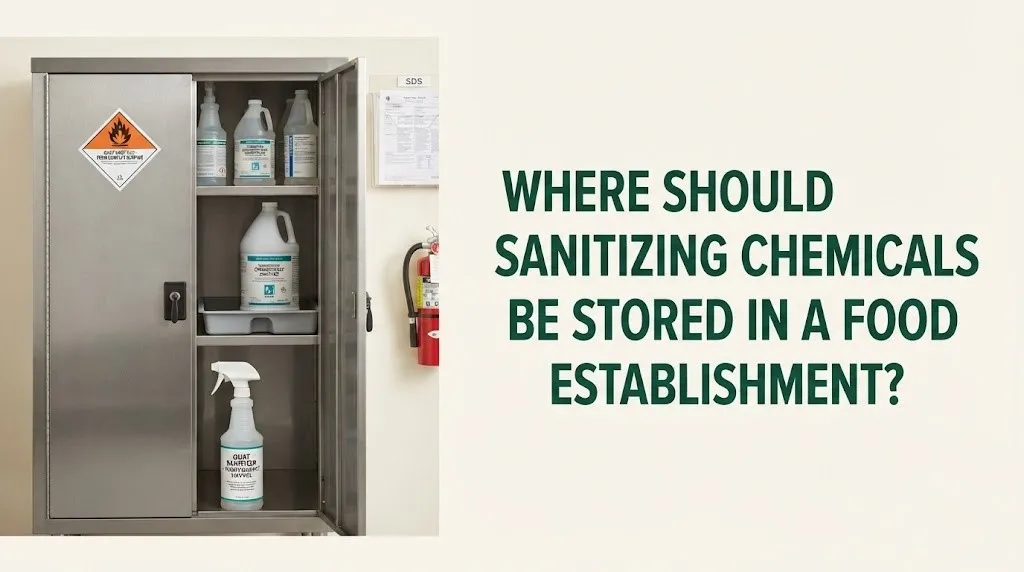
Sanitizing chemicals must be stored in a designated area completely separate from all food, food equipment, utensils, linens, and single-service items. The storage location must be a dedicated cabinet, closet, or room that is clearly labeled for chemicals only and positioned below or away from any surface where food or food contact items could be exposed to a spill, leak, or fumes.
The Centers for Disease Control and Prevention reports that chemical contamination is one of the leading non-biological causes of foodborne illness outbreaks in commercial kitchens. A single misrouted spray bottle of quaternary ammonium sanitizer dripping onto a sheet pan of prepared vegetables creates a contamination event that is nearly invisible to the eye but dangerous enough to sicken customers and trigger a regulatory enforcement action.
You are responsible for knowing exactly what a compliant chemical storage setup looks like. This guide walks you through the FDA Food Code requirements, approved storage locations, the labeling rules that inspectors check first, the cross-contamination risks most kitchens miss, and the storage volume limits that fire codes enforce. Read it as if your next health inspection is tomorrow.
Where Should Sanitizing Chemicals Be Stored in a Food Establishment
Sanitizing chemicals must be stored in a locked or secured designated chemical storage area that is physically separated by a permanent barrier from all food handling zones, food preparation surfaces, food equipment, dry storage shelving, and single-service article storage.
This rule applies to every type of sanitizing product you use: quaternary ammonium compounds, chlorine bleach solutions, iodine-based sanitizers, and peroxyacetic acid formulations. The separation must prevent any possible scenario where a leaking container, splashing liquid, or drifting fumes could contact food or food contact surfaces. A chemical storage area directly above dry food shelving, even with a solid shelf barrier, can still fail an inspection because condensation or fumes rising from sanitizer containers can migrate through shelf gaps.
The logic behind the rule is uncompromising. Unlike a physical contaminant like a broken glass shard that is visible and localized, a chemical spill or vapor release can contaminate a broad area without leaving any visible trace. The FDA Food Code uses the term “poisonous or toxic materials” to classify sanitizers and mandates that they be stored so they “cannot contaminate food, equipment, utensils, linens, or single-service articles.” Your storage setup must demonstrate that you have eliminated every foreseeable contamination pathway.
Designated Chemical Storage Area Requirements for Restaurants
A compliant designated chemical storage area is a permanent, clearly identified space that contains nothing except cleaning and sanitizing products and their associated dispensing equipment.
The space must meet four minimum requirements. First, it must have a floor, walls, and shelving constructed of non-porous, chemical-resistant materials such as epoxy-coated steel, polypropylene, or sealed concrete. Unsealed wood shelving absorbs chemical spills and releases them slowly over time. Second, it must have a raised sill or containment curb at the entrance sufficient to contain the full volume of the largest single container stored inside plus an additional margin, typically a 4-inch minimum curb height or an installed spill containment pallet. Third, it must have dedicated ventilation that exhausts directly to the outside, not into the kitchen HVAC return. Fourth, it must have a self-closing door with a functional lock or latch that prevents unauthorized access.
The location within the building matters. Place the chemical storage area as far from food receiving, storage, preparation, and warewashing zones as the floor plan allows. In small spaces where a separate room is not feasible, a dedicated chemical storage cabinet that meets all four requirements and is positioned well below and away from any food or utensil contact surfaces is the minimum acceptable alternative.
FDA Chemical Storage Guidelines for Food Service Operations
The FDA Food Code section addressing poisonous and toxic material storage requires that sanitizers, cleaners, and all other chemicals be stored in a designated area that prevents the contamination of food, equipment, utensils, linens, and single-service articles.
The Food Code does not prescribe an exact distance measured in feet between chemicals and food. Instead it uses an outcome-based standard: the storage configuration must demonstrably prevent contamination under all reasonably foreseeable conditions. This means a chemical shelf five feet from a food shelf but directly above it in an airflow path that carries heavy chemical vapors downward onto unwrapped produce is non-compliant. A chemical shelf ten feet away on the opposite wall with no potential for drips, splashes, or fume migration onto food surfaces is compliant.
The FDA also requires that sanitizing chemicals be stored in their original containers with the manufacturer’s label intact or in clearly labeled secondary containers that identify the chemical name and hazard class. Container labels must never be removed, defaced, or covered. The Food Code further specifies that poisonous or toxic materials cannot be stored above food, equipment, utensils, or single-service articles, which is an absolute prohibition with no workaround. There is no permitted distance or barrier combination that makes above-food chemical storage acceptable.
Approved Locations for Storing Sanitizing Chemicals Away from Food
Approved storage locations include a dedicated chemical storage room, a locked janitorial closet with chemical-rated shelving, a service corridor alcove with spill containment, or a designated chemical storage cabinet mounted below all food and utensil contact surfaces.
The chemical storage room is the gold standard. It has its own ventilation system, sealed concrete or epoxy flooring with a containment curb, chemical-resistant steel shelving, and a locking door. All bulk chemical containers, floor cleaning equipment, mop buckets, and spare sanitizer stock live here. The room is never used for storing anything food-related, not even empty food storage containers.
A janitorial closet can serve as the chemical storage area if it meets the containment and ventilation requirements. The key failure point in janitorial closets is overcrowding. If mops, brooms, vacuum cleaners, and paper products share the space with chemicals, the shelving must keep chemicals in a physically separated section with secondary containment beneath every liquid container. The door must lock or latch. Floor-level chemical storage inside a janitorial closet that also houses a floor drain connected to the kitchen plumbing can introduce backflow risks if a chemical spill drains into a system that experiences pressure fluctuations.
Can Sanitizing Chemicals Be Stored Above Food Preparation Sinks
No. Sanitizing chemicals must never be stored above a food preparation sink, a warewashing sink, or any surface where food or food contact items are placed.
This prohibition is absolute under the FDA Food Code and every state and local health code based on it. The regulation makes no exception for a locked cabinet above a prep sink, a shelf with a solid bottom, or a container that appears to be sealed. The risk pathway is straightforward: a leaking container or a container knocked over during a busy service period can release liquid sanitizer directly onto the sink basin, the faucet, or the surrounding prep surfaces. Even if the sink is not actively in use when the incident occurs, the residue dries onto the surface and later reactivates when wet food or cleaned utensils contact it.
A common violation scenario involves a shelf mounted on the wall directly above a three-compartment sink where the sanitizer rinse step takes place. Staff place spray bottles of sanitizer on that shelf for easy access during warewashing. A health inspector will write this violation immediately upon seeing it. The compliant alternative is to mount a small chemical holster or caddy on the side of the sink below the basin rim, not above it, and to store only the in-use sanitizer bottle there during active warewashing periods.
Proper Labeling of Sanitizer Bottles and Containers in Kitchens
Every sanitizer container in a food establishment must be labeled with the chemical’s common name and the appropriate hazard warning as specified by the OSHA Hazard Communication Standard.
The original manufacturer’s container with its printed label intact is always compliant. The label shows the product name, active ingredient list, EPA registration number, hazard statements, and first aid instructions. Never remove this label. Never pour a different chemical into an empty original container, even if you relabel it, because trace residue of the original product can react with the new contents.
Secondary containers like spray bottles, squeeze bottles, and small buckets must be labeled if the person who filled them will not be the only person using them and the container will not be emptied by the end of their shift. In practice, this means every spray bottle in a shared commercial kitchen must have a clear, legible label. Use permanent waterproof labels that identify at minimum: the product name as it appears on the original container and the primary hazard pictogram. Color-coded spray bottles add a useful visual cue but do not replace the written label requirement.
Quick Tip:
- Keep a label maker and waterproof label tape in the chemical storage area so staff can create new labels immediately when needed.
- Check spray bottle labels weekly during shift change inspections. Water and sanitizer spray degrades label adhesive over time.
- If a label becomes illegible, empty the bottle into the appropriate drain, rinse it, and relabel before refilling.
Original Container vs Secondary Spray Bottle Storage Rules
Sanitizing chemicals must be stored in their original manufacturer containers with intact labels in the main chemical storage area. Only the quantity needed for the current shift may be transferred to secondary containers like spray bottles.
The original container rule exists because the manufacturer’s label carries safety and hazard information that secondary labels often omit. The EPA registration number, the concentration instructions, the first aid guidance for accidental exposure, and the incompatibility warnings are all on the original container. A spray bottle labeled “Sanitizer” with a Sharpie on masking tape strips away critical safety information.
Secondary spray bottles are permitted at active workstations during the shift for which they were prepared. When the shift ends, the spray bottles must either be emptied and returned to storage or stored overnight in the designated chemical storage area. Never leave partially filled spray bottles sitting on prep counters or in the warewashing area overnight. The night cleaning crew may mistake them for a different product, or an early-morning prep cook may set a box of produce directly next to an unlabeled bottle. All secondary containers must be emptied and air-dried if they contained chlorine-based sanitizers, because chlorine degrades spray bottle components over time and can cause the bottle to fail and leak months later.
Separation of Different Types of Cleaning Chemicals in Storage
Different chemical classes must be separated within the chemical storage area to prevent dangerous reactions, off-gassing that corrodes equipment, and performance degradation of the products themselves.
The critical separation rule involves oxidizers and combustibles. Chlorine bleach is an oxidizer. It must be stored separately from ammonia-based cleaners, acid-based delimers, and flammable solvents like alcohol-based surface disinfectants. Mixing chlorine bleach and ammonia produces chloramine gas, which causes severe respiratory injury. Mixing chlorine bleach and acid produces chlorine gas, which is a chemical warfare agent in high concentrations. Even a slow leak from a bleach container onto a shelf where an acidic delimer previously spilled can produce a localized release of chlorine gas that damages nearby stainless steel and sickens a staff member who opens the chemical closet the next morning.
Quaternary ammonium compounds present a different concern. They are generally stable but can slowly release amine vapors in a poorly ventilated space, and those vapors accelerate corrosion on exposed stainless steel shelving and nearby copper pipes. Store quat concentrates away from open containers of acid-based products and away from any exposed metal that cannot tolerate prolonged amine exposure. The simplest protocol is to assign dedicated shelf zones by chemical class: acids on one shelf, oxidizers on another, quaternary ammonium compounds on another, and flammable solvent cleaners in a grounded flammable storage cabinet if your operation uses them.
| Chemical Type | Incompatible With | Storage Requirement |
|---|---|---|
| Chlorine bleach | Ammonia, acids, degreasers | Separate shelf, below quats |
| Quaternary ammonium | Strong oxidizers, acids | Separate shelf, ventilated area |
| Acid delimers | Chlorine, ammonia, metals | Lowest shelf with containment |
| Degreasers | Oxidizers, concentrated acids | Separate from oxidizers |
Cross-Contamination Risks from Sanitizers Stored Near Food
Chemical cross-contamination from sanitizer storage can occur through direct liquid contact, vapor migration, aerosol drift from spray bottles, and residue transfer from contaminated hands or surfaces.
Direct liquid contact is the most obvious pathway. A leaking gallon jug of sanitizer concentrate on a shelf above a bag of flour creates immediate contamination. The flour absorbs the liquid, the sanitizer spreads through the bag, and the contamination may not be visible or detectable by smell once the liquid evaporates. A baker uses the flour, the sanitizer residue transfers to the dough, and the contamination survives the baking process because quaternary ammonium compounds and many other sanitizers are heat-stable at normal cooking temperatures.
Vapor migration receives less attention in training but can cause equally dangerous contamination. Chlorine-based sanitizers emit chlorine gas slowly from open containers or poorly sealed bottles. In a confined storage area, chlorine vapors can travel surprisingly far and be absorbed by porous foods like bread, cake, and uncovered produce stored in nearby areas even if a wall separates them. This is why ventilation in the chemical storage area must exhaust directly to the outside rather than recirculating into the kitchen. If you can smell sanitizer anywhere near your food storage areas, your chemical storage ventilation has already failed.
Ventilation Requirements for Chemical Storage Rooms in Restaurants
Chemical storage rooms in food establishments must have mechanical exhaust ventilation that moves air directly to the outside at a rate of at least 6 air changes per hour when the room contains volatile chemicals like chlorine or ammonia-based products.
The ventilation system serves three purposes. It removes chemical vapors before they can accumulate to a concentration that poses a health risk to staff entering the room. It prevents vapor migration through wall penetrations and door gaps into adjacent food handling spaces. It controls humidity that can degrade chemical products and accelerate corrosion of shelving and containers.
A passive vent or a louvered door is not sufficient ventilation for a chemical storage room containing sanitizers and cleaners in a commercial food establishment. The FDA Food Code does not prescribe a specific airflow rate, but OSHA ventilation standards for chemical storage and the International Mechanical Code used by most municipal building departments generally require a mechanical exhaust fan rated for continuous operation. The fan must discharge to the exterior of the building at a point away from air intakes, openable windows, and pedestrian walkways. Have a licensed HVAC contractor verify the exhaust discharge location and airflow rate annually, and keep that documentation in your health inspection file.
Temperature Limits for Storing Sanitizing Chemicals Safely
Most commercial sanitizing chemicals must be stored at temperatures between 40 degrees Fahrenheit and 90 degrees Fahrenheit, away from direct sunlight, heat sources, and areas that experience freeze-thaw cycles.
Heat accelerates the degradation of sodium hypochlorite in chlorine bleach, reducing the available chlorine concentration over time. A gallon of bleach stored at 90 degrees Fahrenheit for three months can lose 20 percent of its active chlorine, meaning the sanitizer solution you think is 100 parts per million may actually test closer to 60 parts per million. Test strips will catch this, but only if you test every batch. Storing bleach in a cool, dark area extends its effective shelf life to approximately six months from the manufacture date.
Freezing is equally damaging. Many sanitizer concentrates separate into component phases when frozen and do not reconstitute properly upon thawing. The active ingredient may precipitate out and remain at the bottom of the container, creating a dangerously strong concentration in the first pour and a weak solution in later pours. Frozen and thawed sanitizers should be discarded rather than used, because the concentration has become unpredictable. The chemical storage area must maintain a temperature above 40 degrees Fahrenheit year-round, which in many climates requires a heated storage room or a temperature-controlled cabinet during winter months.
OSHA Chemical Storage Requirements for Restaurant Kitchens
OSHA requires that restaurant employers maintain a written hazard communication program, keep Safety Data Sheets accessible for every chemical product used in the establishment, and train all employees on chemical hazard recognition and safe storage practices.
The Hazard Communication Standard applies to every employer with employees who handle or may be exposed to hazardous chemicals during their work. In a restaurant, this includes every dish machine operator, every person who fills a sanitizer bucket, every prep cook who uses a sanitized cutting board, and any maintenance worker who unclogs a floor drain where chemical residues accumulate. The written program must list all hazardous chemicals present in the workplace by product name and must specify where the SDS binder or digital SDS access point is located.
Safety Data Sheets must be maintained for every chemical product currently in use. The SDS for a quaternary ammonium sanitizer, for example, specifies the chemical’s hazard classification, recommended personal protective equipment, incompatibilities with other chemicals, emergency spill procedures, and first aid measures. The SDS binder must be accessible to employees at all times, which means if the binder is kept in the manager’s office, the office must be unlocked during any shift when employees are working. Digital SDS access is acceptable if employees have unrestricted access to the device and know how to navigate to the correct sheet. A tablet kept in the manager’s desk drawer that requires a passcode is not compliant.
Key Takeaway: FDA and OSHA rules create two overlapping compliance obligations for chemical storage: one focused on preventing food contamination and one focused on protecting worker safety. A compliant storage design satisfies both simultaneously by keeping chemicals physically separated, properly labeled, and stored under conditions that preserve product integrity.
Storing Sanitizer Spray Bottles During Active Food Service
During active food service, sanitizer spray bottles may be kept at the specific workstation where they are in use if and only if they are stored below all food and food contact surfaces and are positioned so that spray mist cannot drift onto exposed food.
The practical reality of a busy kitchen is that sanitizer needs to be immediately accessible to line cooks who must sanitize cutting boards between prep tasks, to servers who sanitize tables between seatings, and to dishwashers who monitor sanitizer concentration at the three-compartment sink. The rule that permits in-use storage at workstations comes with strict placement conditions. A spray bottle hanging from a hook on the side of a prep table at a height below the cutting board surface is acceptable during service. A spray bottle sitting on the prep table surface next to a container of portioned vegetables is never acceptable, even if the cook is actively using it every three minutes.
When the rush ends or the workstation is broken down for the night, every in-use bottle must return to the designated chemical storage area. Establish a shift-change protocol: each station’s closing checklist includes a line item to remove all chemical bottles from the station and return them to chemical storage. The opening shift then retrieves only what they need for that shift. This rhythm prevents the accumulation of unlabeled, partially filled spray bottles that slowly spread across the kitchen over the course of a week.
Mop Bucket and Floor Cleaner Storage Location Requirements
Mop buckets, floor cleaning machines, and all floor-level chemical containers must be stored in the designated chemical storage area after each use, never in food preparation areas or warewashing zones.
The mop bucket is one of the most commonly cited chemical storage violations in food establishments. A wet mop bucket containing sanitizer solution left in the corner of the kitchen near the prep line appears harmless to tired closing staff but presents three contamination risks. The sanitizer solution off-gasses into the kitchen air continuously. The bucket is a trip hazard in a space where staff carry hot liquids and sharp tools. If someone knocks the bucket over during the dinner rush, the splash radius can contaminate multiple food contact surfaces simultaneously.
The compliant workflow requires that all floor cleaning be completed as one of the final closing tasks, after all food has been put away and all food contact surfaces have been cleaned and covered if needed. When mopping is finished, the bucket must be emptied completely into a designated janitorial sink or floor drain, rinsed, inverted to dry, and stored in the chemical storage area along with the mop handle and head. Never leave a mop bucket sitting with solution in it overnight. Never store a mop bucket in the warewashing area, even if that area is closed for the night. A health inspector arriving early the next morning will cite the violation regardless of whether food service was active at the moment they arrived.
Common Health Inspection Violations for Chemical Storage
The most frequent chemical storage violations recorded by health inspectors include chemical spray bottles stored on food preparation surfaces, chemical containers shelved above food or single-service items, and unlabeled secondary containers found at workstations.
A health inspector walking into a kitchen will scan the environment for these violations within the first 30 seconds. The visual scan is systematic: the inspector looks at what is above the food preparation surfaces at every station, what is stored on the warewashing drainboard, what containers are present on the lower shelves of prep tables, and whether the chemical storage closet door is closed and locked. Each violation is documented with a photo and a written note identifying the specific container, its contents, its location relative to food or food contact surfaces, and the corrective action required.
Other violations that appear consistently across inspection reports include storing mops and brooms in the warewashing area instead of the chemical storage area, placing chemical containers directly on the floor without secondary containment, and keeping expired or unneeded chemical products that create an accumulation hazard. A single unlabeled spray bottle filled with a pale yellow liquid on a shelf above a prep sink typically triggers an immediate correction order and a repeat violation observation on the next inspection if the pattern continues.
| Violation | Risk Created | Correction |
|---|---|---|
| Chemical bottle on prep surface | Direct food contact risk | Remove to chemical storage area immediately |
| Chemicals above food shelving | Drip or fume contamination | Relocate chemicals to approved below-food zone |
| Unlabeled spray bottle | Misidentification, misuse | Label with product name or empty and return to storage |
| Mop bucket left in kitchen | Trip hazard, fume exposure | Empty, rinse, invert, store in chemical area |
| Chemical container on floor | Spill risk, unauthorized access | Place on chemical-rated shelving with containment |
Employee Training on Chemical Storage Locations and Safety
Every food establishment employee must be trained during orientation on the exact location of the designated chemical storage area, the procedure for transporting chemicals to and from workstations, and the protocol for reporting a chemical storage problem.
Training must be documented. A signed training log showing the employee’s name, the date, the training topics covered, and the signature of the trainer satisfies both OSHA and health department documentation requirements. Verbal instruction without a record does not protect the establishment during an inspection when the inspector asks an employee “Where do you store the sanitizer spray bottle after your shift?” and the employee gives the wrong answer.
Training content must include a walkthrough of the chemical storage area with the door open, a demonstration of how to read an SDS for the most commonly used sanitizer, an explanation of the color-coded spray bottle system if one is in use, and a clear statement of the rule that no chemical container may ever be placed on a food preparation surface for any reason. The training must also cover the spill response procedure: where the spill kit is located, how to don personal protective equipment, how to contain and absorb a chemical spill, and how to report the incident to the manager on duty and to the chemical safety coordinator.
Quick Tip:
- Retrain all staff on chemical storage procedures every six months at minimum, or immediately after any chemical storage violation is found during an internal audit or a health inspection.
- Post a laminated chemical storage map on the inside of the chemical storage closet door showing exactly where each product category belongs.
- Include a chemical storage check as a line item on the daily opening and closing checklists for every station supervisor.
Key Takeaway: Chemical storage compliance is not a one-time setup. It is a daily operational discipline that fails the moment staff shortcuts become normalized. The best-designed chemical storage room is worthless if nobody uses it correctly, and the most rigorous training is worthless if supervisors do not enforce the rules every single shift.
Frequently Asked Questions About Sanitizing Chemical Storage
Where should sanitizing chemicals be stored in a commercial kitchen?
Sanitizing chemicals must be stored in a designated, locked chemical storage room or cabinet that is physically separated from all food and food contact surfaces.
The space must have non-porous shelving, spill containment, and mechanical ventilation that exhausts to the outside.
Never store any chemical container above a food preparation area, a sink, or dry food storage shelving.
Can cleaning chemicals be stored above a three-compartment sink?
No, cleaning and sanitizing chemicals cannot be stored above a three-compartment sink or any warewashing basin where dishes and utensils are washed.
The FDA Food Code prohibits storing toxic materials above any surface where food contact items are cleaned or placed.
A leak or splash from a container stored above a sink can directly contaminate the wash water, the rinse water, or the sanitizer basin.
How far should chemicals be stored from food in a restaurant?
Health codes do not specify an exact minimum distance in feet but require a permanent physical barrier and a configuration that prevents all foreseeable contamination.
Chemicals should be stored in a separate room or a separate cabinet with a closing door, not on a neighboring shelf separated by an air gap.
The storage layout must also account for vapor migration, which means chemical storage should not share a confined air space with uncovered food products.
Do spray bottles need to be labeled with the chemical name?
Yes, every spray bottle and secondary container in a commercial kitchen must be labeled with the common name of the chemical it contains.
Color-coded bottles do not replace written labels but can supplement them as a visual cue.
The label must be legible, waterproof, and must remain on the bottle until the contents are emptied and the bottle is cleaned for reuse.
What are the most common chemical storage violations during a health inspection?
The most common violations are spray bottles stored on food preparation surfaces, chemical containers shelved above food or single-service items, and unlabeled secondary containers found at active workstations.
Mop buckets left in the kitchen with sanitizer solution still inside also rank near the top of frequent inspection citations.
Each of these violations represents a direct contamination risk and will generate an immediate correction order from the inspecting officer.
Closing Section
Your chemical storage setup must prevent a contamination event that cannot be taken back once it happens. You cannot recall a sanitizer-soaked sheet pan of food that has already been served to a customer. The separation rules, labeling requirements, and daily storage disciplines are the only barrier between your operation and a preventable incident that hurts someone.
Walk your kitchen today with a notepad and a critical eye. Open every cabinet door. Check every shelf above every prep area. Scan every surface at every workstation. If you find a chemical container in a place where it does not belong, correct it immediately and write the correction into your shift checklist so it does not happen again.
The health inspector is not the adversary. The inspector is verifying that your chemical storage practices match the standard that your customers and your staff deserve. If your storage setup and your daily routines meet that standard every single day, the inspection is a formality. If they do not, fix them now.