Most people can return to eating solid food after a tooth extraction somewhere between day 3 and day 7, depending on the type of extraction and how well the socket is healing.
That range matters. The gap between a simple routine extraction and a surgical wisdom tooth removal is not small. According to guidance from the American Association of Oral and Maxillofacial Surgeons (AAOMS), surgical extractions involving bone removal require a meaningfully longer soft-food period than a straightforward single-tooth pull from a general dentist.
This article covers the exact day-by-day food timeline, the best soft foods to eat at each stage, which foods genuinely support healing, what to avoid and why, and the clear signs that your socket is ready to handle regular food again. Your oral surgeon or dentist’s specific post-operative instructions always take priority over general guidance, and any unusual pain, swelling, or signs of infection after day 3 warrant a call to their office.
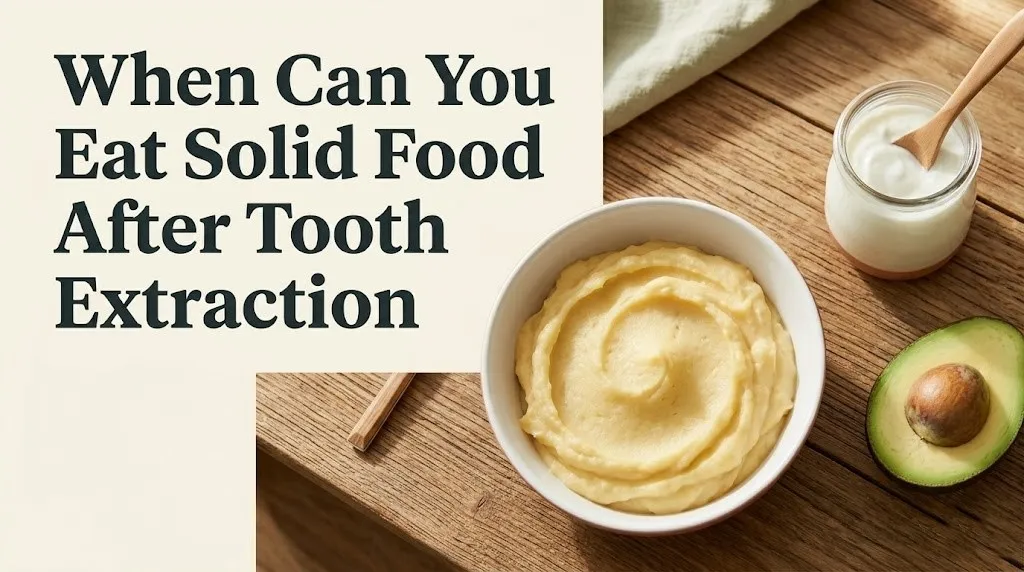
When Can You Eat Solid Food After Tooth Extraction
You can typically eat soft solid foods around day 3 to 5 after a simple tooth extraction, and closer to day 7 after a surgical extraction.
“Solid food” is a spectrum, not a single category. There is a difference between a soft-boiled egg and a crusty baguette. The clinical goal is not to avoid all solid texture forever. It is to avoid any food that requires biting pressure near the extraction site, generates suction, or leaves small hard particles that could lodge in or disturb the healing blood clot.
The American Dental Association (ADA) describes the healing socket as progressing through three phases: the initial clot formation phase (days 1 to 3), the early granulation tissue phase (days 3 to 7), and the soft tissue closure phase (weeks 1 to 4). Each phase has different mechanical vulnerability, which is why the food restrictions change as days pass.
For a simple extraction with no complications, most people tolerate semi-solid foods like mashed potatoes, scrambled eggs, and soft pasta by day 3 to 5. For a surgical wisdom tooth removal, the more conservative recommendation is 7 days before introducing any food that requires significant chewing.
| Extraction Type | When Soft Solid Foods Are Generally Safe | When Regular Food Is Generally Safe |
|---|---|---|
| Simple single-tooth extraction | Day 3 to 5 | Day 5 to 7 |
| Multiple simple extractions | Day 5 to 7 | Day 7 to 10 |
| Surgical wisdom tooth removal | Day 7 | Day 10 to 14 |
| Impacted wisdom tooth (bone removal) | Day 7 to 10 | Day 14 or per surgeon guidance |
These ranges assume no complications. Always follow the specific instructions provided at your post-operative appointment.
How Long After Tooth Extraction Can I Eat Solid Food
The minimum safe window before introducing any solid texture is 24 hours for the most basic soft solids, but most dentists recommend waiting until day 3.
The first 24 hours are entirely about protecting the blood clot. That clot is not just a sign that bleeding has stopped. It is the biological foundation for socket healing. The Mayo Clinic describes alveolar osteitis (dry socket) as occurring when that clot is dislodged or dissolves prematurely, exposing bone and nerve endings to air and food. Eating anything with chew or pressure before the clot stabilizes (roughly 24 hours minimum) raises that risk substantially.
After 48 hours, the clot is more established. Soft foods that require almost no chewing (smooth yogurt, blended soup, mashed banana, soft tofu) are generally tolerated by most patients if kept away from the extraction site.
After 72 hours, many patients with uncomplicated simple extractions can begin introducing foods with a little more texture: soft scrambled eggs, well-cooked oatmeal, ripe avocado. The key qualifier is “on the opposite side of the mouth from the extraction.”
Quick Tip:
- Eat on the side of the mouth furthest from the extraction site for the first week.
- Lukewarm food temperature reduces discomfort and avoids vasodilation at the clot site; avoid very hot foods for at least 48 hours.
- If your socket still feels tender to the touch of your tongue after day 5, that is a reasonable signal to continue soft foods regardless of the general timeline.
When Can I Eat Regular Food After Tooth Extraction
Most patients can return to eating regular food after a tooth extraction at approximately day 7 to 10 for a simple extraction and day 14 for a surgical removal.
“Regular food” here means the full range of your normal diet: cooked vegetables with some texture, tender meat, rice, pasta, and similar foods. It does not mean hard, crunchy, or sticky foods, which generally require a longer wait.
The socket does not feel tender in the same way after about a week for most simple extractions. Soft tissue is beginning to close over the socket opening. Biting pressure is less likely to disturb healing. That said, full bone socket healing takes considerably longer. According to a review published in the Journal of Oral and Maxillofacial Surgery, complete bony healing of an extraction socket typically takes 3 to 6 months, even though soft tissue closure occurs within 2 to 4 weeks.
The practical implication: “eating normally” does not mean applying heavy bite force directly on the extraction site. Even after week 2, it is sensible to continue chewing on the non-extraction side when possible.
| Recovery Phase | Approximate Timeline | Food Category Appropriate |
|---|---|---|
| Liquid and pureed only | Hours 0 to 24 | Broth, smoothies, yogurt, applesauce |
| Soft and minimal chew | Day 2 to 3 | Mashed potatoes, scrambled eggs, soft tofu |
| Semi-solid and gentle | Day 3 to 7 | Soft pasta, oatmeal, ripe banana, soft fish |
| Regular diet (non-crunchy) | Day 7 to 14 | Rice, tender meat, cooked vegetables |
| Full diet including hard foods | Week 3 to 4+ | Hard fruits, crusty bread, raw vegetables |
Key Takeaway: For a simple extraction, day 7 is a reasonable target for most regular foods. For a surgical wisdom tooth removal, day 14 is more appropriate. Either way, very hard and crunchy foods should wait at least 3 to 4 weeks.
What to Eat After Tooth Extraction: Day-by-Day Guide
A structured daily food plan protects healing and prevents unnecessary discomfort or complications after tooth extraction.
Think of your recovery diet like a post-marathon muscle repair protocol. The first 48 hours require the most conservative approach: everything is in service of protecting the repair process. As healing progresses, more options return.
Day 1 (hours 0 to 24): Stick entirely to cold or room-temperature liquids and smooth pureed foods. Blood clot formation is happening now.
Day 2: Introduce soft, no-chew foods. Plain yogurt, smooth hummus, mashed sweet potato, and blended soups are appropriate. Keep all food away from the socket.
Day 3: If there is no unusual pain or swelling, add very soft semi-solid options: soft scrambled eggs, ripe mashed avocado, well-cooked oatmeal (Avena sativa), and soft tofu.
Days 4 to 5: Soft pasta cooked to a very tender consistency, mashed banana, soft canned fish (like tuna or salmon, well-mashed), and cottage cheese are generally manageable.
Days 6 to 7: Most people with simple extractions can tolerate rice, tender baked chicken (well-moistened), and cooked soft vegetables at this stage.
Week 2: Most regular foods excluding hard, crunchy, or sticky items.
| Day | Sample Meals |
|---|---|
| Day 1 | Broth, smoothie, yogurt, applesauce |
| Day 2 | Blended soup, mashed sweet potato, hummus |
| Day 3 | Scrambled eggs, avocado, soft oatmeal |
| Days 4 to 5 | Soft pasta, mashed banana, cottage cheese |
| Days 6 to 7 | Rice, tender chicken, soft cooked vegetables |
| Week 2 | Regular diet excluding hard/crunchy/sticky |
People with diabetes should monitor the carbohydrate content of this soft food recovery diet carefully. Mashed potatoes, smoothies, applesauce, and yogurt all have meaningful glycemic impact. Opting for higher-protein options (eggs, cottage cheese, plain full-fat yogurt) helps moderate blood sugar response during recovery.
When Can I Eat Solid Food After Wisdom Teeth Removal
After wisdom teeth removal, most oral surgeons recommend waiting until day 7 before attempting semi-solid foods, and day 14 before returning to a full regular diet.
Wisdom tooth extraction (third molar removal) is almost always a surgical procedure. Even “simple” wisdom tooth extractions involve manipulating gum tissue and often require stitches. Impacted wisdom tooth removal involves cutting through bone tissue. The healing process is more involved than a routine single-tooth pull from a general dentist.
The American Association of Oral and Maxillofacial Surgeons (AAOMS) advises patients to maintain a soft food diet for at least one full week following wisdom tooth surgery. Some oral surgeons extend this recommendation to two weeks for lower impacted wisdom teeth, which are anatomically deeper and have higher dry socket risk than upper teeth.
A common mistake is misjudging pain reduction as a signal that healing is complete. Pain often improves substantially after day 3 due to the normal progression of post-operative inflammation, not because the socket is structurally ready for chewing pressure.
Quick Tip:
- Lower wisdom tooth sockets are at higher dry socket risk than upper ones. Be more conservative with the lower extraction sites.
- Wisdom tooth removal patients who smoke face a substantially elevated dry socket risk for the full first week, per Mayo Clinic guidance. Smoking after any extraction should be avoided.
- If your oral surgeon placed stitches, do not pull or manipulate them with food or your tongue.
When Can I Eat Hard Food After Wisdom Teeth Removal
Hard foods, including raw vegetables, crusty bread, hard crackers, chips, and whole nuts, should wait until at least 3 to 4 weeks after wisdom teeth removal for most patients.
Soft tissue healing at the socket surface occurs within 2 to 4 weeks. But the bone remodeling process underneath takes months. Biting hard food during the early weeks puts mechanical pressure on a site that still has incomplete structural support.
Hard foods also carry a specific particle risk. Small fragments of crackers, chips, seeds, or nut pieces can work their way into the healing socket, triggering inflammation or infection. This risk is highest in the first two weeks but persists until soft tissue closure is complete.
The clinical distinction is between “eating on the healing side” and “incidental contact.” If a small piece of soft bread touches the area briefly, that is less concerning than pressing a carrot stick against the extraction site with bite force.
| Food Category | When to Reintroduce After Wisdom Tooth Surgery |
|---|---|
| Cold liquids and pureed foods | Day 1 onwards |
| Soft no-chew foods | Day 2 onwards |
| Semi-solid (pasta, eggs, oatmeal) | Day 5 to 7 |
| Regular soft foods (rice, tender meat) | Week 2 |
| Chewy foods (bagels, dense bread) | Week 3 to 4 |
| Hard foods (raw carrots, apples, chips) | Week 4+ |
| Sticky foods (caramel, taffy, gummies) | Week 4+ |
Key Takeaway: Wisdom tooth removal requires a longer soft-food commitment than a simple extraction. Most hard foods need to wait 3 to 4 weeks, even when pain has resolved. Pain relief and socket healing are not the same thing.
Can I Eat Solid Food 3 Days After Tooth Extraction
Three days after a simple tooth extraction, you can usually eat soft solid foods that require very minimal chewing, but not firm, crunchy, or chewy textures.
Day 3 is when most patients notice a real improvement in comfort. Swelling begins to reduce. The initial blood clot has matured into early granulation tissue. The socket is more mechanically stable than it was at 24 hours. This is the phase where foods like soft scrambled eggs, smooth mashed potato, and very well-cooked oatmeal become appropriate.
For wisdom tooth or surgical extractions, day 3 is still early. The guidance from most oral surgeons is to continue liquid and very soft pureed food through at least day 5 to 7 following a surgical procedure.
The question “can I eat rice at day 3?” comes up frequently. The honest answer: it depends on the rice. Well-cooked, soft, sticky rice (like congee or porridge-style rice) is far less risky than fluffy, loose rice grains that can scatter into the socket. Congee is a genuine soft-food recovery option. Standard steamed rice on day 3 carries a higher particle lodgment risk.
Key Fact: The American Dental Association notes that any food that requires significant occlusal (biting) force or generates fragments that could enter the socket should be avoided until the overlying gum tissue has fully closed, typically 2 to 3 weeks post-extraction.
Best Soft Foods to Eat After Tooth Extraction
The best soft foods after tooth extraction are those that require no chewing, leave no particles, provide protein and micronutrients for healing, and can be eaten at room temperature or cold.
Recovery eating is not about enduring bland food for days. It is about choosing foods that actively support the repair process while keeping the socket clean. A well-planned soft food week can be genuinely satisfying.
The most effective recovery foods include:
- Plain yogurt (dairy or coconut-based): provides protein, calcium, and live bacterial cultures (Lactobacillus acidophilus) that support immune defense. Choose unsweetened varieties to avoid excess sugar at the wound site.
- Scrambled eggs: approximately 6 grams of protein per large egg, easily prepared soft, and require almost no chewing.
- Mashed sweet potato: provides vitamin A (as beta-carotene) and potassium, soft in texture, and satisfying as a meal base.
- Avocado (Persea americana): rich in monounsaturated fatty acids and vitamin E, naturally smooth, and requires no chewing when ripe.
- Cottage cheese: provides roughly 14 grams of protein per half-cup serving, soft texture, and high in calcium.
- Blended vegetable soup (pureed): delivers micronutrients without any particle or chewing risk.
- Oatmeal (Avena sativa), well cooked: approximately 5 grams of protein and 4 grams of soluble fiber per half-cup dry, gentle on healing tissue.
- Smooth nut butter (peanut or almond): provides protein and healthy fats in a no-chew format.
People with nut allergies should avoid nut butters and opt for sunflower seed butter or extra cottage cheese as an alternative protein source.
What Foods Should You Avoid After a Tooth Extraction
After tooth extraction, avoid any food that could dislodge the blood clot, lodge in the socket, create suction, generate pressure, or introduce harmful bacteria to the healing site.
The most specific categories to avoid include:
- Hard foods: raw carrots, apples, chips, crackers, crunchy granola, hard candy. These require biting pressure near the site.
- Small particle foods: seeds, nuts, popcorn, rice (loose, not congee), couscous, granola. Particles lodge in the socket and promote bacterial growth.
- Sticky and chewy foods: taffy, gummies, caramel, dried fruit, tough meat. These can physically pull at the clot or stitches.
- Spicy foods: hot peppers, chili-spiced dishes. Capsaicin causes tissue irritation and can increase inflammation at an already sensitive site.
- Very hot foods and drinks: hot coffee, hot soup, hot tea. Heat causes vasodilation, which can disturb the clot and increase bleeding.
- Acidic foods and drinks: citrus juice, tomato-based sauces, vinegar-heavy dressings. Acid delays soft tissue healing and causes discomfort at the wound margin.
- Alcohol: interferes with blood clot stability and interacts with any prescribed antibiotics or pain medication.
- Carbonated drinks: the pressure from carbonation bubbles can dislodge the clot. This applies to sparkling water, soda, and fizzy juice.
According to the Cleveland Clinic, straws should be avoided for at least 72 hours and ideally for the full first week. The suction created during drinking generates negative pressure in the mouth, which is one of the most common mechanical causes of dry socket.
Key Takeaway: The foods that cause the most complications are not just the obviously hard ones. Suction from straws, carbonation pressure, and tiny food particles from seemingly soft foods like couscous or loose rice are among the most common culprits behind painful recovery setbacks.
Foods That Help Healing After Tooth Extraction
Certain foods actively support socket healing by providing specific nutrients involved in tissue repair, collagen synthesis, immune function, and bone remodeling.
The body’s healing process at an extraction site involves three overlapping phases: hemostasis (clotting), inflammation and granulation tissue formation, and tissue remodeling. Each phase requires specific nutritional inputs.
Protein is the most important macronutrient for wound healing. Amino acids, particularly glycine and proline, are the structural building blocks of collagen, the primary protein in soft tissue and bone matrix. According to the NIH, adequate protein intake accelerates wound closure. Best soft-food sources include scrambled eggs, cottage cheese, plain yogurt, soft fish (tilapia, cod), smooth nut butter, and silken tofu.
Vitamin C (ascorbic acid) is required for collagen cross-linking. Without adequate vitamin C, new tissue forms weakly and healing slows. Good soft-food sources include smooth blended strawberry, mashed mango, and pureed butternut squash. Avoid citrus juices because their acidity creates irritation at the wound site.
Zinc supports immune function and is directly involved in wound repair enzyme activity. Soft zinc sources include yogurt, eggs, and smooth peanut butter.
Calcium and phosphorus support bone socket remodeling. Dairy-based foods (yogurt, cottage cheese, warm milk) and calcium-fortified plant milks provide both.
| Nutrient | Role in Healing | Best Soft Food Sources |
|---|---|---|
| Protein | Tissue repair, collagen building | Eggs, cottage cheese, yogurt, soft fish |
| Vitamin C (ascorbic acid) | Collagen synthesis, immune support | Blended mango, soft-cooked butternut squash |
| Zinc | Wound enzyme function, immune defense | Yogurt, eggs, smooth peanut butter |
| Calcium | Bone socket remodeling | Yogurt, cottage cheese, fortified plant milk |
| Vitamin A (as beta-carotene) | Epithelial repair | Mashed sweet potato, blended carrot soup |
Can I Eat Rice or Pasta After Tooth Extraction
You can eat pasta after tooth extraction starting around day 3 to 5, but only if it is cooked very soft and consumed without biting near the extraction site. Rice requires more caution due to particle risk.
Pasta cooked well past al dente, until genuinely soft throughout, breaks down easily and leaves no sharp fragments. Rigatoni, penne, or larger pasta shapes are easier to manage than spaghetti, which can flick against the socket. Eating pasta with a smooth sauce (cream or light butter based) is preferable to chunky tomato sauce with seeds.
Rice is more complicated. Loose, individual grains of cooked rice are small enough to fall into the extraction socket and remain trapped there, creating a focus for bacterial growth and potential infection. Congee (Chinese rice porridge), rice pudding, or blended rice-based soups eliminate this risk because the rice is fully broken down and has no individual particle form.
According to post-operative care guidance reviewed by the American Dental Association, grain-based foods that maintain their individual particle shape should be avoided until the socket has soft tissue coverage, typically around 2 to 3 weeks post-extraction.
Quick Tip:
- Pasta works best in week 1 when it is cooked to a very soft, almost mushy consistency and moistened with sauce.
- Avoid pasta shapes with hard edges (rotini, farfalle) in the first week. Smooth tube shapes or very soft small shapes (orzo cooked very tender) are better options.
- Add extra butter, cream, or olive oil to soft pasta to make it easy to swallow without much movement of the jaw.
How to Prevent Dry Socket Through Food Choices
Dry socket (alveolar osteitis) is prevented through food choices by avoiding anything that creates suction, generates particle debris, or causes physical disturbance to the healing blood clot.
Dry socket occurs in approximately 2 to 5% of routine extractions and up to 30% of lower wisdom tooth extractions, according to a clinical review published in the Journal of Oral and Maxillofacial Surgery. It is among the most painful post-extraction complications and delays healing by days to weeks.
The food-related causes of dry socket are more specific than most people realize. The mechanism is not simply “hard food hits the clot.” There are four distinct food-related pathways:
- Suction pathway: Straws, baby food pouches, and sucking motions create negative oral pressure that can physically pull the clot from the socket.
- Particle pathway: Small food fragments (seeds, rice grains, popcorn kernels, cracker crumbs) settle into the socket and mechanically disrupt the clot foundation.
- Temperature pathway: Very hot liquids or foods cause vasodilation in surrounding blood vessels, which can cause the clot to soften and dislodge.
- Chemical pathway: Alcohol and carbonation introduce chemical instability that disrupts the fibrin network holding the clot together.
- Avoid straws for a minimum of 72 hours, and ideally the full first week.
- Drink cold or room-temperature beverages directly from a cup for the first week.
- Do not eat anything from the prohibited list in the first 72 hours even if you feel fine. The absence of pain is not confirmation that the clot is secure.
Key Takeaway: Dry socket is far more preventable than most people think. Avoiding straws, loose-particle foods, very hot drinks, alcohol, and carbonation in the first 72 hours removes the four main food-related triggers entirely.
When Can I Eat Pizza or Crunchy Food After Tooth Extraction
Pizza, crunchy food, and other hard-textured items are generally safe after 3 to 4 weeks following a simple extraction and after 4 to 6 weeks following surgical wisdom tooth removal.
Pizza seems deceptively soft but presents multiple recovery risks. The crust (particularly a thick or crispy crust) requires significant biting force and generates crumbs. Tomato sauce is highly acidic, which irritates healing gum margins. Cheese can be stringy and sticky, with a pulling action that stresses the socket edge.
A soft, doughy pizza crust with minimal toppings may be manageable around week 2 for simple extraction patients if eaten carefully on the non-extraction side. This is an exception, not a rule, and depends on comfort level.
Crunchy foods present a more clear-cut picture. Raw vegetables, chips, crackers, hard pretzels, nuts, popcorn, and granola remain off the menu until the socket has complete soft tissue coverage. Attempting these too early risks particle-driven infection, reopened soft tissue, and prolonged healing.
| Food | When to Reintroduce (Simple Extraction) | When to Reintroduce (Wisdom Tooth) |
|---|---|---|
| Soft pizza (doughy base) | Week 2 to 3 | Week 3 to 4 |
| Crispy pizza crust | Week 3 to 4 | Week 4 to 6 |
| Crackers | Week 3 to 4 | Week 4 to 6 |
| Chips | Week 3 to 4 | Week 4 to 6 |
| Raw vegetables | Week 3 to 4 | Week 4 to 6 |
| Popcorn | Week 4+ | Week 6+ |
Nutrition Tips for Faster Recovery After Tooth Extraction
A targeted approach to nutrition in the first two weeks after tooth extraction can genuinely support faster soft tissue healing and reduce inflammation duration.
Caloric intake often drops significantly during the soft-food recovery period, which is understandable given the discomfort. But inadequate caloric intake slows wound healing directly. The body needs energy (from carbohydrates and fats) to run the inflammatory and tissue-building phases of recovery. Prioritizing calorie-dense soft foods prevents unintended nutritional deficits.
The most practical strategy is to build every soft-food meal around a protein source first (eggs, cottage cheese, yogurt, soft fish), then add a carbohydrate base (mashed potato, oatmeal, soft pasta), then add a fat for calories and flavor (avocado, olive oil, butter). This rough structure provides a reasonable macronutrient distribution even while eating from a constrained soft-food list.
Anti-inflammatory eating patterns also have a role. A 2021 study published in Nutrients found that higher dietary intake of omega-3 fatty acids (eicosapentaenoic acid/EPA and docosahexaenoic acid/DHA) was associated with reduced inflammatory markers in oral wound healing. Soft omega-3 sources during recovery include canned salmon, sardines mashed in oil, and flaxseed blended into smoothies.
Quick Tip:
- A high-protein smoothie (Greek yogurt, soft banana, nut butter, cow’s or fortified plant milk) consumed carefully from a cup without a straw is a practical way to hit protein targets when chewing is very limited.
- Avoid adding seeds (chia, flax in seed form, hemp hearts) to smoothies in the first week. Blend flaxseed into a fully smooth consistency or use flaxseed oil instead.
- Diabetic patients should use plain, unsweetened Greek yogurt as the smoothie base and limit fruit to reduce glycemic load.
Signs You Are Ready to Eat Solid Food Again After Extraction
You are ready to eat solid food after tooth extraction when the extraction site is no longer tender to the touch of your tongue, swelling has fully resolved, and you can open and close your mouth without restriction.
These three observable signs reliably indicate that the early healing phases are complete. They do not require a return dentist visit to confirm. But they do need to all be present together, not just one.
A fourth practical test: eating on the non-extraction side with a soft, slightly textured food (like well-cooked rice or tender pasta) without any discomfort at the extraction site is a reliable real-world confirmation that the socket is ready for a slightly broader diet.
Be aware that the absence of pain at the socket surface does not mean the underlying bone has healed. Biting pressure directly on the extraction site should continue to be avoided even after soft tissue closure, particularly for the first 4 to 8 weeks.
Indicators that you are not yet ready for solid foods:
- Visible white tissue or socket still open to view
- Tenderness when the tongue presses gently near the site
- Any continued swelling, jaw stiffness, or limited mouth opening
- Unusual taste, odor, or discharge from the socket area (these warrant a dentist call, as they may indicate infection or dry socket)
If pain increases after day 3 rather than improving, that warrants prompt contact with the treating dentist or oral surgeon. Worsening pain after initial improvement is the defining symptom of dry socket and should be evaluated rather than managed with diet adjustments alone.
Key Takeaway: Let your mouth tell you when it is ready. The physical signs, including no tenderness to the tongue, resolved swelling, and full jaw movement, are more reliable guides than the calendar alone. Both matter, but the body always has the final word.
Frequently Asked Questions About Eating Solid Food After Tooth Extraction
Can I eat solid food 24 hours after tooth extraction?
Twenty-four hours after a simple tooth extraction, very soft solid foods with no chewing required are generally safe if there is no active bleeding or unusual pain.
Appropriate options at 24 hours include smooth yogurt, mashed banana, and soft scrambled eggs eaten on the side away from the extraction.
Firm, crunchy, or chewy solids should wait until at least day 3 to 5 for simple extractions and longer for surgical ones.
What happens if I eat solid food too soon after tooth extraction?
Eating solid food too soon can dislodge the blood clot from the socket, increasing the risk of dry socket (alveolar osteitis), a painful condition where exposed bone and nerve endings are left unprotected.
Hard particles from solid food can also lodge in the open socket, creating conditions for bacterial infection.
If you experience worsening pain after eating, especially after day 3 when pain should be decreasing, contact your dentist or oral surgeon to rule out dry socket.
When can I eat solid food after wisdom teeth removal?
Most patients can eat semi-solid foods around day 7 after wisdom teeth removal, and a regular diet around day 10 to 14.
Impacted wisdom tooth extractions involving bone removal may require a longer soft-food period, as directed by your oral surgeon.
Hard and crunchy foods like chips, raw vegetables, and crusty bread should generally wait until 3 to 6 weeks after wisdom tooth surgery.
Can I eat rice after tooth extraction?
Loose cooked rice grains are not recommended in the first 2 to 3 weeks after tooth extraction because individual grains can fall into the healing socket and trigger infection.
Congee (rice porridge), rice pudding, or rice blended into a soup eliminates this risk and is safe from the first few days of recovery.
Plain steamed rice can generally return to the diet around week 2 to 3 once the socket surface has soft tissue coverage.
What is the best food to eat right after a tooth extraction?
Plain cold or room-temperature yogurt is among the best foods to eat immediately after a tooth extraction.
It requires no chewing, provides protein and calcium that support healing, and its cool temperature can help reduce localized discomfort.
Other strong early options include smooth applesauce, cold blended broth-based soup, and mashed ripe banana.
Moving Forward After Extraction
The recovery diet after a tooth extraction is genuinely short compared to how it feels in the moment. Most people are back to a regular soft diet within a week and a fully normal diet within two to three weeks for simple procedures.
The practical approach is straightforward: start conservative, build up based on how the site feels, prioritize protein and vitamin C-rich soft foods for the first two weeks, and treat the “no straws, no suction, no particles” rule as non-negotiable for the first three days.
If something feels wrong, including pain that worsens after day 3, unusual odor, or signs that the socket is not closing, that is worth a conversation with the dentist’s office. Not as a general suggestion, but as a specific step that helps identify dry socket or early infection before either becomes harder to treat.