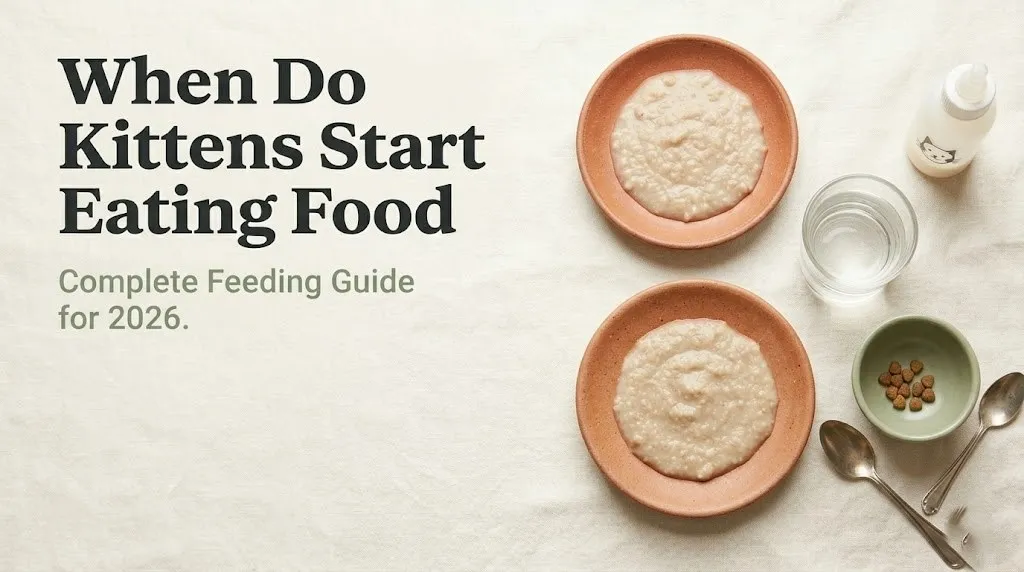
Kittens start eating food at approximately 3 to 4 weeks of age, when they begin transitioning from their mother’s milk (or kitten milk replacer) to a soft, gruel-like mixture of wet kitten food and formula. The full weaning process, where a kitten eats solid food independently and no longer needs milk, is typically complete between 6 and 8 weeks of age.
Getting this timeline right genuinely matters for long-term feline health. According to the American Association of Feline Practitioners (AAFP), kittens weaned too early show higher rates of behavioral problems and immune system vulnerabilities. Kittens weaned too late may lag in learning to self-feed, which creates challenges for foster carers and new owners managing the transition.
This guide covers the full feeding timeline from birth through 12 weeks, including when to introduce water and dry food, how to prepare gruel correctly, what to feed orphaned kittens, and what signs indicate a kitten is genuinely ready to advance through each food stage. Individual variation exists across breeds and litters, and any kitten showing signs of poor weight gain, lethargy, or failure to nurse should be assessed by a licensed veterinarian before any feeding protocol changes are made.
When Do Kittens Start Eating Food?
Kittens start eating food at approximately 3 to 4 weeks of age, when their teeth begin to erupt and their sensory and motor development allows them to investigate and lap at soft food.
Before this point, kittens are fully dependent on their mother’s milk or a commercial kitten milk replacer (KMR) for all nutrition. Queen’s milk (the milk of a domestic cat, Felis catus) is specifically formulated by nature for feline development. It contains higher levels of protein, fat, and the essential nutrient taurine (2-aminoethanesulfonic acid) than cow’s milk, making it impossible to replicate with standard dairy products.
The physical readiness signs at 3 to 4 weeks are worth knowing. Kittens begin to open their eyes fully at 2 to 3 weeks and start developing coordinated movement. By week 3 to 4, baby teeth (deciduous teeth) begin to emerge, and kittens show increasing curiosity about their environment, including the food bowl.
Kitten development and feeding readiness by age:
| Age | Developmental Stage | Feeding Status | Food Type |
|---|---|---|---|
| Birth to 2 weeks | Neonatal | Nursing only | Queen’s milk or KMR |
| 2 to 3 weeks | Transitional | Nursing, eyes opening | Queen’s milk or KMR |
| 3 to 4 weeks | Early transitional | Begin food introduction | Thin gruel (KMR + wet food) |
| 4 to 5 weeks | Transitional | Increasing solid food | Thicker gruel |
| 5 to 6 weeks | Early socialization | Weaning progressing | Wet kitten food |
| 6 to 8 weeks | Socialization | Weaning nearly complete | Wet food, soft dry food |
| 8 to 12 weeks | Juvenile | Fully weaned | Wet and dry kitten food |
Large breed cats including Maine Coon (Felis catus, breed), Ragdoll, and Norwegian Forest Cat kittens may progress through these stages slightly more slowly than average-sized domestic shorthair kittens. Any kitten not meeting weight milestones of approximately 10 to 15 grams of gain per day in early weeks warrants a veterinary assessment.
When Do Kittens Start Eating Solid Food?
Kittens start eating solid food between 3 and 5 weeks of age, beginning with a semi-liquid gruel and progressing to increasingly firm textures over the following two to three weeks.
“Solid food” in the kitten context is a spectrum, not a single transition point. Week 3 looks like a thin, watery mixture. Week 6 looks like normal wet canned kitten food eaten from a shallow dish. Week 8 looks like soft moistened kibble alongside wet food. That progression matters because rushing to a firmer texture too quickly leads to refusal, gastrointestinal upset, and weaning stress.
Think of it like a baby moving from breast milk to pureed food to soft solids to table food. The physical and digestive development takes time, and the texture needs to match where the kitten’s jaw, teeth, and gut actually are, not where you want them to be.
The American Veterinary Medical Association (AVMA) supports a gradual introduction approach for weaning that mirrors the natural behavior of mother cats, who begin bringing prey items and allowing kittens to explore textured food between weeks 4 and 6 in the wild.
Quick Tip:
- Start gruel at a very runny, almost liquid consistency in week 3 to 4
- Thicken it every few days by reducing the KMR ratio
- Watch for loose stool as a sign you’re moving too quickly in texture
- Kittens with food sensitivities to chicken or fish proteins should be discussed with a veterinarian before selecting a specific wet food formula
When Can Kittens Eat Solid Food?
Kittens can physically begin eating solid food at 3 weeks of age, but they are not ready to subsist on solid food alone until approximately 6 to 8 weeks, when weaning is naturally complete.
The distinction between “can begin” and “is ready to rely on” is one that competitors consistently blur. A 3-week-old kitten can lap at gruel and consume small amounts. It cannot yet meet its full caloric and nutritional needs from solid food alone. The mother cat or KMR continues to provide the bulk of nutrition until the kitten is actively seeking solid food more than milk.
The Cornell Feline Health Center notes that the weaning process is as much behavioral as physical. Kittens learn to associate solid food with satiety through repeated exposure and exploration. Forcing the process by removing access to nursing or formula before week 6 puts nutritional and immunological stress on the kitten’s developing system.
The immunological component is underappreciated. Queen’s milk provides maternal antibodies (passive immunity) that protect kittens against infectious diseases until their own immune system develops functional capacity. The optimal window for this passive immunity transfer ends around 6 to 8 weeks, which is one reason complete weaning before this point carries real health risk beyond just nutrition.
Signs a kitten is ready to increase solid food consumption:
- Approaches food bowl independently and without prompting
- Laps gruel or wet food without coaching from the mother cat or foster carer
- Deciduous (baby) teeth are visibly erupting (canine and incisor teeth appear first)
- Shows reduced nursing frequency or duration compared to previous days
- Weight gain is consistent at approximately 10 grams per day or more
Key Takeaway: Kittens can begin exploring solid food at 3 weeks, but they should not be removed from nursing or formula feeding until 6 to 8 weeks, because milk provides both nutritional completeness and passive immune protection that solid food alone cannot replace at that stage.
At What Age Do Kittens Start Eating Solid Food?
Kittens begin eating solid food at approximately 3 to 4 weeks of age, and the transition to eating solid food as their primary nutrition source happens between 5 and 8 weeks of age, depending on the individual kitten and litter.
Age is a useful guide, but developmental readiness is the more accurate marker. Two kittens from the same litter can differ by up to a week in readiness to advance through food textures, particularly in large litters where competition for nursing positions affects individual nutritional status.
Kittens from large litters of six or more may have less consistent access to nursing positions and may benefit from supplemental KMR feeding as early as week 2 to 3 to maintain weight gain targets. A kitten that isn’t gaining weight appropriately may not have the energy reserves to explore solid food with the same enthusiasm as a well-nourished littermate.
According to the Journal of Feline Medicine and Surgery, birth weight and early weight gain trajectory are the strongest predictors of kitten survival and long-term health outcomes in the first eight weeks of life. Weight monitoring should be a daily practice during this period.
Approximate kitten weight milestones by age:
| Age | Target Weight Range | Daily Gain Target |
|---|---|---|
| Birth | 85 to 115 grams | Baseline |
| 1 week | 150 to 200 grams | 10 to 15g per day |
| 2 weeks | 200 to 300 grams | 10 to 15g per day |
| 3 weeks | 300 to 400 grams | 10 to 15g per day |
| 4 weeks | 350 to 450 grams | 10 to 15g per day |
| 6 weeks | 500 to 600 grams | 10 to 15g per day |
| 8 weeks | 700 to 900 grams | 10 to 15g per day |
Any kitten losing weight or failing to gain within these ranges should be evaluated by a licensed veterinarian promptly, as this can indicate underlying health issues beyond simple feeding readiness.
When Do Kittens Start Eating Food and Drinking Water?
Kittens start showing interest in water at approximately 3 to 4 weeks of age, at the same time they begin exploring solid food, and fresh water should be made available from this point onward.
The timing is not coincidental. As kittens begin consuming solid food, their hydration needs change. Queen’s milk and KMR both have high water content, providing most of the kitten’s fluid intake through nursing. When solid food begins replacing milk, a separate water source becomes necessary to maintain adequate hydration.
Water introduction requires the right container. Standard adult cat water bowls are too deep for a 3 to 4-week-old kitten, which can have difficulty reaching the water level without risk of falling in. A shallow dish or saucer with no more than 1 to 2 centimeters of water depth is the appropriate vessel at this age. Replace the water at least twice daily to prevent bacterial contamination.
A note on what not to offer: cow’s milk (from Bos taurus) is not an appropriate water substitute or hydration supplement for kittens. After weaning begins, feline production of lactase (the enzyme that breaks down lactose) declines. Cow’s milk contains substantially more lactose than queen’s milk and causes diarrhea and dehydration in most kittens over 4 weeks of age.
Quick Tip:
- Use a ceramic or stainless-steel shallow saucer rather than plastic, which harbors bacteria in micro-scratches
- Place the water dish away from the litter box to reduce contamination risk
- Monitor whether the kitten is drinking by checking for a moist mouth and observing the water level; dehydration signs include skin that doesn’t spring back when lightly pinched and dark yellow urine
- Wet kitten food contributes significantly to total water intake and is particularly valuable for kittens still learning to drink from a bowl
When to Introduce Food to Kittens
The right time to introduce food to kittens is between 3 and 4 weeks of age, starting with a thin gruel made from commercial kitten milk replacer (KMR) and high-quality wet kitten food.
The gruel preparation process is the most practically important information in this entire topic, and it’s the detail most guides skip. Getting the consistency right at each stage determines whether the kitten accepts the food, whether it causes digestive upset, and how smoothly the transition progresses.
How to prepare kitten weaning gruel by stage:
To introduce gruel at weeks 3 to 4:
- Mix 3 parts prepared kitten milk replacer (KMR) (prepared per package instructions) with 1 part high-quality wet kitten food (AAFCO-compliant, labeled for growth and reproduction).
- Blend or mash until completely smooth with no chunks. The texture should resemble thin soup or whole milk in viscosity.
- Warm to approximately 95 to 100 degrees Fahrenheit (35 to 38 degrees Celsius), close to body temperature. Never microwave directly; heat the bowl in warm water to avoid hot spots.
- Place a small amount (approximately 1 teaspoon per kitten) in a shallow dish or saucer.
- Allow the kitten to approach and investigate. Dipping a clean finger into the gruel and offering it to the kitten’s mouth gently can encourage first tastes.
- Thicken the mixture by increasing the wet food ratio progressively over 10 to 14 days, targeting a ratio of 1 part KMR to 3 parts wet food by weeks 5 to 6.
All wet kitten food used in gruel preparation should carry the AAFCO statement indicating it is complete and balanced for growth and reproduction. Foods labeled “for all life stages” also meet this standard. Adult cat food does not meet kitten nutritional requirements and should not be used at any stage of weaning.
When Do Kittens Start Eating Kitten Food?
Kittens start eating designated kitten food, meaning food specifically formulated and AAFCO-certified for growth and reproduction, from the moment solid food is introduced at 3 to 4 weeks old, and they should continue eating kitten food until 12 months of age (or up to 18 months for large breed cats).
This is one of the most commonly misunderstood aspects of feline feeding. “Kitten food” is not just a marketing label. Under AAFCO standards, kitten food (labeled for growth and reproduction) must meet distinct minimum levels of protein (at least 30% on a dry matter basis for dry food), fat (at least 9% dry matter), taurine (2-aminoethanesulfonic acid), calcium, phosphorus, vitamin A (retinol), and DHA (docosahexaenoic acid) that adult maintenance food does not need to meet.
Adult cat food is nutritionally adequate for adult cats. It is not adequate for kittens, whose rapid growth requires higher caloric density, more protein per body weight, and higher concentrations of DHA and taurine than adult food typically provides.
Kitten food vs. adult cat food: key nutritional differences:
| Nutrient | Kitten Food (AAFCO Growth) | Adult Cat Food (AAFCO Maintenance) |
|---|---|---|
| Minimum crude protein (dry matter) | 30% | 26% |
| Minimum crude fat (dry matter) | 9% | 9% |
| Taurine (dry expanded) | 0.10% minimum | 0.10% minimum |
| DHA requirement | Required for growth | Not required |
| Caloric density | Higher | Lower |
| Calcium minimum | 0.60% | 0.50% |
| Phosphorus minimum | 0.50% | 0.40% |
Large breed kittens including Maine Coon cats may benefit from large breed-specific kitten formulas, which balance higher protein with controlled fat levels to support healthy growth rates. Discussing specific formulas with a veterinarian is the most reliable approach for large breed kitten owners.
Key Takeaway: Kitten food is a nutritional necessity, not a marketing category. AAFCO-certified kitten food meets developmental nutrient requirements that adult maintenance food does not, and feeding the wrong formula during growth has measurable consequences for bone, brain, and heart development.
When Do Kittens Start Eating Hard Food?
Kittens can begin eating hard (dry) food starting at 6 to 8 weeks of age, but only when it is first softened with warm water to a moist, slightly crumbly texture rather than offered as hard kibble directly.
The transition to dry food is often rushed by owners who find it more convenient than wet food. Dry kibble requires adequate jaw strength and tooth development to chew effectively, which kittens under 6 weeks don’t fully have. Offering dry kibble to a 4-week-old kitten that is still learning to lap gruel creates frustration, food refusal, and potential choking risk.
Moistened dry food bridges the gap effectively. Soaking kitten kibble in warm water for 5 to 10 minutes softens the texture to something the kitten’s developing teeth and jaw can manage. The goal is a texture similar to wet food, not the fully reconstituted mush that would result from soaking for an hour.
From 8 to 10 weeks onward, most kittens can manage dry kibble without softening, though individual variation exists. Kittens with delayed dental development or those from large litters that experienced early nutritional competition may need an extended moistened phase.
The practical approach many experienced foster carers and breeders use is to offer both wet and dry food simultaneously from week 8 onward, allowing the kitten to self-select based on preference. Both should be AAFCO-compliant kitten food. Some cats develop a strong preference for one texture over the other, and that preference established in kittenhood often persists into adulthood.
When to Introduce Dry Food to Kittens
Dry food introduction for kittens should begin at 6 weeks of age, starting with softened (water-soaked) kitten kibble and progressing to unsoftened dry food by approximately 8 to 10 weeks, once the kitten’s jaw strength and dentition are adequately developed.
Timing the dry food introduction is about more than texture. Dry food has a substantially lower moisture content than wet food, typically 8 to 10% moisture compared to 75 to 80% moisture in canned wet food. This means kittens eating primarily dry food need to compensate with higher water intake from their bowl, a behavior that takes time to establish.
The Association of American Feed Control Officials (AAFCO) does not differentiate nutrient requirements between wet and dry formulations within the kitten growth standard. Both formats can meet AAFCO kitten requirements. The practical difference is moisture delivery, caloric density per gram, and palatability to individual kittens.
Wet vs. dry kitten food comparison:
| Factor | Wet Kitten Food | Dry Kitten Food |
|---|---|---|
| Moisture content | 75 to 80% | 8 to 10% |
| Caloric density per gram | Lower | Higher |
| Palatability for young kittens | Generally higher | Lower until teeth develop |
| Shelf life (opened) | 24 to 48 hours refrigerated | Months when sealed |
| AAFCO compliant options | Yes | Yes |
| Hydration contribution | High | Low |
| Suitable age to introduce | 3 to 4 weeks (as gruel) | 6 weeks (softened) |
Kittens that are exclusively dry-food fed from a young age are at higher long-term risk of inadequate water intake. Veterinary Clinics of North America: Small Animal Practice research notes that cats are not strong thirst-drive drinkers by nature, having evolved from desert ancestors with low water-intake habits. Supporting adequate hydration through wet food inclusion throughout kittenhood is a dietary pattern worth establishing early.
When Do Baby Kittens Start Eating Food?
Newborn and very young kittens under 3 weeks of age do not eat food at all. They rely entirely on queen’s milk or kitten milk replacer (KMR). Baby kittens begin exploring and consuming food only when they reach approximately 3 to 4 weeks of age, aligned with the eruption of their first baby teeth.
The term “baby kitten” in this context typically refers to neonatal kittens (birth to 2 weeks) and early transitional kittens (2 to 3 weeks). At these stages, the digestive system is not developed enough to handle solid or semi-solid food of any kind. The gut lining, digestive enzyme production, and intestinal motility patterns all develop progressively in the first weeks of life.
Attempting to introduce solid food before week 3 causes diarrhea and potentially dangerous nutrient deficiencies, because the kitten’s gut cannot absorb nutrients from solid food at that stage regardless of food quality.
For orphaned neonatal kittens under 3 weeks, the only appropriate feeding option is a commercially prepared kitten milk replacer (KMR), such as PetAg KMR or Breeders’ Edge Foster Care, fed via bottle or syringe every 2 to 3 hours around the clock. No home-prepared formula using cow’s milk, goat’s milk, or human infant formula meets the specific protein, fat, and taurine requirements of neonatal felids, and these substitutes carry real risks of nutritional deficiency and gastrointestinal harm.
Any orphaned kitten under 3 weeks should be under the care of a veterinarian or an experienced licensed wildlife or cat rehabilitator for feeding guidance specific to that kitten’s weight, health status, and developmental stage.
Key Takeaway: Baby kittens under 3 weeks cannot eat food at all and must have KMR exclusively; attempting solid food before teeth erupt and before the gut is developmentally ready causes harm regardless of food quality.
When Do Cats Start Eating Solid Food?
Domestic cats (Felis catus) start eating solid food at approximately 3 to 4 weeks of age, which is when their transitional developmental stage begins and their sensory, motor, and dental development supports food exploration.
This is the same timeline as the species-specific kitten guidance above, but it’s worth addressing “cats” separately because many people search this way when they’re asking about a specific cat’s litter or an adult cat that has reverted to liquid-only intake due to illness or dental issues.
An adult cat that stops eating solid food is in a different situation entirely. Adult cats (Felis catus, over 12 months) refusing solid food require veterinary evaluation to rule out dental disease, oral pain, nausea from systemic illness, or other underlying conditions. The cause of food refusal in an adult cat is not a developmental timeline question. It is a clinical one.
For the developmental question, the AAFP notes that cats in both domestic and feral settings show the same general weaning timeline of 6 to 8 weeks, with the mother cat naturally reducing nursing availability and increasing exposure to prey or food sources in the 4 to 6 week window.
The mother cat plays an active role in weaning. She begins limiting nursing access by moving away from nursing kittens and occupying herself elsewhere, which naturally motivates kittens to seek alternative food sources. Foster carers replicating this environment can mimic this by offering gruel frequently and allowing the kitten to develop association between the food bowl and satiety.
When Can Cats Eat Solid Food?
Cats (domestic kittens specifically) can eat solid food beginning at 3 to 4 weeks of age in soft gruel form, and they can eat unsoftened solid (dry) food reliably from approximately 8 to 10 weeks of age.
The range from 3 weeks to 10 weeks covers the full weaning transition for the domestic cat. Within that window, the type of solid food appropriate changes substantially, moving from thin gruel to thick gruel to wet food to moistened dry food to dry kibble.
For senior cats (over 7 years of age) or cats with dental disease, solid dry food may become difficult or inappropriate regardless of developmental stage. Senior cats that show difficulty chewing dry kibble benefit from wet food, moistened kibble, or prescription dental diets formulated for reduced chewing effort. This is a veterinary nutrition conversation rather than a developmental timeline question.
The core point for kitten owners is that readiness for solid food is a progression, not a switch. A kitten that seems uninterested in solid food at 3.5 weeks is probably right on schedule. A kitten showing no interest by week 5 and failing to gain weight warrants a veterinary assessment to rule out underlying health concerns affecting appetite or digestion.
Solid food readiness progression summary:
| Age | Solid Food Status | Key Action |
|---|---|---|
| Under 3 weeks | Not ready | KMR only |
| 3 to 4 weeks | Beginning gruel | Introduce thin gruel |
| 4 to 5 weeks | Gruel advancing | Thicken gruel gradually |
| 5 to 6 weeks | Wet food primary | Transition to wet food |
| 6 to 8 weeks | Weaning completing | Add softened dry kibble |
| 8 to 10 weeks | Fully weaned | Offer wet and dry kitten food |
When Should Kittens Start Eating Food?
Kittens should start eating food at 3 to 4 weeks of age, and foster carers or owners should begin offering gruel during this window even if the mother cat is still nursing, to establish familiarity with solid food before nursing frequency naturally decreases.
The “should” in this question is different from the “can” question. “Can” is about physical readiness. “Should” is about optimal timing from a developmental and behavioral standpoint.
Waiting too long to offer food, even with a nursing mother present, means the kitten misses the socialization window during which food exploration is most naturally motivated. Kittens between 3 and 7 weeks are in a critical socialization period when new experiences, including new foods and textures, are most readily accepted without fear responses.
A kitten first offered solid food at week 8 because “the mother was still nursing” may show stronger food neophobia (reluctance toward new foods) and be harder to transition to a varied diet than one exposed to a range of textures and flavors during weeks 3 through 7.
According to the AAFP’s feline life stage guidelines, proactive nutritional exposure during the socialization period supports lifelong dietary flexibility, which is practically important for owners who may need to transition their cat to a therapeutic diet for health reasons at some future point.
Kittens with health conditions affecting appetite, digestion, or weight gain should have their feeding schedule customized by a veterinarian rather than following a standard developmental timeline.
When to Start Feeding Kittens Food
The right time to start feeding kittens food is between 3 and 4 weeks of age, and the process should begin with small, frequent offerings of thin gruel rather than a sudden switch from milk to solid food.
Frequency matters as much as timing. Young kittens have small stomachs and rapid metabolic rates. From the start of solid food introduction through week 6, offering food four to six times daily in small amounts is more appropriate than two large meals. By weeks 6 to 8, frequency can reduce to three to four times daily. By weeks 10 to 12, most kittens thrive on two to three meals per day or free-choice access to dry kitten food with scheduled wet food meals.
Feeding frequency guide by age:
| Age | Feedings Per Day | Portion Per Feeding | Primary Food |
|---|---|---|---|
| Birth to 2 weeks | Every 2 hours | KMR per weight | KMR only |
| 2 to 3 weeks | Every 3 hours | KMR per weight | KMR only |
| 3 to 4 weeks | 4 to 6 times | Small amounts gruel plus KMR | Thin gruel plus KMR |
| 4 to 6 weeks | 4 to 5 times | Increasing gruel, less KMR | Thickening gruel |
| 6 to 8 weeks | 3 to 4 times | Wet food primary | Wet food, softened dry |
| 8 to 12 weeks | 3 times | Measured portions | Wet and dry kitten food |
Overfeeding is a genuine risk from week 8 onward. Free-choice access to dry kitten food should be monitored, as kittens that overeat in the juvenile phase are at higher risk of overweight status in adolescence. A veterinarian can advise on specific portion amounts based on the kitten’s current weight, projected adult size, and activity level.
How Old Are Kittens When They Start Eating Food?
Kittens are approximately 3 to 4 weeks old when they first begin eating food, marking the start of the weaning transition that completes around 6 to 8 weeks of age.
In week terms: food exploration begins at week 3, meaningful consumption from solid food increases through weeks 4 and 5, and a kitten is typically eating primarily solid food by week 6, with full independence from milk by week 8.
There is natural individual variation within this range. Kittens from smaller litters with consistent nursing access tend to begin the transition at the later end (week 4) because their nutritional needs are fully met by nursing. Kittens from larger litters or orphaned kittens often show readiness for food exploration slightly earlier due to competitive nursing pressure or formula feeding patterns that may not fully satisfy them.
Breed matters too. A Siamese kitten (a breed associated with early maturation) may show interest in food at the earlier end of week 3. A Maine Coon (a slow-maturing large breed) may not show consistent interest until mid-week 4. These are generalizations, and the individual kitten’s weight gain, tooth eruption, and behavioral cues are always more reliable guides than breed expectations alone.
The most important takeaway from the age question is this: no kitten should be fully removed from nursing or KMR before 6 weeks of age, regardless of how enthusiastically it is eating solid food. The immune protection and nutritional completeness provided by milk continues to matter through that point, even when solid food intake is increasing.
Any concern about a kitten’s feeding progress, weight gain, or health should be directed to a licensed veterinarian with feline care experience. Small animal veterinary practices, including those affiliated with the American Veterinary Medical Association (AVMA), are equipped to assess individual kittens and adjust feeding protocols for specific health situations.
Frequently Asked Questions About When Kittens Start Eating Food
When do kittens start eating food on their own?
Kittens start eating food on their own, without nursing or bottle assistance, between 5 and 7 weeks of age, when they can approach a food dish and eat without prompting.
Full independence in eating, meaning no nursing or formula supplementation needed, is typically established between 7 and 8 weeks.
Large breed kittens or those from large competitive litters may take until week 8 to 9 to reliably self-feed without supplementation.
Can kittens eat wet food at 3 weeks old?
Kittens can eat wet food at 3 weeks old only when it is blended with kitten milk replacer (KMR) into a thin gruel consistency.
Offering straight wet food from a can to a 3-week-old kitten is too thick and nutrient-dense for their developing digestive system to handle without upset.
The gruel should start at a ratio of approximately 3 parts KMR to 1 part wet kitten food and thicken gradually over 10 to 14 days.
What happens if you wean kittens too early?
Kittens weaned before 6 weeks of age are deprived of maternal antibodies that provide passive immunity against infectious diseases.
According to the American Association of Feline Practitioners (AAFP), early-weaned kittens show higher rates of immune vulnerability, behavioral problems including aggression and anxiety, and digestive disorders.
Any kitten separated from its mother before 6 weeks should be monitored closely by a veterinarian and fed AAFCO-compliant kitten milk replacer until fully ready to transition to solid food independently.
When should I introduce water to kittens?
Water should be introduced in a shallow saucer at the same time solid food introduction begins, at approximately 3 to 4 weeks of age.
At this stage, a dish with no more than 1 to 2 centimeters of water prevents the risk of a young kitten falling in and becoming chilled.
Cow’s milk should never replace water for hydration, as it causes diarrhea in weaned kittens due to insufficient lactase enzyme production.
What is the best food to give kittens when they first start eating?
The best food for kittens first starting to eat is a thin gruel made from commercial kitten milk replacer (KMR) and AAFCO-compliant wet kitten food (labeled for growth and reproduction).
The KMR provides the nutritional bridge between nursing and solid food, while the wet food introduces the textures and nutrient profile the kitten will rely on going forward.
No homemade formulas, cow’s milk, or adult cat food meet the specific developmental requirements of a weaning kitten, and these substitutes carry real health risks at this stage.
Closing
The key number to hold onto is 3 to 4 weeks for first food introduction and 6 to 8 weeks for completed weaning. Everything between those two points is a gradual progression, not a series of hard switches.
Start with thin gruel. Thicken it every few days. Watch the kitten’s weight and stool consistency as your best feedback. Introduce water in a shallow dish from week 3. Add softened dry food at week 6. Keep all food AAFCO-certified for growth and reproduction through the kitten’s first birthday.
If something seems off, a licensed veterinarian is the right resource. Kittens move through developmental stages quickly, and early assessment of any feeding or weight concern makes a measurable difference in outcomes.