Healthy hair has specific, observable characteristics you can evaluate at home without a microscope or a dermatologist appointment. Healthy hair reflects light evenly along the hair shaft, producing a natural shine. It stretches slightly when wet and returns to its original length without breaking. It feels smooth when you run your fingers from root to tip. It sheds between 50 and 100 strands per day, which is the normal range established by the American Academy of Dermatology (AAD) . And it grows from a scalp that is free of persistent flaking, redness, or tenderness.
The signs of healthy hair are not about achieving a shampoo commercial ideal. Hair texture, curl pattern, and thickness are genetically determined and vary enormously across individuals. Healthy hair on a person with fine, straight hair looks different from healthy hair on a person with coarse, tightly coiled hair. The underlying markers of health, proper moisture balance, intact cuticle, sufficient protein structure, and a healthy follicle, are the same across all hair types. What changes is how those markers present visually and tactilely.
This guide provides a complete framework for evaluating your own hair health at home. It covers the visual signs, tactile signs, scalp signs, and behavioral signs of healthy hair. It explains how to perform an elasticity test and a porosity test. It distinguishes normal shedding from problematic hair loss. It provides male-specific guidance, a comparison of healthy versus damaged hair signs, and the nutritional foundations of hair health including the specific vitamins, minerals, and foods that support each aspect of healthy hair.
Signs of Healthy Hair
The signs of healthy hair are grouped into four categories: visual signs you can see in a mirror, tactile signs you can feel with your fingers, scalp signs visible at the roots, and behavioral signs related to shedding and breakage. Each category provides a different piece of information about the health of the hair structure and the hair follicle.
Visual signs of healthy hair include natural shine from a smooth cuticle that reflects light evenly, color that appears rich and consistent from root to tip without premature fading or brassiness, minimal visible split ends, and a general appearance of vitality. Shine is the most immediately recognizable visual sign of healthy hair. It is produced when the cuticle, the outermost layer of overlapping scales on the hair shaft, lies flat and smooth. A lifted or damaged cuticle scatters light rather than reflecting it, producing a dull appearance.
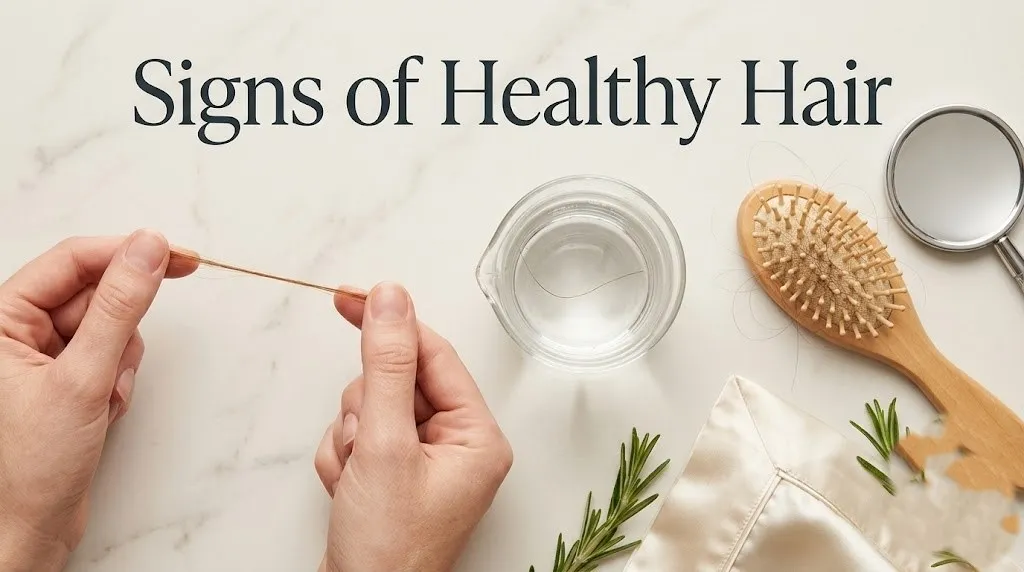
Tactile signs of healthy hair include smoothness when running fingers from root to tip, softness to the touch, and elasticity when a strand is gently stretched. Healthy hair feels smooth in the direction of the cuticle, root to tip. Running fingers in the opposite direction, tip to root, will feel slightly rough even on healthy hair because the cuticle scales are lifted against the grain. This is normal. Smoothness in the correct direction indicates an intact cuticle. The elasticity test is described in detail later in this guide.
| Sign Category | Healthy Hair Sign | What It Indicates |
|---|---|---|
| Visual | Natural shine, light reflection | Smooth, flat cuticle |
| Visual | Rich, consistent color | Intact cuticle protecting pigment |
| Visual | Minimal split ends | Protein structure intact, moisture balance |
| Tactile | Smooth root to tip | Cuticle scales aligned |
| Tactile | Soft, not brittle or gummy | Moisture and protein balanced |
| Tactile | Elasticity, stretches and returns | Proper protein and moisture content |
| Scalp | Clean, no flakes or redness | Healthy follicle environment |
| Behavioral | 50 to 100 strands shed daily | Normal hair cycle |
| Behavioral | Minimal breakage during brushing | Strong protein structure |
Key Takeaway: The signs of healthy hair are organized into visual, tactile, scalp, and behavioral categories. Shine, smoothness, elasticity, a clean scalp, and normal shedding are the five most reliable indicators of overall hair health.
Healthy Hair Looks Like
Healthy hair looks like hair with a visible natural shine, even color, smooth texture, and body or movement. The specific appearance varies by hair type. Healthy straight hair lies smoothly with a uniform light reflection. Healthy wavy or curly hair has defined curl patterns without frizz and reflects light in a more diffused pattern due to the curvature of the hair shaft. Healthy coily or kinky hair has visible definition in the coil pattern, natural sheen rather than glass-like shine, and volume without excessive dryness.
The cuticle is the structure that determines what healthy hair looks like. The cuticle is composed of overlapping scales, similar to roof shingles, that protect the inner cortex where the hair’s protein and pigment are housed. When the cuticle is intact and the scales lie flat, the hair surface is smooth and reflects light. When the cuticle is damaged, the scales are lifted or missing, the surface is rough, and light scatters. The result is dull, frizzy, or lackluster hair. Heat styling, chemical processing, and mechanical damage from rough brushing lift the cuticle. The cuticle cannot repair itself because it is not living tissue. Hair health is about preserving the cuticle from damage and providing moisture and protein to the cortex beneath.
Color is an indicator of cuticle health. Natural hair color that remains rich and vibrant from root to tip indicates that the cuticle is protecting the melanin pigment in the cortex. Premature color fading, brassiness in dyed hair, or a generally washed-out appearance suggests cuticle damage that is allowing pigment to escape. Gray hair is a natural part of aging and is not a sign of unhealthy hair. The cuticle can be healthy on gray hair. The color change is from reduced melanin production in the follicle, not from hair shaft damage.
| Hair Type | What Healthy Looks Like | What Unhealthy Looks Like |
|---|---|---|
| Straight | Smooth, glassy shine, lies flat | Frizzy, dull, flyaways, split ends |
| Wavy | Defined waves, subtle shine, minimal frizz | Undefined frizz, rough texture, breakage |
| Curly | Defined curls, natural sheen, bounce | Frizz, lack of definition, dryness |
| Coily/Kinky | Defined coils, sheen, volume, moisture | Excessive dryness, breakage, lack of definition |
Signs You Have Healthy Hair
You have healthy hair if your hair passes the basic at-home assessments: it shines naturally, feels smooth, stretches without breaking, sheds within the normal range, and grows from a calm scalp. These signs are not a single test. They are a pattern. One sign of damage, a few split ends, does not mean your hair is unhealthy. Multiple signs across multiple categories indicate a problem.
The shine test: in natural light, your hair has a visible sheen or luster. The light reflects along the hair shaft in a continuous line, not a scattered or absent reflection. If your hair is curly or coily, the sheen is more diffuse but still present. Hair that looks matte or dusty in natural light likely has cuticle damage.
The touch test: run your fingers from root to tip. The hair feels smooth and cool. There are no rough patches, no areas of friction, and no sticky or gummy texture. Rough patches indicate lifted cuticles. Sticky or gummy texture when wet can indicate moisture overload or product buildup. Dry, brittle texture indicates protein loss or moisture deficiency.
The shed test: gather the hair that comes out during a normal day, in the shower, on your brush, on your pillow. If you are losing 50 to 100 strands per day, you are in the normal range. If you are losing handfuls, seeing visible thinning, or noticing bald patches, you are beyond the normal range. The AAD distinguishes between normal shedding, which is diffuse and maintains overall density, and hair loss, which produces visible thinning or patches.
Quick Tip:
- Collect the hair you shed in a 24-hour period. Place it on a white piece of paper. Count it or estimate the total. Fifty to 100 strands that are the full length of your hair is normal. More than 150 strands, or strands that are noticeably shorter than your hair length (indicating breakage rather than shedding), is a reason to evaluate your hair care practices or consult a dermatologist.
How Do I Know If My Hair Is Healthy
You know if your hair is healthy by evaluating it across the four categories: visual, tactile, scalp, and behavioral. You do not need a dermatologist to assess basic hair health. The assessments described in this guide are designed for home use. The elasticity test, the porosity test, the shed count, and the scalp check are the four self-assessments that provide the most information.
The combination of assessments matters more than any single result. Hair that passes the elasticity test but fails the shed count is indicating a follicle-level issue, possibly telogen effluvium or nutritional deficiency, rather than a hair shaft issue. Hair that passes the shed count but fails the porosity test is indicating cuticle damage from heat, chemicals, or mechanical stress. The pattern of results points toward the cause of the problem.
If multiple assessments indicate damage, the first step is to evaluate hair care practices. Heat styling, chemical treatments, harsh shampoos, and rough handling are the most common causes of hair shaft damage. Reducing or eliminating these practices allows the hair to grow out with an intact cuticle. The existing damaged hair cannot be repaired, only managed with conditioning products until it is cut off. If the problem is at the follicle level, excessive shedding, thinning, scalp symptoms, a dermatologist can perform blood work to check for nutritional deficiencies, hormonal imbalances, and autoimmune conditions that affect hair.
| Self-Assessment | What It Evaluates | Healthy Result |
|---|---|---|
| Elasticity test | Protein and moisture balance | Stretches 20 to 30% and returns |
| Porosity test | Cuticle integrity | Floats, then slowly sinks |
| Shed count | Hair cycle normalcy | 50 to 100 strands per day |
| Scalp check | Follicle environment | Clean, no flakes, no redness |
Key Takeaway: You know your hair is healthy by evaluating it across the visual, tactile, scalp, and behavioral categories. The elasticity test, porosity test, shed count, and scalp check are the four home assessments. The pattern of results is more informative than any single test.
How to Tell If My Hair Is Healthy
To tell if your hair is healthy, work through the following checklist. Each item corresponds to one of the four assessment categories. Answer each question honestly based on what you observe today, not what you hope is true or what your hair was like last month.
The visual checklist: Does your hair have a natural shine in indirect daylight? Does the color look consistent from root to tip? Are split ends rare or absent? If you answered yes to all three, your hair passes the visual assessment.
The tactile checklist: Does your hair feel smooth when you run your fingers from root to tip? Does it feel soft, not brittle or crunchy? Does a wet strand stretch slightly and return without breaking? If yes to all three, your hair passes the tactile assessment.
The scalp checklist: Is your scalp free of persistent flakes, redness, itching, or tenderness? Do you see healthy skin at the part line? If yes, your scalp passes the assessment. Occasional dryness or a single pimple is not a failure. Chronic symptoms are.
The behavioral checklist: Do you lose between 50 and 100 strands per day? Do you see minimal hair in your brush or shower drain beyond that? Are you not noticing visible thinning or bald patches? If yes to all three, your hair passes the behavioral assessment.
If your hair passes three or four categories, it is generally healthy. One failing category with the others passing indicates a specific problem area. Failing the visual and tactile assessments with a normal scalp and shed count indicates hair shaft damage from styling practices. Failing the shed count with normal hair shaft assessments indicates a follicle-level issue that warrants a dermatology evaluation.
What Does Healthy Hair Feel Like
Healthy hair feels smooth, soft, and elastic. The specific sensation depends on hair type, but the underlying qualities are consistent. Smoothness is the most reliable tactile sign. When you run your fingers from root to tip, the hair feels like a single continuous surface. There are no rough patches, no friction, and no snagging. This smoothness is produced by the flat cuticle scales. It is the same physical principle that makes a polished stone feel smooth while a rough stone feels abrasive.
Softness is distinct from smoothness. Smoothness is about the surface. Softness is about the flexibility and moisture content of the hair. Healthy hair bends easily. It does not feel stiff, brittle, or straw-like. Brittle hair that snaps when bent is deficient in moisture or protein. Hair that feels gummy or overly stretchy when wet has moisture overload and needs protein. The balance between moisture and protein is what produces the sensation of soft, flexible hair.
Elasticity is the quality of stretching and returning. Healthy hair, when wet, can stretch 20 to 30 percent of its length and return to its original length without breaking. Dry hair has less elasticity but should still have some give. Hair that stretches and does not return, or hair that snaps immediately without stretching, has a protein or moisture imbalance. The elasticity test is the quantitative measure of this tactile quality.
| Hair Texture | What Healthy Feels Like | What Unhealthy Feels Like |
|---|---|---|
| Fine | Soft, silky, moves easily | Fragile, breaks easily, limp |
| Medium | Smooth, flexible, bouncy | Rough, dry, split ends |
| Coarse | Strong, substantial, smooth | Brittle, straw-like, wiry |
| Curly/Coily | Soft, defined, moisturized | Dry, rough, brittle, tangles excessively |
Quick Tip:
- Feel your hair at the root, mid-shaft, and ends. Compare the three sections. The root should be the smoothest because it is the newest growth with the least damage. If the mid-shaft and ends feel progressively rougher, the damage is cumulative along the length of the hair. The ends are the oldest part of the hair and have endured the most washing, brushing, styling, and environmental exposure.
Healthy Hair Scalp Signs
A healthy scalp is the foundation of healthy hair. The hair follicle, the living structure that produces the hair shaft, resides in the scalp. If the scalp is inflamed, infected, or malnourished, the follicle cannot produce healthy hair. The American Academy of Dermatology identifies a healthy scalp as one that is free of persistent flaking, redness, itching, tenderness, and scaling.
The visual signs of a healthy scalp include skin that is the same color as the rest of the face, no visible flaking or scaling, no red patches or areas of inflammation, and clean hair follicles without crusting or buildup around the base of each hair. The part line should show healthy skin. A healthy scalp produces sebum, an oily substance that coats the hair shaft and provides natural conditioning and water resistance. The amount of sebum varies by individual. An oily scalp is not necessarily unhealthy. A scalp that is oily with redness, flaking, or odor may have seborrheic dermatitis.
The tactile signs of a healthy scalp include no tenderness when touched, no itching that persists throughout the day, and no painful areas. A healthy scalp can be touched, brushed, and styled without pain. An itchy scalp that does not improve with gentle washing may indicate dandruff, seborrheic dermatitis, psoriasis, or an allergic reaction to a hair product. A dermatologist can diagnose the specific condition.
| Scalp Condition | Appearance | Sensation | What It May Indicate |
|---|---|---|---|
| Healthy | Clean, even color, no flakes | No itching, no pain | Normal scalp function |
| Dry scalp | Small white flakes, no redness | Mild itching | Environmental dryness, harsh shampoo |
| Dandruff | Yellowish greasy flakes | Itching | Seborrheic dermatitis, fungal overgrowth |
| Psoriasis | Thick silvery scales, red patches | Itching, burning | Autoimmune condition |
| Folliculitis | Red bumps around follicles | Tender, painful | Bacterial or fungal infection |
People with scalp symptoms that persist for more than 2 weeks despite gentle care should see a dermatologist. Scalp conditions are treatable. They do not resolve on their own. The dermatologist can prescribe medicated shampoos, topical treatments, or oral medications depending on the diagnosis.
Key Takeaway: A healthy scalp is clean, even-colored, and free of persistent flaking, redness, and tenderness. The scalp is the foundation of hair health. Scalp symptoms lasting more than 2 weeks warrant a dermatology evaluation.
Hair Elasticity Test
The hair elasticity test measures the protein and moisture balance of the hair shaft. It is performed on a single wet hair strand. The test reveals whether the hair has adequate protein structure, adequate moisture, or an imbalance of the two. Elasticity is the single most informative physical property of hair for assessing its internal health.
To perform the hair elasticity test:
- Take a single strand of hair from your brush or shed hair. The strand should be at least 4 inches long.
- Hold the strand between your thumbs and forefingers at both ends.
- Wet the strand with water. The test must be performed on wet hair because water temporarily breaks the hydrogen bonds in the hair’s protein structure, revealing the underlying covalent bond integrity.
- Gently stretch the strand. Healthy hair will stretch 20 to 30 percent of its original length and return to its original length without breaking.
- Interpret the result: If the strand stretches and returns fully, your hair has good elasticity, indicating a proper balance of protein and moisture. If the strand stretches but does not return, or stretches excessively and feels gummy, your hair has moisture overload or insufficient protein. If the strand snaps immediately with little to no stretching, your hair has protein overload or moisture deficiency and is brittle.
| Elasticity Test Result | What It Indicates | Recommended Action |
|---|---|---|
| Stretches 20 to 30% and returns | Balanced protein and moisture | Maintain current care |
| Stretches excessively, feels gummy | Moisture overload, protein deficiency | Add protein treatment |
| Snaps immediately, no stretch | Protein overload or moisture deficiency | Add moisturizing treatments, reduce protein |
| Stretches slightly then breaks | Combination of damage and imbalance | Evaluate overall hair care routine |
The elasticity test should be performed on strands from different parts of the head. Hair at the crown may have different elasticity than hair at the nape. Consistent results across locations indicate a general hair health status. Different results indicate localized damage from styling practices (for example, heat damage on the crown from blow-drying).
Hair Porosity Test
The hair porosity test measures how well the hair cuticle absorbs and retains moisture. Porosity is determined by the condition of the cuticle. Low porosity hair has a tight, flat cuticle that resists moisture absorption. Normal porosity hair has a slightly raised cuticle that allows moisture in and retains it. High porosity hair has a lifted, damaged cuticle that absorbs moisture quickly but also loses it quickly.
The float test is the simplest at-home porosity test:
- Take a clean, dry strand of shed hair.
- Fill a glass with room temperature water.
- Place the hair strand on the surface of the water.
- Observe for 2 to 5 minutes. If the strand floats on the surface and does not sink, your hair has low porosity. The tight cuticle repels water. If the strand floats for a minute then slowly sinks, your hair has normal porosity. If the strand sinks immediately, your hair has high porosity. The damaged cuticle rapidly absorbs water.
| Porosity Level | Float Test Result | Characteristics | Care Approach |
|---|---|---|---|
| Low | Floats indefinitely | Shiny, takes long to dry, products sit on top | Use heat to open cuticle, lighter products |
| Normal | Floats briefly, then sinks | Shiny, manageable, holds styles well | Maintain current care |
| High | Sinks immediately | Dull, frizzy, absorbs water and products quickly but loses them | Use protein treatments, heavier products, seal with oil |
Porosity is not fixed. It can change with hair damage. Heat styling, chemical processing, and UV exposure raise porosity by damaging the cuticle. Hair that was once normal porosity can become high porosity with accumulated damage. The porosity test is worth repeating every few months to monitor changes.
Key Takeaway: The float test measures hair porosity. Low porosity hair floats. Normal porosity sinks slowly. High porosity sinks immediately. Porosity indicates cuticle condition and guides product selection.
Hair Shedding vs Hair Loss
Hair shedding and hair loss are different processes with different causes. Shedding is the normal loss of hair at the end of the telogen (resting) phase of the hair growth cycle. The American Academy of Dermatology states that shedding 50 to 100 strands per day is normal. Hair loss is a reduction in hair density caused by the follicle miniaturizing (androgenetic alopecia), the immune system attacking the follicle (alopecia areata), or a physiological stressor pushing a disproportionate number of follicles into the resting phase (telogen effluvium).
Normal shedding is diffuse across the scalp. You find strands on your pillow, in your brush, in the shower drain. The overall density of your hair remains stable. You do not see visible thinning or bald patches. The shed strands are the full length of your hair, indicating they fell out naturally from the root, not that they broke off mid-shaft.
Hair loss is characterized by visible thinning, a widening part, a receding hairline, or bald patches. The shed count is elevated above 100 to 150 strands per day. The lost hair may be accompanied by changes in the hair shaft, miniaturized hairs that are thinner and shorter than normal. Hair loss has multiple causes including genetics (androgenetic alopecia), stress (telogen effluvium), nutritional deficiency (iron, zinc, protein), hormonal changes (postpartum, menopause, thyroid), and autoimmune disease (alopecia areata).
| Characteristic | Normal Shedding | Hair Loss |
|---|---|---|
| Strands per day | 50 to 100 | 100 to 150+ |
| Distribution | Diffuse across scalp | May be patterned or patchy |
| Visible thinning | No | Yes |
| Strand length | Full length | May include short, thin strands |
| Duration | Constant, stable | Progressive or sudden onset |
A person experiencing hair loss should see a dermatologist. The dermatologist can perform a pull test, examine the scalp under a dermatoscope, and order blood work including ferritin (iron stores), vitamin D, thyroid function, and hormone levels. The cause of hair loss determines the treatment. Telogen effluvium resolves when the trigger is addressed. Androgenetic alopecia is managed with minoxidil, finasteride, or other treatments. Alopecia areata is treated with corticosteroids or immunotherapy.
Normal Hair Shedding per Day
Normal hair shedding is 50 to 100 strands per day, according to the American Academy of Dermatology. This number is an average. Some people naturally shed closer to 50. Some shed closer to 100. The number varies with the hair growth cycle, seasonal changes, and individual factors. The key is stability. If your daily shed count has been 70 strands for years and suddenly increases to 150, that is a change worth investigating even though 150 is only moderately above the normal range.
The hair growth cycle explains why shedding occurs. Each hair follicle cycles through anagen (growth, 2 to 7 years), catagen (transition, 2 to 3 weeks), and telogen (resting, 3 to 4 months). At the end of telogen, the hair strand falls out and a new anagen hair begins growing in its place. Approximately 10 to 15 percent of scalp follicles are in telogen at any given time. With 100,000 follicles on the average human scalp, 10,000 to 15,000 hairs are in the shedding phase. Fifty to 100 of those shed each day.
Shedding increases after physiological stressors including childbirth (postpartum telogen effluvium), major surgery, significant weight loss, high fever, and severe emotional stress. The increased shedding occurs 2 to 4 months after the stressor because the follicles that were pushed into telogen by the stress take that long to complete the resting phase and shed. This type of shedding is temporary. It resolves within 6 to 9 months as the follicles re-enter the anagen phase.
| Shedding Level | Strands per Day | Assessment |
|---|---|---|
| Low normal | 30 to 50 | Healthy |
| Average normal | 50 to 100 | Healthy |
| High normal | 100 to 120 | Borderline, monitor |
| Elevated | 120 to 150 | Evaluate for causes |
| Excessive | 150+ | Consult a dermatologist |
Key Takeaway: Normal hair shedding is 50 to 100 strands per day. The number is individual and should be stable. A sudden increase or visible thinning warrants evaluation. Postpartum and post-stress shedding are temporary and resolve within 6 to 9 months.
Signs of Healthy Hair Male
Signs of healthy hair in males include the same visual, tactile, scalp, and behavioral indicators as in females, with the addition of specific considerations for male hair patterns and common male hair concerns. Male hair is typically thicker in diameter than female hair due to androgens. Male scalps produce more sebum. Male pattern baldness (androgenetic alopecia) affects approximately 50 percent of men by age 50, according to the American Academy of Dermatology. The distinction between normal healthy hair and the early stages of male pattern baldness is a critical assessment for men.
The early signs of male pattern baldness are recession at the temples, thinning at the crown, and a widening part. These changes occur gradually over years. They are not a sign of unhealthy hair in the sense of hair shaft damage. The hair that remains is healthy. The issue is follicle miniaturization driven by dihydrotestosterone (DHT). The follicle produces progressively thinner, shorter hairs until it stops producing hair entirely. A man can have healthy hair on the sides and back of his head while experiencing pattern baldness on top.
For men, the healthy hair assessment should include a comparison of density across regions of the scalp. Is the hair at the temples and crown as dense as the hair at the back of the head? If the answer is no, and the thinning has progressed over time, the likely cause is androgenetic alopecia. If the thinning is diffuse across the entire scalp and began suddenly, the cause may be telogen effluvium or a nutritional deficiency. A dermatologist can distinguish between these.
| Male Hair Health Indicator | Healthy | Concerning |
|---|---|---|
| Temple hairline | No recession | Receding or M-shaped pattern |
| Crown density | Full coverage | Visible thinning or bald spot |
| Part width | Narrow, consistent | Widening part |
| Shedding | 50 to 100 strands daily | Sudden increase, visible thinning |
| Scalp | Clean, no redness | Itching, flaking, redness |
Men experiencing hair thinning should see a dermatologist early. Treatments for androgenetic alopecia are most effective when started before significant hair loss has occurred. Minoxidil and finasteride are FDA-approved treatments that slow loss and can regrow hair in some men. A dermatologist can determine whether the thinning is genetic, nutritional, or related to another medical condition.
How to Know If Your Hair Is Healthy Male
A male knows his hair is healthy by performing the same self-assessments described in this guide, with the addition of monitoring for pattern-specific changes. The elasticity test, porosity test, shed count, and scalp check apply equally to men. The additional assessment is a photographic comparison of hair density over time.
Take a photograph of your hair from the front, top, and back in consistent lighting every 3 to 6 months. Compare the photographs over time. Gradual recession at the temples or thinning at the crown indicates androgenetic alopecia. Stable density across all regions indicates healthy follicle function. Photographs are more reliable than memory or daily mirror checks. Hair density changes slowly. The day-to-day difference is imperceptible. The 6-month comparison reveals the trend.
Men with short hair may not notice shedding the way someone with long hair does. Short strands are less visible on the pillow, in the brush, and in the shower drain. The shed count assessment is less reliable for men with very short hair. The visual density assessment is more informative. If the hair looks as full as it did 6 months ago, the shedding is likely within normal range. If the hair looks visibly thinner, the shedding has exceeded the replacement rate.
| Male Hair Assessment | How to Perform | Frequency |
|---|---|---|
| Visual density | Photos from front, top, back in consistent light | Every 3 to 6 months |
| Elasticity test | Wet strand stretch | Monthly |
| Scalp check | Visual inspection, feel for tenderness | Weekly |
| Shed count | Monitor shower drain, pillow | Weekly (if hair is long enough) |
A dermatologist is the right person to evaluate male hair thinning. The dermatologist can distinguish androgenetic alopecia from telogen effluvium, nutritional deficiency, or other causes. Blood work including ferritin, vitamin D, and thyroid function can identify contributing factors. Early treatment produces better outcomes.
Key Takeaway: Men should monitor hair density with photographs every 3 to 6 months in addition to the standard elasticity, porosity, and scalp assessments. Recession at the temples or thinning at the crown indicates androgenetic alopecia, not hair shaft damage.
Signs of Damaged Hair
Signs of damaged hair are the inverse of the signs of healthy hair. Where healthy hair shines, damaged hair is dull. Where healthy hair feels smooth, damaged hair feels rough. Where healthy hair stretches and returns, damaged hair snaps or stretches without returning. Recognizing the signs of damage identifies the specific type of damage and points toward the appropriate repair strategy.
Visual signs of damaged hair include dullness, lack of shine, split ends, white dots along the hair shaft indicating areas of cuticle loss, and color that appears faded, brassy, or uneven. Split ends are the most recognizable sign of hair damage. They occur when the cuticle is worn away and the inner cortex frays into two or more separate strands. Split ends cannot be repaired. They must be cut off. Products that claim to repair split ends temporarily glue them together. The effect washes out.
Tactile signs of damaged hair include roughness when running fingers along the shaft, a brittle texture that snaps easily when bent, a gummy texture when wet, and tangling. Damaged hair tangles more than healthy hair because the lifted cuticle scales catch on each other. The tangling creates more mechanical damage during brushing, creating a cycle of damage.
| Type of Damage | Visual Signs | Tactile Signs | Primary Cause |
|---|---|---|---|
| Heat damage | Dullness, split ends, white dots | Rough, brittle | Flat iron, blow dryer, curling iron |
| Chemical damage | Color fading, brassiness, breakage | Gummy when wet, stretchy | Bleach, dye, relaxer, perm |
| Mechanical damage | Split ends, breakage at specific lengths | Rough patches | Rough brushing, tight hairstyles |
| Environmental damage | Fading, dullness, dryness | Brittle, straw-like | Sun, wind, chlorine, hard water |
Quick Tip:
- If your hair shows signs of damage, the first intervention is to stop the source of damage. Reduce heat styling. Stop chemical treatments. Switch to a gentle brush. The existing damage cannot be repaired. The new growth will be healthy if the damaging practices stop. Cut off the damaged ends gradually over several haircuts.
Vitamins for Healthy Hair
Vitamins and minerals support hair health by providing the building blocks for hair protein and the cofactors for follicle metabolism. The NIH Office of Dietary Supplements identifies several nutrients with specific roles in hair growth and maintenance. Deficiencies in these nutrients produce visible changes in hair health. Supplementation is appropriate when a deficiency is confirmed by blood work. Supplementation without deficiency has not been shown to improve hair health in well-nourished individuals.
Iron is the nutrient most strongly associated with hair loss. Iron deficiency is a known cause of telogen effluvium, particularly in women with heavy menstrual bleeding. Serum ferritin, the storage form of iron, should be checked by a dermatologist evaluating hair loss. The AAD recommends ferritin levels above 50 nanograms per milliliter for healthy hair growth. Iron-rich foods include lean red meat, lentils, spinach, and fortified cereals. Iron supplements should only be taken under medical supervision. Excess iron is toxic.
Vitamin D receptors are present in hair follicles. Vitamin D deficiency has been associated with alopecia areata and telogen effluvium in observational studies. The RDA for adults is 600 to 800 IU per day. Sunlight exposure, fatty fish, fortified milk, and supplements are sources. A dermatologist can check serum vitamin D levels.
Zinc is a cofactor for protein synthesis and cell division in the hair follicle. Zinc deficiency causes hair loss, scaly scalp, and brittle hair. The RDA is 8 milligrams for women and 11 milligrams for men. Oysters, beef, pumpkin seeds, and lentils are good sources. Zinc supplementation above the RDA without deficiency can cause copper deficiency and actually worsen hair loss.
| Nutrient | RDA (Adults) | Role in Hair Health | Food Sources |
|---|---|---|---|
| Protein | 50 to 60g (minimum) | Keratin structure | Eggs, chicken, fish, lentils, Greek yogurt |
| Iron | 8 to 18mg | Oxygen delivery to follicle | Red meat, lentils, spinach, fortified cereal |
| Vitamin D | 600 to 800 IU | Follicle cycling | Salmon, fortified milk, sunlight |
| Zinc | 8 to 11mg | Protein synthesis, cell division | Oysters, beef, pumpkin seeds |
| Biotin | 30mcg | Keratin production | Eggs, nuts, seeds, sweet potatoes |
| Omega-3s | 250 to 500mg EPA/DHA | Scalp health, inflammation | Salmon, sardines, walnuts, flaxseed |
A balanced diet that includes adequate protein, iron, zinc, and vitamins is the nutritional foundation for healthy hair. The Mediterranean diet, which emphasizes vegetables, fruits, whole grains, lean proteins, and healthy fats, provides the full spectrum of hair-supporting nutrients. Supplementation should be targeted to diagnosed deficiencies, not taken as a general hair health strategy.
Key Takeaway: Iron, vitamin D, zinc, biotin, and protein are the nutrients most directly linked to hair health. Deficiencies cause visible hair changes. Supplementation is appropriate for confirmed deficiencies, not as a general strategy. A balanced Mediterranean-style diet provides the necessary nutrients for most people.
Frequently Asked Questions About Healthy Hair
How much hair shedding is normal per day?
Normal hair shedding is 50 to 100 strands per day, according to the American Academy of Dermatology.
The number varies by individual and should be stable over time.
A sudden increase above your personal normal, or visible thinning, warrants evaluation by a dermatologist.
What does healthy hair feel like compared to damaged hair?
Healthy hair feels smooth when running fingers from root to tip, soft and flexible without brittleness, and elastic when stretched gently.
Damaged hair feels rough with friction along the shaft, brittle or straw-like, and may snap when stretched or feel gummy when wet.
The touch test and elasticity test are the two most reliable home assessments.
Can you test your hair health at home?
Yes, the four home tests are the elasticity test (stretch a wet strand), the porosity float test, the shed count (50 to 100 strands per day is normal), and the scalp check.
The combination of results across these four tests provides a comprehensive picture of hair health.
If multiple tests indicate damage or abnormality, consult a dermatologist.
What are the first signs of unhealthy hair?
The first signs of unhealthy hair are dullness (loss of shine), increased tangling, and split ends.
These indicate cuticle damage. Brittleness and snapping during brushing indicate protein or moisture imbalance.
Increased shedding above 100 strands per day or visible thinning indicates a follicle-level issue.
Do men and women have different signs of healthy hair?
The fundamental signs of healthy hair are the same for men and women: shine, smoothness, elasticity, a healthy scalp, and normal shedding.
Men should additionally monitor for pattern-specific thinning at the temples and crown, which indicates androgenetic alopecia rather than hair shaft damage.
Male pattern baldness affects approximately 50 percent of men by age 50 and is not a sign of unhealthy hair shaft quality.
Your hair tells you how it is doing. It does not require a dermatoscope or a blood test to communicate. It shows you with its shine or dullness. It lets you feel with its smoothness or roughness. It reports its internal state through its elasticity and its shedding rate. The assessments in this guide are the translation tools. They convert what your hair is already telling you into information you can act on.
Run through the four home assessments this week: the shine check in natural light, the smoothness test from root to tip, the wet strand elasticity test, and a 24-hour shed count. Look at your scalp. If everything passes, your hair is healthy. Maintain what you are doing. If something fails, identify the category and address it. Hair shaft damage needs styling practice changes. Follicle-level issues need a dermatologist.
Your hair is a reflection of your internal health and your external care. It is not a vanity metric. It is a health metric. Pay attention to what it is telling you.