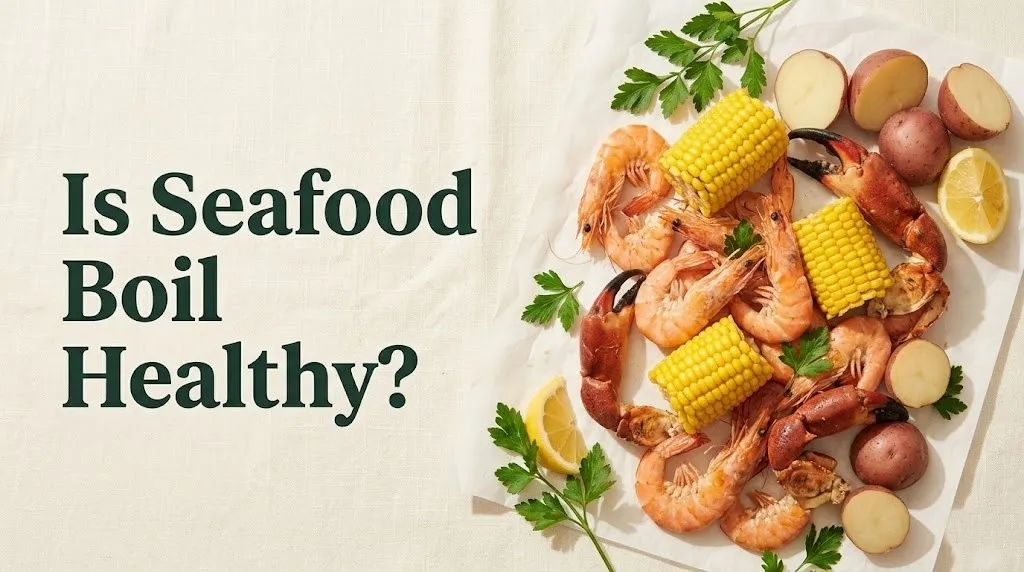
A seafood boil is a genuinely nutritious meal when the shellfish takes center stage and the butter, sausage, and seasoning salt stay in supporting roles. The core ingredients, shrimp, crab, clams, and mussels, deliver high-quality protein, omega-3 fatty acids, zinc, selenium, and vitamin B12 in one shared pot.
The USDA Dietary Guidelines for Americans recommend that adults eat 8 to 10 ounces of seafood per week. A well-portioned seafood boil can supply a meaningful part of that weekly target in a single meal.
This article breaks down the actual nutrition in a seafood boil, including the shellfish, the add-ons, the seasoning, and the butter sauce. You’ll get specific numbers, an honest look at the sodium problem in restaurant versions, and a clear guide to who benefits most and who needs to pay closer attention.
Is Seafood Boil Healthy?
A seafood boil is healthy when the primary components are shellfish, vegetables, and light seasoning, with butter and processed sausage kept to a reasonable portion.
Shellfish are lean, complete protein sources. They contain all nine essential amino acids the human body cannot produce on its own. Most shellfish are also low in saturated fat before any cooking additions, which matters if cardiovascular health is a consideration.
The dish becomes nutritionally complicated through the additions. Restaurant-style preparations typically submerge everything in a substantial amount of butter and seasoning salt. That changes the sodium, saturated fat, and calorie numbers considerably compared to a home-cooked version with a lighter hand.
The shellfish themselves, separated from the preparation method, consistently earn strong ratings from nutritional researchers. The Academy of Nutrition and Dietetics classifies shellfish as a high-quality lean protein source and includes them in recommended dietary patterns.
Key nutrient profile of the core ingredients:
- High-quality complete protein from shrimp, crab, and other shellfish
- Omega-3 fatty acids (DHA and EPA), which the American Heart Association links to cardiovascular health
- Selenium at levels that can meet a substantial portion of daily requirements in a single serving
- Zinc, which supports immune function and wound healing
- Vitamin B12, essential for neurological function and red blood cell formation
- Iodine, which supports thyroid hormone production
The verdict is conditional but generally favorable: seafood boil is healthy for most adults in reasonable portions, with closer attention needed around the butter, seasoning salt, and any processed sausage in the pot.
Seafood Boil Nutrition Facts
Seafood boil nutrition varies based on which shellfish are included, what vegetables are added, how much butter is used, and whether the seasoning is a commercial blend or made from scratch.
The table below shows approximate nutritional values for common seafood boil components in typical serving portions. All figures reference USDA food composition data for boiled or steamed preparations without added butter.
| Ingredient | Serving Size | Calories | Protein | Total Fat | Sodium |
|---|---|---|---|---|---|
| Boiled shrimp | 3 oz (85g) | 84 kcal | 18g | 0.9g | 94mg |
| Steamed blue crab | 3 oz (85g) | 87 kcal | 17g | 1.5g | 294mg |
| Steamed lobster | 3 oz (85g) | 83 kcal | 17g | 0.5g | 323mg |
| Steamed clams | 3 oz (85g) | 126 kcal | 22g | 1.7g | 95mg |
| Steamed mussels | 3 oz (85g) | 146 kcal | 20g | 3.8g | 314mg |
| Corn on the cob | 1 ear (medium) | 77 kcal | 2.9g | 1.1g | 13mg |
| Red potatoes (boiled) | 1/2 cup (75g) | 67 kcal | 1.5g | 0.1g | 190mg |
| Andouille sausage | 2 oz (56g) | 180 kcal | 9g | 15g | 490mg |
The shellfish components alone are low-calorie, high-protein, and relatively low in sodium. The sausage and any butter-based sauce alter the macronutrient picture substantially.
People managing sodium intake from a medical standpoint should pay particular attention to the cumulative effect. Clams, mussels, and crab each contribute meaningful sodium even before seasoning is applied.
Seafood Boil Calories
A typical home-prepared seafood boil containing a mix of shrimp, crab, corn, and potatoes ranges from approximately 450 to 700 calories per person, depending on portion size and how much butter is used.
A restaurant seafood boil can reach 900 to 1,400 calories or more per person when the standard butter-and-seasoning sauce bag is factored in. Many chain-style Cajun seafood boil preparations use 4 to 8 tablespoons of butter per bag, adding 400 to 800 calories from butter alone.
Think of it like a salad. A base salad of mixed greens is low-calorie and nutritious. But once you add full-fat dressing, croutons, and cheese, the calorie count can triple. The seafood in your boil is that salad base. The sauce is everything poured on top.
Approximate calorie ranges by version:
- Light homemade (shellfish, corn, potatoes, olive oil, spices): 450 to 550 kcal per person
- Standard homemade with butter: 600 to 750 kcal per person
- Restaurant Cajun bag style (full sauce): 900 to 1,400 kcal per person
- Restaurant with sausage added: 1,100 to 1,600 kcal per person
These figures represent a full meal serving. Since most restaurant portions are generous, many diners are consuming two-thirds to a full day’s saturated fat in one sitting when the sausage-and-butter combination is present.
People tracking calorie intake for weight management purposes should note that the shellfish and vegetables account for a relatively small share of total calories in the restaurant version. The sauce is the primary caloric driver.
Seafood Boil Protein Content
A seafood boil is an exceptional source of dietary protein, which makes it one of the stronger restaurant meal options for people prioritizing lean protein intake.
A mixed shellfish serving of approximately 12 oz total (combining shrimp, crab, and clams) provides roughly 60 to 75 grams of protein, depending on the exact species mix. That meets or exceeds the protein target of most adults in a single meal, without the saturated fat burden of equivalent protein from red meat.
The protein in shellfish is classified as a complete protein, meaning it contains all nine essential amino acids in adequate ratios. According to the Academy of Nutrition and Dietetics, shellfish rank among the most bioavailable protein sources in the human diet, meaning the protein is efficiently absorbed and used by the body.
| Shellfish Type | Protein per 3 oz (85g) | Protein Quality |
|---|---|---|
| Clams | 22g | Complete protein |
| Shrimp | 18g | Complete protein |
| Mussels | 20g | Complete protein |
| Blue crab | 17g | Complete protein |
| Lobster | 17g | Complete protein |
For people following higher-protein dietary approaches, a seafood boil offers genuine advantages over most restaurant options. The protein-to-calorie ratio of plain boiled shrimp is one of the highest of any commonly available animal protein.
People with phenylketonuria (PKU), a rare metabolic condition requiring restricted phenylalanine intake, should be aware that shellfish is a high-phenylalanine food and would need to factor this into their individual dietary management.
Seafood Boil Sodium Content
Sodium is the single biggest nutritional concern in a seafood boil, particularly the restaurant or Cajun bag-style version.
The American Heart Association recommends no more than 2,300 milligrams of sodium per day, with an ideal target of 1,500 milligrams for adults with hypertension or cardiovascular risk factors. A restaurant seafood boil with standard Cajun seasoning and butter sauce can deliver 2,000 to 4,000 milligrams of sodium in one sitting.
That range is not an exaggeration. Commercial Cajun seasoning blends, Old Bay seasoning, and the concentrated garlic butter sauces used at chains are all sodium-dense. A single tablespoon of Old Bay seasoning contains approximately 160 to 170 milligrams of sodium. Most restaurant preparations use far more than one tablespoon per bag.
Sodium sources in a typical restaurant seafood boil:
- Commercial Cajun seasoning blend: 400 to 800mg per bag preparation
- Old Bay or similar: 160 to 500mg depending on quantity
- Butter (salted): 90mg per tablespoon
- Andouille sausage: 490mg per 2 oz serving
- Shellfish (natural sodium): 90 to 320mg per 3 oz serving depending on species
- Corn and potatoes (minimal): under 20mg each
A homemade seafood boil using low-sodium or no-salt seasoning blends, unsalted butter or olive oil, and no processed sausage can be prepared with 600 to 900 milligrams of sodium per person, which fits comfortably within daily guidelines.
People on sodium-restricted diets, including those prescribed a low-sodium diet by a physician managing heart failure, chronic kidney disease, or hypertension, should approach restaurant seafood boils with the same caution they would apply to any high-sodium restaurant meal.
Key Takeaway: The shellfish in a seafood boil are high-protein, nutrient-dense, and low in saturated fat on their own. The calorie, sodium, and saturated fat numbers climb significantly from the butter sauce, seasoning blends, and processed sausage, particularly in restaurant versions.
Is Shrimp Boil Healthy?
A shrimp boil is one of the healthiest versions of a seafood boil because shrimp (Penaeus vannamei and related species) is among the leanest, highest-protein shellfish available.
Three ounces of boiled shrimp contains approximately 84 calories, 18 grams of protein, and under 1 gram of fat. Shrimp is also a notable source of selenium, providing around 48% of the daily value per 3 oz serving according to NIH Office of Dietary Supplements data.
There has been historical debate about shrimp and dietary cholesterol. Shrimp does contain relatively high cholesterol at approximately 166 milligrams per 3 oz serving. However, research published in the American Journal of Clinical Nutrition indicates that dietary cholesterol from seafood does not raise blood LDL cholesterol the way saturated fat does in most people. The Harvard T.H. Chan School of Public Health notes that for healthy adults, the omega-3 fatty acid content of shrimp is nutritionally more relevant than its cholesterol content.
Quick Tip:
- Request shrimp boiled or steamed with seasoning on the side when ordering at restaurants
- At home, use a light olive oil and garlic preparation rather than a butter base to keep saturated fat low
- People with a shellfish crustacean allergy should avoid shrimp entirely, as it is one of the 9 major FDA-recognized food allergens
Shrimp also contains astaxanthin, a carotenoid antioxidant compound that gives the shell its pink color. Research in the journal Nutrients has linked astaxanthin to anti-inflammatory properties, though most astaxanthin is in the shell rather than the flesh.
Is Crab Boil Healthy?
A crab boil is a healthy meal option built around blue crab (Callinectes sapidus) or Dungeness crab (Metacarcinus magister), both of which are nutritionally dense, low-calorie shellfish.
Three ounces of steamed blue crab contains approximately 87 calories, 17 grams of protein, 1.5 grams of fat, and a meaningful supply of zinc at roughly 3.1 milligrams per serving. The NIH identifies zinc as essential for immune system function, DNA synthesis, and protein production in the body.
Crab is also one of the better dietary sources of vitamin B12, providing approximately 6.2 micrograms per 3 oz serving, which exceeds the recommended daily intake of 2.4 micrograms for most adults per NIH guidelines. Vitamin B12 is essential for red blood cell production and nervous system function, making crab a particularly useful protein for older adults, who absorb B12 less efficiently with age.
Nutritional comparison of popular crab types (3 oz steamed, no butter):
| Crab Type | Calories | Protein | Zinc | Vitamin B12 |
|---|---|---|---|---|
| Blue crab | 87 kcal | 17g | 3.1mg | 6.2mcg |
| Dungeness crab | 94 kcal | 19g | 4.7mg | 8.4mcg |
| King crab | 82 kcal | 16g | 6.5mg | 9.8mcg |
| Snow crab | 90 kcal | 18g | 4.3mg | 7.1mcg |
People following a low-purine diet for gout management should be aware that shellfish including crab are moderate-to-high in purines. Individuals with gout who regularly experience flares should discuss shellfish consumption with the provider managing their condition.
Is Cajun Seafood Boil Healthy?
A Cajun seafood boil is healthy at its nutritional core but can become a high-sodium, high-saturated-fat meal depending on the preparation style and sauce quantity.
The Cajun spice blend itself is not the problem. Cayenne pepper, paprika, garlic powder, onion powder, black pepper, and dried herbs add flavor with minimal caloric impact. A standard Cajun seasoning blend contributes approximately 5 to 15 calories per tablespoon, mostly from trace carbohydrates.
The concern lies in how Cajun restaurant preparations are built. Chains like The Boiling Crab and The Juicy Crab use a bag-style preparation method where shellfish are tossed in a sauce mixture that typically includes 4 to 8 tablespoons of butter per bag, plus heavy seasoning salts. Neither chain consistently publishes full nutritional data on their sauces, which means customers have limited ability to know exactly what they’re eating.
Cajun seasoning impact on the nutritional profile:
| Sauce Style | Approximate Added Calories | Approximate Added Sodium |
|---|---|---|
| Dry Cajun rub only | 10 to 30 kcal | 300 to 600mg |
| Light garlic butter (2 tbsp butter) | 200 kcal | 180mg |
| Standard restaurant bag (4-6 tbsp butter + seasoning) | 450 to 700 kcal | 1,200 to 2,500mg |
| Heavy “Whole Sha-Bang” style | 700 to 1,000 kcal | 2,000 to 3,500mg |
Readers ordering at Cajun seafood restaurants should ask specifically what goes into the sauce preparation at their location, as ingredients and quantities vary by chain and by regional franchise. Menus and preparation methods can change seasonally, so verifying directly with the restaurant is the most reliable approach.
Key Takeaway: Cajun spices are not what makes a restaurant seafood boil calorie-dense. The butter and seasoning salt in the bag-style sauce are the primary nutritional variables, and a light preparation at home or a modified restaurant order changes the nutritional picture dramatically.
Is Boiled Seafood Healthier Than Fried?
Boiled and steamed seafood is consistently lower in calories, total fat, and saturated fat than fried seafood prepared in the same quantity.
Boiling preserves the natural protein and micronutrient content of shellfish without adding significant fat or calories. The water-based cooking medium means the shellfish sits in its own natural compounds rather than absorbing oil. Frying, by contrast, adds oil into the equation, and the breading or batter used in most fried preparations adds refined carbohydrates and additional calories.
Cooking method comparison for 3 oz shrimp:
| Cooking Method | Calories | Total Fat | Saturated Fat | Added Carbohydrates |
|---|---|---|---|---|
| Boiled/steamed (plain) | 84 kcal | 0.9g | 0.2g | 0g |
| Sautéed in olive oil (1 tsp) | 124 kcal | 5g | 0.8g | 0g |
| Fried (breaded) | 206 kcal | 10g | 1.7g | 10g |
| Fried (beer batter) | 240 kcal | 12g | 2.2g | 14g |
According to the USDA Dietary Guidelines for Americans, choosing leaner preparation methods for protein foods is one of the most consistent ways to reduce saturated fat intake without reducing protein intake.
One practical consideration: boiling is among the gentler cooking methods for preserving omega-3 fatty acids. High-heat frying can degrade a portion of DHA and EPA content through oxidation, according to research in the journal Food Chemistry.
Seafood Boil Ingredients Nutrition
The nutritional quality of a seafood boil depends heavily on every ingredient in the pot, not just the shellfish.
Corn and potatoes are the standard vegetable additions. A medium ear of corn (Zea mays) contributes approximately 77 calories, 2.9 grams of protein, 3.5 grams of dietary fiber, and 17 grams of carbohydrates, along with B vitamins including folate. Half a cup of boiled red potatoes adds roughly 67 calories and provides potassium (around 240mg), which is a useful counterbalance to sodium in the overall meal.
The sausage component is where the most nutritional variability lives. Traditional Andouille sausage adds roughly 180 calories and 15 grams of total fat per 2 oz serving, with approximately 490 milligrams of sodium. Swapping to a turkey Andouille reduces fat content by approximately 30 to 40% while maintaining a similar smoky flavor profile.
Nutritional snapshot of common seafood boil add-ins:
| Ingredient | Serving | Calories | Fiber | Sodium | Notes |
|---|---|---|---|---|---|
| Corn on the cob | 1 medium ear | 77 kcal | 3.5g | 13mg | Good source of folate |
| Red potatoes (boiled) | 1/2 cup | 67 kcal | 1.1g | 190mg | Source of potassium |
| Andouille sausage (pork) | 2 oz | 180 kcal | 0g | 490mg | High saturated fat |
| Turkey Andouille | 2 oz | 100 kcal | 0g | 380mg | Lower fat option |
| Hard-boiled egg | 1 large | 78 kcal | 0g | 62mg | Adds protein |
| Mushrooms (added whole) | 1/2 cup | 11 kcal | 0.8g | 2mg | Very low calorie |
People with celiac disease or non-celiac gluten sensitivity should verify that no flour-based thickeners are present in commercial seasoning blends used in the boil. Some blended spice preparations include wheat-derived ingredients.
Is Butter in Seafood Boil Bad for You?
Butter in a seafood boil is not inherently bad for you, but the quantity used in most restaurant preparations pushes saturated fat intake well beyond what major health guidelines recommend for a single meal.
One tablespoon of salted butter contains approximately 102 calories and 7 grams of saturated fat. The American Heart Association recommends limiting saturated fat to no more than 13 grams per day for a 2,000-calorie diet to support cardiovascular health. A restaurant seafood boil using 6 tablespoons of butter in the sauce delivers roughly 42 grams of saturated fat from the butter alone.
Think of the saturated fat in butter like a daily budget. You get 13 grams to spend. Most restaurant seafood boil sauces spend three days’ worth in one meal before you’ve even considered anything else you ate that day.
Butter quantity and its saturated fat impact:
| Butter Amount | Calories Added | Saturated Fat Added |
|---|---|---|
| 1 tbsp (14g) | 102 kcal | 7g |
| 2 tbsp (28g) | 204 kcal | 14g |
| 4 tbsp (56g) | 408 kcal | 28g |
| 6 tbsp (84g) | 612 kcal | 42g |
Replacing some or all of the butter with extra virgin olive oil or a light broth-and-garlic preparation reduces saturated fat substantially while maintaining flavor. Olive oil contains primarily monounsaturated fat, which the AHA identifies as more favorable for cardiovascular health than saturated fat.
People with familial hypercholesterolemia, a genetic condition causing elevated LDL cholesterol, may need to be especially attentive to saturated fat from butter in seafood preparations.
Key Takeaway: Butter is the most significant controllable variable in the healthfulness of a seafood boil. Using 1 to 2 tablespoons at home keeps saturated fat within reasonable limits. Restaurant portions routinely exceed a full day’s recommended saturated fat intake in the sauce alone.
Is Seafood Boil Good for Weight Loss?
A seafood boil can support weight management goals effectively, provided the butter, sausage, and large-portion sauce are kept in check.
The shellfish components provide high protein at a low calorie cost, which is one of the most consistently supported dietary strategies in weight management research. Protein increases satiety, meaning you feel fuller longer after a high-protein meal compared to an equivalent calorie load from refined carbohydrates. Research published in the American Journal of Clinical Nutrition found that higher protein diets are associated with greater satiety and improved weight management outcomes in multiple controlled trials.
A weight-management-friendly seafood boil built around shellfish, corn, and potatoes with 1 to 2 tablespoons of butter or olive oil and light seasoning comes in at approximately 450 to 600 calories for a filling, satisfying meal. That fits comfortably within the calorie targets of most weight management eating patterns.
Comparison of seafood boil versions for weight management:
| Version | Approximate Calories | Protein | Saturated Fat | Weight Management Fit |
|---|---|---|---|---|
| Light homemade (shellfish + veg + olive oil) | 450 to 550 kcal | 55 to 65g | 3 to 5g | Strong |
| Homemade with 2 tbsp butter | 600 to 700 kcal | 55 to 65g | 14 to 17g | Moderate |
| Restaurant (standard sauce) | 900 to 1,200 kcal | 50 to 65g | 28 to 42g | Limited |
| Restaurant (heavy sauce + sausage) | 1,200 to 1,600 kcal | 55 to 70g | 42 to 60g | Poor |
At a restaurant, requesting the sauce on the side and dipping individual pieces rather than having everything submerged is a practical strategy that meaningfully reduces calorie intake without sacrificing the experience.
Seafood Boil and High Blood Pressure
People managing hypertension need to be thoughtful about seafood boils, specifically the sodium content, but the dish doesn’t have to be off the table entirely.
The DASH diet (Dietary Approaches to Stop Hypertension), which is one of the most evidence-backed dietary patterns for managing high blood pressure, includes seafood as an encouraged protein source. The issue isn’t the shellfish. It’s the sodium load from commercial seasoning blends, salted butter, and processed sausage that accompanies most preparations.
For reference, the American Heart Association’s ideal sodium limit for people with hypertension is 1,500 milligrams per day. A restaurant seafood boil can deliver 2,000 to 4,000 milligrams per serving. That is the entire day’s budget, plus overage, in one meal.
Practical sodium management strategies for seafood boil:
- Make it at home using a no-salt-added Cajun or Old Bay seasoning blend
- Use unsalted butter and add garlic, lemon juice, and herbs for flavor
- Skip the Andouille sausage or replace with a very low-sodium protein alternative
- Use low-sodium chicken broth as the boiling liquid instead of water with added seasoning salts
- Add potassium-rich ingredients (corn, potatoes, mushrooms) which support fluid balance
The shellfish themselves contribute natural sodium, particularly mussels (approximately 314mg per 3 oz) and lobster (approximately 323mg per 3 oz). People on medically prescribed sodium-restricted diets should factor in the natural sodium content of the shellfish alongside any added seasoning.
Individuals whose physician has prescribed a specific daily sodium limit should use that figure as their ceiling and plan the entire meal around it, including natural shellfish sodium, any butter used, and any seasoning.
Can Pregnant Women Eat Seafood Boil?
Pregnant women can eat a seafood boil, but with important caveats around specific shellfish choices, thorough cooking, and mercury exposure.
The FDA and EPA jointly recommend that pregnant women eat 2 to 3 servings (8 to 12 oz) of low-mercury seafood per week. Shrimp and crab are listed by the FDA as low-mercury choices, making them appropriate for a seafood boil during pregnancy. Shrimp in particular is among the most widely consumed, lowest-mercury shellfish available.
Pregnant women should avoid any raw or undercooked shellfish. Shellfish must reach an internal temperature of 145 degrees Fahrenheit per USDA food safety guidelines to eliminate Vibrio bacteria, Listeria monocytogenes, and other pathogens that pose heightened risk during pregnancy. In a boil, shellfish that are fully cooked will have open shells (in the case of clams and mussels) and opaque, firm flesh.
Shellfish guidance during pregnancy (per FDA/EPA joint recommendations):
| Shellfish | Mercury Level | Pregnancy Safety |
|---|---|---|
| Shrimp | Very low | Yes, fully cooked |
| Blue crab | Low | Yes, fully cooked |
| Clams | Very low | Yes, fully cooked only |
| Mussels | Very low | Yes, fully cooked only |
| Lobster | Low | Yes, fully cooked |
| King mackerel (if added) | High | Avoid during pregnancy |
The sodium content of a restaurant seafood boil is also relevant during pregnancy, as some pregnant women experience blood pressure changes and fluid retention that make high-sodium meals worth moderating. A homemade version with controlled seasoning gives pregnant women the most flexibility.
Any individual with a pregnancy-related medical condition, including gestational hypertension, gestational diabetes, or a history of preterm labor, should confirm their specific seafood intake plan with their obstetric provider.
Key Takeaway: Shrimp and crab are among the FDA’s recommended low-mercury seafood choices for pregnant women. The requirements are full cooking to 145 degrees Fahrenheit and staying within the 8 to 12 oz weekly seafood guideline. The sodium and butter in restaurant versions are a secondary consideration worth managing.
How to Make Seafood Boil Healthier
A healthier seafood boil is easy to prepare at home by adjusting the butter, seasoning salt, and sausage without sacrificing any of the communal, flavorful experience that makes the dish worth making.
The core strategy is to keep the shellfish and vegetables as the bulk of the pot and treat the butter sauce as a condiment rather than a cooking bath. You get every bit of the flavor with a fraction of the saturated fat and sodium.
Steps to build a healthier seafood boil at home:
- Fill a large stockpot with water or low-sodium chicken broth and bring to a boil.
- Add 2 tablespoons of a low-sodium Cajun or Old Bay blend (or make your own from paprika, garlic powder, onion powder, cayenne, black pepper, thyme, and dried oregano, with no added salt).
- Add halved red potatoes and cook for 10 minutes at a rolling boil.
- Add corn cut into 3-inch sections and cook for another 5 minutes.
- Add shellfish (shrimp, crab legs, clams, or mussels). Cook until shrimp are opaque and pink, clams and mussels are open, and crab reaches an internal temperature of 145 degrees Fahrenheit. This typically takes 3 to 5 minutes for shrimp and 5 to 8 minutes for crab legs and clams.
- Drain and transfer to a serving tray or spread on butcher paper.
- Drizzle with 2 tablespoons of unsalted melted butter and 1 tablespoon of extra virgin olive oil, fresh minced garlic, lemon juice, and fresh parsley.
Nutritional result per person (estimated): Approximately 490 to 580 calories, 55 to 65g protein, 8 to 12g saturated fat, 650 to 900mg sodium.
This preparation reduces sodium by roughly 70% and saturated fat by roughly 60% compared to a standard restaurant bag preparation. People avoiding pork for religious, cultural, or personal reasons can omit the sausage entirely without nutritional loss, since the shellfish already provide substantial protein.
Frequently Asked Questions About Seafood Boil
How many calories are in a seafood boil?
A seafood boil ranges from approximately 450 to 550 calories for a light homemade version up to 1,200 to 1,600 calories for a restaurant preparation with heavy butter sauce and sausage.
The shellfish and vegetables account for a relatively small portion of total calories.
The butter-based sauce is the primary caloric driver in restaurant-style versions.
Is seafood boil good for you if you’re watching your sodium?
A homemade seafood boil prepared with low-sodium seasoning and unsalted butter can be kept to 650 to 900 milligrams of sodium per serving.
Restaurant versions typically deliver 2,000 to 4,000 milligrams of sodium, which exceeds the AHA’s daily recommended limit in a single meal.
Requesting seasoning on the side or making the dish at home gives you the most control over sodium content.
Can you eat seafood boil on a diet?
A seafood boil can fit into a calorie-controlled eating plan when focused on shellfish, vegetables, and a modest amount of butter or olive oil.
The shellfish provide high-protein, low-calorie nutrition that supports satiety at an efficient calorie cost.
Avoiding or significantly reducing the sausage and sauce quantity makes the biggest difference in total calorie count.
Is crab healthier than shrimp in a seafood boil?
Crab and shrimp are both excellent protein sources with similar calorie counts in standard servings.
Crab edges out shrimp in zinc and vitamin B12 content, while shrimp is slightly lower in natural sodium and provides a good amount of selenium.
For most people, choosing based on preference rather than a strict nutritional hierarchy is reasonable, since both are nutritionally strong shellfish choices.
How often can you eat seafood boil and still be healthy?
The USDA Dietary Guidelines recommend 8 to 10 ounces of seafood per week, and a well-portioned seafood boil easily supplies that in one meal.
Eating a homemade version once a week fits comfortably within healthy dietary patterns for most adults.
Restaurant versions with heavy butter and sausage are better treated as an occasional meal rather than a weekly routine, primarily because of the saturated fat and sodium load.
A Practical Final Word
A seafood boil built around quality shellfish, corn, and potatoes is one of the more nutritionally sound shared meals you can make. The shellfish deliver serious protein, omega-3 fatty acids, selenium, zinc, and vitamin B12 in a low-calorie, low-saturated-fat package.
The version that undermines that nutritional foundation isn’t the seafood. It’s the butter quantity, the seasoning salt volume, and the sausage. Control those three variables and the dish holds up well.
Cook it at home with unsalted butter, a low-sodium spice blend, and the shellfish center stage. Or order smart at a restaurant by asking for the sauce on the side. Both approaches let you eat something genuinely good without working against your health goals.