The short answer is 170°F to 200°F. That is the safe warming range set by the USDA for holding hot food. Your oven’s lowest setting above 140°F works. But the precise number depends on what you are holding, for how long, and whether you care about texture or just safety.
Most home cooks set the temperature too high and wreck the food. They pick 250°F because it sounds low. It is not. At 250°F, carryover cooking continues aggressively. A medium-rare roast climbs to well-done in 30 minutes. This guide fixes that mistake before your next dinner party.
You will learn exactly what temperature keeps food warm in the oven, why the USDA’s danger zone rule is the only line that matters, and how long you can safely hold each dish type without ruining the meal or making anyone sick.
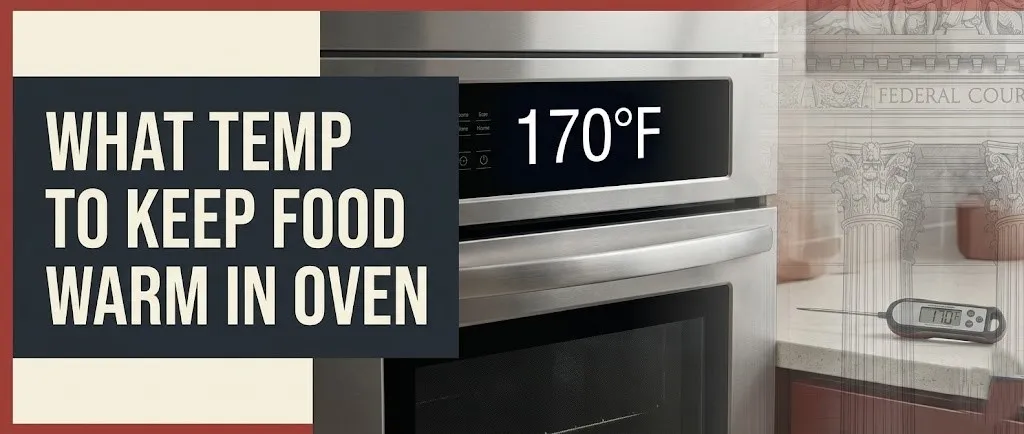
The correct temperature to keep food warm in an oven is 170°F to 200°F. Most ovens manufactured after 2010 cannot be set below 170°F. If yours bottoms out at 200°F, use that. The non-negotiable rule from the USDA Food Safety and Inspection Service is that hot food must stay at or above 140°F internally. Set your oven above 140°F, ideally at 170°F, to create a buffer against temperature drops when you open the door.
The problem with setting the oven right at 140°F is physics. Every time the door opens, the cavity temperature drops 20 to 40 degrees. Food surface temperature drops with it. If the surface sits between 40°F and 140°F for more than two cumulative hours, bacteria like Staphylococcus aureus and Clostridium perfringens begin multiplying. These organisms produce toxins that reheating cannot destroy.
A 170°F oven setting keeps food internal temperature around 145°F to 155°F even with intermittent door openings. That sits above the danger threshold without pushing the food into continued cooking range. The distinction matters. Warming means holding. Cooking means raising internal temperature. You want the former.
Test your actual oven temperature with a standalone oven thermometer. The built-in thermostat on most residential ranges runs 15 to 25 degrees off from the displayed number. If you set 170°F but the actual cavity temperature is 150°F, you are skating dangerously close to the 140°F floor. A $7 thermometer eliminates that gamble.
what temperature to keep food warm in oven
The ideal temperature to keep food warm in the oven sits between 170°F and 200°F depending on the food type. Dense proteins like roasted meats hold best at 170°F. Casseroles and liquid-based dishes can tolerate 200°F because the moisture content buffers against drying. The variable that changes the setting is water content. High-moisture foods tolerate higher warming temperatures. Low-moisture foods do not.
A roasted chicken breast, sliced and sitting exposed, loses moisture rapidly above 170°F. The muscle fibers continue contracting, squeezing water out. Within 45 minutes at 200°F, the meat turns chalky. A stew or braised short rib dish, by contrast, sits in liquid that regulates surface temperature. That liquid cannot exceed 212°F regardless of oven setting, so the food stays moist even at 200°F.
Foods high in fat also tolerate slightly higher warming temperatures. The fat acts as a thermal buffer and moisture barrier. A ribeye roast held at 200°F for one hour fares better than a lean pork tenderloin at the same setting. The principle is straightforward. Lean and exposed means lower and covered. Fatty and sauced means you have some flexibility.
State Spotlight: The FDA Food Code, adopted in most US states, requires commercial food establishments to hold hot food at 135°F or above. That is 5 degrees lower than the USDA’s residential guideline of 140°F. In California, retail food facilities follow the 135°F standard. In Texas, the Department of State Health Services enforces the same 135°F minimum for restaurants. Home cooks should use the stricter 140°F standard because residential ovens cycle on and off more aggressively than commercial holding cabinets.
what temp in oven to keep food warm
The temperature you set in your oven to keep food warm depends on your oven’s low-end capability. Most digital ovens let you set 170°F. Many analog dial ovens start at 200°F. A warming drawer, if your range has one, typically operates at a fixed 140°F to 200°F. Check your model’s manual. If your oven cannot go below 200°F, you have two options. Use the warming drawer instead, or cycle the oven on and off manually using a thermometer to track cavity temperature.
Say your oven’s minimum setting is 200°F and you need to hold sliced turkey breast for 90 minutes. Set the oven to 200°F. Cover the meat tightly with heavy-duty foil. Place a small pan of water on the lower rack to add humidity. The water absorbs heat and releases steam, which slows surface drying. Check the meat’s internal temperature with a probe thermometer every 25 minutes. If it climbs past 155°F, pull the food and tent it on the counter for 15 minutes before returning to the oven after it has cooled slightly.
Some newer ranges include a “Keep Warm” or “Warm and Hold” function. This setting is usually calibrated to 170°F. It is the most reliable option because the oven’s control board maintains a tighter temperature band than the standard bake setting. If your range has this feature, use it instead of manually setting a temperature.
For ovens with a dehydrate or bread-proofing setting, check the temperature range before using it for warming. Proofing modes often run between 85°F and 100°F. That sits squarely inside the danger zone. Never use proofing mode to hold hot food. Dehydrate modes usually start at 135°F and climb. Confirm with your manual before trusting the setting for food holding.
what temp to set oven to keep food warm
Set your oven to 170°F to keep food warm. If 170°F is unavailable, set it to 200°F. For extended holding past 60 minutes, drop to the “Keep Warm” setting if your oven has one. The setting you choose must keep food above 140°F internally for the entire duration of holding. Anything below 140°F invites bacterial growth. Anything above 200°F continues cooking the food rather than merely holding it.
The confusion arises because “warm” means different things to different oven manufacturers. One brand’s “Warm” setting runs at 150°F. Another runs at 175°F. Yet another uses a range that cycles between 140°F and 225°F. Know your appliance. The label on the control panel is marketing. The actual cavity temperature is what matters.
Use a probe thermometer left in the food during holding. Look for a model with a cord that runs out the oven door to a digital display. These cost $25 to $45 and give real-time internal temperature readings without opening the door. Set an alarm at 145°F as your floor. If the food drops to 145°F and the oven is set correctly, the problem is likely frequent door openings, not the oven setting.
Legal Bottom Line: The USDA’s 140°F hot-holding rule is a federal guideline that applies in homes, schools, churches, and any setting where food is served to others. Liability follows the food. If you hold food below 140°F and someone contracts foodborne illness, you can face legal exposure under state food safety codes that adopt the FDA model.
what temp oven to keep food warm
The right oven temperature to keep food warm is 170°F on standard digital ovens. For dishes with high moisture content like soups, stews, and braises, 200°F works without compromising quality. The critical variable is whether the food is covered. Covered food retains steam and holds at a stable temperature even at lower oven settings. Uncovered food dries rapidly and requires a moisture barrier like foil or a pan of water underneath.
Placement inside the oven also matters. The center rack provides the most even temperature. The bottom rack runs hotter because it sits closer to the heating element. The top rack runs cooler in most gas ovens but hotter in many electric ovens during the bake cycle. Test your oven’s hot spots with a tray of white bread slices. Place them across the racks and watch which ones toast fastest. That is your hot zone. Do not put delicate warming dishes there.
Convection ovens complicate the equation. The moving air accelerates surface drying. If you use a convection setting to keep food warm, drop the temperature by 25°F and always cover dishes tightly. The fan blows moisture away from the food surface. What takes 60 minutes to dry uncovered in a standard oven might take 35 minutes under convection.
For ovens with a dedicated warming element separate from the main bake element, use it. This element, usually located at the back or top of the cavity, provides gentler, more even low heat. It cycles less aggressively than the main bake element, which pulses at full power even when set to a low target temperature.
what temp for oven to keep food warm
For most home ovens, use 170°F to 200°F as the warming temperature. The specific number within that range is less important than two other factors. First, the food must start hot. You cannot warm food that has already cooled. Food placed in a warming oven must go in at or above 165°F internal temperature. Second, the food must be monitored. No oven setting is truly set-and-forget beyond the 90-minute mark.
The 170°F baseline works because most cooked food served hot has a target serving temperature of 145°F to 165°F. Holding at 170°F in the oven keeps the food at roughly 150°F to 155°F once equilibrium is reached. That is warm enough for palatability, above the safety threshold, and below the point where proteins denature further. It is the sweet spot.
When holding fried foods, the challenge is texture, not just moisture. A fried chicken piece held at 170°F loses crispness within 20 minutes. The coating absorbs ambient moisture from the steam generated by the meat. There is no oven temperature low enough to preserve a fried crust indefinitely. For these foods, the oven is a 30-minute solution at best. After that, recrisping in a 400°F oven for 5 minutes before serving is the only reliable fix.
Casseroles and baked pasta dishes tolerate warming better than any other category. The starch matrix holds moisture, the sauce buffers against drying, and the structure does not degrade at 200°F. These dishes can hold for up to two hours with minimal quality loss if covered tightly. The cheese on top may darken slightly, but the interior stays moist.
what temperature keeps food warm in the oven
A temperature between 170°F and 200°F keeps food warm in the oven without cooking it further. The reason this range works is that it sits above the bacterial growth danger zone of 40°F to 140°F but below the temperature at which most food proteins undergo significant additional cooking, which begins around 210°F for moist-heat reactions and 250°F for dry-heat browning.
Understanding the USDA danger zone clarifies why 170°F is not an arbitrary number. Pathogenic bacteria multiply most rapidly between 70°F and 125°F. At 140°F, growth stops but bacteria do not necessarily die. That requires temperatures above 165°F sustained for several seconds. A 170°F oven keeps food surfaces above 140°F even accounting for temperature cycling as the heating element turns on and off.
Most home cooks do not realize that the oven’s heating cycle creates a temperature wave. When set to 170°F, the element fires at full power until the cavity reaches roughly 180°F, then shuts off. The temperature drifts down to about 160°F before the element fires again. Food surface temperature follows this wave with a lag. The average stays safe, but the trough matters. If the trough drops below 140°F on the food surface, you start the danger clock. The two-hour cumulative window is cumulative. Multiple short dips add up.
This is why probe thermometers with min/max memory are valuable. They show the lowest temperature the food reached during holding. If the minimum recorded temperature stays above 140°F, your oven setting is adequate. If it dips to 135°F, increase the set temperature by 10 degrees and check again.
what temp keeps food warm in oven
Setting the oven to 170°F is the single best answer to what temp keeps food warm in an oven. It is the lowest common setting on modern digital ovens, it provides a safe margin above 140°F, and it minimizes carryover cooking in proteins. If your oven only goes to 200°F, that works. Cover food tightly and check more frequently.
Gas ovens behave differently from electric ovens at low temperatures. Gas ovens vent combustion byproducts through a flue, usually located at the top or back. This creates a constant airflow that pulls moisture out of the oven cavity. Electric ovens are sealed systems. Food dries faster in a gas oven at the same temperature setting. If you cook with gas, add a water pan and seal dishes with heavy-duty foil folded tightly around the edges.
The temperature you choose also depends on how long you plan to hold the food. For 30 minutes while you finish another dish, 200°F is fine for almost everything. For 90 minutes or more, 170°F is safer for texture. The longer the hold, the lower the temperature should be within the safe range. This minimizes the cumulative effects of heat exposure.
Legal Bottom Line: The FDA Food Code specifies that time alone, without temperature control, can be used as a public health control for up to 4 hours. After 4 hours, the food must be discarded. This applies in commercial settings but is a useful benchmark for home cooks planning a long party. A 4-hour hold in a 170°F oven is safe. A 6-hour hold requires checking and likely replenishing the food with fresh hot dishes.
what oven temperature to keep food warm
The oven temperature to keep food warm ranges from 170°F to 200°F with 170°F as the preferred standard for most dishes. The choice between these two temperatures is not about safety. Both are safe. The choice is about how long you need to hold the food and how sensitive the food is to additional cooking.
A table matching food types to ideal holding temperatures clarifies the decision.
Food Type
Recommended Oven Temp
Max Safe Hold Time
Cover Method
Roasted Meats (beef, pork, lamb)
170°F
90 minutes
Tight foil wrap
Poultry (whole or parts)
170°F
60 minutes
Foil tent
Casseroles and Baked Pasta
200°F
2 hours
Tight foil or lid
Bread and Rolls
170°F
30 minutes
Foil tent, vented
Fried Foods
200°F
30 minutes
Uncovered on wire rack
Soups, Stews, Braises
200°F
3 hours
Lid slightly ajar
Vegetables (roasted or steamed)
170°F
60 minutes
Foil cover
These times assume the food entered the oven hot, at or above 165°F internal. Starting from cold or room temperature makes these numbers meaningless. The oven holds temperature. It does not reheat safely from a cold state. Reheating requires rapidly bringing food through the danger zone to 165°F, which a 170°F oven cannot do fast enough.
The numbers in the table are conservative. USDA guidelines allow longer holding but recommend discarding food held between 40°F and 140°F for more than 2 hours. In a 170°F oven, food stays well above 140°F, so the time limit is about quality degradation, not safety. The texture and moisture loss become unacceptable before the safety limit is reached in most cases.
what temp on oven to keep food warm
Turn your oven dial or press the digital controls to 170°F. If your oven uses a knob with markings starting at 200°F, turn it as low as it will go. The physical action of setting the temperature is simple. What trips people up is trusting that the number on the dial matches reality inside the oven.
Consumer-grade ovens use a thermostat that measures temperature at a single point, usually at the top rear of the cavity. The temperature at the center rack can differ by 15 to 25 degrees from that thermostat reading. Older ovens drift further. A 20-year-old oven set to 200°F might run at 175°F or 230°F. Neither is good. The under-temperature risks safety. The over-temperature ruins food.
Before relying on your oven for a long hold during a holiday meal or party, do a dry run. Place an oven thermometer on the center rack. Set the oven to 170°F. Wait 20 minutes. Record the thermometer reading. Do this three times in a row. If the average reading is within 10 degrees of 170°F, your oven is reliable. If it is off by more than 15 degrees, adjust your set temperature to compensate. An oven that reads 170°F on the dial but actually runs at 155°F should be set to 185°F to achieve a true 170°F.
This testing is not fussy. It is the difference between safe food and a preventable illness. The USDA reports that roughly 48 million Americans contract foodborne illness each year. Improper holding temperature is among the top five contributing factors in outbreak investigations.
what temp to warm food in oven
Warming food that has cooled and holding food that is already hot are different processes with different temperature requirements. To warm food, set the oven to 300°F to 350°F and heat until the internal temperature reaches 165°F. Then reduce the oven to 170°F to hold. The warming phase requires higher heat to drive the food through the danger zone quickly.
The 300°F to 350°F range moves food from refrigerator temperature (38°F) to safe serving temperature (165°F) in 15 to 25 minutes for most dishes. A 170°F oven would take over an hour to accomplish the same temperature rise. During that slow climb, the food spends far too long in the pathogen growth sweet spot between 70°F and 125°F.
This distinction is where party planning goes wrong for many hosts. They prep dishes ahead, refrigerate them, and then put the cold dishes directly into a 170°F warming oven an hour before guests arrive. The food never reaches a safe internal temperature. It sits lukewarm in the danger zone while the host assumes the oven is handling everything. It is not. The oven cannot sense food temperature. It can only maintain air temperature.
Always reheat cold food at 300°F or higher until it is steaming hot throughout. Then switch to the warming setting. If you prep dishes the day before, factor this reheat step into your timeline. A dense casserole straight from the refrigerator needs 30 to 40 minutes at 325°F to reach 165°F internally before you can safely drop the oven to 170°F and hold.
what temperature to warm food in oven
To warm refrigerated food in the oven before holding, use 325°F as your standard reheat temperature. Cover the dish to trap steam and speed the process. Use a probe thermometer to verify 165°F in the center of the dish. Only then reduce the oven to 170°F for holding. The USDA standard for reheating commercially prepared food is 165°F within 2 hours. Home reheating can use the same benchmark.
The physics of reheating explains why 325°F works better than 350°F for most home dishes. At 350°F, the edges and surface of a casserole can reach 200°F before the center hits 165°F. That creates a gradient of overcooked edges and barely-safe center. At 325°F, the heat penetrates more evenly, giving the center time to warm without torching the outside. This is especially important for dense foods like lasagna, macaroni and cheese, or stuffing.
For sliced meats, warming is trickier. The thin profile reheats fast, which is good for safety but bad for moisture. The best method is to warm sliced meat in a covered dish with a small amount of broth, stock, or jus added. The liquid creates a steam environment that transfers heat efficiently without stripping moisture from the meat itself. Heat at 300°F for 10 to 15 minutes until the internal temperature reaches 155°F. Then transfer to a 170°F holding oven.
Never warm food by leaving it in a turned-off oven that is still warm from earlier cooking. The declining temperature passes through the danger zone slowly. This is a common practice and it is unsafe. The oven might still read 150°F but the food inside was 40°F when it went in. It will take too long to reach a safe temperature.
what temperature should the oven be to keep food warm
The oven should be set to 170°F to keep food warm. This is the answer supported by the USDA’s 140°F minimum hot-holding temperature plus a 30-degree safety margin. The margin matters. Ovens cycle, doors open, and heat escapes. A 170°F set point ensures that the food never drops below 140°F during a reasonable holding period with normal kitchen traffic.
Some sources online claim you can keep food warm at 140°F. Technically, yes, if the oven maintained a perfect 140°F with no cycling and no door openings. Real kitchens do not work that way. A 140°F setting in a residential oven almost guarantees that food surface temperature drops below 140°F multiple times during a holding period. Do not set your oven at the safety limit. Set it above.
The same logic applies to 150°F. It is better than 140°F but still provides only a 10-degree buffer. A single door opening drops cavity temperature 30 degrees. That puts your food surface below 140°F for several minutes each time. The 170°F recommendation is not overly conservative. It is practical.
For ovens with a “Slow Cook” or “Sabbath Mode” feature, check the default temperature. Some Sabbath modes default to 350°F, which is far too high for warming. Others allow a custom temperature. If your oven’s Sabbath mode can be set to 170°F, it works well for extended warming because it disables the automatic shutoff that many modern ovens have as a safety feature.
what temp should oven be to keep food warm
Set your oven to 170°F. If 170°F is not an option, set it to 200°F and cover the food tightly. The real question is not just the number on the dial. It is whether your oven can maintain a safe temperature without drying the food. You control this with three tools. A calibrated oven thermometer confirms actual cavity temperature. A probe thermometer tracks internal food temperature in real time. Heavy-duty aluminum foil creates a moisture-sealing barrier.
Foil technique matters. A loose sheet draped over a pan does almost nothing. It reflects some radiant heat but allows steam to escape freely. A tight foil tent crimped around the edges of the pan creates a sealed environment where steam saturates the space around the food. This prevents evaporative cooling, which is the primary cause of food drying in a warming oven.
For large roasts or whole birds, the foil must wrap around the food, not just cover the pan. Otherwise steam condenses on the foil and drips down the sides, basting the meat and keeping it moist. This is the same principle that makes resting a roast under foil effective. The 170°F oven just extends that resting period indefinitely.
Key Takeaway: The dial setting matters less than your monitoring system. A 170°F setting with an uncalibrated oven and no probe thermometer is guesswork. A 200°F setting with a verified thermometer and sealed foil is precision.
how long can you keep food warm in the oven
You can keep food warm in the oven for up to 2 hours at 170°F to 200°F with no safety concerns, provided the food stays above 140°F internally. For quality, the practical limit is usually 60 to 90 minutes for most foods before texture and moisture loss become noticeable. The USDA’s 2-hour rule is a safety guideline, not a quality guarantee.
The 2-hour rule comes from the USDA’s guidance on the danger zone. Food held between 40°F and 140°F for a cumulative total of 2 hours should be discarded. In a properly set warming oven, the food never enters the danger zone, so the 2-hour limit does not apply from a safety perspective. You can hold food longer than 2 hours safely if the temperature stays above 140°F. The limiting factor becomes food quality.
After 2 hours at 170°F, roasted meat loses about 15 to 20 percent more moisture than it had at the start of holding. Vegetables lose texture. Starches absorb liquid from surrounding ingredients and can become gummy. The food is safe. It may not be pleasant.
At a 3-hour mark, most foods show significant quality decline. Sauces separate. Meat fibers have squeezed out most of their free water. Bread products are stale. The USDA does not forbid holding past 3 hours if temperature is maintained, but no professional kitchen does it for a reason. The food simply is not good anymore.
For parties that run 3 hours or longer, the better strategy is to hold a portion of the food in the warming oven and replenish in batches. Keep the backup food covered on the counter for up to 2 hours, then transfer it to the oven as needed. This rotation limits oven dwell time for any individual batch.
how long can i keep food warm in the oven
You can keep food warm in the oven for 2 hours without any safety risk if the oven is set between 170°F and 200°F and the food maintains an internal temperature above 140°F. After 2 hours, the food remains safe indefinitely if the temperature holds, but quality declines sharply. The practical answer for a home cook is 90 minutes to 2 hours.
This timing assumes you are using a standard residential oven. Commercial warming cabinets can hold food for 4 to 6 hours because they maintain tighter temperature control and often include humidity control. Your home oven is not a commercial holding cabinet. It cycles more aggressively and loses moisture faster. Treat the 2-hour mark as your planning ceiling for a party.
The clock starts when the food reaches a stable holding temperature in the oven, not when it first goes in. If you put a 165°F casserole into a 170°F oven, it reaches equilibrium in about 15 minutes. The holding clock starts then. If you are holding multiple dishes, the opening and closing of the door to add more dishes resets the temperature recovery clock for everything inside. That cumulative time below 140°F, even if it is only a few minutes per door opening, eats into the 2-hour safety window.
For events where food will sit out beyond 2 hours, do not rely solely on the oven. Use a combination of covered chafing dishes over sterno for buffet service and the oven as a backup holding area. The USDA recommends that food served buffet style should be kept at 140°F or above using chafing dishes, slow cookers, or warming trays.
how to keep food warm for a party in the oven
To keep food warm for a party in the oven, set the oven to 170°F, cover every dish tightly with heavy-duty foil, and place a shallow pan of water on the bottom rack for humidity. Plan your oven real estate before guests arrive. Know which rack each dish will occupy. Stagger heavier, denser dishes toward the bottom where heat is more stable.
Oven real estate is the hidden bottleneck of party hosting. A standard 30-inch range has roughly 4.5 cubic feet of oven capacity. That fits two 9×13 casseroles on one rack and a sheet pan of rolls on another. It will not hold an entire Thanksgiving spread. Prioritize the dishes that suffer most from cooling. Meats first. Then wet dishes like casseroles. Bread and rolls last, and only for 20 minutes before serving. They stale fast and can be refreshed in a 375°F oven for 4 minutes right before the meal.
Use heavy-duty foil, not standard weight. The heavy foil holds its shape when crimped around a pan edge. It also resists tearing when you open a corner to check food. Standard foil rips too easily and the seal breaks. That steam loss is irreversible without adding more liquid.
Create a humidity chamber in the oven by placing an oven-safe dish filled with boiling water on the lowest rack. The steam generated keeps the air moist. This is the single most effective step for preventing food from drying during a long hold. Refill the water pan every 45 minutes. Do not let it run dry. An empty pan on a hot rack will scorch and throw off burnt odors that flavor the food.
If your party involves multiple courses served over several hours, use the oven as a staging area for the next course while the current course is on the buffet. Hot appetizers held at 170°F come out first. As guests finish, swap in the main dishes, which have been held covered on the counter and need a final reheat. This rotating oven strategy keeps the line moving.
can you keep food warm in the oven
Yes, you can keep food warm in the oven. It is safe and effective when done correctly. Set the oven between 170°F and 200°F, cover food tightly, monitor internal temperatures, and respect the 2-hour quality window. The oven is the most reliable warming tool in a home kitchen because it provides even, controllable heat to multiple dishes at once.
The alternative methods each have limitations. Slow cookers on the warm setting work for individual dishes but you need one per dish. Chafing dishes require sterno fuel and take up table space. Warming trays heat from the bottom only, which can scorch sauces. The oven handles everything in one controlled environment.
There are foods you should not hold in the oven. Salads dressed with vinaigrette wilt and separate. Anything with a raw component like sushi or ceviche is unsafe to hold warm. Dishes with delicate emulsions like hollandaise break at sustained temperatures above 140°F. Fried foods lose their texture. Know the limits of the method.
The question “can you keep food warm in the oven” usually comes from someone hosting their first big holiday meal. The answer is yes, and it is the standard method used by caterers and home cooks alike. The difference between a dry, overcooked meal and a perfect one is simply whether the temperature was set correctly and the food was covered properly. That is the entire skill.
Legal Bottom Line: If you are serving food to guests outside your immediate household, the same USDA guidelines that apply to church potlucks and community events apply to your dinner party. You have a duty of care to serve safe food. A 170°F oven and a probe thermometer demonstrate reasonable care.
Common Questions About Keeping Food Warm in the Oven
Is 170 degrees too low to keep food warm?
No, 170°F is not too low to keep food warm.
It is the ideal setting.
It keeps food above the USDA’s 140°F safety threshold without continuing to cook it.
At 170°F, most food holds between 145°F and 155°F internally, which is safe and pleasant to eat.
What is the danger zone for food in the oven?
The danger zone is 40°F to 140°F.
In this range, bacteria like Staphylococcus aureus multiply rapidly.
Food held in the danger zone for more than 2 cumulative hours should be discarded.
A properly set warming oven at 170°F keeps food above this zone.
Can I keep food warm in the oven overnight?
No, you should not keep food warm in the oven overnight.
Even if the oven maintains a safe temperature, the food quality degrades to an unpleasant state after 3 to 4 hours.
Safety timers and automatic shutoffs on modern ovens also make overnight warming unreliable and potentially dangerous if the oven turns off and the food cools into the danger zone.
Does keeping food warm in the oven dry it out?
Yes, keeping food warm in the oven can dry it out if it is uncovered or held too long.
Cover food tightly with heavy-duty foil to trap steam.
Place a pan of water on the bottom rack to add humidity to the oven cavity.
Do not hold food longer than 2 hours if moisture retention is important.
Can you use a warming drawer instead of the oven?
Yes, a warming drawer is specifically designed to keep food warm and often works better than the main oven.
Most warming drawers operate between 140°F and 200°F with tighter temperature control.
Check your drawer’s manual for the specific temperature of its Low, Medium, and High settings before trusting it with a full meal.
The one fact to take from this guide is that 170°F is your number. It is safe. It is low enough to protect texture. It works for almost every dish you will serve at a dinner party or holiday meal.
Before your next gathering, buy an oven thermometer and a probe thermometer if you do not already have them. Combined they cost less than $30. That is the price of a single ruined roast. Test your oven at 170°F, learn how quickly it recovers after a door opening, and write down your plan for which dish goes on which rack.
Safe food handling is not fussy or difficult. It is a straightforward system of temperature, time, and monitoring. Once you learn it, you will wonder why you ever guessed.