Most people can begin transitioning to soft solid foods 3 to 5 days after wisdom teeth removal, and to a fully normal diet by day 7 to 14, depending on how complex the extraction was and how their healing is progressing. Eating solid food too soon is one of the most common reasons people develop a painful complication called alveolar osteitis, more commonly known as dry socket.
The timeline matters more than most post-procedure instructions make clear. According to the American Association of Oral and Maxillofacial Surgeons (AAOMS), the first 72 hours after extraction are the most biologically critical for blood clot formation and stabilization in the empty socket. What you eat and how you eat it during that window directly affects whether healing proceeds normally or gets disrupted.
This guide covers exactly what to eat at each stage of recovery, which specific foods are safe and when, what to avoid and why, and how to maintain adequate nutrition when your eating is restricted. It also explains the difference between a simple extraction and a surgical removal, because those two procedures don’t share the same recovery timeline.
When Can I Eat Solid Food After Wisdom Teeth Removal
Most people can begin eating soft solid foods around day 3 to 5 after wisdom teeth removal, with a return to fully normal eating between days 7 and 14 for straightforward cases.
The exact timing depends on three factors: how complex your extraction was, whether you had stitches, and how your individual healing is progressing. A simple extraction of an already-erupted wisdom tooth generally allows soft solid foods within 2 to 3 days. Surgical removal of a deeply impacted tooth with bone cutting and sutures typically requires a full 5 to 7 days of soft food before attempting anything with real chewing resistance.
These are general clinical guidance ranges established in post-extraction care literature from the AAOMS. They are not fixed deadlines that apply identically to every patient. Your oral surgeon’s specific instructions take priority over any general timeline, and if you were given a written post-operative care sheet, that document reflects the specifics of your procedure.
| Recovery Stage | Day Range | Food Texture | Key Guideline |
|---|---|---|---|
| Immediate recovery | Day 0 (hours post-surgery) | Liquids only, cold or room temp | No hot food; no suction; no straws |
| Early recovery | Days 1 to 2 | Liquids and very soft pureed foods | Nothing requiring chewing |
| Mid recovery | Days 3 to 5 | Soft solids (mashable with tongue) | Avoid seeds, small particles, hard edges |
| Late recovery | Days 5 to 7 | Soft regular foods | Avoid chewing near extraction site |
| Full return | Days 7 to 14+ | Normal diet (case-dependent) | Confirm readiness with your oral surgeon |
If you are still in pain, still swollen, or if your gum tissue has not visibly begun to close over the socket, you are not ready to eat solid food regardless of what day it is. Pain on chewing is a direct physical signal to wait.
Why You Can’t Eat Solid Food Right After Wisdom Teeth Removal
You cannot eat solid food immediately after wisdom teeth removal because the empty tooth socket requires an undisturbed blood clot to form, and mechanical chewing or suction can dislodge or damage that clot before it stabilizes.
When a tooth is extracted, the socket fills with blood within minutes. That blood clot is not just a temporary stopgap. It is the biological foundation for healing. Beneath it, the body begins building granulation tissue, a vascular repair material that eventually becomes new bone and gum tissue over weeks. Disturbing the clot in those first critical days exposes the underlying bone and nerve directly to air, food, and bacteria.
The result of clot disruption is alveolar osteitis (dry socket), a condition characterized by severe radiating jaw pain, bad breath, and visible empty socket. Research published in the Journal of Oral and Maxillofacial Surgery reports that dry socket occurs in approximately 1 to 5% of routine extractions and up to 38% of cases involving impacted lower wisdom teeth. The lower back molar sockets are the highest-risk sites because blood flow to the mandible is slower than to the upper jaw, making clot formation less stable.
Think of the blood clot like a temporary patch on a drain. The patch needs time to bond firmly before water can run over it. Chewing solid food in the first 48 hours is essentially pouring pressure directly onto a patch that hasn’t set yet.
Solid food carries risk specifically because chewing:
- Creates mechanical pressure near the socket that can crack or shift a fragile clot
- Pushes food particles into the open wound, increasing infection risk
- Requires muscular jaw movement that increases local blood pressure and bleeding risk
- May introduce temperature extremes that affect clot integrity
What to Eat After Wisdom Teeth Removal: Day-by-Day Food Guide
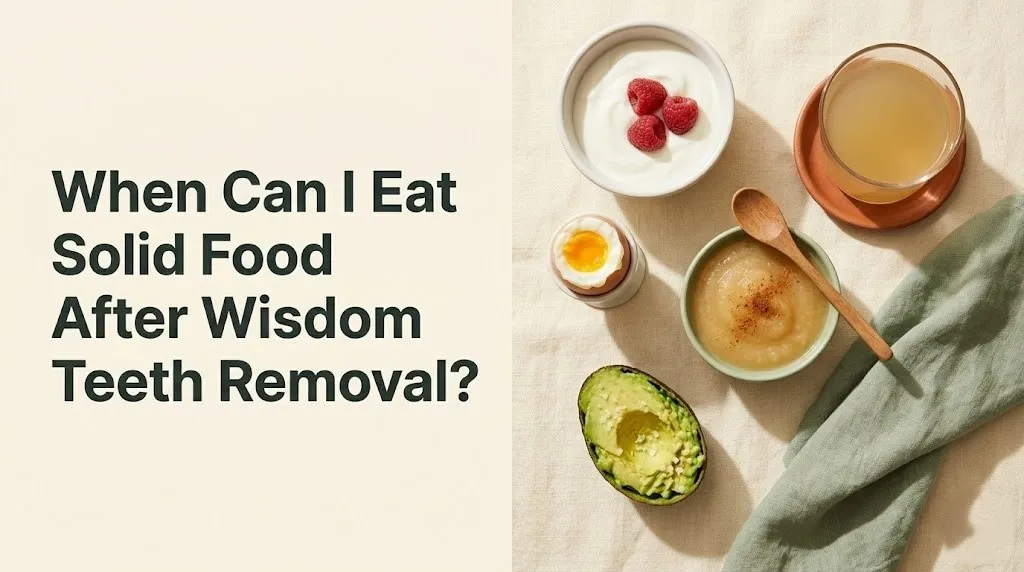
The day-by-day food progression after wisdom teeth removal moves from cold liquids on day 0, to soft pureed foods by day 2, to soft solids by day 5, and toward a normal diet after day 7 in straightforward cases.
Here is a practical day-by-day framework aligned with standard post-extraction care guidance from the Cleveland Clinic and the AAOMS. Individual cases vary. If your procedure involved multiple extractions, surgical bone removal, or sutures, extend each phase by 1 to 2 days beyond what is shown here.
| Day | Food Category | Specific Safe Options | Temperature Rule |
|---|---|---|---|
| Day 0 (surgery day) | Cold liquids only | Water, cold broth, cold unsweetened apple juice, cold coconut water | Cold or room temperature only |
| Day 1 | Liquids and smooth purees | Plain yogurt, applesauce, smooth fruit puree, cold bone broth, protein shake (no straw) | Cold or room temperature |
| Day 2 | Smooth purees and very soft foods | Pureed sweet potato, silken tofu, smooth hummus, very soft scrambled eggs | Room temperature |
| Day 3 | Soft mashable foods | Soft scrambled eggs, mashed potato, ripe mashed avocado, soft oatmeal, cream of wheat | Room temperature; avoid chewy texture |
| Day 4 to 5 | Soft solids | Soft pasta (well cooked), soft white fish, tender ground meat, banana, soft cooked vegetables | Warm acceptable; not hot |
| Day 6 to 7 | Transitional normal foods | Most soft foods; begin testing gentle chewing away from extraction site | Warm or normal temperature |
| Day 7 to 14 | Normal diet (if healing confirmed) | Most regular foods based on comfort | Normal |
All foods during the first three days should be served at cool to room temperature. Hot food and drinks can dissolve or loosen the forming blood clot, increase local blood flow, and prolong bleeding. This is not a discomfort preference issue. It is a healing requirement.
If you have diabetes, reduced caloric intake during recovery can cause blood glucose fluctuations. Working with your managing physician or registered dietitian before your procedure to plan adequate protein and carbohydrate intake is the most practical approach for stable blood sugar throughout recovery.
Key Takeaway: The food-to-solid progression after wisdom teeth removal isn’t arbitrary. It follows the biological timeline of blood clot formation and tissue repair. Follow the day-by-day framework and let pain and swelling guide your pace, not the calendar alone.
Best Soft Foods to Eat After Wisdom Teeth Removal
The best soft foods to eat after wisdom teeth removal are those that require no chewing, contain no small particles that can lodge in the socket, and are served at cool or room temperature.
From both a nutritional and practical standpoint, the following foods meet those requirements across the first five to seven days of recovery:
- Plain yogurt (unsweetened, no granola or fruit chunks): soft, cold-tolerant, provides approximately 5 to 8 grams of protein per 6-ounce serving, and contains live cultures that may support digestive balance during antibiotic use if prescribed
- Scrambled eggs (cooked gently over low heat): provides approximately 12 grams of protein per 2-egg serving; the softest texture is achieved by cooking slowly with no browning
- Mashed potato (Solanum tuberosum, smooth with no skins or lumps): provides carbohydrates for energy and is one of the most universally tolerated post-extraction foods
- Soft-cooked oatmeal (Avena sativa, cooked to a smooth consistency with extra water or milk): provides approximately 5 grams of protein per half-cup dry; avoid steel-cut oats, which retain a harder texture
- Ripe mashed avocado (Persea americana): soft enough to eat with a spoon; provides monounsaturated fat and potassium with no chewing requirement
- Smooth nut butter (peanut, almond, or cashew, thinned with a little water): concentrated protein source; avoid chunky varieties with nut pieces
- Bone broth: provides liquid calories, sodium for electrolyte balance, and gelatin-derived collagen protein; serve warm but not hot (below 140 degrees Fahrenheit)
- Applesauce (unsweetened): easily tolerated; provides vitamin C (ascorbic acid) which supports collagen synthesis in wound repair
- Smoothies (no straw): blend soft fruit with yogurt or protein powder; avoid seeds and consume by sipping from a cup, never a straw
For people following a dairy-free eating pattern, unsweetened coconut yogurt and silken tofu (Glycine max) replace dairy yogurt with a similar soft texture. Vegan protein powder blended into smoothies maintains protein intake without dairy.
Can You Eat Solid Food 3 Days After Wisdom Teeth Removal
At 3 days post-extraction, some soft solid foods are appropriate for most people following a straightforward wisdom tooth removal, but the definition of “solid” matters enormously here.
Day 3 is typically when the initial blood clot has sufficiently stabilized and granulation tissue has begun forming in the socket. The socket is not healed. It is entering its repair phase. Foods that are soft enough to break apart with minimal jaw pressure and that don’t require true grinding or hard chewing are generally appropriate at this point.
Safe soft solids at day 3 typically include:
- Soft scrambled eggs with no crunchy additions
- Mashed potato with soft butter and warm milk
- Cream of wheat or soft-cooked oatmeal
- Ripe banana mashed with a fork
- Soft pancakes without crunchy toppings
- Well-cooked white rice (if individual grains are not lodging in the socket; rinse gently after eating)
- Soft white fish like tilapia or cod that flakes apart with minimal pressure
The American Dental Association (ADA) advises that recovery timelines vary based on the number of teeth removed, their position, and whether bone was involved. Three days is not a universal clearance point. If you had all four wisdom teeth removed surgically, your day 3 experience may differ substantially from someone who had one erupted tooth pulled in a straightforward extraction.
One important practical note: if any food at day 3 causes noticeable pain at the extraction site, stop immediately. Pain during chewing is a reliable indicator that the socket is not ready for that texture, regardless of the day count.
Can I Eat Solid Food 4 Days After Wisdom Teeth Removal
By day 4, most people who had straightforward extractions can manage soft solid foods with minimal risk, though avoidance of the extraction site during chewing remains the key practical rule.
Day 4 represents a point at which swelling has typically peaked and begun to subside (peak swelling occurs at approximately 48 to 72 hours post-extraction, per Cleveland Clinic post-surgical guidance). Reduced swelling means jaw opening has improved somewhat, and room-temperature foods are better tolerated. The socket’s initial clot has transitioned to early granulation tissue.
At day 4, foods like well-cooked pasta, tender ground beef or turkey, tofu, soft cooked vegetables (carrots, zucchini, sweet potato, all cooked until fork-tender), and soft cheese are reasonable additions. The strategy is to chew on the opposite side of the mouth from the extraction site and to rinse gently with warm salt water after eating to clear food debris without applying suction.
Quick Tip:
- Cut food into very small pieces before eating, even at day 4. This reduces the chewing force required for each bite.
- Rinse gently with 1/4 teaspoon of plain table salt dissolved in 8 ounces of warm water after each meal from day 2 onward. This is the standard salt rinse protocol referenced in AAOMS post-operative care guidance.
- Avoid using your tongue to probe or press on the socket to check how it feels. This is one of the most common ways patients inadvertently displace forming tissue.
- If you had stitches, some dental professionals place dissolvable sutures that begin to loosen around days 4 to 7. Small food particles catching on loose sutures is uncomfortable but not dangerous. Rinse gently after eating.
Key Takeaway: Days 3 and 4 are the most common turning points for soft solid food introduction, but “solid” still means mashable, not crunchy. Chew away from the extraction site and stop if eating causes socket pain.
When Can I Eat Normal Food After Wisdom Teeth
Most people can return to a completely normal diet between 7 and 14 days after wisdom teeth removal, though the precise timing depends on how fully the gum tissue has closed over the socket.
“Normal food” for this purpose means anything requiring full, bilateral chewing without site-specific avoidance. That threshold is different from “soft solids eaten carefully.” The socket does not fully close with new gum tissue until approximately 2 to 3 weeks after extraction, and bone remodeling beneath the surface continues for 3 to 6 months. But the soft tissue closure milestone at 7 to 14 days is the practical point at which most foods no longer pose a socket disruption risk.
People who had all four wisdom teeth removed simultaneously, who had bone removal or sutures, or who experienced any post-operative complication (infection, dry socket, prolonged swelling) should expect their return to normal eating to fall at the 10 to 14 day end of that range. Those with single-tooth simple extractions often achieve comfortable normal eating by day 7 to 10.
If you are at day 10 and still finding certain textures painful or uncomfortable, that is not necessarily a sign of complication. It may simply mean your individual healing pace is slower, which is entirely within the normal range. The AAOMS acknowledges that healing rates vary based on age (older patients generally heal more slowly), immune status, nutritional intake during recovery, and whether the patient smoked or used tobacco products, which substantially extends all healing timelines.
If you are concerned about your healing progress at any point during recovery, your oral surgeon is the right person to evaluate your specific socket rather than relying on a general timeline.
Specific Foods: Can You Eat Rice, Pasta, and Eggs After Wisdom Teeth
Eggs are safe from day 2, soft pasta from around day 4 to 5, and rice from approximately day 3 to 4, with preparation method determining safety more than the food itself.
This is the question most people are actually searching: “Is this specific food I want to eat okay right now?” Here’s a practical breakdown by food type and timing.
| Food | Earliest Safe Day | Preparation Requirement | Risk to Watch For |
|---|---|---|---|
| Scrambled eggs | Day 2 | Soft-cooked, no crunchy additions | None if prepared softly |
| Mashed potato | Day 1 to 2 | Smooth, no skins or lumps | Serve at room temperature, not hot |
| Oatmeal | Day 2 | Well-cooked until very soft | Avoid steel-cut; rinse after eating |
| Soup (broth) | Day 0 to 1 | No chunks; cool to warm temperature | Nothing hot; no small hard pieces |
| Yogurt | Day 0 to 1 | Smooth, no granola or seeds | Avoid anything with fruit pieces |
| Soft pasta | Day 4 to 5 | Cooked well beyond al dente | Small pieces can lodge in socket; rinse after |
| White rice | Day 3 to 4 | Well cooked; rinse after eating | Individual grains can enter socket |
| Avocado | Day 1 to 2 | Mashed or soft slices | None if ripe enough to eat without pressure |
| Banana | Day 2 | Ripe and mashed or eaten in small pieces | None |
| Soft fish (tilapia, cod) | Day 3 to 4 | Baked or steamed until flaky | Small bones; ensure bone-free fillet |
| Ground meat | Day 4 to 5 | Well-cooked, small portions | Particles can lodge; rinse after |
| Ice cream | Day 1 to 2 | Plain, no hard mix-ins | Avoid cones; choose cup servings |
Rice deserves a specific note: individual grains of cooked rice are small enough to enter the extraction socket and sit in the wound, potentially causing irritation or infection. From a risk management standpoint, rinsing gently with warm salt water immediately after eating rice from day 3 onward reduces this risk. Many oral surgeons advise patients to simply avoid rice for the first week to eliminate the concern entirely.
Foods to Avoid After Wisdom Teeth Removal
Foods to avoid after wisdom teeth removal are those that are hard or crunchy (which require forceful chewing), small-particle foods that can lodge in the socket, hot foods that dissolve the clot, and acidic or spicy foods that irritate healing tissue.
The risks fall into four distinct categories: mechanical, thermal, particle, and chemical.
Mechanical risk foods (create chewing pressure that can disrupt the socket):
- Hard crackers, pretzels, toast, bagels
- Nuts and seeds of any kind
- Raw carrots, celery, or any raw crunchy vegetable
- Apples and other firm raw fruits
- Crusty bread
- Chips and crisps (including soft potato chips, which still create suction pressure)
Thermal risk foods and drinks (heat dissolves forming clot tissue):
- Hot coffee or tea (above approximately 140 degrees Fahrenheit in the first 72 hours)
- Hot soup served piping hot rather than warm
- Hot food from a microwave served immediately without cooling
Particle risk foods (small pieces enter and sit in the socket):
- White rice (within the first 3 days)
- Sesame seeds and poppy seeds on bread
- Quinoa
- Popcorn (hard hulls are a particular risk)
- Ground spices in coarse form
- Granola
Chemical irritant foods (inflame healing tissue):
- Acidic foods: citrus fruits, tomato-based sauces, vinegar dressings
- Spicy foods containing capsaicin (chili peppers, hot sauce)
- Carbonated beverages (carbonic acid plus suction pressure)
- Alcohol (interferes with clotting and interacts with prescribed pain medications)
Key Takeaway: Avoiding the wrong foods after wisdom teeth removal is not just about comfort. It directly determines whether the socket heals without complication. Mechanical, thermal, particle, and chemical risks are all distinct categories that require different avoidance strategies.
When Can I Eat Spicy or Acidic Food After Wisdom Teeth Removal
Most people can reintroduce mildly spicy and acidic foods around day 7 to 10 after wisdom teeth removal, once the gum tissue has visibly begun to close over the socket.
Spicy foods containing capsaicin (the active compound in chili peppers) cause vasodilation and increased blood flow to surrounding tissue. In the first week after extraction, this effect can increase bleeding risk, prolong inflammation, and cause direct stinging discomfort at the wound site. Capsaicin is not toxic to healing tissue, but the inflammatory response it triggers is counterproductive during early wound repair.
Acidic foods, including citrus juices, tomato products, and vinegar-based dressings, have a different mechanism of concern. Their low pH (typically between 2.0 and 4.5) can irritate the exposed granulation tissue and slow epithelialization (the process by which new surface cells cover the wound). This is not a catastrophic risk, but it extends the discomfort period and may delay full tissue closure.
A practical approach: introduce these foods cautiously after the first week, starting with mild versions. A small amount of tomato sauce on well-cooked pasta at day 8 carries lower risk than a bowl of spicy curry or a glass of orange juice at day 4.
Quick Tip:
- Reintroduce spicy foods at a low heat level first. Plain tomato sauce is tolerated before hot salsa.
- Dilute acidic drinks with water if you want citrus juice before the two-week mark.
- If any reintroduction causes a return of socket pain or bleeding, go back to blander foods for another 2 to 3 days and reassess.
- Black pepper in moderate quantities is generally tolerated before capsaicin-containing hot foods. Start there if you want to test your recovery progress.
What Is Dry Socket and Which Foods Trigger It
Dry socket (alveolar osteitis) is a post-extraction complication that occurs when the blood clot in the tooth socket is dislodged or dissolves before healing is complete, leaving the underlying bone and nerve exposed.
The condition is the most common complication of wisdom tooth removal. According to research published in the Journal of Oral and Maxillofacial Surgery, dry socket occurs in approximately 1 to 5% of all extractions and as many as 38% of impacted lower wisdom tooth removals. The lower jaw (mandible) is the primary site because mandibular blood supply produces less stable clots than the upper jaw (maxilla).
Symptoms of dry socket include:
- Severe, throbbing pain beginning 2 to 4 days after extraction, often radiating to the ear or jaw
- Bad breath or an unpleasant taste that doesn’t resolve with rinsing
- Visible empty socket rather than a dark blood clot when you look in a mirror
- Pain that is notably worse than the post-surgical discomfort of the first 24 hours
Food-related behaviors that trigger or contribute to dry socket:
- Suction pressure: Using a straw creates negative pressure that pulls directly on the clot. This is one of the most reliable clot-dislodging mechanisms.
- Hot liquids: Temperatures above approximately 140 degrees Fahrenheit can dissolve clot material before it has organized into granulation tissue.
- Hard or crunchy foods: Mechanical force from chewing hard food near the socket can crack and displace a fragile early clot.
- Carbonated beverages: The pressure from carbonation combined with sipping motion creates a suction-and-pressure effect on the socket.
- Alcohol: Impairs platelet function and clot stability. The American Dental Association (ADA) advises avoiding alcohol entirely during the first 72 hours post-extraction.
If you suspect dry socket, contact your oral surgeon promptly. It is not a condition that resolves on its own without treatment. The standard clinical treatment involves socket irrigation and placement of a medicated dressing to protect the exposed bone while healing resumes.
Can I Use a Straw or Drink Coffee After Wisdom Teeth Removal
Straws are not safe to use for at least 3 to 5 days after wisdom teeth removal, and most oral surgeons advise waiting a full 7 days before using one.
The suction created by drawing liquid through a straw generates negative pressure that targets the path of least resistance in the mouth: the open socket. This is the single most efficient way to dislodge a forming blood clot. It takes one drink through a straw to undo days of careful food management.
Coffee is a separate question from the straw issue, though the two often come together. Hot coffee served at typical cafe temperatures (around 150 to 170 degrees Fahrenheit) poses a thermal disruption risk during the first 72 hours. Cold brew coffee or iced coffee served at room temperature or below is generally acceptable from day 2 onward in terms of temperature. However, caffeine’s vasoconstrictive effects on blood vessels are not a significant concern at typical beverage consumption levels.
The practical guidance on coffee after wisdom teeth removal:
- Day 0 to 2: Avoid all hot coffee entirely. Cold brew at room temperature is acceptable but optional.
- Day 3 to 5: Warm coffee (below 140 degrees Fahrenheit, tested by feel) is typically tolerable. No straw.
- Day 5 onward: Normal temperature coffee is acceptable for most patients. Continue avoiding straws until day 7.
- No straw, ever: Drink from the rim of the cup, tilting carefully to pour liquid to the back of the mouth on the non-extraction side.
People taking prescribed opioid pain medications for post-extraction pain should avoid caffeine and alcohol, as both interact with these medications in ways that affect sedation levels and cardiovascular function. If you are on a prescription pain medication after your procedure, confirm safe beverage choices with your prescribing provider.
How to Get Enough Protein and Nutrition During Wisdom Teeth Recovery
Getting adequate protein, vitamin C, and calories during wisdom teeth recovery is genuinely important because these three nutritional factors directly support wound healing and tissue repair.
This is the gap that no competitor addresses, and it’s a real one. A person eating only broth, yogurt, and applesauce for five days is unlikely to meet their daily protein needs. The NIH Office of Dietary Supplements and the Academy of Nutrition and Dietetics both identify protein, vitamin C (ascorbic acid), and zinc as the three nutrients most directly involved in post-surgical wound healing.
Protein provides the amino acids used to build collagen, repair tissue, and support immune response. The Dietary Reference Intake for protein is approximately 0.8 grams per kilogram of body weight for healthy adults, rising to 1.0 to 1.5 grams per kilogram in the context of tissue injury and surgical recovery, per NIH nutritional guidance.
Vitamin C (ascorbic acid) is required for collagen cross-linking, the process that gives healed tissue its structural strength. The NIH Recommended Dietary Allowance for vitamin C is 75mg per day for adult women and 90mg per day for adult men. Applesauce, mashed ripe mango, and soft kiwi (if tolerated) are good soft-diet vitamin C sources.
Zinc supports cell proliferation and immune function during healing. The RDA for zinc is 8mg per day for adult women and 11mg per day for adult men. Soft scrambled eggs and yogurt both contribute zinc in meaningful amounts within a soft food diet.
Practical high-protein, soft-food sources to target during recovery:
- Plain Greek yogurt: approximately 15 to 20 grams of protein per 6-ounce serving
- Scrambled eggs (2 large): approximately 12 grams of protein
- Silken tofu (Glycine max, half cup): approximately 8 grams of protein
- Protein shake (blended, consumed from a cup without a straw): 20 to 30 grams of protein per serving depending on brand
- Smooth nut butter (2 tablespoons): approximately 7 to 8 grams of protein
- Bone broth (1 cup): approximately 6 to 10 grams of protein from collagen-derived gelatin
Aiming for at least 60 to 80 grams of total protein per day during the first week of recovery is a reasonable practical target for most adults, achievable through careful food selection even within the soft-food restrictions.
Key Takeaway: The nutritional adequacy of your recovery diet is not a secondary concern. Protein, vitamin C, and zinc are all directly involved in how quickly and how well the extraction socket heals. Intentional food selection during the restricted eating period matters.
Simple Extraction vs Surgical Removal: Does Recovery Time Differ
Yes, the recovery timeline for solid food after wisdom teeth removal differs meaningfully between a simple extraction and a surgical removal, with surgical cases typically requiring 2 to 4 additional days at each recovery stage.
A simple extraction involves a wisdom tooth that has fully erupted through the gum line and can be removed with forceps in a single motion without cutting gum tissue or removing bone. Healing is faster because tissue trauma is minimal.
A surgical extraction involves a wisdom tooth that is partially or fully impacted (beneath the gum line or bone), requiring an incision in the gum tissue, possible removal of surrounding bone, sectioning of the tooth into pieces, and suturing of the incision site after removal. This is a more involved procedure with greater tissue trauma, more swelling, a higher dry socket risk, and a longer overall healing timeline.
| Factor | Simple Extraction | Surgical Removal |
|---|---|---|
| Gum incision | No | Yes |
| Bone removal | Rarely | Often |
| Sutures | Usually not | Usually yes |
| Day 1 to 2 diet | Liquids and soft purees | Liquids only |
| Soft solids begin | Day 2 to 3 | Day 4 to 5 |
| Normal eating | Day 5 to 7 | Day 10 to 14 |
| Dry socket risk | 1 to 5% | Up to 38% (impacted lower) |
If you are unsure which category your procedure fell into, your post-operative care instructions or a quick call to your oral surgery office will clarify. The distinction is relevant not just for food timing but for all recovery behaviors including rinsing, activity level, and suture management.
Older patients, those who smoke, and those with immune-compromising conditions should anticipate recovery at the longer end of the surgical range. The AAOMS identifies tobacco use as the single most significant behavioral risk factor for extended healing and dry socket development after wisdom tooth removal.
Signs You Are Ready to Eat Solid Food After Wisdom Teeth Removal
You are ready to begin eating soft solid foods after wisdom teeth removal when swelling has visibly decreased, pain is manageable without medication, your jaw opens comfortably, and the extraction site shows no active bleeding or severe sensitivity.
These readiness indicators are more reliable than the calendar alone. Healing is a biological process that doesn’t follow a strict schedule. Using your body’s actual signals alongside the general timeline gives you the most accurate read on when to progress.
Readiness signs to look for before advancing your food texture:
- Swelling reduction: Peak swelling occurs at 48 to 72 hours. If swelling is visibly decreasing by days 3 to 4, healing is progressing normally.
- Pain manageable without strong medication: If you’ve moved from prescription pain relievers to over-the-counter ibuprofen (an NSAID, non-steroidal anti-inflammatory drug) or acetaminophen alone, your pain level likely permits gentle eating.
- Jaw mobility improving: If you can open your mouth without severe stiffness, you have enough range of motion to eat soft solids.
- No active bleeding: Some minor spotting in saliva on day 1 is normal. Active bleeding at days 3 to 4 is not. If bleeding has fully resolved, that is a positive healing indicator.
- Socket appearance: Looking at the site in a mirror (carefully, without probing), a socket that is beginning to show pink tissue growing in from the edges is healing normally.
- No worsening pain: Pain that increases after day 3 rather than decreasing is a warning sign worth reporting to your oral surgeon. Increasing pain is a primary symptom of dry socket or infection.
If all of these indicators are positive and you are within the expected timeline for your procedure type, transitioning to soft solid foods is appropriate. If any of these signs are absent or reversed, wait another day and reassess.
People who had their procedure at an academic oral surgery center or teaching hospital may have more readily available post-operative follow-up access. Use it if you are uncertain about your healing progress.
Frequently Asked Questions About Eating After Wisdom Teeth Removal
Can I eat solid food 3 days after wisdom teeth removal?
For most people who had a straightforward wisdom tooth extraction, soft solid foods are appropriate around day 3.
Foods like soft scrambled eggs, mashed potato, ripe banana, and well-cooked oatmeal are generally safe at this stage, provided you chew away from the extraction site.
If your procedure involved surgical removal, impacted teeth, or sutures, extend this timeline by 1 to 2 additional days and follow your oral surgeon’s specific instructions.
What happens if I eat solid food too soon after wisdom teeth removal?
Eating solid food too soon can dislodge the blood clot in the extraction socket, leading to alveolar osteitis, commonly called dry socket.
Dry socket causes severe radiating pain beginning 2 to 4 days after extraction and requires treatment from your oral surgeon, typically a medicated dressing placed in the socket.
Beyond dry socket, premature solid food also increases the risk of food particle contamination in the wound and may slow overall healing.
How long after wisdom teeth removal can I eat normally?
Most people can return to a fully normal diet between 7 and 14 days after wisdom teeth removal.
The exact timeline depends on whether you had a simple extraction or a surgical removal, how many teeth were extracted, and how your individual healing progresses.
If you still have pain when chewing at day 7, that is a reliable signal to continue soft foods for several more days before testing normal textures.
What is the best food to eat the first day after wisdom teeth removal?
The best foods on day 1 after wisdom teeth removal are cold or room-temperature liquids and smooth purees that require no chewing whatsoever.
Plain yogurt, cold bone broth, smooth applesauce, cold fruit puree, and protein shakes consumed from a cup (without a straw) are all appropriate.
Avoid anything hot, anything with seeds or small particles, and anything that requires the jaw to close with pressure.
When can I eat chips or pizza after wisdom teeth removal?
Chips are among the highest-risk post-extraction foods and should be avoided for at least 7 to 10 days.
Their hard, crunchy texture requires significant chewing force, and small chip fragments are one of the most effective ways to lodge a food particle in an open socket.
Pizza can be reintroduced around days 7 to 10 if the crust is soft and you avoid chewing near the extraction site, though the tomato sauce’s acidity may cause mild irritation before full gum closure.
Getting Back to Eating Well After Wisdom Teeth Removal
The discomfort of eating on a restricted diet for a week or two feels worse than it is in hindsight. The window is short. The consequences of rushing it, particularly dry socket, extend that window considerably.
Stick to the progression: cold liquids first, then smooth purees, then soft solids, then normal food as your swelling drops and your pain decreases. Use your body’s signals as your primary guide. Eat to meet your protein and calorie needs, not just to satisfy hunger.
If your healing feels off at any point, your oral surgeon’s office is a phone call away. That’s a better call to make than a second visit to treat a preventable complication.