Set your oven between 170 and 200 degrees Fahrenheit to keep food warm, and always check that the internal food temperature stays above 140 degrees Fahrenheit. This is the safety floor. Anything below 140 degrees for more than two hours falls into the USDA “Danger Zone” where bacteria multiply rapidly.
The USDA Food Safety and Inspection Service reports that hot food left at room temperature for over two hours must be discarded. During the holidays alone, the CDC estimates millions of foodborne illness cases stem from improper holding temperatures. Your oven is the best tool to prevent this, but only if you use it with a thermometer, not just the dial.
We will walk through the exact settings for juicy meat, crispy skin, and non-soggy casseroles. You will learn the foil tenting technique, the water bath method, and the absolute maximum time limit for holding each food type before texture and safety collapse.
How to Keep Food Warm in Oven
The method is straightforward but specific. Place your cooked food in an oven-safe dish. Cover it tightly with aluminum foil. Set the oven to 200 degrees Fahrenheit. Use an instant-read probe thermometer to verify the food’s core temperature never drops below 140 degrees.
Do not trust your oven’s built-in thermostat. In most home kitchens, the actual temperature swings 25 to 50 degrees around the set point. An oven set to 170 might cycle down to 140 and up to 195. An independent oven thermometer placed inside, visible through the window, gives you the real number. Adjust the dial until the steady state temperature holds between 170 and 200.
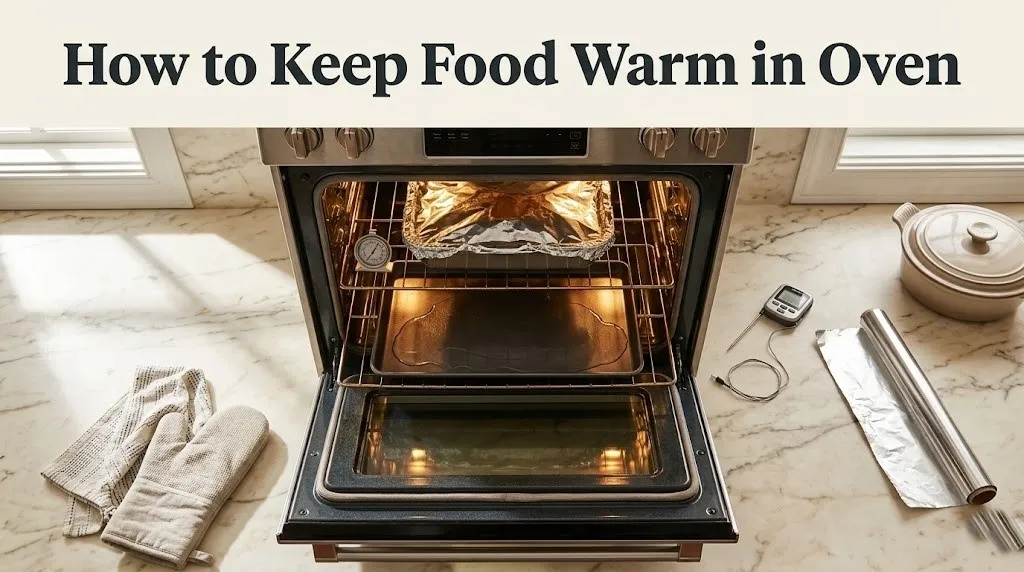
The foil is non-negotiable. Uncovered food in a warm oven loses moisture to evaporation rapidly. The dry, circulating air pulls water from the surface of the food. Foil traps a layer of humid air directly against the meat or casserole. This is the difference between a rested, juicy roast and a dry, curling piece of chicken.
Key Takeaway: An oven thermometer and tight foil cover are the only two pieces of equipment that prevent a warm oven from becoming a food dehydrator.
How to Keep Food Warm in the Oven
Place the dish on the middle rack. The bottom rack, even at 200 degrees, is close enough to the heating element to create a hot spot that will continue cooking the bottom of the food. The top rack exposes the foil cover to the hottest air rising through the oven cavity.
Large cuts of meat like a whole roasted chicken or a beef tenderloin benefit from being placed on a wire rack set inside a rimmed baking sheet. This allows air to circulate under the food, preventing the bottom from steaming in its own trapped moisture. The wire rack setup preserves the crisp exterior you worked to develop during roasting.
Fried and crispy foods like chicken wings, fries, or breaded cutlets cannot be held in a moist, foil-wrapped environment. They steam and turn soggy within minutes. Place these on a wire rack in the oven, uncovered, at 200 degrees. The dry heat preserves the crisp crust for roughly 30 to 45 minutes before degradation begins.
How to Keep Food Warm in Oven Without Drying
A water bath underneath the food creates a humid oven environment. Place a large roasting pan on the bottom rack and fill it with an inch of hot water. Place your covered food on the middle rack above it. The steam from the water pan fills the oven cavity with moisture.
This technique works best for casseroles, braised meats, rice dishes, and anything with a sauce that can tolerate additional moisture. It is less effective for roast chicken skin or anything you need to serve crispy. The water bath is the single most effective method for preventing drying during a 60 to 90 minute hold.
Sealing the food container is equally important. A tight double layer of heavy-duty aluminum foil works. A lidded Dutch oven is even better. The cast iron walls hold heat and the heavy lid traps steam. A ceramic baking dish with a fitted glass lid creates an almost airtight seal that rivals a commercial steam table for short-term holding.
How Do You Keep Food Warm in the Oven
Preheating the serving dishes along with the oven stops cold plates from stealing 20 degrees of temperature between the kitchen and the dining table. Stack your plates and bowls in the oven on a separate rack during the last 15 minutes of the hold. Use oven-safe ceramic or stoneware only.
Transfer food to a clean, hot serving platter immediately before carrying it to the table. Do not serve from the foil-wrapped baking dish if you can avoid it. The presentation matters, and the preheated platter continues to radiate warmth through the meal.
For buffet-style service, leave the main dish in the oven at 200 degrees and bring small portions out to a smaller hot plate or chafing dish on the serving table. Refill as needed. This keeps the bulk of the food in a precisely controlled environment and minimizes the time any single portion spends exposed to room-temperature air.
Key Takeaway: Preheated plates and a staged serving strategy keep food hotter on the table without requiring you to overcook the entire batch in the oven.
Lowest Oven Temperature to Keep Food Warm
The lowest safe holding temperature is 140 degrees Fahrenheit internal food temperature, which typically requires an oven setting between 170 and 200 degrees Fahrenheit. Many ovens cannot be set below 170 degrees, which is the “Warm” setting floor on standard models.
If your oven’s lowest setting is 170 degrees, use it. The air temperature will cycle slightly above this. The food will not cook further at this temperature as long as it is covered and the internal temperature stays below 165 degrees for proteins that are already cooked. Carryover cooking from the initial roasting phase will have already stopped.
Smart ovens in 2026 often include a dedicated “Keep Warm” mode with precise temperature probes. These systems use an internal meat probe to hold food at exactly 145 degrees or 150 degrees indefinitely. If your oven has this feature, set it to 145 degrees for poultry and 140 degrees for beef and pork, matching the USDA safe minimum internal temperatures for fully cooked meats.
Oven Warm Setting Temperature
The “Warm” setting on most home ovens targets an air temperature of 170 to 200 degrees Fahrenheit. This is not a precision setting. The oven cycles on and off to maintain an average within this range.
Use the Warm setting as a default, but always verify with an oven thermometer. The Warm setting on an older gas oven might fluctuate between 150 and 220 degrees. That fluctuation at the low end can drop the food into the Danger Zone if sustained for more than a few minutes.
A warming drawer operates differently. It provides a lower, gentler heat, typically between 140 and 170 degrees, and often includes a humidity control slider. A warming drawer is the superior tool for holding food, but an oven on Warm with a water bath is a close substitute for a drawer if you do not have one.
How Long Can You Keep Food Warm in the Oven
The USDA FSIS states that hot food can be held safely for up to 4 hours if the internal temperature stays above 140 degrees Fahrenheit. After 4 hours, even if the temperature is maintained, the cumulative risk of bacterial spore activation and toxin production increases.
Texture degradation is a separate, more restrictive clock. Most roasted meats begin to dry noticeably after 90 minutes, even with foil and a water bath. Casseroles and saucy dishes last 2 to 3 hours before edges over-thicken or dry. Fried foods lose crispness after 30 to 45 minutes.
Plan your holding time backward from your serving time. The ideal window is 30 to 60 minutes. This is enough to finish the last side dishes and get everyone to the table. Holding food for multiple hours is an emergency solution for timing errors, not a recommended hosting strategy.
| Food Type | Max Safe Hold Time | Max Quality Hold Time |
|---|---|---|
| Roasted Chicken/Turkey | 4 hours | 60 to 90 minutes |
| Braised Meats (Pot Roast) | 4 hours | 2 to 3 hours |
| Casseroles and Bakes | 4 hours | 90 to 120 minutes |
| Fried Foods | 4 hours | 30 to 45 minutes |
| Bread and Rolls | 4 hours | 30 minutes |
Key Takeaway: Safety gives you 4 hours of oven holding, but quality gives you 90 minutes or less for most foods; plan the meal, not the emergency hold.
How to Keep Food Warm for a Party
A party with multiple dishes demands oven space management. Use all available racks. Place the driest items, like roasted meats, on the top racks. Place the wettest items, like casseroles with water baths, on the bottom racks. The natural moisture gradient in the oven helps each dish hold properly.
A large party often exceeds one oven’s capacity. Borrow insulated coolers for secondary hot storage. Pre-warm a large cooler by filling it with hot water, emptying it, and drying it completely. Place hot, foil-wrapped dishes inside and close the lid tightly. A pre-warmed cooler holds food above 140 degrees for 2 to 3 hours without any electricity.
Slow cookers set to “Warm” become auxiliary hot-holding stations for sides like mashed potatoes, mac and cheese, and gravy. Do not use the “Low” setting, which can bring food up to simmering temperatures and cause curdling or scorching. The “Warm” setting on a slow cooker is calibrated for holding, similar to a warming drawer.
Holding Food in Oven at 170
The 170 degree oven setting is the standard minimum for most home ovens and serves as a reliable holding temperature. At 170 degrees air temperature, the food’s internal temperature will hold steady between 140 and 155 degrees in a covered dish.
Lean meats like turkey breast and pork loin lose moisture fastest at this temperature. They do not have enough intramuscular fat to tolerate long holds, even at 170. A drizzle of warm broth or a pat of butter added to the dish before covering provides a moisture buffer for lean proteins.
Dense, saucy dishes like lasagna, baked ziti, and scalloped potatoes hold beautifully at 170 degrees for up to 2 hours. The starch in the pasta and sauce acts as a thermal mass that resists temperature change. These dishes benefit from the rest, allowing the sauce to further absorb into the pasta layers.
Keep Food Warm in Oven With Water Bath
A water bath is the best protection against oven drying. To set up a proper water bath, use a large, deep pan like a turkey roaster. Fill it with 1 to 2 inches of hot tap water. Place it on the lowest oven rack. Place your covered food on the middle rack.
The physics is simple. The water evaporates slowly, raising the humidity inside the closed oven cavity. Dry oven air pulls moisture from the food. Humid oven air pulls moisture much more slowly, or not at all if the humidity reaches equilibrium with the food surface.
This method is not for every dish. Roast chicken skin will soften in a water bath oven. The fat renders and the collagen breaks down beautifully, but the skin loses its crackle. Accept this trade-off. A juicy bird with soft skin is preferable to a dry bird with cracking skin that no one wants to eat.
How to Keep Food Warm in Oven Without Overcooking
Overcooking during the hold phase is caused by the food’s internal temperature continuing to rise above the desired doneness. This happens when the oven temperature is set above 200 degrees. A 250-degree oven will gently cook food, not just hold it.
To stop carryover cooking, rest your meat at room temperature for 10 to 15 minutes before placing it in the oven. The temperature peak from carryover occurs roughly 5 to 10 minutes after removal from the cooking heat source. Once the internal temperature begins to fall, then place it in the 170-degree holding oven.
Slice large roasts like brisket and pork shoulder before holding if you plan to serve them sliced. Sliced meat cools faster, but it does not continue to cook as a whole muscle would. Cover the sliced meat with a small amount of its own juices or a thin, warm broth to prevent surface drying.
Key Takeaway: Rest the meat on the counter first until the internal temperature stops climbing, then transfer to the warm oven to halt the cooking process entirely.
How to Hold Food in Oven Safely
Safe hot holding requires a probe thermometer, not a timer. Check the internal temperature of the thickest part of the food every 30 minutes. Record it if you are holding for more than 2 hours. If the temperature falls to 140 degrees, serve immediately or reheat to 165 degrees before continuing to hold.
The Danger Zone is between 40 and 140 degrees Fahrenheit. Bacteria like Clostridium perfringens and Bacillus cereus grow best in this range. These organisms form heat-resistant spores that survive initial cooking. They germinate in warm, slowly cooling food and produce toxins.
A 2026 food safety update from the Partnership for Food Safety Education emphasizes that the 2-hour rule is cumulative. If a dish sat on the counter for 30 minutes before entering the oven, those 30 minutes count. If it was on the buffet table for 15 minutes before being returned to the oven, those 15 minutes also count.
How to Keep Multiple Dishes Warm in the Oven
Multiple dishes require a systematic rack arrangement. Place the food requiring the highest temperature, or the driest item, on the top rack. Place the food that benefits most from moisture, or the one with the water bath, on the bottom.
Rotate dishes every 30 minutes. Move the back dish to the front, the top dish to the middle, and the middle dish to the top. This compensates for hot spots in your oven and ensures no single dish bears the brunt of the heating element cycling on and off.
Airflow matters more with a full oven. Leave at least 1 inch of space between each dish and between the dish and the oven walls. A packed, tight oven traps steam in pockets and creates cold spots where air cannot circulate. Two properly spaced dishes hold temperature better than four crammed ones touching each other.
Frequently Asked Questions About Keeping Food Warm in the Oven
What is the best temperature to keep food warm in the oven?
The best temperature is 200 degrees Fahrenheit, or 170 degrees if your oven sets that low.
This range keeps food above the 140-degree safety floor without continuing to cook it.
Use an oven thermometer to confirm the actual temperature inside, not just the dial setting.
Can you keep food warm in the oven for 2 hours?
Yes, you can safely hold food for 2 hours if the internal temperature stays above 140 degrees Fahrenheit.
The USDA permits hot holding for up to 4 hours before food must be discarded.
Texture and moisture quality decline steadily; most foods are at their best within the first hour.
How do you keep food warm without drying it out?
Cover the food tightly with heavy-duty aluminum foil or a fitted lid.
Place a pan of hot water on the lower oven rack to create steam.
Slice large meats and add a small amount of warm broth to the dish before covering.
Is it safe to keep food warm in the oven overnight?
No, holding food warm in the oven overnight is unsafe and should not be attempted.
Even with perfect temperature control, the cumulative risk of bacterial toxin production after 4 hours is high.
Cool leftovers rapidly in shallow containers and refrigerate, then reheat thoroughly the next day.
Can you use a warming drawer instead of an oven?
Yes, a warming drawer is the ideal appliance for holding hot food.
It provides lower, steadier heat between 140 and 170 degrees with better humidity control than a full oven.
Use it for rolls, side dishes, and sliced meats that benefit from gentle, moist warmth.
The difference between a proud host and a stressed one is a calm 200-degree oven with a pan of water humming on the bottom rack. You are not just keeping food hot. You are managing a 2-hour countdown clock that begins the moment the cooking stops.
Buy the oven thermometer. Set the probe. Set a timer on your phone for the 2-hour mark. When the timer goes off, pull the food, serve it, or cool it down. The meal that sits in the Danger Zone for three hours while people pick at appetizers is the one that causes problems.
You cooked it right. Hold it right. The foil, the water bath, and the thermometer are your tools. Use them, and enjoy the dinner you actually planned to serve.