Thai food is naturally gluten free at its core in more ways than most cuisines, but it is not automatically safe for someone with celiac disease or gluten sensitivity. The foundation of Thai cooking, rice noodles, jasmine rice, fish sauce, coconut milk, fresh herbs, and curry pastes, contains no wheat, barley, or rye. The problem is that most Thai restaurants in the United States use wheat-derived soy sauce as a default seasoning in stir-fries, noodle dishes, and marinades, which introduces gluten into dishes that would be safe if made traditionally or with the correct soy sauce substitution.
According to the Celiac Disease Foundation, eating out at any restaurant carries a risk of gluten cross-contact, and the risk increases in kitchens where wheat-based soy sauce is poured liberally into shared woks across dozens of dishes per service. Thai food is not inherently dangerous for gluten-free diners. It is a cuisine where the naturally gluten-free options are abundant relative to Italian or Chinese food. But the difference between a safe meal and a glutening depends almost entirely on which soy sauce the restaurant uses, whether they understand the question you are asking, and whether they are willing to clean a wok and use a clean ladle for your order.
This article walks through every major Thai dish category and identifies which ones are naturally gluten free, which ones contain hidden gluten, and which ones fall into a gray zone where the answer depends on the specific restaurant. You will learn the exact soy sauce varieties used in Thai cooking, which sauces are always safe and which are never safe, and the specific phrases to use when ordering to maximize your odds of getting an actually gluten-free meal.
What Thai food is gluten free
Many classic Thai dishes are gluten free when prepared traditionally with Thai-sourced ingredients, including clear soups, coconut milk-based curries, grilled meats with tamarind or chili dipping sauces, and rice noodle dishes made with fish sauce instead of soy sauce. The safest categories are Tom Yum soup, Tom Kha soup, Thai curries (red, green, yellow, massaman, panang), grilled satay without the peanut sauce, larb (minced meat salad), som tum (green papaya salad), and steamed jasmine rice or sticky rice.
The natural gluten-free status of these dishes rests on the ingredients that define Thai cooking. Rice noodles are made from rice flour and water. Fish sauce is fermented anchovies and salt. Coconut milk is pressed coconut meat and water. Curry paste is pounded fresh chilies, lemongrass, galangal, kaffir lime, shallots, garlic, and shrimp paste, none of which contain gluten. Fresh herbs like Thai basil, cilantro, and mint are whole plant ingredients. Rice in all forms is gluten free. These core ingredients mean Thai cuisine has more naturally gluten-free building blocks than most Asian cooking traditions.
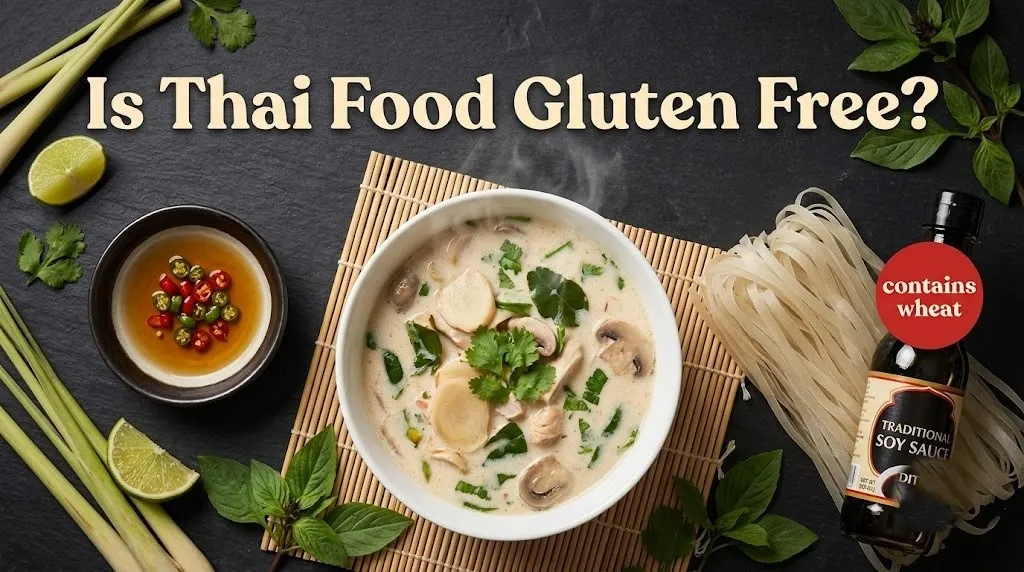
The dishes that are never gluten free in any standard Thai restaurant preparation include Pad See Ew (wide rice noodles with dark soy sauce), Pad Kee Mao (Drunken Noodles with soy sauce and oyster sauce), Thai fried rice (seasoned with soy sauce), egg noodle dishes, wonton soups, and fried appetizers like spring rolls and crab rangoon that use wheat wrappers and shared fryer oil. These dishes rely on wheat-derived soy sauce, wheat noodles, or wheat wrappers, and no reasonable modification makes them safe.
The gray zone dishes are the ones where the answer depends entirely on the restaurant. Pad Thai is the most famous example. It uses rice noodles, which are gluten free. The traditional sauce is tamarind paste, fish sauce, and palm sugar, all gluten free. But many American Thai restaurants add soy sauce to their Pad Thai for color and umami, and that soy sauce usually contains wheat. A Pad Thai is gluten free only if you confirm the sauce recipe with that specific kitchen.
| Dish | Naturally GF Ingredients | Hidden Gluten Risk | Safe with Verification? |
|---|---|---|---|
| Tom Yum soup | Broth, lemongrass, shrimp, mushrooms | Some versions add soy sauce | Usually safe; ask |
| Tom Kha soup | Coconut milk, galangal, chicken | Soy sauce in some recipes | Usually safe; ask |
| Green/Red/Yellow Curry | Coconut milk, curry paste, protein | Some pastes contain soy | Usually safe; verify paste |
| Pad Thai | Rice noodles, tamarind, fish sauce | Soy sauce often added | Ask about soy sauce |
| Som Tum (papaya salad) | Papaya, lime, fish sauce, chili | Soy sauce or bottled dressing | Usually safe; ask |
| Larb (meat salad) | Minced meat, herbs, lime, fish sauce | Soy sauce in marinade | Ask about marinade |
| Pad See Ew | Wide rice noodles, broccoli, egg | Dark soy sauce (always wheat) | Not safe |
| Pad Kee Mao | Wide rice noodles, basil, chili | Soy sauce, oyster sauce | Not safe |
| Fried rice | Jasmine rice, egg, protein | Soy sauce (always added) | Not safe unless requested |
Key Takeaway: Thai soups, curries, and salads are the safest categories for gluten-free diners because their traditional recipes do not call for soy sauce; noodle dishes and fried rice are the riskiest because soy sauce is a standard ingredient, and only the restaurant can tell you whether they will omit or substitute it.
Pad Thai gluten free
Pad Thai is naturally gluten free in its traditional Thai formulation, but it is not reliably gluten free in American Thai restaurants because many kitchens add wheat-derived soy sauce to the dish. The traditional sauce for Pad Thai is a combination of tamarind paste, fish sauce, and palm sugar, none of which contain gluten. The noodles are sen lek, thin flat rice noodles made from rice flour and water. The protein is shrimp, chicken, or tofu. The garnishes are bean sprouts, crushed peanuts, lime, and cilantro. A traditional Pad Thai at a street stall in Bangkok has no gluten in it.
The problem is adaptation to Western palates. Many American Thai restaurants add soy sauce to their Pad Thai for a darker color, a saltier flavor, and the umami that American diners expect from “Asian” food. That soy sauce is almost always a wheat-derived product unless the restaurant specifically stocks tamari or a wheat-free Thai thin soy sauce. A Pad Thai that contains soy sauce is not gluten free. The noodles are still rice, but the sauce is not safe.
Ordering gluten-free Pad Thai requires asking a specific question: “Does your Pad Thai sauce contain soy sauce, and if so, is it made with wheat?” A server may not know the answer. In that case, the safer move is to ask if the kitchen can make Pad Thai with fish sauce and tamarind only, no soy sauce. Some restaurants can accommodate this. Some cannot because their sauce is pre-batched. If the restaurant cannot confirm a wheat-free sauce, order a curry or a soup instead.
The crushed peanut garnish on Pad Thai is an additional consideration for people with celiac disease who are also managing peanut allergies. Cross-contact between peanuts and wheat is less common than cross-contact between soy sauce and everything else, but people with multiple food restrictions should verify. The bean sprouts, lime wedge, and cilantro are safe.
Gluten free Thai curry
Thai curries are the safest and most reliably gluten-free category on a Thai menu. Red curry, green curry, yellow curry, massaman curry, and panang curry all start with a coconut milk base and a curry paste made from fresh aromatics and dried spices. The traditional ingredients in Thai curry paste, fresh chilies, lemongrass, galangal, kaffir lime zest, shallots, garlic, coriander root, cumin, and shrimp paste, contain no gluten. The coconut milk adds fat and body. The protein, typically chicken, beef, pork, tofu, or shrimp, is simmered directly in the coconut-curry mixture.
The gluten risk in Thai curries is small but real. Some commercially produced curry pastes, particularly those made in large factories for export, may contain soy sauce or hydrolyzed wheat protein as flavor enhancers. This is uncommon in pastes imported directly from Thailand, where rice and fish sauce are the dominant seasonings, but it appears in some Western-manufactured Thai curry pastes. A restaurant that makes its own curry paste from fresh ingredients is the safest bet. A restaurant that uses a premade paste should be able to check the label or confirm the brand with you.
Massaman curry and panang curry have a small additional risk because they sometimes include peanuts or peanut butter, and some commercial peanut products are processed on shared equipment with wheat. The risk is low, but for a person with celiac disease who also has a peanut allergy, it is worth asking. Yellow curry contains turmeric, which gives it the characteristic golden color, and is generally the mildest of the Thai curries. It is naturally gluten free.
Ordering Thai curry gluten free is straightforward. Ask: “Is your curry paste made in-house or from a brand you can check for wheat ingredients?” Most servers will not know the answer to this question. The more practical approach is to order a curry that the menu describes as “spicy coconut milk” or “Thai herb” based, avoid curries that list soy sauce as a menu description, and request that the curry be served with steamed jasmine rice rather than any noodle or bread accompaniment.
Tom Yum gluten free
Tom Yum soup is one of the most reliably gluten-free dishes on any Thai menu because its defining ingredients are a clear broth, lemongrass, galangal, kaffir lime leaves, fresh chilies, mushrooms, and shrimp or chicken. There is no soy sauce in a traditional Tom Yum recipe. The broth is water or light chicken stock, acidulated with lime juice and seasoned with fish sauce. The soup is clear, hot, sour, and aromatic, with no thickeners, no wheat noodles, and no soy-based coloring agents.
Tom Yum Goong, the shrimp version, and Tom Yum Gai, the chicken version, are both safe in their traditional form. The broth is the key. Some restaurants may use a powdered Tom Yum base rather than making the soup from scratch. Powdered soup bases can contain maltodextrin derived from wheat, hydrolyzed wheat protein, or soy sauce powder. The risk is lower than with noodle dishes, but it is not zero. Asking whether the Tom Yum is made from scratch or from a base is the most reliable way to verify.
Tom Kha Gai, the coconut milk-based galangal soup with chicken, is also naturally gluten free. The coconut milk adds a creamy texture and mild sweetness that balances the sour lime and spicy chili. The ingredients are nearly identical to Tom Yum with the addition of coconut milk. The same powdered-base caution applies. A restaurant that makes Tom Kha from scratch using fresh coconut milk, galangal, and lemongrass is serving a gluten-free soup. A restaurant that uses a powdered mix may not be.
For someone with celiac disease eating at an unfamiliar Thai restaurant, Tom Yum and Tom Kha are the safest possible orders. They are soups. They do not go into a wok. They are not stir-fried. They are ladled from a pot into a bowl. The cross-contact risk from shared cooking surfaces is lower than for any noodle or stir-fry dish.
Thai soy sauce gluten
Thai soy sauce is the single most important variable in gluten-free Thai food, and understanding the different types of soy sauce used in Thai cooking is the difference between a safe meal and a gluten exposure. The default soy sauce in most American Thai restaurants is a wheat-derived product similar to Chinese-style thin soy sauce, and it contains gluten unless the restaurant specifically stocks a wheat-free alternative.
Thai cuisine uses several distinct soy sauce varieties. Thin soy sauce, also called light soy sauce or see ew khao, is the all-purpose seasoning soy sauce used in stir-fries, marinades, and dipping sauces. It is thin, salty, and light brown. Most commercial thin soy sauces, including the Thai brands commonly exported, contain wheat as a fermentation ingredient alongside soybeans. Dark soy sauce, or see ew dum, is thicker, darker, and slightly sweet, used primarily for color in dishes like Pad See Ew. It almost always contains wheat and often contains added molasses. Sweet soy sauce, or see ew wan, is the Thai version of Indonesian kecap manis, thick and syrupy with added sugar. It contains wheat.
Mushroom soy sauce is a Thai and Chinese product made from soybeans and mushroom extract. It may or may not contain wheat depending on the brand. Fish sauce, or nam pla, is a separate category entirely. It is made from fermented anchovies and salt. It contains no soy and no wheat. Fish sauce is the primary salty seasoning in traditional Thai cooking, which is why so many Thai dishes are naturally gluten free before Americanized soy sauce enters the recipe.
The safe alternatives that a restaurant may have available are tamari, a Japanese soy sauce brewed without wheat, and coconut aminos, a soy-free, gluten-free liquid seasoning made from coconut sap. Thai restaurants are less likely to stock tamari than Japanese restaurants, but some do. Asking “Do you have tamari or wheat-free soy sauce?” is a clear, specific question that most kitchens can answer.
| Sauce | Contains Wheat? | Used In | Gluten-Free Alternative |
|---|---|---|---|
| Thai thin soy sauce | Almost always | Stir-fries, marinades, dipping | Tamari, coconut aminos |
| Dark soy sauce | Almost always | Pad See Ew, fried rice | Not easily substituted |
| Sweet soy sauce | Almost always | Dipping sauces, some curries | Not easily substituted |
| Mushroom soy sauce | Sometimes | Vegetarian dishes | Verify brand |
| Fish sauce (nam pla) | No | Soups, curries, salads, Pad Thai | Naturally GF |
| Oyster sauce | Usually | Stir-fries, vegetable dishes | GF oyster sauce exists; rare |
| Tamari | No (traditionally) | Japanese cuisine, substitute | GF by default |
Key Takeaway: Soy sauce is the gatekeeper of gluten-free Thai food; if the restaurant uses wheat-derived soy sauce as its default, most noodle dishes and stir-fries are unsafe unless they agree to cook yours with fish sauce or tamari instead.
Fish sauce gluten free
Fish sauce is naturally gluten free. It is made by fermenting small fish, typically anchovies, with salt for several months to several years. The liquid that results is strained, filtered, and bottled. There is no soy, no wheat, no barley, and no rye in traditional fish sauce. The ingredient list on a bottle of Tiparos, Squid Brand, or Three Crabs fish sauce reads: anchovy extract, water, salt, sugar. That is it. No gluten.
Fish sauce is the foundational seasoning of Thai cuisine. It provides the salt, umami, and depth that soy sauce provides in Chinese and Japanese cooking. Traditional Thai cooks reach for fish sauce where a Chinese cook reaches for soy sauce. This is the structural reason why Thai cuisine has so many naturally gluten-free dishes. The primary seasoning liquid contains no wheat.
The concern with fish sauce is not the fish sauce itself but what gets added to it in Western Thai restaurants. Some restaurants add soy sauce to dishes that traditionally use only fish sauce because they believe American customers expect the darker color and soy flavor. This is an adaptation issue, not an ingredient issue. The fish sauce in the bottle is gluten free. The question is whether the kitchen added wheat-derived soy sauce to the wok alongside the fish sauce.
For home cooking, fish sauce is one of the most useful gluten-free pantry ingredients. It adds the savory depth that soy sauce provides without the wheat. A person with celiac disease can use fish sauce freely in stir-fries, soups, marinades, and dipping sauces, and the result will taste authentically Thai rather than like a compromised substitution.
Oyster sauce gluten
Oyster sauce is a thick, dark brown sauce made from oyster extract, sugar, salt, and typically soy sauce, which means it almost always contains wheat unless a specifically gluten-free version is sourced. The standard oyster sauce used in most Thai and Chinese restaurant kitchens, brands like Lee Kum Kee and Maekrua, contains wheat-derived soy sauce as an ingredient.
Oyster sauce is used in Thai stir-fries, particularly vegetable dishes like stir-fried broccoli or mixed vegetables, and in some fried rice recipes. It adds a glossy finish and a savory-sweet flavor that fish sauce alone does not provide. Dishes that list oyster sauce on the menu or that have a thick, glossy brown sauce are almost certainly not gluten free unless the restaurant has specifically sourced a wheat-free oyster sauce.
Gluten-free oyster sauce does exist. Some specialty brands produce oyster sauce without wheat, using cornstarch instead of soy sauce as the thickener and flavor base. These brands are uncommon in restaurant kitchens. A Thai restaurant that caters to gluten-free customers may stock one, but it is not safe to assume. If a dish contains oyster sauce and the restaurant cannot confirm a wheat-free version, avoid the dish.
Pad Kee Mao (Drunken Noodles) and Pad See Ew both use a combination of dark soy sauce and oyster sauce in their standard recipes. These dishes are not safe for gluten-free diners even if the noodles are rice noodles, because the sauces contain wheat. Substituting the sauces changes the dish fundamentally, and most kitchens will not do it.
Rice noodle gluten free
Rice noodles are naturally gluten free because they are made from rice flour and water, sometimes with a small amount of tapioca starch added for elasticity. There is no wheat flour in traditional rice noodles. The three main types used in Thai cooking, sen lek (thin flat noodles for Pad Thai), sen yai (wide flat noodles for Pad See Ew), and sen mee (thin vermicelli for soups and spring rolls), are all made from rice.
The gluten concern with rice noodles is not the noodle itself but what happens to it in the kitchen. Rice noodles are cooked in the same woks that just cooked wheat noodles or wheat-containing sauces. They are handled with the same tongs and ladles. They are served on the same plates. The noodle is gluten free. The dish may not be because of the cooking process and the sauces added during that process.
Dried rice noodles from a grocery store, the kind you soak in water and then stir-fry at home, are gluten free as an ingredient. A person cooking Thai food at home can make Pad Thai, Pad See Ew, and noodle soups with complete confidence that the noodle itself contains no gluten. The sauces and the wok hygiene are the variables, and at home, you control both.
Egg noodles, which appear in some Thai soups and as a noodle option at restaurants that also serve Chinese-influenced dishes, are made from wheat flour and eggs. They are not gluten free. If a menu offers “egg noodles” or “wheat noodles” as an alternative to rice noodles, choose rice noodles and verify the sauce.
Thai curry paste gluten free
Traditional Thai curry paste is made by pounding fresh ingredients in a mortar and pestle until a smooth, aromatic paste forms. The ingredients, fresh red or green chilies, lemongrass, galangal, kaffir lime zest, shallots, garlic, coriander root, cumin, white peppercorns, and shrimp paste, contain no wheat, barley, or rye. A curry paste made from scratch in a Thai kitchen is gluten free by default.
The risk appears when a restaurant uses a commercially manufactured curry paste. Some factory-made pastes, particularly those produced in facilities that also process wheat-containing products, may contain soy sauce, hydrolyzed wheat protein, or wheat-based thickeners. This is uncommon in pastes imported from Thailand, where wheat is not a traditional ingredient, but it is more common in pastes manufactured in the United States or Europe for the food service industry.
Red curry paste and green curry paste are the most commonly made-in-house pastes because they are the foundation of so many Thai dishes. Massaman curry paste and panang curry paste are more likely to be commercially sourced because they require dried spices that are not part of the daily fresh mortar-and-pestle prep in many kitchens. The safest approach is to ask whether the curry paste is made in-house. A server who says yes, or who says the cooks pound it fresh, is describing a gluten-free product. A server who does not know means you are relying on the statistical likelihood that commercial Thai curry pastes are generally wheat free, which is high but not 100 percent.
Shrimp paste (kapi), the fermented shrimp product used in small amounts in Thai curry pastes, is naturally gluten free. It is shrimp and salt. It is an allergen concern for shellfish-allergic diners but not for gluten-free diners.
Key Takeaway: Thai curry pastes are gluten free in their traditional form, and the risk of wheat contamination is low but not zero; a restaurant that makes its own paste is the safest option, and curries remain the best category for gluten-free diners overall.
Ordering gluten free at Thai restaurant
Ordering gluten free at a Thai restaurant requires specific, clear questions that account for the fact that most Thai restaurant servers are not trained in celiac-level gluten safety and may not know the ingredients in pre-made sauces. The goal is to communicate the seriousness of the restriction while asking questions that the kitchen can actually answer.
The single most effective question is: “Do you use soy sauce that contains wheat in your cooking, and can you make my dish with fish sauce or tamari instead?” This question is direct, it names a specific ingredient, and it offers a specific alternative. A server who understands the question can ask the kitchen. A server who does not understand can at least relay the key words “soy sauce” and “wheat.” If the answer is no, or if the server seems uncertain, order a curry or a soup instead of a noodle dish or stir-fry.
The second question is about the wok: “Can you use a clean wok for my order? I have a serious allergy to wheat, and even small amounts from a shared pan will make me sick.” Framing the request as an allergy, even though celiac disease is autoimmune rather than allergic, is often more effective in restaurants because kitchens are trained on allergy protocols. The word “celiac” may not be recognized. The words “wheat allergy” and “clean pan” are universally understood in professional kitchens.
The third layer of protection is choosing dishes that are inherently lower risk. A Tom Yum soup ladled from a pot is safer than a Pad Thai tossed in a shared wok. A curry simmered in its own pot is safer than a stir-fry cooked at high heat in a wok that just finished a soy-sauce-heavy order. The fewer shared cooking surfaces between your food and wheat, the lower the cross-contact risk, regardless of what the server says.
To order gluten free at a Thai restaurant:
- Call ahead during a slow time and ask whether the kitchen uses wheat-derived soy sauce
- Tell the server you have a wheat allergy and need a clean wok or pot
- Order naturally gluten-free dishes: Tom Yum, Tom Kha, curry, larb, som tum
- Avoid noodle dishes and fried rice unless the kitchen confirms wheat-free soy sauce and a clean wok
- Request steamed jasmine rice instead of noodles or fried rice as your starch
Thai food cross contamination
Cross-contamination in Thai restaurant kitchens is a real risk for people with celiac disease because the cooking style relies on a small number of high-volume woks that are quickly rinsed, not sanitized, between orders. A wok that just cooked Pad See Ew with wheat-containing dark soy sauce is then rinsed with water and used to cook the next order, which might be your supposedly gluten-free stir-fry. The rinse removes visible food debris. It does not remove the soy sauce residue that is polymerized onto the wok surface.
Shared woks are the primary cross-contact vector. During a busy dinner service, the same two or three woks produce every dish on the menu. The wok is seasoned with oil and develops a patina over time, and that patina contains traces of every sauce that has been cooked in it, including wheat-derived soy sauce. A truly gluten-free meal requires a wok that has been thoroughly scrubbed with soap and water, not just rinsed, which is not practical during service at most restaurants.
Shared fryer oil is the second major concern. Spring rolls, crab rangoon, fried tofu, fried chicken, and fried bananas all go into the same fryer. The breading on spring rolls and crab rangoon contains wheat flour. The oil is not changed between orders. Any fried item at a Thai restaurant that also fries wheat-battered foods is not safe for a person with celiac disease, regardless of whether the item itself is made from gluten-free ingredients.
Shared utensils are the third concern. Tongs, ladles, and spoons that touch wheat-containing sauces and noodles are used across multiple dishes. A ladle that scoops soy sauce into a wok and then goes back into the sauce container has introduced wheat residue into that sauce container. This is difficult to control in a busy kitchen and is one of the reasons that absolute safety at a restaurant is never guaranteed.
Pad See Ew gluten
Pad See Ew is not gluten free and should not be ordered by anyone with celiac disease or wheat allergy. The dish is built on wide rice noodles, which are gluten free, but the sauce that defines the dish is made with dark soy sauce and thin soy sauce, both of which contain wheat in virtually all commercial formulations. The dish also typically includes oyster sauce, which contains wheat in standard versions.
The name Pad See Ew translates roughly to “fried with soy sauce.” Soy sauce is the defining flavor. The wide, flat rice noodles are seared in a hot wok with soy sauce, egg, Chinese broccoli, and a protein. The soy sauce caramelizes on the noodle surface, creating the charred, savory flavor that makes the dish popular. There is no reasonable substitution that preserves the dish’s identity. Removing the soy sauce produces stir-fried noodles with egg and broccoli, which is a different and less flavorful dish.
Some gluten-free recipe blogs suggest making Pad See Ew at home with tamari. The result is edible but does not taste like restaurant Pad See Ew because tamari lacks the molasses-like depth of dark soy sauce. At a restaurant, the kitchen cannot make this substitution without fundamentally changing the dish, and most will not try. Avoid Pad See Ew entirely.
Thai fried rice gluten
Thai fried rice is not gluten free in standard restaurant preparation because the seasoning sauce contains thin soy sauce, which is wheat-derived. The rice itself is jasmine rice, which is gluten free. The egg, protein, onion, tomato, and scallions are gluten free. The soy sauce that gives fried rice its characteristic color and savory flavor is not.
The same soy sauce problem that affects noodle dishes affects fried rice. The rice is stir-fried in a hot wok with oil, egg, and protein, and then soy sauce is added for seasoning and color. The soy sauce coats every grain of rice. There is no picking it off or eating around it. The entire dish contains gluten once the soy sauce hits the wok.
Gluten-free diners can request fried rice made with fish sauce or tamari instead of soy sauce, but this requires a kitchen willing to accommodate the substitution and a clean wok. The result will be lighter in color than standard fried rice, which is typically medium brown from the soy sauce, but the flavor will be savory and satisfying. Pineapple fried rice, which uses fresh pineapple, cashews, and sometimes curry powder, is sometimes made with less soy sauce than standard fried rice, but it is not reliably gluten free without verification.
Key Takeaway: Pad See Ew and fried rice are high-risk dishes that should be avoided unless the restaurant explicitly confirms wheat-free soy sauce and a clean wok; these dishes are defined by soy sauce, and removing or substituting the sauce changes them fundamentally.
Tom Kha gluten free
Tom Kha Gai is naturally gluten free when made from scratch with fresh ingredients. The soup is a coconut milk-based galangal soup with chicken, mushrooms, lemongrass, kaffir lime leaves, and fresh chilies. The seasoning is fish sauce and lime juice. The garnish is cilantro and sometimes a drizzle of chili oil. None of the traditional ingredients contain wheat, barley, or rye.
The coconut milk base is made from coconut cream and water or chicken stock. There is no roux, no flour thickener, and no wheat-derived stabilizer in fresh coconut milk. The galangal, a rhizome related to ginger, provides the distinctive medicinal-citrus flavor that defines Tom Kha. The lemongrass adds the bright, lemony top note. The kaffir lime leaves add the floral, citrusy depth. All of these are fresh whole ingredients that are added to the pot and either removed before serving or left in as aromatic garnishes.
The risk factors for Tom Kha are the same as for Tom Yum. A restaurant that uses a powdered Tom Kha base may be using a product that contains wheat-derived maltodextrin or soy sauce powder. A restaurant that makes the soup from scratch is serving a gluten-free product. The safest approach is to ask whether the soup is made fresh or from a base. If the server does not know, Tom Kha is still one of the safest possible orders based on its traditional ingredient profile.
Thai stir fry gluten
Thai stir-fried dishes are the highest-risk category on a Thai menu for gluten-free diners because stir-frying uses soy sauce as a default seasoning and the wok is the most cross-contaminated surface in the kitchen. A “stir-fry” on a Thai menu, whether it is called pad pak (stir-fried vegetables), pad krapow (holy basil stir-fry), or pad prik king (chili paste stir-fry), almost always includes soy sauce unless the dish is specifically built on a curry paste base.
Pad Krapow, the classic Thai basil stir-fry with ground or sliced meat, is one of the most popular Thai dishes and is often assumed to be gluten free because it is a simple stir-fry of meat, holy basil, garlic, and chili. The traditional Thai version uses fish sauce and a splash of thin soy sauce. The soy sauce is a small component, but it is present. The dish can be made with fish sauce only, and some Thai cooks prepare it this way, but the restaurant default is soy sauce plus fish sauce.
Pad Prik King, the dry-fried green bean and pork dish with red curry paste, is one of the safer stir-fry options because the primary seasoning is curry paste rather than soy sauce. The curry paste provides the flavor base. Some soy sauce may still be added for saltiness, but the amount is less than in soy sauce-forward stir-fries.
The safest approach to stir-fries is to ask for the dish to be made with fish sauce only, no soy sauce, in a clean wok. Not every restaurant will accommodate this. Those that do will produce a stir-fry that tastes authentically Thai, cleaner and lighter than the soy-heavy Americanized version.
Celiac Thai food
People with celiac disease can eat Thai food safely if they choose the right restaurants, ask the right questions, and stick to the lowest-risk dishes. The safest Thai dishes for someone with celiac disease are Tom Yum soup, Tom Kha soup, Thai curries made from scratch with coconut milk, larb (minced meat salad), som tum (green papaya salad), grilled satay without the peanut sauce, and steamed jasmine rice.
The restaurant selection matters as much as the dish selection. A Thai restaurant that advertises gluten-free options on the menu or that has answered gluten-free questions knowledgeably in the past is a safer bet than one that has never considered the question. Restaurants in areas with higher celiac awareness, larger metropolitan areas, and neighborhoods with health-conscious dining cultures are more likely to have encountered the question and developed a protocol.
The reality of eating out with celiac disease is that zero restaurant meal is 100 percent safe. The FDA’s gluten-free labeling standard of 20 parts per million is a manufacturing standard, not a restaurant standard. Kitchens are not tested for gluten levels. The goal is risk reduction, not risk elimination. A person with celiac disease who eats at Thai restaurants should choose the safest dishes, communicate clearly, and understand that some level of cross-contact risk is inherent to any restaurant meal.
Pad Kee Mao gluten
Pad Kee Mao, also called Drunken Noodles, is not gluten free. The dish is made with wide rice noodles, which are gluten free, but the sauce is a combination of thin soy sauce, dark soy sauce, oyster sauce, and fish sauce. The soy sauces and oyster sauce contain wheat. The dish also typically includes fresh chili, garlic, Thai basil, bell peppers, and a protein. The noodles and vegetables are stir-fried in a hot wok with the sauces.
The name “Drunken Noodles” suggests a late-night, spicy, indulgent dish, and the sauce reflects that. It is savory, slightly sweet, and deeply colored from the dark soy sauce. The combination of soy sauces and oyster sauce creates a complex, umami-heavy flavor that fish sauce alone cannot replicate. Substituting tamari for all the soy sauces would produce a dish that is edible but does not taste like Drunken Noodles.
Like Pad See Ew, this dish should be avoided by anyone with celiac disease or wheat allergy. There is no practical way to order it gluten free at a standard Thai restaurant. The sauces are integral to the dish’s identity, and the kitchen is unlikely to have gluten-free substitutes for all of them.
Key Takeaway: Pad See Ew and Pad Kee Mao are the two noodle dishes that are categorically unsafe for gluten-free diners because they are defined by wheat-containing soy and oyster sauces; no reasonable substitution preserves the dish, and the risk is too high to justify ordering them.
Frequently Asked Questions About Thai Food and Gluten
Is pad thai usually gluten free?
Pad Thai is made with rice noodles and is traditionally gluten free, but many American Thai restaurants add wheat-derived soy sauce to the dish.
You must ask the specific restaurant whether their Pad Thai sauce contains soy sauce and whether the soy sauce is made with wheat.
If the kitchen cannot confirm a wheat-free sauce, order a curry or soup instead.
What Thai sauces have gluten?
Thin soy sauce, dark soy sauce, sweet soy sauce, and standard oyster sauce all contain wheat in almost all commercial formulations.
Fish sauce is naturally gluten free and is the primary traditional seasoning in Thai cooking.
Tamari is a wheat-free soy sauce that some restaurants may have available as a substitute.
Can people with celiac disease eat Thai food safely?
People with celiac disease can eat Thai food with reasonable safety if they stick to soups, curries, and salads, ask about soy sauce and shared woks, and choose restaurants that understand gluten-free requirements.
The lowest-risk dishes are Tom Yum soup, Tom Kha soup, coconut milk-based curries, larb, and som tum with steamed jasmine rice.
Zero restaurant meal is 100 percent safe for someone with celiac disease, but Thai cuisine offers more naturally gluten-free options than most Asian cuisines.
Is jasmine rice gluten free?
Yes, jasmine rice is naturally gluten free.
It is a long-grain aromatic rice from Thailand that contains no wheat, barley, or rye.
Fried rice made with jasmine rice is not gluten free unless the kitchen uses wheat-free soy sauce, because the soy sauce added during frying coats the rice.
Are Thai curries gluten free?
Yes, traditional Thai curries made with coconut milk and fresh curry paste are gluten free.
Red curry, green curry, yellow curry, massaman curry, and panang curry are all naturally free of wheat when made traditionally.
The small risk is commercially made curry paste that may contain soy sauce or wheat-derived ingredients, which is uncommon but worth verifying.
Thai cuisine is one of the most naturally gluten-free friendly cuisines in the world because its foundational ingredients are rice, fish sauce, coconut milk, and fresh herbs. The problem is not the cuisine. It is the Americanization of the cuisine, where wheat-derived soy sauce has replaced fish sauce as the default seasoning in many restaurant kitchens. The difference between a safe meal and a gluten exposure is a single ingredient and a single question.
Ask about the soy sauce. Ask about the wok. Choose the soups, the curries, and the salads. Avoid the noodle dishes and the fried rice unless the kitchen can confirm wheat-free soy sauce and a clean cooking surface. Thai food is worth the effort, and with the right approach, it can be one of the most reliably satisfying options for a gluten-free diner.