Food you can’t eat with braces mostly falls into four categories: hard, sticky, chewy, and anything that requires biting straight down with your front teeth. Popcorn, caramel, hard candy, nuts, raw carrots, and crusty bread top nearly every orthodontist’s list because they put direct stress on brackets and wires.
This matters because broken brackets don’t just hurt. According to the American Association of Orthodontists, damaged appliances often require an emergency repair visit, which can push your total treatment timeline back by weeks. Food debris trapped around brackets also raises the risk of enamel demineralization, the early, chalky-white stage of tooth decay that orthodontists watch closely during treatment.
This guide breaks down exactly which foods to skip, why each one causes trouble at the bracket and wire level, how to modify borderline foods so you can still eat them, and what to reach for instead. You’ll also get a real timeline for the sensitive first week and a rundown of braces-safe meals that don’t feel like a consolation prize.
What Food Can’t You Eat With Braces
The foods you can’t eat with braces are the ones that are hard, sticky, chewy, or require a hard direct bite, because each of these puts mechanical stress on brackets, wires, or elastic ligatures. Orthodontic brackets are bonded to the tooth surface with a strong adhesive, but that bond has a shear limit. Bite down on a frozen bagel or a whole almond and you can pop a bracket clean off the tooth.
Wires work differently. An archwire threads through every bracket and holds a light, constant tension that guides teeth into position. Sticky candy or chewing gum can wrap around that wire, pull it out of alignment, or drag a bracket loose as you try to separate the food from your teeth.
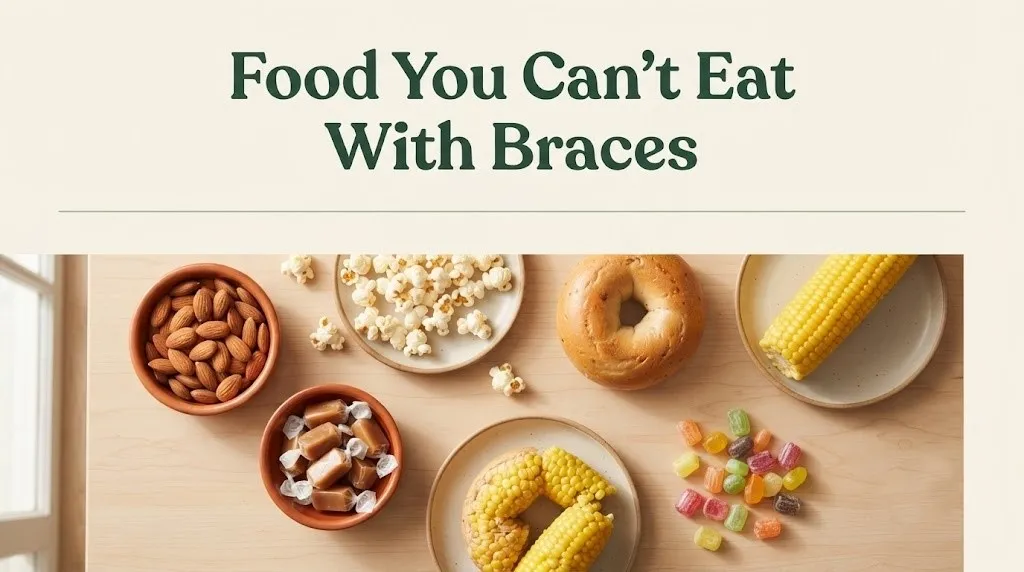
The American Association of Orthodontists notes that hard candy, sticky candy, popcorn, nuts, crunchy raw produce, hard pizza crust, and dense bagels are the most common culprits behind broken appliances. Chewy cuts of meat make the list too, mostly because people tend to tear at them with their front teeth instead of cutting bite-sized pieces first.
Not every food on a “don’t eat” list has to disappear from your diet for the entire treatment. Many can be modified, cooked, or cut differently and still make it back onto your plate safely.
Quick Tip:
- If a food requires a hard front-tooth bite, cut it into small pieces first.
- If a food is sticky at room temperature, it’s sticky in your mouth too. Skip it.
- When in doubt, ask if the food is hard, chewy, sticky, or acidic. Any yes means proceed with caution.
Key Takeaway: Food doesn’t damage braces because it’s unhealthy or indulgent, it damages braces because of texture, and texture is something you can usually work around with smart prep.
What Food to Avoid With Braces
The full list of food to avoid with braces breaks down into five texture groups: hard, sticky, chewy, sugary, and acidic. Each group threatens your braces or your teeth in a slightly different way, and knowing which category a food falls into helps you make quick decisions at the grocery store or restaurant table.
Hard foods risk breaking a bracket off the tooth outright. Sticky foods pull at wires and elastics and are difficult to fully remove even with careful brushing. Chewy foods, like dense bread or tough meat, create sustained pressure over many bites rather than one sharp impact, which still adds up to loosened hardware over time.
Sugary foods aren’t a bracket risk in the same mechanical sense, but they matter for a different reason. Braces create more surface area and more nooks where plaque, the sticky bacterial film that forms on teeth, can build up. According to the National Institute of Dental and Craniofacial Research (NIDCR), people in orthodontic treatment face a higher cavity risk specifically because plaque removal is harder around brackets and wires.
Acidic beverages, including regular soda, diet soda, sports drinks, and citrus juice, soften tooth enamel temporarily. That softened enamel is more vulnerable to the extra plaque buildup braces already encourage.
| Food Category | Example Foods | Primary Risk |
|---|---|---|
| Hard | Nuts, hard candy, ice | Cracked or dislodged bracket |
| Sticky | Caramel, taffy, gum | Wire or elastic displacement |
| Chewy | Bagels, tough meat, pizza crust | Sustained bracket stress |
| Sugary | Candy bars, soda, pastries | Cavity risk from trapped plaque |
| Acidic | Soda, sports drinks, citrus juice | Temporary enamel softening |
People managing diabetes should pay particular attention to the sugary food category, since frequent high-sugar snacking affects both blood glucose control and cavity risk simultaneously. Anyone with a tree nut or peanut allergy should already be avoiding the nut category for reasons unrelated to braces, so that overlap is one less adjustment to make.
Hard Foods to Avoid With Braces
Hard foods are the single most common cause of broken orthodontic brackets, because a sharp, sudden bite force exceeds what the bonding adhesive can hold. Ice is one of the biggest offenders precisely because people don’t think of it as a solid food. Chewing on ice cubes, even absentmindedly while finishing a drink, is a leading cause of emergency orthodontic repair visits.
Nuts fall into the same category. Almonds, walnuts, peanuts, and cashews are all dense enough that biting straight down can shear a bracket off the enamel surface. Hard candy behaves similarly, and the risk doesn’t disappear just because you’re sucking on it slowly. Accidentally biting down, which happens more often than people expect, can crack a bracket in an instant.
Whole raw fruits and vegetables that require a hard front-tooth bite, like a whole apple or a carrot eaten straight from the bag, belong in this group too. The fruit or vegetable itself isn’t the problem. The way it’s normally eaten is.
Key points to remember include:
- Ice should stay in your drink, not in your mouth.
- Whole nuts should be skipped entirely or eaten only if crushed into a soft food like oatmeal.
- Hard candy and lollipops carry real bite-down risk even when you think you’re being careful.
- Whole apples and raw carrots need to be cut into thin, bite-sized pieces rather than bitten directly.
According to the American Dental Association, patients wearing fixed orthodontic appliances are advised to avoid biting directly into hard foods with their front teeth for the full duration of active treatment, not just the first few weeks. This applies to both traditional metal brackets and ceramic brackets, since ceramic brackets can actually be more prone to chipping under sharp impact than metal ones.
Sticky and Chewy Foods to Avoid With Braces
Sticky and chewy foods are dangerous for braces because they cling to brackets and wires long after you’ve swallowed, pulling at the hardware with every subsequent bite. Caramel, taffy, and gummy candy are the classic examples. Their low melting point means they soften with body heat and mold directly around wires and elastic ligatures.
Chewing gum deserves its own mention, including sugar-free varieties. Gum wraps around the archwire as you chew, and pulling it free can bend the wire out of the precise shape your orthodontist set. Once a wire loses its shape, it stops applying the intended pressure to your teeth, which can slow your treatment progress.
Dense, chewy breads like bagels and thick pizza crust apply a different kind of stress. Instead of one sharp impact, they create repeated, sustained pulling force on brackets over dozens of chews. That sustained pull is often what causes a bracket to loosen gradually rather than snap immediately.
- Caramel, taffy, and gummy candies: avoid completely during treatment.
- Chewing gum, including sugar-free gum: skip it, since it wraps the wire regardless of sugar content.
- Bagels and hard rolls: choose soft sandwich bread instead.
- Thick pizza crust: order thin crust or eat only the toppings and softer center.
A study referenced by the Journal of Clinical Pediatric Dentistry found that patients who reported frequent consumption of sticky snacks during orthodontic treatment experienced a measurably higher rate of bracket bond failure compared to patients who avoided them. Anyone following a vegan diet who relies on chewy dried fruit or nut-based candy as a sweet treat will want gel-based or soft fruit alternatives instead during treatment.
Crunchy Foods and Vegetables to Avoid With Braces
Crunchy foods and raw vegetables threaten braces because their brittle structure shatters under bite pressure, sending small hard fragments directly against brackets and wires. Chips, pretzels, and granola clusters are common everyday snacks that fall squarely into this danger zone.
Raw carrots, celery, and broccoli stems carry real nutritional value, offering fiber, vitamin A, and vitamin K, but eating them raw and whole isn’t compatible with braces. The fibrous strands in celery in particular can wrap around wires in a way that’s genuinely difficult to remove without a water flosser or interdental brush.
Corn on the cob is a special case. It’s not the corn itself that’s risky, it’s the motion of biting directly into the cob with your front teeth. Cutting the kernels off before eating removes almost all of the risk while keeping the food itself on the table.
To keep crunchy vegetables in your diet safely:
- Steam or roast raw vegetables at 400°F for about 20 minutes until they’re fork-tender.
- Cut them into pieces no larger than a dice, roughly half an inch.
- Chew using your back molars rather than biting with your front teeth.
- If you prefer them raw, use a food processor to shred vegetables like carrots finely enough that they require no biting force.
- Rinse your mouth with water after eating to clear any small fragments from around brackets.
Quick Fact: The USDA Dietary Guidelines for Americans recommend most adults eat between 2 and 3 cups of vegetables daily, and braces don’t need to interrupt that target. Cooking method is the adjustment, not the vegetable itself. People managing type 2 diabetes should still prioritize non-starchy vegetables like broccoli and cauliflower in cooked form rather than cutting vegetables out of the diet altogether.
Sugary Foods and Drinks to Avoid With Braces
Sugary foods and drinks aren’t a mechanical threat to brackets the way hard or sticky foods are, but they meaningfully raise cavity risk during orthodontic treatment. Braces create dozens of new surfaces and edges where sugar residue and bacteria can hide from a regular toothbrush.
Candy bars, pastries, and sweetened cereal all leave behind a sugar film that feeds the bacteria responsible for producing the acid that erodes enamel. According to the Academy of Nutrition and Dietetics, frequency of sugar exposure matters more than total amount, meaning six small sugary snacks throughout the day are worse for teeth than one larger dessert eaten in a single sitting.
Sugary drinks compound the problem because they coat the entire mouth, including areas around brackets that are already hard to clean. Regular soda, sweetened iced tea, and sports drinks all fall into this category.
Foods and drinks worth limiting or skipping during treatment:
- Candy bars, especially ones containing caramel or nuts
- Sweetened breakfast cereals that leave sugary residue on brackets
- Regular soda and sweetened iced tea
- Sports drinks, which combine sugar with acidity
- Frosted pastries and doughnuts
People managing diabetes benefit from limiting these same foods for blood sugar reasons independent of braces, so the overlap here works in their favor. If you do have something sweet, rinsing with water immediately afterward and brushing within the next hour meaningfully reduces the extra cavity risk that braces introduce.
Key Takeaway: Sugar isn’t a bracket-breaker, it’s a cavity risk multiplier, and the fix is frequency control plus faster cleanup, not total elimination.
Meat and Tough Proteins to Avoid With Braces
Tough cuts of meat and food eaten directly off the bone put sustained pressure on braces that can loosen brackets over repeated bites. Beef jerky is one of the clearest examples, since its dense, dehydrated texture requires prolonged, forceful chewing that stresses both brackets and the wire itself.
Chicken wings and ribs carry a hidden risk too. It’s rarely the meat that causes damage, it’s gnawing directly off the bone, which involves the same front-tooth bite force that damages braces when eating whole apples or corn on the cob.
Pork chops and other thick, fibrous cuts of meat behave similarly if eaten in large pieces. The fix isn’t cutting meat from your diet, since protein remains an important part of any balanced diet during treatment, it’s changing how the meat is prepared and portioned.
| Meat Type | Risk Level With Braces | Safer Preparation |
|---|---|---|
| Beef jerky | High | Avoid, choose soft cooked beef instead |
| Chicken wings on the bone | High | Remove meat from bone before eating |
| Pork chops | Moderate | Slice thin, cook until tender |
| Ground beef or turkey | Low | Safe as prepared |
| Slow-cooked shredded meat | Low | Safe, naturally soft texture |
Braces wearers following halal or kosher dietary practices don’t need to change protein sourcing at all, only preparation and cutting method matter here. Anyone managing a soft or mechanical soft diet after dental surgery should already be familiar with this same slow-cooked, shredded, bite-sized approach to meat.
Bread, Pizza Crust, and Bagels to Avoid With Braces
Dense, chewy bread products like bagels, hard rolls, and thick pizza crust are risky with braces because their chew resistance places sustained pulling force on brackets with every bite. Unlike hard foods that snap a bracket instantly, these breads wear down bracket bonding gradually over repeated meals.
Bagels are particularly dense due to their boiling-then-baking preparation method, which creates a chewy crumb structure that resists breaking down quickly in the mouth. Hard rolls and crusty baguettes share the same problem.
Thick, chewy pizza crust behaves the same way, though this doesn’t mean pizza is entirely off-limits. Thin-crust pizza, or simply eating the softer center of a slice while setting aside the crust edge, keeps this favorite food on the table.
To make bread safer with braces:
- Choose soft sandwich bread, sliced white or whole wheat, over anything crusty.
- Toast bread lightly rather than to a hard, crunchy finish.
- Tear bagels into small pieces rather than biting directly, or switch to a soft roll instead.
- Order pizza with a thin crust and eat with a fork if the crust is thick.
- Avoid crusty baguettes and French bread until treatment is complete.
According to the American Association of Orthodontists, soft tortillas, pitas, pancakes, and muffins are all considered safe braces alternatives that still deliver the carbohydrate and fiber content people look for in grain-based foods. This swap matters for anyone following a plant-based diet who relies on grain products as a core calorie source.
Popcorn and Nuts With Braces
Popcorn and whole nuts are two of the most frequently cited causes of broken brackets, and both share the same underlying problem: small, hard fragments that get trapped or bitten down on unexpectedly. Popcorn’s real danger isn’t the fluffy kernel body, it’s the hard, unpopped hull fragment, technically the pericarp, that frequently lodges beneath the gumline where it’s difficult to remove even with floss.
That trapped hull fragment can cause localized gum inflammation within a day or two if it isn’t cleared out. Nuts pose a more direct mechanical threat, since biting straight down on an almond, cashew, or peanut concentrates a large amount of force onto a small area of a single bracket.
“Hulless” popcorn varieties reduce but don’t eliminate this risk, since even hulless corn still has a smaller, softer hull that can still get trapped.
Things to watch out for:
- Any popcorn variety, including hulless, still carries some hull-fragment risk.
- Whole nuts eaten straight, including trail mix with nuts included, should be avoided.
- Nut butters are generally fine since they contain no hard fragments, though check for added nut pieces.
- Movie theater and microwave popcorn carry the same risk regardless of flavoring.
People with a peanut or tree nut allergy are already avoiding this category, so braces simply reinforce an existing dietary boundary. For everyone else, smooth nut butter remains a reasonable protein and healthy fat source in place of whole nuts during treatment.
Key Takeaway: Popcorn and nuts don’t just risk your braces, they risk trapped debris and gum irritation even when nothing breaks, which is why they top nearly every orthodontist’s avoid list.
Foods to Avoid Right After Getting Braces or an Adjustment
Right after braces are placed or tightened, the safest approach is a fully soft diet for the first two to three days, transitioning to a mechanical soft diet for the remainder of the first week. This period is about comfort as much as appliance safety, since teeth and gums are adjusting to new pressure and can feel tender or sore.
During days one through three, foods that require essentially no chewing work best. Mashed potatoes, yogurt, smoothies, scrambled eggs, and soup fall into this category. This isn’t the time to test how your braces handle a crunchy apple, even a small piece.
By days four through seven, most people can tolerate slightly more texture, including soft pasta, well-cooked vegetables, and flaky fish, as gum tenderness starts to ease. Individual recovery time varies, and some people feel back to normal within two days while others need the full week.
| Timeframe | Recommended Foods | Foods Still to Avoid |
|---|---|---|
| Day 1 to 3 | Yogurt, smoothies, mashed potatoes, soup | Anything requiring chewing |
| Day 4 to 7 | Soft pasta, scrambled eggs, cooked fish | Raw vegetables, chewy bread |
| Week 2 onward | Most regular foods, cut into smaller pieces | Hard, sticky, chewy list categories |
This same soft-to-mechanical-soft progression repeats after every adjustment appointment, though soreness after a tightening is usually milder and shorter than the initial placement. If soreness persists beyond a week or worsens rather than improves, that’s a signal worth mentioning to the orthodontist directly at your next visit, since it falls outside the typical recovery pattern.
Food You Can Eat With Braces
Food you can eat with braces spans nearly every food group, as long as it’s soft, cut into manageable pieces, or cooked until tender. The safe list is genuinely large, which surprises most people expecting a restrictive diet.
Soft fruits like bananas, ripe pears, mangoes, kiwis, and berries require minimal bite force and deliver real nutritional value, including potassium, vitamin C, and dietary fiber. Melons and grapes work the same way. Dairy products, including yogurt, soft cheese, and milk-based puddings, are excellent choices, offering calcium and protein without any chewing resistance.
Cooked grains and proteins round out a solid braces-friendly plate. Rice, soft pasta, scrambled eggs, flaky fish, and shredded cooked chicken all deliver protein and energy without stressing brackets.
Foods that work well throughout treatment include:
- Bananas, melons, grapes, and berries
- Yogurt, soft cheese, milk, and pudding
- Mashed potatoes, rice, and soft pasta
- Scrambled eggs, tofu, and flaky fish
- Smoothies blending fruit, yogurt, and vegetables
- Steamed or roasted vegetables
According to the USDA Dietary Guidelines for Americans, a balanced plate built around fruits, vegetables, whole grains, and lean protein is achievable within braces restrictions with only minor preparation changes. Someone following a gluten-free diet can substitute rice, quinoa, or gluten-free pasta in place of standard wheat pasta with no additional adjustment needed for braces specifically.
How to Modify Risky Foods to Make Them Braces-Safe
Most foods on the “avoid” list can be modified through cutting, cooking, or portion changes rather than eliminated outright. The technique depends entirely on which risk category the food falls into.
For hard raw produce like apples or carrots, cutting into small, thin pieces removes the need for a direct front-tooth bite, which is the actual source of risk rather than the food itself. For fibrous or tough meat, slow cooking until it shreds easily with a fork accomplishes the same goal.
For chewy bread, toasting lightly rather than to a hard crisp, or choosing a softer variety in the first place, reduces sustained pulling force on brackets. For crunchy vegetables, steaming or roasting until fork-tender changes the texture enough to make them fully safe.
To modify a risky food into a braces-safe version:
- Identify which category the food falls into: hard, sticky, chewy, or requiring a direct bite.
- For hard produce, cut into pieces no larger than a half inch before eating.
- For tough meat, cook low and slow until it shreds, generally 2 to 3 hours at 300°F for tougher cuts.
- For crunchy vegetables, steam for 8 to 10 minutes until tender with a fork.
- Chew all modified foods with back molars, not front teeth, to reduce direct bracket pressure.
Quick Tip:
- A food processor turns raw carrots into a safe, shreddable texture in seconds.
- A slow cooker turns tough cuts of meat into braces-safe protein without extra effort.
- When traveling or eating out, ask for dishes to be prepared well-done or extra tender rather than avoiding the dish entirely.
This approach matters most for people who don’t want their diet to shrink dramatically during a treatment period that can last well over a year. Modification, not elimination, keeps meals varied and nutritionally complete.
What Happens If You Eat the Wrong Food With Braces
Eating the wrong food with braces typically results in one of three outcomes: a loosened or detached bracket, a bent or displaced wire, or trapped food debris that raises cavity and gum inflammation risk. None of these are usually medical emergencies, but all three can affect your treatment timeline.
A detached bracket means the tooth it was attached to is no longer receiving the intended pressure from the archwire. Left unaddressed for too long, that tooth can drift out of the position your orthodontist is working to achieve, which sometimes requires extending treatment to correct.
A bent wire changes the force distribution across your entire mouth, not just one tooth, since the archwire threads through every bracket in sequence. This is why even a minor wire displacement is usually addressed at the next available appointment rather than left until your regularly scheduled visit.
According to the American Association of Orthodontists, patients who experience a broken bracket or dislodged wire should contact their orthodontist promptly rather than waiting, since prolonged delay increases the chance of the issue affecting tooth movement.
Warning signs worth watching for include:
- A bracket that feels loose or has visibly detached from the tooth
- A wire poking or irritating the inside of the cheek or gum
- Persistent pain in one specific tooth rather than general soreness
- Visible food debris that won’t clear with normal brushing and flossing
If a wire is poking uncomfortably before you can reach your orthodontist, covering the area with orthodontic wax, a soft dental wax provided at your first appointment, offers temporary relief without altering the hardware yourself.
Foods and Drinks That Stain or Damage Braces
Certain foods and drinks discolor the elastic ligatures around brackets or contribute to enamel staining that becomes visible once braces come off. This is a cosmetic concern rather than a structural one, but it matters to a lot of people investing a year or more into a straighter smile.
Coffee, tea, dark sodas, and red wine are common staining culprits, particularly around the clear elastic ties used with ceramic or clear brackets. Curry-based dishes, tomato sauce, and berries with deep pigment, like blueberries and blackberries, can stain in the same way over time.
Elastic ligatures are typically replaced at each adjustment appointment, roughly every 4 to 8 weeks, which limits how much staining accumulates on the elastics themselves. Enamel staining is a separate, longer-term concern that builds gradually across the full treatment period.
Foods and drinks that commonly contribute to staining:
- Coffee and black tea
- Red wine and dark sodas
- Tomato-based sauces and curry dishes
- Deeply pigmented berries like blueberries
Rinsing with water immediately after consuming any of these, and brushing within the same hour when possible, meaningfully reduces the staining effect without requiring you to eliminate these foods and drinks entirely. Using a straw for dark beverages also limits direct contact with front teeth and visible brackets.
Braces-Friendly Meal and Snack Ideas
Braces-friendly meals and snacks can cover every meal of the day without repeating the same handful of soft foods on rotation. Breakfast options like Greek yogurt with soft berries, scrambled eggs, oatmeal, and smoothies deliver protein, fiber, and calcium without any chewing resistance.
Lunch and dinner work well built around soft grains, tender protein, and cooked vegetables. Think soft pasta with marinara, rice bowls with shredded chicken and steamed vegetables, or a baked fish fillet with mashed sweet potato.
Snacks are often where people struggle most, since many popular grab-and-go snacks, like chips, granola bars, and trail mix, fall into the avoid category. Soft cheese, hummus with soft pita, and sliced soft fruit fill that gap without sacrificing satisfaction between meals.
| Meal | Braces-Safe Option | Key Nutrients |
|---|---|---|
| Breakfast | Greek yogurt with soft berries | Protein, calcium, vitamin C |
| Lunch | Rice bowl with shredded chicken and steamed veggies | Protein, fiber, vitamin A |
| Dinner | Baked fish with mashed sweet potato | Protein, potassium, vitamin A |
| Snack | Hummus with soft pita | Plant protein, fiber |
To build a braces-friendly snack:
- Choose a base that’s naturally soft, like hummus, yogurt, or soft cheese.
- Pair it with a soft dipper such as pita, crackers softened by the dip, or sliced soft fruit.
- Avoid pairing with raw vegetables unless finely shredded or steamed first.
- Keep portions small enough to eat without needing a hard front-tooth bite.
Key Takeaway: A varied, satisfying diet with braces comes down to swapping textures, not swapping food groups, so nothing on your usual grocery list has to disappear for good.
Frequently Asked Questions About Food You Can’t Eat With Braces
Can I eat pizza with braces?
Yes, as long as you choose a thin crust or eat the softer center of the slice.
Thick, chewy crust puts sustained pressure on brackets and is best avoided or eaten with a fork.
Cutting your slice into smaller pieces also reduces the front-tooth biting that causes most bracket problems.
How long do I have to avoid hard food after getting braces?
Most people need a fully soft diet for the first two to three days after getting braces placed.
A mechanical soft diet, with foods cut into small pieces, is generally recommended through the rest of the first week.
Individual recovery time varies, so confirm with your orthodontist if soreness lasts noticeably longer than a week.
Is popcorn really that bad for braces?
Yes, popcorn is one of the most common causes of trapped food debris and broken brackets during orthodontic treatment.
The hard hull fragment can lodge under the gumline and is difficult to remove even with flossing.
Both regular and hulless popcorn carry this risk, so it’s best avoided entirely during treatment.
Can you chew gum with braces?
Chewing gum, including sugar-free varieties, is generally not recommended with braces.
Gum wraps around the archwire as you chew, and removing it can bend the wire out of its intended shape.
A bent wire changes how pressure is applied across all your teeth, not just one area.
What should I eat the first few days after getting braces tightened?
Soft foods like yogurt, mashed potatoes, smoothies, and soup work best in the first two to three days after a tightening.
Teeth and gums are more sensitive to pressure during this window, so minimal chewing keeps you comfortable.
Most people can return to slightly firmer foods, like soft pasta or cooked vegetables, by the end of the first week.
Your braces don’t need to shrink your diet, they just need you to think about texture before you take a bite. Cut hard produce small, skip anything sticky or chewy, and lean on soft proteins and cooked vegetables when your mouth feels sensitive.
Keep a running mental list of your personal trouble foods, since everyone’s mouth reacts a little differently to specific textures. When something doesn’t feel right after a meal, a quick call to your orthodontist beats waiting it out and risking a longer treatment.
Treat the avoid list as a temporary adjustment, not a permanent loss. Most of your favorite meals are still on the table, just prepared a little differently for now.