Most adult dogs need roughly 2 to 3 percent of their ideal body weight in homemade food per day, split across two meals. This is your starting point. You will adjust from here based on your dog’s body condition and activity level.
The Association of American Feed Control Officials (AAFCO) sets nutrient profiles for commercial diets, but home kitchens lack that standardization. Your 2 percent starting rule is safe only if the recipe is complete and balanced. A lean chicken and rice batch has far fewer calories per cup than a beef and potato stew.
We will walk you through the weight chart, the ounce calculations, and the visual body check you need to do every week. You will also learn why a gram scale matters more than a measuring cup and how to tell if you are accidentally feeding too many table scraps alongside that beautiful home-cooked meal.
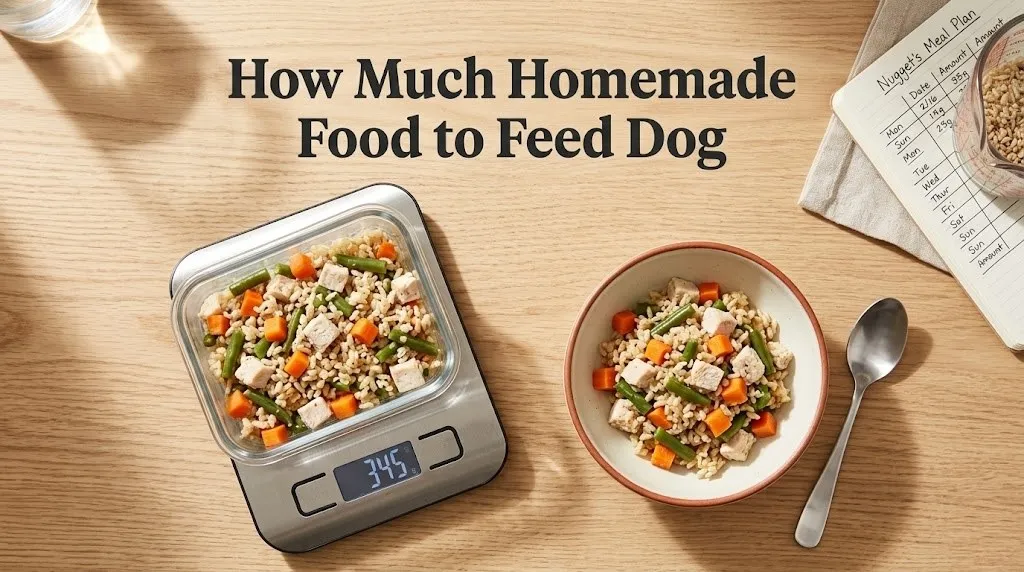
How Much Homemade Food to Feed Dog
The amount of homemade food a dog needs each day is based on their resting energy requirement, not just their weight. A 50-pound adult dog with a normal activity level typically needs about 1,000 to 1,200 calories per day from a balanced homemade diet.
This calorie target translates into physical food volume. The exact volume shifts depending on your recipe. A diet heavy in lean poultry and vegetables contains more water and fewer calories per spoonful. A recipe with fatty ground beef, oils, and dense starches packs more energy into the same physical space.
Veterinary nutritionists at the American College of Veterinary Nutrition (ACVN) recommend starting with a baseline of 25 to 30 calories per pound of ideal body weight for a healthy adult dog. For the 50-pound dog at 25 calories per pound, that is 1,250 calories. You then divide that number by the calories per cup of your specific homemade batch.
| Dog’s Ideal Weight | Approx. Daily Calories (Adult, Active) | Approx. Food per Day (Medium-Density Recipe) |
|---|---|---|
| 10 lbs | 250 to 300 kcal | 1/2 to 3/4 cup |
| 25 lbs | 550 to 650 kcal | 1.5 to 2 cups |
| 50 lbs | 1,000 to 1,200 kcal | 2.5 to 3 cups |
| 75 lbs | 1,300 to 1,600 kcal | 3.5 to 4 cups |
| 100 lbs | 1,700 to 2,000 kcal | 4.5 to 5 cups |
How Much Homemade Dog Food to Feed My Dog
Start with 2 percent of your specific dog’s target body weight in food weight. For a 40-pound dog, that equals 0.8 pounds of food, or about 12.8 ounces, spread across the day. Weigh the total daily portion on a kitchen scale.
The 2 percent rule is a maintenance baseline. It covers a neutered or spayed adult with light to moderate daily exercise. This is not a weight loss formula or a puppy growth formula. Treat it as day one of a 14-day observation period where you track your dog’s physical response to the new volume.
Your dog’s metabolism, breed, and even coat thickness affect their actual burn rate. A lean, shorthaired Vizsla living in a cold climate may burn more calories than a thick-coated Labrador in an air-conditioned house. Watch the dog, not just the math. Adjust the weight of the food up or down by 10 percent increments after you assess body condition at the end of two weeks.
Key Takeaway: The 2 percent rule is a safe launch point, but the food scale and a weekly rib-check are your real portioning tools.
How Much Homemade Dog Food Per Day
Adult dogs eat between 2 and 3 percent of their body weight in total daily food. Senior dogs, being less active, often maintain lean mass on 1.5 to 2 percent. Puppies, because they are building bone and tissue, may require 4 to 6 percent of their body weight spread over three to four feedings.
The daily percentage is a total food weight calculation. A 60-pound adult dog at 2.5 percent needs 1.5 pounds of food total for the day. Weigh the food in the morning and divide it into two equal sealed containers. This prevents the “eyeballing” error that creeps in when you are late for work and scoop directly into the bowl.
Very active working dogs or canine athletes can push past 3 percent. A Border Collie herding sheep for hours may need 4 percent or more just to hold weight. These dogs burn through glycogen and fat reserves rapidly. Their daily portion must account for the physical output, not just the number on the scale.
How Many Cups of Homemade Dog Food Per Day
Cups are the least accurate way to measure homemade dog food. A standard measuring cup of a dense, meat-heavy stew can contain 400 to 500 calories. That same cup filled with a vegetable and broth-heavy soup might contain 200 calories. Your dog’s caloric needs do not change just because you scooped a fluffier batch.
If you must use cups as a rough shorthand, one tightly packed level cup of a typical meat, grain, and vegetable mix weighs roughly 7 to 8 ounces. A 25-pound dog needing 12 to 13 ounces per day would receive just under 2 tightly packed cups. A 50-pound dog needing 20 ounces receives roughly 3 packed cups.
The difference between a “loose scoop” and a “packed scoop” in the same recipe can be 20 percent of the daily calories. That error margin over months is the difference between a healthy weight and clinical obesity. Buy a digital kitchen scale. They cost less than a bag of dog food and prevent a lifetime of portion drift.
- 1 loose, unpacked cup of homemade food: approximately 5 to 6 ounces.
- 1 tightly packed cup of homemade food: approximately 7 to 8 ounces.
- Daily error using loose cups alone: up to 150 calories of unintended overfeeding for a medium dog.
How Many Ounces of Homemade Dog Food to Feed
Using a kitchen scale to measure ounces removes the guesswork. A 10-pound dog requires 4 to 5 ounces of prepared homemade food per day. A 50-pound dog needs 16 to 20 ounces daily. A 90-pound dog climbs to 26 to 32 ounces.
These ounce ranges assume a standard caloric density of roughly 40 to 50 calories per ounce. Your actual recipe must be checked against this assumption. A lean turkey and quinoa mix lands near 40 calories per ounce. A beef, lentil, and coconut oil mix can hit 65 calories per ounce. Feeding the same 20 ounces of both recipes delivers either 800 or 1,300 calories.
Weigh the finished batch after cooking and calculate your total recipe calories. Divide total calories by total ounces. That number, the calories per ounce, is your personal multiplier. Write it on a piece of tape and stick it to the storage container in the refrigerator. This transforms every meal prep into a precise, anxiety-free scoop session.
Key Takeaway: Calories per ounce is the single most important number in your homemade dog food system; calculate it once per batch and use it daily.
How Much Homemade Food Should I Feed My Dog Chart
A feeding chart translates weight ranges into daily homemade food portions based on the standard 2 to 3 percent guideline. This chart uses ounces, the only measurement that remains consistent across all recipe densities when you know your batch’s calorie count.
| Dog’s Body Weight | Food at 2% Maintenance (oz/day) | Food at 3% Active (oz/day) | Approx. Cups (Packed) |
|---|---|---|---|
| 5 lbs | 1.6 oz | 2.4 oz | 1/4 cup |
| 15 lbs | 4.8 oz | 7.2 oz | 3/4 to 1 cup |
| 30 lbs | 9.6 oz | 14.4 oz | 1.5 to 2 cups |
| 45 lbs | 14.4 oz | 21.6 oz | 2 to 3 cups |
| 60 lbs | 19.2 oz | 28.8 oz | 3 to 4 cups |
| 80 lbs | 25.6 oz | 38.4 oz | 4 to 5.5 cups |
| 100 lbs | 32.0 oz | 48.0 oz | 5 to 6.5 cups |
This chart is for a food density of roughly 1.3 calories per gram or 37 calories per ounce. If your recipe is richer, feed the lower end of the range. If it is leaner, feed the higher end. Puppies and pregnant or nursing dogs can require double these amounts and should be managed with a board-certified veterinary nutritionist involved in the recipe formulation.
How Much Should I Feed My Dog Homemade Food
Feed based on the dog’s ideal body weight, not their current weight. A Labrador who should weigh 70 pounds but currently weighs 85 needs portions calculated for a 70-pound dog. Using the 85-pound number keeps them in an energy surplus they do not need.
Divide the total daily portion into two meals for adult dogs. Feeding once daily with a large homemade meal can increase the risk of bloat in deep-chested breeds like Great Danes and Standard Poodles. Puppies under six months should eat three to four times per day to support stable blood sugar and digestion.
This section applies to adult maintenance. A dog recovering from illness, surgery, or malnutrition needs a different caloric multiplier. The World Small Animal Veterinary Association (WSAVA) notes that sick or recovering animals may need energy intake increased by 20 to 50 percent temporarily. This is a short-term adjustment you make with direct veterinary guidance, not a permanent chart number.
How Much to Feed Homemade Dog Food
Treats, dental chews, and training rewards all subtract from the daily homemade food budget. An active training session with high-value treats can easily add 100 to 150 calories to a small dog’s day. That is 30 percent of their total allowance.
Measure the full daily portion of homemade food in the morning. Remove a small amount, roughly 10 percent by weight, and set it aside in a pouch. Use that reserved portion as training rewards throughout the day instead of separate processed treats. This keeps the calorie budget airtight and reinforces the bond without silently expanding the dog’s waistline.
If you use processed treats separately, reduce the main meal portion by the treat calorie equivalent. A single large milk bone can contain 60 to 80 calories. For a 10-pound dog on a 250-calorie diet, two milk bones represent over half the daily energy requirement before a single spoonful of breakfast hits the bowl.
Key Takeaway: The daily calorie budget includes everything that crosses the gums; training treats are the invisible budget-breakers for most homemade feeders.
How Much Homemade Food to Give Dog
The evening meal should match the morning meal exactly in weight. Asymmetric feeding, a small breakfast and large dinner, can create behavioral patterns like pre-dinner anxiety or early morning hunger pukes from an empty stomach overnight. Consistency regulates the dog’s internal clock.
The food amount stays the same on weekends and rest days. Humans eat emotionally, dogs eat biologically. Your dog’s energy expenditure on a lazy Sunday is only slightly lower than a weekday walk day. Drastically cutting food on rest days can trigger a hunger response that leads to counter surfing or coprophagia.
Seasonal shifts matter more than day-to-day laziness. A husky who runs outside all winter may genuinely need an extra 15 percent calories in January compared to July. A city dog who refuses to walk in August heat burns fewer calories. Watch the ribs, not the calendar. The ribs tell you exactly how much homemade food to give today.
How Much to Feed a Dog Homemade Food
Large-breed puppies require controlled growth, not maximum growth. Feeding a Great Dane puppy too much homemade food, especially rich in calcium and calories, can accelerate skeletal growth and contribute to developmental orthopedic disease. Portions must be calibrated for slow, steady growth, not a pudgy puppy belly.
Small-breed dogs have higher metabolic rates per pound. A 5-pound Chihuahua may need 40 to 50 calories per pound, while a 100-pound Mastiff needs 20 calories per pound. The smaller the dog, the higher the energy density per ounce of body weight. Homemade portions for tiny dogs look almost comically small but are calorically appropriate.
Intact dogs, those not spayed or neutered, often have 10 to 15 percent higher energy requirements due to hormonal and muscle mass differences. Show dogs, breeding bitches, and active intact males commonly sit at the 3 percent or higher body weight range while maintaining lean body condition. The same recipe fed to a neutered male must be portioned down to prevent silent weight gain.
How to Portion Homemade Dog Food
Portioning starts with a digital gram scale, not a cup. Weigh the entire batch after cooking in grams. Divide the total grams by the number of days the batch is meant to last. Write that number down. Use it every meal.
To portion homemade dog food accurately:
- Prepare the recipe and allow it to cool completely to room temperature.
- Place a large, clean container on a gram scale and tare the weight to zero.
- Transfer all prepared food into the container and record the total weight in grams.
- Divide the total grams by the number of meals the batch provides.
- Scoop each meal portion into individual, reusable containers by weight, not by sight.
Batch freezing locks in precision. Buy a set of identical small containers. Portion seven days of meals in one session. Stack them in the freezer. Pull one container to thaw in the refrigerator overnight for the next day’s meals. This system removes the daily scooping variability and makes it impossible for a tired, generous hand to overfeed.
How Much Human Food to Feed a Dog
Human food fed as table scraps must stay under 10 percent of the dog’s total daily calorie intake. The remaining 90 percent must come from a complete and balanced core diet. Breaking this rule for more than a few days risks deficiencies in calcium, phosphorus, zinc, or essential fatty acids.
A single unseasoned scrambled egg is roughly 70 to 90 calories. For a 20-pound dog, that egg represents 20 to 25 percent of their daily energy. That is a meal skip, not a topper. Skinless, boneless, boiled chicken breast added as a treat is healthier than processed bacon, but the calorie math remains the same. Count it.
Foods toxic to dogs must be excluded from any sharing. Onions, garlic, grapes, raisins, macadamia nuts, and anything sweetened with xylitol cannot enter the treat rotation. The safe list includes plain, cooked lean meats, steamed green beans, carrot sticks, and small amounts of plain pumpkin puree. Even these safe foods count against the daily calorie budget.
| Safe Human Food Topper | Approx. Calories |
|---|---|
| 1 scrambled egg (no oil) | 70 to 90 kcal |
| 1/4 cup boiled chicken breast | 50 to 60 kcal |
| 1/4 cup steamed green beans | 10 to 15 kcal |
| 1 tbsp plain pumpkin puree | 5 to 10 kcal |
Key Takeaway: “Just a little snack” from the dinner table can erase 30 percent of a small dog’s daily calorie allowance; measure the scraps too.
How Much Home Cooked Dog Food to Feed
Home cooked dog food, prepared through gentle simmering or baking, often retains more water than raw or freeze-dried alternatives. This high moisture content means you are feeding a heavier, less calorie-dense product by volume. A half-pound of cooked stew looks larger in the bowl than a half-pound of dehydrated raw.
The cooking method changes the fat content of the final meal. Draining the fat from browned ground beef removes roughly 50 calories per ounce of drained fat. Skimming the surface of a stew removes pure energy. If the recipe says “do not drain,” leaving the fat in could shift your batch from 40 calories per ounce to 55 or higher.
Cooked grains like brown rice or quinoa absorb water and swell dramatically. One cup of dry rice becomes three cups of cooked rice. The recipe’s final weight includes all that water. This is why you must weigh the finished batch, not the raw ingredients. Home cooked batches often surprise owners by yielding a higher total weight that looks like “more food” but is simply more water.
How Much Homemade Food Should a Dog Eat
The amount a dog should eat is the amount that maintains a 4 out of 9 body condition score. You cannot see the ribs, but you can feel them easily with flat fingers under a thin layer of fat. The waist tucks up when viewed from above. The abdomen tucks up from the side.
A dog eating the correct amount produces firm, formed, chocolate-brown stools. Chronic loose stools on a homemade diet often signal too much fat in the recipe or too large a portion size overwhelming the pancreas. Hard, crumbly, white-chalk stools may indicate too much bone meal or calcium supplementation. The stool is a daily feedback loop.
Weight changes happen slowly. A safe loss rate is 1 to 2 percent of body weight per week for an overweight dog. A safe gain rate for an underweight dog is similar. Weigh your dog every two weeks on the same scale. Take a photo from above and from the side. If the waist is disappearing, reduce the total daily ounces by 10 percent and recheck in two weeks.
How Much Homemade Dog Food to Feed Your Dog
Your dog is an individual, not a chart. The final volume number lives at the intersection of your specific recipe’s caloric density and your specific dog’s metabolic fingerprint. A 50-pound Border Collie and a 50-pound Bulldog have different energy outputs.
Commit to a four-week hand-feeding trial if you are new to this. Measure the exact starting portion based on the 2 percent rule. Feed nothing else. Weigh your dog at the start. Do not change the portion for 14 days. At day 14, evaluate the body condition score. Adjust up or down by 10 percent. Wait another 14 days. This controlled method isolates the food variable.
A board-certified veterinary nutritionist is the ideal partner for long-term homemade feeding. General-practice veterinarians can assess body condition and run blood work. The nutritionist formulates the recipe to meet AAFCO standards, factoring in your dog’s breed-specific risks, age, and current health markers. This investment upfront prevents nutritional deficiencies that take months or years to appear as chronic disease.
Frequently Asked Questions About Homemade Dog Food Portions
How do I calculate how much homemade food to feed my dog?
Multiply your dog’s ideal body weight in pounds by 16 to convert to ounces, then multiply by 0.02 to 0.03 for the 2 to 3 percent range.
Weigh that final daily ounce amount on a gram scale and split it into two meals.
This is your baseline, which you adjust every two weeks based on body condition.
Can I feed my dog a mix of kibble and homemade food?
Yes, mixing kibble and homemade food is common, but the calorie math gets complicated quickly.
Determine the calories in each food separately, then add them together to hit the daily target without exceeding it.
Uneven mixing can unbalance the overall nutrient profile over time, so a consistent ratio matters.
Why is my dog still hungry after eating homemade food?
Fresh food digests faster than dry extruded kibble, sometimes creating a hunger sensation an hour or two after eating.
Splitting the daily portion into three smaller meals rather than two can solve this behavioral hunger.
A quarter cup of steamed, fibrous green beans added to the meal can also increase gastric stretch and satiety without adding calories.
What happens if I overfeed my dog homemade food?
Overfeeding homemade food causes weight gain at a rate of roughly 1 to 2 pounds per month on a small daily calorie surplus.
The extra body fat stresses joints, organs, and shortens lifespan.
Reducing the daily portion by 10 to 15 percent and increasing low-impact exercise brings the dog back to target weight safely.
How do I adjust portions if my dog gains weight on a homemade diet?
Cut the total daily portion by 10 percent by weight and hold that new amount for two weeks.
Reassess the body condition score at the end of that period.
If weight gain continues, cut another 10 percent and schedule a vet visit to rule out hypothyroidism or other metabolic conditions.
The two percent rule gets you in the game. The body condition score keeps you there. Your dog’s ribs, waistline, and energy levels are truer measures than any chart or calculator. Trust what you see and feel over what you assume the recipe “should” yield.
Buy the gram scale. Weigh the food. Write the calories per ounce on the container. Those three actions separate dogs who thrive on homemade diets from those who silently slide into obesity or malnutrition.
You are doing something most dog owners never attempt. The precision is not paranoia. It is love translated into measured scoops and a dog who runs lean, bright-eyed, and ready for another decade of adventures.