Wet cat food should not sit out for more than 1 to 2 hours at room temperature before you discard it. That window tightens further during summer heat or in warm kitchens, where bacterial growth can make the food unsafe in under an hour.
Food safety for pets matters more than many owners realize. The U.S. Food and Drug Administration (FDA) regulates pet food under the Federal Food, Drug, and Cosmetic Act, holding cat food to the same spoilage and contamination standards applied to human food. Bacteria that colonize spoiled wet food can cause serious gastrointestinal illness in cats, and the risks are not trivial.
This guide covers the science behind that time limit, how temperature and environment shift it, what spoilage actually looks like, how to store leftovers correctly, and which cats face the greatest risk. If you have a kitten, a senior cat, or an animal with a health condition, the guidance here is especially worth reading carefully.
How Long Can Wet Cat Food Sit Out?
Wet cat food can sit out safely for no longer than 1 to 2 hours at a typical indoor room temperature of around 68 to 72°F (20 to 22°C). Beyond that window, bacterial populations reach levels that make the food genuinely unsafe.
The USDA Food Safety and Inspection Service (FSIS) identifies the temperature range between 40°F and 140°F (4°C and 60°C) as the “danger zone” for perishable food. Within this range, harmful bacteria can double their population every 20 minutes under ideal conditions. Wet cat food, with its high moisture content (typically 70 to 80% water) and rich protein base, is a near-perfect bacterial growth medium.
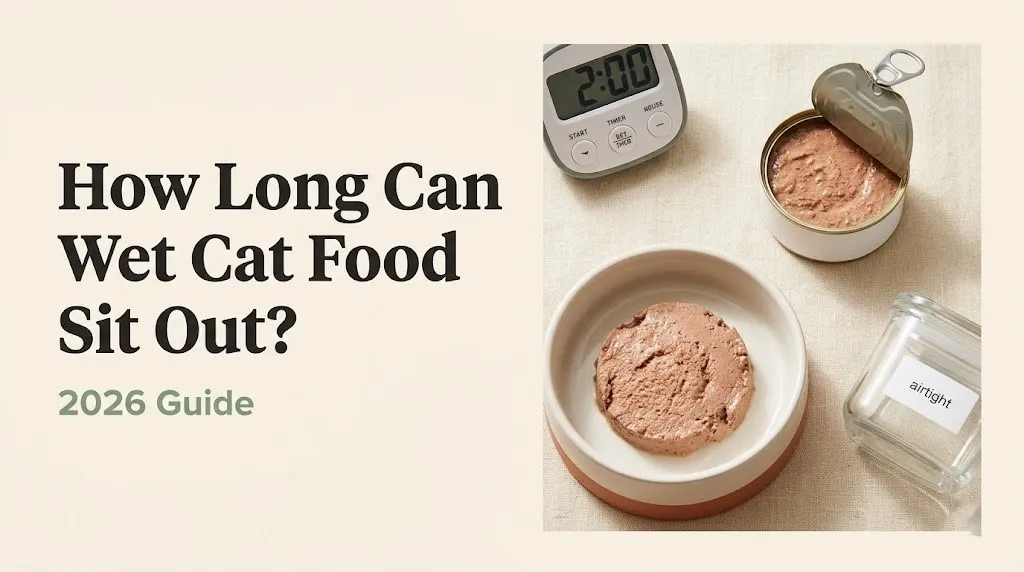
Most veterinary nutrition guidelines align with the 1 to 2 hour standard as a practical, conservative threshold for wet food left at room temperature. This is not a guideline you want to test casually. Think of it like a bowl of moist, protein-rich stew left on the counter. You would not eat that yourself after three hours. Your cat’s digestive system, while adapted to a meat-based diet, is not immune to the pathogens that flourish in spoiled food.
Cats are obligate carnivores, meaning their entire metabolic system is built around animal protein. That same protein-dense, moisture-rich food that fuels them also spoils faster than dry food. The equation is simple: wet food + warmth + time = bacteria.
| Room Temperature | Safe Time Window for Wet Cat Food |
|---|---|
| Below 40°F (4°C) | Food is refrigerated; not applicable |
| 40 to 68°F (4 to 20°C) | Up to 2 hours |
| 68 to 72°F (20 to 22°C) | 1 to 2 hours |
| 72 to 85°F (22 to 29°C) | 30 to 60 minutes |
| Above 85°F (29°C) | 30 minutes or less |
How Long Can You Leave Wet Cat Food Out?
You can leave wet cat food out for up to 2 hours maximum under standard indoor conditions, and less if your kitchen or feeding area is warm. This applies whether it is an opened canned product or a freshly pouch-served meal.
Many cat owners practice free-feeding, leaving food available throughout the day so the cat grazes at will. Free-feeding works reasonably well with dry kibble. With wet food, it creates a food safety problem. Serving a fresh small portion every few hours is a far better approach than leaving a full bowl out all morning.
Some owners assume their cat’s strong smell aversion will protect them, reasoning that a cat will walk away from food that has gone off. This is partly true. Cats do have sensitive noses and often refuse obviously rancid food. But bacterial contamination serious enough to cause illness can build up before the food smells or looks noticeably different. Relying on your cat to self-screen is not a reliable safety strategy.
Portion size matters here, too. A cat that eats quickly from a small portion leaves less food exposed to air and warmth than one that picks slowly at a large bowl. Adjust your serving size to what your cat will finish within about 20 to 30 minutes.
Quick Tip:
- Serve small portions your cat will finish quickly, rather than a large bowl left out for hours.
- Use a clean bowl every time. Residue from a previous serving accelerates bacterial contamination.
- In summer, reduce the serving window to 30 minutes, not two hours.
Can I Leave Wet Cat Food Out Overnight?
No. Leaving wet cat food out overnight is not safe, and you should discard any food that has sat out for more than 2 hours, regardless of whether your cat has finished it.
Overnight periods typically span 8 to 12 hours. During that time, even in a cool kitchen, bacterial populations in wet food can multiply to unsafe levels. Pathogens including Salmonella, Staphylococcus aureus, and Listeria monocytogenes can colonize moist, protein-rich food well within that window. According to CDC food safety data, Salmonella is one of the most common causes of foodborne illness in domestic animals, and contaminated pet food is a documented transmission route.
If your cat is a nighttime grazer and you want to leave something available, dry kibble is a more appropriate overnight option. It has a much lower moisture content and spoils far more slowly than wet food.
Do not refrigerate and rewarm the same batch of wet food multiple times overnight. Each refrigeration and warming cycle increases the risk of temperature abuse and uneven heating, both of which create conditions where bacteria can survive and thrive.
If your cat has specific overnight feeding needs due to a medical condition or feeding schedule prescribed by a veterinarian, discuss food safety logistics directly with that vet. They can advise on timed feeders, appropriate food types, and safe portion management based on your cat’s specific health profile.
| Overnight Scenario | Safe? | What to Do Instead |
|---|---|---|
| Wet food left out 8 to 12 hours | Not safe | Discard; serve dry kibble overnight |
| Refrigerated wet food served at midnight | Safe if refrigerated under 4 hours | Warm gently and serve fresh |
| Small dry food portion left overnight | Generally safe | Use this for nighttime grazing |
| Timed feeder with wet food pre-loaded | Only if served within 1 to 2 hours | Use auto feeder with small portions |
Does Wet Cat Food Go Bad If Left Out?
Yes. Wet cat food begins to degrade the moment it is exposed to air, and bacterial contamination accelerates rapidly at room temperature. “Going bad” is not just a texture or smell change; it is an active microbial process.
There are two overlapping processes at work. The first is oxidation, where the fats and proteins in the food react with oxygen in the air, causing the surface to dry, discolor, and develop off-aromas. The second, more dangerous process is bacterial proliferation, where microorganisms already present in the food or environment multiply on the moist surface.
Oxidation is mostly an unpleasantness issue. Your cat may refuse oxidized food, and you will notice it looks darker or drier at the edges. Bacterial contamination is the genuine safety concern. It is invisible at first and progresses rapidly in the temperature danger zone.
Preservative-free and natural wet cat food formulas, while often higher quality from a nutritional standpoint, reach unsafe bacterial levels faster than formulas containing approved preservatives. If you feed a preservative-free product, the 1-hour window is a smarter limit than the full 2 hours.
The Association of American Feed Control Officials (AAFCO), which sets nutritional standards for commercial pet food in the United States, does not regulate post-serving shelf life. That responsibility falls to the owner. There is no label on a can that tells you the food is still safe after 90 minutes on your kitchen floor.
Key Takeaway: Wet cat food starts spoiling from the moment it hits the bowl. The 1 to 2 hour rule exists because of measurable bacterial growth science, not guesswork. Environment, formula type, and your cat’s health all determine exactly where in that window the risk becomes real.
Wet Cat Food Temperature Danger Zone
The temperature danger zone for wet cat food is 40°F to 140°F (4°C to 60°C), which is the same danger zone the USDA applies to human perishable food. Within this range, spoilage bacteria multiply at rates fast enough to make food unsafe within hours.
At the lower end of the danger zone (just above refrigerator temperature), bacterial growth is slow but not stopped. At room temperature around 70°F (21°C), bacteria can double every 20 minutes under optimal conditions. At above 85°F (29°C), which is common in summer kitchens or outdoor feeding areas, the doubling rate can accelerate further.
Wet cat food is particularly vulnerable because of its composition. High moisture content (water activity) is the single biggest driver of bacterial growth rate in food science. The higher the water activity, the faster bacteria colonize the food. Wet cat food’s 70 to 80% moisture content places it squarely in the high-risk category, comparable to deli meats, cooked chicken, and soft cheeses in terms of spoilage speed.
Understanding this helps you make smarter decisions. A bowl served in a cool, air-conditioned room at 65°F may be marginally safer for closer to 2 hours. The same bowl served in a warm laundry room at 80°F should be pulled at 30 to 45 minutes.
| Temperature Environment | Approximate Safe Window |
|---|---|
| Air-conditioned room (65°F / 18°C) | Up to 2 hours |
| Standard indoor room (70 to 72°F / 21 to 22°C) | 1 to 1.5 hours |
| Warm kitchen (75 to 80°F / 24 to 27°C) | 30 to 60 minutes |
| Hot room or outdoor feeding (above 85°F / 29°C) | Under 30 minutes |
Wet Cat Food in Hot Weather
In hot weather, wet cat food can become unsafe in 30 minutes or less, making warm-season feeding one of the most underappreciated food safety risks for cat owners. Summer kitchens, outdoor feeding stations, and sun-exposed bowls create the fastest possible spoilage conditions.
Direct sunlight accelerates the process beyond just ambient air temperature. A bowl placed in a patch of afternoon sun can reach surface temperatures of 90°F or higher (32°C+) within minutes, even if the room itself is only 75°F. That eliminates any meaningful safe window almost immediately.
For cats fed outdoors during summer months, the practical solution is serving smaller portions more frequently and removing the bowl promptly after feeding. Do not fill a bowl and walk away assuming your cat will return to finish it in two hours. In July heat, that bowl should come inside within 20 to 30 minutes.
Insects are an additional concern in warm-weather outdoor feeding. Flies can contaminate wet food with bacteria and parasites within minutes of landing. This is a genuine health risk that is separate from the bacterial growth concern but compounds it significantly.
If your home runs warm during summer without air conditioning, treat wet cat food the same way you would treat your own cooked food in the same conditions. The CDC notes that even brief periods of improper temperature holding can allow pathogen levels in perishable food to reach illness-causing thresholds.
Quick Tip:
- In summer, serve wet food in a shaded, cool spot and remove the bowl after 20 to 30 minutes.
- Never leave wet food in direct sunlight, even briefly.
- Consider chilled ceramic bowls to slow the temperature rise of fresh food.
Signs Wet Cat Food Has Gone Bad
Wet cat food that has gone bad shows several recognizable signs, though bacterial contamination can be present before any visual or olfactory changes appear. Knowing both the visible signs and the invisible risk is the key.
Visible spoilage signs:
- Surface has dried, darkened, or developed a crusty film
- Color has changed from the original fresh hue (graying, browning, or greening)
- Texture has become slimy or unusually sticky
- Visible mold (rare indoors within the first hours, but possible in humid conditions)
Smell-based spoilage signs:
- Sour, rancid, or fermented odor distinct from the food’s normal smell
- Sharp ammonia-like smell, which signals advanced protein breakdown
Behavioral signs from your cat:
- Sniffing the bowl and walking away without eating
- Eating a small amount and then vomiting shortly after
- Complete refusal of food they normally enjoy
The problem is that none of these signs are guaranteed to appear before dangerous bacterial levels are reached. Staphylococcus aureus, for example, can produce heat-stable toxins in food with no detectable change in appearance, smell, or texture. This is why the time-and-temperature rule is the primary safety tool, not the sniff test.
If the food has been out more than 2 hours, discard it regardless of how it looks or smells. When in doubt, throw it out. That applies to human food and cat food equally.
Key Takeaway: Spoilage signs are a useful secondary check, but they are not a substitute for the time limit. Bacteria can make wet food dangerous before it looks or smells different. The clock matters more than your cat’s reaction.
What Happens If a Cat Eats Spoiled Wet Food?
A cat that eats spoiled wet food may experience vomiting, diarrhea, lethargy, or loss of appetite, typically within a few hours to 24 hours of consuming the contaminated food. In more severe cases involving higher pathogen loads, dehydration and systemic illness can follow.
The severity depends on several factors: how long the food was left out, the ambient temperature during that time, the specific bacteria or toxins involved, the amount consumed, and the cat’s individual health status. A healthy adult cat with a robust immune system may recover quickly from a mild exposure. A kitten, a senior cat, or a cat with an existing health condition faces a meaningfully higher risk of serious complications.
The ASPCA Animal Poison Control Center identifies bacterial contamination in spoiled pet food as a genuine cause of food poisoning in domestic cats. Symptoms to watch for include:
- Repeated vomiting within a few hours of eating
- Loose or liquid diarrhea, especially if persistent or bloody
- Lethargy or unusual weakness
- Refusal to eat subsequent meals
- Visible abdominal discomfort or hunching
If a cat shows more than one of these symptoms after eating food that was left out too long, contact a veterinarian promptly. Persistent vomiting and diarrhea can cause dehydration quickly in cats, which becomes its own serious concern separate from the original food poisoning.
Do not wait to see if symptoms resolve on their own if your cat is very young, very old, small-bodied, or already managing a health condition. Those cats need veterinary attention sooner rather than later when food poisoning is suspected.
How Long Is Wet Cat Food Good for After Opening?
An opened can or pouch of wet cat food is good for 3 to 5 days when properly refrigerated at or below 40°F (4°C). That window assumes the food was sealed immediately after opening and stored in a clean, covered container.
Leaving the food in the opened can is not ideal. Cans are not airtight once opened, and metallic transfer can occur over multiple days, particularly with acidic food contents. A dedicated BPA-free airtight plastic container or a ceramic or glass food storage container maintains food quality better and reduces odor transfer in your refrigerator.
According to general veterinary nutrition guidance, the 3 to 5 day refrigerator window is conservative and appropriate. Some sources extend this to 7 days for properly sealed products, but most veterinarians and the FDA’s general guidance on perishable food storage favors the shorter window as a reasonable margin of safety.
Label your containers. It takes ten seconds and eliminates the guesswork about whether that container of salmon pate in the back of the fridge is three days old or nine. A simple piece of masking tape with the date works perfectly.
Wet food pouches should be treated the same as opened cans. Transfer leftover pouch contents to a sealed container immediately. Do not store an open pouch in the fridge; it will dry, absorb refrigerator odors, and harbor bacteria faster than a properly sealed container.
| Storage Method | Shelf Life After Opening |
|---|---|
| Left in opened can, uncovered, in fridge | 1 to 2 days (not recommended) |
| Covered in opened can in fridge | 2 to 3 days |
| Airtight container in fridge (40°F / 4°C) | 3 to 5 days |
| Frozen in airtight container | Up to 2 months |
| Left at room temperature | 1 to 2 hours maximum |
Key Takeaway: Opened wet cat food lasts 3 to 5 days in the fridge in a sealed container. Always date your containers, transfer food out of opened cans, and treat the 5-day mark as a firm discard point, not a suggestion.
How to Store Leftover Wet Cat Food
Store leftover wet cat food in a clean, airtight container in the refrigerator at 40°F (4°C) or below immediately after serving. Speed matters. The faster the food goes from bowl to fridge, the smaller the bacterial load you are starting with.
Follow these steps every time:
- Measure your serving before the meal so you are not scooping leftovers from a partially eaten bowl back into storage.
- If there is uneaten food in the bowl after feeding, discard it if it has been out more than 1 hour.
- Transfer unused refrigerated food from the opened can or pouch into a BPA-free plastic, glass, or ceramic airtight container immediately.
- Seal the container completely before placing it in the refrigerator.
- Write the date on the container using a piece of tape or a food-safe marker.
- Store at the back of the refrigerator where temperature is most stable, not in the door.
- Discard any refrigerated wet food that has not been used within 3 to 5 days.
Wash food storage containers with hot soapy water between uses. Do not simply rinse them. Protein-based food residue that is not fully removed creates a starting point for bacteria in the next batch.
If you buy in bulk and want to extend the shelf life of opened product beyond 5 days, freezing is an option. Portion the food into ice cube tray sections or silicone freezer molds, freeze solid, then transfer to a freezer-safe bag. Frozen wet cat food maintains quality for up to 2 months. Thaw individual portions in the refrigerator overnight, never on the counter.
Can I Put Wet Cat Food Back in the Fridge?
Yes, you can refrigerate uneaten wet cat food as long as it has not been sitting out for more than 1 to 2 hours and has not been in contact with your cat’s saliva in a way that significantly contaminated the portion.
The practical version of this is simple. Food that was just served and your cat barely touched: refrigerate it within the safe window. Food that has been sitting out for 3 hours in a warm kitchen while your cat snacked from it repeatedly: discard it.
Saliva introduces bacteria from your cat’s mouth directly into the food. This does not make refrigerating partially eaten food automatically unsafe, but it does mean the stored food should be used at the earlier end of the 3 to 5 day window rather than the later end.
Never refrigerate food that was left out overnight or that shows any signs of spoilage. Refrigeration slows bacterial growth; it does not kill bacteria already present or undo the growth that occurred at room temperature. Putting clearly degraded food in the fridge does not restore it to safety.
A simple rule of thumb: if you would not put it in the fridge yourself for your own leftovers under the same conditions, do not put it in the fridge for your cat.
Quick Tip:
- Refrigerate promptly. The safe window for refrigerating is the same as the safe window for leaving out: 1 to 2 hours maximum.
- Do not mix fresh food with an older refrigerated batch in the same container.
- Always smell and inspect refrigerated food before serving, even if it is within the 3 to 5 day window.
How to Reheat Refrigerated Wet Cat Food
Reheat refrigerated wet cat food by placing the portion in a small bowl and setting it in a larger bowl of warm water for 2 to 3 minutes, or microwave it for 5 to 10 seconds and stir thoroughly before serving.
Cats often reject cold food from the refrigerator because low temperatures mute the aromas that make wet food appealing to them. Warming the food back to approximately body temperature (around 99°F / 37°C) is the goal, not making it hot.
Follow these steps for safe reheating:
- Remove the portion you intend to serve from the refrigerator container. Do not reheat the entire stored batch.
- Place it in a clean serving bowl.
- For the warm water method: set the bowl in a larger shallow dish filled with warm (not boiling) water. Wait 2 to 3 minutes.
- For microwave reheating: heat on low power for 5 to 10 seconds only. Stir thoroughly to eliminate hot spots.
- Use a clean finger or a kitchen thermometer to check the temperature. It should feel warm, not hot. Target around 98 to 100°F (37°C).
- Never serve food that is steaming hot from the microwave. Cats can burn their mouths and hot food also loses moisture quickly.
- Serve immediately after warming. Do not warm and then leave out again.
The American Veterinary Medical Association (AVMA) generally recommends serving cat food at or near body temperature to encourage food acceptance, particularly in cats recovering from illness or surgery where appetite stimulation matters.
How to Keep Wet Cat Food Fresh Longer
Keep wet cat food fresh longer by minimizing its exposure to air, warmth, and time between serving and refrigeration. No method extends the safe window past 2 hours at room temperature, but good handling habits do preserve quality throughout the refrigerated storage period.
The best practical approaches:
- Buy appropriate can sizes. If your cat eats one small portion per meal, buy 3-ounce (85g) single-serve cans rather than larger cans that require days of refrigerator storage.
- Use can lids or plastic can covers. If you must store food in the original can briefly, a silicone or plastic can lid reduces air exposure and odor transfer.
- Keep the fridge consistently cold. Refrigerators should maintain 40°F (4°C) or below. A refrigerator thermometer costs a few dollars and is worth having in any household that stores perishable food.
- Rotate stock properly. Open older cans first. Check expiration dates on unopened cans and use within date.
- Store away from strong-smelling foods. Wet cat food absorbs refrigerator odors quickly. A sealed container in a clean section of the fridge maintains palatability longer.
Fresh cat food subscription products and refrigerated raw or lightly cooked cat food have even shorter shelf lives than standard canned wet food. Follow the manufacturer’s specific guidance for those products carefully; they do not follow the standard canned-food rules.
Key Takeaway: Fresh habits beat clever workarounds. Buying appropriately sized cans, refrigerating immediately, using airtight containers, and serving within 3 to 5 days of opening are the four practices that make the biggest difference in wet food safety and quality.
Wet Cat Food vs. Dry Cat Food Shelf Life
Wet cat food spoils significantly faster than dry cat food at room temperature, primarily due to moisture content. Dry kibble, with a moisture content of roughly 10 to 12%, does not support bacterial growth nearly as readily as wet food’s 70 to 80% moisture.
Dry kibble left out at room temperature is generally considered safe for 8 to 12 hours before it goes stale, though this does not mean it is bacteria-free. Insects, environmental contamination, and oxidation of fats in the kibble can degrade quality over time. In humid climates, mold can develop on dry kibble left out for extended periods.
Unopened canned wet food has a long shelf life because the sealed, heat-treated canning process creates a shelf-stable environment. Most commercially canned cat food is shelf-stable for 2 to 5 years when stored in a cool, dry pantry. Once opened, that stability disappears entirely.
Dry cat food from an opened bag is best used within 4 to 6 weeks of opening if stored in an airtight container, or within 2 to 4 weeks if left in the original bag. The fats in kibble oxidize over time, reducing nutritional quality and palatability even before mold or bacteria become an issue.
| Food Type | Unopened Shelf Life | After Opening (Room Temp) | After Opening (Refrigerated) |
|---|---|---|---|
| Wet cat food (canned) | 2 to 5 years | 1 to 2 hours | 3 to 5 days |
| Wet cat food (pouch) | 1 to 3 years | 1 to 2 hours | 3 to 5 days |
| Dry kibble (bagged) | 12 to 18 months | 8 to 12 hours | Not typically refrigerated |
| Raw/fresh cat food | Varies (see label) | 1 to 2 hours | 1 to 3 days (per label) |
Wet Cat Food Feeding Schedule for Kittens and Seniors
Kittens should be fed wet food 3 to 4 times per day, while senior cats (typically 11 years and older) generally do well with 2 to 3 smaller meals per day. Both groups benefit from consistent meal timing and fresh food at every serving.
Kittens have high caloric needs relative to their body size, rapid growth demands, and still-developing immune systems. That last point matters most here. A kitten’s immune response to foodborne pathogens like Salmonella or Listeria is less robust than a healthy adult cat’s. This means shorter safe windows and stricter food handling are genuinely important for households with young kittens.
Senior cats often have reduced kidney function, dental issues, or other age-related health conditions that affect both their nutritional needs and their ability to recover from food-related illness. Wet food is frequently recommended for senior cats specifically because of its high moisture content, which supports kidney hydration. A board-certified veterinary nutritionist or your cat’s regular veterinarian can advise on the best wet food formulas and feeding frequency for your specific senior cat’s health profile.
The general guidance for both groups:
- Serve fresh wet food at every meal. Never offer a warmed-over portion from a previous meal that sat out.
- Remove and discard any uneaten food within 30 to 45 minutes for kittens, given their immune vulnerability.
- For senior cats with appetite variability, serve smaller portions more frequently rather than a large meal left available.
- Consult your veterinarian about whether timed automatic feeders are appropriate for your cat’s specific routine and health needs.
| Life Stage | Meals Per Day | Safe Out-of-Bowl Window | Special Note |
|---|---|---|---|
| Kitten (under 1 year) | 3 to 4 | 30 to 45 minutes | Higher immune vulnerability; strict handling |
| Adult cat (1 to 10 years) | 2 to 3 | 1 to 2 hours | Standard guidelines apply |
| Senior cat (11+ years) | 2 to 3 | 30 to 60 minutes | May have reduced immunity; consult vet |
| Cat with chronic illness | Per vet guidance | Per vet guidance | Individual medical needs override general rules |
Safe Wet Cat Food Handling Practices
Safe wet cat food handling means treating your cat’s food with the same basic hygiene standards you apply to your own. That includes clean bowls, prompt refrigeration, proper storage containers, and discarding food that has exceeded its safe window.
The full checklist of best practices:
- Wash the food bowl with hot soapy water after every meal. Do not simply rinse it. Protein film left in a bowl accelerates bacterial growth in the next serving.
- Wash your hands before and after handling wet cat food. This protects both you and your cat from cross-contamination.
- Use separate utensils for scooping cat food. Do not use the same spoon you use for human food preparation without washing it thoroughly.
- Refrigerate promptly. Any uneaten food still within the 1 to 2 hour window should go directly into a sealed container in the fridge, not back in the original can.
- Check expiration dates on all unopened cans and pouches before serving.
- Store unopened wet food in a cool, dry pantry away from direct sunlight. Heat accelerates degradation even in sealed cans.
- Inspect the can before opening. Avoid any cans that are swollen, dented at the seam, or leaking. A swollen can is a sign of internal bacterial activity (Clostridium botulinum can be a concern in improperly processed cans, though this is rare in commercial pet food).
- Clean the can lid before opening with a can opener. The top surface of cans collects dust, warehouse residue, and environmental bacteria.
According to FDA guidance on pet food safety, proper food handling at home is one of the most important factors in preventing foodborne illness in pets, alongside choosing products from reputable manufacturers who follow established pet food safety standards.
Frequently Asked Questions About Wet Cat Food Safety
How long can you leave wet cat food out before it goes bad?
Wet cat food should not be left out for more than 1 to 2 hours at typical room temperature.
Beyond that window, bacterial growth reaches levels that make the food potentially unsafe for your cat.
In warm conditions above 75°F (24°C), that window shortens to 30 to 60 minutes.
Can I leave wet cat food out overnight for my cat?
No. Leaving wet cat food out overnight is not safe under any conditions.
An overnight period of 8 to 12 hours is far beyond the maximum safe 2-hour window, and bacteria will have multiplied to potentially harmful levels.
If your cat needs overnight access to food, dry kibble is a safer alternative.
What happens if my cat eats wet food that was left out too long?
A cat that eats spoiled wet food may vomit, develop diarrhea, or become lethargic within a few hours.
These symptoms reflect the body’s response to bacterial toxins or pathogen load in the spoiled food.
Contact your veterinarian promptly if symptoms are persistent, severe, or your cat is a kitten, senior, or already managing a health condition.
How long does opened canned cat food last in the fridge?
Opened canned cat food lasts 3 to 5 days in the refrigerator when stored in an airtight container at 40°F (4°C) or below.
Transfer the food out of the opened can into a sealed container immediately and label it with the date.
Discard any refrigerated portion that has not been used within 5 days.
Is it safe to leave wet cat food out all day?
No. Leaving wet cat food out all day poses a genuine food safety risk.
Wet food left out for more than 2 hours at room temperature should be discarded, not offered again later.
For cats that graze throughout the day, serve multiple small fresh portions rather than one large bowl left available all day.
The Bottom Line on Wet Cat Food Safety
The 1 to 2 hour rule is the single most important thing to take away from this guide. Set a mental timer when you serve wet food. In summer, a warm kitchen, or for kittens and senior cats, tighten that to 30 to 60 minutes and stick to it.
Refrigerate leftovers immediately, use airtight containers, and label everything with the date. A container of opened wet cat food is safe for up to 3 to 5 days in the fridge, not indefinitely.
When in doubt, throw it out. A portion of cat food costs far less than a veterinary visit, and your cat’s health is worth the extra few seconds of attention at every meal.