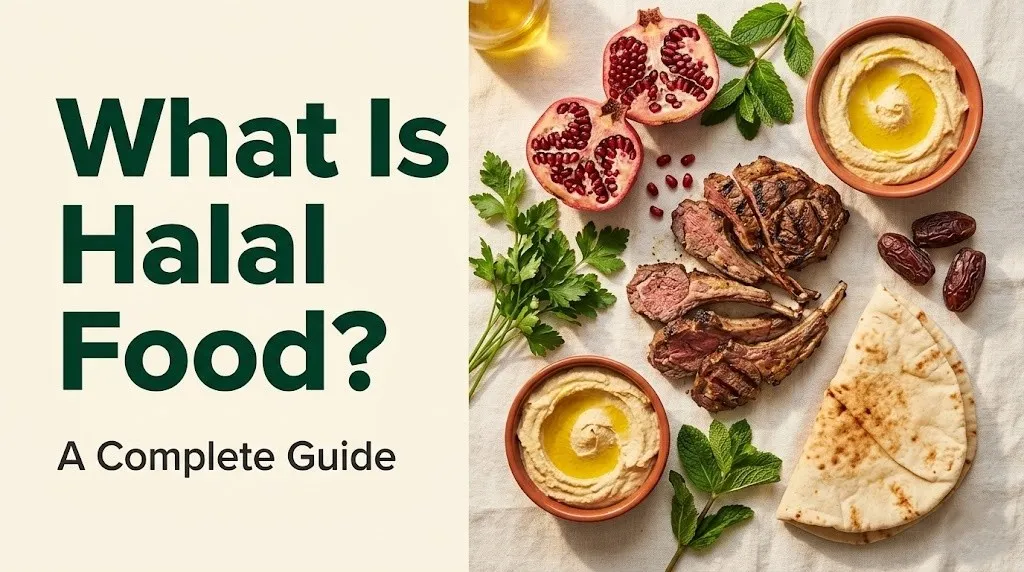
Halal food is food permitted under Islamic dietary law, making it religiously lawful for Muslims to eat and drink. The word halal comes from Arabic and means “permissible” or “lawful.”
More than 2 billion Muslims worldwide follow halal dietary guidelines. Multiple industry research reports valued the global halal food market at approximately USD 2.5 trillion in 2024, making it one of the largest food classification systems by market size on the planet.
This guide covers the core questions about halal food. You’ll find what it means, where it comes from, and which foods qualify. It also explains how US halal certification works and whether any genuine health or food safety advantages apply.
What Is Halal Food?
Halal food is food that complies with Islamic dietary law, making it religiously permissible for observant Muslims to consume.
The category covers far more than meat. It applies to every ingredient, additive, and processing step a food goes through during production. A food can start with permissible ingredients and still lose halal status. If it contacts forbidden substances during processing or storage, it is no longer halal.
Think of halal as a full-chain standard, not a label on a single ingredient. The same logic applies across meat, packaged snacks, dairy products, beverages, and sauces.
The opposite of halal is haram, meaning “forbidden.” Any food containing haram ingredients, or produced in contact with haram substances, does not qualify regardless of how the finished product appears.
Muslims are required to avoid haram foods as a religious obligation. The rules come from the Quran, Islam’s holy text, and the Hadith, the documented sayings and practices of the Prophet Muhammad.
In 2026, halal-certified products are standard inventory at major supermarkets across North America, Europe, and Asia. The Islamic Food and Nutrition Council of America (IFANCA) certifies thousands of products across dairy, confectionery, beverages, sauces, and food additives.
Permitted halal categories include:
- Meat and poultry from permitted animals, slaughtered correctly by the dhabiha method
- Fish and most seafood
- Dairy, eggs, grains, fruits, and vegetables, provided they contain no haram additives
- Packaged foods bearing a recognized halal certification mark from a credible third-party body
What Does “Halal” Mean in Food?
“Halal” is an Arabic word meaning “permissible” or “lawful.” In food contexts, it defines every food and drink a Muslim is allowed to consume.
The term applies broadly in Arabic to any action or object permitted under Islamic law. For food and beverages, it carries requirements covering ingredients, slaughter methods, processing conditions, and contamination prevention at every production stage.
Its counterpart, haram, means “forbidden.” A third category exists: mashbooh, meaning “doubtful” or “questionable.” This covers ingredients whose halal status is unclear, such as certain food colorings or gelatin without a specified animal source.
The Quran contains the foundational statement in Surah Al-Baqarah (2:168): “O mankind, eat from whatever is on earth that is lawful and pure.” The word translated as “lawful” is halal. The word translated as “pure” is tayyib.
Tayyib adds a second layer to the standard. It means clean, beneficial, and free from harm. Food can avoid all haram ingredients and still fail the tayyib requirement if it is contaminated, spoiled, or otherwise unsafe.
This dual standard means halal requirements go beyond a banned-ingredients list. They include:
- Freedom from prohibited ingredients: pork, alcohol, blood, and their derivatives
- Hygiene and cleanliness at every production and handling stage
- Absence of contamination with haram substances throughout the supply chain
- Accurate labeling and ingredient disclosure
For non-Muslims reading a halal label, this dual standard signals that a product has passed cleanliness and traceability requirements that often exceed basic food safety codes.
What Is the Religious Foundation of Halal Food in Islam?
The religious basis for halal food comes from two primary texts: the Quran, Islam’s central scripture, and the Hadith, the documented sayings and practices of the Prophet Muhammad.
These texts identify specific foods as forbidden. Surah Al-Baqarah (2:173) and Surah Al-Maida (5:3) in the Quran explicitly prohibit pork, blood, animals that died without proper slaughter, and anything slaughtered in the name of something other than God.
Islamic scholars have built extensive jurisprudence around these prohibitions over fourteen centuries. Different schools of Islamic law, including the Hanafi, Maliki, Shafi’i, and Hanbali traditions, hold varying positions on edge cases. The permissibility of certain shellfish, for example, differs depending on which scholarly tradition a Muslim follows. This variation explains why halal certification standards differ between organizations.
Eating halal is not framed as merely a dietary rule in Islamic theology. It is treated as an act of worship. The conscious choice to eat permitted food is understood as obedience to God’s command and an expression of mindfulness about what one consumes.
A 2023 article published in the Journal of Clinical and Basic Research described the tayyib principle as one that “contributes to a healthier and more sustainable food system” when applied consistently across the production chain.
Key Takeaway: Halal is a full-chain food standard drawn from the Quran and Hadith. It covers ingredients, slaughter, processing, and hygiene. Different schools of Islamic jurisprudence apply it with some variation, which is why certification standards and logos differ between organizations.
Where Did Halal Food Originate?
Halal dietary rules originated in the 7th century CE with the revelation of the Quran on the Arabian Peninsula, in what is now the modern nation of Saudi Arabia.
The Prophet Muhammad received Quranic revelations beginning around 610 CE in the city of Mecca. The dietary regulations in these revelations were not invented from nothing. They built on earlier Abrahamic food traditions, sharing clear parallels with kosher dietary laws in Judaism. Both prohibit pork and require specific slaughter procedures for meat.
The Arabian Peninsula was a crossroads of trade routes. These routes connected Africa, Persia, the Byzantine Empire, and South Asia. As Islam spread through those networks from the 7th through the 13th centuries, halal dietary practices traveled with Muslim merchants, scholars, and communities.
By the medieval period, halal practices were established across the Middle East, North Africa, Persia (modern-day Iran), Central Asia, and large parts of South Asia. The regions now comprising Pakistan, India, and Bangladesh were among the early adopters. Early Silk Road trade brought halal practices into parts of Southeast Asia and China by the 8th century.
This history explains why halal food has no single national identity. It is a set of dietary standards that traveled with people across centuries and continents. The food produced under those standards reflects the local culinary traditions of wherever Muslims have settled.
What Country Is Halal Food From?
Halal food does not come from one country. It is produced in dozens of nations across every continent, wherever Muslim consumers or export demand for halal-certified products exist.
This is the most frequent factual misunderstanding about halal food. When people ask whether halal food is Indian, Arabic, or tied to a specific region, the accurate answer is that the dietary standard originated in the Arabian Peninsula. The food produced under that standard comes from countries spanning six continents.
The Asia-Pacific region leads global halal food production. According to 2024 market data, this region accounted for more than 48.5% of the global halal food market share. Indonesia, Malaysia, Bangladesh, and Pakistan lead both domestic consumption and export production.
Brazil is one of the world’s largest halal meat exporters, sending major volumes of certified beef and chicken to markets in the Middle East and Southeast Asia. Australia is a major exporter of halal-certified lamb, beef, and dairy products.
In the United States, the halal food segment exceeds $20 billion annually, according to the American Halal Foundation. States with large Muslim populations, including New York, California, Texas, Illinois, and Michigan, have the highest concentrations of halal restaurants and certified retailers.
| Region | Role in Halal Market | Key Products |
|---|---|---|
| Asia-Pacific | Largest producer and consumer | Meat, poultry, packaged foods |
| Middle East | Major consumer and standards setter | Meat, dairy, beverages |
| South America | Leading halal meat exporter | Beef, chicken |
| North America | Large and growing consumer market | Certified packaged goods, meat |
| Europe | Fast-growing consumer segment | Meat, dairy, confectionery |
| Australia | Export-focused producer | Lamb, beef, dairy |
Is Halal Food Muslim Food? Who Follows Halal Dietary Rules?
Halal food is rooted in Islamic religious law and primarily followed by Muslims, but a growing number of non-Muslim consumers worldwide choose halal-certified products for non-religious reasons.
For observant Muslims, eating halal is a religious obligation. It applies regardless of where they live or which cuisine they are eating. A Muslim eating Italian pasta, Japanese ramen, or American fast food must still verify every ingredient and preparation step against halal standards.
Not all Muslims apply halal rules with the same level of strictness. Some observe all requirements, including third-party certified dhabiha slaughter. Others prioritize avoiding pork and alcohol but are less strict about certification for processed foods. Individual observance varies by country, community, religious tradition, and personal conviction.
Non-Muslims choose halal products at measurable rates. A 2024 Nielsen survey found that 62% of consumers expressed concern about food safety in commercial food production. Halal certification provides a documented, independently verified record from animal health at slaughter to shelf labeling.
People with alcohol sensitivities, those following certain Christian or Jewish dietary traditions, and consumers trying to avoid porcine additives may find halal certification relevant to their choices. Vegetarians and vegans sometimes choose plant-based halal-certified products as confirmation that no hidden animal derivatives entered the production process.
Key Takeaway: Halal food originated in the Arabian Peninsula in the 7th century and spread globally through trade and migration. It is now produced on six continents. Indonesia, Malaysia, Brazil, Australia, and the United States rank among the world’s leading producers.
Halal vs. Haram: What Is the Difference?
Halal means permitted under Islamic law; haram means forbidden. Every food and drink fits into one of these two categories, or into mashbooh (doubtful) when its status is unclear.
The distinction applies at every point in the food chain. An ingredient can be halal on its own but become haram if processed in contact with a forbidden substance. Proper storage and handling matter as much as the original ingredients.
Pork is the most universally recognized haram food. The Quran prohibits it explicitly in multiple verses. No preparation method or cooking technique changes this status.
Alcohol is haram in any intentional food application. This prohibition covers vanilla extract made with an alcohol carrier, wine-based sauces in restaurant cooking, and alcohol-based flavor extracts in packaged goods. Most Islamic scholars consider intentionally added alcohol haram regardless of the quantity remaining in the finished product.
Blood is haram. This is a core reason why the dhabiha slaughter method requires complete blood drainage before meat qualifies as halal.
The mashbooh category is where most confusion arises during everyday shopping. Many common food additives require investigation before their halal status can be confirmed:
| Potentially Questionable Ingredient | Concern | Halal Status Guidance |
|---|---|---|
| Gelatin | May be derived from pork (porcine) | Haram if porcine; halal if from correctly slaughtered animals |
| L-cysteine (E920) | May come from pig bristles or human hair | Check source declaration before consuming |
| Carmine / cochineal (E120) | Insect-derived red coloring | Haram in most scholarly opinions |
| Vanilla extract | Often uses alcohol as a carrier | Verify alcohol-free version is used |
| Pepsin and rennet | May be porcine in origin | Check source; look for microbial or plant-based versions |
| Emulsifiers E471 / E472 | May be derived from animal fat | Check whether vegetable-based source is specified |
What Foods Are Considered Halal?
Halal food includes all foods free from forbidden ingredients, correctly processed, and uncontaminated by haram substances at every production stage.
The category is far broader than most non-Muslims assume. Most fruits, vegetables, grains, legumes, nuts, seeds, dairy products, and eggs are naturally halal. The condition is that they contain no haram additives and are not processed in contaminated conditions.
Meat is where the strictest requirements apply. According to standards published by the Islamic Food and Nutrition Council of America (IFANCA) and the American Halal Foundation (AHF), the following meat categories are halal when correctly slaughtered:
- Beef from cattle slaughtered by the dhabiha method
- Lamb and goat slaughtered by the dhabiha method
- Chicken, turkey, duck, and most poultry slaughtered by the dhabiha method
- Fish with scales, including salmon, tuna, tilapia, cod, and most common finfish
- Most seafood, though specific schools of Islamic jurisprudence differ on shellfish
Beyond meat, these food categories are generally halal:
- Fresh, frozen, canned, and dried fruits and vegetables (free of haram additives)
- Rice, pasta, bread, cereals, and grain products (made without lard or alcohol)
- Milk, butter, cheese, and yogurt from permitted animals (no haram additives)
- Eggs from permitted birds
- Nuts, seeds, legumes, tofu, and plant proteins
- Honey, sugar, and plant-based sweeteners
- Most oils and fats (excluding lard and fat from non-halal animal sources)
- Coffee, tea, fruit juice, and all non-alcoholic beverages
- Spices and condiments free of haram ingredients
Packaged foods and restaurant meals require label verification or certification checking. Even products that appear plant-based may contain haram additives or be made on shared equipment with non-halal products.
What Foods Are Haram?
Haram foods are those explicitly forbidden by Islamic dietary law. Consuming them is prohibited for observant Muslims regardless of context, quantity, or how the food is prepared.
The Quran identifies the core categories directly. These include animals that died without proper slaughter, blood and blood products, pork and any pork derivative, and any food dedicated to beings other than God.
The main haram categories in practical food terms are:
- Pork and all pork derivatives: ham, bacon, lard, pork gelatin, pork-based emulsifiers, and any food cooked in lard or pork fat
- Blood and blood products: blood sausage, black pudding, and any dish using blood as a primary ingredient
- Alcohol in any intentional food application: wine, beer, spirits, and food or sauce made with alcohol as a primary ingredient
- Improperly slaughtered animals: meat from animals not killed by the dhabiha method, or where death preceded complete blood drainage
- Carnivorous animals with fangs, and birds of prey: lions, tigers, bears, eagles, and vultures
- Animals that died from disease, strangulation, or impact: all forms of carrion
- Most insects: with the exception of locusts, which most schools of Islamic jurisprudence permit
- Any intoxicating substance: narcotics or psychoactive compounds used in food applications
The USDA Food Safety and Inspection Service (FSIS) requires that any meat or poultry labeled “Halal” or “Zabiah Halal” in the United States must be certified by an approved third-party authority. Mislabeling a product as halal is a federal offense under USDA FSIS regulations. This legal protection exists specifically to prevent fraud against Muslim consumers.
Key Takeaway: Most fruits, vegetables, grains, dairy, and correctly slaughtered meat are halal. Pork and all its derivatives, blood, alcohol, improperly slaughtered animals, and several common food additives are haram. Packaged goods require ingredient-level checking because haram substances often appear as additives, colorings, or processing aids.
How Is Halal Meat Prepared: The Dhabiha Method
Halal meat is produced through a slaughter method called dhabiha (also written zabiha), an Arabic term meaning “slaughtered.” Islamic law requires this method to make meat religiously permissible.
The dhabiha process has specific requirements with direct implications for meat quality, hygiene, and animal welfare. These are not ceremonial formalities. Each step has practical effects on what ends up on the plate.
To produce halal meat by the dhabiha method:
- The animal must be alive and healthy at the time of slaughter. Diseased or sick animals cannot enter a halal supply chain.
- The slaughterer must be a mentally sound adult Muslim. In some scholarly opinions, a person of Jewish or Christian faith may also perform the slaughter.
- The name of God must be invoked before or at the moment of slaughter. The phrase “Bismillah, Allahu Akbar” (In the name of God, God is the Greatest) is standard.
- A sharp, clean knife must make a single, swift cut across the front of the throat.
- The cut must sever the jugular veins, carotid arteries, trachea, and esophagus in one motion.
- The spinal cord must not be cut during the initial stroke.
- Blood must drain completely from the carcass before processing continues.
The requirement that the spinal cord remain intact after the initial cut has a documented food safety dimension. When the spinal cord is intact, the heart continues to beat after the cut. This acts as a natural pump, expelling a greater volume of blood. A 2023 article in the Journal of Clinical and Basic Research noted that this practice reduces the environment for bacterial growth, since blood is a primary medium for pathogens including Salmonella and E. coli.
One active area of debate in halal certification involves pre-slaughter stunning. Some certification bodies accept reversible electrical stunning, where the animal is rendered unconscious but not killed before the dhabiha cut. Others reject any form of stunning. Muslim consumers who care about this distinction should check the specific policy of their chosen certification body before purchasing.
What Is Halal Certification and How Does It Work?
Halal certification is an independent verification process confirming that a food product meets Islamic dietary standards. Products that pass earn the right to display a recognized halal mark on packaging.
In the United States, the USDA Food Safety and Inspection Service (FSIS) requires that any meat or poultry labeled “Halal” or “Zabiah Halal” must be certified by an appropriate third-party authority. The FDA does not issue a legal definition for halal, because constitutional separation of church and state prevents the government from making religious dietary rulings.
The two most recognized US halal certification bodies are:
- Islamic Food and Nutrition Council of America (IFANCA): One of the oldest certifiers in North America. Their Crescent M logo is recognized on thousands of products domestically and internationally.
- American Halal Foundation (AHF): A leading US certifier whose certification is accepted in over 180 countries, including markets with the strictest halal import controls.
The certification process involves:
- The manufacturer submits an application with complete ingredient lists, supplier documentation, and full production process records.
- An auditor reviews all ingredients against halal standards, including additives, flavorings, and processing aids.
- A physical facility inspection checks cross-contamination controls, equipment sanitation, and segregation of halal and non-halal production lines.
- Products meeting all standards receive certification and the right to display the certifying body’s logo.
- Annual re-audits and ongoing random inspections maintain active certification status.
Halal certification does not indicate that a product is organic, non-GMO, or free from allergens. These are entirely separate classification systems. Shoppers with other dietary requirements must check relevant labeling separately from the halal mark.
Key Takeaway: In the US, the USDA FSIS governs halal labeling on meat and poultry and requires third-party certification. The dhabiha slaughter method’s blood drainage requirement reduces the bacterial growth environment. IFANCA and the American Halal Foundation are the most widely accepted US certifiers.
Is Halal Food Healthier Than Conventional Food?
Halal food is not automatically healthier than conventionally produced food. Specific aspects of halal production do have genuine food safety and quality implications that nutrition researchers have examined and documented.
The most studied health-relevant aspect is blood drainage during dhabiha slaughter. Blood is a primary medium for bacterial pathogens including Salmonella and E. coli. Complete blood removal after slaughter reduces the available environment for microbial growth during storage and transport. A 2023 article in the Journal of Clinical and Basic Research concluded that halal production standards “ensure specific standards of cleanliness, hygiene, animal welfare, and the prohibition of the inclusion of harmful chemicals.”
The requirement that animals be healthy and disease-free before slaughter adds a quality checkpoint. Diseased animals cannot enter a halal-certified supply chain. This removes one pathway through which contaminated meat could reach consumers, beyond the minimum standards required in conventional commercial slaughter.
Alcohol prohibition in halal certification means halal-certified packaged foods exclude alcohol as a flavoring carrier, processing solvent, or preservative. This matters for people who avoid alcohol for health, religious, or personal reasons, and for those with sensitivity to alcohol residues in food.
The absence of pork-derived additives removes certain emulsifiers and gelatin sources from the product. For consumers who prefer to avoid these substances for any reason, halal certification provides a consistent signal.
These advantages apply only to products from legitimate third-party certified facilities with active audit trails. A restaurant claiming halal without a named certifying body cannot provide the same documented assurances.
Calorie content, fat, protein, and other macronutrients are not automatically different in halal meat compared to conventionally produced meat from the same species. Cooking method, cut, and the animal’s feeding history during its life are the primary determinants of nutritional composition.
Why Do Non-Muslims Choose Halal Food?
Non-Muslim demand for halal food has grown consistently over the past decade, driven by overlapping interests in food safety documentation, animal welfare, and ingredient transparency.
The global halal food market was valued at approximately USD 2.5 trillion in 2024, with a growing share attributed to non-Muslim consumers who treat halal certification as a quality indicator rather than a religious one.
Food safety documentation is the most commonly cited reason. A 2024 Nielsen survey found that 62% of consumers expressed concern about commercial food production safety. Halal certification provides a verified chain of custody from animal health at slaughter to the label on the finished product.
Animal welfare is a growing factor. The dhabiha method’s requirements for healthy animals, a trained operator, and a swift cut designed to minimize distress align with the concerns of consumers focused on humane food sourcing. Some animal welfare researchers debate whether pre-slaughter stunning further reduces animal distress. This remains an active area of scientific and policy discussion, with no settled consensus.
Ingredient transparency attracts shoppers wanting to avoid specific substances. Halal certification systematically excludes pork derivatives (including lard used in some commercial baked goods and fried foods), alcohol-based flavor carriers, and carmine (E120). Carmine is a red coloring derived from crushed cochineal insects and appears in many pink and red food products. Consumers who avoid insect-derived ingredients for ethical or dietary reasons may choose halal-certified products partly for this assurance.
Some Jewish consumers find halal and kosher standards overlapping enough to be useful when kosher options are unavailable. Plant-based and vegan consumers sometimes choose halal-certified plant products to confirm that no hidden animal derivatives entered the production process.
How to Identify and Buy Halal Food When Shopping
Identifying halal food requires knowing which certification marks to trust, how to check ingredient labels for common haram additives, and when a restaurant or butcher’s verbal claim is adequate.
The most reliable indicator is a recognized halal certification logo from a credible, named third-party body. In the United States, the main marks to look for are:
- IFANCA Crescent M logo: One of the most widely recognized marks in North America, present on thousands of products
- American Halal Foundation (AHF) shield logo: Accepted in 180+ countries and common on meat, poultry, and packaged goods
- Islamic Services of America (ISA) logo: Common on US meat, poultry, and exported products
When no certification logo appears, check the ingredient list for:
| Ingredient to Check | Why It Matters | What to Do |
|---|---|---|
| Gelatin | May be porcine (pork-derived) | Look for “bovine,” “fish,” or plant-based source specified |
| Vanilla extract | Often alcohol-based | Look for “non-alcoholic” or verify vanillin is used instead |
| Carmine (E120) / cochineal | Insect-derived red coloring | Avoid; look for beet red or annatto as alternatives |
| L-cysteine (E920) | May be from pig bristles | Check source declaration; look for plant-based or microbial source |
| Emulsifiers E471 / E472 | May be animal-fat derived | Look for “vegetable-based” designation |
| Rennet / pepsin | May be porcine | Look for microbial rennet or plant-based enzymes |
| Agar-agar, pectin, carrageenan | Plant-derived gelatin alternatives | Safe; generally halal |
For restaurants: ask whether halal meat is sourced from a named certified supplier, whether the kitchen maintains separate utensils and cooking surfaces for halal and non-halal food, and whether any sauces, marinades, or stock bases contain alcohol.
A credible halal restaurant or butcher will name its certifying body and produce documentation on request. A verbal claim of “halal” without a named third-party certifier does not meet the standard for strict halal observance.
Halal Food and Dietary Restrictions: What Different Groups Should Know
Halal standards interact with other dietary systems in ways worth understanding before shopping, hosting guests, or cooking for people with multiple requirements.
Halal and kosher share meaningful overlap: both prohibit pork, both require specific slaughter methods, both prohibit blood consumption, and both enforce ingredient and facility cleanliness. They are not identical. Kosher law has different requirements around separating meat and dairy, certain seafood categories, and the personnel authorized to perform slaughter. Some halal certifiers accept kosher certification for specific ingredients, but the two systems are not interchangeable for all products.
Halal and vegan diets share an emphasis on ingredient transparency and both exclude pork products. They are not equivalent. Halal permits all correctly slaughtered animal products. Vegan standards exclude all animal products without exception.
Halal and gluten-free are entirely separate classifications. A halal-certified product may contain wheat, rye, or barley. People with celiac disease or gluten intolerance must check for gluten content independently, regardless of any halal mark present.
For people managing diabetes or following low-sodium or low-fat diets: halal certification says nothing about sugar, salt, or fat content. Nutritional evaluation remains a separate step.
For shoppers with tree nut, sesame, or shellfish allergies: many halal food traditions, including Middle Eastern, South Asian, and Southeast Asian cuisines, use these ingredients regularly. A halal label never means allergen-free. The allergen statement on the packaging must be read separately.
Parents choosing halal-certified packaged snacks for children should know that halal certification confirms religious permissibility, not nutritional quality. A halal-labeled snack can still contain high levels of added sugar, sodium, and refined carbohydrates. Halal and nutritionally balanced are two separate evaluations that require two separate label checks.
Key Takeaway: Halal certification confirms religious compliance under Islamic law. It says nothing about allergen status, caloric content, or nutritional quality. People with celiac disease, nut allergies, diabetes, or other requirements must read nutrition and allergen labels separately from any halal certification mark.
Frequently Asked Questions About Halal Food
Is halal food the same as Muslim food?
Halal food is food that meets Islamic dietary standards, which is why most people associate it with Muslim consumers. Not all food eaten by Muslims is technically halal, and a growing number of non-Muslims worldwide eat halal-certified products for non-religious reasons. Halal is a production and ingredient standard, not a cuisine or ethnicity. It describes how food is made and what it contains, not what it tastes like.
Is halal food from a specific country?
Halal food does not come from one country. The dietary standards originated in the Arabian Peninsula in the 7th century, but halal food is now produced across six continents. The largest halal food producing nations in 2024 include Indonesia, Malaysia, Brazil, Pakistan, and Australia. The United States is a major halal food producer, with the domestic segment estimated above $20 billion annually according to the American Halal Foundation.
What makes a food halal or haram?
A food is halal when it is free from prohibited ingredients, correctly processed, and uncontaminated by haram substances at every production stage. The core haram categories are pork and all pork derivatives, blood, alcohol, improperly slaughtered animals, and certain food additives sourced from forbidden materials. Processed and packaged foods often require ingredient-level checking or third-party certification verification, since haram substances can appear as colorings, emulsifiers, or flavor carriers.
Is halal food healthier than regular food?
Halal food is not automatically nutritionally superior to conventionally produced food. The dhabiha slaughter method’s requirement for complete blood drainage reduces the environment for bacterial growth, which is a documented food safety advantage. Caloric content, fat, and protein are determined by the animal species, cut, and cooking method. Halal status alone does not change a food’s macronutrient composition.
Can non-Muslims eat halal food?
Yes, non-Muslims can eat halal food freely. Nothing in Islamic dietary law restricts non-Muslims from consuming halal-certified products. Millions of non-Muslim consumers in North America, Europe, and Asia eat halal food regularly, often choosing it for food safety documentation, animal welfare practices, or ingredient purity reasons. Halal certification confirms a product meets Islamic dietary standards. It does not change the food’s taste, texture, or nutritional profile.
Halal food is a verified dietary standard with real-world implications for ingredients, slaughter methods, and production hygiene. Whether you’re a Muslim consumer confirming religious compliance, a shopper checking ingredient labels, or a host accommodating guests with varied needs, the principles are practical and clearly defined.
Look for certification marks from recognized bodies like IFANCA or the AHF. Check ingredient lists for porcine gelatin, carmine, and alcohol-based flavorings when no certification mark appears. And remember: halal certification and nutritional quality are two separate evaluations. Read both labels.