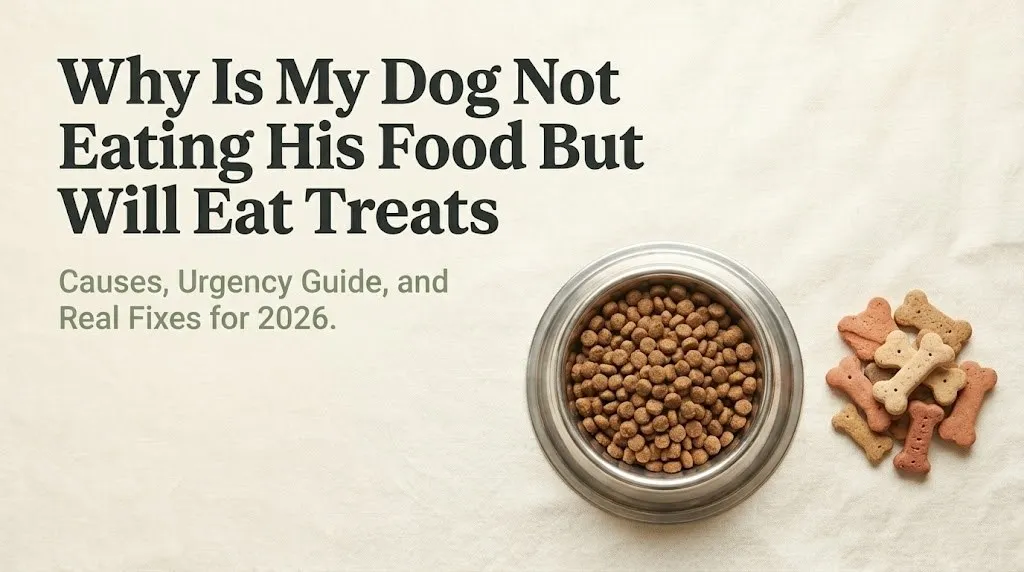
When a dog refuses his regular food but eagerly accepts treats, the most common explanation is a behavioral pattern called pseudo-anorexia, where the dog has learned that holding out for more palatable food gets results, rather than any underlying illness. That said, treats-but-not-food behavior can also signal dental pain, nausea, gastrointestinal issues, or early-stage systemic illness, so ruling out medical causes before assuming it’s behavioral is the right approach.
The stakes vary by dog. According to the American Animal Hospital Association (AAHA), treats should comprise no more than 10% of a dog’s total daily caloric intake. A dog skipping complete meals while eating only treats is likely falling into nutritional deficit over time, regardless of whether the cause is behavioral or medical.
This guide covers the palatability science behind why treats remain appealing when food isn’t, the specific behavioral and medical causes of this pattern, how to assess urgency based on your dog’s specific symptoms, and the most effective practical steps to correct the problem based on the actual cause.
Why Is My Dog Not Eating His Food But Will Eat Treats?
A dog that refuses regular food but accepts treats is most often experiencing either behavioral conditioning (having learned that refusing food leads to receiving more palatable alternatives) or a palatability gap between their regular food and treats, though medical causes including dental pain and nausea must be ruled out.
The mechanism behind this specific pattern is worth understanding. Commercial dog treats are formulated very differently from complete and balanced dog food. Most treats contain significantly higher fat content, added palatants including animal digest (produced by enzymatic hydrolysis of animal tissues), stronger aromatic compounds, and softer textures than dry kibble. These properties lower the palatability threshold needed to trigger eating, meaning a dog with partially suppressed appetite will often still accept treats when regular food doesn’t meet that threshold.
Think of it like a person with mild nausea. They might turn down a full dinner but still eat a few crackers or sip broth, because the intensity of the desired food sensory experience is lower. The dog isn’t necessarily faking. The palatability difference is real and physiologically meaningful.
The American Veterinary Medical Association (AVMA) notes that appetite changes in dogs, including selective eating, can be early indicators of underlying health conditions. Observing this pattern for more than 24 to 48 hours in an adult dog without other symptoms is reasonable. Observing it alongside vomiting, lethargy, diarrhea, or weight loss requires veterinary assessment, not home management.
Possible causes at a glance:
| Cause Type | Example | Urgency Level |
|---|---|---|
| Behavioral conditioning | Learned that holding out gets treats | Low, manage at home |
| Palatability gap | Food is less appealing than treats | Low, address food quality |
| Food formula change | Manufacturer changed recipe | Low to moderate |
| Dental pain | Chewing dry kibble is painful | Moderate, see vet within 48 hours |
| Nausea (mild) | Early gastrointestinal upset | Moderate, monitor 24 hours |
| Systemic illness | Kidney disease, pancreatitis | High, see vet promptly |
| Gastrointestinal obstruction | Foreign body ingested | High, see vet immediately |
Why Won’t My Dog Eat His Food But Will Eat Treats?
A dog that won’t eat his food but will eat treats is most commonly experiencing behavioral conditioning, where previous owner responses to food refusal (offering treats, hand-feeding, or switching foods) have taught the dog that refusing the bowl leads to something better.
Dogs are highly skilled at learning cause-and-effect relationships with their owners. The pattern usually develops gradually. The dog skips a meal. The owner, concerned, offers a treat. The dog eats the treat. The owner, relieved, continues the pattern. Within a week or two, the dog has learned that skipping the food bowl is a reliable strategy for getting higher-value food.
This is not stubbornness in any human sense. It’s operant conditioning, where a behavior that produces a rewarding outcome gets repeated. The dog isn’t being manipulative. It’s simply responding to the reinforcement history you’ve inadvertently created.
According to Veterinary Clinics of North America: Small Animal Practice research on canine feeding behavior, this pattern is especially common in toy breed dogs, which tend to have stronger food preferences and whose owners are more likely to accommodate food refusal out of concern for hypoglycemia risk. Small dogs including Chihuahuas, Yorkshire Terriers, and Shih Tzus are disproportionately represented in behavioral food refusal cases.
Quick Tip:
- Do not offer a treat within 30 minutes of a refused meal. This directly reinforces the refusal behavior.
- Place the food bowl down for 15 to 20 minutes, then remove it without comment or alternative offerings.
- Repeat at the next scheduled meal. Most healthy adult dogs will begin eating within 2 to 3 meal cycles once the treat-as-reward pattern is broken.
- Small breeds under 5 kilograms should be monitored more carefully. If a toy breed dog has refused two consecutive meals, a veterinarian should assess the dog the same day to rule out hypoglycemia.
Why Won’t My Dog Eat His Dog Food?
The most common reasons a dog won’t eat his dog food include behavioral conditioning from treat substitution, a recent change in the food’s formula or brand, storage issues causing the food to taste or smell stale, dental pain making chewing uncomfortable, or underlying medical conditions affecting appetite.
Food storage is one of the most overlooked causes and one of the easiest to fix. Dry kibble (extruded dry dog food) contains fats that undergo lipid oxidation when exposed to air, heat, or light. This process, commonly called going rancid, changes both the smell and taste of the food. Dogs, with their highly developed olfactory systems (estimated at 10,000 to 100,000 times more sensitive than humans, per research at the Cornell University College of Veterinary Medicine), detect rancid fat long before any human would notice.
A bag of kibble left open in a warm garage or exposed to humidity will lose palatability quickly. The same food stored in an airtight container in a cool, dry location will maintain palatability significantly longer. If your dog has recently started refusing food that they previously ate without issue, checking the storage conditions and the “best by” date is a reasonable first step before assuming a behavioral or medical cause.
The Association of American Feed Control Officials (AAFCO) requires dog food carrying a “complete and balanced” claim to meet minimum nutritional standards for the life stage indicated. However, AAFCO does not regulate palatability or flavor consistency. Manufacturers can legally change ingredient sourcing, fat levels, or processing methods without a label change, which can alter palatability without any visible indication to the owner.
Key Takeaway: Before assuming a behavioral problem, check your dog food’s storage conditions, “best by” date, and whether the manufacturer recently changed the formula. A palatability problem with the food itself is often the simplest explanation and the easiest to fix.
Why Will My Dog Eat Treats But Not Food?
A dog eating treats but not food is telling you that its appetite is not fully suppressed, only that the regular food isn’t clearing the palatability threshold needed to trigger eating given its current state.
This distinction is genuinely useful for diagnosis. Full anorexia (complete appetite loss) typically means a dog refuses everything, including high-value treats. Pseudo-anorexia or selective eating (refusing regular food while accepting treats) means some degree of appetite remains, but the food’s sensory properties aren’t motivating enough to overcome whatever is reducing eating drive.
That reducing factor could be behavioral habit, mild nausea, dental discomfort when chewing hard kibble, or reduced olfactory sensitivity in older dogs. The treat-eating behavior narrows the range of likely causes considerably.
What treat-eating tells you about the cause:
| Observation | What It Suggests | What It Rules Out |
|---|---|---|
| Eats soft treats, refuses dry kibble | Possible dental pain; texture preference | Full appetite loss; severe illness |
| Eats any treats, refuses all food | Behavioral conditioning; mild nausea | Severe gastrointestinal obstruction |
| Eats treats slowly and less enthusiastically | Mild systemic illness reducing appetite | Pure behavioral conditioning |
| Eats treats eagerly, acts completely normal | Behavioral conditioning most likely | Medical cause as primary driver |
| Eats treats but vomits them up | Vomiting is the problem, not food refusal | Behavioral cause |
Senior dogs over 7 years of age deserve particular attention here. Reduced olfactory receptor sensitivity in aging dogs means that dry kibble with lower aromatic intensity may genuinely become less appealing as the dog ages, while highly aromatic treats maintain appeal longer. This is not stubbornness. It’s a sensory change, and it often responds well to switching to wet food or adding warm water or low-sodium broth to kibble to increase aromatic intensity.
Why Won’t My Dog Eat Dog Food?
A dog refusing dog food, whether dry kibble or wet food, is most often responding to one of four factors: a sensory issue with the food itself, a behavioral pattern reinforced by treat substitution, a physical discomfort making eating harder, or a health condition affecting appetite.
Each factor requires a different response. Treating a behavioral cause with a veterinary appointment wastes time and money. Treating a medical cause with behavioral intervention leaves the underlying condition untreated and worsening. The most common owner mistake is defaulting to behavioral explanations because they’re more comfortable than medical ones.
A practical diagnostic approach starts with observing what else is going on. A dog that refuses food but plays normally, drinks water, has normal stools, and accepts treats with its usual enthusiasm is most likely showing a behavioral or food-quality issue. A dog that refuses food and also seems quieter than usual, is drinking more or less water than normal, has changed stool consistency, or shows any physical discomfort is showing a pattern that warrants veterinary evaluation.
Breed-specific notes: Large breeds including German Shepherds (Canis lupus familiaris) and Labrador Retrievers are prone to gastrointestinal sensitivity and food intolerances that can cause selective appetite. Brachycephalic breeds (dogs with flattened faces, including Bulldogs, Pugs, and French Bulldogs) are prone to nausea related to their anatomy, which can cause food refusal that mimics behavioral picky eating. Breed history is a relevant data point when evaluating this behavior, and veterinarians with breed-specific knowledge are particularly well-positioned to assess these cases.
Why Is My Dog Not Eating His Dog Food?
A dog not eating his dog food may be responding to a recent formula change by the manufacturer, food that has lost palatability through improper storage, competition or stress from other pets in the household, or the early stages of a health condition affecting appetite.
Manufacturer formula changes are more common than most owners realize. Dog food companies regularly adjust ingredient sourcing, processing methods, and fat or protein levels in response to supply chain availability, cost pressures, or reformulation. The bag may look identical. The food inside may taste and smell different enough that a sensitive dog notices and refuses it.
If your dog suddenly refused a food they had been eating for months or years without issue, checking whether the batch number on the bag is different from previous purchases, or whether other owners of the same dog food brand are reporting palatability changes on forums or recall databases, is a reasonable investigative step.
The AAFCO nutritional adequacy statement on a dog food label confirms that the food meets minimum nutritional requirements for the stated life stage. It does not confirm that the food’s palatability is consistent between production batches, or that no ingredients changed. These are separate variables entirely.
Quick Tip:
- Compare the current bag’s ingredient list to a previous bag if you kept the old one. Ingredient lists must be listed in order by weight.
- A change in the first five ingredients represents a meaningful formulation change that could affect palatability.
- If you suspect a formula change, transitioning to a new food using a 7 to 10-day gradual transition (mixing increasing proportions of new food with decreasing proportions of old) reduces gastrointestinal upset and palatability rejection.
- Dogs with known food sensitivities to specific proteins should have any new food reviewed by a veterinarian before introduction.
Key Takeaway: A sudden change in a food your dog has eaten for months points to either a storage problem, a manufacturer formula change, or an early health change in your dog. All three are worth investigating before defaulting to a behavioral explanation.
Do Dogs Stop Liking Their Food?
Dogs can and do develop reduced interest in a food over time, but genuine food boredom is less common in dogs than in humans, and a dog showing sudden disinterest in a food they previously ate without issue is more likely responding to a change in the food, their environment, or their health than to boredom alone.
True dietary monotony aversion, where an animal reduces food intake purely because the diet hasn’t changed, is well-documented in humans and some species but is not strongly supported as a primary driver in dogs in the peer-reviewed veterinary literature. Dogs in controlled feeding studies generally continue eating the same food consistently over long periods when behavioral conditioning and health factors are controlled.
That said, palatability preferences in individual dogs are real and vary widely. Some dogs show strong preference changes after experiencing a highly palatable food (a switch to a premium brand, introduction of wet food, or frequent treat exposure), making their previous food feel less satisfying by comparison. This is sometimes called contrast-induced food preference, and it’s the mechanism behind a common pattern: the dog that ate its food happily until the owner started giving high-value treats regularly.
Think of it like eating plain oatmeal every morning for a year with no issues, then spending a week on vacation eating restaurant breakfasts, and then returning home to find the plain oatmeal somehow harder to get through. The oatmeal hasn’t changed. Your reference point has.
Older dogs deserve a specific note. The American Veterinary Medical Association (AVMA) recognizes that senior dogs experience progressive decline in olfactory receptor cell numbers and function with age. This means that the aromatic signals that make food appealing are literally less detectable, not that the dog has become picky. Wet food, warmed food, or food with added low-sodium broth is often the practical solution, not a new brand.
Why Won’t My Dog Eat Her Dog Food?
A female dog that won’t eat her dog food should be evaluated in the context of her reproductive status, as pregnancy, the period immediately after whelping, and the weeks of nursing all involve appetite changes that are distinct from the behavioral and medical causes seen in non-reproductive females.
During the first trimester of canine pregnancy, many females experience reduced appetite or mild food aversion similar to human morning sickness. This is a normal hormonal response and typically resolves by mid-pregnancy. A pregnant female refusing food should be monitored closely, and a veterinarian should be involved in dietary management throughout pregnancy to ensure adequate caloric intake for both the mother and developing puppies.
During the final week of pregnancy, many female dogs experience a further reduction in appetite as the uterus expands and stomach capacity reduces. After whelping, appetite typically increases substantially to support milk production. A nursing female refusing food is a more serious concern, as her caloric requirements are dramatically elevated and food refusal during nursing can affect both her health and milk supply.
For non-reproductive female dogs, the behavioral and medical causes described in other sections of this article apply equally regardless of sex. No sex-specific behavioral difference in food refusal patterns is well-established in the veterinary literature. The word “her” in the search query typically just reflects the gender of the specific dog, not a distinct cause category.
When a female dog’s food refusal is a priority concern:
- During pregnancy (any stage): monitor intake and consult a veterinarian if more than one meal is refused
- In the 24 hours before or after whelping: normal, but monitor
- During nursing: food refusal is an urgent concern due to elevated caloric demand
- Any female dog that is spayed and otherwise healthy: same urgency guidelines as any adult dog
Why Doesn’t My Dog Eat Dog Food?
A dog that consistently refuses dog food across multiple meal attempts over several days may have developed a conditioned food aversion, where a negative experience (nausea, gastrointestinal upset, or physical discomfort) was paired with eating a specific food, and the dog now associates that food with the unpleasant experience.
Conditioned food aversions in dogs are well-documented in veterinary behavioral literature. They work like this: a dog eats its regular food and shortly afterward experiences nausea or vomiting from an unrelated cause (a virus, motion sickness, or eating something else). The brain pairs the food’s smell and taste with the subsequent bad experience. The next time that food is offered, the association triggers avoidance, even though the food itself was never the problem.
This mechanism is why dogs that have been sick during a period when a specific food was being fed may persistently refuse that food afterward. It’s also why introducing a new food during a period of illness often creates a lasting aversion to that new food, and experienced veterinary nutritionists recommend against introducing novel foods during illness for exactly this reason.
Resolving a conditioned food aversion usually requires a full food change, not just attempts to coax the dog back to the original food. A veterinarian or board-certified veterinary nutritionist can recommend appropriate alternative foods based on the dog’s nutritional needs, health history, and any known food sensitivities.
The Journal of Veterinary Internal Medicine has published research on food aversion in dogs receiving chemotherapy, where learned food aversion is a documented complication affecting nutritional adequacy during treatment. Dogs undergoing any medical treatment affecting appetite or causing nausea should have their food choices managed in consultation with their treating veterinarian.
Key Takeaway: A dog that consistently refuses one specific food it previously ate may have formed a conditioned food aversion, not a behavioral preference problem, and a full food transition rather than persistence with the original food is usually the more effective resolution.
Dog Not Eating But Acting Normal
A dog not eating but acting completely normal, meaning it plays, drinks water, seeks attention, and shows no signs of physical discomfort, is most likely experiencing a behavioral food refusal pattern rather than a medical problem.
“Acting normal” is the most practically useful piece of information for urgency assessment. Energy level, water intake, interest in play and interaction, stool consistency, and absence of vomiting are the five behavioral indicators that most reliably distinguish behavioral food refusal from illness-related appetite reduction.
A dog that skips one meal while displaying all of these normal behaviors is almost certainly not in medical danger. A dog that skips two consecutive meals but remains fully energetic and normal in every other way falls into a monitoring window. A dog skipping meals alongside any change in normal behavior crosses into veterinary evaluation territory regardless of how many meals have been skipped.
Urgency assessment by symptom combination:
| Symptoms Observed | Recommended Action | Timeframe |
|---|---|---|
| Food refusal only, acting fully normal | Remove food after 15 minutes, retry next meal | Monitor up to 48 hours |
| Food refusal plus one episode of vomiting | Withhold food for 6 hours, offer bland food, monitor | See vet if vomiting continues |
| Food refusal plus lethargy | Veterinary assessment | Within 24 hours |
| Food refusal plus diarrhea | Monitor hydration, veterinary assessment | Within 24 to 48 hours |
| Food refusal plus abdominal bloating | Emergency veterinary care | Immediately |
| Food refusal plus rapid weight loss | Veterinary assessment | Within 24 hours |
| Food refusal in a toy breed (under 5 kg) | Veterinary assessment | Within 12 to 24 hours |
The bloating entry in this table deserves emphasis. Bloating with food refusal in large breed dogs can indicate gastric dilatation-volvulus (GDV), a life-threatening emergency. Deep-chested breeds including Great Danes, Standard Poodles, German Shepherds, and Doberman Pinschers are at elevated risk. A dog of any size showing a visibly distended abdomen alongside food refusal, retching without vomiting, or obvious distress should be taken to an emergency veterinary clinic immediately.
When Should I Worry About My Dog Not Eating?
You should worry about your dog not eating and seek veterinary assessment within 24 hours if food refusal is accompanied by vomiting, diarrhea, lethargy, or behavioral changes; within 12 hours for toy breed dogs or puppies; and immediately for any dog showing abdominal bloating, labored breathing, or obvious pain.
For a healthy adult dog of normal size showing food refusal with no other symptoms, a monitoring window of up to 48 hours is generally reasonable before veterinary assessment becomes urgent, per AVMA general guidance on canine appetite changes.
The 48-hour window applies to adult dogs over 6 months of age that are not pregnant, not nursing, and have no known chronic health conditions. Any deviation from that profile shortens the window.
Specific conditions that shorten the monitoring window to immediate or same-day veterinary assessment:
- Any toy breed or dog under 5 kilograms (hypoglycemia risk)
- Any puppy under 6 months (faster metabolic depletion)
- Any pregnant or nursing female dog
- Any dog with a known chronic condition (kidney disease, diabetes, liver disease, pancreatitis history)
- Any dog on medication that requires food for administration or stomach protection
- Any dog that is also vomiting, has bloody stool, or shows abdominal pain
A veterinarian at a practice affiliated with the American Animal Hospital Association (AAHA) is equipped to assess the full clinical picture, run blood work to screen for systemic illness, and evaluate dental health as a contributing cause, all in a single appointment.
How to Get My Dog to Eat His Food Again
The most effective way to get a dog eating his food again is to identify whether the cause is behavioral or physical, then apply the matching intervention: food management and routine for behavioral causes, veterinary assessment for medical ones.
For behavioral food refusal where a medical cause has been ruled out, the strategy is structured and consistent:
To reset a dog’s eating behavior after treat-driven food refusal:
- Stop offering treats entirely for 5 to 7 days. This removes the alternative reward that is reinforcing the refusal.
- Establish a fixed feeding schedule of two meals per day at consistent times. Free-feeding (leaving food out all day) makes behavioral management much harder.
- Place the food bowl down for exactly 15 minutes. Do not encourage, coax, or interact with the bowl. Remove it after 15 minutes regardless of whether the dog ate.
- Do not offer any food, treats, or table scraps between scheduled meals.
- At the next scheduled meal, offer the same food again. Most healthy adult dogs will begin eating within 2 to 3 days of consistent implementation.
- Once eating is re-established, treats can be reintroduced at or below 10% of daily caloric intake, never as a meal substitute.
For palatability improvement without switching foods entirely: add 1 to 2 tablespoons of low-sodium chicken broth (no onion, no garlic, no added salt) to dry kibble. This increases aromatic intensity and moisture content, both of which raise palatability. Warming kibble slightly in a microwave for 10 seconds and stirring to distribute heat (always check temperature before serving) can also increase aromatic release without changing the food’s nutritional content.
Should I Withhold Treats If My Dog Won’t Eat?
Yes, withholding treats is the most important first step when a dog refuses food but accepts treats, because continuing to offer treats directly reinforces the food refusal behavior and often perpetuates the problem indefinitely.
The behavioral logic is straightforward. If refusing food reliably produces something better (a treat), the dog has no incentive to eat the food. Each time a treat is offered after food refusal, the association between refusing food and getting a treat is strengthened. Removing the treat removes the incentive for the refusal.
This does not mean treats are harmful or that dogs should never have them. AAHA guidelines support treats as part of a balanced feeding routine when they stay at or below 10% of daily caloric intake and when the dog is reliably eating its complete and balanced main food.
The withholding approach applies specifically to behavioral food refusal. If a dog is refusing food due to dental pain, nausea, or another physical cause, withholding treats does not address the underlying issue and the dog should receive veterinary assessment. Soft treats or very small amounts of high-value food may actually be used by veterinarians to assess appetite level in sick dogs.
People with dogs on prescription diets for specific health conditions (kidney disease, food allergies, urinary issues) should discuss treat options with their veterinarian before any changes, because many commercial treats are not appropriate for dogs on therapeutic diets. A veterinarian can recommend prescription-compatible treat options or appropriate whole food alternatives like small pieces of cooked plain chicken (Gallus gallus domesticus, boneless, unseasoned) or cooked plain green beans (Phaseolus vulgaris).
How to Make Dog Food More Appealing to a Picky Dog
The most effective ways to make dog food more appealing to a picky dog are increasing its aromatic intensity through warming or adding low-sodium broth, improving texture by switching from dry to wet food or softening kibble with water, and ensuring the food is stored properly to maintain its original palatability.
These approaches address the sensory properties of the food directly. They’re most appropriate when the cause of food refusal is palatability (the food genuinely isn’t appealing enough) rather than behavioral conditioning or a medical issue.
Proven palatability improvement strategies for dogs:
| Method | How to Apply | Best For |
|---|---|---|
| Add low-sodium broth | 1 to 2 tbsp per meal, no onion or garlic | Most dogs; especially seniors |
| Warm the kibble | Microwave 10 seconds, stir, check temp | Dogs with reduced olfactory sensitivity |
| Add water to kibble | 2 to 4 tbsp warm water, allow to soften 2 minutes | Dogs preferring softer texture; dental concerns |
| Mix wet and dry food | Start at 25% wet, 75% dry; adjust gradually | Dogs transitioning from dry to wet |
| Use food topper | Small amount of AAFCO-compliant wet food on top | Dogs needing palatability boost without full switch |
| Switch to wet food entirely | Transition over 7 to 10 days | Senior dogs, dental disease dogs |
One preparation note: onion (Allium cepa) and garlic (Allium sativum) are toxic to dogs (Canis lupus familiaris). They contain thiosulfate compounds that cause oxidative damage to canine red blood cells, leading to hemolytic anemia. Any broth used to improve dog food palatability must be confirmed free of both ingredients. Most standard grocery store chicken or beef broths contain onion or garlic and are not appropriate. Low-sodium broths specifically formulated for dogs, or homemade broths from plain cooked chicken or beef with no aromatics, are the safe alternatives.
Dogs with food allergies or sensitivities to specific proteins should have any palatability enhancement ingredient reviewed for cross-reactivity with their known allergens before use.
Frequently Asked Questions About Why Dogs Won’t Eat Food But Will Eat Treats
Why will my dog eat treats but not his regular food?
Your dog eats treats but not food most likely because treats have higher fat content, stronger aromatic compounds, and palatants that make them more appealing than regular kibble.
In many cases, treat-eating while refusing food is a behavioral pattern where the dog has learned that holding out produces something more palatable.
A medical cause including dental pain or mild nausea should be ruled out if the behavior is new, sudden, or accompanied by any other change in the dog’s energy or behavior.
How long can a dog go without eating before it becomes dangerous?
A healthy adult dog can typically go 48 to 72 hours without eating before dehydration and metabolic stress become serious concerns.
Toy breeds and puppies under 6 months reach risk much faster, within 12 to 24 hours, due to limited glycogen reserves and hypoglycemia risk.
Any dog that has not eaten in 48 hours should be evaluated by a veterinarian regardless of breed or size.
Should I take away my dog’s treats if he won’t eat his food?
Yes, withholding treats is the most effective first step when food refusal is behavioral in origin.
Continuing to offer treats after food refusal reinforces the behavior by rewarding it, and the refusal pattern will typically intensify over time rather than resolve on its own.
Treats can be reintroduced once the dog is reliably eating its complete food again, at or below 10% of daily caloric intake per AAHA guidelines.
Can switching dog food brands cause a dog to stop eating?
Yes, switching dog food brands or formulas without a gradual transition commonly causes food refusal, gastrointestinal upset, or both.
A proper food transition takes 7 to 10 days, starting with approximately 25% new food mixed with 75% old food and increasing the new food proportion every 2 to 3 days.
Dogs with known gastrointestinal sensitivity, including breeds like German Shepherds and Standard Poodles, often need an even slower transition of 14 days or more.
What are signs my dog’s food refusal is a medical problem?
Food refusal becomes a medical concern when it is accompanied by vomiting, diarrhea, lethargy, increased or decreased water intake, abdominal bloating, or any visible signs of pain.
A dog eating treats slowly or less enthusiastically than normal (rather than eagerly) can also indicate illness rather than pure behavioral refusal.
Abdominal bloating combined with food refusal is a potential emergency in large, deep-chested breeds and requires immediate veterinary care.
Closing
The fastest path to solving this problem is accurately identifying whether it’s behavioral or medical. Observe your dog’s full behavior, not just its relationship with the food bowl, and use what you see to make that call before acting.
If your dog is acting completely normal in every other way, remove treats entirely, establish a fixed meal schedule, and give the 15-minutes-then-remove approach five to seven consistent days before drawing conclusions. Most behavioral food refusal resolves within that window.
If anything else seems off, even something subtle, a veterinary appointment is always the right next step. A licensed veterinarian can assess dental health, run basic bloodwork, and tell you within a single visit whether you’re dealing with a behavior pattern or something that needs treatment.