Eating expired food does not automatically make you sick, but certain expired foods carry a real and sometimes serious risk of foodborne illness. Whether the expired item harms you depends on what type of food it is, how it was stored, and how far past its date it actually is.
According to the CDC, roughly 48 million Americans get foodborne illness each year, resulting in approximately 128,000 hospitalizations and 3,000 deaths. Not all of those cases trace back to expired food specifically, but spoilage and improper storage are contributing factors in a meaningful percentage.
This guide covers exactly what expired food can do to your body, which foods are genuinely high-risk, how long before symptoms appear, and how to read the date labels that actually matter. You’ll also find a clear breakdown of who faces the highest risk and when expired food is simply not worth eating.
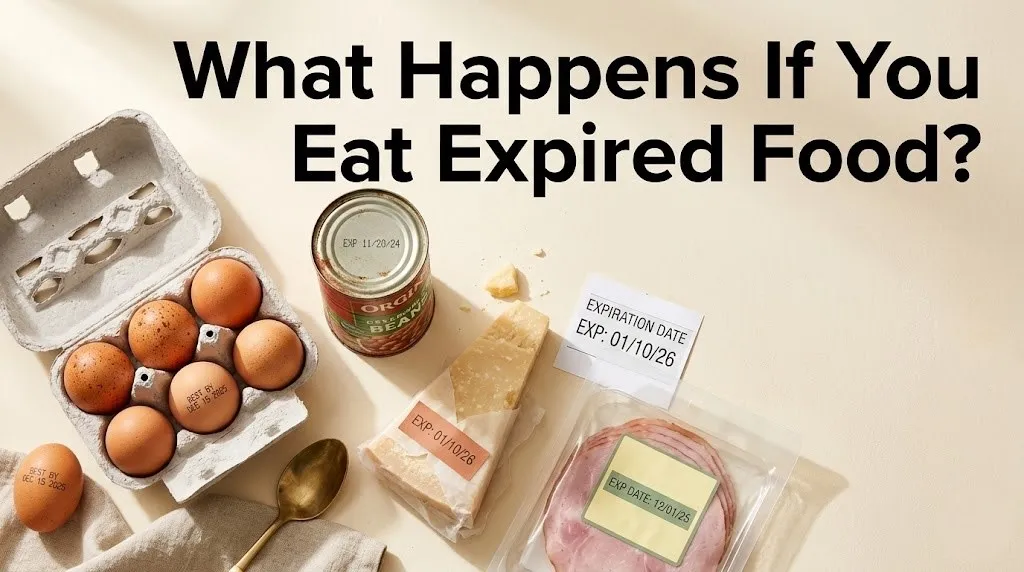
What Happens If You Eat Expired Food
Eating expired food most often results in one of three outcomes: nothing, mild gastrointestinal discomfort, or full foodborne illness. The specific outcome depends almost entirely on what type of food you ate, how it was stored, and what microorganisms may have grown in it.
Most expired food that was stored correctly and shows no signs of spoilage will not make you sick at all. Date labels on most packaged foods in the United States reflect peak quality, not a safety deadline. A yogurt cup one day past its “best by” date, kept cold and properly sealed, is almost always safe.
The real danger comes from foods where harmful bacteria have had time and conditions to multiply. Bacteria like Salmonella enterica, Listeria monocytogenes, and Escherichia coli O157:H7 don’t always change how food looks, smells, or tastes. You genuinely cannot sense their presence the way you can sense obvious mold on bread.
Think of it this way: the date label is like a “freshness warranty.” Once it expires, the manufacturer isn’t making promises anymore. That doesn’t mean the product has failed, but it does mean you need to evaluate it yourself, using the food type and storage conditions as your actual guide.
Key points about what expired food can do to you:
- Cause no symptoms at all (most common outcome with shelf-stable foods stored correctly)
- Trigger mild nausea, stomach cramps, or loose stools from bacteria beginning to multiply
- Produce classic food poisoning symptoms from active pathogen growth or preformed bacterial toxins
- Rarely, cause severe illness requiring hospitalization, particularly in high-risk individuals
Is It Safe to Eat Expired Food
Whether expired food is safe depends on the type of food, its storage history, and whether it shows signs of actual spoilage. Shelf-stable, low-moisture, or high-acid foods are generally safe past their printed dates. High-protein perishables like meat, poultry, seafood, and eggs are not.
The USDA Food Safety and Inspection Service distinguishes between food that has passed a quality date (best by, best if used by) and food that poses an active safety risk. For most packaged foods, the date is about taste and texture, not bacterial safety.
That said, “safe” is not a binary. Food safety exists on a spectrum shaped by temperature history, packaging integrity, moisture content, pH level, and the presence of natural or added preservatives. A sealed can of chickpeas five years past its “best by” date stored at room temperature is almost certainly edible. Raw chicken one day past its “use by” date is a different matter entirely.
| Food Category | Safe Past Date? | Risk Level | Notes |
|---|---|---|---|
| Canned vegetables (undamaged can) | Usually yes | Low | Quality declines but bacteria unlikely |
| Dried pasta, rice, oats | Usually yes | Low | Check for moisture damage or insects |
| Hard cheeses (unopened) | Often yes | Low to moderate | Trim any visible mold (1 inch margin) |
| Raw poultry | Rarely | High | Discard if past “use by” date |
| Raw ground beef | Rarely | High | 1 to 2 days max past purchase date |
| Deli meats (opened) | No | High | Listeria risk even at fridge temperature |
| Eggs | Often yes | Low to moderate | Float test is a useful guide |
| Soft cheeses (ricotta, brie) | No | High | Listeria risk especially in pregnancy |
| Commercially jarred condiments | Usually yes | Low | High acid and salt content protect them |
| Fresh leafy greens | No | High | E. coli risk increases rapidly post-date |
What Do Expiration Date Labels Actually Mean
Date labels in the United States are not federally standardized for most foods, and the terminology varies by manufacturer. Only infant formula requires a federally mandated “use by” date under FDA rules.
The FDA and USDA have been pushing voluntary industry standardization since 2019, recommending that manufacturers use only “best if used by” for quality dates and “use by” for genuine safety-related deadlines. Many manufacturers still use their own terminology, which creates real confusion for consumers.
Understanding what each label actually means:
- Best if used by / Best by: Indicates peak flavor and texture, not a safety cutoff. The food may still be safe to eat after this date if stored correctly.
- Sell by: A retailer-facing date indicating when the store should remove the product from shelves. It’s not a consumer expiration date. Food sold on or before this date typically has additional days of quality life.
- Use by: The manufacturer’s estimate of the last date the product will be at peak quality. For perishable products, this functions closer to a real safety deadline. The FDA recommends treating “use by” dates on perishables as meaningful.
- Freeze by: Indicates the date by which a product should be frozen to preserve quality.
Quick Tip:
- A “sell by” date on raw chicken doesn’t mean it’s safe to eat on that day. It means the store should have removed it from the shelf.
- “Best by” on a box of crackers means the crackers may be staler, not dangerous.
- “Use by” on deli turkey is the one to take seriously, especially if the package has been opened.
Key Takeaway: Expiration date labels in the U.S. are primarily quality indicators, not safety deadlines. Only “use by” dates on perishables function as a genuine safety signal, and only infant formula has a federally required expiration date.
What Are the Symptoms of Eating Expired Food
Symptoms from eating expired food that has become unsafe typically include nausea, vomiting, stomach cramps, and diarrhea. These are the hallmark signs of foodborne illness, caused by bacteria, bacterial toxins, viruses, or in some cases mold toxins called mycotoxins.
The specific symptoms depend on the pathogen involved. Staphylococcus aureus toxins (common in improperly stored cooked meats and dairy products) cause rapid-onset vomiting, often within one to six hours. Salmonella enterica infections typically cause diarrhea, fever, and cramps starting 6 to 72 hours after eating contaminated food. Listeria monocytogenes, which grows in deli meats, soft cheeses, and smoked seafood, can cause fever, muscle aches, and in severe cases headache and stiff neck, appearing anywhere from 1 to 30 days later.
Foodborne illness symptoms to watch for:
- Nausea (often the first signal)
- Vomiting, sometimes severe and repeated
- Watery or bloody diarrhea
- Stomach cramps or abdominal pain
- Fever (above 101.5°F / 38.6°C)
- Muscle aches or fatigue
- Headache
- Chills
The CDC notes that most healthy adults recover from foodborne illness within 24 to 72 hours without medical intervention. But bloody diarrhea, fever above 102°F (38.9°C), severe dehydration, or symptoms lasting more than three days warrant prompt medical evaluation rather than home management.
How Long After Eating Expired Food Do You Get Sick
The time between eating contaminated expired food and developing symptoms varies from as little as 30 minutes to as long as six weeks, depending entirely on the pathogen involved. There is no single “safe window” after which you can conclude you’re in the clear.
This variability is the part that most online guides get wrong. People expect a consistent 24-hour window. The reality is far more variable.
| Pathogen | Common Food Sources | Symptom Onset |
|---|---|---|
| Staphylococcus aureus (toxin) | Cooked meats, egg salad, dairy | 1 to 6 hours |
| Bacillus cereus (toxin) | Rice, pasta, refried beans | 30 minutes to 6 hours |
| Salmonella enterica | Poultry, eggs, raw produce | 6 hours to 6 days |
| Escherichia coli O157:H7 | Ground beef, leafy greens | 1 to 10 days |
| Listeria monocytogenes | Deli meats, soft cheese, smoked fish | 1 to 30 days |
| Clostridium botulinum | Home-canned goods, damaged cans | 12 to 72 hours |
| Norovirus | Any contaminated food | 12 to 48 hours |
Clostridium botulinum deserves special mention. Botulism is rare but potentially fatal. It produces a neurotoxin in improperly sealed canned or preserved foods. Symptoms include blurred vision, drooping eyelids, difficulty swallowing, and progressive muscle weakness. Anyone experiencing these symptoms after eating home-canned or commercially canned food from a damaged or swollen container should seek emergency care immediately.
What Expired Foods Are Most Dangerous
The expired foods most likely to cause serious illness are raw or minimally processed animal proteins, ready-to-eat deli products, raw leafy greens, and unpasteurized dairy. These foods support rapid bacterial growth when temperature control fails or when natural protective barriers (pasteurization, intact packaging, low pH) are compromised.
The food science behind this is consistent: foods with high water activity (aw above 0.85), neutral pH (between 4.6 and 7.5), and available protein provide the ideal growth environment for dangerous bacteria. Raw chicken, ground beef, raw fish, and fresh deli meats tick every one of those boxes.
Most dangerous expired foods:
- Raw poultry (chicken, turkey, duck): Supports Salmonella and Campylobacter growth rapidly. Discard any poultry past its “use by” date.
- Raw ground beef and pork: Ground meat has more surface area than whole cuts, accelerating bacterial multiplication.
- Raw seafood and shellfish: Spoils faster than any other animal protein. Vibrio bacteria in shellfish can cause severe illness within hours.
- Deli meats and hot dogs (opened packages): Listeria monocytogenes grows at refrigerator temperatures (34°F to 40°F / 1°C to 4°C). An opened package past its date is genuinely high risk.
- Soft cheeses (brie, camembert, queso fresco, ricotta): High moisture and neutral pH make these Listeria-friendly environments.
- Fresh leafy greens: Pre-washed bagged salads past their date carry elevated E. coli risk.
- Raw eggs (cracked or dirty): Support Salmonella growth. Discard cracked eggs regardless of date.
- Unpasteurized juices and ciders past date: Lack the heat treatment that eliminates E. coli and Cryptosporidium.
Key Takeaway: The most dangerous expired foods are raw animal proteins and ready-to-eat deli products. Their combination of high moisture, neutral pH, and available nutrients makes them ideal environments for pathogens that don’t always signal their presence through smell or appearance.
Can You Eat Expired Canned Food
Properly stored, undamaged canned food is generally safe to eat years past its printed date, with declining quality but low safety risk. The canning process creates a sterile, anaerobic environment that prevents bacterial growth in intact cans.
The USDA distinguishes between high-acid canned goods (tomatoes, citrus fruits, pineapple, vinegar-based foods) and low-acid canned goods (vegetables, beans, meats, fish, soups). High-acid canned foods maintain quality for 12 to 18 months. Low-acid canned goods can remain safe for 2 to 5 years or longer, though texture and nutrient density decline over time.
The exception is critical: never eat canned food from a damaged, swollen, rusted, or deeply dented can. These conditions may indicate Clostridium botulinum activity and botulism toxin production. A swollen can lid is a specific warning sign. Discard it without opening, and do not taste the contents to “check.”
Signs a can of food should be discarded:
- Swollen, bulging, or buckled lid
- Spurting liquid when opened
- Rust that has penetrated the can seam
- Deep dents along the can seam (not cosmetic side dents)
- Off odor on opening
- Mold visible inside
A small dent on the side of a can with no seam damage is generally cosmetic and not a safety concern. When in doubt, the USDA recommends discarding any can you’re uncertain about. The contents are not worth the risk of botulism, which has a fatality rate of 5 to 10% even with modern medical treatment.
What Foods Are Safe to Eat After the Expiration Date
Many foods remain safe and palatable well past their printed dates when stored correctly. Low-moisture, high-acid, high-salt, or high-sugar foods are naturally resistant to bacterial growth and are typically safe past their quality dates.
The key concept here is water activity (aw). Think of water activity like the amount of free water available for bacteria to use. Dried pasta has an aw of about 0.60. Bacteria need at least 0.85 to grow. That’s why a box of dried spaghetti is safe for months or years past its date, while fresh pasta in the fridge is not.
Foods generally safe past their date:
- Dried pasta and rice: Quality declines but safety risk is minimal if stored dry.
- Honey: Indefinite shelf life when sealed. Never truly expires due to low moisture and antimicrobial properties.
- Distilled spirits and wine: Alcohol is antimicrobial. Quality changes but safety does not.
- Commercially produced hot sauce and vinegar-based condiments: High acid prevents bacterial growth.
- Whole spices and dried herbs: Lose potency but don’t become unsafe.
- White sugar and table salt: Don’t support microbial growth.
- Commercially packaged crackers and cookies (unopened): Safe past date if sealed and moisture-free.
- Hard cheeses (unopened, refrigerated): Mold on the cut surface can be trimmed with a 1-inch margin; the remaining cheese is generally safe.
- Frozen foods: Freezing stops bacterial growth entirely. Frozen foods past their date are a texture question, not a safety one.
People with celiac disease should check that dried grains labeled “gluten-free” haven’t been cross-contaminated through old or damaged packaging, regardless of date. Also, individuals with mold allergies should be cautious about any food showing visible mold, even foods where surface mold is generally considered manageable.
How to Tell If Food Has Gone Bad
The most reliable way to assess whether food has gone bad is a combination of appearance, texture, smell, and packaging integrity checks, used together rather than relying on any single test. No single sensory check is foolproof.
This is where the honest caveat matters: sensory evaluation catches spoilage caused by mold, yeast, and putrefactive bacteria (the organisms that produce off odors and visible growth). It does not reliably detect Salmonella, E. coli O157:H7, Listeria monocytogenes, or Clostridium botulinum toxin. These pathogens can be present in food that smells and looks completely normal.
What sensory checks can tell you:
- Appearance: Visible mold (any color), discoloration, sliminess on meat surfaces, or unusual texture change are signals to discard.
- Smell: Sour, rancid, sulfuric, or fermented odors in foods that shouldn’t have those characteristics indicate spoilage. Cooked meat with an ammonia or off smell should be discarded immediately.
- Texture: Sliminess in poultry or fish, unusual stickiness, or mushiness in vegetables that should be firm are spoilage indicators.
- Packaging: Swollen bags or containers, broken seals, and moisture inside dry-food packaging all suggest spoilage.
- Taste: Do not use taste as a safety test. Botulism toxin has no distinctive flavor. Tasting food to assess safety is not a reliable method.
Quick Tip:
- The “sniff test” will catch obvious spoilage but won’t detect the most dangerous pathogens.
- Trust packaging integrity as much as sensory assessment. A broken seal on vacuum-packed salmon changes your risk calculation entirely.
- When in genuine doubt, discard. Food costs money. A foodborne illness hospitalization costs far more.
Key Takeaway: You can use appearance, smell, and texture to detect obvious spoilage, but you cannot reliably use your senses to detect the most dangerous bacterial pathogens. High-risk perishables past their dates should be discarded regardless of how they look or smell.
Can Expired Food Give You Food Poisoning
Yes, expired food can cause food poisoning when it contains pathogenic bacteria, bacterial toxins, viruses, or mold toxins at levels sufficient to cause illness. Whether expired food actually causes food poisoning depends on what grew in it and in what quantity.
Food poisoning technically refers to illness caused by preformed toxins already present in food before consumption, typically from Staphylococcus aureus or Clostridium botulinum. These toxins are heat-stable in many cases; cooking the food after bacterial growth will kill the bacteria but won’t neutralize toxins already produced.
Foodborne infection (often called food poisoning colloquially) involves ingesting live pathogens that then cause illness within the gastrointestinal tract. Salmonella, E. coli, Listeria, Campylobacter, and norovirus fall into this category.
According to the CDC, the five most common causes of foodborne illness in the United States are norovirus, Salmonella, Clostridium perfringens, Campylobacter, and Staphylococcus aureus. All five can be associated with improperly stored or expired food.
The distinction that matters practically: if you ate cooked food (like leftover rice or a potato salad) that was left at room temperature for hours before or after its date, toxin-mediated food poisoning is the most likely risk. If you ate raw or undercooked animal protein past its date, pathogen-based infection is the concern.
Can You Die from Eating Expired Food
Death from eating expired food is rare but documented, primarily in cases involving botulism, severe Listeria infection, hemolytic uremic syndrome from E. coli O157:H7, or overwhelming sepsis in immunocompromised individuals. For the vast majority of healthy adults, expired food causes discomfort, not fatal illness.
The CDC reports approximately 3,000 deaths per year in the United States attributable to foodborne illness across all causes. The highest-risk scenarios specifically tied to expired or improperly stored food include:
- Botulism from home-canned or commercially damaged canned goods: fatality rate of 5 to 10% with treatment
- Listeriosis from expired deli meats or soft cheeses: fatality rate of approximately 20 to 30% in high-risk groups (pregnant women, adults over 65, immunocompromised individuals)
- Hemolytic uremic syndrome (HUS) from E. coli O157:H7 in contaminated ground beef or leafy greens: associated with acute kidney failure, primarily in children under 5
For a healthy adult eating expired crackers, yogurt, or canned beans: the realistic risk is very low to negligible. For a pregnant woman eating expired deli turkey or soft cheese, the Listeria risk is real and potentially fatal to the fetus regardless of how the food appears.
The honest answer is that yes, people do die from contaminated food, but the risk is concentrated in specific food types, specific pathogens, and specific populations. Understanding which combination applies to you is the practical skill.
Who Is Most at Risk from Eating Expired Food
People at highest risk from eating expired or contaminated food are pregnant women, adults over 65, children under 5, and anyone with a compromised immune system. These groups face not just higher likelihood of infection but significantly worse outcomes when infection occurs.
The Academy of Nutrition and Dietetics and the CDC both identify these four populations as requiring stricter food safety practices, including more conservative assessment of expired foods.
Why each group faces elevated risk:
Pregnant women: Hormonal changes suppress certain immune functions, increasing susceptibility to Listeria monocytogenes. Listeria can cross the placental barrier, causing miscarriage, stillbirth, premature delivery, or severe illness in newborns. The CDC recommends that pregnant women avoid all deli meats not heated to steaming (165°F / 73.9°C), all soft cheeses made from unpasteurized milk, and any refrigerated smoked seafood past its date.
Adults over 65: Stomach acid production often decreases with age, reducing one of the body’s natural defenses against ingested pathogens. Recovery from dehydration is also slower, making complications from vomiting and diarrhea more serious.
Children under 5: Immature immune systems and lower body weight mean smaller doses of toxins and pathogens have a disproportionate effect. E. coli O157:H7 poses particular risk of hemolytic uremic syndrome and kidney failure in young children.
Immunocompromised individuals: People undergoing chemotherapy, living with HIV/AIDS, on long-term corticosteroids, or who have had organ transplants lack the normal immune response to contain infections. What causes 48 hours of discomfort in a healthy adult can become a life-threatening systemic infection in someone with suppressed immunity.
| Group | Primary Pathogen Risk | Specific Food Concern |
|---|---|---|
| Pregnant women | Listeria monocytogenes | Deli meats, soft cheese, smoked seafood |
| Adults 65+ | Salmonella, Listeria | Eggs, poultry, deli products |
| Children under 5 | E. coli O157:H7, Salmonella | Ground beef, leafy greens, raw produce |
| Immunocompromised | All pathogens (lower threshold for illness) | Any perishable past date |
Key Takeaway: If you are pregnant, elderly, immunocompromised, or feeding a child under 5, the risk calculus for expired perishables is fundamentally different. The same expired deli meat that a healthy 30-year-old might eat without consequence can cause miscarriage or death in a different person.
What Does “Best By” vs “Use By” vs “Sell By” Mean
“Best by” indicates peak quality and flavor, “use by” signals the manufacturer’s last recommended date for a specific food product (and should be treated as a safety deadline for perishables), and “sell by” is a retail inventory management date that doesn’t directly tell consumers when food becomes unsafe.
The lack of federal standardization across most food categories in the United States is a documented contributor to food waste. A 2019 analysis published in the journal Resources, Conservation and Recycling estimated that date label confusion contributes to 20% of consumer-level food waste in the U.S. The FDA and USDA have pushed voluntary adoption of unified language, but compliance is not universal as of 2026.
Here’s what each label type actually communicates in plain terms:
| Label | Who It’s For | What It Means | Safety Signal? |
|---|---|---|---|
| Best if used by / Best by | Consumer | Peak quality date | No (quality only) |
| Sell by | Retailer | Pull-from-shelf date | No (retail management) |
| Use by | Consumer | Last recommended use date | Yes (for perishables) |
| Freeze by | Consumer | Date for optimal freezing | Quality guidance |
| Packed on / Production date | Consumer | Manufacturing date | Baseline reference only |
One consistent rule across all label types: once a perishable food’s “use by” date passes, refrigeration alone cannot reverse any bacterial growth that has already occurred. Freezing halts further growth but doesn’t kill all bacteria already present.
How Long Is Food Safe After the Expiration Date
How long food remains safe after its expiration date ranges from zero additional days (raw poultry, fresh shellfish) to indefinitely (honey, distilled spirits, pure salt). The range is enormous and depends entirely on food type and storage conditions.
The USDA provides specific guidance for common food categories. Raw ground beef and poultry should not be held past their “use by” dates under any circumstances. Eggs can typically remain safe 3 to 5 weeks past their pack date when refrigerated at or below 40°F (4°C). Hard cheeses can often be safely used 3 to 4 weeks past their date if mold-free.
| Food | Typical Safe Window Past Date | Key Condition |
|---|---|---|
| Raw ground beef / pork | 0 days past “use by” | Discard immediately |
| Raw poultry | 0 days past “use by” | Discard immediately |
| Raw seafood | 0 to 1 day | If smell is neutral and kept at 32°F to 34°F |
| Eggs (refrigerated, whole) | 3 to 5 weeks past pack date | Keep at or below 40°F |
| Milk | 5 to 7 days past “sell by” | Unopened, refrigerated |
| Hard cheese (unopened) | 3 to 4 weeks | Refrigerated, mold-free |
| Yogurt (unopened) | 1 to 3 weeks | Refrigerated |
| Canned goods (intact) | 2 to 5 years | Room temperature storage, no damage |
| Dried pasta / rice | 1 to 2 years | Dry storage, sealed |
| Frozen meat | 4 to 12 months past date | Properly frozen at 0°F / -18°C |
Frozen food is worth a separate note. Freezing stops bacterial growth completely. Frozen chicken thighs from two years ago are a quality question (freezer burn affects texture), not a safety concern, provided they were frozen before their “use by” date and the freezer maintained 0°F (-18°C) consistently.
When Should You Throw Expired Food Away
Throw expired food away immediately when it is a high-risk perishable past its “use by” date, shows any signs of spoilage, comes from a damaged or swollen container, or will be eaten by someone in a high-risk group. The cost of discarding questionable food is always lower than the cost of foodborne illness treatment.
The decision framework is straightforward when you break it down by food category and risk level.
Discard immediately with no further evaluation:
- Raw meat, poultry, or seafood past its “use by” date
- Any canned food from a swollen, deeply dented (seam area), or leaking container
- Opened deli meats past 3 to 5 days in the refrigerator
- Any food with visible mold that is a soft, high-moisture product (soft cheese, bread, berries, cooked leftovers)
- Any food intended for a pregnant woman, elderly person, young child, or immunocompromised individual that is past its date and in the perishable category
- Leftovers stored in the refrigerator for more than 3 to 4 days
Evaluate before discarding:
- Hard cheese with surface mold (trim 1 inch around and below the mold; the rest is generally safe)
- Intact, undamaged canned goods significantly past their date (quality will have declined; safety is usually maintained)
- Frozen foods past their date (assess for freezer burn; safe to eat, but quality may be poor)
- Dried goods (pasta, rice, oats) well past date (check for moisture, insects, or rancid smell before using)
Quick Tip:
- Use FIFO (first in, first out) storage: move older items to the front of the fridge and pantry when new groceries arrive.
- Label leftovers with the date stored so you’re never guessing whether Tuesday’s soup is safe on Friday.
- When feeding someone in a high-risk group, apply the rule: if you’re not 100% certain, discard it.
Frequently Asked Questions About Expired Food
How long after eating expired food do you get sick?
Symptoms can appear anywhere from 30 minutes to 30 days after eating contaminated expired food, depending on the pathogen.
Staphylococcal toxin causes vomiting within 1 to 6 hours; Listeria can take 1 to 30 days to produce symptoms.
If you feel fine after 72 hours and ate a low-risk food, illness is unlikely.
Can you get food poisoning from expired food?
Yes, expired food that contains pathogenic bacteria, bacterial toxins, or mold toxins at sufficient levels can cause food poisoning.
The risk is highest with expired raw animal proteins, deli meats, soft cheeses, and leafy greens.
Many expired foods, particularly dry and shelf-stable products, do not cause food poisoning even well past their dates.
Is it safe to eat food one day after the expiration date?
For most packaged shelf-stable foods, eating one day past the date is generally safe if the food was stored correctly and shows no spoilage signs.
For raw meat, poultry, and seafood, one day past a “use by” date carries meaningful risk and those items should be discarded.
The type of food and storage history matter far more than the number of days.
What expired foods are most dangerous to eat?
The most dangerous expired foods are raw poultry, raw ground meat, raw seafood, opened deli meats, soft cheeses, and fresh leafy greens.
These foods support rapid growth of Salmonella, Listeria, E. coli O157:H7, and Campylobacter when past their dates.
Damaged or swollen canned goods are also high-risk due to potential Clostridium botulinum toxin.
How can you tell if food has gone bad without tasting it?
Check for visible mold, unusual discoloration, slimy texture on meat, sour or rancid odors, and compromised packaging.
These signs reliably detect spoilage from mold, yeast, and putrefactive bacteria, but won’t reveal the presence of Salmonella, Listeria, or botulism toxin.
Never taste food to assess safety; sensory evaluation has real limits with the most dangerous pathogens.
The Bottom Line
Expired food won’t automatically send you to the hospital. Most of the time, a past-date yogurt or a slightly old box of pasta is a non-event. The real skill is knowing which foods change the risk calculation entirely: raw meat, deli products, soft cheese, seafood, and fresh produce are the categories where the date genuinely matters.
Store food correctly, check packaging integrity before eating anything past its date, and apply a stricter standard if you’re feeding someone pregnant, elderly, very young, or immunocompromised. Those groups deserve your most conservative judgment.
When genuine doubt exists, the practical answer is to discard it. No meal is worth a week of illness.