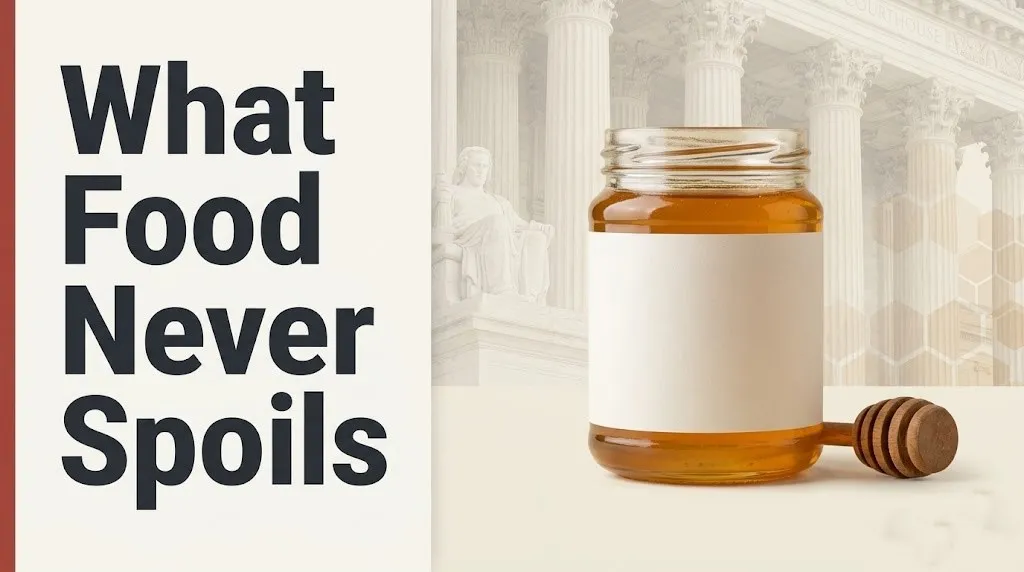
You open a kitchen cabinet and find a jar of honey pushed to the back. The label says it expired three years ago. You pause. Do you throw it out, or do you remember hearing somewhere that honey never spoils. That question sends you searching for what food never spoils, and the answer is more concrete than most people expect.
Honey is the only food that never spoils under proper storage conditions. That is the direct answer. Archaeologists have found honey in Egyptian tombs dated to 3,000 years ago. It was still edible. The reason combines chemistry, microbiology, and a surprising gap in US food labeling law. The FDA does not require honey to carry an expiration date because honey, by its nature, does not support the growth of spoilage organisms.
The spoilage claim is real, but it comes with rules. Honey must be pure, properly sealed, and kept free of introduced moisture. A jar of honey left open in a humid kitchen can absorb water from the air, dilute its protective sugar concentration, and eventually ferment. The food itself is incapable of spoiling. Human handling is what compromises it.
What surprises most people is not just the honey fact. It is the legal vacuum around it. The United States has no federal law requiring expiration dates on honey or most shelf-stable foods. The dates you see on jars are manufacturer quality estimates, not safety mandates. In 2026, Congress continues debating standardized date labeling through the Food Date Labeling Act, but honey remains exempt from mandatory dating because regulators accept the science that it does not spoil.
Honey is the food that never spoils. No other edible substance has the same combination of chemical and biological properties that make spoilage impossible under normal conditions. The spoilage resistance comes from three factors working together. Honey has extremely low water content, roughly 17 percent. It has a high acid content with a pH between 3.2 and 4.5. It contains hydrogen peroxide, a natural antimicrobial compound produced by an enzyme bees add during the honey-making process.
The low water content is the primary defense. Bacteria and fungi need water to grow. Honey’s water activity level sits around 0.6, well below the 0.9 threshold most spoilage organisms require. When honey comes into contact with microorganisms, it draws water out of their cells through osmotic pressure. The cells collapse and die. This is the same principle that makes salt and sugar effective preservatives, but honey does it more aggressively.
The acidity adds a second barrier. Few pathogenic bacteria can survive in an environment with a pH below 4.0. The hydrogen peroxide adds a third. When honey is diluted, an enzyme called glucose oxidase activates and produces hydrogen peroxide at levels sufficient to kill bacteria but harmless to human tissue. This is why honey has been used as a wound dressing for thousands of years and why medical-grade honey is regulated by the FDA as a wound treatment device.
No other food has all three properties at once. Salt is antimicrobial but has no water to speak of. It does not spoil because it is a mineral, not a food in the biological sense. White rice lasts decades but eventually oxidizes and goes rancid. Honey remains unchanged across millennia because its defenses are redundant. If one barrier fails, two more remain.
what is the only food that can never go bad
The only food that can never go bad is pure, properly sealed honey. This claim is not folklore. It is a matter of chemistry and microbiology confirmed by modern food science. The phrase “can never go bad” requires a precise definition of “bad.” In food law, “bad” means unsafe for consumption due to pathogenic bacterial growth or toxin production. By that legal and scientific standard, honey qualifies.
The distinction between spoilage and quality loss is where most confusion lives. Honey can crystallize. It can darken. It can lose volatile aromatic compounds that give it a specific floral flavor. None of that means it has spoiled. Crystallization is a natural physical process where glucose molecules form solid crystals. The honey is still safe. Heating it gently in a warm water bath restores the liquid texture.
Fermentation is the one genuine spoilage risk, and it only happens when honey absorbs excess moisture. If the water content rises above about 20 percent, naturally occurring yeast spores in the honey can activate and begin fermenting the sugars into alcohol. Fermented honey smells sour and tastes off. It is not dangerous in small amounts, but it is no longer shelf-stable. Properly sealed honey in a dry environment never crosses that threshold.
Legal Bottom Line: Under FDA rules, a food is considered adulterated if it bears or contains any poisonous or deleterious substance that may render it injurious to health. Honey that has crystallized or darkened over time does not meet this standard. It is legally safe to sell and consume indefinitely unless moisture contamination triggers fermentation.
what food never expires
No food truly “never expires” in a legal sense because expiration dating is almost entirely voluntary in the United States. The only food that is scientifically incapable of expiring, meaning becoming unsafe to eat due to microbial growth, is pure honey. The word “expires” implies a safety endpoint. For honey, no such endpoint exists under proper conditions.
Federal law does not require expiration dates on honey. The FDA leaves date labeling to manufacturer discretion for most foods. Infant formula is the only food product with a federally mandated expiration date. For everything else, the dates are quality suggestions, not safety deadlines. This legal reality means that honey past its “best by” date remains legally saleable in most states, though retailer policies vary.
The absence of required dating creates consumer confusion. A 2026 survey by the Food Marketing Institute found that over 80 percent of consumers throw away food based on date labels, believing the dates indicate safety. For honey, this leads to perfectly good product being discarded. Industry groups have pushed for clearer “quality” versus “safety” labeling distinctions in the pending Food Date Labeling Act, which would standardize “Best If Used By” for quality and “Use By” for safety. Honey would only require a “Best If Used By” label, and even that would be a concession to marketing norms rather than a safety necessity.
State Spotlight: California requires date labels on some perishable foods but exempts honey. New York’s food labeling laws defer to federal standards on shelf-stable products. Texas has no additional state-level dating requirements for honey beyond FDA guidelines. In all three states, honey can be sold indefinitely after its labeled date as long as it remains unadulterated.
what food never goes bad
Honey is the food that never goes bad. The science behind this claim is settled, but the public understanding of it is not. The question “what food never goes bad” usually comes from someone staring at an old jar and trying to decide whether to keep it. The answer is yes, keep it. The jar is almost certainly fine.
The conditions that make honey immune to spoilage also exist in a few other foods to a lesser degree. Pure maple syrup, properly sealed, lasts indefinitely because its sugar concentration mirrors honey’s in key respects. Soy sauce in an unopened bottle lasts years due to its salt and fermentation byproducts. Vinegar, with its acetic acid content, self-preserves. But none of these match honey’s perfect track record across archaeological timescales.
The practical test for whether honey has gone bad is simple. Smell it. If it smells like honey, it is safe. If it smells sour, fermented, or alcoholic, it has absorbed water and should be discarded. Look at it. If mold is visible on the surface, water has been introduced. Pure honey does not mold. If you see mold, something other than honey is in the jar, or the lid was left open in a humid environment.
State Spotlight: Under the Florida Food Safety Act, honey sold at farmers markets and roadside stands must meet the state’s definition of pure honey, which includes a maximum moisture content of 18.6 percent. Honey exceeding that threshold can be deemed adulterated. This standard, mirrored by the National Honey Board’s voluntary guidelines, is the legal line where honey crosses from “never spoils” to “may ferment.”
what is the only food that doesn’t spoil
Honey is the only food that does not spoil under proper storage. The claim is both scientifically accurate and legally significant. A food that does not spoil is a food that does not require preservation, refrigeration, or date-limited sale. This property makes honey unique in the global food supply and creates a regulatory category all its own.
The reason honey gets this designation while other sugar-rich foods do not comes down to how it is made. Bees collect nectar, which is mostly water with some sugar. They reduce the water content by evaporating it through wing fanning and by enzymatically breaking down complex sugars into simple ones. They add glucose oxidase, which produces the hydrogen peroxide. The result is a product that is chemically hostile to life.
Table sugar, by contrast, is pure sucrose extracted from cane or beets. It has low water activity and does not spoil, but it is not a whole food. It is a refined ingredient. Salt is a mineral. White rice is a dried grain that eventually oxidizes. Honey is the only unprocessed, whole food substance that spoilage organisms cannot colonize. This is not a claim about nutrition or health. It is a claim about microbiology.
Legal Bottom Line: The legal definition of spoilage under FDA regulations refers to decomposition by microorganisms that makes food unfit for consumption. Because honey’s intrinsic properties prevent microbial decomposition, it does not legally spoil. A jar of honey that is 50 years old with an intact seal meets the federal definition of unspoiled food.
what is the only food that never goes bad
Honey is the only food that never goes bad, provided it is real honey. The distinction between real honey and adulterated honey matters here. Adulterated honey, cut with corn syrup or other sweeteners, does not have the same antimicrobial properties. The purity of the honey is what makes the spoilage resistance work.
Honey adulteration is a significant enforcement issue for the FDA in 2026. Imported honey frequently contains undeclared sweeteners that dilute the natural enzyme and acidity profile. Testing by the Honey Integrity Task Force has found that roughly 30 percent of imported honey samples show evidence of adulteration. These diluted products may ferment, crystallize abnormally, or support mold growth in ways that pure honey does not.
To guarantee you have the food that never goes bad, buy honey labeled “pure” from a source you trust. Look for country of origin labeling. US-produced honey regulated under USDA standards has a lower adulteration risk than imported blends. Raw, unfiltered honey retains more pollen and enzymes, which may enhance antimicrobial activity, though pasteurized honey still does not spoil.
State Spotlight: In 2022, a class action lawsuit in Illinois targeted a major honey distributor for selling product labeled “pure honey” that testing showed contained undeclared rice syrup. The settlement required reformulation and labeling changes. Cases like this underscore that the “never spoils” property belongs only to honey that is what it claims to be.
what food does not expire
Honey does not expire. It is the only food product sold in American grocery stores that, by its nature, can outlast the person who buys it. The “best by” date on a honey jar is a suggestion about peak flavor, not a warning about safety. After that date passes, the honey is still safe.
Other foods can last far beyond their labeled dates without becoming unsafe. Dried beans, white rice, salt, sugar, and pure vanilla extract all last for years or decades. But they degrade. Rice oxidizes. Beans become so hard they require hours of soaking. Vanilla extract loses volatile compounds. Honey, properly sealed, changes the least over the longest period.
The reason honey gets singled out as the food that does not expire is archaeological. The Egyptian tomb honey was not just safe. It was recognizable. No other food has been recovered from ancient sites in an edible state. This singular status has made honey the canonical answer to the question, even though several other foods approach the same longevity.
Key Takeaway: The legal absence of a required expiration date on honey is not an oversight. It is a regulatory acknowledgment that the product does not have a safety endpoint. When the FDA chooses not to require a date, it is because the science supports the conclusion that a date would be meaningless.
what food can never go bad
Pure honey can never go bad. The word “never” is absolute, and it applies. The mechanism that prevents spoilage is not a preservative added during processing. It is intrinsic to the substance. As long as the honey remains pure and sealed against moisture, the chemistry holds forever.
The hydrogen peroxide in honey is the most overlooked part of this story. Most people focus on the sugar concentration. But sugar syrup left on a counter will mold. Honey will not. The difference is the enzyme glucose oxidase, which bees secrete from glands in their heads during nectar processing. This enzyme remains inactive in full-strength honey. If the honey is diluted, the enzyme activates and produces hydrogen peroxide.
This enzyme system is so effective that honey has been studied as a treatment for antibiotic-resistant bacterial infections. The FDA has cleared medical-grade honey dressings for wound care. The same peroxide-producing chemistry that keeps honey from spoiling in a jar also kills MRSA bacteria on a wound. That is how robust the preservation system is.
The practical implication is that honey is not just long-lasting. It is actively hostile to the organisms that cause spoilage. Most preservatives work by creating an environment where bacteria cannot grow. Honey goes further. It kills bacteria on contact if they are in a water-based medium. It does not just resist spoilage. It prevents it.
what is the only food that does not spoil
Honey is the only food that does not spoil by the legal and scientific definition of spoilage. Other foods resist spoilage for long periods. None match honey’s permanent stability. The reason involves a technical definition from food science called water activity, often abbreviated as Aw.
Water activity measures the free water available for microbial growth. Pure water has an Aw of 1.0. Most fresh foods are above 0.95. Bacteria generally need an Aw above 0.91. Molds can grow down to 0.80. Yeasts need 0.88. Honey has an Aw between 0.50 and 0.65, depending on the variety. That is lower than almost any other food.
Only dry crystalline substances like pure salt and pure sugar have lower water activity than honey. But those are refined single compounds, not whole foods. Among edible, unprocessed foods, honey has the lowest water activity that is not the result of industrial dehydration. This is what makes it the only food that does not spoil in its natural state.
Legal Bottom Line: Under 21 CFR Part 101, the FDA requires that food labels be truthful and not misleading. A claim that a food “does not spoil” would be considered a labeling claim subject to substantiation. For honey, the scientific consensus provides that substantiation. For any other food, making the same claim would likely be considered misleading under federal law.
what food doesn’t spoil
Honey doesn’t spoil. Salt doesn’t spoil. White rice doesn’t spoil for decades. Pure maple syrup doesn’t spoil if sealed. But honey is the standard answer because it is the only one that combines being a recognizable whole food with truly indefinite stability at room temperature.
The other candidates have limitations. Salt is a mineral, not a food that provides calories. White rice is a food, but its stability depends on low humidity and protection from pests. Weevils can infest rice. Nothing infests honey. Maple syrup can mold if opened and left at room temperature. Honey will not.
This is where the practical answer meets the technical one. When people ask what food doesn’t spoil, they are often thinking about emergency preparedness or stocking a pantry. For that purpose, honey belongs in the list of forever foods. So do properly packaged white rice, dried beans, salt, and sugar. But honey is the only one you can open, use a spoonful, reseal, and put back without worrying about moisture, mold, or pests.
State Spotlight: The Utah Department of Agriculture and Food maintains guidelines for long-term food storage that explicitly list honey as a “30-plus year” storage food alongside salt and sugar. The state’s large emergency preparedness community has tested honey stored for decades and confirmed its stability, contributing to the practical knowledge base on the topic.
what food doesnt expire
Honey doesn’t expire. The date on the jar is a manufacturer’s best guess about when the honey will taste closest to fresh. It has nothing to do with safety. The legal framework that allows honey to be sold without a true expiration date is the same framework that governs all shelf-stable foods in the United States.
The FDA does not require expiration dates on foods that are shelf-stable and do not pose a time-based safety risk. Honey falls squarely in this category. The agency’s position, articulated in guidance documents and compliance policies, is that date labeling is a manufacturer decision for most products. When manufacturers choose to put dates on honey, they typically use “Best By” language to indicate quality rather than “Expires” to indicate safety.
Some states impose additional requirements. But no state requires an expiration date on honey specifically. The Uniform Food Safety Code adopted by most states defers to FDA standards on date labeling for shelf-stable products. This means a jar of honey sold in Florida follows the same dating rules as a jar sold in Oregon, which is to say almost no rules at all.
The absence of regulation is not a loophole. It reflects a scientific consensus. If honey had a spoilage endpoint, the FDA would regulate it. The fact that the agency does not is indirect confirmation that the “honey never spoils” claim has regulatory support.
is honey the only food that never goes bad
Yes, honey is the only food that never goes bad. The question gets asked often enough to warrant a direct yes or no, and the answer is yes. No other edible substance combines whole-food status, indefinite room-temperature stability, and active antimicrobial properties the way honey does.
The follow-up question is usually about salt. Salt does not go bad either. But salt is not a food in the biological sense. It provides no calories. It is a mineral seasoning. When the question specifies “food,” meaning something that provides nutritional energy, honey is the answer. If you broaden the definition to include edible substances generally, salt and baking soda join the list.
Sugar is another candidate that requires clarification. Pure white sugar does not spoil. It has an indefinite shelf life. But sugar is a refined product, not a whole food. Honey is the unprocessed version of sugar’s longevity principle. It achieves without industrial processing what sugar achieves through refinement.
Key Takeaway: Honey occupies a unique category that food scientists recognize and the law implicitly acknowledges. It is a whole, unprocessed food that cannot be colonized by spoilage organisms. No other food meets all three conditions.
only food that can never go bad
Honey is the only food that can never go bad. The emphasis on “only” is important because it corrects a common misconception that many foods share this property. They do not. Several foods have very long shelf lives. None are permanent.
The confusion arises because some foods last so long that they seem permanent within a human lifespan. A sealed bucket of white rice stored in a cool, dry basement will be edible in 20 years. That feels like forever. But the rice’s oils will eventually oxidize and go rancid. The texture will degrade. The nutritional value will decline. Honey does none of these things.
Freeze-dried foods are another category that seems permanent but is not. Freeze-dried meals packaged for emergency storage carry 25 to 30 year shelf lives. The freeze-drying process removes water, but the food matrix still contains fats, proteins, and carbohydrates that slowly react with oxygen. The packaging is the barrier, not the food itself. With honey, the food is its own barrier.
Legal Bottom Line: The Food Date Labeling Act proposed in Congress would create a dual labeling system across the US. Under this proposed standard, honey would qualify for “Best If Used By” labeling rather than “Use By” because it does not pose a time-based safety risk. The law would formally recognize what science already knows.
what food doesn’t go bad
Honey doesn’t go bad. The phrase “go bad” means to become unsafe or unpalatable due to microbial growth. Honey does neither unless water gets in. This is the practical rule for anyone staring at an old jar and wondering whether to toss it.
The most common reason honey appears to have gone bad is crystallization. Crystallized honey looks grainy, solid, or cloudy. It is not bad. It is exactly the same substance in a different physical state. Glucose, one of the two main sugars in honey, tends to form crystals over time. The rate depends on the floral source. Clover honey crystallizes slowly. Alfalfa honey crystallizes fast. The crystals are glucose. The liquid portion is mostly fructose.
Crystallization is reversible. Place the jar in a pan of warm water at about 100°F to 110°F. Do not boil it. High heat destroys enzymes and alters flavor. Stir occasionally until the crystals dissolve. The honey is now liquid again and has not degraded in any safety-relevant way.
If you see foam on top of the honey, that is a sign of fermentation, not crystallization. Fermented honey smells sour or yeasty. This is the one scenario where honey has actually gone bad, and it only happens if the water content was too high from the start or the jar was left open in humidity. Discard fermented honey.
what is the only food that cannot go bad
Honey is the only food that cannot go bad. The word “cannot” is the strongest claim, and it holds. Honey is incapable of supporting the microbial growth that defines spoilage. This is not a property that can be added to other foods through processing. It is inherent.
The inherency matters for food law. Preservatives are regulated as food additives. They must be declared on labels and approved by the FDA. Honey requires no preservatives. Its stability is a natural characteristic. This exempts it from the regulatory framework that governs foods with added shelf-life extenders.
For consumers, the “cannot go bad” property means honey is uniquely suited to long-term storage. No other food can be purchased today with a reasonable expectation that it will be edible and safe in 50 years without freezing, refrigeration, or special packaging. This makes honey a staple of emergency food planning, but it also makes it a quiet marvel of the everyday pantry.
State Spotlight: In 2018, the Texas A&M Food Science Department tested honey samples stored for up to 40 years under variable conditions in Texas homes. All samples with intact seals were found to be safe for consumption, though some showed darkening and flavor changes. The study confirmed that real-world storage in a hot climate does not compromise honey’s safety.
what food does not spoil
Honey does not spoil. The statement is scientifically precise. Spoilage is defined in food microbiology as the process by which food becomes unacceptable for consumption due to microbial growth and the production of off-flavors, odors, or toxins. Honey does not support this process.
The definition matters because it separates honey from foods that simply last a long time. A Twinkie lasts a long time. But it does so because of preservatives and packaging, not because of intrinsic stability. The fats in a Twinkie will eventually oxidize. The cake will stale. Honey is different because the preservation is chemical and permanent.
The practical application of this knowledge is straightforward. Buy pure honey. Store it in a sealed container at room temperature away from direct sunlight. Use clean utensils when dipping into the jar to avoid introducing moisture or food particles. If you follow these steps, the honey will remain unspoiled for the rest of your life and well beyond.
Legal Bottom Line: The USDA’s FoodKeeper app, a consumer guidance tool developed with the FDA and CDC, lists honey’s shelf life as “indefinite” when stored in a pantry. This government resource is the closest thing to an official US endorsement of the “never spoils” claim, and it uses exactly the word “indefinite.”
what food cant go bad
Honey can’t go bad. The contraction “can’t” makes the claim informal, but the substance backs it up. The pH of honey, typically between 3.2 and 4.5, makes it more acidic than almost anything in a kitchen. Tomato juice has a pH around 4.0. Lemon juice is around 2.0. Honey sits between them. That acidity alone would preserve many foods. Combined with the sugar concentration and peroxide, it becomes impenetrable.
The pH scale measures hydrogen ion concentration. Low pH means high acidity. Most bacteria prefer a neutral pH around 7.0. They struggle below 4.6. Honey’s pH of 3.9 on average is deeply hostile to bacterial life. The few organisms that can survive acidity face the sugar onslaught. The few that might survive both face the peroxide. No known spoilage organism can overcome all three defenses simultaneously.
This triple barrier is what makes the “can’t” claim accurate. It is not that honey is merely resistant to spoilage. It is that the spoilage organisms themselves cannot establish a foothold. The food environment is lethal to them. This active killing capacity is what separates honey from merely stable foods like dried pasta, which resist spoilage passively through dryness but do not attack microorganisms.
what is the only food that doesn’t go bad
Honey is the only food that doesn’t go bad. The public fascination with this question reflects a broader interest in food resilience and waste reduction. Americans throw away roughly 30 to 40 percent of the food supply, much of it due to confusion over date labels. Honey is the exception that proves the rule. It is the food you can buy today and your grandchildren can eat.
The “doesn’t go bad” property has legal implications for retailers. A store can sell honey past its labeled date without violating federal law. Many grocery chains have internal policies against this, but those are business decisions, not legal requirements. A retailer who removes honey from shelves based on an expired “best by” date is complying with marketing norms, not safety regulations.
Consumer education efforts in 2026 have started focusing on this disconnect. The FDA’s public messaging encourages consumers to understand that “best by” dates indicate quality, not safety. For honey, this message is especially relevant because the quality changes are minimal and reversible. Crystallized honey is not defective. It is honey doing what honey does.
Key Takeaway: The phrase “doesn’t go bad” is a vernacular way of saying “does not support pathogenic microbial growth.” Under that definition, honey is unique. It is the only whole food that meets the standard, and the legal system effectively confirms this by exempting honey from the labeling requirements that govern perishable foods.
Common Questions About What Food Never Spoils
Does honey ever actually go bad?
No, pure honey does not go bad if it is kept sealed and free from added moisture.
It can crystallize or darken over time, but these are physical changes, not spoilage.
If water is introduced, honey can ferment, which produces a sour smell and taste.
Fermented honey should be discarded, but properly stored honey remains safe indefinitely.
What does the expiration date on honey mean legally?
The expiration date on honey is a quality suggestion from the manufacturer, not a legal safety requirement.
The FDA does not require expiration dates on honey because it is a shelf-stable food that does not support microbial growth.
A jar of honey past its labeled date is legally saleable in most states.
The date is there because consumers expect one, not because honey expires.
Can you eat 100-year-old honey safely?
Yes, you can eat 100-year-old honey safely if the jar has remained sealed.
Archaeological honey from Egyptian tombs has been found in edible condition after 3,000 years.
The taste may be muted compared to fresh honey, but no pathogenic organisms can grow in pure, sealed honey.
If the seal is intact and no mold or fermentation odor is present, the honey is safe.
Are there other foods that never spoil besides honey?
No other whole food never spoils the way honey does.
Salt, sugar, and baking soda are edible substances with indefinite shelf lives, but they are minerals or refined products, not whole foods.
White rice, dried beans, and pure maple syrup last decades but eventually degrade.
Honey is the only unprocessed food that remains stable and safe at room temperature indefinitely.
Why does the FDA allow honey to be sold without an expiration date?
The FDA allows honey to be sold without an expiration date because scientific consensus confirms it does not support spoilage organism growth.
Federal law only requires expiration dates on infant formula.
For all other foods, date labeling is voluntary and left to manufacturer discretion.
Honey’s low water activity, high acidity, and natural hydrogen peroxide content make a safety-based expiration date meaningless.
The one fact to remember is that honey is the only food that never spoils. The chemistry is permanent. The law recognizes it. The archaeology confirms it. When you find that old jar in the back of the cabinet, keep it.
Next time you see a “best by” date on a honey jar, read it as a suggestion about peak flavor, not a warning about safety. Share that knowledge with someone who is about to throw away perfectly good honey. It is a small piece of consumer education that pushes back against the enormous waste that date label confusion creates every year.
The honey in your pantry will outlast you. That is not a myth or a marketing claim. It is a biological fact that makes honey unlike any other food in the human diet.