An adult cat eating kitten food will not drop dead from a single stolen meal, but routinely feeding it sets the stage for obesity and organ stress. Kitten food is not chemically toxic to adult felines. It is, however, metabolically inappropriate for a physically mature animal and can cause serious health consequences over time.
According to the Association of American Feed Control Officials (AAFCO), kitten food must meet a nutrient profile for growth and reproduction that far exceeds the maintenance requirements of a fully grown cat. This means every serving delivers a calorie and nutrient load designed for rapid tissue development. A 2023 survey by the American Association of Feline Practitioners identified obesity as the most common preventable disease in domestic cats, a condition directly fueled by mismatched nutrition.
This article walks you through the exact nutritional differences between life-stage formulas and what those differences do inside your cat’s body. You will learn the specific organ systems affected by excess dietary fat and protein, why a spayed or neutered house cat is especially vulnerable to kitten food, and how to handle everything from a one-time accidental nibble to a weeklong emergency when no other food is available. You will also get practical equipment solutions for multi-cat homes where kittens and adults live under one roof.
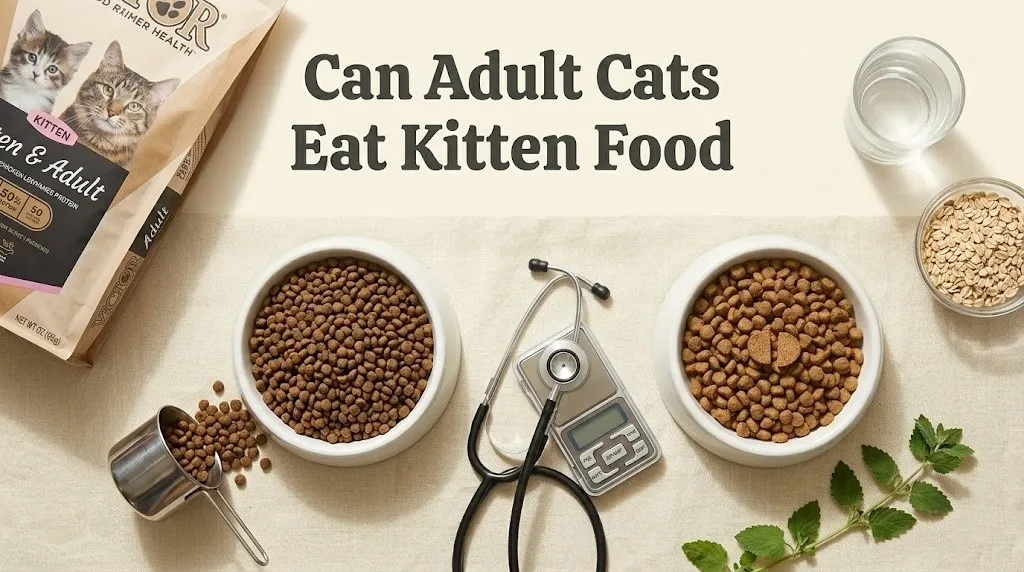
Can Adult Cats Eat Kitten Food
An adult cat can physically eat kitten food, but doing so regularly will cause a caloric surplus that the body stores as fat while forcing the kidneys to process nitrogen waste from protein that the cat does not need. Kitten food is not poison, and the immediate danger to a healthy adult cat is low. The real risk is cumulative metabolic injury from a diet mismatched to the animal’s biological stasis.
Think of a cat’s energy requirement like a house fund that has already reached its savings goal. An adult cat needs enough fuel to maintain the existing structure. Kitten food, by contrast, is a massive wire transfer intended to build an entirely new wing. Once the house is built, that extra money does not disappear. It gets stored in the attic as fat, piling up until the rafters strain. The extra amino acids from the protein do not get discarded freely. The liver deaminates them, turning the nitrogen into ammonia, then urea, which the kidneys must filter and excrete. A young, healthy kidney can handle this for a while. A borderline kidney, or one working alone into a cat’s senior years, cannot.
The Cornell Feline Health Center classifies feline life stages based on metabolic need, not just age. A cat reaches adult maintenance stage, meaning physical maturity, around 12 months. At this point, the anabolic drive for growth switches off, and the animal needs a diet that supports homeostasis, not construction. Putting a construction diet into an animal in maintenance mode creates a state of chronic positive energy balance, the medical term for “more fuel coming in than the body burns.”
| Life Stage | AAFCO Nutrient Profile Designation | Primary Metabolic Goal |
|---|---|---|
| Kitten (0 to 12 months) | Growth and Reproduction | Tissue accretion, bone mineralization, neural development |
| Adult (1 to 7 years) | Adult Maintenance | Body weight stability, organ function support, lean mass retention |
| Senior (7+ years) | Adult Maintenance (with age-adjusted monitoring) | Lean mass preservation, renal workload reduction, phosphorus management |
Key Takeaway: A healthy adult cat’s body is in maintenance mode, not construction mode. Feeding a growth-formulated diet chronically forces the cat’s organs to process excess energy and nitrogen that the body did not ask for, turning “extra nutrition” into a metabolic burden.
Can an Adult Cat Eat Kitten Food
An adult cat can eat kitten food without immediate toxicity, but the question is really about whether the cat should eat it, and the nutritional consensus from veterinary researchers is a firm no for long-term feeding. The AAFCO Adult Maintenance profile caps certain nutrient minimums specifically because a mature body does not need, and can be harmed by, excessive intake.
The confusion often comes from the fact that kitten kibble looks and smells the same as adult kibble to a human. It comes in the same brand, the same flavor profile, and the same bag shape. To a cat, however, kitten food is profoundly different. Manufacturers coat kitten kibble with animal digest and fat to make it hyper-palatable, ensuring the kitten grows fast. An adult cat, faced with this intensely aromatic, high-fat food, will naturally prefer it over its own more moderate maintenance diet. If given a choice, the adult cat will consistently raid the kitten’s bowl. This is a behavioral and sensory preference, not a sign that the cat “needs” something from the kitten food.
The immediate risk scenario is the owner who misreads this preference and thinks, “She likes it better, so I will just buy kitten food for everyone.” This decision initiates a slow-moving nutritional pathology. Weight gain starts within weeks. Bloodwork changes, including elevated triglycerides and potentially rising blood urea nitrogen (BUN) levels, can show up within months in a susceptible animal. For a young, active, intact male cat who burns off the excess, the damage may take years to manifest. For a sedentary, spayed female living strictly indoors, the consequences accelerate rapidly.
Quick Tip:
- If your adult cat steals a few pieces of kitten kibble daily, do not panic.
- Monitor body weight weekly using a digital scale.
- If the cat gains more than half a pound in a month, aggressive feeding separation is mandatory.
Kitten Food vs Adult Cat Food Nutritional Difference
Kitten food delivers roughly 25 to 40 percent more calories per cup than adult cat food, contains significantly higher minimum crude protein and fat, and is fortified with elevated levels of docosahexaenoic acid (DHA) and phosphorus that a mature cat’s body no longer requires at growth levels. The calorie gap alone explains most of the obesity risk.
The AAFCO nutrient profile for growth and reproduction mandates a minimum of 30 percent crude protein on a dry matter basis, while adult maintenance requires 26 percent. The fat minimum is 9 percent for growth versus 9 percent for adult maintenance, but in practice, commercial kitten foods often push fat to 20 percent or higher to achieve the calorie density needed for rapid growth. Adult maintenance foods typically hover closer to 12 to 15 percent fat. This practical, real-world difference matters far more than the AAFCO minimums suggest.
Calcium and phosphorus also sit much higher in kitten formulas. A growing skeleton needs roughly 1 percent calcium and 0.8 percent phosphorus on a dry matter basis. Adult maintenance food drops these figures. Excess phosphorus in an adult cat with undiagnosed early-stage chronic kidney disease accelerates renal damage. This is not a hypothetical concern. The International Renal Interest Society estimates that chronic kidney disease affects up to 30 to 40 percent of cats over age 10, and many cases simmer undetected for years before a diagnosis is made.
| Nutrient (Dry Matter Basis) | Typical Kitten Food Range | Typical Adult Food Range | Physiological Consequence of Excess in Adults |
|---|---|---|---|
| Crude Protein | 35 to 45 percent | 28 to 35 percent | Increased renal nitrogenous waste load |
| Crude Fat | 18 to 25 percent | 10 to 16 percent | Adipose deposition, hypertriglyceridemia, pancreatitis trigger |
| Calorie Density | 400 to 500 kcal per cup | 300 to 380 kcal per cup | Positive energy balance leading to obesity |
| Phosphorus | 1.0 to 1.4 percent | 0.5 to 0.9 percent | Accelerated renal secondary hyperparathyroidism in CKD cats |
| DHA | Fortified at 0.1 to 0.2 percent | Not required for maintenance | Excess excreted, no known toxicity but represents formulation cost with no benefit |
Key Takeaway: The nutritional gap between kitten and adult food is not a subtle tweak. It is a 30 percent calorie hike packaged with growth-specific minerals that a mature body excretes at best and is harmed by at worst.
Why Is Kitten Food Bad for Adult Cats
Kitten food is bad for adult cats because it creates a sustained state of caloric excess that drives obesity, exposes the pancreas to high dietary fat that can trigger inflammation, and burdens the kidneys with nitrogenous waste and phosphorus that the mature body cannot repurpose for growth. The food is not “bad” in an absolute sense. It is specifically formulated for an animal building new tissue, not an animal preserving existing tissue.
Obesity in cats is not a cosmetic issue. Feline adipose tissue is metabolically active, releasing pro-inflammatory cytokines that promote a low-grade, whole-body inflammatory state. This inflammation reduces insulin sensitivity over time, pushing the cat toward feline diabetes mellitus type II, a condition that requires lifelong insulin therapy in many cases. The Cornell Feline Health Center reports that obese cats are up to four times more likely to develop diabetes than lean cats. Feeding a high-calorie growth diet to an adult cat is an extremely efficient way to create an obese cat.
The protein issue is more nuanced. Healthy adult cats have a high protein requirement compared to dogs or humans, but there is a ceiling. When a cat consumes protein beyond what it needs for cellular repair and maintenance, the liver does not store the excess amino acids as protein. It strips off the nitrogen-containing amine group in a process called deamination, converts the carbon skeleton into glucose or fatty acids via gluconeogenesis, and sends the nitrogen to the kidneys to be eliminated in urine. This is normal physiology. However, persistently elevated nitrogenous waste production means the kidneys are always filtering a concentrated load, which over years can contribute to glomerular hyperfiltration injury, especially in cats already predisposed to renal decline.
Quick Tip:
- If your cat carries extra weight around the abdomen and you can no longer feel its ribs easily, stop all kitten food access immediately.
- A body condition score of 4 to 5 on a 9-point scale is ideal for adult cats.
- Switch to a measured adult maintenance diet and weigh the cat every two weeks.
Adult Cat Ate Kitten Food What to Do
If your adult cat ate a small portion of kitten food, the appropriate response is to monitor for mild gastrointestinal signs and prevent future access, not to induce vomiting or panic. Kitten food is not a toxin, and a single meal will not cause lasting damage in an otherwise healthy cat.
Remove any remaining kitten food immediately. Note roughly how much the cat consumed, one mouthful versus a full bowl. For a full bowl consumed rapidly, a distended cat may vomit simply from mechanical stomach overload, not from the nutritional content. Watch the cat for the next six to eight hours. Normal signs include a brief period of postprandial sleepiness, also called post-meal lethargy, which is a normal parasympathetic response. Abnormal signs that warrant a call to your veterinarian include repeated vomiting, watery diarrhea, abdominal pain when the belly is gently pressed, or hiding behavior that is out of character for your cat.
The most common consequence of a single kitten food binge in an adult cat is transient soft stool or diarrhea. The small intestine of a mature cat has a stable population of gut microbiota adapted to a specific diet. A sudden blast of high-fat, high-protein food can outpace the intestine’s absorptive capacity, pulling water into the bowel lumen osmotically. This typically resolves within 24 hours. Offer the cat its normal adult food at the next scheduled meal time and ensure fresh water is available. Do not withhold food as a “punishment” or attempt to “rest” the digestive tract unless a veterinarian advises it.
| Sign | Likely Cause | Action |
|---|---|---|
| Single episode of soft stool | Dietary fat sudden load overwhelming fat digestion | Monitor, continue adult diet, expect normal stool within 24 hours |
| Vomiting undigested food immediately after eating | Mechanical distention from rapid intake | Withhold food for 2 hours, offer water, feed smaller portion next meal |
| Repeated watery diarrhea lasting more than 24 hours | Intestinal inflammation or dysbiosis | Call your vet, bring a fresh fecal sample |
| Lethargy, hiding, painful abdomen | Potential pancreatitis flare | Veterinary evaluation urgently, do not wait |
Kitten Food Protein and Fat Content for Adult Cats
Standard dry kitten food contains 35 to 45 percent crude protein and 18 to 25 percent crude fat on a dry matter basis, numbers that land squarely in the excessive range for an animal that has stopped growing. A typical indoor adult cat needs roughly 30 to 35 percent protein and 12 to 16 percent fat to maintain lean muscle mass without gaining body fat.
The macronutrient distribution matters because cats are obligate carnivores. Their livers are downregulated for gluconeogenesis, meaning they are always converting amino acids into glucose to some degree, regardless of dietary carbohydrate intake. This is a survival adaptation. When you overload that system with dietary fat and protein together, you create a scenario where the cat is simultaneously generating glucose from protein and packing away dietary triglycerides directly into adipocytes. The combined effect accelerates fat mass accumulation faster than either macronutrient would alone.
Manufacturers add specific amino acids to kitten food that adult cats still need but in far smaller amounts. Taurine is the classic example. A deficiency causes dilated cardiomyopathy, so it is added to both kitten and adult food. Kitten food simply has more of everything, including taurine. The excess is water-soluble and excreted in urine, so taurine toxicity is not a practical concern. However, arginine and methionine are also added at higher levels. Excess methionine in particular has been studied in relation to urinary acidification and potential oxalate crystal formation, though the data is not conclusive in otherwise healthy cats.
- Kitten food delivers roughly 4.5 to 5.0 kilocalories of metabolizable energy per gram of dry matter.
- Adult maintenance food delivers roughly 3.5 to 4.0 kilocalories per gram.
- A 10-pound adult cat needs roughly 200 to 250 calories per day, total.
- One cup of dry kitten food can contain 450 to 500 calories, meaning one cup supplies roughly two days of energy for a sedentary adult.
Key Takeaway: The specific protein and fat numbers matter less than the calorie density they produce. Kitten food packs two meals into one bowl for an adult cat, and the liver and adipose tissue dutifully store every unused calorie.
Spayed or Neutered Adult Cat Eating Kitten Food
A spayed or neutered adult cat eating kitten food is at significantly higher risk for rapid weight gain and subsequent diabetes than an intact cat because sterilization reduces resting metabolic rate by roughly 20 to 25 percent while often increasing appetite. Feeding a high-calorie growth diet to a sterilized cat is a metabolic mismatch that produces obesity faster than almost any other dietary choice.
Research published in the Journal of Feline Medicine and Surgery has documented that gonadectomy reduces energy requirements in cats within weeks of the procedure. The hormonal changes, specifically the drop in gonadal steroids, alter metabolic rate and lean body mass partitioning. At the same time, many sterilized cats exhibit a measurable increase in food-seeking behavior. Owners often interpret this as the cat “needing more food” when in fact the cat’s caloric requirement has just dropped sharply.
Now introduce kitten food into this scenario. The food is already 30 to 40 percent more calorie-dense than adult food. The cat’s resting energy requirement has fallen by one-fifth. The cat is hungrier than before and presented with a hyper-palatable, high-fat option. The math is brutal. A spayed female domestic shorthair that should maintain a 9-pound body weight eating 180 calories daily of adult food might instead consume 280 calories of kitten food if fed free-choice. This 100-calorie daily surplus, roughly an extra 35 percent, translates to a pound of fat gain in about 35 days. Within four months, the cat is carrying a 30 percent heavier body, all of it adipose tissue.
Quick Tip:
- After spay or neuter surgery, reassess your cat’s portion size downward, not upward.
- A sterilized adult cat eating kitten food should be transitioned to a calorie-controlled adult or even a “light” formula immediately.
- Use a gram scale to weigh daily food allotments rather than a measuring cup, which is imprecise.
Can Kitten Food Cause Pancreatitis in Adult Cats
High dietary fat intake is an established risk factor for acute pancreatitis in cats, and kitten food, with its 20 to 25 percent fat content, can trigger a pancreatic inflammatory episode in a susceptible adult cat. The mechanism involves a sudden increase in chylomicron-rich serum after a high-fat meal, which can cause microcirculatory changes and premature activation of digestive enzymes within the pancreas itself.
Feline pancreatitis differs from canine pancreatitis in presentation and cause. In dogs, a single greasy meal is often the clear culprit. In cats, the disease is more insidious and multifactorial, but dietary fat indiscretion remains a recognized trigger. The feline pancreas produces lipase, the enzyme that digests fat. When it receives a fat load far beyond what an adult maintenance diet provides, the pancreatic acinar cells can become stressed, leading to a localized inflammatory cascade. The condition is serious, often requiring hospitalization, intravenous fluids, pain management, and sometimes weeks of nutritional support via a feeding tube.
Cats with a history of inflammatory bowel disease or concurrent triaditis, an inflammatory condition involving the bowel, liver, and pancreas, are at the highest risk. If you have an adult cat with a known sensitive gastrointestinal tract or a previous episode of pancreatitis, kitten food should be considered a dangerous dietary indiscretion, not a harmless snack. Even a single can of wet kitten food can deliver 4 to 6 grams of fat, which may exceed the cat’s usual per-meal fat intake by 50 percent or more.
- Signs of pancreatitis to watch for include anorexia, extreme lethargy, hiding, vomiting, and a crouched or hunched posture indicating abdominal pain.
- These signs are not specific and require a veterinary exam and bloodwork, including a feline pancreatic lipase immunoreactivity (fPLI) test, for diagnosis.
- Do not wait to see if the cat “improves on its own” if multiple signs are present.
How Long Can an Adult Cat Eat Kitten Food
A healthy adult cat can survive on kitten food for several weeks without obvious illness, but clinically measurable metabolic changes, including weight gain and elevated serum triglycerides, can begin within 7 to 10 days of daily consumption. The question of “how long” is deceptive because the organ stress is cumulative and often silent until a crisis point.
In a short-term emergency, defined as a situation where you genuinely have no other food and the stores are closed for a day or two, feeding kitten food is acceptable to prevent hepatic lipidosis from fasting. A cat that refuses to eat for even 48 hours can start mobilizing fat stores to the liver, potentially developing hepatic lipidosis, a life-threatening condition. In this scenario, the caloric density of kitten food is actually an asset. It provides energy quickly and efficiently, and it is highly palatable, which encourages a stressed or anorexic cat to eat. The immediate danger of not eating outweighs the long-term concern about excess calories for that one- to two-day window.
The line blurs around the five- to seven-day mark. By day seven of exclusive kitten food consumption, a sedentary adult cat will almost certainly have gained measurable body fat. The kidneys will have been filtering a high nitrogen load for a week. If the cat had borderline renal function, blood urea nitrogen and creatinine levels could already be edging upward. This is the point where veterinary telemedicine consultation is warranted. A vet can assess, via a phone or video call, whether the emergency has lasted long enough that bloodwork is advisable or whether transitioning back to adult food immediately is sufficient.
Key Takeaway: Two days of kitten food to get through a snowstorm or supply delay is a reasonable emergency bridge. Seven days is a metabolic event that should trigger a veterinary conversation and a hard pivot back to species-appropriate adult maintenance nutrition.
How to Stop Adult Cat from Eating Kitten Food
Stopping an adult cat from eating kitten food requires physical separation strategies and equipment rather than training, because the cat’s powerful sensory drive toward the high-fat, high-protein aroma will reliably override any behavioral discouragement. You cannot train the kitten food preference out of a cat.
The simplest method is structured, supervised feeding. Feed the kitten in a separate room with the door closed. Give the kitten a set amount of time, typically 15 to 20 minutes, to eat. Remove any uneaten food. Do not leave kitten food down to graze. Grazing is the enemy in a mixed-age household because the adult cat will find and consume the leftovers as soon as you leave. This method requires you to be home and consistent at meal times, which is feasible for many but not all schedules.
If work schedules prevent strictly supervised meal times, meal-timing technology is the next step. Automatic feeders with portion control can dispense kitten-appropriate food on a schedule. The kitten eats its portion immediately, and the hopper closes. This still does not prevent an adult cat from pushing the kitten aside and eating the food as it dispenses. The technology prevents all-day grazing but does not solve inter-cat food theft unless you combine it with a microchip-activated station.
- Feed the kitten in a closed room three times daily for 15-minute windows.
- Use a timed automatic feeder set to dispense a measured portion that the kitten finishes quickly.
- Elevate the kitten’s feeding station to a surface only the kitten can reach, such as a high cat tree shelf, if the adult cat is less agile.
- Never leave wet kitten food out for more than an hour due to bacterial growth risk.
- Place the adult cat’s adult food in a separate room during kitten meal times to create a positive distraction.
Microchip Feeders for Multi-Cat Households
Microchip-activated feeding stations, such as the SureFeed Microchip Pet Feeder, read the cat’s implanted identification microchip or a collar-attached RFID tag and open a clear lid only for the authorized cat, providing a permanent, technology-driven solution to adult cats stealing kitten food. This is the gold standard for managing a mixed life-stage household.
The feeder works by registering the kitten’s microchip number into its memory. When the kitten approaches, the lid retracts. When the kitten leaves, the lid closes, keeping the high-calorie kitten food sealed in a compartment the adult cat cannot access. This allows the kitten to graze naturally throughout the day, which is the recommended feeding pattern for growing kittens who need frequent small meals, without any risk of the adult cat stealing the food. The adult cat can have its own microchip feeder programmed with adult maintenance food, or it can eat in a separate location.
The main practical limitation is the initial training period. Some cats are startled by the motor noise or the moving lid. Manufacturers recommend a training mode where the lid stays open and the cat gets comfortable eating from the unit for several days before the lid-activation mode is enabled. Place the feeder in a quiet, low-traffic area. If the adult cat is particularly food-motivated, it may attempt to shove its head in alongside the kitten. The lid is designed to close when a second cat approaches, but determined food thieves occasionally require the feeder to be set to a faster close speed, and some models have a rear cover accessory to prevent access from behind.
- The SureFeed unit stores wet or dry food and has a sealed bowl to maintain freshness.
- It holds up to 400 grams of dry kibble, roughly several days of food for a single kitten.
- The unit runs on batteries lasting roughly 6 months in typical use.
- For microchipped cats, no collar tag is needed, the feeder reads the implanted chip directly.
Key Takeaway: A microchip feeder solves the “adult cat stealing kitten food” problem at the engineering level, removing the need for owner vigilance and allowing kittens the frequent access to calories that their growth demands.
Emergency Kitten Food for Adult Cat Temporary
In an emergency where no adult cat food is available and stores are inaccessible, kitten food is a better short-term option than letting an adult cat fast for more than 24 hours, but you must feed a tightly portioned amount based on the adult cat’s calorie needs, not the kitten food label’s free-feeding instructions. The goal is to prevent hepatic lipidosis from fasting while minimizing the caloric overshoot.
Calculate the adult cat’s daily maintenance energy requirement using the standard formula: 70 times body weight in kilograms to the power of 0.75, then multiplied by a factor of 1.0 to 1.2 for a typical neutered indoor cat. For a 5-kilogram (11-pound) cat, this works out to roughly 220 to 250 calories per day. Look at the kitten food label for the metabolizable energy per cup or per can. If a cup of kitten kibble contains 450 calories, the cat needs only half a cup per day, not a full cup. Split that half cup into two measured meals. You will be feeding the cat a volume of food that looks surprisingly small. Trust the math, not the cat’s vocal protests.
For wet kitten food, one 3-ounce can typically contains 100 to 130 calories. The same 11-pound cat would need roughly two cans per day, which is closer to the adult feeding amount and less likely to cause massive overconsumption. In an emergency, wet kitten food is a safer choice than dry kitten food for temporary adult feeding because the calorie density per unit volume is lower, and the high moisture content helps dilute the protein and phosphorus load presented to the kidneys.
| Cat Weight | Daily Adult Calorie Need | Dry Kitten Food (450 kcal per cup) | Wet Kitten Food (110 kcal per 3 oz can) |
|---|---|---|---|
| 8 lbs (3.6 kg) | 180 to 200 kcal | Slightly less than half a cup | Roughly 1.75 cans |
| 10 lbs (4.5 kg) | 200 to 230 kcal | Half a cup | Roughly 2 cans |
| 12 lbs (5.4 kg) | 230 to 260 kcal | Slightly more than half a cup | Roughly 2.25 cans |
| 15 lbs (6.8 kg) | 280 to 310 kcal | Roughly two-thirds of a cup | Roughly 2.75 cans |
When Do Veterinarians Prescribe Kitten Food for Adult Cats
Veterinarians prescribe kitten food for adult cats in specific clinical contexts: recovery from severe illness or injury with significant muscle wasting, late-stage cachexia from cancer, or hyperthyroid cats who have lost substantial lean body mass and need a calorically dense, highly digestible diet to regain weight before definitive treatment. This is a therapeutic use, not a maintenance plan.
An adult cat recovering from major surgery, particularly orthopedic or abdominal surgery with a prolonged period of hyporexia, may catabolize its own muscle tissue rapidly. This cat needs an anabolic nutritional profile to rebuild lost lean mass, and kitten food temporarily fills that role. The high protein and high calorie density support tissue synthesis that is not normally needed in a healthy adult cat. The vet will specify a feeding period, often 2 to 4 weeks, after which the cat transitions back to adult maintenance food.
Nursing mother cats, also called queens during lactation, are the other standard adult cat population that should eat kitten food. Lactation is the most energetically expensive physiological state a mammal can sustain. A nursing queen producing milk for four to six kittens can require 2 to 2.5 times her maintenance calorie intake. Kitten food, formulated for the growth and reproduction AAFCO profile, is precisely calibrated for this demand. The queen should stay on kitten food from late gestation through weaning, and transition back to adult food once the kittens are eating solid food independently and the queen’s milk production has dried up.
- Cancer cachexia with documented muscle wasting and a short-term palliative feeding plan.
- Severe starvation or neglect cases where an underweight adult cat needs “refeeding” under veterinary supervision.
- Hyperthyroid cats who are dangerously thin and awaiting radioactive iodine treatment or surgical thyroidectomy.
- Documented malabsorption or exocrine pancreatic insufficiency requiring highly digestible, calorie-dense nutrition temporarily.
Can Senior Cats Eat Kitten Food
Senior cats, typically defined as cats over 10 years old, should generally not eat kitten food unless a veterinarian diagnoses a specific wasting condition, because the high phosphorus and protein load can accelerate the progression of age-related chronic kidney disease. Senior cats and kitten food are a particularly dangerous pair.
Aging feline kidneys undergo nephron loss that reduces the glomerular filtration rate even in “healthy” seniors. The remaining nephrons work harder to compensate, a state called hyperfiltration. When you feed a high-phosphorus, high-protein diet, you increase the solute load those remaining nephrons must handle. Research in the Journal of Feline Medicine and Surgery has demonstrated that dietary phosphorus restriction slows the progression of renal disease in cats. Kitten food, formulated with phosphorus levels around 1.0 to 1.4 percent on a dry matter basis, runs directly counter to this protective strategy.
Senior cats also move less and sleep more than young adults. Their energy expenditure is lower, meaning the calorie density of kitten food will cause weight gain even faster in a 12-year-old cat than it would in a 3-year-old cat. The combination of renal stress and obesity is particularly harmful in seniors, increasing the risk of osteoarthritis exacerbation from extra body weight and metabolic syndrome. If a senior cat is losing weight, that weight loss needs a diagnostic workup, not an automatic calorie increase with kitten food. Hyperthyroidism, diabetes, chronic kidney disease, and intestinal lymphoma are all common senior cat weight loss causes that kitten food does not fix and may make worse.
- Senior cats with undiagnosed kidney disease may show a sudden clinical decompensation when switched to a high-phosphorus kitten food.
- Weight loss in an older cat should prompt bloodwork, a thyroid panel, and a urinalysis before any diet change is considered.
- Senior-specific cat foods are formulated with moderate phosphorus and higher digestibility for a reason, and they remain the safer maintenance choice.
Key Takeaway: Unless a veterinarian has explicitly diagnosed severe muscle wasting in your senior cat and prescribed kitten food as a timed therapeutic intervention, keep older cats on a senior or adult maintenance diet with controlled phosphorus levels.
Adult Cat Weight Gain from Kitten Food
Adult cat weight gain from kitten food occurs because the energy density of kitten food exceeds the cat’s daily metabolic requirement, creating a positive energy balance that is deposited as adipose tissue at a rate of roughly one pound of fat per month in a chronically overfed cat. The math is straightforward and relentless.
One pound of body fat in a cat represents roughly 3,500 stored calories. If an adult cat eats an extra 100 calories of kitten food daily beyond its maintenance requirement, it will gain one pound of fat in roughly 35 days. In six months, the cat will have gained five to six pounds, potentially doubling its body fat percentage. This speed of weight gain is not just a cosmetic concern. Rapid adipose expansion can outpace the vascular supply to the tissue, leading to localized hypoxia and inflammation within the fat depots, a process implicated in insulin resistance and metabolic dysfunction.
The weight gain is often abdominal and intra-abdominal, not just subcutaneous. Visceral fat surrounds the liver, kidneys, and intestines, secreting adipokines that promote systemic inflammation. This is the fat depot most strongly associated with feline diabetes. A cat with a hanging belly pouch, sometimes called a primordial pouch, may have it genetically and be lean overall. A cat with a distended, firm belly and no palpable ribs is storing dangerous visceral fat. Distinguishing between the two requires a hands-on body condition assessment, not just a visual check.
- Weigh your cat on the same digital scale every week at the same time of day.
- Record the weight in a notebook or app, watching for an upward trend of more than 2 percent per month.
- If weight is climbing, calculate the total daily calorie intake and cut by 10 to 15 percent, rechecking weight in two weeks.
Transitioning Cats from Kitten Food to Adult Food
Transitioning cats from kitten food to adult food should occur at approximately 12 months of age, using a gradual 7- to 10-day schedule where you replace 10 to 15 percent of the kitten food with adult food daily until the kitten is eating only adult food. A slow transition protects the cat’s intestinal microbiome and prevents food refusal from a sudden flavor change.
The 12-month mark works for the average domestic shorthair cat, which reaches skeletal maturity and adult body size around this age. Large breed cats like the Maine Coon, which can continue growing until 18 to 24 months, benefit from a longer kitten food period. Ask your veterinarian to assess the cat’s individual body condition and skeletal frame at the one-year checkup before making the switch. The goal is to feed growth food while the cat is still growing and not a day longer than necessary.
The transition itself involves mixing the foods in the bowl at each meal. Day one and two, use 75 percent kitten food and 25 percent adult food. Day three and four, use a 50-50 mix. Day five and six, use 25 percent kitten food and 75 percent adult food. Day seven, offer only adult food. Watch the stool during this period. A small amount of soft stool is normal and self-limiting. If diarrhea develops, slow the transition down, holding at the current ratio for an extra two days before advancing.
- Choose an adult food from the same brand and protein source as the kitten food if possible to minimize digestive shock.
- A kitten moving to adult food at 12 months may also be approaching the end of its growth phase and already need fewer daily calories.
- Monitor weight for two months after the transition to confirm the cat maintains a stable body condition on adult portions.
Key Takeaway: The transition out of kitten food is a scheduled event in a cat’s life, not an optional or delayed choice. At 12 months, unless your veterinarian advises otherwise, begin the 7-day shift to adult maintenance food and start measuring portions.
Differences Between Dry Kitten Food and Wet Kitten Food for Adults
Dry kitten food presents a significantly greater risk of overfeeding and obesity for an adult cat than wet kitten food because its low moisture content and high caloric density allow rapid, passive calorie consumption, while wet kitten food provides some protective dilution. Both are inappropriate for long-term adult feeding, but the magnitude of danger differs.
Dry kitten kibble is engineered for a kitten’s small stomach and high energy needs. A kitten can eat a small volume and get a large energy payload. An adult cat, with a larger stomach capacity but no growth energy demand, can consume far more dry kibble than it needs before feeling satiated. The crunching action is also pleasurable for cats, and the highly palatable fat coating on kitten kibble can create a compulsive eating pattern. A bowl of dry kitten food left out for free-choice access is the single fastest way to produce an obese adult cat.
Wet kitten food contains roughly 75 to 80 percent moisture. A 3-ounce can is mostly water, meaning the cat’s stomach fills with volume and moisture before the calorie load becomes excessive. It is much harder for an adult cat to consume a dangerous calorie excess from wet kitten food alone, though it is still possible with free access to multiple cans. In an emergency where only kitten food is available and you must feed an adult cat, wet kitten food is the lower-risk option strictly from a calorie-overload perspective. The moisture also helps with urinary dilution, which is protective against feline lower urinary tract disease in stressed cats.
| Format | Caloric Density | Risk Level for Adult Cat | Key Behavioral Concern |
|---|---|---|---|
| Dry Kitten Food | 400 to 500 kcal per cup | High | Easy passive overconsumption, highly palatable, supports free grazing |
| Wet Kitten Food (canned) | 100 to 130 kcal per 3 oz can | Moderate | Volume fill provides natural satiety, harder to massively overeat |
| Semi-Moist Kitten Food | 350 to 400 kcal per cup | High | Often contains added sugars and humectants, contributes to dental issues |
Key Takeaway: If you are in a true bind and must feed kitten food to an adult cat for a day or two, choose wet kitten food in measured portions. The water content dilutes the calorie density and provides a volume-based satiety cue that dry kibble cannot.
Frequently Asked Questions About Adult Cats and Kitten Food
Can a small amount of kitten food hurt an adult cat?
A few stolen kibbles of kitten food will not cause a healthy adult cat any measurable harm.
The metabolic impact of kitten food is dose-dependent and cumulative, not an acute toxicity.
Monitor your cat’s body weight weekly and prevent future access to ensure a small habit does not become a daily routine.
What happens if my adult cat eats kitten food for a week?
A week of daily kitten food consumption typically causes measurable weight gain, often a quarter to half a pound.
Serum triglyceride levels may rise, and the cat’s kidneys will filter an elevated nitrogenous waste load for the duration.
You should transition the cat back to a calorie-appropriate adult food immediately and weigh it to set a new baseline.
Is kitten food higher in calories than adult cat food?
Kitten food is significantly higher in calories than adult cat food, containing roughly 400 to 500 calories per cup compared to 300 to 380 calories per cup for adult formulas.
This calorie gap is intentional, designed to fuel the rapid growth of kittens, but it far exceeds what a physically mature cat burns in a day.
Always check the metabolizable energy statement on the label to calculate exactly how much more dense a specific kitten food is.
Why is my older cat losing weight eating kitten food?
Weight loss while eating a high-calorie food like kitten food is a red flag and not a normal response.
It may indicate hyperthyroidism, diabetes mellitus, malabsorption, or an underlying neoplastic process that kitten food does not address.
Stop the kitten food and schedule bloodwork with your veterinarian promptly to identify the cause of the weight loss.
Can nursing mother cats eat kitten food?
Nursing mother cats should eat kitten food during lactation because the AAFCO growth and reproduction nutrient profile matches the massive energy and nutrient demands of milk production.
A lactating queen feeding multiple kittens can require more than double her normal adult maintenance calories, and kitten food provides that density efficiently.
Transition the queen back to adult food gradually after the kittens have weaned and her milk production has stopped.
Feeding an adult cat is about matching the food to the body’s stopped growth clock. Kitten food exists to build a cat from a single pound into a fully formed adult. Once that adult skeleton and brain are built, that same nutritional intensity becomes a long-term health liability. The calories go to fat, the phosphorus taxes the kidneys, and the fat can inflame the pancreas. The only adult cats who genuinely benefit from kitten food are nursing queens and specific wasting-condition patients under direct veterinary supervision.
If your adult cat accidentally ate kitten food today, place the kitten bowl where only the kitten fits and go back to the adult diet at the next meal. If you are managing a household with a kitten and an adult, invest in a microchip feeder or a strict closed-door feeding schedule. Measure everything. Know your adult cat’s target calories per day and stick to that number regardless of what a kitten food label suggests.
You are not denying your adult cat a treat by withholding kitten food. You are protecting its kidneys, pancreas, and waistline from a nutritional formula that was never designed for a finished body.